See all formats and editions
Kindle $50.27
Hardcover $81.79
6 New from $67.72
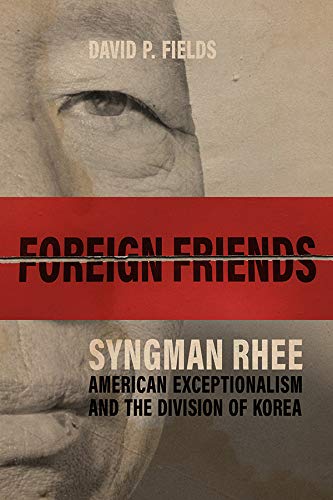
The division of Korea in August 1945 was one of the most consequential foreign policy decisions of the twentieth century. Despite the enormous impact this split has had on international relations from the Cold War to the present, comparatively little has been done to explain the decision. In Foreign Friends: Syngman Rhee, American Exceptionalism, and the Division of Korea, author David P. Fields argues that the division resulted not from a snap decision made by US military officers at the end of World War II but from a forty-year lobbying campaign spearheaded by Korean nationalist Syngman Rhee.
Educated in an American missionary school in Seoul, Rhee understood the importance of exceptionalism in American society. Alleging that the US turned its back on the most rapidly Christianizing nation in the world when it acquiesced to Japan's annexation of Korea in 1905, Rhee constructed a coalition of American supporters to pressure policymakers to right these historical wrongs by supporting Korea's independence. Following the attack on Pearl Harbor, Rhee and his Korean supporters reasoned that the American abandonment of Korea had given the Japanese a foothold in Asia, tarnishing the US claim to leadership in the opinion of millions of Asians.
By transforming Korea into a moralist tale of the failures of American foreign policy in Asia, Rhee and his camp turned the country into a test case of American exceptionalism in the postwar era. Division was not the outcome they sought, but their lobbying was a crucial yet overlooked piece that contributed to this final resolution.
Through its systematic use of the personal papers and diary of Syngman Rhee, as well as its serious examination of American exceptionalism, Foreign Friends synthesizes religious, intellectual, and diplomatic history to offer a new interpretation of US-Korean relations.
Follow the Author
David P. Fields
+ Follow
Foreign Friends: Syngman Rhee, American Exceptionalism, and the Division of Korea (Studies in Conflict, Diplomacy, and Peace) Kindle Edition
by David P. Fields (Author) Format: Kindle Edition
4.5 out of 5 stars 2 ratings
The Making of the First Korean President: Syngman Rhee’s Quest for Independence
Young Ick Lew
5.0 out of 5 stars 5
The Park Chung Hee Era
Byung-Kook Kim
4.7 out of 5 stars 17
Kindle Edition
$30.67$30.67
& FREE Shipping
Product description
About the Author
David P. Fields is the associate director of the Center for East Asian Studies at the University of Wisconsin--Madison. He is also the editor of The Diary of Syngman Rhee and the book review editor of the Journal of American-East Asian Relations. --This text refers to the hardcover edition.
Publisher : The University Press of Kentucky (19 April 2019)
Print length : 260 pages)
Customer Reviews:
4.5 out of 5 stars 2 ratings
Top reviews from other countries

Robert J. York
5.0 out of 5 stars The contradictions of Rhee
Reviewed in the United States on 12 June 2019
Verified Purchase
An excellent contribution to the history of US-Korea relations, to the Japanese colonial period and to the biography of Korea's first president. A history that probably only a scholar of both the US and Korea could have written, and one that captures the contradictions of Rhee - persistent but not patient, a liberal reformer but also a paternalist, a man determined to elevate the fortunes of his people even if it meant embracing American white supremacists and casting aspersions on the character of the Japanese. It also casts the division of the Korean peninsula in a new light; rather than a choice undertaken in haste, the US responded to public pressure - the result of lobbying by Rhee and others - by insisting on a stake in Korea, even if preventing the Soviets from also having one was unavoidable.
4 people found this helpful
Verified Purchase
An excellent contribution to the history of US-Korea relations, to the Japanese colonial period and to the biography of Korea's first president. A history that probably only a scholar of both the US and Korea could have written, and one that captures the contradictions of Rhee - persistent but not patient, a liberal reformer but also a paternalist, a man determined to elevate the fortunes of his people even if it meant embracing American white supremacists and casting aspersions on the character of the Japanese. It also casts the division of the Korean peninsula in a new light; rather than a choice undertaken in haste, the US responded to public pressure - the result of lobbying by Rhee and others - by insisting on a stake in Korea, even if preventing the Soviets from also having one was unavoidable.
4 people found this helpful
===
Foreign Friends: Syngman Rhee, American Exceptionalism, and the Division of Korea
(Studies in Conflict, Diplomacy and Peace)
by David P. Fields
4.88 · Rating details · 8 ratings · 4 reviews
The division of Korea in August 1945 was one of the most consequential foreign policy decisions of the twentieth century. Despite the enormous impact this split has had on international relations from the Cold War to the present, comparatively little has been done to explain the decision. In Foreign Friends: Syngman Rhee, American Exceptionalism, and the Division of Korea, author David P. Fields argues that the division resulted not from a snap decision made by US military officers at the end of World War II but from a forty-year lobbying campaign spearheaded by Korean nationalist Syngman Rhee.
Educated in an American missionary school in Seoul, Rhee understood the importance of exceptionalism in American society. Alleging that the US turned its back on the most rapidly Christianizing nation in the world when it acquiesced to Japan's annexation of Korea in 1905, Rhee constructed a coalition of American supporters to pressure policymakers to right these historical wrongs by supporting Korea's independence. Following the attack on Pearl Harbor, Rhee and his Korean supporters reasoned that the American abandonment of Korea had given the Japanese a foothold in Asia, tarnishing the US claim to leadership in the opinion of millions of Asians.
By transforming Korea into a moralist tale of the failures of American foreign policy in Asia, Rhee and his camp turned the country into a test case of American exceptionalism in the postwar era. Division was not the outcome they sought, but their lobbying was a crucial yet overlooked piece that contributed to this final resolution. Through its systematic use of the personal papers and diary of Syngman Rhee, as well as its serious examination of American exceptionalism, Foreign Friends synthesizes religious, intellectual, and diplomatic history to offer a new interpretation of US-Korean relations. (less)
GET A COPY
KoboOnline Stores ▾Book Links ▾
Hardcover, 264 pages
Published April 19th 2019 by University Press of Kentucky
COMMUNITY REVIEWS
Showing 1-30
Average rating4.88 · Rating details · 8 ratings · 4 reviews
Search review text
All Languages
More filters | Sort order
Sejin,
Sejin, start your review of Foreign Friends: Syngman Rhee, American Exceptionalism, and the Division of Korea
Write a review
Stefania Dzhanamova
Dec 25, 2020Stefania Dzhanamova rated it it was amazing
Shelves: korean-war, us-foreign-policy
FOREIGN FRIENDS is is a study of both American exceptionalism defined as a special American mission and how the Korean independence movement invoked such a mission to influence American policy prior to the division of Korea in 1945.
In the months and years after Pearl Harbor, Americans wondered how their country had become embroiled in a war so suddenly and so unexpectedly. The raid on Pearl Harbor inclined American towards involvement in the war, but it also raised questions about how their political and military leaders could have been so unprepared.
Korean independence movement leader Syngman Rhee had his own explanation of what went wrong with American foreign policy – one that was designed to resonate with Americans accustomed to overlaying a "moral geography" on human history and geopolitical events. In the nineteenth century the American people were the “envy of the world,” but Rhee argued that over the previous fifty years their “very greatness, wealth, and power” had a “stupefying influence” on the American mind. Americans had lost sight of the fact that the “heritage of Liberty, for which their forebears paid so dearly,” might not be theirs forever. They had become complacent, self-absorbed, and selfish. They forgot that “justice is the foundation of peace” among men and nations; that the “safety of the weak and the strong is inseparable”; and that the American principle of “democracy, liberty, and justice for all” should include places like Korea. Rhee insisted that Korea had a special claim on the United States. The two countries had signed a treaty in 1882 the first article of which read “If other powers deal unjustly or oppressively with either Government, the other will exert their good offices on being informed of the case to bring about an amicable arrangement, thus showing their friendly feelings.” Rhee himself had informed President Theodore Roosevelt of Korea’s situation in 1905, but instead of extending American “good offices” – as required by the treaty – Roosevelt tacitly supported the Japanese annexation of Korea, providing the Japanese with a toehold on the Asian mainland. Germans, in Rhee’s opinion, were not the only ones guilty of regarding treaties as “mere scraps of paper.”
He set Roosevelt’s violation of the obscure 1882 Korean-American Treaty at the beginning of a series of disastrous American decisions, in which American leaders sacrificed their own values, the freedom of other peoples, and finally their own security for their own convenience. Sacrificing Korea to Japan had been the first step on the road to Pearl Harbor, but according to Rhee, Korea was more than just an example of American shortsightedness. Korea was also a chance for the United States to redeem its foreign policy if the American people – once they understood the facts of the Korean situation – would pressure their leaders to do justice to Korea by honoring their treaty obligations and helping to restore Korea’s independence. "Rhee helped Americans locate Korea in their moral geography by arguing that Korea had been a place of betrayal and moral failing, but could also be a site of redemption," explains David P. Fields.
Significant is the fact that Rhee clearly distinguished between the actions of the American government and the sentiments of the American people. For him, the actions of the American missionaries, who built his school, who saved his life in prison, and who supported his education in the United States, were always the true embodiment of American sentiments and values, not American political leaders. "During his forty-year exile in the United States as the de facto leader of the Korean independence movement, Rhee never tired of imploring the American people to make right the mistakes of their leaders and to restore the values that had made the United States 'the envy of the world' to their rightful place in American foreign policy," writes Fields.
When Rhee and other Korean independence activists challenged American audiences to live up to the American mission by honoring their treaty obligations to Korea, they were evoking a very old version of American exceptionalism – the idea that the United States has a special mission in world affairs. The first Americans Rhee met – missionaries of the Student Volunteer Movement – had a profound effect on how he viewed the United States and the American people. For these Americans, the United States being a wealthy nation or a great power was not the goal if it involved moral compromises. They believed that their nation had a special mission to lead the effort to Christianize the world in a generation. These missionaries were unusual in their definite understanding of what America’s special mission was and what it required of them personally, but as Fields argues, the belief in a special mission and anxiety over it is "a recurring theme in American history, especially in the context of the United States’ relations with other societies". Syngman Rhee understood the opportunity these ideological commitments and their accompanying anxieties offered the Korean people in their search for independence.
Organized in 5 chapters, this book tells the story of how Rhee and the Korean independence movement used the ideology of the American mission as a means of entry into American foreign policy debates and as a means to shift American perceptions and policy toward Korea.
The first chapter explores the importance of American missionaries both to US-Korean relations and to the transmission of the American mission from one society to the other. It describes Rhee’s first encounter with the American mission via American missionaries, how he came to realize the potential of invoking the American mission for his own personal and nationalistic aspirations, and how such invocations were essential to his establishing himself as a leader of exiled Koreans in the United States.
Chapter 2 examines the lobbying activities of Rhee and the Korean independence movement in the immediate aftermath of the March First Movement and in the context of Woodrow Wilson’s "embrace of self-determination" as an American war aim. As Fields shows, the Koreans used this new American interest in international affairs to expand their lobbying activities beyond those who had been involved in the American missionary effort in Korea; through grassroots organizing, print media and lectures, the Koreans established a small but influential group of American supporters who were willing to publicly advocate for the Korean cause.
The next chapter focuses on the way Rhee and the Korean independence movement utilized this group of supporters to place pressure on American policymakers during the fight over the ratification of the Versailles Treaty. The chapter pays special attention to the common cause the Korean activists and their American supporters made with the Irreconcilables, Republican populists from the Midwest and a few Democrats, who opposed ratification under almost any circumstances and believed that joining the League of Nations would yoke the United States with the Old World problems Americans had mostly avoided prior to the Great War, in the US Senate. The Koreans, for their part, were against the USA joining an organization where Japan was one of the permanent members. The Korean independence movement provided these senators with an “internationalist” justification for opposing the treaty and thus an answer to the charge that they were advocating isolationism. In return, the Koreans received an airing of their views in the US Senate and even a vote on a Korean reservation to the Versailles Treaty. While Korean activists’ passionate invocations of the American mission during the fight over the Versailles Treaty did not result in any official policy changes toward Korea, they significantly shifted American perceptions of the Japanese colonization of Korea and brought much of the informed American public opinion on the situation into sympathy with the Koreans, asserts Fields.
Chapter 4 examines the Korean independence movement in the interwar period – a period when the movement was nearly destroyed by factionalism and when its leaders began to look beyond the United States for support. Although Rhee and Korean regional identities did much to quench factionalism, this chapter highlights how the efficiency of Japanese control of Korea aggravated these problems. Here, Fields demonstrates the Korean efforts in the 1930s to look beyond the United States for potential allies. Such efforts are revealing of the Korean independence movement’s relationship with the American mission: Koreans embraced the idea of an American mission not because they necessarily believed in it – though some might have – but as part of a broad and pragmatic strategy to regain their country's independence. Take, for instance, Rhee's view of Communism prior to 1945: "To us Koreans, the most urgent, the most important, and the biggest issue is liberation activities. If Communism will help this work we should all become communist without delay, but [ if ] this work seems to be damaged by communism we can never agree to it.” David P. Fields adds, "[H]e approached it not with an ideological lens, but with a pragmatic one. When asked directly by a supporter in 1928 what he thought of revolutionary violence, seeking the support of the Soviet Union, and nationalizing industries as a matter of economic policy, Rhee’s response was pragmatic, except on the question of violence." Rhee made clear that he would contact the Soviet Union if given the chance, although “it is difficult for me, given the fact that I am implementing the Korean independence movement from the United States, to promote communism.”
The last chapter deals with Korean lobbying during World War II. It shows how Rhee and others were able to build on the popularity and sympathy they received in the 1920s, but also how they were able to adapt their message to take advantage of the anxieties and ambitions of that moment. In the aftermath of Pearl Harbor, Rhee was able to portray Korea as the first victim of Japan’s "march of conquest" and to link Theodore Roosevelt’s betrayal of Korea in 1905 to the causes of World War II. His constant assertions that Korean manpower could substitute for American manpower in the Pacific War may have been far-fetched to the point of deceitful, points out Fields, but it was a claim "that grabbed the attention of any American with a family member in uniform", and one that American politicians could not ignore. Rhee’s constant lecturing, writing, and media appearances during the war turned him into a minor American celebrity and provided the Koreans with allies all over the United States. Such lobbying convinced many Americans that their nation’s Korean policy for the last forty years had indeed been wrong: that in the case of Korea, the United States had not lived up to the idealism of the American mission. Thus, Rhee’s lobbying and the sympathy it aroused was a key factor behind the American decision to suggest the temporary division of Korea.
Yet, while invoking the American mission provided the Koreans with a means of entry into American foreign policy debates, it did not provide them with a means of actually determining American policy toward Korea. Their strategy of invoking the American mission earned them a hearing in the United States, but they had no way to control what lessons Americans would draw from their invocations or what the policy implications might be. The division of Korea was a tragedy they did not intend and did not foresee. "Invoking the American mission is not the same thing as defining it," concludes Fields.
This interesting book ends in 1945 with the division of Korea. As the author explains, although Syngman Rhee continued to invoke American exceptionalism almost to the end of his life, his relationship with American exceptionalism changed fundamentally when American forces landed in Korea in September 1945. With American forces on Korean soil, Korea became an American problem. Once occupied, it could not easily be abandoned. Rhee had been arguing for years that Korean independence was an American responsibility. After 1945 this was a fact – at least for the southern half of the peninsula. After 1945 the choice facing Americans was not whether or not to do something about Korea, but what to do about Korea. In this new circumstances, invoking American exceptionalism was still valuable to Rhee, but anti-communism would come to take the major role the American mission had long played in Rhee's lobbying.
FOREIGN FRIENDS is a truly impressive study of US-Korean relations, concise but highly insightful. I recommend it to anyone interested in the modern history of the United States, and especially in US foreign policy. (less)
flag21 likes · Like · 10 comments · see review
---
Rob
Jun 11, 2019Rob rated it it was amazing
An excellent contribution to the history of US-Korea relations, to the Japanese colonial period and to the biography of Korea's first president. A history that probably only a scholar of both the US and Korea could have written, and one that captures the contradictions of Rhee - persistent but not patient, a liberal reformer but also a paternalist, a man determined to elevate the fortunes of his people even if it meant embracing American white supremacists and casting aspersions on the character of the Japanese. It also casts the division of the Korean peninsula in a new light; rather than a choice undertaken in haste, the US responded to public pressure - the result of lobbying by Rhee and others - by insisting on a stake in Korea, even if preventing the Soviets from also having one was unavoidable. (less)
flag3 likes · Like · comment · see review
---
Nate
Sep 09, 2019Nate rated it it was amazing
"It should be unsurprising that Korean lobbying and its influence on the decision to divide Korea has been poorly remembered. Indeed, neither the Koreans nor the Americans had any incentive to remember it, much less commemorate it."
I came at this book knowing next to nothing about the history of America's involvement with Korea. Fields uses Syngman Rhee's early life interacting with American missionaries in Korea and his subsequent time lobbying for the Korean Independence Movement to explore the complexities of US foreign policy in the early 20th century and specifically the American government's ambiguity towards the people of Korea as they were colonized by the Japanese. That is until, as Fields argues, Rhee and the Korean Independence Movement leveraged popular opinion and the nebulous idea of American exceptionalism to raise grassroots awareness of Korea's plight.
According to Fields, after the Japanese attack on Pearl Harbor, politicians were ready to listen and Rhee's prior years of groundwork played an important role in positioning Korea as a key player in post-war diplomacy and the first battleground of the Cold War. Eventually resulting in, to Rhee's horror, a divided Korea.
The joy of reading history for me is discovering new facts that simultaneously enlighten and complicate my understanding of how we got here. Foreign Friends is filled with these revelatory moments. Given Syngman Rhee's influence on American involvement in the Cold War, it is shocking I'd never even heard of him prior to this book, but then again this is an omission Fields is attempting to correct. I also first learned of the March First Movement, a 1919 nonviolent protest that the Republic of Korea marks as its birth. It was a revelation to me that Korea's origins could be traced to something so Gandhi-esque over a decade before the famous Salt March!
Foreign Friends is a scholarly work, but the writing is refreshingly accessible and full of important historical insight that will undoubtedly inform my understanding of today's headlines. Highly recommend. (less)
flag1 like · Like · comment · see review
----
Yong Kwon
Apr 04, 2021Yong Kwon rated it it was amazing
Excellent and much-needed history of the evolving foreign policy outlook in the inter-war years. Through his careful examination, Fields answers a question that is often glossed over in conventional narratives of the early Cold War: Why did the US feel so compelled to stop the full Soviet occupation of the Korean Peninsula in the waning days of WWII? The narrative that he lays out suggests that the US outlook in East Asia was as much the product of a Korean project as the resulting nascent Korean republic in 1948 was that of an American mission.
One thing that I did find a little wanting is the lack of detail on the political activities of other advocates for Korean independence - for instance, did the Korean National Association in California have any impact on the domestic political discourse? Naturally, the book places the spotlight on Syngman Rhee - but also alludes that other actors played influential roles in shaping American views without going into further detail.
Regardless, there should be an anthology that this book belongs to that explores how other peripheral players throughout history have shape the policies of their more powerful partners. This book is a good place to start on this underappreciated subject area. (less)
===
https://www.covenantmadison.org/post/book-review-foreign-friends-syngman-rhee-american-exceptionalism-and-the-division-of-korea
Covenant Presbyterian Church
Book Review: Foreign Friends: Syngman Rhee, American Exceptionalism, and the Division of Korea
Written by David Fields and Reviewed by Alan Crist
In this telling of the history and events that preceded World War II and the actions and influences that resulted in the division of Korea, David Fields reminds us of the role we have and can still play on the stage of world affairs as Americans and especially as Americans of faith. Primarily, the strong role that mainline Christian missionaries played in bringing the good news to the people of Korea and its consequences for world events even to this day.
Professor Fields’ eloquence with the English language and his clear understanding, based on extensive research and experience, of the history of Korea are a gift to this generation and those going forward as we think about our continued role and mission as this world’s most powerful democracy. I expect most people born after the end of World War II, like myself, have no real understanding of how and why Korea was divided and why we would go to war to keep it that way. Fields in Foreign Friends answers those questions in an engaging and convincing fashion.
Fields has also caused me to question our role going forward as Americans as we seek peace in this world. Are we to continue on the path of nationalism as our American mission defining our role and responsibility in this world? Have we given over the voice of Christian mission in this world from progressive mainline churches to evangelical fervor and fundamentalist leanings of mega churches and literalists proclaiming exclusivity rather than inclusivity in our caring and interaction with others? Others, that is, who do not think, act, or look like us. Fields provides examples of mainline Christian leaders speaking truth to power. Examples that, in my view, are not seen today.
There seems to be a reluctance on the part of mainline Christians to engage and or challenge our political leaders, perhaps so as not to offend or cross the line between affairs of church and state. I wonder what Bonhoeffer would say about such reluctance to challenge political leaders today. In my view, I have also seen this reluctance in our higher education leaders. You do not see the likes of John Dewey, Robert Maynard Hutchins, or Myles Horton leading the way for social and economic justice.
We need to ask ourselves, as Syngman Rhee challenges us to do, what is our American mission? How do we make the world safe for democracy, rid the world of fascism, and defeat communism? Is it still our mission to Christianize the world as the means to these ends? Fields gives us ample food for thought and direction as we seek to answer this question in 21st century America.
No comments:
Post a Comment
Note: Only a member of this blog may post a comment.