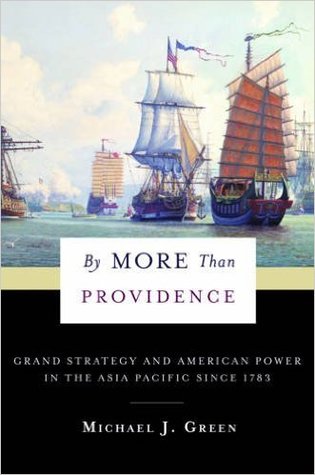
By More Than Providence: Grand Strategy and American Power in the Asia Pacific Since 1783
by
4.37 · Rating details · 71 ratings · 11 reviews
Soon after the American Revolution, the United States began to recognize the strategic significance of Asia and the Pacific and its vast material and cultural resources. Many asked whether the United States should partner with China, which operates at the center of Asia, or Japan, which is located in the middle of the Pacific. Where should the United States draw its defensive line, and how should it export democratic principles? In a history that spans the eighteenth century to the present, Michael J. Green follows the development of U.S. policy toward East Asia, identifying recurring themes in American statecraft that reflect the evolving nation's political philosophy and material realities.
Drawing on archives, interviews, and his own experience in the Pentagon and White House, Green finds one overarching concern driving U.S. policy toward East Asia: a fear felt by Americans that a rival power might use the Pacific to isolate and threaten the United States and prevent the ocean from becoming a conduit for the westward free flow of trade, values, and forward defense. By More Than Providence works through these problems from the perspective of history's major strategists and statesmen, from Thomas Jefferson to Alfred Thayer Mahan and Henry Kissinger. It records the fate of their ideas as they collided with the realities of the Far East and adds clarity to America's stakes in the region, especially when compared with those of Europe and the Middle East. (less)
Drawing on archives, interviews, and his own experience in the Pentagon and White House, Green finds one overarching concern driving U.S. policy toward East Asia: a fear felt by Americans that a rival power might use the Pacific to isolate and threaten the United States and prevent the ocean from becoming a conduit for the westward free flow of trade, values, and forward defense. By More Than Providence works through these problems from the perspective of history's major strategists and statesmen, from Thomas Jefferson to Alfred Thayer Mahan and Henry Kissinger. It records the fate of their ideas as they collided with the realities of the Far East and adds clarity to America's stakes in the region, especially when compared with those of Europe and the Middle East. (less)
Hardcover, 760 pages
Published April 4th 2017 by Columbia University Press

May 10, 2020Hunter Marston rated it it was amazing
Mike's overview of the history of U.S. grand strategy toward Asia is as enjoyable as it is comprehensive. He finds a way to masterfully weave in extraordinary detail without sacrificing readability. What's more, he's surprisingly evenhanded in his evaluation of both Republican and Democratic administrations. He retains focus on broad themes even as circumstances, personalities, and details change from decade to decade and across multiple centuries in the book. The only disappointment, really, was that it was published when it was. A second edition after the Trump era would be a timely update! (less)

Mar 01, 2018Riley Feldmann rated it really liked it · review of another edition
I can't imagine trying to summarize the entire history of U.S-Asia relations is an easy task. The primary source material from the 18th Century isn't all that copious, and as you move closer the present it becomes increasingly difficult to separate the facts on the ground from the prevailing biases of our current discourse. Author Michael J. Green does his best to thread this needle, though the attempt isn't perfect.
Green's attention to detail is commendable, especially concerning the nature of policy formation from the founding of the U.S. through roughly the Vietnam War. He chronicles the early theories of the Founding Fathers and the evolution of interaction from occasional commercial deals to the development of dedicated "Asia hands" in the State Department. From there, the debates over where American priorities lay began in full with a small group of professionals clashing over the direction of U.S. interests. Every aspect of the historical relationship is combed over and plenty of context is provided. This section, which occupies about half of the book, is, in a word, excellent.
Unfortunately (at least from my perspective), Green suffers from the sheer influx of source material as he moves his analysis from the 18th and 19th Centuries to the latter 20th and 21st. He still works to provide each perspective plenty of page space, but the number of people involved both in the U.S. and in actively involved Asian nations multiplies to the point where every point is painstakingly reconstructed. If the U.S. decided to base a F-16 on an obscure island off the coast of Indonesia, Green will make sure that the thought process of all involved, from the White House to the State Department and then the Pentagon (and the equivalent actors in Indonesia), is made clear. This makes an interesting read a bit of a slog.
However, that aside, what Green has crafted is surely the definitive summary of U.S.-Asia relations, and for anyone interested in tracing the paths that have led to our current seemingly chaotic moment, I'd highly suggest investing the time to read By More Than Providence. (less)
Green's attention to detail is commendable, especially concerning the nature of policy formation from the founding of the U.S. through roughly the Vietnam War. He chronicles the early theories of the Founding Fathers and the evolution of interaction from occasional commercial deals to the development of dedicated "Asia hands" in the State Department. From there, the debates over where American priorities lay began in full with a small group of professionals clashing over the direction of U.S. interests. Every aspect of the historical relationship is combed over and plenty of context is provided. This section, which occupies about half of the book, is, in a word, excellent.
Unfortunately (at least from my perspective), Green suffers from the sheer influx of source material as he moves his analysis from the 18th and 19th Centuries to the latter 20th and 21st. He still works to provide each perspective plenty of page space, but the number of people involved both in the U.S. and in actively involved Asian nations multiplies to the point where every point is painstakingly reconstructed. If the U.S. decided to base a F-16 on an obscure island off the coast of Indonesia, Green will make sure that the thought process of all involved, from the White House to the State Department and then the Pentagon (and the equivalent actors in Indonesia), is made clear. This makes an interesting read a bit of a slog.
However, that aside, what Green has crafted is surely the definitive summary of U.S.-Asia relations, and for anyone interested in tracing the paths that have led to our current seemingly chaotic moment, I'd highly suggest investing the time to read By More Than Providence. (less)

Jul 18, 2020Tim Fawcett rated it really liked it
Very detailed progression and analysis. There were two events that I wish were covered more thoroughly:
1. Carter’s ill-informed decision to pull troops from South Korea (while our intelligence estimates proved the North’s superiority)
2. The fallout of the US bombing the Chinese embassy in Belgrade.
Also two errors (that I found):
1. PACFLT HQ is in Makalapa, not “Macalapa”
2. 1995 rape of an Okinawan girl was committed by two Marines and one Navy Corpsman, not Vice versa.
Michael Green is also an admirer of John Lewis Gaddis (a good strategist). This should be a must-read for planners/analysts in the USINDOPACOM AOR. (less)
1. Carter’s ill-informed decision to pull troops from South Korea (while our intelligence estimates proved the North’s superiority)
2. The fallout of the US bombing the Chinese embassy in Belgrade.
Also two errors (that I found):
1. PACFLT HQ is in Makalapa, not “Macalapa”
2. 1995 rape of an Okinawan girl was committed by two Marines and one Navy Corpsman, not Vice versa.
Michael Green is also an admirer of John Lewis Gaddis (a good strategist). This should be a must-read for planners/analysts in the USINDOPACOM AOR. (less)

Jul 26, 2020Lilly rated it liked it
This is an excellent and super comprehensive piece of research that gives a complete look at the US's China strategy until the Obama era. Green has a very nice writing style: interesting, packed full of knowledge yet not dry, and deeply personal in the sense that the author's voice always shines through despite this being a historical factual enterprise.
The reason for my rating is very personal. I wish I were a more patient person, but this is too comprehensive for me, who was reading this out of general interest. I'd highly recommend this to anyone who is researching the topic academically (at a graduate/postgraduate level), or in a policy position related to this topic. (less)
The reason for my rating is very personal. I wish I were a more patient person, but this is too comprehensive for me, who was reading this out of general interest. I'd highly recommend this to anyone who is researching the topic academically (at a graduate/postgraduate level), or in a policy position related to this topic. (less)

Jun 30, 2019Matt DeSabio rated it it was amazing
Masterful historical and analytical account of the US Policy and Strategy in the Pacific. He used an approach I appreciated where he closes several chapters with opposing assessments from reknowned historical and contemporary political theorists. This offered a balanced review of the contributions of dozens of administrations.

May 05, 2020Jefferson rated it it was amazing
Fantastic overview of the topic (and the first, according to the author, since before World War II). Does a great job of examining contradictions inherent in the US' foreign policy since the country's founding and offers lessons for future policymakers on how to mitigate problems that arise from these tensions. (less)

An absolutely essential text for anyone interested in U.S. foreign policy and Asia in particular. A readable but thorough review of the contexts and decisions that have shaped U.S. policy in the region.

Dec 03, 2018Emil Milanov rated it it was amazing
Probably the best place to start studying the United States' foreign policy in the Asia-Pacific. ...more

Nov 27, 2017Vikas Erraballi rated it it was amazing
Reference

Jan 04, 2018Eddie Choo rated it it was amazing · review of another edition
A good historical summary of America’s foreign policy in Asia
This is an outstanding book, and serves as a good introduction to the main threads of American foreign policy in Asia. Learnt a lot about the figures that made American foreign policy in Asia. Learnt a lot as well about the roles of the.
NSC, State, and Defense in policy making. A solid book for the American side of the Pacific.
This is an outstanding book, and serves as a good introduction to the main threads of American foreign policy in Asia. Learnt a lot about the figures that made American foreign policy in Asia. Learnt a lot as well about the roles of the.
NSC, State, and Defense in policy making. A solid book for the American side of the Pacific.
Top reviews from other countries
Traveler2015
4.0 out of 5 stars Foundational Reading for Understanding U.S. Policy in the Indo-Pacific
Reviewed in the United States on 28 September 2019
Verified Purchase
One of the most important books I have come across in recent years related to U.S. policy in the Indo-Asia Pacific region. I thought it was valuable enough that I bought several copies to pass out to my younger colleagues in our office who are up-and-coming experts on U.S. strategy and policy in this critical region of the world.
There are a lot of excellent books out there related to this topic. Some very clinical and academic in nature such as John Miksic's book Singapore and the Silk Road of the Sea, 1300-1800 (https://www.amazon.com/dp/9971695588/ref=cm_sw_em_r_mt_dp_U_QONJDbXMJ81Q7) and others more basic and easier to read for non-experts on U.S. policy in the region such as Robert Kaplan's Asia's Cauldron: The South China Sea and the End of a Stable Pacific (https://www.amazon.com/Asias-Cauldron-South-Stable-Pacific-ebook/dp/B00G8ELTCK/ref=sr_1_1?keywords=asia+cauldron&qid=1569618832&s=gateway&sr=8-1). What I liked about this book is that it struck the right balance with me. Kaplan's book was useful as a summary of the South China Sea history and discussion on policy going forward, but it was not as insightful as I had expected. Miksic's was very insightful on the maritime history and culture of the region but very tedious to read as detailed discussion on beads and ceramics was tough to absorb. For me, Green's book struck the right balance of historical fact mixed with helpful narrative from the U.S. historical perspective. I thought this book was valuable in scoping the complex Indo-Asia Pacific policy puzzle down to a manageable size. More than likely, this may be true only because of all the other reading and studying I have done to this point, but it is precisely because it complements the dozens of other books that I have read that I found it so valuable.
It is laid out in a chronological manner, highlighting key strategic adjustments in U.S. policy over the course of more than 200 years, but not surprisingly, there is consistency in what the U.S. has done. While there may be some criticism of the current trend of U.S. strategy (or lack thereof as some may believe), Green seems to imply that the U.S. has weathered each storm and the values and beliefs that underpin U.S. society in general has served the U.S. well. He does provide a warning though that the U.S. should not be complacent and reactionary.
I recommend this book for anyone interested in U.S. strategy, U.S. policy in the Indo-Asia Pacific, and U.S. Naval foreign policy and engagement as a subset of broader U.S. foreign policy. I also recommend this book to foreign area officers who want to better understand the role of the U.S. Navy in peacetime.
Read less
5 people found this helpful
Report abuse
Kenneth A. Weene
4.0 out of 5 stars Good solid academic work
Reviewed in the United States on 11 May 2017
Verified Purchase
This is a solid work of academic excellence, but it is slow and stolid reading. I'm glad I bought it and will eventually finish reading it, but it is certainly not a fast, easy read. I think the author is perhaps a little too sure of their own thinking and tends to present some very complex lines of thinking too quickly and without clarification so my guess is that it was developed after teaching a course and that I would find it easier to read if there were lectures provided.
9 people found this helpful
Report abuse
Christian Schlect
5.0 out of 5 stars Our Aims in Asia Paciifc
Reviewed in the United States on 16 May 2017
Verified Purchase
With North Korea making hot news daily, it is highly useful for citizens (not to mention current policy-makers) to know more about how the United States historically has approached the nations and islands of the Asia Pacific. This book gives a solid and informative overview of U.S. grand strategy as applied to this region of the world, from the inception of our republic through to the end of the Obama Administration.
Threads of diplomatic, economic, and military thinking are woven into this account, which has its main focus on Japan, China, Taiwan, and the Korean peninsula. India and Australia are mentioned, but in a glancing way. I found it interesting to learn more about the key American officials and other large personalities over the years who helped set, or clashed over setting, the policies our country has pursued toward this vibrant, complex, and often dangerous policy theatre, one that has often played second fiddle to European affairs.
Michael J. Green, the author, is an expert on Japan and also a participant in some of this history from his work in the Bush II Administration.
6 people found this helpful
Report abuse
Ajay Pasricha
5.0 out of 5 stars Michael Green Has Written An Excellent Book
Reviewed in the United States on 16 January 2020
Verified Purchase
This book should be crucial reading for anyone who wants to learn about US policy in East Asia. It is the only one of its kind and it covers all major strategic decisions made by the US in East Asia since 1783. Michael Green does a terrific job in explaining just how great the foresight of the founders really was as they thought about East Asia. He also confirms again the foreign policy genius of John Quincy Adams, Theodore Roosevelt and Richard Nixon.
One person found this helpful
Report abuse
Eddie Choo
5.0 out of 5 stars A good historical summary of America’s foreign policy in Asia
Reviewed in the United States on 5 January 2018
Verified Purchase
This is an outstanding book, and serves as a good introduction to the main threads of American foreign policy in Asia. Learnt a lot about the figures that made American foreign policy in Asia. Learnt a lot as well about the roles of the.
NSC, State, and Defense in policy making. A solid book for the American side of the Pacific.
Report abuse
No comments:
Post a Comment
Note: Only a member of this blog may post a comment.