Within the Whirlwind
| Within the Whirlwind | |
|---|---|
 | |
| Directed by | Marleen Gorris |
| Written by | Nancy Larson |
| Starring | Emily Watson |
Release date |
|
Running time | 98 minutes |
| Country | Germany |
| Language | English |
Within the Whirlwind is a 2009 film directed by Marleen Gorris and based on the book by Yevgenia Ginzburg. It stars Emily Watson and Pam Ferris.[1] Watson has described the film as "the most stretching thing I’ve done as a mature actress."[2]
Plot[edit]
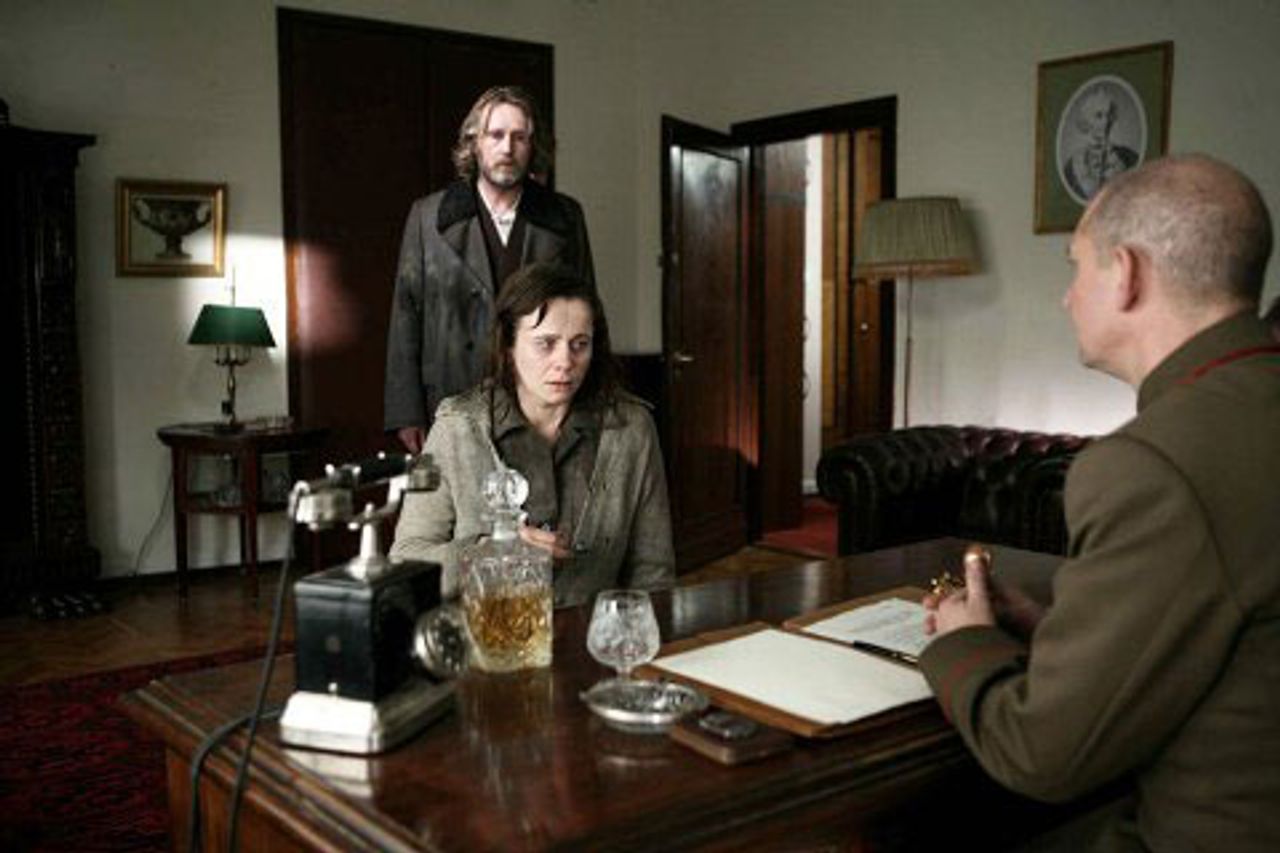
During Joseph Stalin's Great Purge, literature professor Yevgenia Ginzburg is falsely convicted of anti-Soviet agitation and sentenced to 10 years hard labor in a Soviet forced labour camp. Having lost everything, and no longer wishing to live, she meets Dr. Anton Walter (Ulrich Tukur), a Crimea German political prisoner who is a camp doctor in Kolyma. He recommends her for a position as a nurse in the camp infirmary. They fall in love and, slowly, Evgenia begins to come back to life.
Cast[edit]
- Emily Watson as Yevgenia Ginzburg
- Pam Ferris as Genia's mother
- Ian Hart as Beylin
- Ben Miller as Krasny
- Ulrich Tukur as Dr. Anton Walter
Distribution[edit]
As of 2011, Within the Whirlwind has not been picked up for distribution. According to Watson, "It was delivered pretty much the day the market crashed so nobody was buying anything. You have to be very Zen. Walk away and say: 'I have no idea what’s going to happen and it’s not in my hands.’ At the same time you never quite think that's going to happen."[2]
References[edit]
External links[edit]
- Within the Whirlwind at IMDb
- Bernd Reinhardt reviews the film for the, "World Socialist Website."
- Ronnie Scheib reviews "Within the Whirlwind" for Variety.com
Within the Whirlwind: Stalin’s Great Terror and a big question mark
Bernd Reinhardt
13 June 2011
Directed by Marleen Gorris, written by Nancy Larson, based on the book by Eugenia Ginzburg
 Within the Whirlwind
Dutch director Marleen Gorris’s film Within the Whirlwind is based on the autobiographical writings of Eugenia Ginzburg (published in English in 1967 as Journey into the Whirlwind). Following the assassination of the prominent Soviet official Sergey Kirov in 1934, the young academic at the University of Kazan was swept into the maelstrom that culminated in the bloody terror of 1936 to 1937, a terror waged against an entire people and its revolutionary socialist elements in particular.
The first part of the film charts the growth of suspicion, denunciation and arrests among Eugenia’s associates after Kirov’s death. A general feeling of insecurity and mutual distrust becomes rampant. Respected intellectuals and party officials are declared criminals and enemies of the people. The history professor, Elvov—who like Eugenia (Emily Watson) writes for a regional newspaper—is arrested allegedly for failing to interpret Trotsky’s theory of permanent revolution along Stalinist lines in an historical article.
Ginzburg is accused of lacking “political vigilance” in relation to Elvov. When she protests—in contrast to her colleagues—against the absurd accusations, she herself is accused of being a member of a Trotskyist terrorist group, planning to reintroduce capitalism into the USSR. Expelled from the party, she is sentenced by a court to 10 years hard labour. Her husband, a senior party official, is also arrested.
The second, longer part of the film depicts the gruelling life in a Siberian prison camp: felling trees in temperatures of -40C degrees and lower, the brutalisation of people, the ubiquity of illness and death, prisoners’ uncertainty about the fate of their children. Ginzburg collapses when she learns that one of her sons has starved to death in Leningrad during the siege of the German army. She is saved by a Volga German doctor, Anton (Ulrich Tukur), who like her has managed to retain his humanity under the atrocious conditions, and shares her passion for literature. When it is discovered that the two have become lovers, Anton is moved to another camp. Both survive, and one senses that the two will stay together.
 Within the Whirlwind
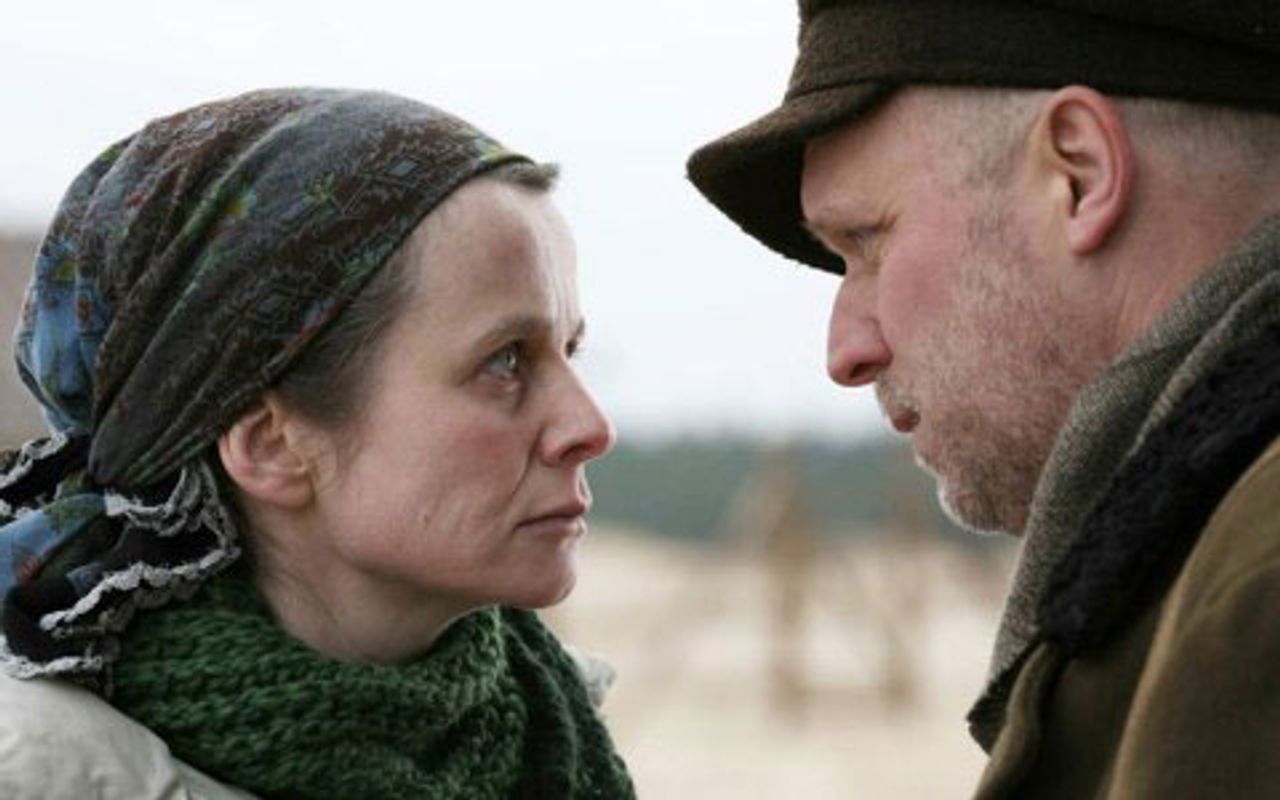
The film is distinguished by emotionally disturbing scenes and images, especially in the first part, when the brutal machinery of suppression is set in motion. Overall, however, the film proves disappointing. It is like a war monument evoking a terrible epoch, but too unspecific and innocuous.
Concerning the scenes in the camp, one has the impression of having seen them all before in other films—right up to the scene of a woman who in desperation runs into the barbed wire of the camp fence. There is both humiliation and solidarity among the prisoners. Criminals in the barracks constantly fight among themselves for any clothing they can get. Finally, the film resorts to the excessive emotionalism of violins and choral singing, an all too common feature of films about the Holocaust. The real spirit of the Soviet people and reality of Soviet life is missing from the film. The people as Ginzburg describes them in her books do not appear in the film.
In 1932, Eugenia Ginzburg joined the party as—in her own words—a convinced communist, consistently adhering to the “general line” of the party until 1934. She questioned neither the brutal forced collectivisation, which led to a huge famine, nor the fight against “saboteurs” and Trotskyists. Due to the position of her husband, she lived in privileged circumstances.
Her attitude to Stalin’s policies changed, as her memoir recounts, while she was in prison. Ginzburg’s autobiography is full of animated political discussion among the inmates.
There are “orthodox Stalinists”, who theoretically justify their own sad plight by alluding to Stalin’s infamous thesis of the intensification of the class struggle in the course of building socialism. One argues completely along official party lines to complain about the ubiquitous treachery in the country. Ginzburg replies: “If everyone is said to have betrayed one person [Stalin], is it not easier to suppose that he has betrayed them all?”
“Speak openly of your break with Stalin”, advises a cell neighbour, with whom she corresponds by knocking on the wall, “and name as many people as possible who share your view. They can’t arrest the whole party. As soon as a few thousand of such people are on record, they’ll have to convene an extraordinary party congress. And then we’ll have the opportunity to have ‘him’ removed. Believe me, he’s hated no less in the Central Committee than in our cells.... It’s the only way to save the party”.
But Ginzburg is reluctant to join cause with this fellow prisoner. She thinks there is no chance “that he [Stalin] deliberately wants to eliminate the top-level members of the party. On whom would he then be able to base his power?”
The chapter, “The Communist International”, describes the fate of foreign inmates from Poland, China, France and Latvia, the majority of whom were communist party members—like Greta Kästner of the German Communist Party, who was accused of espionage. Carola Neher—the well-known German actress, and a collaborator of playwright Bertolt Brecht, who fled Nazi Germany—is also now accused of the same crime as Ginzburg’s: counter-revolutionary Trotskyist activities.
Later, another “spy”, a young female Italian communist, is tortured. Her desperate cries of “Comunista italia” echo through the prison corridors. Ginsberg writes that she was ashamed of what was happening to these Comintern comrades, and feels responsible for their incarceration in “our” prisons.
The discussions in the book continue during the transport of the prisoners to Siberia. Younger comrades mistakenly believe Stalin had nothing to do with the arrests. Blame is levelled instead against people like Nikolai Yezhov, head of the secret police. Following his fall in 1939, hopes are placed in his successor Lavrenti Beria. There is also a long-time revolutionary, a member of the party years before the revolution, who ridicules such arguments.
Although Ginzburg is unable to make any political sense of the all-enveloping terror, she attempts to chronicle everything she sees and hears. She tells the stories of many individuals and sketches the entire lives of people in a few words, rescuing them from oblivion by documenting numerous names, occupations and party functions. Again and again, she comes to write about the trials of leading party members. Ginzburg’s personal history is an integral part of the catastrophe that befell Soviet society. The nagging question—consuming millions of people—about the reason for the state terror runs through her autobiography.
For the film, however, this question has no real relevance. The apparent aim of Gorris (Antonia’s Line, Mrs. Dalloway) is to convey the timeless, personal story of a strong woman. The reality of that period, the social atmosphere, the passions of the time are apparently of little interest to the filmmaker. Consequently, some of characters are stereotypical—like the Stalinist fanatic and the informer, and the naive young woman who adores Stalin as a god. In the scene at the railway station, we are struck by the docile Christian look on the face of a peasant woman, who hands a few berries to prisoners in the train carriage. This one-dimensionality in no way contributes to an understanding of the era and its people.
Literature plays an important role in Ginzburg’s account. The prisoners thirst for contact with the outside world, with people and culture. They read whatever they can: Blok, Nekrasov, Pasternak, Mandelstam, Pushkin, etc. The reader has a sense of the significance of literature for the isolated women, who only see the same supervisors with their same six words every day. Ginzburg writes that the poet Blok “visits them”. So long as they have access to art, the vessel of life, they are capable of carrying on.
In the film the continual literary recitations become boring. The theme of literature was apparently seized upon in order to fill the ideological vacancy of the film. It becomes sentimental when its treatment here leads to a kind of literary onanism, literature reflecting upon itself, its own lost world, etc. Ginzburg and Anton sometimes appear to be aloof beings from another planet.
There is another major difference between the book and the film. Ginzburg’s records from her period of exile are underpinned with hopes for better times in Soviet society. After Stalin’s death, she succumbed to the illusion of many intellectuals that the end of Stalinism had begun with Khrushchev’s criticism of Stalin in 1956.
Within the Whirlwind was made in the contemporary climate of open anti-communism, a climate to which Stalinism contributed so much. If it can be said that Stalin’s supporters once served something they regarded as “communism”, it is also true that many of the same people went on to write tomes about the “crimes of communism” after the collapse of the Soviet Union. The film conveys a certain bewildered lack of understanding for those who maintained their belief in socialist ideals despite the Great Terror.
Although the film was made decades after Ginzburg’s autobiography, the oft-mentioned Leon Trotsky also appears largely as a somewhat sinister blank page. The arbitrary charges of terrorism, espionage and “counter-revolutionary Trotskyist activities” are obviously absurd. But that does not automatically exonerate Trotsky in the film, who is portrayed as a rather dubious figure for the viewer.
Born in the year of the Great Terror in 1937, the outstanding Russian historian Vadim Rogovin unceasingly addressed the question of why millions of people who were ready to give their all for the Soviet Union landed up in the camps at that time. In his book, 1937: Stalin’s Year of the Terror, he comes to the following assessment.
In the 1930s, “the traditions and ideals of the October Revolution were still alive. These unextinguished traditions threatened the very existence of the bureaucracy, which feared the masses, who had shown their true force and capacity for action during the years of the revolution and Civil War.... The falsified charges against the Opposition (headed by Trotsky), which reached their culmination in the sensational (show) trials, served as a means of crushing the social protest which had accumulated among the people against growing inequality and the political disenfranchisement of the masses”.
The Left Opposition’s publication, Bulletin of the Opposition, commented in 1937 that the repression was undertaken “precisely to prevent the masses from learning the true programme of ‘Trotskyism’, which demands above all greater equality and more freedom for the masses”.
As Rogovin explains in his book Before the Great Terror: Stalin’s Neo-NEP, quite a few people who had opposed Trotsky in the 1920s now sought to affiliate with him. Trotsky was becoming increasingly popular with the younger generation. Despite accusations to the contrary, this emerging opposition had no intention of introducing capitalism but rather sought to restore the revolutionary foundations of the Soviet Union.
In 1937: Stalin’s Year of the Terror, Rogovin continues: “What was needed in order to overcome this force (the rising opposition) which had no precedent in history, was state terror which was just as unprecedented in its scale and cruelty”. He goes on to add: “This terror proved to be possible and effective, because it superficially acted not in its genuine counter-revolutionary form, but in a form of social mimicry, under the mask of defending the gains of the October Revolution”.
In the screen credits at the end of the film, we are reminded that 5 million of the total of 18 million people arrested were killed. Eugenia Ginzburg’s daughter pointed out to an interviewer that no Soviet or post-Soviet government has “ever apologised for the generation that was annihilated at that time”.
Within the Whirlwind
Like "Antonia's Line" and "Mrs. Dalloway," Dutch helmer Marleen Gorris' latest cinematic paean to female fortitude places a strong woman at the flashpoint of historical change.
By Ronnie Scheib
Plus Icon
Like “Antonia’s Line” and “Mrs. Dalloway,” Dutch helmer Marleen Gorris’ latest cinematic paean to female fortitude places a strong woman at the flashpoint of historical change. Based on Evgenia Ginzburg’s memoirs, “Within the Whirlwind” chronicles the high-ranking professor’s fall from grace during the Stalinist purges and her subsequent 10-year incarceration in Soviet gulags. If Gorris never quite liberates her narrative from its biopic-driven adherence to a single, heroic p.o.v., Emily Watson’s stunning, all-consuming perf sweeps all before it in a virtuoso interpretation of courage under fire. A Jewish fest fave, this English-language pic’s distinctly nonsectarian slant spells crossover potential.
Related Stories
VIP
Netflix’s Squirm Game: Defending Chappelle Again Doesn’t Help Matters
All 12 ‘Halloween’ Movies in the Franchise, Ranked
Watson’s Ginzburg, a leading intellectual and true believer in the brave new communist world, only slowly comprehends the profound changes wrought by Stalin’s ascension to power. Invigorated by classes where her lively wit and intense engagement win the loyalty of students, and privately reveling with her fellow-traveler hubby (Benjamin Sadler) and two young sons, she naively assumes that the party bosses know what they’re doing. Gorris skillfully builds tension between Ginzburg’s self-confident belief in logic and justice and the growing cravenness and urge for self-preservation among those around her.
Her refusal to kowtow to bullies and philistines (rising in the ranks under Stalin’s paranoid regime) stems as much from pride as from conviction, as evidenced by her glee at getting her teaching prohibition temporarily lifted. Indeed her inability (or unwillingness) to entirely suppress a triumphant little smile when crossing the path of a KGB-type nemesis (a wonderfully hateful Ian Hart) leads to more severe charges being filed.
Soon she is shivering in a prison cell, keeping sane by reciting verse (Gorris and co-scripter Nancy Larson thread poetry as an alternate discourse throughout). When, after months of privation, she still refuses to sign a confession, Ginzburg is tried in a kangaroo court, Watson’s eyes straying in shocked disbelief from the legal proceedings to a nearby clock as her guilt is decided in six minutes flat.
The pic is at its most strikingly idiosyncratic when exploring this surreal gap between the heroine’s intellectual individualism and the Kafkaesque rationale of the state. Once Ginzburg is sent to the gulags, however, “Whirlwind” shifts into a less dialectic mode as victimization takes a more physical form.
Beaten by guards and harassed by criminal inmates, Ginzburg rallies the political detainees around her in tableaux of feminist solidarity. The pic tips toward melodrama when Ginzburg, learning of her family’s fate, sinks into suicidal depression, the women closing ranks to protect her until the possibility of romance with a compassionate German doctor (the excellent Ulrich Tukur) gives her the will to survive.
Gorris’ gulag interludes never lapse into mere cliche, the helmer even managing to spice up the love story with over-the-top touches. But the prison setting gives Gorris’ historical sense and savvy political irony (doubtless what attracted her to Ginzburg’s story in the first place) little to work with. Watson retains flashes of her character’s sarcastic flair but, lacking a foil to give it full sway, soon finds herself absorbed in the timelessness of heroism.
optional screen reader
Read More About:
Fortitude
Within the Whirlwind
Germany
Production: A Tatfilm production in co-production with Yeti Films, Sagafilm, Lorival, with the collaboration of ARD Degeto, Polish TV, WDR/Arte, in association with Motion Investment Group, supported by Filmstitung NRW, Polish Film Institute, Eurimages, Media Programme of the European Community, Deutschen Filmforderfonds. (International sales: Telepool/Cinepool, Munich.) Produced by Christine Ruppert. Executive producers, Priscilla Cohen, Nancy Larson, Vincent Macheras. Co-producers, Piotr Mularuk, Hubert Toint. Directed by Marleen Gorris. Screenplay, Nancy Larson, based on the memoir by Evgenia Ginzburg.
Crew: Camera (color), Arkadiusz Tomiak; editor, Ewin Ryckaert; music, Wlodek Pawlik; production designer, Ewa Skoczkowska; costume designers, Jagna Janicka, Katarzyna Lewinska; sound (Dolby Digital), Gert Jenssen; casting, Sabine Schwedhelm, Weronika Migon, Gail Stevens. Reviewed at New York Jewish Film Festival, Jan. 27, 2010. Running time: 97 MIN.
With: (English dialogue)
Music By:
No comments:
Post a Comment
Note: Only a member of this blog may post a comment.