Audiobook purchased on 17 Feb 2025 View order
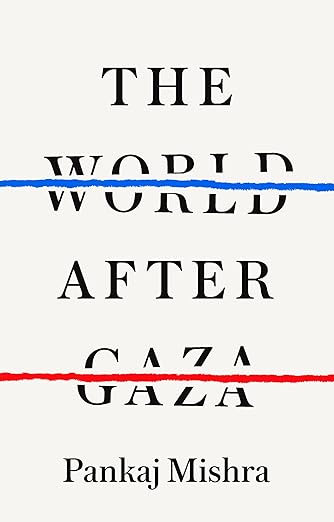

The World after Gaza Hardcover – 11 February 2025
by Pankaj Mishra (Author)
4.8 4.8 out of 5 stars 7 ratings
From the award-winning writer and thinker, an essential reckoning with the war in Gaza, its historical conditions, and moral and geopolitical ramifications
Memory of the Holocaust, the ultimate atrocity of Europe's civil wars and the paradigmatic genocide, has shaped the Western political and moral imagination in the postwar era.
Fears of its recurrence have been routinely invoked to justify Israel's policies against Palestinians.
But for most people around the world - the 'darker peoples', in W. E. B. Du Bois's words - the main historical memory is of the traumatic experiences of slavery and colonialism, and the central event of the twentieth century is decolonisation - freedom from the white man's world.
The World After Gaza takes the war in the Middle East, and the bitterly polarised reaction to it within as well as outside the West, as the starting point for a broad reevaluation of two competing narratives of the last century
The World After Gaza takes the war in the Middle East, and the bitterly polarised reaction to it within as well as outside the West, as the starting point for a broad reevaluation of two competing narratives of the last century
- the West's triumphant account of victory over Nazi and communist totalitarianism, and the spread of liberal capitalism, and the global majority's frequently thwarted vision of racial equality.
At a moment when the world's balance of power is shifting and a long-dominant Western minority no longer commands the same authority and credibility, it is critically important to enter the experiences and perspectives of the majority of the world's population.
As old touchstones and landmarks crumble, only a new history with a sharply different emphasis can reorient us to the world and worldviews now emerging into the light.
As old touchstones and landmarks crumble, only a new history with a sharply different emphasis can reorient us to the world and worldviews now emerging into the light.
In this concise, powerful and pointed treatise, Mishra reckons with the fundamental questions posed by our present crisis
- about whether some lives matter more than others,
why identity politics built around memories of suffering is being widely embraced and
why racial antagonisms are intensifying amid a far-right surge in the West, threatening a global conflagration.
The World After Gaza is an indispensable moral guide to our past, present and future.
Read less
Report an issue with this product
Print length
304 pages
Language
+
From the Publisher
Product description
Review
A book of passion, fury and clarity. Mishra is one of the most important voices of our generation -- Peter Frankopan
This is a rare text: courageous and bracing, learned and ethical, rigorous and mind-expanding -- Naomi Klein
As scholarly and subtle as it is brave and original, it’s by a long way the saddest and most thought-provoking book I have read this year ― Spectator, *Books of the Year*
In this urgent book, Mishra grapples with the inexplicable spectacle of stone-faced Western elites ignoring, and indeed justifying, the slaughter and starvation of Palestinians in Gaza. Mishra reflects on the supposedly universal consensus that emerged from the Holocaust, as well as his own early sympathies for Israel, as he expounds on the terrible toll of this passivity in the face of atrocity -- Rashid Khalidi
This profoundly important and urgent book finds Mishra, one of our most intellectually astute and courageous writers, at the peak of his powers. His outrage is hard to ignore. But at the centre of this book is a humane inquiry into what suffering can make us do, and he leaves us with the troubling question of what world will we find after Gaza -- Hisham Matar
If books have a role today in the elucidation of justice, then I believe The World after Gaza will prove to be as crucial to our own times as James Baldwin’s The Fire Next Time was to his -- Andrew O’Hagan
A brilliant book, as thoughtful, scholarly and subtle as it is brave and original, The World After Gaza does what great writing is meant to do: to remind us of what it is to be human, to help us feel another's pain, to reach out and make connections across the trenches of race, colour and religion -- William Dalrymple
We all owe Pankaj Mishra a debt for crafting eloquent, urgent and undeniable words from the horrors we are struggling to witness -- Afua Hirsch
An astute, humane and necessary intervention, opening a path to the altered consciousness which has to be a consequence of Israel’s war on Gaza -- Ahdaf Souief
Pankaj Mishra remembers the future. The World After Gaza, with its elegant outrage and eloquent ache, will be the reference for those who judge our times tomorrow. Thanks to Mishra's all-too-human work, the next generation will know we were not all in vain -- Ece Temelkuran
Both a timeless and timely book, reading The World After Gaza feels like engaging in an ongoing conversation about the meaning of the Holocaust and colonialism with a good attentive friend’ -- Eyal Weizman, Director, Forensic Architecture
Pankaj Mishra is our globally leading public intellectual and his coruscating and scintillating meditation on the ethical purchase of Holocaust memory as the Gaza war goes on is one of the indispensable documents of civilisation in a barbaric time. With his alert conscience, impeccable learning and meditative writing, Mishra chronicles how the very attempt to register the crimes of the past in a world of continuing hierarchy can transform into an alibi for the disasters of the present -- Samuel Moyn
With clarity and even a dose of self-reflection, the always brilliant Pankaj Mishra sifts through the many implications of the horrid war on Gaza -- Joe Sacco
A seething and erudite indictment of the west’s role in the creation of Israel and everything that has flowed from it ― Guardian
Read less
Report an issue with this product
Print length
304 pages
Language
+
From the Publisher
Product description
Review
A book of passion, fury and clarity. Mishra is one of the most important voices of our generation -- Peter Frankopan
This is a rare text: courageous and bracing, learned and ethical, rigorous and mind-expanding -- Naomi Klein
As scholarly and subtle as it is brave and original, it’s by a long way the saddest and most thought-provoking book I have read this year ― Spectator, *Books of the Year*
In this urgent book, Mishra grapples with the inexplicable spectacle of stone-faced Western elites ignoring, and indeed justifying, the slaughter and starvation of Palestinians in Gaza. Mishra reflects on the supposedly universal consensus that emerged from the Holocaust, as well as his own early sympathies for Israel, as he expounds on the terrible toll of this passivity in the face of atrocity -- Rashid Khalidi
This profoundly important and urgent book finds Mishra, one of our most intellectually astute and courageous writers, at the peak of his powers. His outrage is hard to ignore. But at the centre of this book is a humane inquiry into what suffering can make us do, and he leaves us with the troubling question of what world will we find after Gaza -- Hisham Matar
If books have a role today in the elucidation of justice, then I believe The World after Gaza will prove to be as crucial to our own times as James Baldwin’s The Fire Next Time was to his -- Andrew O’Hagan
A brilliant book, as thoughtful, scholarly and subtle as it is brave and original, The World After Gaza does what great writing is meant to do: to remind us of what it is to be human, to help us feel another's pain, to reach out and make connections across the trenches of race, colour and religion -- William Dalrymple
We all owe Pankaj Mishra a debt for crafting eloquent, urgent and undeniable words from the horrors we are struggling to witness -- Afua Hirsch
An astute, humane and necessary intervention, opening a path to the altered consciousness which has to be a consequence of Israel’s war on Gaza -- Ahdaf Souief
Pankaj Mishra remembers the future. The World After Gaza, with its elegant outrage and eloquent ache, will be the reference for those who judge our times tomorrow. Thanks to Mishra's all-too-human work, the next generation will know we were not all in vain -- Ece Temelkuran
Both a timeless and timely book, reading The World After Gaza feels like engaging in an ongoing conversation about the meaning of the Holocaust and colonialism with a good attentive friend’ -- Eyal Weizman, Director, Forensic Architecture
Pankaj Mishra is our globally leading public intellectual and his coruscating and scintillating meditation on the ethical purchase of Holocaust memory as the Gaza war goes on is one of the indispensable documents of civilisation in a barbaric time. With his alert conscience, impeccable learning and meditative writing, Mishra chronicles how the very attempt to register the crimes of the past in a world of continuing hierarchy can transform into an alibi for the disasters of the present -- Samuel Moyn
With clarity and even a dose of self-reflection, the always brilliant Pankaj Mishra sifts through the many implications of the horrid war on Gaza -- Joe Sacco
A seething and erudite indictment of the west’s role in the creation of Israel and everything that has flowed from it ― Guardian
About the Author
Pankaj Mishra's books include The Romantics, which won the LA Times' Art Seidenbaum Award for fiction, Age of Anger and From the Ruins of Empire. He contributes political and literary essays to the Guardian, the London Review of Books, the New York Review of Books and the New Yorker. A fellow of the Royal Society of Literature, he lives in London.
Product details
Publisher : Fern Press (11 February 2025)
Language : English
Hardcover : 304 pages
ISBN-10 : 1911717499
ISBN-13 : 978-1911717492
Dimensions : 14.6 x 2.9 x 22.4 cmBest Sellers Rank: 11,095 in Books (See Top 100 in Books)9 in Religious Intolerance & Persecution
21 in Colonialism & Post-Colonialism (Books)
36 in FascismCustomer Reviews:
4.8 4.8 out of 5 stars 7 ratings
About the author
Follow authors to get new release updates, plus improved recommendations.
Follow
Pankaj Mishra
Discover more of the author’s books, see similar authors, read book recommendations and more.
Customer reviews
4.8 out of 5 stars
Abu Haitham
5.0 out of 5 stars A candle in the darkReviewed in Canada on 14 February 2025
Verified Purchase
An eloquent personal intellectual journey that discusses a systematically neglected aspect of reality in “Western” affluent societies, with lessons for all in reconciling a horrific past and addressing a menacing future. A conversation needed for decades if not longer, possibly now more than ever.
Report
wonderbhoy
5.0 out of 5 stars Essential reading for a morally bankrupt political ageReviewed in the United Kingdom on 11 February 2025
Verified Purchase
Excellent, very well informed analysis and essential reading for our time. Mishra makes clear the deep malaise of our modern age, demonstrates how the exalted ideals which were expressed post-1945 have crumbled, and yet he manages to articulate a note of hope in this dark age for humanity. This is a work of great wisdom and courage, and deserves to be a classic testament for future ages.
Report
See more reviews
===
What Is the Best Way to See the Violence in the Middle East?
In “The World After Gaza,” Pankaj Mishra looks for moral clarity in the conflict between Israelis and Palestinians.
Share full article
Ben Hubbard
By Ben Hubbard
Feb. 9, 2025
Buy Book ▾
When you purchase an independently reviewed book through our site, we earn an affiliate commission.
THE WORLD AFTER GAZA: A History, by Pankaj Mishra
Growing up in a Hindu nationalist household in India in the 1970s, the critic and author Pankaj Mishra felt great admiration for Israel, even as India’s leaders championed the Palestinian cause. Encouraged by his grandfather, an ardent nationalist, he absorbed stories of Israel’s quest for statehood, respecting the determination of the Zionist movement to overcome formidable odds to create a state for the Jews, one that would grant them both safe harbor in a hostile world and an army with the unflinching will to strike its enemies. He even hung a photo of Moshe Dayan, Israel’s eye-patch-wearing defense minister during the 1967 Six-Day War, in his bedroom.
Mishra describes this education and his emergence from it in “The World After Gaza,” an exploration of the entwined threads of history, memory, identity and politics that he hopes will illuminate the significance of the war between Israel and Hamas. Even as his mind has changed, what has been consistent for Mishra is the way the violence in the Middle East has always been more than a narrow sectarian fight in one part of the globe. Tied up in the legacies of the great wars, the collapse of colonialism and the shadow of the Holocaust, it has always been freighted with other conflicts that act as mirrors. The deeper he delves, the more kaleidoscopic his reflections become.
To the Hindu nationalists around him, Israel’s resounding successes highlighted India’s failures. “In comparison,” he writes, “Hindu nationalism seemed like a tragedy: Deprived of a united country by Muslim separatists, softheaded Gandhi (and Nehru) allowed a catastrophic partition of British-ruled India in 1947 that led to the slaughter and rape of countless Hindus.”
But literature led Mishra to outgrow the lessons his family imparted to him. Reading critics of nationalism like the Indian playwright and Nobel laureate Rabindranath Tagore and the cultural Zionist Ahad Ha’am, he soured on what he now sees as an ideal of ethnic domination, in India and in Israel. This change in his beliefs accelerated during a visit to the West Bank in 2008, where he witnessed Palestinian suffering under the control of Israel’s military. He was “unnerved,” he writes, that their “persecutors were the West’s former victims,” and felt deep racial overtones that shook a writer from a formerly colonized land. Mishra saw the Palestinians as “people who looked like me, and who now endured a nightmare that my own ancestors had put behind us.” He returned home with an “awakened, affronted sensibility.”
This outraged, post-colonial attitude animates “The World After Gaza.” The book was written before the current cease-fire between Hamas and Israel began last month, but that likely would not have diminished the opprobrium he heaps on the Israeli government and the United States, which he criticizes for providing Israel with weapons that have devastated civilian life.
===
Tracking the First 100 Days ›
The Trump administration’s previous actions on Gaza
Feb. 10
Threatened cutting U.S. aid to Jordan and Egypt ›
Feb. 10
Issued an ultimatum to Hamas ›
Feb. 6
Defended Gaza takeover plan ›
Feb. 5
Tried to walk back President Trump’s proposal for Gaza ›
Feb. 4
Proposed that the U.S. take over Gaza ›
Feb. 4
Again floated idea of displacing Palestinians from Gaza ›
Jan. 25
Suggested relocating Gazans to Jordan and Egypt ›
See every major action by the Trump administration ›
Mishra’s book is more than a memoir of personal growth. He hopes to “alleviate my demoralizing perplexity before an extensive moral breakdown” and appeal to “a solidarity between human beings” that transcends racial and ethnic divisions.
To accomplish his ambitious goal, Mishra has armed himself with a vast bibliography. Some of his ruminations are carefully wrought, as when he presents the fitful and growing awareness of the horrors of the Holocaust before, as he sees it, Hollywood gloss distorted the tragedy and Israel’s defenders made it into an adaptable shield to deflect criticism of Israel. Elsewhere, quotations from various luminaries cascade down the page and his prodigious reading overwhelms his argument.
In often meandering chapters, he cites Holocaust survivors and historians; Israeli and Palestinian intellectuals; and Black American writers like W.E.B. Du Bois and James Baldwin. Even Woody Allen makes a surprising cameo, writing an opinion piece in The New York Times in 1988 to express his outrage at Israel’s forceful efforts to put down the first Palestinian uprising. “Are we talking about state-sanctioned brutality and even torture? My goodness!” Allen wrote.
The point seems to be to surprise readers with criticisms of Israel from unexpected sources as a way of opening them up to alternate ways of understanding history. Mishra’s scope is always wide. He spends little time discussing the Oct. 7 attack and how it heightened Israel’s sense of vulnerability. He focuses more on the effects on a generation of young people who witnessed what he calls “acts of savagery aided by the world’s richest and most powerful democracies.” The result has been part of a broader trend, he argues, of a growing number of people across continents who consider decolonization the most important event of the 20th century. In addition to political independence, he writes, this process offered the “seductive and perpetually renewable promise of equality,” and many of these people now see Israel as among the colonizers.
For Mishra, decolonization has played itself out largely in racial terms. It is “the physical and intellectual emancipation of the vast majority of the human population from the white man’s world” — although, he writes, “the Jew is not a white man in any simple sense,” not least because, as Mishra notes, “much of Israel’s population consists of Jews of Middle Eastern ancestry.” And yet, in his telling, Israel, in its treatment of Palestinians, has crossed from one side of the color line to the other, becoming an oppressor.
Decolonization is a tremendously large frame in which to fit the last eight or so decades of human history, and while it broadens Mishra’s realm of inquiry, it results in few new insights into the violence in the Middle East. After billing decolonization as “an unstoppable revolution,” he concludes that it might not make much difference anyway and predicts that Israel will eventually expel the Palestinians from the West Bank and Gaza.
That struck me on my first reading as a dramatic and risky prediction. But now, President Trump has called publicly not just for removing two million Palestinians from Gaza, but also for the United States to take control of the territory and develop it into “the Riviera of the Middle East.” The Palestinians, Trump expects, will be “thrilled” by the idea.
One might expect that after arguing so forcefully that decolonization had profoundly altered global perspectives, Mishra might also predict a new and effective resistance to mass displacement or at least hope that his appeal to a more complicated view of the past could inspire change. But his pessimism seems to outstrip his optimism. He speaks admirably of the campus protesters who supported the Palestinians; they might help the people of Gaza feel less lonely in their sorrow. Is this what he means by solidarity? If so, it may be little comfort to those who continue to live under the profound burdens of their shared histories.
THE WORLD AFTER GAZA: A History | By Pankaj Mishra | Penguin Press | 292 pp. | $28
Ben Hubbard is the Istanbul bureau chief, covering Turkey and the surrounding region. More about Ben Hubbard
===
===
The World After Gaza
Pankaj Mishra
3.82
28 ratings4 reviews
From the award-winning writer and thinker, an essential reckoning with the war in Gaza, its historical conditions, and moral and geopolitical ramifications
'Courageous and bracing, learned and ethical, rigorous and mind-expanding' NAOMI KLEIN
'Mishra has made a powerful contribution to the moral history of the world' ANDREW O'HAGAN
'Urgent' HISHAM MATAR
'Brilliant' WILLIAM DALRYMPLE
Memory of the Holocaust, the ultimate atrocity of Europe’s civil wars and the paradigmatic genocide, has shaped the Western political and moral imagination in the postwar era. Fears of its recurrence have been routinely invoked to justify Israel’s policies against Palestinians. But for most people around the world – the ‘darker peoples’, in W. E. B. Du Bois’s words – the main historical memory is of the traumatic experiences of slavery and colonialism, and the central event of the twentieth century is decolonisation – freedom from the white man’s world.
The World After Gaza takes the war in the Middle East, and the bitterly polarised reaction to it within as well as outside the West, as the starting point for a broad reevaluation of two competing narratives of the last the West’s triumphant account of victory over Nazi and communist totalitarianism, and the spread of liberal capitalism, and the global majority's frequently thwarted vision of racial equality. At a moment when the world’s balance of power is shifting and a long-dominant Western minority no longer commands the same authority and credibility, it is critically important to enter the experiences and perspectives of the majority of the world’s population.
As old touchstones and landmarks crumble, only a new history with a sharply different emphasis can reorient us to the world and worldviews now emerging into the light. In this concise, powerful and pointed treatise, Mishra reckons with the fundamental questions posed by our present crisis – about whether some lives matter more than others, why identity politics built around memories of suffering is being widely embraced and why racial antagonisms are intensifying amid a far-right surge in the West, threatening a global conflagration. The World After Gaza is an indispensable moral guide to our past, present and future.
GenresNonfictionHistoryPoliticsAudiobook
293 pages, Kindle Edition
First published February 11, 2025
Book details & editions
Pankaj Mishra (पंकज मिश्रा) is a noted Indian essayist and novelist.
In 1992, Mishra moved to Mashobra, a Himalayan village, where he began to contribute literary essays and reviews to The Indian Review of Books, The India Magazine, and the newspaper The Pioneer. His first book, Butter Chicken in Ludhiana: Travels in Small Town India (1995), was a travelogue that described the social and cultural changes in India in the context of globalization. His novel The Romantics (2000), an ironic tale of people longing for fulfillment in cultures other than their own, was published in 11 European languages and won the Los Angeles Times Art Seidenbaum award for first fiction. His book An End to Suffering: The Buddha in the World (2004) mixes memoir, history, and philosophy while attempting to explore the Buddha's relevance to contemporary times. Temptations of the West: How to be Modern in India, Pakistan and Beyond (2006), describes Mishra's travels through Kashmir, Bollywood, Afghanistan, Tibet, Nepal, and other parts of South and Central Asia.
Show more
Displaying 1 - 4 of 4 reviews

Vartika
473 reviews786 followers
Follow
December 1, 2024
Pankaj Mishra's brilliant moral-political treatise may as well have been called 'The World before Gaza', for he here casts his rigorous eye on the historical events that have paved way for the escalation – and indeed, the silent sanctioning – of cold-blooded genocide of Palestinians at the hands of Israeli forces over the last 14 months.
He begins with a re-evaluation of how the collective memory of the Holocaust – as the ultimate atrocity of humankind – has come to shape the post-war moral and political imagination in the West. In this, he contends with the two major competing narratives of the twentieth century: the West's triumphant quashing of the totalitarian threats Nazism and Communism, and the ongoing and often thwarted post- (and de-)colonial project of racial equality.
Scrupulously researched, The World After Gaza demonstrates how the motivation for the West's involvement in quashing Nazi Germany, far from a moral imperative of rescuing European Jewry from annihilation, rested in the Allied powers' interest in preventing an influx of Jewish refugees in their own lands: Britain and the United States were, contrary to the now-popular saviour narratives, less than willing to admit Jewish refugees into their borders during wartime; Britain was in fact reluctant even to allow Jewish refugees of the Holocaust into British-administered Palestine despite Balfour and the ostensible motive for the creation of Israel.
As the book goes on to show, the Nazi extermination of six million Jews was seen as a mere 'detail' of the war, with Europe and even Israel abjuring the memory of the Shoah until the 1960s, when the Arab-Israeli war prompted the latter to focus on memorialising the Holocaust and using the manufactured fear of a second Shoah (manufactured because they were too evidently stronger than their opposition) to acquire military, monetary support from diaspora Jews elsewhere. Meanwhile, the shame of the Suez Crisis and the American defeat in East Asia meant that the West began seeing Israel as an important proxy in the Middle East. In the 1980s, European philosemitism in former sites of anti-semitism (exemplified by Germany, which fast went from being seen as the immoral and totalitarian enemy to a legitimate liberal democracy allied against the next big threat: the Soviets) became a requirement for membership of the European Union.
But while the project of Israelisation took hold, and even as the Holocaust was taking a central position in Western collective memory, it came to be challenged by decolonisation and the rise of other forms of collective self-identification. Quoting Aimé Césaire, Mishra argues that
Hitler seemed exceptionally cruel only because he presided over 'the humiliation of the white man': the 'fact that he applied to Europe colonialist procedures which until then had been reserved exclusively for the Arabs of Algeria, the coolies of India, and the blacks of Africa'.The question then was, what gave the Holocaust weight over the crimes committed in Hiroshima and Vietnam, over the institutions of slavery, colonisation and plunder, and over the genocides of Armenians, Cambodians, and Native Americans?
Mishra argues that apart from the colour line, the American discourse of progress after the Cold War rendered Nazi and Soviet totalitarianism as the sole measures of evil, and
the racism of American and Western societies, which Hitler had learned and borrowed from, was taken out of its original location, the institutions of slavery, colonialism and imperialism, and presented as a case of ugly individual bigotry.During the Cold War, the overplaying of the dangers of communism was further used to distract from the underlying causes and consequences of widespread decolonisation. Philosemitism and Israelisation strengthened with the colonial powers losing their potency, as did the resurgence from the 1990s onwards of the kind of ethnonationalism that resulted in the Holocaust in the first place.
Indeed, 'Never Again' became more distorted, propagandistic, and visibly racialised as the traditionally anti-semitic and once-again powerful far-right in Europe and elsewhere began identifying with and supporting Israel. Anti-refugee and violently xenophobic rhetoric was now levelled at people of colour (seen as a threat by the Whites who were once their masters, and who once levelled it just as forcefully against European Jews). In Part III of the book, Mishra explores this formation at length, examining the relationships between the Jewish consciousness and the emancipation of Asia, Africa and the Caribbean and also looking at the global media's complicity in the destruction of Gaza. It all comes together in his identification of why anti-semitic far-right alliances with Israel have come to be in a world where critical race theory and decolonisation are seen as a threat, and where Arabs have carefully been constructed as the most hated 'other':
There is among majoritarian movements a strong sense of identification with an ethnonational state that unleashes lethal force without constraints; it explains, much better than any calculus of geopolitical and economic interests, the stunning complicity of many in the West in an absolute moral transgression: a genocide.The book ends with a lamentation of – and an expression of wary hope for – what will become of the loneliness of the Palestinians, and of the world after Gaza. Though Mishra begins and ends with a formulation of current events in occupied Palestine as a 'war' despite also recognising the genocide– a centrist, pacifist and even Gandhian position that is sometimes confusing and also colours, I think, his understanding of post- and de- colonial movements – what holds in the middle makes a strong case for the Palestinian cause in a world that continues to turn a blind eye, to repeat history as it has time and time again.
The World After Gaza is not only essential reading for all who continue to show courage in the face of a crushing mainstream, or those who, like Mishra, are undertaking a personal journey of reckoning with our present, but also for those who seek to better understand the history of the West and close the gaps in the knowledge that the countless other books about the World Wars and the Holocaust fail to serve.
18 likes
3 comments
Like
Comment

koyna
9 reviews4 followers
Follow
February 6, 2025
mandatory reading; for a present that is horrifying, for the way in which history that is ongoing needs to be written and understood– the myriad threads that Mishra weaves together include the treatment of Jews in East and West Europe before, during, and after WWII, in the Middle East where they were not blond and blue eyed, the role of the Allies and USA in the Holocaust and the utter lack of guilt and responsibility on their part + parallels with Vietnam, Germany's totally perverse absolution of the guilt + parallels to their colonial history (hardly ever spoken about), India's own hindutva nationalism sharing deeply in the zionist psyche, leaving us reeling today in an abyss of moral & political decrepitude – the colour line stronger than ever, the decolonial project still far too distant in the horizon
5 likes
Like
Comment
Dilip Phadke
Author 1 book2 followers
Follow
February 12, 2025
A book of this caliber comes out only rarely. It is brilliant and courageous , at the same time it is disturbing and thought provoking. Some, in denial mode, will downplay it's importance which in itself would be vindication of its brilliance.
1 like
Like
Comment
Gandalf84
5 reviews
Follow
February 14, 2025
How anyone can be taken in by these one-sided arguments which reduce everything to postcolonial tropes and diminish the tragedy of the Holocaust is beyond me. Sadly many will read this book and, even worse, repeat its poisonous reasoning. It is shocking that Penguin has published such an incendiary book.
1 comment
Like
Comment
Displaying 1 - 4 of 4 reviews
===
To accomplish his ambitious goal, Mishra has armed himself with a vast bibliography. Some of his ruminations are carefully wrought, as when he presents the fitful and growing awareness of the horrors of the Holocaust before, as he sees it, Hollywood gloss distorted the tragedy and Israel’s defenders made it into an adaptable shield to deflect criticism of Israel. Elsewhere, quotations from various luminaries cascade down the page and his prodigious reading overwhelms his argument.
In often meandering chapters, he cites Holocaust survivors and historians; Israeli and Palestinian intellectuals; and Black American writers like W.E.B. Du Bois and James Baldwin. Even Woody Allen makes a surprising cameo, writing an opinion piece in The New York Times in 1988 to express his outrage at Israel’s forceful efforts to put down the first Palestinian uprising. “Are we talking about state-sanctioned brutality and even torture? My goodness!” Allen wrote.
The point seems to be to surprise readers with criticisms of Israel from unexpected sources as a way of opening them up to alternate ways of understanding history. Mishra’s scope is always wide. He spends little time discussing the Oct. 7 attack and how it heightened Israel’s sense of vulnerability. He focuses more on the effects on a generation of young people who witnessed what he calls “acts of savagery aided by the world’s richest and most powerful democracies.” The result has been part of a broader trend, he argues, of a growing number of people across continents who consider decolonization the most important event of the 20th century. In addition to political independence, he writes, this process offered the “seductive and perpetually renewable promise of equality,” and many of these people now see Israel as among the colonizers.
For Mishra, decolonization has played itself out largely in racial terms. It is “the physical and intellectual emancipation of the vast majority of the human population from the white man’s world” — although, he writes, “the Jew is not a white man in any simple sense,” not least because, as Mishra notes, “much of Israel’s population consists of Jews of Middle Eastern ancestry.” And yet, in his telling, Israel, in its treatment of Palestinians, has crossed from one side of the color line to the other, becoming an oppressor.
Decolonization is a tremendously large frame in which to fit the last eight or so decades of human history, and while it broadens Mishra’s realm of inquiry, it results in few new insights into the violence in the Middle East. After billing decolonization as “an unstoppable revolution,” he concludes that it might not make much difference anyway and predicts that Israel will eventually expel the Palestinians from the West Bank and Gaza.
That struck me on my first reading as a dramatic and risky prediction. But now, President Trump has called publicly not just for removing two million Palestinians from Gaza, but also for the United States to take control of the territory and develop it into “the Riviera of the Middle East.” The Palestinians, Trump expects, will be “thrilled” by the idea.
One might expect that after arguing so forcefully that decolonization had profoundly altered global perspectives, Mishra might also predict a new and effective resistance to mass displacement or at least hope that his appeal to a more complicated view of the past could inspire change. But his pessimism seems to outstrip his optimism. He speaks admirably of the campus protesters who supported the Palestinians; they might help the people of Gaza feel less lonely in their sorrow. Is this what he means by solidarity? If so, it may be little comfort to those who continue to live under the profound burdens of their shared histories.
THE WORLD AFTER GAZA: A History | By Pankaj Mishra | Penguin Press | 292 pp. | $28
Ben Hubbard is the Istanbul bureau chief, covering Turkey and the surrounding region. More about Ben Hubbard
===
===
The World After Gaza
Pankaj Mishra
3.82
28 ratings4 reviews
From the award-winning writer and thinker, an essential reckoning with the war in Gaza, its historical conditions, and moral and geopolitical ramifications
'Courageous and bracing, learned and ethical, rigorous and mind-expanding' NAOMI KLEIN
'Mishra has made a powerful contribution to the moral history of the world' ANDREW O'HAGAN
'Urgent' HISHAM MATAR
'Brilliant' WILLIAM DALRYMPLE
Memory of the Holocaust, the ultimate atrocity of Europe’s civil wars and the paradigmatic genocide, has shaped the Western political and moral imagination in the postwar era. Fears of its recurrence have been routinely invoked to justify Israel’s policies against Palestinians. But for most people around the world – the ‘darker peoples’, in W. E. B. Du Bois’s words – the main historical memory is of the traumatic experiences of slavery and colonialism, and the central event of the twentieth century is decolonisation – freedom from the white man’s world.
The World After Gaza takes the war in the Middle East, and the bitterly polarised reaction to it within as well as outside the West, as the starting point for a broad reevaluation of two competing narratives of the last the West’s triumphant account of victory over Nazi and communist totalitarianism, and the spread of liberal capitalism, and the global majority's frequently thwarted vision of racial equality. At a moment when the world’s balance of power is shifting and a long-dominant Western minority no longer commands the same authority and credibility, it is critically important to enter the experiences and perspectives of the majority of the world’s population.
As old touchstones and landmarks crumble, only a new history with a sharply different emphasis can reorient us to the world and worldviews now emerging into the light. In this concise, powerful and pointed treatise, Mishra reckons with the fundamental questions posed by our present crisis – about whether some lives matter more than others, why identity politics built around memories of suffering is being widely embraced and why racial antagonisms are intensifying amid a far-right surge in the West, threatening a global conflagration. The World After Gaza is an indispensable moral guide to our past, present and future.
GenresNonfictionHistoryPoliticsAudiobook
293 pages, Kindle Edition
First published February 11, 2025
Book details & editions
Pankaj Mishra (पंकज मिश्रा) is a noted Indian essayist and novelist.
In 1992, Mishra moved to Mashobra, a Himalayan village, where he began to contribute literary essays and reviews to The Indian Review of Books, The India Magazine, and the newspaper The Pioneer. His first book, Butter Chicken in Ludhiana: Travels in Small Town India (1995), was a travelogue that described the social and cultural changes in India in the context of globalization. His novel The Romantics (2000), an ironic tale of people longing for fulfillment in cultures other than their own, was published in 11 European languages and won the Los Angeles Times Art Seidenbaum award for first fiction. His book An End to Suffering: The Buddha in the World (2004) mixes memoir, history, and philosophy while attempting to explore the Buddha's relevance to contemporary times. Temptations of the West: How to be Modern in India, Pakistan and Beyond (2006), describes Mishra's travels through Kashmir, Bollywood, Afghanistan, Tibet, Nepal, and other parts of South and Central Asia.
Show more
Displaying 1 - 4 of 4 reviews
Vartika
473 reviews786 followers
Follow
December 1, 2024
Pankaj Mishra's brilliant moral-political treatise may as well have been called 'The World before Gaza', for he here casts his rigorous eye on the historical events that have paved way for the escalation – and indeed, the silent sanctioning – of cold-blooded genocide of Palestinians at the hands of Israeli forces over the last 14 months.
He begins with a re-evaluation of how the collective memory of the Holocaust – as the ultimate atrocity of humankind – has come to shape the post-war moral and political imagination in the West. In this, he contends with the two major competing narratives of the twentieth century: the West's triumphant quashing of the totalitarian threats Nazism and Communism, and the ongoing and often thwarted post- (and de-)colonial project of racial equality.
Scrupulously researched, The World After Gaza demonstrates how the motivation for the West's involvement in quashing Nazi Germany, far from a moral imperative of rescuing European Jewry from annihilation, rested in the Allied powers' interest in preventing an influx of Jewish refugees in their own lands: Britain and the United States were, contrary to the now-popular saviour narratives, less than willing to admit Jewish refugees into their borders during wartime; Britain was in fact reluctant even to allow Jewish refugees of the Holocaust into British-administered Palestine despite Balfour and the ostensible motive for the creation of Israel.
As the book goes on to show, the Nazi extermination of six million Jews was seen as a mere 'detail' of the war, with Europe and even Israel abjuring the memory of the Shoah until the 1960s, when the Arab-Israeli war prompted the latter to focus on memorialising the Holocaust and using the manufactured fear of a second Shoah (manufactured because they were too evidently stronger than their opposition) to acquire military, monetary support from diaspora Jews elsewhere. Meanwhile, the shame of the Suez Crisis and the American defeat in East Asia meant that the West began seeing Israel as an important proxy in the Middle East. In the 1980s, European philosemitism in former sites of anti-semitism (exemplified by Germany, which fast went from being seen as the immoral and totalitarian enemy to a legitimate liberal democracy allied against the next big threat: the Soviets) became a requirement for membership of the European Union.
But while the project of Israelisation took hold, and even as the Holocaust was taking a central position in Western collective memory, it came to be challenged by decolonisation and the rise of other forms of collective self-identification. Quoting Aimé Césaire, Mishra argues that
Hitler seemed exceptionally cruel only because he presided over 'the humiliation of the white man': the 'fact that he applied to Europe colonialist procedures which until then had been reserved exclusively for the Arabs of Algeria, the coolies of India, and the blacks of Africa'.The question then was, what gave the Holocaust weight over the crimes committed in Hiroshima and Vietnam, over the institutions of slavery, colonisation and plunder, and over the genocides of Armenians, Cambodians, and Native Americans?
Mishra argues that apart from the colour line, the American discourse of progress after the Cold War rendered Nazi and Soviet totalitarianism as the sole measures of evil, and
the racism of American and Western societies, which Hitler had learned and borrowed from, was taken out of its original location, the institutions of slavery, colonialism and imperialism, and presented as a case of ugly individual bigotry.During the Cold War, the overplaying of the dangers of communism was further used to distract from the underlying causes and consequences of widespread decolonisation. Philosemitism and Israelisation strengthened with the colonial powers losing their potency, as did the resurgence from the 1990s onwards of the kind of ethnonationalism that resulted in the Holocaust in the first place.
Indeed, 'Never Again' became more distorted, propagandistic, and visibly racialised as the traditionally anti-semitic and once-again powerful far-right in Europe and elsewhere began identifying with and supporting Israel. Anti-refugee and violently xenophobic rhetoric was now levelled at people of colour (seen as a threat by the Whites who were once their masters, and who once levelled it just as forcefully against European Jews). In Part III of the book, Mishra explores this formation at length, examining the relationships between the Jewish consciousness and the emancipation of Asia, Africa and the Caribbean and also looking at the global media's complicity in the destruction of Gaza. It all comes together in his identification of why anti-semitic far-right alliances with Israel have come to be in a world where critical race theory and decolonisation are seen as a threat, and where Arabs have carefully been constructed as the most hated 'other':
There is among majoritarian movements a strong sense of identification with an ethnonational state that unleashes lethal force without constraints; it explains, much better than any calculus of geopolitical and economic interests, the stunning complicity of many in the West in an absolute moral transgression: a genocide.The book ends with a lamentation of – and an expression of wary hope for – what will become of the loneliness of the Palestinians, and of the world after Gaza. Though Mishra begins and ends with a formulation of current events in occupied Palestine as a 'war' despite also recognising the genocide– a centrist, pacifist and even Gandhian position that is sometimes confusing and also colours, I think, his understanding of post- and de- colonial movements – what holds in the middle makes a strong case for the Palestinian cause in a world that continues to turn a blind eye, to repeat history as it has time and time again.
The World After Gaza is not only essential reading for all who continue to show courage in the face of a crushing mainstream, or those who, like Mishra, are undertaking a personal journey of reckoning with our present, but also for those who seek to better understand the history of the West and close the gaps in the knowledge that the countless other books about the World Wars and the Holocaust fail to serve.
18 likes
3 comments
Like
Comment
koyna
9 reviews4 followers
Follow
February 6, 2025
mandatory reading; for a present that is horrifying, for the way in which history that is ongoing needs to be written and understood– the myriad threads that Mishra weaves together include the treatment of Jews in East and West Europe before, during, and after WWII, in the Middle East where they were not blond and blue eyed, the role of the Allies and USA in the Holocaust and the utter lack of guilt and responsibility on their part + parallels with Vietnam, Germany's totally perverse absolution of the guilt + parallels to their colonial history (hardly ever spoken about), India's own hindutva nationalism sharing deeply in the zionist psyche, leaving us reeling today in an abyss of moral & political decrepitude – the colour line stronger than ever, the decolonial project still far too distant in the horizon
5 likes
Like
Comment
Dilip Phadke
Author 1 book2 followers
Follow
February 12, 2025
A book of this caliber comes out only rarely. It is brilliant and courageous , at the same time it is disturbing and thought provoking. Some, in denial mode, will downplay it's importance which in itself would be vindication of its brilliance.
1 like
Like
Comment
Gandalf84
5 reviews
Follow
February 14, 2025
How anyone can be taken in by these one-sided arguments which reduce everything to postcolonial tropes and diminish the tragedy of the Holocaust is beyond me. Sadly many will read this book and, even worse, repeat its poisonous reasoning. It is shocking that Penguin has published such an incendiary book.
1 comment
Like
Comment
Displaying 1 - 4 of 4 reviews
===
London Rev of Books
https://www.lrb.co.uk/the-paper/v46/n06/pankaj-mishra/the-shoah-after-gaza
Vol. 46 No. 6 · 21 March 2024
The Shoah after Gaza
Pankaj Mishra
7503 words
In 1977, a year before he killed himself, the Austrian writer Jean Améry came across press reports of the systematic torture of Arab prisoners in Israeli prisons. Arrested in Belgium in 1943 while distributing anti-Nazi pamphlets, Améry himself had been brutally tortured by the Gestapo, and then deported to Auschwitz. He managed to survive, but could never look at his torments as things of the past. He insisted that those who are tortured remain tortured, and that their trauma is irrevocable. Like many survivors of Nazi death camps, Améry came to feel an ‘existential connection’ to Israel in the 1960s. He obsessively attacked left-wing critics of the Jewish state as ‘thoughtless and unscrupulous’, and may have been one of the first to make the claim, habitually amplified now by Israel’s leaders and supporters, that virulent antisemites disguise themselves as virtuous anti-imperialists and anti-Zionists. Yet the ‘admittedly sketchy’ reports of torture in Israeli prisons prompted Améry to consider the limits of his solidarity with the Jewish state. In one of the last essays he published, he wrote: ‘I urgently call on all Jews who want to be human beings to join me in the radical condemnation of systematic torture. Where barbarism begins, even existential commitments must end.’
Améry was particularly disturbed by the apotheosis in 1977 of Menachem Begin as Israel’s prime minister. Begin, who had organised the 1946 bombing of the King David Hotel in Jerusalem in which 91 people were killed, was the first of the frank exponents of Jewish supremacism who continue to rule Israel. He was also the first routinely to invoke Hitler and the Holocaust and the Bible while assaulting Arabs and building settlements in the Occupied Territories. In its early years the state of Israel had an ambivalent relationship with the Shoah and its victims. Israel’s first prime minister, David Ben-Gurion, initially saw Shoah survivors as ‘human debris’, claiming that they had survived only because they had been ‘bad, harsh, egotistic’. It was Ben-Gurion’s rival Begin, a demagogue from Poland, who turned the murder of six million Jews into an intense national preoccupation, and a new basis for Israel’s identity. The Israeli establishment began to produce and disseminate a very particular version of the Shoah that could be used to legitimise a militant and expansionist Zionism.
Améry noted the new rhetoric and was categorical about its destructive consequences for Jews living outside Israel. That Begin, ‘with the Torah in his arm and taking recourse to biblical promises’, speaks openly of stealing Palestinian land ‘alone would be reason enough’, he wrote, ‘for the Jews in the diaspora to review their relationship to Israel’. Améry pleaded with Israel’s leaders to ‘acknowledge that your freedom can be achieved only with your Palestinian cousin, not against him’.
Five years later, insisting that Arabs were the new Nazis and Yasser Arafat the new Hitler, Begin assaulted Lebanon. By the time Ronald Reagan accused him of perpetrating a ‘holocaust’ and ordered him to end it, the Israel Defence Forces (IDF) had killed tens of thousands of Palestinians and Lebanese and obliterated large parts of Beirut. In his novel Kapo (1993), the Serbian-Jewish author Aleksandar Tišma captures the revulsion many survivors of the Shoah felt at the images coming out of Lebanon: ‘Jews, his kinsmen, the sons and grandsons of his contemporaries, former inmates of the camps, stood in tank turrets and drove, flags waving, through undefended settlements, through human flesh, ripping it apart with machine-gun bullets, rounding up the survivors in camps fenced off with barbed wire.’
Primo Levi, who had known the horrors of Auschwitz at the same time as Améry and also felt an emotional affinity to the new Jewish state, quickly organised an open letter of protest and gave an interview in which he said that ‘Israel is rapidly falling into total isolation ... We must choke off the impulses towards emotional solidarity with Israel to reason coldly on the mistakes of Israel’s current ruling class. Get rid of that ruling class.’ In several works of fiction and non-fiction, Levi had meditated not only on his time in the death camp and its anguished and insoluble legacy, but also on the ever present threats to human decency and dignity. He was especially incensed by Begin’s exploitation of the Shoah. Two years later, he argued that ‘the centre of gravity of the Jewish world must turn back, must move out of Israel and back into the diaspora.’
Misgivings of the kind expressed by Améry and Levi are condemned as grossly antisemitic today. It’s worth remembering that many such re-examinations of Zionism and anxieties about the perception of Jews in the world were incited among survivors and witnesses of the Shoah by Israel’s occupation of Palestinian territory and its manipulative new mythology. Yeshayahu Leibowitz, a theologian who won the Israel Prize in 1993, was already warning in 1969 against the ‘Nazification’ of Israel. In 1980, the Israeli columnist Boaz Evron carefully described the stages of this moral corrosion: the tactic of conflating Palestinians with Nazis and shouting that another Shoah is imminent was, he feared, liberating ordinary Israelis from ‘any moral restrictions, since one who is in danger of annihilation sees himself exempted from any moral considerations which might restrict his efforts to save himself’. Jews, Evron wrote, could end up treating ‘non-Jews as subhuman’ and replicating ‘racist Nazi attitudes’.
Evron urged caution, too, against Israel’s (then new and ardent) supporters in the Jewish American population. For them, he argued, championing Israel had become ‘necessary because of the loss of any other focal point to their Jewish identity’ – indeed, so great was their existential lack, according to Evron, that they did not wish Israel to become free of its mounting dependence on Jewish American support.
They need to feel needed. They also need the ‘Israeli hero’ as a social and emotional compensation in a society in which the Jew is not usually perceived as embodying the characteristics of the tough manly fighter. Thus, the Israeli provides the American Jew with a double, contradictory image – the virile superman, and the potential Holocaust victim – both of whose components are far from reality.
Zygmunt Bauman, the Polish-born Jewish philosopher and refugee from Nazism who spent three years in Israel in the 1970s before fleeing its mood of bellicose righteousness, despaired of what he saw as the ‘privatisation’ of the Shoah by Israel and its supporters. It has come to be remembered, he wrote in 1988, ‘as a private experience of the Jews, as a matter between the Jews and their haters’, even as the conditions that made it possible were appearing again around the world. Such survivors of the Shoah, who had been plunged from a serene belief in secular humanism into collective insanity, intuited that the violence they had survived – unprecedented in its magnitude – wasn’t an aberration in an essentially sound modern civilisation. Nor could it be blamed entirely on a hoary prejudice against Jews. Technology and the rational division of labour had enabled ordinary people to contribute to acts of mass extermination with a clear conscience, even with frissons of virtue, and preventive efforts against such impersonal and available modes of killing required more than vigilance against antisemitism.
When I recently turned to my books to prepare this piece, I found I’d already underlined many of passages I quote here. In my diary there are lines copied from George Steiner (‘the nation-state bristling with arms is a bitter relic, an absurdity in the century of crowded men’) and Abba Eban (‘It is about time that we stand on our own feet and not on those of the six million dead’). Most of these annotations date back to my first visit to Israel and its Occupied Territories, when I was seeking to answer, in my innocence, two perplexing questions: how did Israel come to exercise such a terrible power of life and death over a population of refugees; and how can the Western political and journalistic mainstream ignore, even justify, its clearly systematic cruelties and injustices?
I had grown up imbibing some of the reverential Zionism of my family of upper-caste Hindu nationalists in India. Both Zionism and Hindu nationalism emerged in the late 19th century out of an experience of humiliation; many of their ideologists longed to overcome what they perceived as a shameful lack of manhood among Jews and Hindus. And for Hindu nationalists in the 1970s, impotent detractors of the then ruling pro-Palestinian Congress party, uncompromising Zionists such as Begin, Ariel Sharon and Yitzhak Shamir seemed to have won the race to muscular nationhood. (The envy is now out of the closet: Hindu trolls constitute Benjamin Netanyahu’s largest fan club in the world.) I remember I had a picture on my wall of Moshe Dayan, the IDF chief of staff and defence minister during the Six-Day War; and even long after my childish infatuation with crude strength faded, I did not cease to see Israel the way its leaders had from the 1960s begun to present the country, as redemption for the victims of the Shoah, and an unbreakable guarantee against its recurrence.
I knew how little the plight of Jews scapegoated during Germany’s social and economic breakdown in the 1920s and 1930s had registered in the conscience of Western European and American leaders, that even Shoah survivors were met with a cold shoulder, and, in Eastern Europe, with fresh pogroms. Though convinced of the justice of the Palestinian cause, I found it hard to resist the Zionist logic: that Jews cannot survive in non-Jewish lands and must have a state of their own. I even thought it was unjust that Israel alone among all the countries in the world needed to justify its right to exist.
I wasn’t naive enough to think that suffering ennobles or empowers the victims of a great atrocity to act in a morally superior way. That yesterday’s victims are very likely to become today’s victimisers is the lesson of organised violence in the former Yugoslavia, Sudan, Congo, Rwanda, Sri Lanka, Afghanistan and too many other places. I was still shocked by the dark meaning the Israeli state had drawn from the Shoah, and then institutionalised in a machinery of repression. The targeted killings of Palestinians, checkpoints, home demolitions, land thefts, arbitrary and indefinite detentions, and widespread torture in prisons seemed to proclaim a pitiless national ethos: that humankind is divided into those who are strong and those who are weak, and so those who have been or expect to be victims should pre-emptively crush their perceived enemies.
Though I had read Edward Said, I was still shocked to discover for myself how insidiously Israel’s high-placed supporters in the West conceal the nihilistic survival-of-the-strongest ideology reproduced by all Israeli regimes since Begin’s. It is in their own interests to be concerned with the crimes of the occupiers, if not with the suffering of the dispossessed and dehumanised; but both have passed without much scrutiny in the respectable press of the Western world. Anyone calling attention to the spectacle of Washington’s blind commitment to Israel is accused of antisemitism and ignoring the lessons of the Shoah. And a distorted consciousness of the Shoah ensures that whenever the victims of Israel, unable to endure their misery any longer, rise up against their oppressors with predictable ferocity, they are denounced as Nazis, hellbent on perpetrating another Shoah.
In reading and annotating the writings of Améry, Levi and others I was trying somehow to mitigate the oppressive sense of wrongness I felt after being exposed to Israel’s bleak construal of the Shoah, and the certificates of high moral merit bestowed on the country by its Western allies. I was looking for reassurance from people who had known, in their own frail bodies, the monstrous terror visited on millions by a supposedly civilised European nation-state, and who had resolved to be on perpetual guard against the deformation of the Shoah’s meaning and the abuse of its memory.
Despite its increasing reservations about Israel, a political and media class in the West has ceaselessly euphemised the stark facts of military occupation and unchecked annexation by ethnonational demagogues: Israel, the chorus goes, has the right, as the Middle East’s only democracy, to defend itself, especially from genocidal brutes. As a result, the victims of Israeli barbarity in Gaza today cannot even secure straightforward recognition of their ordeal from Western elites, let alone relief. In recent months, billions of people around the world have witnessed an extraordinary onslaught whose victims, as Blinne Ní Ghrálaigh, an Irish lawyer who is South Africa’s representative at the International Court of Justice in The Hague, put it, ‘are broadcasting their own destruction in real time in the desperate, so far vain, hope that the world might do something’.
But the world, or more specifically the West, doesn’t do anything. Worse, the liquidation of Gaza, though outlined and broadcast by its perpetrators, is daily obfuscated, if not denied, by the instruments of the West’s military and cultural hegemony: from the US president claiming that Palestinians are liars and European politicians intoning that Israel has a right to defend itself to the prestigious news outlets deploying the passive voice while relating the massacres carried out in Gaza. We find ourselves in an unprecedented situation. Never before have so many witnessed an industrial-scale slaughter in real time. Yet the prevailing callousness, timidity and censorship disallows, even mocks, our shock and grief. Many of us who have seen some of the images and videos coming out of Gaza – those visions from hell of corpses twisted together and buried in mass graves, the smaller corpses held by grieving parents, or laid on the ground in neat rows – have been quietly going mad over the last few months. Every day is poisoned by the awareness that while we go about our lives hundreds of ordinary people like ourselves are being murdered, or being forced to witness the murder of their children.
Those driven to scan Joe Biden’s face for some sign of mercy, some sign of an end to bloodletting, find an eerily smooth hardness, broken only by a nervous little smirk when he blurts out Israeli lies about beheaded babies. Biden’s stubborn malice and cruelty to the Palestinians is just one of many gruesome riddles presented to us by Western politicians and journalists. The Shoah traumatised at least two Jewish generations, and the massacres and hostage-taking in Israel on 7 October by Hamas and other Palestinian groups rekindled a fear of collective extermination among many Jews. But it was clear from the start that the most fanatical Israeli leadership in history would not shrink from exploiting a widespread sense of violation, bereavement and horror. It would have been easy for Western leaders to choke off their impulse of unconditional solidarity with an extremist regime while also acknowledging the necessity of pursuing and bringing to justice those guilty of war crimes on 7 October. Why then did Keir Starmer, a former human rights lawyer, assert that Israel has the right to ‘withhold power and water’ from Palestinians? Why did Germany feverishly start selling more arms to Israel (and with its mendacious media and ruthless official crackdown, especially on Jewish artists and thinkers, provide a fresh lesson to the world in murderous ethnonationalism’s quick ascent there)? What explains headlines on the BBC and in the New York Times like ‘Hind Rajab, six, found dead in Gaza days after phone calls for help’, ‘Tears of Gaza father who lost 103 relatives’ and ‘Man Dies after Setting Himself on Fire Outside Israeli Embassy in Washington, Police Say’? Why have Western politicians and journalists kept presenting tens of thousands of dead and maimed Palestinians as collateral damage, in a war of self-defence forced on the world’s most moral army, as the IDF claims to be?
The answers for many people around the world cannot but be tainted by a long-simmering racial bitterness. Palestine, as George Orwell pointed out in 1945, is a ‘colour issue’, and this is the way it was inevitably seen by Gandhi, who pleaded with Zionist leaders not to resort to terrorism against Arabs using Western arms, and the postcolonial nations, which almost all refused to recognise the state of Israel. What W.E.B. Du Bois called the central problem of international politics – the ‘colour line’ – motivated Nelson Mandela when he said that South Africa’s freedom from apartheid is ‘incomplete without the freedom of the Palestinians’. James Baldwin sought to profane what he termed a ‘pious silence’ around Israel’s behaviour when he claimed that the Jewish state, which sold arms to the apartheid regime in South Africa, embodied white supremacy not democracy. Muhammad Ali saw Palestine as an instance of gross racial injustice. So, today, do the leaders of the United States’s oldest and most prominent Black Christian denominations, who have accused Israel of genocide and asked Biden to end all financial as well as military aid to the country.
In 1967, Baldwin was tactless enough to say that the suffering of Jewish people ‘is recognised as part of the moral history of the world’ and ‘this is not true for the blacks.’ In 2024, many more people can see that, when compared with the Jewish victims of Nazism, the countless millions consumed by slavery, the numerous late Victorian holocausts in Asia and Africa, and the nuclear assaults on Hiroshima and Nagasaki are barely remembered. Billions of non-Westerners have been furiously politicised in recent years by the West’s calamitous war on terror, ‘vaccine apartheid’ during the pandemic, and the barefaced hypocrisy over the plight of Ukrainians and Palestinians; they can hardly fail to notice a belligerent version of ‘Holocaust denial’ among the elites of former imperialist countries, who refuse to address their countries’ past of genocidal brutality and plunder and try hard to delegitimise any discussion of this as unhinged ‘wokeness’. Popular West-is-best accounts of totalitarianism continue to ignore the acute descriptions of Nazism (by Jawaharlal Nehru and Aimé Césaire, among other imperial subjects) as the radical ‘twin’ of Western imperialism; they shy away from exploring the obvious connection between the imperial slaughter of natives in the colonies and the genocidal terrors perpetrated against Jews inside Europe.
One of the great dangers today is the hardening of the colour line into a new Maginot Line. For most people outside the West, whose primordial experience of European civilisation was to be brutally colonised by its representatives, the Shoah did not appear as an unprecedented atrocity. Recovering from the ravages of imperialism in their own countries, most non-Western people were in no position to appreciate the magnitude of the horror the radical twin of that imperialism inflicted on Jews in Europe. So when Israel’s leaders compare Hamas to Nazis, and Israeli diplomats wear yellow stars at the UN, their audience is almost exclusively Western. Most of the world doesn’t carry the burden of Christian European guilt over the Shoah, and does not regard the creation of Israel as a moral necessity to absolve the sins of 20th-century Europeans. For more than seven decades now, the argument among the ‘darker peoples’ has remained the same: why should Palestinians be dispossessed and punished for crimes in which only Europeans were complicit? And they can only recoil with disgust from the implicit claim that Israel has the right to slaughter 13,000 children not only as a matter of self-defence but because it is a state born out of the Shoah.
In 2006, Tony Judt was already warning that ‘the Holocaust can no longer be instrumentalised to excuse Israel’s behaviour’ because a growing number of people ‘simply cannot understand how the horrors of the last European war can be invoked to license or condone unacceptable behaviour in another time and place’. Israel’s ‘long-cultivated persecution mania – “everyone’s out to get us” – no longer elicits sympathy’, he warned, and prophecies of universal antisemitism risk ‘becoming a self-fulfilling assertion’: ‘Israel’s reckless behaviour and insistent identification of all criticism with antisemitism is now the leading source of anti-Jewish sentiment in Western Europe and much of Asia.’ Israel’s most devout friends today are inflaming this situation. As the Israeli journalist and documentary maker Yuval Abraham put it, the ‘appalling misuse’ of the accusation of antisemitism by Germans empties it of meaning and ‘thus endangers Jews all over the world’. Biden keeps making the treacherous argument that the safety of the Jewish population worldwide depends on Israel. As the New York Times columnist Ezra Klein put it recently, ‘I’m a Jewish person. Do I feel safer? Do I feel like there’s less antisemitism in the world right now because of what is happening there, or does it seem to me that there’s a huge upsurge of antisemitism, and that even Jews in places that are not Israel are vulnerable to what happens in Israel?’
This ruinous scenario was very clearly anticipated by the Shoah survivors I quoted earlier, who warned of the damage inflicted on the memory of the Shoah by its instrumentalisation. Bauman warned repeatedly after the 1980s that such tactics by unscrupulous politicians like Begin and Netanyahu were securing ‘a post-mortem triumph for Hitler, who dreamed of creating conflict between Jews and the whole world’ and ‘preventing Jews from ever having peaceful coexistence with others’. Améry, made desperate in his last years by ‘burgeoning antisemitism’, pleaded with Israelis to treat even Palestinian terrorists humanely, so that the solidarity between diaspora Zionists like himself and Israel did not ‘become the basis for a communion of two doomed parties in the face of catastrophe’.
There isn’t much to be hoped for in this regard from Israel’s present leaders. The discovery of their extreme vulnerability to Hizbullah as well as Hamas should make them more willing to risk a compromise peace settlement. Yet, with all the 2000 lb bombs lavished on them by Biden, they crazily seek to further militarise their occupation of the West Bank and Gaza. Such self-harm is the long-term effect Boaz Evron feared when he warned against ‘the continuous mentioning of the Holocaust, antisemitism and the hatred of Jews in all generations’. ‘A leadership cannot be separated from its own propaganda,’ he wrote, and Israel’s ruling class act like the chieftains of a ‘sect’ operating ‘in the world of myths and monsters created by its own hands’, ‘no longer able to understand what is happening in the real world’ or the ‘historical processes in which the state is caught’.
Forty-four years after Evron wrote this, it is clearer, too, that Israel’s Western patrons have turned out to be the country’s worst enemies, ushering their ward deeper into hallucination. As Evron said, Western powers act against their ‘own interests and apply to Israel a special preferential relationship, without Israel seeing itself obligated to reciprocate’. Consequently, ‘the special treatment given to Israel, expressed in unconditional economic and political support’ has ‘created an economic and political hothouse around Israel cutting it off from global economic and political realities’.
Netanyahu and his cohort threaten the basis of the global order that was rebuilt after the revelation of Nazi crimes. Even before Gaza, the Shoah was losing its central place in our imagination of the past and future. It is true that no historical atrocity has been so widely and comprehensively commemorated. But the culture of remembrance around the Shoah has now accumulated its own long history. That history shows that the memory of the Shoah did not merely spring organically from what transpired between 1939 and 1945; it was constructed, often very deliberately, and with specific political ends. In fact, a necessary consensus about the Shoah’s universal salience has been endangered by the increasingly visible ideological pressures brought to bear on its memory.
That Germany’s Nazi regime and its European collaborators had murdered six million Jews was widely known after 1945. But for many years this stupefying fact had little political and intellectual resonance. In the 1940s and 1950s, the Shoah was not seen as an atrocity separate from other atrocities of the war: the attempted extermination of Slav populations, Gypsies, disabled people and homosexuals. Of course, most European peoples had reasons of their own not to dwell on the killing of Jews. Germans were obsessed with their own trauma of bombing and occupation by Allied powers and their mass expulsion from Eastern Europe. France, Poland, Austria and the Netherlands, which had eagerly co-operated with the Nazis, wanted to present themselves as part of a valiant ‘resistance’ to Hitlerism. Too many indecent reminders of complicity existed long after the war ended in 1945. Germany had former Nazis as its chancellor and president. The French president François Mitterrand had been an apparatchik in the Vichy regime. As late as 1992, Kurt Waldheim was president of Austria despite there being evidence of his involvement in Nazi atrocities.
Even in the United States, there was ‘public silence and some sort of statist denial regarding the Holocaust’, as Idith Zertal writes in Israel’s Holocaust and the Politics of Nationhood (2005). It wasn’t until long after 1945 that the Holocaust began to be publicly remembered. In Israel itself, awareness of the Shoah was limited for years to its survivors, who, astonishing to remember today, were drenched with contempt by the leaders of the Zionist movement. Ben-Gurion had initially seen Hitler’s rise to power as ‘a huge political and economic boost for the Zionist enterprise’, but he did not consider human debris from Hitler’s death camps as fit material for the construction of a strong new Jewish state. ‘Everything they had endured,’ Ben-Gurion said, ‘purged their souls of all good.’ Saul Friedlander, the foremost historian of the Shoah, who left Israel partly because he couldn’t bear to see the Shoah being used ‘as a pretext for harsh anti-Palestinian measures’, recalls in his memoir, Where Memory Leads (2016), that academic scholars initially spurned the subject, leaving it to the memorial and documentation centre Yad Vashem.
Attitudes began to change only with the trial of Adolf Eichmann in 1961. In The Seventh Million (1993), the Israeli historian Tom Segev recounts that Ben-Gurion, who was accused by Begin and other political rivals of insensitivity to Shoah survivors, decided to stage a ‘national catharsis’ by holding the trial of a Nazi war criminal. He hoped to educate Jews from Arab countries about the Shoah and European antisemitism (neither of which they were familiar with) and start binding them with Jews of European ancestry in what seemed all too clearly an imperfectly imagined community. Segev goes on to describe how Begin advanced this process of forging a Shoah consciousness among darker-skinned Jews who had long been the target of racist humiliations by the country’s white establishment. Begin healed their injuries of class and race by promising them stolen Palestinian land and a socioeconomic status above dispossessed and destitute Arabs.
This distribution of the wages of Israeli-ness coincided with the eruption of identity politics among an affluent minority in the US. As Peter Novick clarifies in startling detail in The Holocaust in American Life (1999), the Shoah ‘didn’t loom that large’ in the life of America’s Jews until the late 1960s. Only a few books and films touched on the subject. The film Judgment at Nuremberg (1961) folded the mass murder of Jews into the larger category of the crimes of Nazism. In his essay ‘The Intellectual and Jewish Fate’, published in the Jewish magazine Commentary in 1957, Norman Podhoretz, the patron saint of neoconservative Zionists in the 1980s, said nothing at all about the Holocaust.
Jewish organisations that became notorious for policing opinion about Zionism at first discouraged the memorialisation of Europe’s Jewish victims. They were scrambling to learn the new rules of the geopolitical game. In the chameleon-like shifts of the early Cold War, the Soviet Union moved from being a stalwart ally against Nazi Germany to a totalitarian evil; Germany moved from being a totalitarian evil to a stalwart democratic ally against totalitarian evil. Accordingly, the editor of Commentary urged American Jews to nurture a ‘realistic attitude rather than a punitive and recriminatory one’ towards Germany, which was now a pillar of ‘Western democratic civilisation’.
This extensive gaslighting by the free world’s political and intellectual leaders shocked and embittered many survivors of the Shoah. However, they weren’t then regarded as uniquely privileged witnesses of the modern world. Améry, who loathed the ‘obtrusive philosemitism’ of postwar Germany, was reduced to amplifying his private ‘resentments’ in essays aimed at ruffling the ‘miserable conscience’ of German readers. In one of these he describes travelling through Germany in the mid-1960s. While discussing Saul Bellow’s latest novel with the country’s new ‘refined’ intellectuals, he could not forget the ‘stony faces’ of ordinary Germans before a pile of corpses, and discovered that he bore a new ‘grudge’ against Germans and their exalted place in the ‘majestic halls of the West’. Améry’s experience of ‘absolute loneliness’ before his Gestapo torturers had destroyed his ‘trust in the world’. It was only after his liberation that he had again known ‘mutual understanding’ with the rest of humanity because ‘those who had tortured me and turned me into a bug’ seemed to provoke ‘contempt’. But his healing faith in the ‘equilibrium of world morality’ had quickly been shattered by the subsequent Western embrace of Germany, and the free world’s eager recruitment of former Nazis in its new ‘power game’.
Améry would have felt even more betrayed if he had seen the staff memorandum of the American Jewish Committee in 1951, which regretted the fact that ‘for most Jews reasoning about Germany and Germans is still beclouded by strong emotion.’ Novick explains that American Jews, like other ethnic groups, were anxious to avoid the charge of dual loyalty and to take advantage of the dramatically expanding opportunities offered by postwar America. They became more alert to Israel’s presence during the extensively publicised and controversy-haunted Eichmann trial, which made inescapable the fact that Jews had been Hitler’s primary targets and victims. But it was only after the Six-Day War in 1967 and the Yom Kippur War in 1973, when Israel seemed existentially threatened by its Arab enemies, that the Shoah came to be broadly conceived, in both Israel and the United States, as the emblem of Jewish vulnerability in an eternally hostile world. Jewish organisations started to deploy the motto ‘Never Again’ to lobby for American policies favourable to Israel. The US, facing humiliating defeat in East Asia, began to see an apparently invincible Israel as a valuable proxy in the Middle East, and began its lavish subvention of the Jewish state. In turn, the narrative, promoted by Israeli leaders and American Zionist groups, that the Shoah was a present and imminent danger to Jews began to serve as a basis for collective self-definition for many Jewish Americans in the 1970s.
Jewish Americans were by then the most educated and prosperous minority group in America, and were increasingly irreligious. Yet, in the rancorously polarised American society of the late 1960s and 1970s, where ethnic and racial sequestration became common amid a widespread sense of disorder and insecurity, and historical calamity turned into a badge of identity and moral rectitude, more and more assimilated Jewish Americans affiliated themselves with the memory of the Shoah and forged a personal connection with an Israel they saw as menaced by genocidal antisemites. A Jewish political tradition preoccupied with inequality, poverty, civil rights, environmentalism, nuclear disarmament and anti-imperialism mutated into one characterised by a hyper-attentiveness to the Middle East’s only democracy. In the journals he kept from the 1960s onwards, the literary critic Alfred Kazin alternates between bafflement and scorn in charting the psycho-dramas of personal identity that helped to create Israel’s most loyal constituency abroad:
The present period of Jewish ‘success’ will some day be remembered as one of the greatest irony ... The Jews caught in a trap, the Jews murdered, and bango! Out of ashes all this inescapable lament and exploitation of the Holocaust ... Israel as the Jews’ ‘safeguard’; the Holocaust as our new Bible, more than a Book of Lamentations.
Kazin was allergic to the American cult of Elie Wiesel, who went around asserting that the Shoah was incomprehensible, incomparable and unrepresentable, and that Palestinians had no right to Jerusalem. In Kazin’s view, ‘the American Jewish middle class’ had found in Wiesel, a ‘Jesus of the Holocaust’, ‘a surrogate for their own religious vacancy’. The potent identity politics of an American minority was not lost on Primo Levi during his only visit to the country in 1985, two years before he killed himself. He had been profoundly disturbed by the culture of conspicuous Holocaust consumption around Wiesel (who claimed to have been Levi’s great friend in Auschwitz; Levi did not recall ever meeting him) and was puzzled by his American hosts’ voyeuristic obsession with his Jewishness. Writing to friends back in Turin he complained that Americans had ‘pinned a Star of David’ on him. At a talk in Brooklyn, Levi, asked for his opinion on Middle East politics, started to say that ‘Israel was a mistake in historical terms.’ An uproar ensued, and the moderator had to halt the meeting. Later that year, Commentary, raucously pro-Israel by now, commissioned a 24-year-old wannabe neocon to launch venomous attacks on Levi. By Levi’s own admission, this intellectual thuggery (bitterly regretted by its now anti-Zionist author) helped extinguish his ‘will to live’.
Recent American literature most clearly manifests the paradox that the more remote the Shoah grew in time the more fiercely its memory was possessed by later generations of Jewish Americans. I was shocked by the irreverence with which Isaac Bashevis Singer, born in 1904 in Poland and in many ways the 20th century’s quintessential Jewish writer, depicted Shoah survivors in his fiction, and derided both the state of Israel and the eager philosemitism of American gentiles. A novel like Shadows on the Hudson almost seems designed to prove that oppression doesn’t improve moral character. But much younger and more secularised Jewish writers than Singer seemed too submerged in what Gillian Rose in her scathing essay on Schindler’s List called ‘Holocaust Piety’.
In a review in the LRB (23 June 2005) of The History of Love, a novel by Nicole Krauss set in Israel, Europe and the US, James Wood pointed out that its author, born in 1974, ‘proceeds as if the Holocaust happened just yesterday’. The novel’s Jewishness had been, Wood wrote, ‘warped into fraudulence and histrionics by the force of Krauss’s identification with it’. Such ‘Jewish fervency’, bordering on ‘minstrelsy’, contrasted sharply with the work of Bellow and Norman Mailer and Philip Roth, who had ‘not shown a great interest in the shadow of the Shoah’.
A strenuously willed affiliation with the Shoah has also marked and diminished much American journalism about Israel. More consequentially, the secular-political religion of the Shoah and the over-identification with Israel since the 1970s has fatally distorted the foreign policy of Israel’s main sponsor, the US. In 1982, shortly before Reagan bluntly ordered Begin to cease his ‘holocaust’ in Lebanon, a young US senator who revered Elie Wiesel as his great teacher met the Israeli prime minister. In Begin’s own stunned account of the meeting, the senator commended the Israeli war effort and boasted that he would have gone further, even if it meant killing women and children. Begin himself was taken aback by the words of the future US president, Joe Biden. ‘No, sir,’ he insisted. ‘According to our values, it is forbidden to hurt women and children, even in war ... This is a yardstick of human civilisation, not to hurt civilians.’
Along period of relative peace has made most of us oblivious to the calamities that preceded it. Only a few people alive today can recall the experience of total war that defined the first half of the 20th century, the imperial and national struggles inside and outside Europe, the ideological mass mobilisation, the eruptions of fascism and militarism. Nearly half a century of the most brutal conflicts and the biggest moral breakdowns in history exposed the dangers of a world where no religious or ethical constraint existed over what human beings could do or dared to do. Secular reason and modern science, which displaced and replaced traditional religion, had not only revealed their incapacity to legislate human conduct; they were implicated in the new and efficient modes of slaughter demonstrated by Auschwitz and Hiroshima.
In the decades of reconstruction after 1945, it slowly became possible to believe again in the concept of modern society, in its institutions as an unambiguously civilising force, in its laws as a defence against vicious passions. This tentative belief was enshrined and affirmed by a negative secular theology derived from the exposure of Nazi crimes: Never Again. The postwar’s own categorical imperative gradually acquired institutional form with the establishment of organisations like the ICJ and the International Criminal Court and vigilant human rights outfits like Amnesty International or Human Rights Watch. A major document of the postwar years, the preamble of the Universal Declaration of Human Rights of 1948, is suffused with the fear of repeating Europe’s past of racial apocalypse. In recent decades, as utopian imaginings of a better socioeconomic order faded, the ideal of human rights drew even more authority from memories of the great evil committed during the Shoah.
From Spaniards fighting for reparative justice after long years of brutal dictatorships, Latin Americans agitating on behalf of their desaparecidos and Bosnians appealing for protection from Serbian ethnic-cleansers, to the Korean plea for redress for the ‘comfort women’ enslaved by the Japanese during the Second World War, memories of Jewish suffering at the hands of Nazis are the foundation on which most descriptions of extreme ideology and atrocity, and most demands for recognition and reparations, have been built.
These memories have helped define the notions of responsibility, collective guilt and crimes against humanity. It is true that they have been continually abused by the exponents of military humanitarianism, who reduce human rights to the right not to be brutally murdered. And cynicism breeds faster when formulaic modes of Shoah commemoration – solemn-faced trips to Auschwitz, followed by effusive camaraderie with Netanyahu in Jerusalem – become the cheap price of the ticket to respectability for antisemitic politicians, Islamophobic agitators and Elon Musk. Or when Netanyahu grants moral absolution in exchange for support to frankly antisemitic politicians in Eastern Europe who continually seek to rehabilitate the fervent local executioners of Jews during the Shoah. Yet, in the absence of anything more effective, the Shoah remains indispensable as a standard for gauging the political and moral health of societies; its memory, though prone to abuse, can still be used to uncover more insidious iniquities. When I look at my own writings about the anti-Muslim admirers of Hitler and their malign influence over India today, I am struck by how often I have cited the Jewish experience of prejudice to warn against the barbarism that becomes possible when certain taboos are broken.
All these universalist reference points – the Shoah as the measure of all crimes, antisemitism as the most lethal form of bigotry – are in danger of disappearing as the Israeli military massacres and starves Palestinians, razes their homes, schools, hospitals, mosques, churches, bombs them into smaller and smaller encampments, while denouncing as antisemitic or champions of Hamas all those who plead with it to desist, from the United Nations, Amnesty International and Human Rights Watch to the Spanish, Irish, Brazilian and South African governments and the Vatican. Israel today is dynamiting the edifice of global norms built after 1945, which has been tottering since the catastrophic and still unpunished war on terror and Vladimir Putin’s revanchist war in Ukraine. The profound rupture we feel today between the past and the present is a rupture in the moral history of the world since the ground zero of 1945 – the history in which the Shoah has been for many years the central event and universal reference.
There are more earthquakes ahead. Israeli politicians have resolved to prevent a Palestinian state. According to a recent poll, an absolute majority (88 per cent) of Israeli Jews believe the extent of Palestinian casualties is justifiable. The Israeli government is blocking humanitarian aid to Gaza. Biden now admits that his Israeli dependants are guilty of ‘indiscriminate bombing’, but compulsively hands out more and more military hardware to them. On 20 February, the US scorned for the third time at the UN most of the world’s desperate wish to end the bloodbath in Gaza. On 26 February, while licking an ice-cream cone, Biden floated his own fantasy, quickly shot down by both Israel and Hamas, of a temporary ceasefire. In the United Kingdom, Labour as well as Tory politicians search for verbal formulas that can appease public opinion while providing moral cover to the carnage in Gaza. It hardly seems believable, but the evidence has become overwhelming: we are witnessing some kind of collapse in the free world.
At the same time, Gaza has become for countless powerless people the essential condition of political and ethical consciousness in the 21st century – just as the First World War was for a generation in the West. And, increasingly, it seems that only those jolted into consciousness by the calamity of Gaza can rescue the Shoah from Netanyahu, Biden, Scholz and Sunak and re-universalise its moral significance; only they can be trusted to restore what Améry called the equilibrium of world morality. Many of the protesters who fill the streets of their cities week after week have no immediate relation to the European past of the Shoah. They judge Israel by its actions in Gaza rather than its Shoah-sanctified demand for total and permanent security. Whether or not they know about the Shoah, they reject the crude social-Darwinist lesson Israel draws from it – the survival of one group of people at the expense of another. They are motivated by the simple wish to uphold the ideals that seemed so universally desirable after 1945: respect for freedom, tolerance for the otherness of beliefs and ways of life; solidarity with human suffering; and a sense of moral responsibility for the weak and persecuted. These men and women know that if there is any bumper sticker lesson to be drawn from the Shoah, it is ‘Never Again for Anyone’: the slogan of the brave young activists of Jewish Voice for Peace.
It is possible that they will lose. Perhaps Israel, with its survivalist psychosis, is not the ‘bitter relic’ George Steiner called it – rather, it is the portent of the future of a bankrupt and exhausted world. The full-throated endorsement of Israel by far-right figures like Javier Milei of Argentina and Jair Bolsonaro of Brazil and its patronage by countries where white nationalists have infected political life – the US, UK, France, Germany, Italy – suggests that the world of individual rights, open frontiers and international law is receding. It is possible that Israel will succeed in ethnically cleansing Gaza, and even the West Bank as well. There is too much evidence that the arc of the moral universe does not bend towards justice; powerful men can make their massacres seem necessary and righteous. It’s not at all difficult to imagine a triumphant conclusion to the Israeli onslaught.
The fear of catastrophic defeat weighs on the minds of the protesters who disrupt Biden’s campaign speeches and are expelled from his presence to a chorus of ‘four more years’. Disbelief over what they see every day in videos from Gaza and the fear of more unbridled brutality hounds those online dissenters who daily excoriate the pillars of the Western fourth estate for their intimacy with brute power. Accusing Israel of committing genocide, they seem deliberately to violate the ‘moderate’ and ‘sensible’ opinion that places the country as well as the Shoah outside the modern history of racist expansionism. And they probably persuade no one in a hardened Western political mainstream.
But then Améry himself, when he addressed his resentments to the miserable conscience of his time, was ‘not at all speaking with the intention to convince; I just blindly throw my word onto the scale, whatever it may weigh.’ Feeling deceived and abandoned by the free world, he aired his resentments ‘in order that the crime become a moral reality for the criminal, in order that he be swept into the truth of his atrocity’. Israel’s clamorous accusers today seem to aim at little more. Against the acts of savagery, and the propaganda by omission and obfuscation, countless millions now proclaim, in public spaces and on digital media, their furious resentments. In the process, they risk permanently embittering their lives. But, perhaps, their outrage alone will alleviate, for now, the Palestinian feeling of absolute loneliness, and go some way towards redeeming the memory of the Shoah.
28 February
===
No comments:
Post a Comment
Note: Only a member of this blog may post a comment.