Kindle
$17.99
Available instantly
Audiobook
1 CreditAvailable instantly
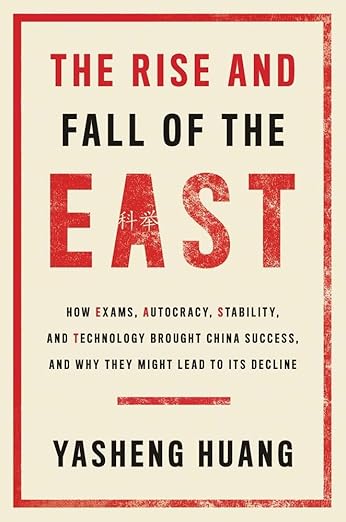
The Rise and Fall of the EAST: How Exams, Autocracy, Stability, and Technology Brought China Success, and Why They Might Lead to Its Decline Hardcover – 8 December 2023
by Yasheng Huang (Author)
4.6 4.6 out of 5 stars (117)
The long history of China’s relationship between stability, diversity, and prosperity, and how its current leadership threatens this delicate balance
Chinese society has been shaped by the interplay of the EAST―exams, autocracy, stability, and technology―from ancient times through the present. Beginning with the Sui dynasty’s introduction of the civil service exam, known as Keju, in 587 CE―and continuing through the personnel management system used by the Chinese Communist Party (CCP)―Chinese autocracies have developed exceptional tools for homogenizing ideas, norms, and practices. But this uniformity came with a huge downside: stifled creativity.
Yasheng Huang shows how China transitioned from dynamism to extreme stagnation after the Keju was instituted. China’s most prosperous periods, such as during the Tang dynasty (618–907) and under the reformist CCP, occurred when its emphasis on scale (the size of bureaucracy) was balanced with scope (diversity of ideas).
Considering China’s remarkable success over the past half-century, Huang sees signs of danger in the political and economic reversals under Xi Jinping. The CCP has again vaulted conformity above new ideas, reverting to the Keju model that eventually led to technological decline. It is a lesson from China’s own history, Huang argues, that Chinese leaders would be wise to take seriously.
Read less
Report an issue with this product
ISBN-10
This item: The Rise and Fall of the EAST: How Exams, Autocracy, Stability, and Technology Brought China Success, and Why They Might Lead to Its Decline
$40.01
+
Sparks: China's Underground Historians and Their Battle for the Future
$48.30
Total Price: $88.31
Product description
Review
"Riveting."--Tunku Varadarajan, Wall Street Journal
"Comprehensive and scholarly as one might expect from an economics professor at MIT. . . . [Huang's] wry dedication--'to the autocrats of the world. They give us so much to write about'--says it all."--James Crabtree, Financial Times
"The rigours of imperial China's civil-service examination system . . . are described in a new book by Yasheng Huang. . . . Arguing that the exams stifled innovation in ancient times, Professor Huang sees lessons for Xi Jinping's China."--The Economist
A Foreign Affairs Best Book of 2023
"One of those lamentably rare books that ask the really big questions, and that offer pretty bold original ideas about how and why China is the way that it is."--Kaiser Kuo, China Project
"This book is a sweeping inquiry that both China scholars and a general audience will value--not the least for Dr. Huang's wit, colorful observations, and direct style. . . . It is a must-read for anyone seeking a deeper understanding of China today and where it is headed."--Ann Scott Tyson, Christian Science Monitor
"Besides its breathtakingly original, brilliant and insightful theoretical argument, Huang's book is also notable for its methodological virtuosity. It makes use of extensive comparative examples and robust statistical analysis to illustrate how the introduction of an institution has fundamentally altered Chinese history. Written in elegant and accessible style, this book will be a perfect textbook for both graduate and undergraduate students. . . . An instant classic and an inspiring example of theoretical ambition and scholarly excellence."--Minxin Pei, China Quarterly
"A compelling and easily digestible argument."--Brad Glosserman, Japan Times
"Thought-provoking . . . illuminating. This book is a good example of how social sciences and historical investigations can provide useful insights into governance, economics, and politics that a less interdisciplinary approach would miss."--Xiang Gao, Australian Outlook
"This is by far the best book on Chinese bureaucracy I have read, and probably one of the best books on China period."--Tyler Cowen, Marginal Revolution (blog)
"[The book] offers a careful analysis of these questions that distinguishes it from the biased and predictable speculations of many commentators."--Krzysztof Tyszka-Drozdowski, American Conservative
"This is the sort of book that academia too rarely produces: a daring and absorbing . . . attempt to answer a vitally important question at the heart of one of the oldest, most important polities in world history, and one on whose future that of all humanity will largely turn."--Scott M. Moore, Journal of Asian Studies
"Yasheng Huang has written one of the decade's great China books. It is a deeply rich book, a product of a career of reflections that pairs . . . gripping anecdotes and systematic thinking, with each page delivering something novel and provocative that will leave every reader smarter and more thoughtful about China."--Jordan Schneider, ChinaTalk (podcast)
"This is a big idea book; it is bold, sweeping. It covers hundreds of years in terms of history, and it makes . . . very interesting conclusions."--Ilaria Mazzocco, Center for Strategic & International Studies
"An extraordinary book. . . . Interdisciplinary, . . . provocative."--Robert Daly, Woodrow Wilson Center
"An engaging and informative book that blends historical resonance with modern China, and highlights the more alarming idiosyncrasies and risks of Xi's China."--George Magnus, author of Red Flags: Why Xi's China Is in Jeopardy
"An extraordinary, innovative argument for a key question: Why has China's autocratic system proved so sustainable? Paying particular attention to China's traditional examination system, Huang provides a powerful new explanation."--Rana Mitter, author of China's Good War: How World War II Is Shaping a New Nationalism
About the Author
Yasheng Huang is the Epoch Foundation Professor of Global Economics and Management at the MIT Sloan School of Management. His books include Capitalism with Chinese Characteristics: Entrepreneurship and the State. He lives in Brookline, MA.
Product details
Publisher : Yale University Press
Publication date : 8 December 2023
Edition : 1st
Language : English
Print length : 440 pages
Customer Reviews:
4.6 4.6 out of 5 stars (117)
Camilo Augusto Sequeira
5.0 out of 5 stars EAST modelReviewed in Brazil on 23 May 2025
Verified Purchase
Leitura muito enriquecedora
Report
Translate review to English
Steve Yang
5.0 out of 5 stars A must read especially for China policies makersReviewed in the United States on 27 November 2023
Verified Purchase
In this book, MIT professor Yasheng Huang has a highly scientific analysis on why and how a seemingly crumbling authoritarian regime could have such long lasting stability, including why and how it survived the 1989 democracy movement, and where China could head next.
Really worth your time to dive in if you’re curious about why some so-called China Experts had failed so miserably for so many years in predicting China’s total collapse.
China is a giant puzzle and Huang’s academic book provides the best solution to help you solve it on your own.
On a side note, a taste for reading a PhD dissertation would certainly help in completing this highly scholastic book. For those looking for thrills of denigrating China based on oversimplified ideological divide do not need to bother, although Prof. Huang did provide his insights on why the current system under Xi is worrisome and the dangers it pose to even the CCP elites.
Report
Robert Ray
5.0 out of 5 stars Interesting interpretation of Chinese government over a thousand yearsReviewed in the United States on 7 November 2023
Verified Purchase
This is an original analysis of how China's government and its system of control have developed,. starting from the first imperial examinations which locked a large part of the literate male population into a very limited (Confucian) view of the world, thus limiting any thinking 'outside the box.' The author dates the collapse in Chinese innovation to the start of these examinations, as they diverted millions from any independent thought or research. Particularly surprising was the author's view on Xi Jinping's succession; Xi has locked himself into a situation where he can't retire, having sent so many cadre to prison (or even execution) in his anti-corruption campaign which in the process also created millions of enemies in the Party who would like to do him in. This is particularly problematic because Xi's family itself is rumored to have over a billion dollars.
Report
Daniel Taylor
3.0 out of 5 stars Awkward writing styleReviewed in the United States on 22 July 2024
Verified Purchase
Author Huang would do well to collaborate with a professional editor in order to clarify his perpetual distractions and as well to untangle many convoluted sentences and surprising expressions intended to garnish his text with scholarly flavor.
Huang’s unusual approach, however, renders an interesting interpretation of Chinese rich splendid history. The approach is Huang’s selection of certain themes 1. (Keju - the ancient esteemed and universal written exam system designed to select government servants), 2. Autocracy (government top-down power to regulate social behavior, 3. Stability (

Report
Tad Rivelle
5.0 out of 5 stars Unique and Balanced AnalysisReviewed in the United States on 20 February 2024
Verified Purchase
Accessible yet most scholarly read. Thought provoking. A key takeaway is the author's observation that the economic success of a nation depends on "scope" (encouraging independent thought, ie. letting the "daisies bloom") and "scale" (making resources available so that innovation can be rapidly and cost effectively commercialized). Autocratic political structures discourage "scope" but can excel at mobilizing resources to achieve scale. China's model from the '80s-2018 was "heterodox", combining indigenous "scale" while "outsourcing" the scope via collaborations with Western scholars, businesses, enhanced by a reliance on Hong Kong's historical property rights and financing infrastructure.
Report
See more reviews
==
Mateo Buriticá
5.0 out of 5 stars Una obra magistral sobre el modelo politico chino y que puede ocasionar que cambie su dirección
Reviewed in the United States on 6 April 2024
Verified Purchase
El autor con un lenguaje ameno nos presenta la hipótesis de que el éxito del modelo chino depende de cuatro vertientes(EAST) - Examination, Autocracy, Stability y Technology. Nos muestra con evidencia histórica porque estos componentes han moldeado la política china y como han sido usados para tener el control social.
El texto también muestra las falencias del modelo chino y que puede ocasionar un cambio en su política.
One person found this helpful
Report
Translate review to English
Minxin Pei
5.0 out of 5 stars This is a new classic
Reviewed in the United States on 25 June 2024
Verified Purchase
The argument of the book is original and provocative. The evidence used to support the author's argument is extensive and persuasive. The writing is brilliant. It can be an excellent choice for a college-level course on China.
3 people found this helpful
Report
MJB
5.0 out of 5 stars Measure of a Good Book
Reviewed in the United States on 15 January 2024
Verified Purchase
I ask myself a simple question when I finish any foreign policy and history book, do I have more questions after the book than before. If a book does not open your mind to different ways of thinking than you bought the wrong book. While this is not a book for the masses, it is a book for people who want to look behind the Chinese government curtain and have a better understanding if the why behind Chinese actions.
2 people found this helpful
Report
friscon
5.0 out of 5 stars Well researched balanced perspective on China today
Reviewed in the United States on 20 September 2023
Verified Purchase
This was one of the best geopolitical books I have read. It was a balanced, well written and a thoroughly researched account of politics, history, economics and other countries influence on China. I am not an historian, nor a geopolitical strategist. However, I would urge any statesman that deals with China or other nations to read and fully comprehend the approach this author has taken. I cannot say enough about how impressed I was with this book.
3 people found this helpful
Report
Wu James
5.0 out of 5 stars Great book!!
Reviewed in the United States on 23 October 2023
Verified Purchase
This is a great book!! Very informative and analytical to understand what China was and will be.
The author is so detailed and insightful to lead readers to know what ahead of China and why this country will proceed to the next phase.
A must read book for readers who want to know the future of the world and the fate of 1.4 billion Chinese people.
Report
From other countries
Donald Louis Erwin
5.0 out of 5 stars A great read.
Reviewed in the United States on 19 March 2024
Verified Purchase
I've read many books about China, trying to understand the country, and this is the best book I've read.
It's clear and concise and has startling insights. A pleasure to read.
One person found this helpful
Report
DPS
5.0 out of 5 stars Informative
Reviewed in the United States on 2 March 2024
Verified Purchase
Helped me understand where China is coming from. Fairly academic so a push to get through but worth it.
One person found this helpful
Report
Sci-fi fan
5.0 out of 5 stars Links China’s communist government to its imperial past
Reviewed in the United States on 28 September 2023
Verified Purchase
I loved the careful detailing of communist government including its stability and risks caused by Xi. Helps with understanding autocracy in general.
One person found this helpful
Report
Denis Timko
5.0 out of 5 stars In depth analysis
Reviewed in the United States on 11 December 2023
Verified Purchase
Must read for anyone interested in furthering their understanding of China. Excellent work.
Report
Howard S.
2.0 out of 5 stars Keju
Reviewed in the United States on 21 June 2024
Verified Purchase
While I was expecting a lively read, the book is quite academic and “this sociologist and that political scientist and this study and that study. Not for the casual China watcher
Report
==
Australian Institute of International Affairs
0
Home Australian Outlook Blog Posts Reading room Book Review: The Rise and Fall of the EAST
Reading room
27 Mar 2024
Book Review: The Rise and Fall of the EAST
By Dr Xiang Gao
Share
Share on Facebook
Share on LinkedIn
Share on X (Twitter)
In this thought-provoking book Yasheng Huang seeks to explain the unique stability of the Chinese political system over 1500 years and the consequent consolidation of authoritarian rule under Xi Jinping. He reveals the power of the Chinese examination system in shaping authoritarian and bureaucratic values in ancient and contemporary China.
The Confucius classic goes: “He who excels in study can follow a government career (学而优则仕).” In this thought-provoking book, Yasheng Huang reveals the power of the Chinese examination system in shaping authoritarian and bureaucratic values in ancient and contemporary China. The book presents a mixture of history and social science analysis. It seeks to explain the unique stability of the Chinese political system over 1500 years and the consequent consolidation of authoritarian rule under President Xi Jinping. For Huang, the crucial component has been the development of norms and ideas reinforcing centralised rule (both imperil and now under Xi) while undermining Chinese civil society and preventing the rise of potential autonomous power centres and stakeholders.
In imperial China, Huang focuses on the seminal role of the Keju examination system and the role of imperial institutions and social values. These examinations have long been a part of the Chinese national narrative and myth. Huang, like many scholars, argues that the Keju system was fundamental to the creation of a meritocratic bureaucracy dedicated to imperial power, which underpinned stability from the Sui dynasty (581–618) through to the end of imperial era in 1911. Its selection process enabled non-aristocratic individuals to advance into government, creating an institutional structure and governance process that impacted societal norms which in turn facilitated authoritarian rule.
After the 1949 revolution these values, joined with Chinese Communist Party (CCP) ideology and organisational prowess, led to a subsequent decline of liberal values and social capital. This outcome contributed to the establishment of a “Shackled Society” where independent hierarchies, such as organised religion, universities, businesses, voluntary organisations or charities, do not and cannot “compete with and constrain the state” because they “lack legitimacy, status or wherewithal to challenge the state.” Thus China is a “state without a society,” which enables the Party to exercise authority over all aspects of social life while concentrating power in the hands of a few individuals without institutional constraints.
One difficulty with theory-driven historical analysis, particularly quantitative historical analysis, is that it tends to focus on one or two measurable elements, either as a heuristic or a causal mechanism. When doing so researchers can privilege causal paramountcy to a limited number of variables. In these circumstances, the contingency and impact of other historical causes or explanations can be undervalued or ignored in the historical narrative. Huang, who focuses on four elements (Exams, Autocracy, Stability, and Technology) to explain the exceptionalism of Chinese governance and CCP control of contemporary Chinese society avoids this trap of over-explanation, but nevertheless tends to over-explain the trajectory of Chinese society and governance. History is not so clean; nor are the theoretical frameworks or the variables immune from bias (normative or methodological) or historiographical contention. For example, it is clear that Huang thinks the general normative state of Chinese society (inherited from the successful imperial dynasties) was not particularly impacted by economic and political developments through the colonial era and the tumultuous 20th century. The chaos of 19th century European colonialism in China, the economic, social and political issues associated with the decaying Qing dynasty, the Revolution of 1910, the rise of Japan and the Sino-Japanese War, the 1949 Communist victory under Mao Zedong, and the subsequent Cultural Revolution and Opening-up are simply a recrudescence of subliminal disposition and historical teleology in favour of authoritarianism. This reversion to an authoritarian “mean” is also evident in failed attempts to democratise in the 1980s and Xi’s consolidation of power.
Yet, Huang is too astute an observer of Chinese politics to completely fall into his own neat narrative. First, his application of social and economic theory to explain Communist rule or the post-1978 Chinese economy is illuminating, extending the literature in new ways. For example, his discussion of the modern Chinese economy as analogous to an M-Form corporation explains the persistent puzzles western observers have with Chinese economic policy and politics. On the one hand, China has been able to maintain high levels of growth for decades. Yet by pointing out that Chinese growth was regionally “autarkic,” it is unsurprising that cross-regional integration was devalued relative to international economic exchanges. High economic and developmental variation among regions makes more sense as a matter of policy – as is the growing importance of regional officials in the higher echelons of the CCP. At the same time, western policy-makers have been taken aback by the laser-focus on growth to the detriment of other social, economic or governance values such as environmental protection. Nevertheless, this emphasis on GDP as a performance measure is not only a relatively easy metric to evaluate but is also viewed as a better alternative than previous “performance” measures the CCP has pursued, such as class struggles, mass campaigns, and loyalty to the leader. For Huang, rather than creating detrimental externalities in the political economy, an emphasis on GDP by the CCP “has a moderating effect on Chinese politics.” His discussion of the CCP from an organisational economic perspective, despite being reductionist, provides a good political economy explanation of CCP’s organisational incentives. These incentives, and Huang’s analogising of CCP governance structures to private corporate structures, explains many economic and political developments over the past several decades.
Second, it is evident that Huang has a deep understanding of Chinese governance and the personalities involved at the highest levels of the CCP. This discussion is not theory-driven. Rather it is a historically sensitive narrative that explains both the defeat of those intent on liberalising economic and political institutions while explaining the basis for the increased authoritarianism of Xi’s regime. His discussion of the leadership between the 1980s Reformers, such as Zhao Ziyang, and the more ideological or conservative members of the CCP leadership, such as Chen Yun, provides new insights into how pivotable the decade was – and how the Tiananmen crackdown ushered in a new and more authoritarian leadership with an increasing developmental focus on the coastal areas. Indeed, Huang writes about how in an effort to secure the authority of newly installed Jiang Zemin, Deng Xiaoping abolished the Central Advisory Commission that was staffed by retired revolutionary elders. The action eliminated any subsequent check on future leadership because it removed an “institutional base from which the elders could interfere with the frontline management of state affairs,” thus undermining collective leadership and institutional governance. This started the slide toward a new post-Mao personalistic rule under Xi. If history is any guide, this embrace of personalistic rule will likely lead to policy inconsistency, mishaps and paralysis.
This book is a good example of how social sciences and historical investigations can provide useful insights into governance, economics, and politics that a less interdisciplinary approach would miss. While the book is sanguine about the strength and resilience of the Chinese system, Huang also argues that the system is under stress and that current developments have taken it outside the scope of his “East” framework. To return to a more “stable” and “balanced” governance, Huang argues for increased political openness in the Chinese political system and an embrace of various western values – free speech and debate – to enable Chinese society to evaluate its own strengths and weakness. Yet this call for openness is not a call for more liberal values or individual rights. Rather, it is accompanied by a continued acceptance that China’s historical trajectory remains firmly fixed between “authoritarianism” and “bad-authoritarianism.” To this extent, Huang remains trapped in his version of Chinese history.
This is a review of Yasheng Huang’s The Rise and Fall of the EAST: How Exams, Autocracy, Stability, and Technology Brought China Success, and Why They Might Lead to Its Decline (New Haven, Connecticut: Yale University Press, 2023). hardcover, ISBN: 9780300266368
Dr Xiang Gao is a Senior Lecturer and the Discipline Convenor of Political and International Studies at the University of New England.
This article is published under a Creative Commons Licence and may be republished with attribution.
==
The Rise and Fall of the EAST: How Exams, Autocracy, Stability, and Technology Brought China Success, and Why They Might Lead to Its Decline
Reviewed by Andrew J. Nathan
November/December 2023
Published on October 24, 2023
In This Review
The Rise and Fall of the EAST: How Exams, Autocracy, Stability, and Technology Brought China Success, and Why They Might Lead to Its Decline
By Yasheng Huang
Buy the Book
Share & Download
Print
Save
The EAST in Huang’s title stands not only for China but for the four keys to its history listed in the subtitle. The imperial examination system dating back to the sixth century forced aspiring elites to unite around the single goal of service to the state. Autocracy grew from the elimination of balancing forces within the state and of societal power centers outside the state. The stability of the authoritarian system was what the Chinese Communist Party achieved—despite self-inflicted episodes of chaos—by adopting its own forms of these ancient traditions. But technological stagnation was the price the Chinese dynasties paid for their supreme stability. Reformist leaders after the death of Mao Zedong, the founder of the People’s Republic of China, opened up the system enough to allow for innovation, entrepreneurialism, and economic growth. Now, however, Huang predicts that the crackdown on freedom under the Chinese leader Xi Jinping’s modernized version of imperial rule may bring an end to the country’s brief spurt of dynamism. Huang’s wide-ranging and consistently shrewd analysis suggests that Xi’s “China dream” of national greatness may be just that: a dream.
==
==
No comments:
Post a Comment
Note: Only a member of this blog may post a comment.