Yujin Pak, [2025-05-29 오후 8:11]
Hi all, I wrote an article about the historic impeachment of the Korean president last month and the role of two remarkable men in that event. Below is the chatgpt summary of my article. I am attaching the full version also in case you want to read it. It's a remarkable story of the influence of character at a pivot moment in history. The documentary about Jang-Ha Kim is available in Netflix in Korea but I see there is no English subtitle. Jang-Ha Kim is the uncle of Yeong-Seo Choi who is the program director of our Art of Living School in Korea.
Yujin Pak, [2025-05-29 오후 8:12]
(Summary) One Humble Man’s Influence in Changing Korean History in 2025
In late 2024, South Korean President Yoon declared martial law in an attempted military coup to suppress the nation's democratic movement. With 1,500 soldiers, helicopters, and police deployed to seize the National Assembly, the plan included arresting lawmakers and staging false attacks. The coup failed, and Yoon was impeached by parliament, but the final decision awaited the Constitutional Court.
For weeks, public fear grew that the Court might split, potentially restoring Yoon’s power. But in a historic and unanimous 8–0 ruling, the Court removed Yoon from office. The Court’s delay stemmed from efforts to reach full consensus—led by Chief Justice Hyeong-bae Moon, whose moral leadership was critical.
Moon’s integrity and humility traced back to his mentor and benefactor, Jang-Ha Kim, who had quietly funded Moon’s education decades earlier. Kim, a self-made herbalist from poverty, spent his life anonymously supporting over 1,000 low-income students, advancing women’s rights, press freedom, and social equity. In 1983, he built and donated a high school (valued at $13M) to the nation, living simply throughout.
Justice Moon, in his confirmation hearing, publicly stated that he intentionally kept his wealth below the national average—rejecting typical paths of power—and credited Kim’s influence for this choice. His moral clarity played a key role in persuading hesitant judges to reach a consensus on impeachment. Had they failed in the impeachment Korea may have faced a successful coup. A 2023 documentary about Kim’s life, produced without his participation per his wishes, became a Netflix favorite, reflecting the public’s hunger for ethical leadership.
💡 Final Reflection
his story reveals how one man’s lifelong moral example (Kim) shaped a just leader (Moon) who helped protect an entire democracy. In a world fraught with crisis and corruption, it’s a reminder: the quiet force of integrity can alter the course of history. It is an invitation to each of us—to be that stone of noble character in the face of destructive power.
===
Dear friends, I wrote the below
article because I felt it important to share this inspiring story from Korea in
the midst of all the terrible world news and because I saw no other way for it
to become known outside of Korea. I hope it will reach many people. - Yujin Pak
===
THE
TRANSFORMING INFLUENCE OF CHARACTER – A Recent Example from Korea
This is a story of how one man’s
character and principled life over many decades—though low-profile—had a
pivotal influence on a nation’s future.
Probably you heard in December of
Korean President Yoon’s declaration of martial law–late in the night–and a few
weeks ago that his impeachment was finalized by the Constitutional Court. The
background facts of this barely made it to Western news, and these facts carry
important insights into similar patterns that might happen
elsewhere.
MARTIAL
LAW, CONSTITUTIONAL VIOLATION, and an Attempted Coup in Korea
On December 3, 2024, then-President
Yoon of South Korea declared martial law in an attempt to consolidate power
through a military coup. (This parallels the martial law and coup of 1979 which
brought a decade of violence and is portrayed via a courageous character in the
blockbuster movie 12.12: The Day (available on Netflix, and free on Amazon
Prime-Freeve, Plex etc..). This declaration was not a sudden impulse, but a
planned attempt by increasingly desperate and decades long entrenched power in
Korea to break the nation’s inexorable democratic movement by any means
possible. A staggering force—1,500 soldiers, 12 Blackhawk helicopters, 107
military vehicles, and 4,000 police officers—was deployed to seize control of
the National Assembly. The plan included arresting members of the Assembly who
were in their way, staging a false-flag operation to blame North Korea, and
even possibly killing leaders of the opposition democratic movement and party.
The coup ultimately failed, and the president was impeached by a large majority
in the Assembly. However, final judgment rested with the Constitutional Court.
FINAL IMPEACHMENT & THE ROLE OF ONE JUDGE
The Constitutional Court’s decision
took an unusually long time, and the nation waited anxiously. Their long
deliberations over numerous weeks stirred fears of a split ruling, that judges
might be bought out. Such an outcome could restore Yoon and his co-conspirators
to power and thus potentially lead to a second martial law and coup.
But in a historic, clear, and
decisive ruling, the Constitutional Court unanimously (8–0) removed President
Yoon from office. It was later revealed that the delay was because it took that
long to reach a unanimous ruling. Central to this outcome was Chief Justice
Hyeong-Bae Moon, whose integrity and ethical leadership was vital in unifying
such ideologically diverse justices toward consensus. Chief Justice Moon knew
that only a unanimous decision would preserve national unity and trust in the
rule of law, so he worked diligently to facilitate it.
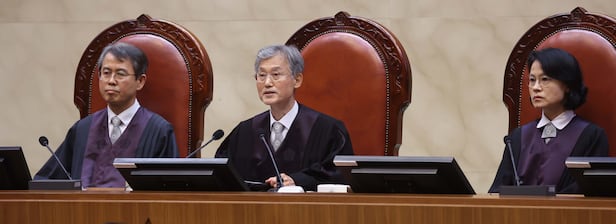
PHOTO: Justice Moon
pronouncing the thorough and easily understandable impeachment ruling. This
will likely be a key reference in constitutional law textbooks for decades..
THE CHARACTER OF ONE MAN,
ONE JUDGE
In the aftermath, the personal story of
Justice Moon and his background came to light and captivated the nation. Born
into poverty as the eldest son of a farming family, Moon was supported through
high school and college by a local donor, Jang-Ha Kim.
About two years ago, during Moon’s
confirmation hearing to become a Constitutional Judge, members of both parties,
having heard of Moon’s principled life, said they were honored because they
never saw someone like Moon in such a hearing. He was asked, ”Is it true that
years ago you made the decision that your wealth should not be above the
average in Korea?” (assets about $400,000, only a quarter of what most court
justices own) Moon answered, “Yes, because of my mentor Jang-Ha Kim who helped
me become who I am. I wanted to honor his principled life and public generosity
through my own choices.” Moon also declared that, after his term, he would not
join a high-paying private law firm–a common post-judicial career path criticized
because of corruption by special interests during the judicial term that such a
path opens.
Moon's middle
school graduation photo. He is wearing a school uniform with another student’s
name (a relative) because his parents couldn’t afford to buy him a uniform.
A PRINCIPLED DONOR WHO SHAPED A JUDGE AND
INFLUENCED A NATION
This brings us to the
life and legacy of Justice Moon’s early supporter and moral mentor: Jang-Ha
Kim. If not for this mentor’s life of selfless generosity and example, could
Moon, his mentee, have made the decisive life decisions he made? And if not, would
Moon have had the inner clarity and moral authority to persuade other
justices—some of whom initially opposed impeachment—during the most critical
decision of their careers? If the Court had failed to impeach the president, a
second, more effective martial law might have followed. Through the integrous
life of one man, Jang-Ha Kim, Justice Moon’s life was transformed which most
likely helped change the course of a nation’s history—and this, perhaps, gives
a glimmer of hope to a world yearning for genuine moral leadership.
Hyeong-Bae Moon (left) and Jang-Ha
Kim (right) now in his 80s
JANG-HA KIM: A Symbol of Noble
Character in Korea
From
a Life of Poverty to Purpose
Born in 1944 to a poor scholarly family in post-war
Korea, Kim endured a difficult youth. After barely finishing middle school, he
worked in an herbal medicine shop—cutting herbs by day, studying by night. At
18, he became the nation’s youngest licensed herbalist and opened his own shop
a year later. Through affordable, high-quality herbs, he gained success and
used it not for personal gain, but to benefit the Whole.
Lifelong
Giving and Impact
Kim spent his earnings on
charitable causes and social welfare efforts, rather than accumulating wealth.
He provided scholarships to over 1,000 underprivileged students—many of whom
later entered public service. He also supported women’s rights, press freedom,
social equality, and local culture—always remaining anonymous and refusing public
interviews. In 1983, he began a high school and donated it to the state eight
years later once it became established and high-ranking, valued then at $13
million, all while living frugally. Though not a political activist, his
actions quietly nurtured a generation committed to equity and public good.
Mentoring
a Justice Who Changed History
One of
Kim’s scholarship recipients, Hyeong-bae Moon, eventually became a
Constitutional Court Justice. Moon openly credited Kim’s example as the most
important influence on his life and choices. Kim’s quiet, purposeful giving
stands as a testament to how consistent spiritual character can uplift
society—especially in times of crisis.
In
2023 a documentary about Kim was released, in accordance with his wishes
without any formal interviews of him. It resonated deeply with the public, even
reaching and staying in the top 10 on Korea's Netflix in recent months.
A Final Thought
This is an example of how corrupt power was met by integrity and
true character. There is a message in this for people around the world: Those of true character have an essential part to
play in
dispelling corrupt power and, as in this example, it can make a decisive
difference for a whole nation. The principled giving of one man perhaps is like
the humble river stone in the hand of David that found the path to topple
Goliath’s destructive power. May we, individually and together, be that humble
stone of noble character and spirit.
===




No comments:
Post a Comment
Note: Only a member of this blog may post a comment.