Occupation 101: Voices Of The Silenced Majority [ Full Documentary ] HQ

Worlds Best Videos4.41K subscribers
23,139 views Jan 7, 2017
====
Transcript
===
1
MEDIA EDUCATION
FOUNDATION
60 Masonic
St. Northampton, MA 01060 | TEL 800.897.0089 |info@mediaed.org |
www.mediaed.org
Occupation
101
[TRANSCRIPT]
Text on Screen: “The greatest enemy of knowledge is not ignorance... It is the
illusion of knowledge” -‐ Stephen Hawking
Amira Hass: Any violence by a large population is not because these people are
more violent than any other. Its an alarm, its a sign, its a signal that
something is wrong in the treatment of this population.
Music: Where is the outcry! Where is the
voice of the day! Where is the voice of the people!
Malcolm X:They attack all of us for the same reasons. All of us catch hell
from the same enemy. We’re all in the same bag... the same boat. We suffer
political oppression, economic exploitation, and social degradation. All of
them from the same enemy.
Nelson Mandela: It is useless and point futile for us to continue talking peace
and non-‐violence against a government whose reply is only savage attacks
on an unarmed and defenseless people.
Voiceover: This year will be a year of violence. This
year cometh... the keynote is violence and the slogan is attack! I am minded of
young David... I am minded of young David the Shepherd boy. Who stood up before
the great warrior of the Philistines. Young David having all the courage! There
must be someone
MEDIA
EDUCATION FOUNDATION | www.MEDIAED.org
This transcript may be reproduced for
educational, non-profit uses only.
© 2013
2
somewhere... There’s got to be somebody somewhere
that cares. Young David took that one small stone and the faith of his God...
and slayed the giant Goliath!
Title Screen: Occupation 101
Reporter: A Pathe dispatcher shows the scene in Jerusalem as
Jewish and Arab mobs clashed in the center of the city. It remains to be seen
whether a threatened full-‐scale war will materialize.
Al Jazeera Reporter (in Arabic): Soldiers take over homes and
snipers don’t hesitate to shoot at anything that moves in front of them, which
includes journalists as well.
Narrator: As a journalist the more you look
into the issue of Israel and Palestine, the more you sense that something is
not quite right. The images and the narration are out of synch, a little like a
foreign film that has been awkwardly dubbed.
Al Jazeera Reporter (in Arabic): Damaged homes and roads destroyed
-‐-‐and only skeletal remains of cars. Even food and medicine are ever
scarce.
Narrator: As you look into it for yourself,
you begin to suspect that there is something extremely odd going on. The more
you look into it, the more you begin to feel it is not just odd, it is deeply
disturbing. Our media portray Mid-‐East violence
as though it’s an inherent part of the culture and region,
implying that the Israeli-‐Palestinian
conflict is an ancient problem with little hope of solution.
Al Jazeera Reporter (in Arabic): Israeli soldiers reign
destruction in all areas of the West Bank. The “City of Peace” is under siege
and the Church of Nativity is under fire by heavy military artillery. Hundreds
of citizens are stuck inside the church without any food or medicine.
MEDIA
EDUCATION FOUNDATION | www.MEDIAED.org
This transcript
may be reproduced for educational, non-profit uses only.
© 2013
3
Narrator: These misperceptions come from the fact that we’re only
hearing a fraction of the story. You are about to witness images and testimony,
largely hidden from mainstream America.
Ch. 2
Kathleen Kamphoefner: This place draws many people, whether
they’re Jewish, Muslim or Christian. This is a holy place to significant
numbers of us, in the world, we all have an interest in sort of seeing what is
this land, and what’s the situation here. And, once you come, if you open your
eyes at all, you can’t miss the problems and the patterns that are here.
Allegra Pacheco: I think it’s hard to understand what occupation
is. I think it’s a foreign concept for many Americans, what it’s like to live
under military
occupation.
Phyllis Bennis: The definition of an occupation is when a foreign
army occupies your land physically and controls your life.
Allegra Pacheco: In addition, Palestinians under occupation – and
this why there’s so much struggle against the occupation – they’re not
citizens, they don’t have rights, they don’t have civil rights. They’re under a
military rule.
Phyllis Bennis: This is a particular kind of occupation that’s
both military and settler occupation.
Bishop Allen Bartlett, Jr.: Settlements are
areas of Palestinian land which are selected, and whatever is there, whether
it’s roads, or whether it’s villages, or homes, they are bulldozed, and then a
new town is built on the hilltop.
MEDIA
EDUCATION FOUNDATION | www.MEDIAED.org
This transcript may be reproduced for
educational, non-profit uses only.
© 2013
4
Kathleen Kamphoefner: One very good friend is
Rodina Jabber. She and her husband Ata have landed in a rural valley near here
called the Ba’a. And it’s pretty clear these settlements want this land. It’s
some of the best agricultural land around here. So that valley has had repeated
home demolitions. Rodina, herself, has lived through two home demolitions. They
are living now in their third house.
Rodina (in Arabic): A bulldozer arrived with
soldiers; I was totally shocked and began to argue with them not to demolish my
home, so they began to beat me and pull my hair. As the bulldozer was to begin
the demolition, I remembered that my son was sleeping inside. So I ran towards
the house to get him; as I ran, the soldiers tried to hold me back. They began
beating and kicking me and pulled my hair. I managed to push one to the ground
and ran inside to my son and carried him out like this.
Narrator: Rodina and her children were once
again homeless, and had to endure living in a tent for many months. Her
husband, Ata was even imprisoned for protesting the destruction of their home.
Rodina (In Arabic): As I was cooking for my
children, I noticed that one of my daughters had tied a rope to a tree and
around her neck to attempt to hang herself. I asked her “ What are you doing?”
She said, “How can we live outside in the sun like this?” I don’t want to live,
I’d rather die.” It was a miserable time for us. Imagine a mother seeing her
own child trying to kill herself. Their mental condition is awful! They don’t
even sleep at night; they ask “Mommy! What is that? Check if it’s the army!..” 3
days ago... the army came at night and my children began screaming from all
directions, and the soldiers are yelling for my ID in the middle of the dark. I
tell them not to be fearful and try to calm and console them but I’m even more
afraid than they are.
MEDIA
EDUCATION FOUNDATION | www.MEDIAED.org
This transcript
may be reproduced for educational, non-profit uses only.
© 2013
5
Jeff Halper: Here you have Palestinians that have no input
whatsoever in the policies that are made. They’re not on the City Council.
They’re not in any of the decision-‐making bodies on the West Bank or Gaza. They’re certainly
not in the government. The policies are made in order to ensure Israeli
control. So the law is designed in a way, in a very cynical way, to prevent
Palestinians from building, and to keep them confined in little islands, so
that most of the land of the occupied territories is free for Israeli
settlement.
Richard Falk: These are armed settlements, about 190 of them,
spread all over the West Bank.
Narrator: Settlements are strategically built
colonies of Israel that are connected by a network of roads, which separate
each Palestinian community from the next and confine their ability to expand.
They are often constructed around the best farmland and water resources.
Phyllis Bennis: They are surrounded by barbwire. They are armed
inside. Settler residents are required to be armed, by the Israeli military.
And they are defended from the outside, by the Israeli military itself.
Allegra Pacheco: The purpose of these settlements today, number
one, is to continue the Israeli control and domination of the occupied
territories.
Jeff Halper: And the bottom in all of this is
to make Palestinians leave the country. It’s a very hard term, I know, but in a
sense it’s a kind of ethnic cleansing.
Ch. 3
MEDIA
EDUCATION FOUNDATION | www.MEDIAED.org
This transcript may be reproduced for
educational, non-profit uses only.
© 2013
6
Yael Stien: The Israeli government and the Israeli army is not
dealing with people as equal. I mean, I think that that’s the main problem,
that Palestinians are not considered, or not perceived as, equals, to Israelis.
Douglas Dicks: There is no specific discrimination against
Palestinian Christians, as opposed to Palestinian Muslims – it’s a shared
suffering.
Father Drew Christiansen: Christians see themselves very much a
part of the Palestinian national movement. They identify with the Palestinian
people as being their people.
Douglas Dicks: Palestinian Christians have difficulty getting to
churches on Sunday morning, if they wanted to come to Jerusalem, because they
don’t have that permission, or that legal right, according to the Israeli
government, to come to Jerusalem, for worship.
Thomas Getman: This, I picked up in a home of a wonderful
Christian family in Beit Jala. And this is the kind of armor-‐piercing weaponry that’s being used against civilians, innocent civilians.
Beit Jala Woman: It’s not easy to tell
everything you know. It’s easy to say some words, but you can’t tell how do you
feel. As everybody, I want my children to be happy, to live their right life as
children. We just think about one thing: Where can I put my children while they
are shooting? They didn’t want to go to school, because they are scared to come
back and there is no house. They doesn’t want to go without me and their
father, because they think that they will lose us. What about these children,
why they are going to the streets. They don’t think “let’s go to swim” because
I’m sure they have no right to swim now. Why? Because we are Palestinian...
Thanks God. I don’t imagine that there is a woman, in all of the world,
MEDIA
EDUCATION FOUNDATION | www.MEDIAED.org
This transcript may be reproduced for
educational, non-profit uses only.
© 2013
7
can send her child, or her man, just go to
die. Do You think we are working all of this life to give them something, and
to let them die in a minute, can you?
Thomas Getman: The suffering, the persecution of Christians,
they’ve been robbed of their heritage. They’ve been robbed of their ancestral
lands. They’ve been robbed of their culture.
Dr. Baker: Some of the first converts to the
teachings of Jesus were Palestinians. So that’s how long Christians have been
in that land. Their quarter, the Christian Quarter, has been really, really
decimated, and taken over and sliced up.
Bishop Allen Bartlett, Jr.: That has really bled the Christian
community to where they’re less than two percent of the population now.
Dr. Baker: The presence of a Christian community within the holy
land—can you imagine, where Jesus first stepped foot—will no longer be there.
Ch. 4
Adam Keller: I know, both from the moral sense and from the
practical sense, that the only way to stop the violence is to treat the root
cause from which the violence has started.
Title Screen: Root Cause of the Conflict
Douglas Dicks: The number one myth that Westerners have about this
conflict, is that Arabs and Jews have been fighting for thousands of years and
they’re going to continue to fight.
MEDIA
EDUCATION FOUNDATION | www.MEDIAED.org
This transcript may be reproduced for
educational, non-profit uses only.
© 2013
8
James Akins: This is really quite bizarre
because all it takes is a little bit of reading of history to find out that
this just isn’t true. There is no congenital, historical enmity between the
Arabs and the Jews. The Jews flourished in the Arab world, at a time when they
were being persecuted throughout all of Europe.
Rashid Khalidi: At the end of the 19th Century, because of anti-‐Semitism in Europe, European Jews began to try and figure out a
solution to the Jewish problem. A very small minority adhered to Zionism: The
idea that the only place in which they could be safe is within a Jewish state.
Douglas Dicks: Zionist Jews actually had a design on the land of
Palestine, the idea of creating a homeland for Jews in the land of Palestine.
And this is really the beginning of the conflict.
Ilan Pappe: The mainstream Israeli-‐Jewish society believe, because that’s the way
they had been educated, that Palestine was empty, had been empty, when the
Jewish settlers came there.
Phyllis Bennis: Who paid the price when they settled there? Is it
really true that Israel was “a land without a people, for a people without a
land?”
James Akins: Palestine was not empty. It was a land populated by
Arabs, who had a high level of culture, a high level of education.
Phyllis Bennis: With farms, and markets, and towns and villages,
and roads and commerce, and lots of interaction with the rest of the world.
James Akins: The population was
overwhelmingly, overwhelmingly Arab.
MEDIA
EDUCATION FOUNDATION | www.MEDIAED.org
This transcript may be reproduced for
educational, non-profit uses only.
© 2013
9
Text on Screen: Population Distribution in 1878, Total= 462,465, Muslim
& Christian Arabs = 96.8%, Jews = 3.2% // 1882-‐1914 Immigration of 65,000 European Jews.
Narrator: Jewish immigration increased, under British rule,
following World War I, when Britain implemented the Balfour Declaration,
promising a Jewish homeland in Palestine. This measure conflicted with
Britain’s previous promise of self-‐rule for Arab inhabitants throughout the region.
Rashid Khalidi: Britain was basically extremely supportive of the
Zionist movement. It helped to establish all of the structures of a state. At
the same time, the Arabs of Palestine were denied the right of self-‐determination.
Text on Screen: Population Distribution 1922, Total= 757,182,
Muslim & Christian Arabs= 87.6%, Jews= 11%
Narrator: The Palestinians saw a European
power decide the future of a non-European territory, in flat disregard of both
their presence and wishes. In the 1920s, as land was being stripped away from
local residents, the first clashes between Palestinians and Jews began, and
would continue on for years to come.
Text on Screen: 1920-‐1931, 108,825 additional Jewish immigrants
arrive. Population Distribution 1931, Total = 1,035,154. Muslim & Christian
Arabs = 81.6%, Jews = 16.9%
Narrator: Until the early 1930s, the Jewish
population of Palestine remained under 17 percent. Hitler’s rise to power in
Germany completely changed that. In just five years, 174,000 Jews flooded into
Palestine, doubling their population.
Text on Screen: 1937-‐1945, 119,800 additional Jewish immigrants
arrive.
MEDIA
EDUCATION FOUNDATION | www.MEDIAED.org
This transcript may be reproduced for
educational, non-profit uses only.
© 2013
10
Narrator: As the world attempted to make
amends for the horrors of Nazi genocidal policies, efforts to make Palestine a
Jewish homeland increased.
Phyllis Bennis: The Palestinians -‐-‐ they were
not the Nazis. They were not responsible for the Holocaust. But they were the
ones who paid the price.
Narrator: In 1947, with the conflict
spiraling out of control, Britain decided to turn the problem of Palestine over
to the United Nations. The UN, under pressure, proposed to divide the land into
two states: an Arab state, and a Jewish state. Arabs were to be given 43
percent of the land, despite the fact that they made up more than two-‐thirds of the population, and owned over 92
percent of the land. Jews were to be given 56 percent, although they comprised
only one-‐third of the population, and owned less than
eight percent of the total area.
Rashid Khalidi: Nevertheless, they were given, not only most of
the land, they were given the most fertile land.
Narrator: Zionist leaders took advantage of their superior
military preparation and immediately began occupying major Arab cities in
Palestine.
Hava Keller: I was among the people that conquered Acre. We were
walking around. We entered the flat. There was a pair of shoes of a small
child, maybe two years old. They didn’t have time to put on the shoes, so they
left the shoes and they runaway. They left everything.
Ilan Pappe: We found out that there was a
systematic expulsion of Palestinians, and there was, as I said, there was an
ethic cleansing operation taking place.
MEDIA
EDUCATION FOUNDATION | www.MEDIAED.org
This transcript
may be reproduced for educational, non-profit uses only.
© 2013
11
Narrator: The most infamous campaign was the
massacre at the village of Deir Yassin, where over 100 men, women and children
were systematically murdered.
[Old Woman-‐In Arabic]:
Me, my children, and my brother where hiding in this house. My brother spent
the night in order to keep us company. They threw bombs at our home and my
children and I got wounded. When things calmed down, the Jews broke the door
down and took us out. They started to beat up my brother Musa severely. I gave
a soldier some money so that he wouldn’t kill Musa.
He took the money and said you are kind-‐hearted, I
will show you what I will do to your brother; he threw him to the ground and my
brother fell down like this. The soldier then pointed his gun to Musa’s head
and shot him five times.
Text on Screen: The majority of her family members and relatives
were killed. Which include her two sons and one stepson, her father and mother,
her two brothers, her grandparents, her uncle and aunt and their children.
Narrator: The ruthlessness of the attack on Deir Yassin drove fear
and panic into the Palestinian population, and led to the flight of unarmed
civilians from their homes, all over the country.
Rashid Khalidi: As a result, maybe three
hundred-‐or-‐so-‐thousand Palestinians had already been
expelled before the first Arab soldier entered Palestine.
Narrator: Some of the neighboring Arab armies finally intervened
after May 15, 1948, when Israel officially announced its statehood.
Ilan Pappe: Although there was a lot of war rhetoric on the Arab
side, very few soldiers, Arab soldiers, were sent into the battlefield. And
actually, for most part of the war, there was superiority on the side of the
Israeli army.
MEDIA EDUCATION FOUNDATION | www.MEDIAED.org
This transcript
may be reproduced for educational, non-profit uses only.
© 2013
12
Text on Screen: Arab Soldiers Totaled:
68,000/ Jewish Soldiers Totaled 90,000.
Noam Chomsky: The Israeli army cleansed much of the territory and
took over a large part of the designated Palestinian state.
Narrator: The new state of Israel encompassed 78 percent of the
total land of Palestine. The West Bank came under Jordanian control, and the
Gaza Strip under Egyptian dominion. Although a truce was declared between
Israel and the Arab states, true peace remained elusive, as over 700,000
Palestinian refugees languished in nearby camps, often in sight of homes to
which they still held the deeds and a deep desire to return.
Ilan Pappe: Most of the deserted and evicted Palestinian villages
were erased from upon the earth and were either turned into Jew settlements or
into fertile land.
Rashid Khalidi: Of the five hundred Palestinian villages, in what
became Israel in 1948, four hundred were destroyed.
Narrator: These efforts to destroy the
possibility of their returning home were countered by the United Nations, which
continues to affirm their human right, enshrined in international law and
morality, to return.
Phyllis Bennis: A Palestinian who had lost
her land, or lost his land, as the result of the creation of Israel in 1948,
cannot come back even for a visit. I can go back to Israel as if I were
returning and claim immediate citizenship, having no historic tie, speaking no
Hebrew, knowing no one in the country, having no family who ever was there; all
that one needs is... being Jewish, a religious group, like any other.
Ch. 5
MEDIA
EDUCATION FOUNDATION | www.MEDIAED.org
This
transcript may be reproduced for educational, non-profit uses only.
© 2013
13
Jewish Man: I am from Al-‐Quds (Jerusalem) I’m a witness. I know the Arabs, the Arabs are very good... no
problem until the Zionist movement start. My grandmother tell me before the
Zionist movement start they baby sitting each others kids. They borrow both
from each other like brothers. The idea of Zionism you take away the land from
the Palestinians, from the Arabs, started all the fighting. Not Arabs the
problem, not Jews the problem, not Judaism, not Muslim, only Zionism.
Narrator: The events of 1948 were a defining
moment for the Middle East, and, from that point onward, created instability
throughout the region. Violent tensions continued and led to another war in
1967. In that war, Israel occupied the remainder of historic Palestine, what is
known today as the West Bank and Gaza.
James Akins: Another myth was that Israel was about to be pushed
into the sea. But I was working in the State Department at that time. There was
no question of Israel being pushed into the sea. The question was just the
rapidity of the total-ness of Israeli victory, and the victory was crushing.
Narrator: During the 1967 war, Israel displaced more than 400,000
Palestinians, half of whom were 1948 refugees, displaced for a second time, in
less than two decades.
Ch. 6
Narrator: It became clear that the world was
not going to address their plight. Palestinians in Israel lived as third class
citizens of a state whose core identity excluded them, while those in the newly
occupied territories and abroad continued as dispossessed refugees. The United
Nations passed resolution after resolution, affirming their rights. Leaders of
surrounding Arab nations verbally championed their cause but failed to take
action. Finally, Palestinians took matters into their
MEDIA
EDUCATION FOUNDATION | www.MEDIAED.org
This transcript may be reproduced for
educational, non-profit uses only.
© 2013
14
own hands. There was a mass uprising, in Arabic
an “Intifada” “shaking off”, as people throughout the West Bank and Gaza Strip
rebelled. The Israeli government adopted a strategy, in the words of Defense
Minister Itzak Rabin of “might, power and beating”, which became known as the
“Break the Bones Strategy”. Thousands of Palestinians were rounded up and
imprisoned; since 1967 over 400,000. Many were held without any charges
whatsoever, under harsh conditions, where physical abuse and torture were
rampant.
Text on Screen: During the First Intifada (Uprising) Dec. 1987 to
Dec. 1993: Palestinians civilians killed = 1,100. 250 of them were minors.
Jewish civilians killed= 114. 5 of them were minors. B’tselem (Israeli Human
Rights Group). By the end of 1993, the first intifada began to wind down. For
the next seven years the Palestinians entered into a peace process with Israel.
Ch. 7
Bill Clinton (archival): Today, we bear witness to an
extraordinary act... In one of history’s defining dramas.
Chomsky:The Oslo process begins officially with the handshake on
the white house lawn.
Amira Hass: I think the main misconception is the years of
Oslo where years of peace.
Phyllis Bennis: And, in that period, when there was supposed to be
a peace process underway, in fact, the daily lives of Palestinians, throughout
the occupied territories, got worse and worse and worse.
MEDIA EDUCATION FOUNDATION | www.MEDIAED.org
This transcript may be reproduced for
educational, non-profit uses only.
© 2013
15
Amira Hass: The reality—and I saw it with my own eyes—that this
was a new form of Israeli domination over Palestinians.
Roger Normand: Economic and social rights,
which are rights to health,
education, work, etcetera, these areas are the areas that declined
the worst for the majority of Palestinians, almost all Palestinians.
Allegra Pacheco: All the economic indicators turned for the worse
under Oslo, during this peace process.
Rashid Khalidi: Moreover, Israeli settlements have continued to
expand throughout that period.
Text on Screen: Israeli Settlements doubled in size and
population. The number of Jewish settlers increased from 200,000 to 400,000.
Narrator: At the same time that Israeli
control was expanding, the Palestinian authority was given the trappings of
power over the shrinking and noncontiguous Palestinian land being held out as a
future Palestinian state.
Phyllis Bennis: The challenges of governing, for the Palestine
authority, are extraordinarily complex. This is an authority that has very
little authority. It has virtually no power. Its power is derivative. It has
the power that is given to it by Israel. And, at any moment, any of those
powers can be taken away.
Amira Hass: It was very convenient to believe
that there is no occupation, that the occupation is over. How many aspects in
your life somebody else determines for you? This is occupation. And Israel
could determine, in the last ten years, could determine everything. But
everybody heard Arafat saying ten times, a hundred times, that Ramallah is
liberated and Gaza is liberated. How can it be liberated if
MEDIA
EDUCATION FOUNDATION | www.MEDIAED.org
This
transcript may be reproduced for educational, non-profit uses only.
© 2013
16
there is an army around it? The Palestinian officials spoke very
warmly about the situation, about the reality, and they were hiding the fact,
that for the great majority of the population, these years were a disaster.
Rashid Khalidi: Those abuses, those violations of the public trust
had been happening regularly, since the Oslo process began.
Amira Hass: Palestinians who would protest against Oslo were
labeled as terrorists. The authority would not allow it – the P.A.
Rashid Khalidi: Instead of having a real
national authority, you had this corrupt institution whose main task, as far as
Israel was concerned, was to police the Palestinians and prevent them from
resisting the continuing occupation.
Richard Falk: It has wasted a lot of the money the international
community has given it. One sees the villas of leading Palestinian officials
and the poverty with which the Palestinian masses are living in.
Rashid Khalidi: The performance of the PLO in running the
Palestinian authority and its failures in negotiating with Israel, have very
much diminished support for the PLO leadership.
Text on Screen: In January 2006, elections were held and the
Palestinians voted the PLO led government out of office, giving Hamas the
required seats to form a majority government.
Ch. 8
Narrator: While Americans were being told by
the media that a peace process was moving forward, Israel continued its policy
of home demolitions. Since 1967, about
MEDIA
EDUCATION FOUNDATION | www.MEDIAED.org
This
transcript may be reproduced for educational, non-profit uses only.
© 2013
17
12,000 Palestinian homes have been demolished. More than 700 of those
homes were demolished during the Oslo peace process.
Edward Walker: What you’ve got to have...and I think it’s a fair
demand on the part of Palestinians, that, during the process of negotiation
you’re not turning over more and more territory to Israeli settlers and
changing the character of the land that you’re supposed to be negotiating
about.
Phyllis Bennis: The notion that this is going to be a negotiable
question does not ring true to any Palestinian who lives up against one of
these settlements; which are continually expanding. And what does it mean to
expand? It means you steal more land.
Narrator: Abdul Jawad is a Palestinian farmer, whose family has
lived there and tended the land for centuries. The Israel authorities have
confiscated countless acres of their farmland.
Abdul Jawad (in Arabic): Look at the
beautiful trees that used to be in this area. Basically I had cultivated a
garden of heaven on earth. And look instead of this heaven, look what they’ve
done. I wish you could just see what they’ve done here.
Text on Screen: Jewish Settlements
Abdul Jawad (in Arabic): Look how the trees
continue to grow from underneath the rocks. Isn’t this a sin! How can a human
being that mentions God do this? This here is our food supply we don’t have
anything imported from anywhere. And we wait for God’s mercy! What else can we
do?
Amira Hass: These settlers live and prosper at the expense of the
Palestinians, and the Palestinians well being – present well-‐being and future well-‐being.
MEDIA EDUCATION FOUNDATION | www.MEDIAED.org
This
transcript may be reproduced for educational, non-profit uses only.
© 2013
18
Rabbi Lillian: And they don’t see this horrible, disproportionate
allocation of resources where Jewish settlers get water and electricity and
gas, garbage pickup, all kinds of things that their Palestinian neighbors don’t
get, because of the military occupation.
Abdul Jawad (in Arabic): That village over there isn’t allowed to
visit us look do you see anyone outside? Not even one Arab is outside! If this
car weren’t Israeli it wouldn’t be allowed on the road.
Kathleen Kamphoefner: They lost the middle of the valley for a
bypass road which is now an Israeli-‐only bypass road. They can’t drive on it to go to their homes.
Noam Chomsky: The thing is extremely ugly to watch. This is just
day-‐to-‐day life. I’m not talking about the fighting here. I mean, you walk through
Hebron, you’ve got an Arab city – a hundred thousand Arabs, a couple hundred Jews, and settlers
walking around with rifles, looking as if they own the place.
Yael Stien: The settlers can go in a Palestinian village and burn
the fields there, destroy the house, hit Palestinians, even shoot Palestinians.
Kathleen Kamphoefner: Several of the women have been beaten by
settlers on different occasions. In each of those cases, we were just being a
nonviolent presence on the street, observing when settlers were acting out. And
they just attacked different ones of us.
Hebron man (in Arabic): From what we’ve told you, we only
mentioned a fraction of what happens.
MEDIA
EDUCATION FOUNDATION | www.MEDIAED.org
This transcript
may be reproduced for educational, non-profit uses only.
© 2013
19
Yael Stien: The Israeli government is not doing anything
to try and stop the settlers from violating Palestinian rights. From all the
cases that settlers actually killed Palestinians, very few were accused of
murder, but then the president came and gave amnesty or shortened the
punishment that they received from the court. And, in some cases, they
cooperate with them. They guard there. Like one case, the settlers went and
took a house, Palestinian house, and just said “well, now it’s ours”, so the
border police stood down there to protect them, because the Palestinians were
angry; so the border police just stood there and protected the settlers,
instead of, of course, arresting them, just saying it’s illegal.
Jeff Halper: The bottom line is to make things so difficult for the
Palestinians that anybody that wants a future for their children, anybody that
wants to get ahead in life, anybody that wants a normal life, will leave.
Abdul Jawad (in Arabic): Why would anyone who owns a heaven like this abandon it and leave?
Where else would we go?
Ch. 9
Narrator: The Jaber family continues to live under constant harassment. Most
recently Abdul Jawad broke his leg while trying to protect his grandchildren
from settler attacks.
Jeff Halper: Many of us feel hostage, that we’re held
hostage to the settlers; because I think the vast majority of Israelis don’t
care about the occupied
territories. But we’re held hostage to the
settlers that have enough political power, within the Israeli political system,
that they can frustrate any attempt to get them out. And, as long as they’re
there, the Palestinians can’t possibly make peace.
MEDIA EDUCATION FOUNDATION | www.MEDIAED.org
This
transcript may be reproduced for educational, non-profit uses only.
© 2013
20
Adam Keller: There are two kinds of settlers,
basically. There are the ideological settlers, who feel that these territories
have been promised to the Jewish people by God. And they feel that every place
which is mentioned in the bible, they have, not only the right, but the sacred
duty to come and to build a modern Jewish
settlement; and, if Palestinians who live on
that spot have other ideas, then they have the right to break their resistance
by force, or to call in the army. And the other kind, which are the
more...majority of the settlers, are, in fact, ordinary Israelis who came there
simply because the government was offering them very cheap housing. When you go
to live there, then most of the money you get is a government loan. And, if you
stay there for ten years, then you don’t have to pay back the loan.
Text on Screen: Only 10% of the West Bank is
populated with Jewish settlers, yet they enjoy superior privileges at the
expense of the native Palestinian population.
Ch. 10
Richard Falk: Well, I think the unpleasant and unavoidable
comparison is with South Africa during the apartheid period. And I must say
that—having visited South Africa—that they were much better off than the
Palestinians living in the refugee camps.
[Mandela -‐ Excerpt]: We
went to jail because it was impossible to sit still while the obscenity of the
apartheid system was being imposed on our people.
Ch. 11
James Akins: The United States is seen, quite
correctly, as being the sole supporter of Israel, and that Israel would not be
able to do what it is doing without American green light.
MEDIA
EDUCATION FOUNDATION | www.MEDIAED.org
This transcript may be reproduced for
educational, non-profit uses only.
© 2013
21
Paul Findley:
The US-‐Israeli relationship is really unique on Capital
Hill. In my 22 years that I served there, there was never a moment when there
was really a debate about US policy in the Middle East. It was always “what
does Israel want?” and almost always Congress gave them exactly what they
wanted without any debate, without any amendments being considered. This type
policy exists as a result of a number of factors. First of all, there is the
lobby—the US lobby—for Israel: AIPAC, American Israeli Public Affairs
Committee. It has a multi-‐million
dollar budget. It has a highly professional group of people working on Capitol
Hill. They know the legislative process, they know the personalities, and
therefore advance what’s best for the state of Israel.
James Akins: Congress seems to think that, if you oppose what Israel wants,
you’ll be defeated in the next election.
Text on Screen: From 1978-‐2006 Pro-‐Israeli Political Action Committees have contributed $43,724,035
to candidates who vote in Congress according to AIPAC’S
recommendations.
Paul Findley:
Another factor is the fundamentalist
Christian community. Fundamentalists are often represented by the tele-‐evangelists that are on TV. They believe that
a strong Israel is a part of God’s plan. They
believe that the day will come when a battle will occur on the plain of
Armageddon in the Middle East; there will be the forces of truth and
righteousness on one side, the force of evil on the other side. And, in that
struggle, the Christian forces led by the second coming of Jesus Christ, will
prevail. All of the Jews will be either destroyed or converted instantly to
Christianity. It may sound, to the viewer, as a very far-‐out notion. But, believe me, it is widely
held and supported by millions of Americans, whose doctrines really, in the
ultimate, are hostile to the survival of Jews but,
MEDIA
EDUCATION FOUNDATION | www.MEDIAED.org
This transcript
may be reproduced for educational, non-profit uses only.
© 2013
22
nevertheless, the supporters of Israel see this vast body of
American people as being a great asset at this time, so they embrace them.
Dr. Baker: And Mr. Robertson who said, “I had a vision from God that we have
to support Israel. And no matter what happens, and what they do, this is the
will of God because their God’s chosen people.” A couple of weeks later he
added, “And that’s when this ministry started really being blessed, when we
made that commitment to Israel”—not the commitment to God, or Jesus Christ
teachings, but to Israel.
Pat Robertson (archival): We have come from all the nations of the earth, to say to the
people of Israel were your friends, were with you and we believe that your
called by God to posses this land.
Dr. Baker: I, as a Christian, and a Christian pastor, object, not in my name,
and not in the name of over a hundred and fifteen to a hundred and twenty
million Christians, do you dare say that we support injustice and deceit. We do
not.
Richard Falk: The citizenry of this democratic society is systematically
deprived of access to the real facts.
Narrator: The American media play a major role in continuing US support for
Israel, through leaving out vast swaths of information. It is the classic case
of lying through omission. Major statements by American diplomats, senators,
military leaders, are going unreported. Sentences are being removed from news
stories. Information is being manipulated.
Paul
Findley: Those are the three factors that
work together, on Capitol Hill, and lead to such total bias, such total absence
of free speech of open debate, that is, I think, very destructive to our
institutions, and to our best interests in world affairs.
MEDIA
EDUCATION FOUNDATION | www.MEDIAED.org
This transcript
may be reproduced for educational, non-profit uses only.
© 2013
 Ch. 12
Jeff Halper: Israel, for example, does not abide at all by
international law. The entire occupation is illegal. It’s a violation, in particular,
of the Fourth Geneva Convention. By the rules of the Fourth Geneva Convention:
you’re not allowed to build settlements; you’re not allowed to build roads;
you’re not allowed to appropriate land; you’re not allowed to deport people;
you’re not allowed to restrict their freedom of movement; you’re not allowed to
harm their economy; you’re not allowed to make them unemployed and
impoverished.
Noam Chomsky: Everything that Israel does in
the occupied territories, US taxpayers are paying for. The US gives the
financing; it gives the military support.
Richard Falk: Israel receives as much foreign economic assistance
as all the countries combined in the world...combined in the world.
Text on Screen: Total US Aid from 1949-‐1996: $62.5 Billion (the Caribbean, Sub
Saharan Africa and Latin America. Total US Aid from 1949-‐1996: $62.5 Billion (Israel). (Israel)
Population 5.8. (The Caribbean, Sub-‐Saharan
Africa and Latin America) 1.05 Billion. US Aid Dollars Spent per Person, Israel
= $10,775, The Caribbean, Sub-‐Saharan
Africa and Latin America = $59. Of the total aid the US gives annually, Israel
receives one third. There are currently one hundred ninety one independently
recognized countries in the world.
Narrator: In March 2003, the US government
approved ten billion dollars in aid for Israel. At the same time, it withheld a
$3.5 billion grant to upgrade the training of first responders, those who would
be first to respond to a terrorist attack. Spent domestically, that ten billion
dollars could buy healthcare coverage for over four million children without
proper coverage, or pay for one and a half million
MEDIA
EDUCATION FOUNDATION | www.MEDIAED.org
This transcript
may be reproduced for educational, non-profit uses only.
© 2013
24
American children to attend Head Start Child Development programs
to prepare them for school, or simply help states offset the costs of one of
the worst fiscal crises in half a century.
Text on Screen: From 1949 to 2006 US Aid to Israel amounts to: 108
Billion. That averages $2 to $3 billion per year or $6 -‐ $8 million per day. Israelis currently the most extensive
violator of UN SECURITY COUNCIL RESOLUTIONS. The United States has used its
veto power more than 40 times in the U.N. to defend Israeli violations of
International Law.
Richard Falk: And one of the reasons that the
American commitment to Israel is so strong, that it’s not only reflecting the
impact of well-‐organized,
pro-‐Israel lobbies, but it also represents the
views of the Pentagon, that sees Israel now as an indispensable strategic ally
in the effort to control and exert influence throughout the region.
Noam Chomsky: The main concern for the United States, like the
world, is the oil producing regions. And, in order to control that, you need a
way of doing it.
Ch. 13
Narrator: Desperate for a peace that would finally end occupation,
Palestinians again came to the negotiating table in 2000.
Jeff Halper: People think, look, Israel was
very forthcoming, it offered 95 percent of the West Bank of the occupied
territories to the Palestinians and they rejected it in violence. The
assumption of that 95 percent argument is that, getting 95 percent of the land
gives you 95 percent sovereignty, a sovereign country. But I think it’s very
useful to think in terms of a prison. If you look at a blueprint of a prison,
it looks like the prisoners own the place. And the prisoners have 95 percent of
the
MEDIA
EDUCATION FOUNDATION | www.MEDIAED.org
This transcript may be reproduced for
educational, non-profit uses only.
© 2013
25
area. They’ve got the living areas. They have the exercise yard.
They have the cafeteria. They’ve got the work areas. All the prison authorities
have is five percent...is the control.
Rabbi Arik Ascherman: The average Palestinian
didn’t think they were throwing anything away because there was nothing to
throwaway. They had tuned out what Barak and Arafat were talking about,
because, on the ground, there were ongoing land expropriations, tree
uprootings, road building, unfair water allocation; leaving many Palestinian
families, in the summer and fall, with two hours of running water a week, when
next door you have a settlement with a swimming pool and green lawns. So what
do you expect people to think?
Ch. 14
Phyllis Bennis: And it was that pressure, that sense of being
squeezed, that finally exploded in September of 2000, in what became the Second
Intifada.
Richard Falk: What is called “the Second Intifada” is essentially
a mobilization of resistance against this structure of occupation and
oppression. Israel, from the very beginning of these demonstrations, had indeed
relied on excessive force. They had used live ammunition against unarmed
demonstrators, had inflicted several deaths and hundreds of causalities in the
opening days of the Intifada.
Text on Screen: In the first 10 days of the uprising alone... The
Israeli security forces killed 74 Palestinians and injured nearly 3000.
Red Crescent Hospital Doctor: Sometimes the
Israelis are speaking about rubber bullets they used. By the way, it’s not
rubber; it’s steel coated with rubber. This bullet it killed many of the kids
who are demonstrating and who sometimes while they are throwing stones. As this
case, I’ll show you what happened... He is a 14-
MEDIA
EDUCATION FOUNDATION | www.MEDIAED.org
This transcript may be reproduced for
educational, non-profit uses only.
© 2013
26
years-‐old, from Khan Yunis. He was shot with one like this and it
entered here and he died.
Sharon Burke: A lot of the deaths have been
children and we do have some documentary evidence that security forces are
firing on crowds of children.
Thomas Getman: The soldiers weren’t at risk. They’re heavily
armored. They have all this high-‐powered weaponry. And no child with a stone is going to be a risk
to them.
Ch. 14
Peter Bouckaert: Most of the Palestinian
abuses involve shooting at settlements, ambushes on settler cars, and obviously
the suicide bombings inside Israel.
Yael Stien: There are some risks to Israeli
life. Many Israelis have been killed.
Rabbi Lillian: When there was this horrible
suicide bombing, at the pizza place in Jerusalem, I went to visit some of the
kids who survived that blast, in the hospital. It was horrible. It was horrible
to see what happened to these children.
Amira Hass: You see the blood, you see the agony of the family.
This is what the world sees. But one cannot take it out of the general context.
And the context is of an Israeli occupation which is...it seems not to be so
brutal, but it’s very brutal. It really makes people’s lives unbearable.
Richard Falk: The use of suicide bombers is an act of desperation.
It’s the weapons of the weak.
MEDIA
EDUCATION FOUNDATION | www.MEDIAED.org
This transcript may be reproduced for
educational, non-profit uses only.
© 2013
27
Hava Keller: Israel doesn’t do it, never, because it has airplanes
and helicopters. Why should they send anybody to make suicide?
Jeff Halper: I think we have to change our
conception of what Israelis. Israel likes to present itself as this little
country surrounded by a sea of hostile Arabs, and we just want peace and
they’re violent. Israelis the fifth largest nuclear power in the world. It’s
got between two-‐and-‐three-‐hundred
nuclear warheads. So the reality is that Israelis a regional super power.
Phyllis Bennis: For the first time, the
resistance to that occupation had, to a very small extent, an armed component.
There was nothing close to equal force.
Text on Screen: Israeli Tanks 3930/ Palestinian Tanks 0, Israeli
F-‐16 Jets 362 / Palestinian F-‐16 Jets 0, The largest fleet in any country in the world behind
the United States.
Richard Falk: At every stage, they had used grossly excessive
force against a completely defenseless civilian population.
Sharon Burke: The victims have been
overwhelmingly Palestinian civilians...overwhelmingly; not armed groups or
armed individuals.
Text on Screen: From September 2000 to February 2007: Palestinians
killed = 4,009/ Israelis Killed = 1,021 (source: B’tselem). More than 935
children were killed during the current conflict: 816 Palestinian / 119
Israeli.
Ch. 16
Richard Falk: Israel has established all of
these checkpoints within the West Bank, which require Palestinians to wait
hours and hours to go very short distances.
MEDIA
EDUCATION FOUNDATION | www.MEDIAED.org
This transcript may be reproduced for
educational, non-profit uses only.
© 2013
28
Douglas Dicks: Just the freedom of movement,
that’s something that Palestinians are denied on a daily basis: The access to
Jerusalem, the access to healthcare, the access to hospitals, clinics and
schools.
Allegra Pacheco: We’re talking about three million people who’ve
had the freedom of movement totally stopped.
Sharon Burke: It’s a violation of
international law. That the right to freedom of movement is a fundamental right
in the Declaration of Human Rights. What you have is young Israeli conscripts
who look bored. These guys are sitting out there, and they’re watching
thousands of Palestinians go by. They have carte blanche, to pull anyone over
and harass them, for whatever reason. They can detain them for hours. And it’s
a dangerous situation.
Yael Stien: The main population that are being affected by Israeli
policies is the civilian population, those population who is not being involved
in any attacks against the Israeli’s civilians or the army.
Allegra Pacheco: During this time of closure, unfortunately there
have been lots of bombings, lots of attacks. The closure is not meant to deter
suicide bombings. It’s meant to punish and put pressure on three million
civilians.
Yael Stien: People do not earn anymore,
because the majority of the Palestinians used to work in Israel. And the
majority of the Palestinian economy was based on the income of people who were
working inside Israel. Now they cannot go into Israel, so tens of thousands of
families just lose the source of income that they had.
MEDIA
EDUCATION FOUNDATION | www.MEDIAED.org
This transcript may be reproduced for
educational, non-profit uses only.
© 2013
29
Text on Screen: According to World Bank Estimates: Unemployment is
now reaching 53% of the Population... 75% of Palestinians live in poverty (less
than $2 a day).
Ch. 17
Yael Stien: The education system is also affected by that.
Students cannot go to the university.
Dr. Albert Aghazarian: Bir Zeit University was subject to army
closures for something like 18 times. The longest closure was during the First
Intifada. For five years we could not set foot on campus. During this period we
organized what the Israeli army called “cells of illegal education”. We were
teaching in apartments, in rented flats, in churches, in mosques, in gardens,
in cars. And we kept our infrastructure, even this attempt, to minimize the
damage and to keep the university going. They attempted to crush it.
Bir Zeit Student: I went to college in the
States and I found it very differently. You’re biggest, like worry about in the
States is if I’m going to pass in class, or, oh, I hope I have a lot of
friends. Over here it’s totally different. You have to worry, oh, my God, would
I be able to get to school, is there going to be a checkpoint, is there going
to be a demonstration am I going to get shot at, is there going to be teargas.
So, it’s like completely different.
Bir Zeit Student: And here, it’s just like
you don’t know if you’re going to live or you’re going to die, you know?
It’s...you’re going to school as if you’re going to fight a war. You don’t find
a tank in the middle of the road on your way to college.
Bir Zeit Student: Just the other day there
were two tanks and an army Jeep. And they’re standing there checking your
passport, and, you know, your student visa
MEDIA
EDUCATION FOUNDATION | www.MEDIAED.org
This transcript may be reproduced for
educational, non-profit uses only.
© 2013
30
and all this stuff. And it’s just like, we want to get to school,
we want an education we’re...we’re humans and we have a right to our education.
Dr. Albert Aghazarian: In places like the
United States people cannot understand what’s going on, because simply, the
experience is beyond their frame of reference.
Bir Zeit Student: I can’t study at night
because my bedroom light is going to be open and it’s across the street from a
settlement. They shot at me. I was reading my biology book. I was studying for
my mid-‐term. And my mom and dad are like, “No, get out of the room,” because they started shooting. I was like, “No, mom, I want to get an “A” in the
class, let me study!” So I’m sitting there and all of the sudden you
hear something on my bedroom window. And I was just like, okay, maybe I should
go downstairs. I couldn’t study for my test. It’s like...I tell my American
friends, “Do you understand what I’m going through?”
Dr. Albert Aghazarian: The amazing thing is
not that you have cases of suicide in students. The amazing thing is the bulk
of them, they try to carry on in the middle of this mess, as if life is normal,
as if they want to celebrate their graduation, and they want to build their
life, and they want to carry on. That’s the other part of the coin. The root
problem here is occupation. Everything else emanates from there.
Yael Stien: The most severe problem is people
who need medical care.
Sharon Burke: We’ve documented numerous
cases, cases where people have died. In fact, I believe that one of the last
cases we documented was a woman who was in labor, who was not allowed to get to
the hospital, and she and the baby both died.
Yael Stien: If people like that, people who
are really sick and really need to go to hospital cannot do that, so I think
you can imagine what happen to regular people
MEDIA
EDUCATION FOUNDATION | www.MEDIAED.org
This transcript may be reproduced for
educational, non-profit uses only.
© 2013
31
that just want to go to work, just want to go to do some shopping,
or even just visit friends.
Richard
Falk: It’s like living in a prison, a
gigantic prison.
Ch. 18
Allegra
Pacheco: Haaretz, the intellectual newspaper
in Israel, ran a whole four-page magazine article on the refugee issue. It had
a picture of Tel Aviv University, now, and what was there before Tel Aviv
University, a Palestinian village. And those refugees are in Gaza.
Hebron Old man: Gaza is one place that’s seen hell. No lie...I swear Gaza is even
worse than what we’ve experienced! Gaza is much worse!
Yael Stien: I think that Gaza is a main problem. There
are lots of violations that you will not see in the West Bank, you will see in
Gaza. We find it hard to monitor the human rights situation in Gaza because the
Israel army do not let us in.
Narrator: Palestinians in Gaza had been under Israeli
military control for over 38 years, where 1.3 million Palestinians were crowded
together, to make room for 8,000 Israeli settlers. In August of 2005, Israel
dismantled its settlements and military posts inside Gaza and relocated its
settlers. The media, along with Israel politicians portrayed this as an
unprecedented sacrifice. In reality, it was simply a matter of Israel finally
complying with international law.
Text on
Screen: The evacuation of settlers from Gaza
constituted only 2% of the entire Israeli settler population. Each illegal
settler was promised an estimated $227,700 to relocate...a total cost of $2.2
billion – an expense Israel has asked the United States to pay for.
MEDIA
EDUCATION FOUNDATION | www.MEDIAED.org
This
transcript may be reproduced for educational, non-profit uses only.
© 2013
32
Narrator: Although Israel’s presence inside Gaza is no longer
visible; Israel will still retain ultimate control over Gaza’s borders, coastal
waters and air space, creating a virtual prison.
Richard Falk: The refugee camps, even if
there was no conflict with Israel, are just humanly horrible. They’re so
overcrowded...and you have 14-‐to-‐25 people living in a space. There’s no place for children to be... there are no
streets—they’re little
alleys—no trees, nothing.
Text on Screen: Many generations of
Palestinians have grown up and continue to live in refugee camps throughout the
region. In 1948, they numbered over 750,000. Today those who continue to live
in refugee camps number 4,255,120.
Gaza Boy: Could you live here? Could you? You couldn’t because the
conditions are horrible and you’d be terrified whenever the missiles strike and
the walls begin to crack!
Leila in Gaza: The shelling struck the
window everything broke and got burnt. Why did they break my things? And break
my toys? I lost a lot of my stuff, we threw it all in the garbage, we also got
rid of our clothes, we beg from our neighbors for clothing to wear. The food we
eat smells like gas, we don’t want to get rid of our clothes even though they
smell like gas. Only if you’d smell our clothing! Let the Israelis come and
smell our clothes and see our home. Whenever we take a shower or do anything at
home. The smell of gas suffocates us to death! Come and look at my clothes,
smell them...its gas. What can I do? I didn’t even get to enjoy the sunglasses
that my dad gave me, even the bracelets and necklace that my mom gave me. I
didn’t even get to enjoy my rings. How am I supposed to enjoy all of my
belongings? How? Enjoy our things with what?
MEDIA
EDUCATION FOUNDATION | www.MEDIAED.org
This transcript may be reproduced for
educational, non-profit uses only.
© 2013
33
Gaza Women: Our children can’t even live, we don’t even know how to live, we
live in constant fear. We live in fear and terror!
Leila in Gaza: On my way to school I hear gunshots. I get so scared from the
shooting. I begin to tremble all over.
Thomas Getman: This is what has been fired on this neighborhood. This is a
civilian neighborhood. There are no soldiers here. There are no military
installations here. This is strictly harassment, to get these people to move
away from the border, so that the Israeli tanks can move at will. The want
these people cleansed from this area. It’s that simple. And it’s a way to get
people to be humiliated and destitute again.
Yael Stien: In Gaza you can see also the extent of house demolitions, much
more extensive than in the West Bank. Whole neighborhoods have been demolished.
Hundreds of people do not have any houses anymore, because they are next to
settlements or next to the border—which is, of course, a clear violation of
humanitarian law.
Thomas Getman: People have no chance to get their personal items out. They have
no chance to call for help. And this is far away from most media outlets. You
are amongst the very few journalists who have even seen this...European or
American journalists, who have even been here—because people are afraid to come
or it’s too hard to come.
Richard Falk:
One of the things we were told in
Gaza by a very respected Palestinian psychologist who had just completed a
study of a thousand Palestinian children, was that they had discovered that
many of these Palestinian children no longer had a will to live, that they were
so dehumanized and so affected by seeing
MEDIA
EDUCATION FOUNDATION | www.MEDIAED.org
This transcript
may be reproduced for educational, non-profit uses only.
© 2013
34
their fathers particularly beaten by Israeli
defense forces, that the psychological condition is one of the dimensions of
the conflict that is not widely understood.
Narrator: Palestinians called for an
international observer force that would stop the violence, but this action was
blocked by Israel. Finally, a group of Palestinian and Israeli human rights
activists, together, created the International Solidarity Movement, which has
brought people from around the world, of all ages and backgrounds, to provide a
nonviolent, international presence, to try to fill this need. Rachel Corrie a
23-‐year-‐old American
student, went to Gaza to join in these efforts, sending back e-‐mails to her parents:
Cindy Corrie Reading: “I have been in
Palestine for two weeks and one hour now, and I still have very few words to
describe what I see. It is most difficult for me to think about what’s going on
here, when I sit down to write back to the United States, something about the
virtual portal into luxury. I don’t know if many of the children here have
every existed without tank shell holes in their walls, and the towers of an
occupying army surveying them constantly from the near horizons. I think,
although I’m not entirely sure, that even the smallest of these children
understand that life is not like this everywhere.”
Cindy Corrie: It was Sunday afternoon in
Charlotte, about noon, actually, and I received a phone call. And my son-‐in-‐law, Kelly,
was on the phone. And he asked if Craig was there. And something about the way
that he asked made me realize—I felt right
away that something was wrong. And then I asked, “Why, Kelly?” And he hesitated for a minute and he said, “We’ve had some
very sad news.” And then my daughter, Sara, I could hear her
in the background and she got on the telephone and she said, “Mom, it’s Rachel.”
And, I think the first words out of my mouth then were, “Is she dead?”
MEDIA
EDUCATION FOUNDATION | www.MEDIAED.org
This transcript may be reproduced for
educational, non-profit uses only.
© 2013
35
Joe Carr: We were opposing the demolition of
farmland and other property, Palestinian property, by Israeli destruction force
bulldozers. And a bulldozer drove up, and it kept going, and she tried to move
back, but she couldn’t move back, and she got caught underneath. She got caught
underneath the bulldozer. Many other internationals began to surround the
bulldozer and yell at it, and tell it that there is somebody there and it did
not stop.
Craig Corrie: Where Rachel was killed, she was protecting a
doctor’s home. And that’s important to realize, and three children and his
wife. She knew that family and that doctor felt that Rachel was like a daughter
to him. He bought that house, it was in the middle of a neighborhood. There
were other rows of houses between his house and the border. Those other homes,
those other streets, were all destroyed and now it was his turn. And I’ve had
people say, well, she was in a war zone. And somebody points out, that war zone
is people’s neighborhoods. Those are children.
Rachel Corrie (5th grade speech archive): I’m
here for other children. I’m here because I care. I’m here because children
everywhere are suffering, and because 40,000 people die each day from hunger.
I’m here because those people are mostly children. We have got to understand
that the poor are all around us and we are ignoring them. We have got to
understand that these deaths are preventable. We have got to understand that
people in third world countries think and care, and smile, and cry just like
us. We have got to understand that they are us; we are them. My dream is to
stop hunger by the year 2000. My dream is to give the poor a chance. My dream
is to save the 40,000 people who die each day. My dream can, and will come
true, if we all look into the future, and see the light that shines there.
Text on Screen: Rachel Corrie died at the age
of 23. The U.S. Congress has refused her parents’ request to conduct an
independent investigation into her murder.
MEDIA
EDUCATION FOUNDATION | www.MEDIAED.org
This transcript may be reproduced for
educational, non-profit uses only.
© 2013
36
Ch. 20
Narrator: As Israel completed its withdrawal
from Gaza, the following day it issued orders to confiscate additional
Palestinian land from the West Bank, and continue the construction of a
separation wall. This wall is twice the height of the Berlin Wall, and four
times longer. It rips through villages, severing travel for work, healthcare
and education, separating farmers from their lands, and families from loved
ones. An Israeli study revealed that the barriers route was chosen in order to
confiscate land intended for illegal settlement expansion, not for security
reasons.
Rabbi Lerner: Here you have this huge wall being constructed,
right in the middle of the West Bank. How can anybody believe that there is
going to be the creation of a real state? It’s a symbol and a reality of
oppression.
Illan Pappe: Anybody outside of Israel, who
supports a two-‐state
solution, has to be very careful, because, what they mean in a two-‐state solution is that 90 percent of
historical Palestine will be Israel. In the rest 10 percent, you’ll have two huge prison camps: one in the
Gaza Strip and one in the West Bank.
Text on Screen: There are currently over
420,000 Israeli settlers living inside the West Bank and East Jerusalem. Over
the coming years, Israel intends to expand that number by the thousands. Maj.
General Ya’ir Naveh, head of Israel’s West Bank occupation forces: “We have no
intention of intention of leaving Judea and Samaria [West Bank]. We will remain
here in one way or another for hundreds and thousands of years.” *Foundation
Middle East Peace Settlement Report Nov-‐Dec 2005
Ch. 21
MEDIA
EDUCATION FOUNDATION | www.MEDIAED.org
This transcript may be reproduced for
educational, non-profit uses only.
© 2013
37
Illan Pappe: The people who fought in the war
were also the people who wrote the history books of the war. And they already
had the story that they made up about what had really happened. And that story
was integrated in the Israeli education system. It was integrated in the media,
in the political discourse.
Rabbi Lillian: Some of us who work as Jewish educators have been
admitting, over the last maybe ten years, that it is propaganda.
Jeff Halper: Israelis don’t understand what’s going on. They don’t
know the occupation.
Gila Svirsky: We began to educate ourselves.
And the first thing we did was invite women, Palestinian women, to come into
our homes and talk to us, and tell us what exactly was the problem, as they saw
it. And, little-‐by-‐little, we learned about their lives. We
learned about the suffering they encountered on a daily basis. We learned about
the killing going on there, about the lives that were completely circumscribed
by an occupation that they had no control over.
Rabbi Arik Ascherman: I’m one of the few Israelis not in uniform
and not a settler that has been in the territories in the last nine months. You
see that the army was actually waging a very cruel war.
Kathleen Kamphoefner: On the Israeli side
there seems to be no understanding that this how you create terrorism. If you
are so repressive on a people, you give them the sense of having no options,
and that’s a very dangerous place.
Peter Bouckaert: In fact, there’s a very clear correlation between
the kind of human rights abuses that Israel commits in the West Bank and Gaza,
and the Palestinian militant response to those abuses.
MEDIA
EDUCATION FOUNDATION | www.MEDIAED.org
This transcript may be reproduced for
educational, non-profit uses only.
© 2013
38
Text on Screen: A report that examined the
background of 87 suicide attackers concluded: “Suicide bombers often experience
personal trauma related to the Israeli forces prior to their volunteering, such
as the death or injury of a family member.”
Source: ‘Suicide Bombers: A Statistical
Analysis’ by Sean Yom and Basel Saleh
Peretz Kidron: Most Israelis have very clear
views, this is a very political country. And, when you talk to somebody, you
can argue all night, and you can gored in the face, or blue in the face, or
whatever color – you won’t get anywhere. But, when somebody says “I refuse to
do this. This is wrong, for me, for us, for our country. This is immoral and
I’ll go to prison rather than do it.” And one guys does it, five guys, then 50,
then a hundred. And people say, “Hey. What’s going on here? These aren’t cowards.
These aren’t traitors...” Most of them are officers, by the way. “...So, if
these guys are refusing, there must be something wrong here.”
Text on Screen: Currently...1674 Israeli Soldiers currently refuse
to serve the occupation. At least 323 have been imprisoned for objecting.
Thomas Getman: Nobody can argue with what I’ve seen. I mean they
may not like how I say it. Or, they may not like all the facts that I convey.
It may sound like I’m imbalanced. But the fact is, when you’re dealing with
oppression, there is no balance.
Richard Falk: Even someone with a 20 percent
open mind, would reach the same conclusions that our commission reached. You
could be pro-‐Israel, and still, if you saw these
realities, you’d have to have a completely closed mind not
to come to the same conclusions that we reached.
Peretz KIdron: So, the violence begins with
the occupation. The opposition is resistance to the occupation. Resistance to
violence is legitimate in any country in
MEDIA
EDUCATION FOUNDATION | www.MEDIAED.org
This transcript
may be reproduced for educational, non-profit uses only.
© 2013
39
the world. I may disagree with some of the acts of resistance. I
think some of the tactics are stupid.
Ch. 22
Rashid Khalidi: Attacks on Israeli civilians are stupid, immoral
and counterproductive. They should be stopped.
Dr. Sarraj: We should not use violence
whatsoever, because it really destroys our intentions and it destroys our
position, which is in the higher moral standing. We are the victims. And the
world should now understand that we are the victims.
Allegra Pacheco: Criticizing the Israeli government policy for
assassinating people, or for shooting children, and maiming them, for thousands
of children, that’s not anti-‐Semitic; that’s humane.
Thomas Getman: We have to tell the truth about what’s going on,
and say, as clearly as we can, “if you keep going down this path, you’re going
to destroy yourselves. No enemy will have to destroy you. You’re rotting from
within, because of the methods you’re using against innocent people.”
Doug Hostetter: I don’t think, even with the best video that you
can make, Americans will really understand what it is like to be a Palestinian
under occupation. I guarantee you, if you spend one week in Gaza, or in the
West Bank, you will understand it, in a very profound way.
Hava Keller: All the wars of independence, you can start, if you
want, with the war of independence of the United States. They said “no taxation
without representation”. And we demand taxation from the Palestinians, and
don’t give
MEDIA
EDUCATION FOUNDATION | www.MEDIAED.org
This transcript
may be reproduced for educational, non-profit uses only.
© 2013
40
them any representation, it is the same all over the world. And nobody
wants to be under somebody’s occupation.
Ch. 23
Neta Golan: As an Israeli, we go to India,
and to, you know, to South America, to meet the Native American Indians. We’re
looking for these, like, you know, indigenous people with some kind of more,
more rooted wisdom, you know, and they’re right here. They’re right here, right
under our noses. Nobody ever comes here. You know, I mean, for me, the
“Falaheen”... It’s like, you know, everything that people go looking for, you
know, people with deep, deep roots, really connected to the earth, with this
romance with their land. You know, and just incredibly wise and open-‐hearted, and simple, beautiful. And Israelis
never see them, unless it’s through,
you know, a target. I wish that people knew, what was really going on here. And
I wish that people could see these people through my eyes. You know, that’s what often I’m looking at
people, and they’re so
incredibly beautiful. And I’m just
thinking, I wish that Israelis could, for one minute, see them through my eyes.
Ch. 24
Rachel Corrie’s Final Thoughts (emailed to her mother prior to her
death): “No amount of reading, attendance
at conferences, documentary viewing and word of mouth could have prepared me
for the reality of the situation here. You just can’t imagine it unless you see
it. This is not at all what I asked for when I came into this world. This is
not at all what the people here asked for when they came into this world. This
is not the world you and Dad wanted me to come into when you decided to have
me. This has to stop. I think it is a good idea for us all to drop everything
and devote our lives to making this stop.”
MEDIA
EDUCATION FOUNDATION | www.MEDIAED.org
This transcript may be reproduced for
educational, non-profit uses only.
© 2013
41
Text on Screen: Peace and stability in the Holy Land...serves the
interests of the entire world. This film is dedicated to the pursuit of peace
and justice for all innocent victims of conflict and tribulations throughout
the globe.
Ch. 25
Paul Findley: The real battle, for justice in the Middle East has
to be fought in one here in America.
Phyllis Bennis: This is an American issue, because this is an
issue of American foreign policy.
Allegra Pacheco: Israelis are talking about this, and I think it’s
time for Americans to realize; that they’re the only ones not talking about it.
It’s actually very dangerous for their own interest, and for the interest of
Israeli Jews here.
Noam Chomsky: I mean, we’re not going to be tossed in jail. We’re
not going to be tortured. You know, we’re not facing what people in the
occupied territories are facing. And if we decide we don’t want to do it, fine.
But then, try to look yourself in the mirror and say “I’m a murderer.”
Bishop Allen Bartlett, Jr.: It’s really high time for Americans to
step up to the plate, to do whatever we can, encourage our government to take a
strong initiative to end the occupation.
Peretz Kidron: Those who really care about the interests of Israel
should exert all the pressure possible in order to force Israel to stop the
aggression, stop the repression, end the occupation.
MEDIA
EDUCATION FOUNDATION | www.MEDIAED.org
This transcript may be reproduced for
educational, non-profit uses only.
© 2013
 Gila Svirsky: And the just
solution has to be ending the occupation. Ending the occupation is Step Number
One.
Gila Svirsky: And the just
solution has to be ending the occupation. Ending the occupation is Step Number
One.
Rabbi Ascherman: Justice is the
best way of bringing about security and peace.
Thomas Getman: There’ll be no
security for Israel, as long as this kind of oppression continues.
[END]
MEDIA EDUCATION FOUNDATION | www.MEDIAED.org
This transcript may be reproduced for
educational, non-profit uses only.
© 2013
===
Occupation 101
| Occupation 101 | |
|---|---|
 | |
| Directed by | Sufyan Omeish Abdallah Omeish |
| Written by | Sufyan Omeish Abdallah Omeish |
| Produced by | Sufyan Omeish Abdallah Omeish |
| Narrated by | Alison Weir |
| Cinematography | Sufyan Omeish Abdallah Omeish |
| Edited by | Sufyan Omeish Abdallah Omeish |
| Music by | Zan Nakari Eric Olsen |
Release dates |
|
Running time | 90 minutes |
| Country | United States |
| Language | English |
Occupation 101: Voice of the Silenced Majority is a 2006 documentary film on the Israeli–Palestinian conflict directed by Sufyan Omeish and Abdallah Omeish, and narrated by Alison Weir, founder of If Americans Knew.
The film focuses on the effects of the Israeli occupation of the West Bank and Gaza Strip, and discusses events from
the rise of Zionism to the Second Intifada and Israel's unilateral disengagement plan, presenting its perspective through dozens of interviews, questioning the nature of I
sraeli–American relations—in particular, the Israeli military occupation of the West Bank and Gaza, and the ethics of US monetary involvement.[1]
Occupation 101 includes interviews with mostly American and Israeli scholars, religious leaders, humanitarian workers, and NGO representatives—more than half of whom are Jewish—who are critical of the injustices and human rights abuses stemming from Israeli policy in the West Bank, East Jerusalem, and Gaza.
Cast
[edit]The entire list of featured interviews:[2]
- Dr. Albert Aghazarian, Director of Public Relations at Birzeit University, Palestinian Armenian
- Ambassador James E. Akins, Former U.S. Ambassador to Saudi Arabia
- Rabbi Arik Ascherman, Rabbis for Human Rights (Israeli group)
- Dr. William Baker (theologian), Christians and Muslims for Peace
- Bishop Allen Bartlett, Jr., Diocese of Washington
- Phyllis Bennis, Institute for Policy Studies, and co-chair of the U.S. Campaign to End the Israeli Occupation
- Peter Boukaert, Director of Emergencies at Human Rights Watch
- Sharon Burke, Former Advocacy Director of Amnesty International
- Professor Noam Chomsky, linguist, MIT Professor.
- Father Drew Christiansen, United States Catholic Conference
- Cindy and Craig Corrie, parents of the late solidarity activist Rachel Corrie
- Douglas Dicks, Catholic Relief Services in Jerusalem, outreach program director
- Richard Falk, 2001 United Nations Fact-finding Commission in the West Bank and Gaza
- Paul Findley. U.S. Congressman, 1961–1983
- Thomas Getman, World Vision International
- Neta Golan, Israeli co-founder of International Solidarity Movement
- Jeff Halper, Israeli Committee Against House Demolitions
- Amira Hass, Israeli journalist, Haaretz
- Doug Hostetter, Fellowship of Reconciliation
- Kathy Kamphoefner, Christian Peacemaker Team
- Adam Keller, Gush Shalom, Israeli Peace Group
- Hava Keller, Woman's Organization for Political Prisoners (Israeli group)
- Professor Rashid Khalidi, School of International and Public Affairs, Columbia University
- Peretz Kidron, Israeli journalist, Yesh Gvul (Israeli peace group)
- Rabbi Michael Lerner, Founder & editor-in-chief of Tikkun magazine
- Rabbi Rebecca Lillian, Jewish Alliance for Justice and Peace
- Roger Normand, Center for Economic and Social Rights
- Allegra Pacheco, Israeli human rights lawyer
- Professor Ilan Pappe, Israeli historian – University of Haifa (now University of Exeter)
- Dr. Eyad al-Sarraj, prominent Palestinian psychiatrist
- Yael Stein, B'Tselem, Israeli human rights group
- Gila Svirsky, Coalition of Women for Peace, Israeli
- Ambassador Edward Walker, Former U.S. Ambassador to Israel
- Alison Weir, Founder of If Americans Knew
Awards
[edit]The film has won several awards from various film festivals.[3][4][5][6]
- Winner of the "Golden Palm" Award (highest honor given by jury) and for "Best Editing" at the 2007 International Beverly Hills Film Festival.[7][8]
- Winner of the 'Artivist Award' for Best Feature Film under the category of Human Rights at the 2006 Artivist Film Festival & Awards in Hollywood.
- Winner of the Best Documentary Award (Special Recognition) at the 2007 New Orleans International Human Rights Film Festival.
- Winner of the Best Feature Film Award at the 2006 River's Edge Film Festival.[9]
- Winner of the Best Documentary Feature Award at 2006 The Dead Center Film Festival.
- Winner of the Audience Award for Best Documentary at 2006 East Lansing Film Festival.
- Winner of the John Michaels Memorial Award at the 2006 Big Muddy Film Festival.
References
[edit]- ^ Official Website of Occupation 101. See the multimedia page for movie clips.
- ^ Occupation 101 :: Interviewees. From official Occupation101.tv site.
- ^ Screenings and awards. From official Occupation101.com site.
- ^ "NeoFlix welcomes 'Occupation 101' – May 4, 2007" Archived March 12, 2018, at the Wayback Machine. Press release.
- ^ Occupation 101 – Voices of the Silenced Majority Archived 2007-10-17 at the Wayback Machine. Info and awards list from Palestine Online Store site.
- ^ 2007 Global Visions Film Festival : Film Details Archived 2008-05-14 at the Wayback Machine. Info about Occupation 101. List of awards from other film festivals.
- ^ "'Occupation' takes home Golden Palm". By Gregg Kilday. April 18, 2007. The Hollywood Reporter. "2007 Global Visions Film Festival : Film Details". Archived from the original on May 14, 2008. Retrieved 2008-05-14.
- ^ "2007 Beverly Hills Film Festival" Archived 2007-10-28 at the Wayback Machine. By John Esther. April 11, 2007. Los Angeles Journal.
- ^ River's Edge Film Festival review of Occupation 101. Archived August 20, 2007, at the Wayback Machine
External links
[edit]- Official website
- Free Movie Broadcast in High-Definition
- Occupation 101 at IMDb
- Film review: "Occupation 101". Maureen Clare Murphy, The Electronic Intifada, Jun 27, 2007.
- Film Review: "Occupation 101". Nadia Naas Elkhatib, Institute for Middle East Understanding, Oct 19, 2006.
- "Film explores Israeli-Palestine conflict". By Gloria Er-Chua. October 19, 2007. The Queen's Journal.
Film review: “Occupation 101”
Maureen Clare Murphy The Electronic Intifada 27 June 2007
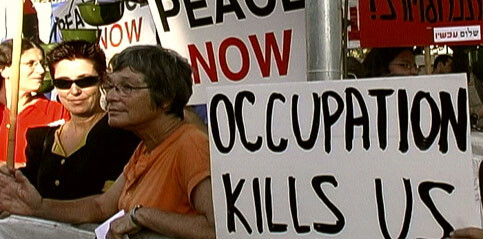
Israeli activists protest the occupation in Occupation 101.
“You begin to suspect that there is something extremely odd going on … it is deeply disturbing,” says Alison Weir, narrator of the new documentary Occupation 101, on what one experiences as soon as they read between the lines of news reports from Israel/Palestine. The film indeed succeeds in instilling this feeling in its viewers.
Newly released on DVD, Occupation 101 does not rely on dull narration or names and dates that are not relatable to the average American viewer. Best suited to educate university students, clergies, community groups, and others who do not necessarily have a firm grasp of the history and context of the conflict, this slickly produced film does take the viewer through 100 years of history. The chronology of the conflict is explained through snappily edited interviews with activists, journalists, clergy people, and others, while richly illustrated by archive footage and photographs.
The film opens with imagery from other countries that have experienced foreign military occupation — Ireland, Algeria, South Africa, and India — as well as the Civil Rights movement in the U.S. A split-screen sequence of footage paralleling Israel/Palestine and South Africa reinforces the idea that any population would resist such oppression, rebutting the myth that the conflict is an intractable and historic one between Jews and Muslims or Arabs. On both sides of the screen, the occupied population attempt to travel through checkpoints, have their IDs inspected and are arrested.
Though these parallels of injustice are obvious to those who have an understanding of the Palestinian narrative, the persistent misconceptions regarding the conflict “come from the fact that we’re only hearing one side of the story.” Occupation 101 attempts, in the course of an hour and a half, to provide that historically neglected other side of the story.
The filmmakers deftly delve back into history, explaining the origins of political Zionism in the wake of Nazi persecution of European Jews, Britain’s reneging on its promise of independence to the Arabs — particularly through the Balfour declaration that pledged a Jewish homeland in Palestine — and the proposed partition of historic Palestine at the United Nations before the state of Israel declared its independence
A Palestinian woman recounts in Occupation 101 the day while she was pregnant that Israeli military bulldozers arrived to demolish her family’s home.Israeli historian Ilan Pappe describes the period around the declaration of Israel’s independence as one during which the indigenous Palestinian population was ethnically cleansed from the land when they were forced from their homes or fled in terror after hearing news of rapes and massacres at other Palestinian villages. Today, the situation is not much better for the Palestinians who live under Israeli rule. “The bottom line is to make things so difficult for the Palestinians [so that] anyone who wants a normal life [will] leave,” Israeli activist Jeff Halper says of Israel’s current policies vis-a-vis the Palestinians. Those 750,000 Palestinians and their descendants whom Israel made into refugees now number over 4 million people who languish in refugee camps, where, as one refugee boy explains, the walls crack when they are struck by Israeli missiles.
So how does Israel get away with all of this? The film explains that not only does the international community do nothing to hold accountable Israel, the US provides more aid to the state than all of sub-Saharan Africa and South America combined. “Everything Israel does in the occupied territories, US tax payers are paying for it,” Noam Chomsky states.
And with the media spin that Israel is a lone David in a sea of Arab Goliaths, the image of Palestine that prevails among the general American public is that of suicide bombers. However, through the handful of Palestinian voices we hear in the film, it is explained that the reality on the ground is a very different one. “That war zone is people’s neighborhoods,” the father of slain peace activist Rachel Corrie says of the Gaza Strip.
While at times too over-produced — the techno music that accompanies violent scenes of the second intifada a bit over the top, when such heavy imagery can really speak for itself — Occupation 101 sets itself apart from dry documentaries and would certainly hold the attention of university students and other newcomers to the conflict. It is easily a film one would recommend to those seeking to make sense of the increasingly bloody headlines that come out of this complicated part of the world.
Maureen Clare Murphy is Managing Editor of The Electronic Intifada.
Related Links
===
No comments:
Post a Comment
Note: Only a member of this blog may post a comment.