Can Ishiba and South Korea’s Lee keep the hatchet buried?
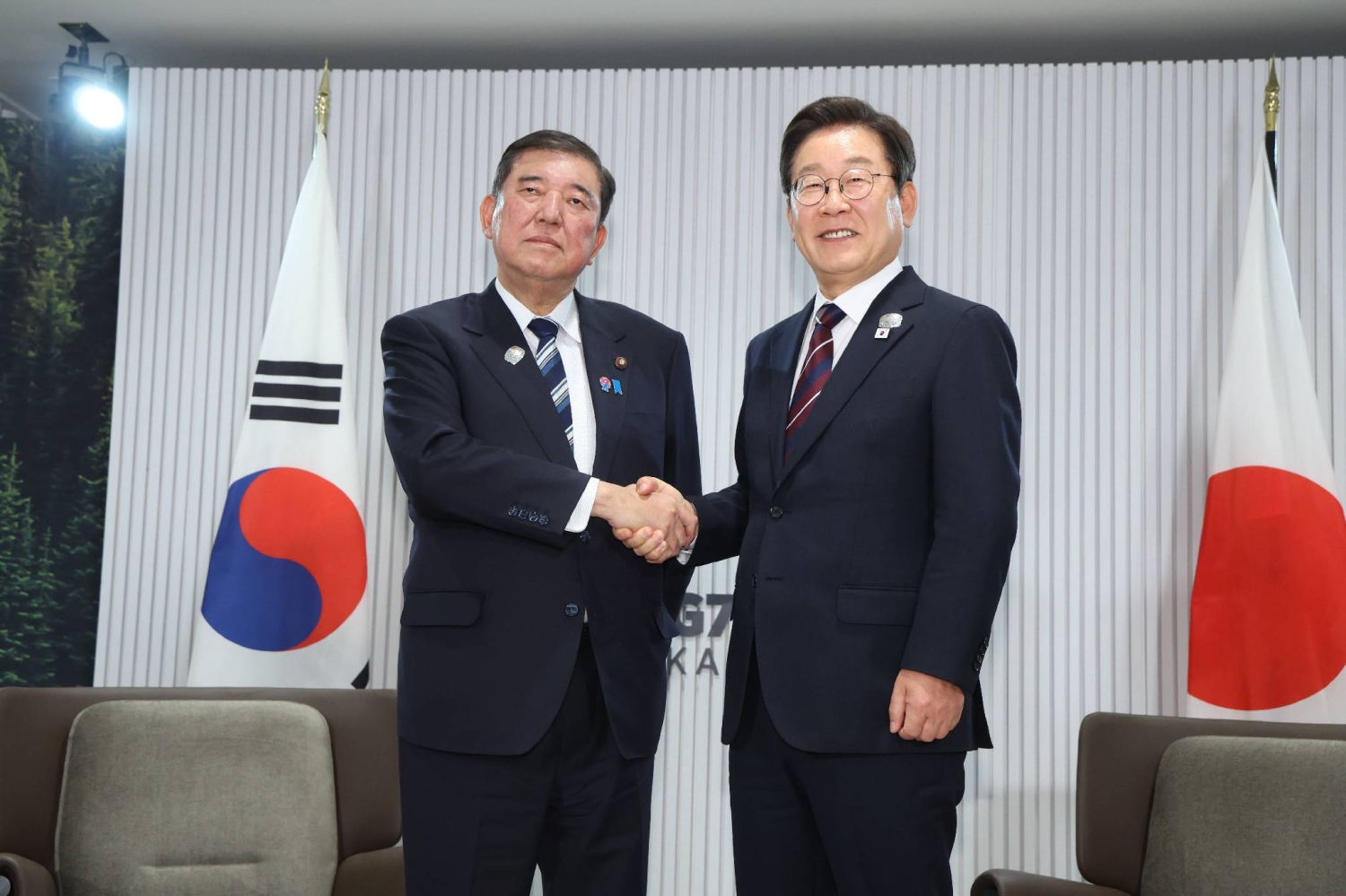
Prime Minister Shigeru Ishiba shakes hands with South Korean President Lee Jae Myung on the sidelines of the Group of Seven leaders' summit in Kananaskis in Alberta, Canada, on June 17. | JIJI
By Jesse Johnson
Aug 21, 2025
==
When South Korean President Lee Jae Myung arrives in Japan for talks with Prime Minister Shigeru Ishiba on Saturday, he will be making history — and not the contentious kind that has at times put relations in a tailspin.
Lee will be the first South Korean president to visit Japan — his country’s former colonial master — before traveling to the United States, the two Asian nations’ mutual ally. South Korean leaders have traditionally made the U.S. their first overseas destination.
He will head immediately to Washington for a Monday summit with U.S. President Donald Trump following his two-day trip to Japan.
The unprecedented visit to Tokyo, which is expected to be rich in symbolism, comes on the 80th anniversary of imperial Japan’s brutal 1910-45 rule of the Korean Peninsula and the 60th anniversary of the neighbor’s establishment of diplomatic ties.
But more than marking key anniversaries, the visit will highlight how Lee has seemingly put his history of anti-Japan views in the rearview mirror, with Seoul and Tokyo looking to continue to bury the hatchet — at least for the time being — as they face a number of common challenges.
Both countries are grappling with how best to respond to Trump’s tariffs on key sectors of their economies, as well as the U.S. president’s demands that they shoulder more of the burden for their defense. Meanwhile, North Korea’s growing nuclear and missile arsenal, as well as its growing military cooperation with Russia in its war in Ukraine, continue to unnerve Tokyo and Seoul.
The June election of Lee — who had been known for his hard-line views on Japan — had raised concerns in Tokyo that he might reverse agreements to resolve contentious historical issues reached under his ousted predecessor, Yoon Suk Yeol, that led to a thaw in ties, while also halting trilateral military cooperation with the United States.
Those fears have largely subsided following Ishiba’s first meeting with Lee at a Group of Seven summit in Canada, where the two agreed to continue what is known as “shuttle diplomacy,” or mutual visits by the two countries' leaders.
Lee signaled in an interview with Japan’s Yomiuri Shimbun published Thursday that his administration would continue along this path.
“I believe Japan is very important to South Korea. I also believe South Korea can be beneficial to Japan. The most significant issue is certainly the historical issues, but we cannot dwell on them,” he said in his first media interview, including with the South Korean press.
“The uncomfortable aspects of our relationship will not disappear, even if we try to ignore them,” Lee said. “So we must acknowledge reality as much as possible, make an effort to understand each other, compromise where necessary and resolve issues without resorting to confrontation.”
Historical grievances, including the issues of Korean wartime laborers at Japanese factories and mines, as well as “comfort women” who suffered under Japan’s military brothel system before and during World War II, have long stymied attempts to improve relations.
South Korea announced a plan in March 2023 to resolve the wartime labor issue via a third-party payment system, a move that helped open a new chapter in relations.
Lee on Thursday reiterated his commitment to maintaining this deal, saying that despite its shortcomings “it is a commitment made by the state, so it is not desirable to overturn it.”
In what would be seen as a major breakthrough in further cementing improved ties, Lee also praised a key joint declaration issued by the two countries nearly 30 years ago, calling it “a turning point” in the relationship and expressing his desire to draft a new joint statement during his term in office.
“I hope that we can build on the declaration and issue a new joint declaration that goes beyond it,” he said.

Lee speaks during a ceremony to celebrate the 80th anniversary of Korea's liberation from Japanese colonial rule, in Seoul, on Aug. 15. | POOL / VIA REUTERS
Signed in Tokyo in 1998 by then-Prime Minister Keizo Obuchi and then-South Korean President Kim Dae-jung, the Japanese leader expressed “deep remorse and heartfelt apology” for Japan's colonial rule in the document, while his South Korean counterpart called on the neighbors “to overcome their unfortunate history and to build a future-oriented relationship.”
For his part, Lee had campaigned on a platform of maintaining continuity in key relationships, especially with the United States and Japan, said Jenny Town, director of the Korea program at the Stimson Center in Washington, adding that ties are “largely expected to stay stable for the near future.”
“Lee is likely to be more sensitive to any kind of insensitivities from the Japanese side, than what Yoon was, which could lead toward disruptions in the future,” she said. “But for now, both sides seem to understand the value of maintaining stable ties.”
Ishiba is seen as similarly pragmatic about improving Japan-South Korea relations as his predecessor, Fumio Kishida.
“While not as warm as under Kishida-Yoon, this pragmatism is helping to keep bilateral relations on an even keel despite intensifying external pressures,” said Robert Ward, a Japan expert at the International Institute for Strategic Studies.
But speed bumps on the road to building more durable ties may come sooner than anticipated.
Following the ruling Liberal Democratic Party’s disastrous performance in a recent Upper House poll, Ishiba has been under pressure to step down — especially from the party’s right-leaning lawmakers.
These lawmakers, together with a handful of vociferous and strident right-wing opposition parties that stunned observers by winning an unexpected number of seats, have repeatedly assailed the prime minister for his relatively conciliatory approach to Japan’s neighbors and their historical baggage.
“President Lee will... be viewing the political uncertainty in Japan at the moment with some concern, particularly the drift to the right in Japan suggested by the results of the July Upper House election,” said Ward.
Lee and Ishiba will also find themselves at loggerheads on the issue of North Korea.
The South Korean leader is considerably more dovish on relations with Pyongyang than Yoon, and has pledged to pursue dialogue with the recalcitrant North.
Tokyo, meanwhile, remains laser-focused on finally resolving the issue of Japanese citizens abducted by North Korea in the 1970s and '80s, as well as reining in the country’s increasingly advanced nuclear weapons and missile programs under a crumbling U.N. sanctions regime.
Still, Lee could get Ishiba’s implicit support for dialogue, especially if the South Korean leader’s push for a return to denuclearization talks is backed by Trump — who, in his campaign for a Nobel Peace Prize, is widely expected to be interested in restarting diplomacy with North Korean leader Kim Jong Un.
Lee, in Thursday’s interview, unveiled for the first time a three-stage plan for the North to relinquish its nuclear weapons that includes the freezing of its nuclear and missile programs in the first stage and their reduction and dismantlement in the second and final stages.
Saturday’s meeting also highlights how the Trump administration’s trade and defense demands are drawing Japan and South Korea even closer.
Their summit comes just weeks after both countries secured separate trade agreements with the U.S. that shielded their economies from Trump’s highest tariffs — reciprocal duties remain at 15%, down from an initial threat of 25% — and also saw them pledge hundreds of billions of dollars in U.S. investments.
It will also be held under the shadow of Trump’s transactional approach to Washington’s military alliances with Tokyo and Seoul, a stance that has seen his administration demand the two allies ramp up defense spending to 5% of gross domestic product.
Indeed, the meeting is expected to go beyond just highlighting strength in bilateral ties — giving the two leaders time to discuss the elephant in the room.
“It may also provide a sense of solidarity in dealing with the U.S. these days,” said Stimson’s Town, “giving them an opportunity to share notes and strategies for a successful meeting ahead of Lee's first encounter with Trump.”
KEYWORDSSouth Korea-Japan relations, Shigeru Ishiba, Lee Jae Myung, SOUTH KOREA
No comments:
Post a Comment
Note: Only a member of this blog may post a comment.