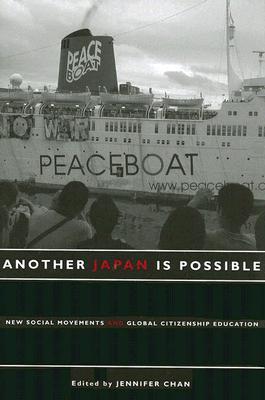
Another Japan Is Possible: New Social Movements and Global Citizenship Education
by Jennifer Chan (Editor)
3.60 · Rating details · 5 ratings · 0 reviews
This book looks at the emergence of internationally linked Japanese nongovernmental advocacy networks that have grown rapidly since the 1990s in the context of three conjunctural forces: neoliberalism, militarism, and nationalism.
It connects three disparate literatures—on the global justice movement, on Japanese civil society, and on global citizenship education.
Through the narratives of fifty activists in eight overlapping issue areas—global governance, labor, food sovereignty, peace, HIV/AIDS, gender, minority and human rights, and youth—
Another Japan is Possible examines
the genesis of these new social movements;
their critiques of neoliberalism, militarism, and nationalism;
their local, regional, and global connections;
their relationships with the Japanese government;
and their role in constructing a new identity of the Japanese as global citizens.
Its purpose is to highlight the interactions between the global and the local—that is, how international human rights and global governance issues resonate within Japan and how, in turn, local alternatives are articulated by Japanese advocacy groups—and to analyze citizenship from a postnational and postmodern perspective.
Paperback, 432 pages
Published 2008 by Stanford University Press
===
Title
Another Japan is possible : new social movements and global citizenship education
Contributor(s) Chan, Jennifer.
Contents
Introduction: global governance and Japanese nongovernmental advocacy networks --
Pt. I. Global governance.
1. Global governance monitoring and Japan / Kawakami Toyoyuki --
2. Education, empowerment, and alternatives to neoliberalism / Sakuma Tomoko --
3. Building a people-based peace and democracy movement in Asia / Ogura Toshimaru --
4. Tobin tax, Kyoto Social Forum, and pluralism / Komori Masataka --
5. Education for civil society capacity building / Yoko Fukawa --
6. Community development, peace, and global citizenship / Kiyotaka Takahashi --
Pt. II. Labor.
7. Globalization and labor restructuring / Ken'ichi Kumagai --
8. Corporate restructuring and homelessness / Kasai Kazuaki --
9. Gender, part-time labor, and indirect discrimination / Kazuko Sakai --
10. Migration, trafficking, and free trade agreements / Virgie Ishihara --
11. Neoliberalism and labor organizing / Yukihiro Yasuda --
12. Water, global commons, and peace / Mizukoshi Takashi --
Pt. III. Food sovereignty.
13. Agricultural liberalization, World Trace Organization, and peace / Ohno Kazuoki --
14. Multifunctionality of agriculture over free trade / Yamaura Yasuaki --
15. Citizens' movement against genetically modified foods / Keisuke Amagasa --
16. Self-sufficiency, safety, and food liberalization / Kazuhiko Imamura --
Pt. IV. Peace.
17. "We want blue sky in peaceful Okinawa" / Hirayama Motoh --
18. World Peace Now / Machiko Hanawa --
19. Article 9 and the peace movement / Ken Takada --
20. Fundamental law of education, peace, and the marketization of education / Nobuaki Nishihara --
21. Japan and international war crimes / Higashizawa Yasushi --
22. Landmine ban and peace education / Yasuhiro Kitagawa --
23. Nuclear disarmament, advocacy, and peace education / Keiko Nakamura --
24. Building a citizens' peace movement in Japan and Asia / Otsuka Teruyo --
Pt. V. Hiv/Aids.
25. HIV/AIDS from a human rights perspective / Tarui Masayoshi --
26. HIV/AIDS, gender, and backlash / Hyodo Chika --
27. Migrant workers and HIV/AIDS in Japan / Inaba Masaki --
Pt. VI. Gender.
28. International lobbying and Japanese women's networks / Miho Watanabe -- 29. Gender, human rights, and trafficking in persons / Yuriko Hara --
30. Gender, reproductive rights, and technology / Yukako Ohashi --
31. As a lesbian feminist in Japan / Naeko Wakabayashi --
32. Sex workers' movement in Japan / Yukiko Kaname --
33. Women's Active Museum on War and Peace / Mina Watanabe --
34. Art, feminism, and activism / Yoshiko Shimada --
Pt. VII. Minority and human rights.
35. Proposal for a law on the elimination of racial discrimination / Fujimoto Mie -- 36. Antidiscrimination, grassroots empowerment, and horizontal networking / Hideki Morihara --
37. Multiple identities and buraku liberation / Maya Mori --
38. Indigenous peoples' rights and multicultural coexistence / Hideaki Uemura --
39. On the recognition of the indigenous peoples' rights of the Ainu / Mina Sakai --
40. "I would like to be able to speak Uchinaguchi when I grow up!" / Satoko Taira --
41. Art activism and Korean minority rights / Hwangbo Kangja --
42. Ethnic diversity, foreigners' rights, and discrimination in family registration / Tony Laszlo --
43. Disability and gender / Ryoko Hirukawa --
44. The UN Convention on Refugee and Asylum Protection in Japan / Eri Ishikawa --
45. Torture, penal reform, and prisoners' rights / Emi Akiyama --
46. Death penalty and human rights / Akiko Takada --
Pt. VIII. Youth groups.
47. Experience, action, and the floating peace village / Tatsuya Yoshioka --
48. Ecology, youth action, and international advocacy / Yuko Mitsumoto --
49. Organic food, education, and peace / Kiyoshi Shikita --
50. "Another work is possible" : slow life, ecology, and peace / Kenkichi Takahasi -
- Conclusion: social movements and global citizenship education.
Publisher
Stanford, Calif. : Stanford University Press
Format
xxiii, 406 p. : ill. ; 23 cm.
Language
English
===
Review
A surprise for observers who view Japan as a developmental state, run by a powerful central bureaucracy and aligned with a conservative party whose policies often override public interest,
Another Japan is Possible casts new light on a neglected but vital aspect of Japan's emerging political economy.
A remarkable group of scholars, professionals and citizen activists reveal the growing numbers of committed Japanese participating energetically in local and global organizations devoted to a broad range of issues, from the environment and sustainable development to health care, migrant workers, disability, gender, and minority rights. --Daniel I. Okimoto, Professor, Department of Political Science, and Director Emeritus, Walter H. Shorenstein Asia Pacific Research Center, Stanford University
As a civil society scholar, I can say that this book is a desired piece of work...This book makes an important contribution to connecting Japanese accounts to both Japanese and global discourses on civil society.--Akihiro Ogawa "Stockholm University"
Chan's study is a rare and comprehensive compilation of Japanese voices articulating their demand for an alternative model of citizenship...Chan's book can be highly recommended to all interested in 'the other Japan.'--Internationales Asienforum
The days are gone forever when the prevailing cliche in Japan suggested that there were only two types of social entities: governmental institutions and non-governmental individuals (the so-called middle mass). However, of late the former has been fragmenting themselves while the latter has been flourishing and fraternalizing themselves with transnational and international counterparts. Jennifer Chan has vividly illustrated this incredible turnaround with good contextualizing narratives and rich and informative constructions of the thinking and sentiments those non-governmental organizations generate in a vast array of areas. A must read in the study of globalization and localization.
--Inoguchi Takashi, Professor Emeritus "University of Tokyo, and Professor of Political Science, Chuo University, Tokyo"
This book is rich in primary material on the human side of NGO activity in Japan, along a wide spectrum of organizations. In that alone it is a valuable text. This is a nuanced view of advocacy, strategies and institutions, sometimes against the grain of existing views, and it adds the perspectives of new global citizens of Japan, engaged in knowledge production. The book will be very useful indeed in social and political science courses, and in courses on globalization, social change and identity.
--Merry White, Professor, Department of Anthropology, Boston University
To conclude, the use of the book is twofold. Firstly, it can serve as an eye-opener to readers who are stuck in the image of Japan as a country where discontent seldom takes the form of overt protest or citizen engagement. Secondly, it presents a lot of raw material and information which... can be useful to readers interested in Japanese civil society or the groups presented in the book. --Japanese Studies
About the Author
Jennifer Chan is Associate Professor of Education at the University of British Columbia. She is the author of Gender and Human Rights Politics in Japan (Stanford, 2004)
===
Another Japan is possible : new social movements and global citizenship education
Chan, Jennifer.; c2008
Barr Smith Library
Available , Main collection 303.4840952 C4542a
(1 copy, 1 available, 0 requests)

No comments:
Post a Comment