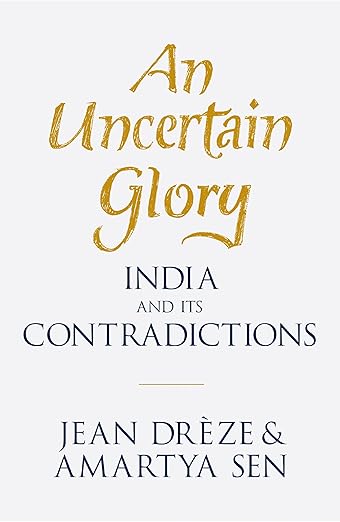
Roll over image to zoom in
Read sample
Follow the authors

Amartya SenAmartya Sen
Follow
Uncertain Glory: India and its Contradictions, An Hardcover – 21 August 2013
by Dreze Jean & Sen Amartya (Author)
4.5 out of 5 stars 456
When India became independent in 1947 after two centuries of colonial rule, it immediately adopted a firmly democratic political system, with multiple parties, freedom of speech and extensive political rights. The famines of the British era disappeared, and steady economic growth replaced the economic stagnation of the Raj. The growth of the Indian economy quickened further over the last three decades and became the second fastest among large economies. Despite a recent dip, it is still one of the highest in the world.
Maintaining rapid as well as environmentally sustainable growth remains an important and achieveable goal for India. In An Uncertain Glory, two of India's leading economists argue that the country's main problems lie in the lack of attention paid to the essential needs of the people, especially of the poor, and often of women. There have been major failures both to foster participatory growth and to make good use of the public resources generated by economic growth to enhance people's living conditions. There is also a continued inadequacy of social services such as schooling and medical care as well as of physical services such as safe water, electricity, drainage, transport and sanitation. In the long run, even the feasibility of high economic growth is threatened by the underdevelopment of social and physical infrastructure and the neglect of human capabilities, in contrast with the Asian approach of simultaneous pursuit of economic growth and human development, as pioneered by Japan, South Korea and China.
In a democratic system, which India has great reason to value, addressing these failures requires not only significant policy rethinking by the government, but also a clearer public understanding of the abysmal extent of social and economic deprivations in the country. Yet the deep inequalities in Indian society tend to constrict public discussion to the lives and concerns of the relatively affluent. This book presents a powerful analysis not only of India's deprivations and inequalities, but also of the restraints on addressing them - and of the possibility of change through democratic practice.
Read less
Report an issue with this product
Print length
448 pages
Product description
From the Inside Flap
When India became independent in 1947 after two centuries of colonial rule, it immediately adopted a firmly democratic political system, with multiple parties, freedom of speech and extensive political rights. The famines of the British era disappeared, and steady economic growth replaced the economic stagnation of the Raj. The growth of the Indian economy quickened further over the last three decades and became the second fastest among large economies. Despite a recent dip, it is still one of the highest in the world.
Maintaining rapid as well as environmentally sustainable growth remains an important and achieveable goal for India. In An Uncertain Glory, two of India's leading economists argue that the country's main problems lie in the lack of attention paid to the essential needs of the people, especially of the poor, and often of women. There have been major failures both to foster participatory growth and to make good use of the public resources generated by economic growth to enhance people's living conditions. There is also a continued inadequacy of social services such as schooling and medical care as well as of physical services such as safe water, electricity, drainage, transport and sanitation. In the long run, even the feasibility of high economic growth is threatened by the underdevelopment of social and physical infrastructure and the neglect of human capabilities, in contrast with the Asian approach of simultaneous pursuit of economic growth and human development, as pioneered by Japan, South Korea and China.
In a democratic system, which India has great reason to value, addressing these failures requires not only significant policy rethinking by the government, but also a clearer public understanding of the abysmal extent of social and economic deprivations in the country. Yet the deep inequalities in Indian society tend to constrict public discussion to the lives and concerns of the relatively affluent. This book presents a powerful analysis not only of India's deprivations and inequalities, but also of the restraints on addressing them - and of the possibility of change through democratic practice.
From the Back Cover
'In dealing with India's multitude of problems, there may well be a temptation - but not a serious reason - for India to give up or reduce its long commitment to democracy, for which so many people have fought and out of which so much good has already come to the country. It is deeply disappointing that more use has not been made of the opportunities offered by a political democracy and a free society to solve the problems that so many Indians continue to face. The success of a democracy depends ultimately on the vigour of its practice, and with that in mind, the book presents material for informed and reasoned public engagement. The important task is not so much to find a 'new India', but to contribute to making one.'
[adapted from Chapter I, 'A New India?']
About the Author
Amartya Sen is one of the world's leading public intellectuals. He is Professor of Economics and Professor of Philosophy at Harvard. He was Master of Trinity College, Cambridge, from 1998 to 2004, and won the Nobel Prize for Economics in 1998. His many celebrated books include Development as Freedom (1999), The Argumentative Indian (2005) and The Idea of Justice (2010). They have been translated into more than 30 languages.
Read less
Product details
Publisher : Allen Lane; 1st edition (21 August 2013)
Language : English
Hardcover : 448 pages
ISBN-10 : 1846147611
ISBN-13 : 978-1846147616
Dimensions : 16.2 x 3.9 x 24 cmCustomer Reviews:
4.5 out of 5 stars 456
About the authors
Follow authors to get new release updates, plus improved recommendations.
Follow
Amartya Sen
Amartya Sen is Professor of Economics and Professor of Philosophy at Harvard. He was Master of Trinity College, Cambridge, from 1998 to 2004, and won the Nobel Prize for Economics in 1998. His many celebrated books including Development as Freedom (1999), The Argumentative Indian (2005), Identity and Violence: The Illusion of Destiny (2007), and The Idea of Justice (2010), have been translated into more than 40 languages. In 2012 he received the National Humanities Medal from President Obama and in 2020 he was awarded the Peace Prize of the German Book Trade by President Steinmeier.
See more on the author's page

Follow
Jean Drèze
Customer reviews
4.5 out of 5 stars
Top reviews from Australia
There are 0 reviews and 0 ratings from Australia
Top reviews from other countries

Paradesi K.Yarikipati
5.0 out of 5 stars An essential read for every IndianReviewed in India on 10 November 2023
Verified Purchase
New Introduction to this Revised Edition provides a sensible and essential assessment of the state of the nation . Updated Statistical Appendix provides latest data on important parameters. A must read book for every Indian..

One person found this helpfulReport

Sandrine
5.0 out of 5 stars amazing readReviewed in Japan on 16 June 2019
Verified Purchase
hands down the best book I read this year! so thorough, profound analysis, balanced opinion and centered on social development.
Report

gilebout
5.0 out of 5 stars Satisfait !Reviewed in Canada on 13 June 2016
Verified Purchase
Excellent achat auprès de ce vendeur
Report
Romi Mahajan
5.0 out of 5 stars Where's the "Shining India?"Reviewed in the United States on 25 September 2013
Verified Purchase
Sen and Dreze's "An Uncertain Glory" is a salutary and timely corrective to the "India Shining" meme propagated by the business press and other interested (and powerful) parties. An absolute treasure trove of real information on nutrition, education, health, gender equality and other indices of human development, this book is not "just another" analysis of the Indian polity and the existential difficulties of the majority of Indians. The detailed analyses, replete with easy-to-follow statistics make for a grim story of India's lag in taking care of its own citizens. Written with a clear sense of moral urgency, An Uncertain Glory asks us very provocative questions and relegates any hubris to the dustbin. Why is it that India's human development indicators rank below those of even far poorer countries like Bangladesh and on many indices, Nepal and much of sub-Saharan Africa. Further, do these facts conform to the typical middle-class Indian's assessment of his/her own country?
You can't read this book and not change. You can't read this book and not work towards remedying the pitiful situation in which our fellow human beings live and toil.
2 people found this helpfulReport

MR ABOUDI MOHAMED
5.0 out of 5 stars A very good book.Reviewed in France on 6 December 2014
Verified Purchase
I'm happy to register a comment about this pretty book. I recommend to everybody. This is an excellent view of India. This country deserves to be better studied.
Good delivery and just in time.
Report
See more reviews



 스포일러 포함


