
amazon.co.jp
Amazon.co.jp: 続・日本軍兵士―帝国陸海
軍の現実 (中公新書 ...
- 주요 주제:
From Japan
- Reviewed in Japan on September 25, 2026戦場を経験していない世代は読んでおくべき本。今のウクライナの現実を見て今後の日本穂防衛問題を考えるうえで戦争の実態は知っておくべき
- Reviewed in Japan on February 23, 20257年前に出た『日本軍兵士ーアジア・太平洋戦争の現実』の続編の『続・日本軍兵士ー帝国陸海軍の現実』である。
新書本で『続』という題になっているのは珍しいという印象を受けた。手元にある『岩波新書解説総目録1938ー2019』の索引によると、2019年までの岩波新書3400点(?)のうち、『続』から始まる題の本は、16点にすぎない。体験記、エッセイを除くとさらに少ない。中公新書でも同様と思う。そういう、題名的にも貴重な、『続』新書の刊行である。
一、私的感想
〇『正』新書と『続』新書との関連が興味深い。個人的感想(誤解ご容赦)としては、正篇も続編も、『戦死学(日本軍兵士戦死学)』ともいうべき学問の成果であって、正篇はアジア・太平洋戦争の絶望的抗戦期を中心に、凄惨な戦場と多数の日本軍兵士の無惨な死の現実を歴史学的手法で描いた新書であり、続編はそういう無惨な大量死を生み出した歴史的背景としての、明治以降の帝国陸海軍の問題点を探っていく本と思う。
◯正篇の「第3章 無惨な死、その歴史的背景」は無惨な大量死の根本的背景として、①国力を超えた戦線の拡大と、②戦争終結という国家意志の決定が遅れたことをあげ、前線の兵士に大きな負担をかけるような帝国陸軍の構造的要因として、ア、「短期決戦」「速戦即決」を重視する作戦思想、イ、作戦至上主義によって、補給、情報、衛生、防禦、海上防禦などが軽視されたこと、ウ、極端な精神主義により、日本軍の精神的優越性がことさら強調され、火力の充実、軍の機械化や軍事技術の革新に大きな関心が払われず、兵士に白兵主義を要求し、ついには体当たり戦法が採用されたことをあげていた。
◯続編では、イのうちの、補給(給養、兵站)と衛生の軽視が、兵士の戦時栄養失調症を多発させ、病気を悪化させ、多数の死を招いたとして、明治以後の帝国陸海軍の給養、衛生の方針・実態について検討していく。
また、続編では、兵士の日常生活や衣食住への配慮がきわめて乏しく、給養の豊かなアメリカ軍と異なり、戦争末期には最低限の生活も保障できなくなったことが、大量死の素因として展開されている。
◯ウ、極端な精神主義重視に関連することとして、機械化の遅れとしての歩兵徒歩行軍依存が続き、行軍歩兵の負担量、負担率が過大なものになって兵士を衰弱させたことも続編で詳述されている。
◯日中戦争の拡大によって、身体障害者、知的障害者、中年男性にまで召集が拡大され、軍隊内に「老兵」「弱兵」が増えてきたことは、正篇にも書かれていたが、続編に詳述されている。障害者教育の関係者が早くから視覚・聴覚・発話障害者の採用を軍に働くかけていたいう興味深いエピソードも出てくるが、召集された弱兵たちがどういう運命をたどったかの統計的なデータは出てこない。
◯正篇では、日本資本主義の後進性のゆえに、工場熟練労働者や農業労働力を現場に残していく必要があり、総人口中の動員兵力は列強に比して低かったこと、この状況を突破する一方法として女性の兵士召集があり、アメリカ、イギリスでは女性の補助部隊が作られ、ソ連では戦闘部隊に女性が配備されたが、日本では軍需工場への未婚女性の動員と女子通信隊の編成に終わった。軍の側からの積極的働きかけがあれば、女性の側はそれに応じる可能性はあった、という興味深い記述が展開されている。続編では、女性動員については、何の記述もない。
◯続編の重要問題は、最後に出てくる、「帝国陸海軍において、将校と下士官・兵士の間に、「犠牲の不平等」(つまり、「戦死の不平等」「生存のチャンスの不平等」)があったのではないか」というテーマの探究である。徴兵検査の時の担当医官の温情で徴兵を免れること、大学を卒業し、陸軍経理部幹部候補生試験に通り、前線後方の経理部将校となること、会社の重役等有力者を介して、または贈賄により召集を免れること、そして、補給を絶たれた島でも、将校は増食されていたことなどなど・・今後の研究課題とのこと。
ニ、私的結論
◯正篇ほどの衝撃度はないが、無惨な大量死を生み出した帝国陸海軍の問題点を探る良書と思う。
◯勘違い、不勉強、誤記等ご容赦。 - Reviewed in Japan on November 10, 2025前作に続き作戦面ではなく現場の兵士の現実と、戦死より戦病死が多い場合もあるということに驚かされます。
戦争を見直す新たな視点です。 - Reviewed in Japan on May 8, 2026ニューギニアで現地人を食べたり
同僚まで食べるほど追い詰められていた日本軍
戦争で戦う以前に亡くなっていた兵士が多いと言うのは
日本は戦争ができない国だという事だと思います。
先の戦争の敗北は、最初から確定されていて
資源がなく食料の自給率が低い国が
経済制裁された時点で既に終わっている。
徴兵制にしても少子高齢化で
自衛隊を国軍にしても
兵士が足りません。
今のイラン戦争を見ても
最新兵器だけでは勝てないのが証明されています。
そもそも過去の日本のこの酷いざまを見て
今だ戦争に夢を見る軍国主義者、日本右翼は
もっと真摯に謙虚に日本と言う国と国民性を
客観的に見られる方がいいのではないでしょうか?
仮想敵国を作り、国民を煽動していますが
今の日本にはどの国とも戦争をしても
悲劇でしかない現実があります。
過去のこの教訓から学ぶどころか
賛美するような首相では
日本は再び同じ道を選び
今度は再起できないほど壊滅するでしょうね。 - Reviewed in Japan on October 23, 2025読んでいると、腹が立つと同時に悲しくなる。日本の兵隊さんの本当の敵はアメリカや中国、イギリスて無かった。戦前の人間軽視はかなり酷くかったのですね。
- Reviewed in Japan on June 26, 2025戦死よりも多い病死、餓死。さらには階級による過酷さの違い。前作に引き継いで書かれた戦闘の現実。是非多くの人に読んでほしい一冊です。
- Reviewed in Japan on May 25, 2025昭和の戦争に従軍した人たちが病気や飢餓でいかに苦しんだかに関しては多くの元兵士が体験談を残していますが、本書はその実態と歴史的背景を俯瞰的にまとめた著作としてよくできていると思います。明治から続いてきた進歩と改善の流れが日中戦争の長期化によって破綻したという本著の主旨は、平和で物質的にはるかに豊かになった現代社会も無縁とはいいきれない教訓として響くところがあります。
国際情勢の見通しを誤りながら国力以上のことをしようとしたのが昭和の日本の根本的な敗因ですが(山本五十六の戦略も大局に合わない夢想だったといわざるを得ません)、「日本独特の栄養型」や「皇国特有のもの」といった言葉で伝統食への回帰を是認する一方で兵士の持久力を過大視した軍医総監についての記述を読むと、国民国家のアイデンティティを求める気分も悲劇を大きくする要因だったことがわかります。前線の島々でも飯盒炊さんに依存する日本兵と、重油とガソリンを大量に消費しながら侵攻する米軍の攻防は、稲作文化が石油文明には勝てないことを多大な犠牲を払って証明した戦いだったといえるかもしれません。
私見になりますが、アイデンティティあるいはセルフイメージを守ろうとする心のはたらきが平時の人間性を維持し、戦時では兵士を強くするというのは万国共通ですが、それを合理的に扱う知性が昭和の日本には乏しかったと感じます。「日本人なら贅沢はできないはずだ」といった銃後向けのスローガンと同じ発想で戦争を継続できるなどと思えば輸送の途絶しやすい外地の兵士は病気や飢餓で苦しまざるを得ないわけですが、上と下で考え方があまり変わらない社会の構造も、実はその原因になっていたのではないかと思えます。与えられた条件で頑張るのが下の務めであるならば、頑張れば報われる条件を準備するのが上の義務、という立場と責務の違いを十分に自覚できず、上も努力や精神の力を過信して下にモラルや自己犠牲を漫然と求めてしまう傾向は、おそらく今でも多くの組織に根強く残っています。 - Reviewed in Japan on March 27, 2025評判どうりの内容で、なるほどと思いながら納得しました。
- Reviewed in Japan on March 24, 2025兵站の重要性の認識が戦局を左右することがわかっていながら兵士の命を粗末に扱い、結果相手国や自国の市民を切り捨てていった経緯がよくわかった。


- Reviewed in Japan on March 20, 2025私も兄貴がアドミラル諸島で戦死していますので、身につまされます
- Reviewed in Japan on July 6, 2025呆れる事ばかりの日本軍首脳。
読んでいて戦死した方々のことを思うと涙が流れた。
国民の事を考えぬ今の政府とあい通じる物を感じるのは私だけ? - Reviewed in Japan on July 10, 2025第二次大戦記は読むのが好きで今回は新聞の中の広告を見て買いたいとアマゾンで探し購入。時間の合間に読むのに丁度良いサイズでアマゾンで調べると色々シリーズが有り、又購入して楽しめる事にアマゾンの有り難さがわかりました❢😀✋‼️
- Reviewed in Japan on June 6, 2025戦後生まれが承知しておくべき内容だ
- Reviewed in Japan on May 11, 2025良い。教授の研究本で真実と思います。現在、70才・80才台の人の父親が日本兵と思います。
戦死より戦病死の方が多かった感じがします。
侵略戦でも、沖縄防衛戦でも無念だったと思います。特に、若い人はかわいそうです。 - Reviewed in Japan on May 20, 2025満州事変から太平洋戦争まで、「兵士の目」から見た戦争現場の惨状を明確に指摘した好著である。政府の無策、軍幹部の失策が「しわ寄せ」られ、兵士達に降りかかったことからも、「戦争責任」を「極東東京裁判」などから切り離して考える資料を与えてくれる。1930年頃から1945年までの一連の15年にわたる戦争の呼称を、著者が「アジア・太平洋戦争」という提案したことにも共感が持てる。
- Reviewed in Japan on April 16, 2025陸海両軍ともに兵の生活を顧みなかったことが崩壊の根底にあるとわかる。衣・食・住それに休を加えるべきだと思うが、それらを満足に整えずに、戦う以前に疲労し憔悴するような状態を強いておきながら精神論を振りかざす愚かさが恐ろしい。軍はその母体となる社会の縮図であって、日本軍の体質は日本社会の体質から生まれたものだろう。そして軍の中で醸された風潮は社会に還流していく。この本は日本軍のというだけでなく戦前日本のシステム全体への評価になっていると思う。
翻って、今の日本社会はそれよりも進歩しているだろうか。 働く者が衣食住休を十分に得られずに過労死や精神を病むことが頻発するような状態で成果だけは要求され、弱者は「自己責任」と切り捨てられる。この社会、旧軍と似ていないだろうか。似ているならば、行き着く先もまた然りではないのか? - Reviewed in Japan on February 8, 2025前著『日本軍兵士』は、2018年に読んでいて、その続編『続・日本軍兵士』であるが、眼点は、戦場での日本兵士の「戦死者より戦病死」の方がはるかに多い。それは何ゆえかを新たな資料を探しながら「7年かけての、空振りの多かった本は他にはない」と書くが如く、資料が残っていないのである。
それはこの本の主題である戦場の日本兵士(兵隊)の衣食住、気象や病気などへの備えが、余りにも軽視されている。したがって、その記録も非常に軽視され、折角情報を得て行くと、「行方不明か廃棄か」と言う扱いに現れている。
陸・海軍省、参謀本部、軍令部は「武力装備(正面装備)」は、開戦時にはアメリカに匹敵する軍事力を持ったが、兵站(人員や軍需品の輸送・補給)、情報、衛生、医療、給養(食糧や被覆など)」は、極めて色んな気象条件や環境への備えが劣悪で、「蟻の兵隊」には極めて過酷な長期過労で、しかも食事や医療体制も劣悪、そのために「多くに兵隊がやせ衰え、老化現象を来たし、それに加えマラリア、脚気などの病気で衰弱し、餓死して行く。制空権を握られているため、補給船も兵士と物資も海の藻屑と化し、太平洋に広がる島々にいる兵団に補給も届かず、放置された。
まさに、「日本軍の兵士」に如何なる状態に置かれ、戦場で戦い、さまよったかを伝えようとして、吉田裕一橋大名誉教授にしてようやく新書として出せるという、悪戦苦闘の書であるのだが、きれいには纏まっていない。短文を集めたような書になっている。
しかし、伝えようとしたこと・戦場における日本兵士の姿、本当に過酷なまでに上層部の配慮のなさ(正面装備・軍事力・戦術には力を入れるが、人間である兵隊を軽視する思考、感性のなさ)、兵士を単なる歩としての駒(蟻の兵隊)として扱い、戦死者より圧倒的な戦病死(病気、重傷、凍傷、衰弱、放置、餓死)の圧倒的多いという事実と原因、将校(士官)と下士官以下二等兵までの扱いの差、アメリカ軍兵士との待遇の差を活写した労作と言えようか。 - Reviewed in Japan on April 3, 2025いまだに日本軍は悪いことをしなかった。あるいは残虐さが誇張されているという意見を目にするが、この本はその日本軍兵士を内側からみた本といってよい。一番衝撃を受けたのは根こそぎ動員に伴い招集された人たちが健康面で兵役に耐えられなかった事だと思う。日本軍ほど戦病死、自死が多い軍隊はほかに例を見ないが、なぜそうなったか、特に自死を選択せざるを得なかった方々がどういう人たちか行間から浮かび上がってくる。それを理解できない人たちが無敵皇軍をいうのはあまりに亡くなった方に対して失礼である。
- Reviewed in Japan on March 25, 2025実際はまだ読んでいない、がこの前作を今読んでいる、本当に思う、旧軍と指導者たちの愚息さ、兵隊の命をなにも尊んでいない、赤紙一枚で徴収できるからか、米軍との落差はどこから来るのか、民主主義と全体主義の違い、前からこの手の本はあったのだが、年を取ると忘れてしまうので、たんびたんびに読まなくてはいけない、艦船が沈没して、救命ボートに手を掛けた兵の手を刀で切り落とすどうしようもない将校。
- Reviewed in Japan on February 17, 2025あらためて一般の無名の兵隊は消耗品、expendablesだったのだなあと本書を読んで痛感させられた。お国のため、いったい誰のための戦争だったのか。いまふたたびさきの戦争を美化しようとする動きが目につきはじめているとき誰が言っているのかよく注目してゆかねばならない。アメリカの要求のもと軍備の増強を正当化するため危機感をあおり、障害となる憲法9条の改定をもくろみ八紘一宇などという言葉を軽々しく口にし。それにしてもアラートとは誰が思いついたのだろう。
- Reviewed in Japan on April 6, 2025著者の前書「日本軍兵士」に続いて本書を読む機会を得た。戦死以上に病死が多かったという
歴史にはため息しか出ない。本書を読んだ感想は以下二点である。
一点目。本書は日本軍の装備や武器をアメリカのそれらと比較している場面が多い。本書で
描かれる限りでは、アメリカは兵士の装備、艦船の設備等は非常に優れており、比較に
ならないくらい日本を凌駕していた。戦う以前に圧倒的な差がついていた訳だ。
ここで気をつけなくてはいけないのは、上記状況はアメリカが人道的に優れていたというような
話しにならないようにすべきであるという点だと思う。確かにアメリカが日本に比べて兵士の待遇
に気を使ったのだと思うが、それは兵士を十全に「使う」ためであったと僕は思う。「兵士を
十全に使う」という考え方自体が「非人道的」だとすると、その点においてはアメリカも日本と
同類項であり、同罪である。
二点目。では、なぜアメリカの方が兵士の待遇に力を入れることが出来たのか。
勿論、第一義的には国力の差であることは本書が縦横に描き出している。限られた国力の
中で戦線を拡大した日本の当時の政治判断が結局何を齎したのかという点は今なお学ばなくて
はならない。但し、本書を読んでいるうちに、かような国力の差以前に、日本の固有の精神主義
の凄まじい弊害が噴き出ていたのだろうとも思わざるを得ない。
今の日本は気が付いたら観光立国である。非常に多くの海外の方が日本を訪問している。
彼らが喜ぶものは日本の自然と文化なのだと思うが、例えばその「文化」とは何なのかを
彼らの視点を通じて考えることは日本人としても重要だと思う。誤解を恐れずに言うならば
外国人からみて日本の文化にはかなり奇妙な点が多く、その「奇妙さ」が珍重されている
ということはないだろうか。かつ、そんな「奇妙さ」の頂点に「日本の固有の精神主義」
が今なお存在しているということは無いだろうか。そんな事を考えながら本書を読み終えた。
日本の美学というものがある。何が「日本の美学」なのかは、言語化しにくいが、確かに
そこに存在すると皮膚感覚で感じる。僕も日本人の一人として「日本の美学」には
共感するのだが、そもそも「美学」というものには副作用としての「毒性」があることも
肝に銘じなくてはならないと思う。戦争や戦死を美化することは案外容易であるような
気がしている。本書はかような「毒性」に対する優れた「解毒剤」である。僕はそう思った
次第だ。 - Reviewed in Japan on July 26, 2025アジア・太平洋戦争で亡くなった兵士は約230万人である。これだけの死者を出して大敗した背景を具体的な事例から説き起こした著書である。貧国でありながら強兵を目指したがために、様々な分野で歪が生まれていたことをていねいに記している。実態は、作戦遂行以前の問題で、日本軍兵士は消耗されていたのである。前著同様に今回の著作も、とても読み易かった。巻末の参考文献はとてもありがたい。膨大な文献にあたり、複数の裏付けをとりながら文章を作り上げているのがわかる。私たち一般人では調べようもない事実をわかりやすく伝えてくれている。
2025年は敗戦後80年にあたる年である。全国各地で戦争に関する企画展が開催されている。地元の郷土資料館などに足を運び、すこしでも当時の事実に触れてほしい。この夏には国立公文書館でも「終戦」と題する企画展が開催されている。「終戦の詔」の原本に触れることができる貴重な機会でもある。 - Reviewed in Japan on March 22, 2025前作程の鮮度はなかったが、戦争は、侵略だろうと防衛だろうと、理不尽を強いる点で同じと感じた。
明治以降、日本は対外戦争を繰り返し、たくさんの戦没者を出した。筆者は戦没者を、戦闘死者と戦病死者に分け、戦病死者の割合を追究する。日清戦争戦没者は1万3164名、うち戦病死者1万1763名、割合は89•3%。日露戦争ではこの割合が26•3%に激減し、第一次大戦では21•99%、満洲事変17•35%とさらに減少する。ところが日中戦争以降、この割合が上昇に転じる。どれほど増えたか、その正確な数字はない。というのは、戦史編纂が滞り、戦局逼迫でついに中止されたこと、加えて敗戦前後の公文書焼却が追い討ちとなってデータが欠けており出せないのだ。ただ、いくつか傍証となるデータを利用して、おそらく6割くらいかと推定している。頼りない話だが、ガダルカナルやインパール作戦の結果から見て、まぁ妥当と納得。
さてそうであるとして、何故右肩下がりだった戦病死率が上昇したのか?筆者は、一因を小泉親彦・陸軍省医務局長に求める。小泉は、欧米の物質機械万能主義に対し、日本の“人的要素”重視を強調する。要するに、日本人の持久力は抜群で、物資もトラックがないなら歩兵が運ぶのだ、というところにある。元々陸軍省は歩兵の力に依存し、負担量負担率は体重の4割を適当としていた。60キロの体重の者なら24キロを担いでもノープロブレム、小泉はそれを正当化し教条化した。しかし本当にそんな負担率をこなすことができたのか?
1938年日中戦争中の徐州作戦では、歩兵は毎日40〜50キロを歩き、宿営地には午後九時頃到着。それから夕食の炊爨、馬の餌やり、さらに翌日の朝食昼食も用意した。そのため十分な睡眠が取れず激しく消耗、過労死も相次いだという。日本兵はスーパーマンだと念仏唱えても、生身の人間がスーパーマンになれるはずもない。小泉と陸軍省の罪は重い。
自然災害が多い、我が日本。災害死は悲しいことだが防ぎきれない場合がある。けれど災害関連死は、防ごうと思えば防ぐことができる。同様に戦病死も減らすことができる筈だ。事実明治以降の日本は減らしてきたのだから。災害関連死を減らす日々の努力が、戦病死を減らすことになるのではないか、そんなことも感じた。 - Reviewed in Japan on January 25, 2025軍役は辛い。庶民が戦争に加わるとする
と、ほとんどは一兵士として働くことだ。
一般論のレベルでも、楽しくないこと、
辛いことがみえている。しかも、命を落
とすこともめずらしくない。
さらに、日本軍の特徴もあるのだ。具体
論にこそ価値があるので、本書は有益な
兵士論であり、戦争論でもある。
重い現実を知ることで気が重くなるが、
事実を知ることは良いことだ。 - Reviewed in Japan on July 13, 2025人間軽視、それが真っ先に頭に浮かんだ言葉であった。戦闘には兵士が必要。大切な戦力なのに、そんな視点は初めからない。兵力を温存し、できるだけ好待遇して戦闘に臨む力を備えさせようという配慮はみじんもなく、虐待としか思えない酷い扱いをして、最後は落命覚悟の突撃を命じるなど、日本軍兵士の敵は連合国でなく、自軍の指導層だったのではないかとすら思われる。その証拠に落命した兵士の大半が餓死病死。敵の攻撃でなく、味方であるはずの指導層には兵士が人間であるという配慮が全くなかった。食料は不足、満足な靴がない、歯医者はいない。兵士はひたすら己の精神力を唯一の頼りにこの状況に耐えなくてはならない。
こんなメンタリティは戦中のことだけでなく、現在も続いているのではないか。国民を滅ぼすべき敵とさえ考えているのではないかと思われる、ひどい政策の数々。かつては一億総中流とさえ言われた富裕な国家だったのに、これほどまで貧困層の増加を招いたのは、戦時中のメンタリティが今も生きていて、ひたすら国民を苛めの対象とし、その犠牲を軽視しつつ、どこか夢を見ている戦時中の日本の再現ではないかとすら思われる。
この書物を読んだ人達は、あまりの人間軽視に絶句すると思うが、それこそ、今を理解するうえで必要であると思う。徴兵されて戦地に送られた健康な若者が、どんな悲惨な目に合わされたか、親の気持ちになって読んでほしい。
少ない資料にもかかわらず、このような重大な書物を世に出された吉田裕先生にお礼を言いたい。 - Reviewed in Japan on April 23, 2025日本軍が、戦う集団としてあまりにレベルの低かったことをあますことなく、書き表した労作です。大体正面装備ですら、数はともかく列国と比べて質的に劣悪だったことを考えると、暗然たる気持ちになります。
ただ、本書にしても資料の壁で調べ切れない所が多々あります。戦後、軍隊をなくしてしまったことで、全て水に流してしまった、なかったことにしてしまった。戦後、体験的・実感的平和主義から、軍事や軍隊に対する忌避感が先にたち、一部を除いて真摯に何をどう誤ったのかが検討されなかった。実はそのありようは戦前と同じです。国民も軍事や政治、外交を真剣に考えなかった。
いずれにせよ、日本の近現代史は、軍事史を除いて語ることは不可能です。時の壁のために失われたものも多くどこまで掘り起こせるかわかりませんが、今後とも多くの研究がすすめられることを期待します。本書はそのパイロットになるものだと思います。 - Reviewed in Japan on April 15, 2025「残された史料があまりにも少ないことに最後まで悩まされた」(p223)にもかかわらず、日本軍兵士の現実を明らかにされた著者に敬意を表します。
ところで今後研究すべき点に、留守家族の生活問題があります。徴兵、召集された兵士の多くは会社員、工員であれ自営業者、農民であれ家族を養う大黒柱です。その稼ぎ手が兵隊にとられると留守家族の収入はどうなるのか。兵士の俸給などでは家族は暮らしていけません。
大企業は基本給を留守家族に支払っていましたが、戦時が長引くにつれ耐えられなくなり、経済界から「戦争はいつ終わるのか」との声があがりました。体力のない中小企業では退職扱いとなる場合があり、つまり失業。また年齢構成が崩れるので除隊兵の就職を厭う企業も少なくありませんでした。
まさに本書の表現(p195)を借りれば、「犠牲の不平等」。
この実態についてあれこれ調べているのですが、企業に尋ねても「当時のことはわからない、知る者がいない」との返答。先行研究については、加瀬和俊「兵役と失業」(『社会科学研究』第44巻、第3・4号)などがありますが、本書著者におかれては是非『続・続・日本軍兵士』で解明してほしいと願っています。 - Reviewed in Japan on July 30, 2025話題を呼んだ「日本軍兵士」の続編である。兵力の動員、兵士たちの食糧などの生活の実態、飢えと病気、そして死という、日本軍の構造的な欠陥が浮き彫りになってくる。読みすすめばすすむほど、過酷な状況が重なっていく。再度、本編である「日本軍兵士」を読み返しながら、犠牲になった兵士たちに手をあわさざるには、いられなくなった。
- Reviewed in Japan on June 18, 2025焼却され残された史料が少ない中、ここまで追及していく研究者の凄さが溢れています。某大学にひっそり眠っている史料を発見するなど、もの凄い執念です。戦訓研究”ではない”軍事史研究が、今後徐々に広まっていくことを願っています。


- Reviewed in Japan on February 23, 20257년 전에 나온 '일본군 병사-아시아·태평양 전쟁의 현실'의 속편인 '속·일본군 병사-제국 육해군의 현실'이다.
신서본에서 '계속'이라는 제목이 되고 있는 것은 드물다는 인상을 받았다. 수중에 있는 ‘이와나미 신서 해설 총목록 1938-2019’의 색인에 따르면, 2019년까지의 이와나미 신서 3400점(?) 중 ‘계속’부터 시작되는 제목의 책은 16점에 불과하다. 체험기, 에세이를 제외하면 더 적다. 중공신서에서도 마찬가지라고 생각한다. 그러한, 제목적으로도 귀중한 『계속』 신서의 간행이다.
첫째, 사적감상
'정'신서와 '계속' 신서와의 관계가 흥미롭다. 개인적 감상(오해 용서)로서는, 정편도 속편도, 「전사학(일본군 병사 전사학)」이라고도 말해야 할 학문의 성과로서, 정편은 아시아·태평양 전쟁의 절망적 항전기를 중심으로, 처참한 전장과 다 수의 일본군 병사의 무참한 죽음의 현실을 역사학적 수법으로 그린 신서이며, 속편은 그러한 무참한 대량사를 낳은 역사적 배경으로서의 메이지 이후의 제국 육해군의 문제점을 찾아가는 책이라고 생각한다.
◯정편의 「제3장 무참한 죽음, 그 역사적 배경'은 무참한 대량사의 근본적 배경으로, ①국력을 넘은 전선의 확대와 ②전쟁 종결이라는 국가의지의 결정이 늦어진 것을 게다가 전선의 병사에게 큰 부담을 가하는 제국 육군의 구조적 요인으로서, 「단기 결전」 「속전 즉결」을 중시하는 작전 사상, 이, 작전 지상주의 에 의해, 보급, 정보, 위생, 방패, 해상 방언 등이 경시된 것, 우, 극단적인 정신주의에 의해, 일본군의 정신적 우월성이 더욱 강조되어, 화력의 충실, 군의 기계화나 군사 기술의 혁신에 큰 관심이 지불되지 않고, 병사에게 백병주의를 요구했고,
◯속편에서는 이 중 보급(급양, 병수)과 위생의 경시가 병사의 전시 영양실조증을 다발시켜 질병을 악화시켜 다수의 죽음을 초래했다고 메이지 이후 제국육해군의 급양, 위생의 방침·실태에 대해 검토해 나간다.
또 속편에서는 병사의 일상생활이나 의식주에 대한 배려가 매우 부족하고 급양이 풍부한 미군과 달리 전쟁 말기에는 최소한의 생활도 보장할 수 없게 된 것이 대량사의 소인으로 전개되고 있다.
◯우, 극단적인 정신주의 중시와 관련하여 기계화의 지연으로서의 보병 도보행군 의존이 이어지고, 행군 보병의 부담량, 부담률이 과대한 것이 되어 병사를 쇠약시킨 것도 속편에서 상세하게 설명되고 있다.
◯일중전쟁의 확대에 의해, 신체장애인, 지적장애인, 중년 남성까지 소집이 확대되어, 군대내에 「노병」 「약병」이 늘어 온 것은, 정편에도 쓰여졌지만, 속편에 상세하게 기술되고 있다. 장애인 교육 관계자들이 일찍부터 시각·청각·발화 장애인 채용을 군에 일하는 흥미로운 에피소드도 나오지만, 소집된 약병들이 어떤 운명을 따랐는지 통계적인 데이터는 나오지 않는다.
◯ 정편에서는 일본 자본주의의 후진성 때문에 공장 숙련 노동자와 농업 노동력을 현장에 남겨 갈 필요가 있으며, 총 인구 중의 동원 병력은 열강에 비해 낮았으며, 이 상황을 돌파하는 한 가지 방법으로 여성의 병사 소집이 있었고, 미국, 영국에서는 여성의 보조 부대가 만들어졌고, 소련에서는 전투 부대에 여성이 배치되었지만, 일본에서는 군수 공장에 미혼 여성의 동원과 여자 통신대의 편성에 끝났다. 군 측으로부터의 적극적인 작용이 있으면, 여성 측은 그에 응할 가능성은 있었다는 흥미로운 설명이 전개되고 있다. 속편에서는 여성 동원에 대해서는 아무런 설명도 없다.
◯속편의 중요문제는 마지막에 나오는 '제국육해군에서 장교와 하사관·병사 사이에 '희생의 불평등'(즉, '전사의 불평등', '생존의 기회의 불평등')이 있었던 것이 아닌가'라는 주제의 탐구이다. 징병 검사 때 담당 의관의 온정으로 징병을 면할 것, 대학을 졸업하고, 육군 경리부 간부 후보생 시험에 대로, 전선 후방의 경리부 장교가 되는 것, 회사의 중역 등 유력자를 개입시켜, 또는 뇌물에 의해 소집을 면할 수 있는 것, 그리고, 보급을 끊어진 것 등 지금의 연구의 증식
니, 사적결론
◯정편만큼의 충격도는 없지만, 무참한 대량사를 낳은 제국 육해군의 문제점을 찾는 양서라고 생각한다.
◯ 착각, 공부, 오기 등 용서. - Reviewed in Japan on November 10, 2025전작에 이어 작전면이 아닌 현장 병사의 현실과 전사보다 전병사가 많은 경우도 있다는 것에 놀라게 됩니다.
전쟁을 재검토하는 새로운 관점입니다. - Reviewed in Japan on May 8, 2026뉴기니에서 현지인을 먹거나
동료까지 먹을 정도로 몰려 있던 일본군
전쟁에서 싸우기 전에 사망했던 병사가 많다는 것은
일본은 전쟁을 할 수 없는 나라라는 것이라고 생각합니다.
앞의 전쟁 패배는 처음부터 확정돼
자원이 없고 식량 자급률이 낮은 나라가
경제제재된 시점에서 이미 끝났다.
징병제로 해도 저출산 고령화로
자위대를 국군으로 해도
병사가 부족합니다.
지금의 이란 전쟁을 봐도
최신 무기만으로는 이길 수 없는 것이 증명되고 있습니다.
애초에 과거의 일본의 이 끔찍한 모습을 보고
지금이다 전쟁에 꿈을 꾸는 군국주의자, 일본 우익은
더욱 진지하게 겸허하게 일본이라고 하는 나라와 국민성을
객관적으로 볼 수 있는 것이 좋지 않을까요?
가상 적국을 만들어 국민을 선동하고 있습니다만
지금의 일본에는 어느 나라와도 전쟁을 해도
비극밖에 없는 현실이 있습니다.
과거의 이 교훈으로부터 배우는커녕
찬양하는 것 같은 총리에서는
일본은 다시 같은 길을 선택해
이번은 재기할 수 없을 정도로 괴멸하겠지요. - Reviewed in Japan on October 23, 2025읽고 있으면 화가 나면서 동시에 슬프게 된다. 일본 병대의 진짜 적은 미국이나 중국, 영국이 아니었다. 전전의 인간 경시는 상당히 심했다.
- Reviewed in Japan on June 26, 2025전사보다 많은 병사, 아사. 게다가 계급에 의한 가혹함의 차이. 전작에 이어 쓰여진 전투의 현실. 꼭 많은 사람에게 읽어 주었으면 한 권입니다.
- Reviewed in Japan on May 25, 2025쇼와의 전쟁에 종군한 사람들이 병이나 기아로 어떻게 고통 받았는지에 관해서는 많은 전 병사가 체험담을 남기고 있습니다만, 본서는 그 실태와 역사적 배경을 부감적으로 정리한 저작으로서 잘 되어 있다고 생각합니다. 메이지에서 이어진 진보와 개선의 흐름이 일중 전쟁의 장기화에 의해 파탄했다는 본저의 주지는 평화로 물질적으로 훨씬 풍부해진 현대 사회도 무연과는 좋을 수 없는 교훈으로서 울리는 곳이 있습니다.
국제 정세의 전망을 잘못하면서 국력 이상의 일을 하려고 한 것이 쇼와의 일본의 근본적인 패인입니다만(야마모토 56의 전략도 대국에 맞지 않는 꿈상이었다고 말할 수 밖에 없습니다), 「일본 독특한 영양형」이나 「황국 특유 「노모노」라고 하는 말로 전통식으로의 회귀를 시인하는 한편으로 병사의 지구력을 과대시한 군의총감에 대한 기술을 읽으면, 국민국가의 정체성을 요구하는 기분도 비극을 크게 하는 요인이었던 것을 알 수 있습니다. 전선의 섬들에서도 이반 밥에 의존하는 일본병과, 중유와 가솔린을 대량으로 소비하면서 침공하는 미군의 공방은, 벼농사 문화가 석유 문명에는 이길 수 없는 것을 다대한 희생을 지불해 증명한 싸움이었다고 할 수 있을지도 모릅니다.
사견이 됩니다만, 아이덴티티 혹은 셀프 이미지를 지키려고 하는 마음의 작용이 평시의 인간성을 유지해, 전시에서는 병사를 강하게 한다고 하는 것은 만국 공통입니다만, 그것을 합리적으로 취급하는 지성이 쇼와의 일본에는 부족했다고 느낍니다. 「일본인이라면 사치는 할 수 없을 것이다」라고 하는 총후용의 슬로건과 같은 발상으로 전쟁을 계속할 수 있다고 생각하면 수송의 끊기기 쉬운 외지의 병사는 병이나 기아로 고통받을 수밖에 없습니다만, 위와 아래에서 생각이 그다지 변하지 않는 사회의 구조도, 실은 그 원인이 되고 있었던 것. 주어진 조건에서 열심히 하는 것이 아래의 과제라면, 노력하면 보상받는 조건을 준비하는 것이 위의 의무라는 입장과 책무의 차이를 충분히 자각할 수 없고, 위도 노력이나 정신의 힘을 과신해 아래에 모랄이나 자기 희생을 만연히 요구해 버리는 경향은, 아마 지금도 많은 조직에 강요. - Reviewed in Japan on March 27, 2025평판의 내용으로, 과연이라고 생각하면서 납득했습니다.
- Reviewed in Japan on March 24, 2025병참의 중요성 인식이 전국을 좌우하는 것을 알면서 병사의 목숨을 조말로 취급해, 결과 상대국이나 자국의 시민을 잘라 버린 경위를 잘 알았다.
- Reviewed in Japan on March 20, 2025나도 형이 애드미럴 제도에서 전사하고 있기 때문에 몸에 걸려
- Reviewed in Japan on July 6, 2025어리석은 일뿐인 일본군 정상.
읽고 전사한 분들을 생각하자 눈물이 흘렀다.
국민의 일을 생각하지 않는 지금의 정부와 교통하는 것을 느끼는 것은 나만? - Reviewed in Japan on July 10, 2025제2차 대전기는 읽는 것을 좋아해서 이번은 신문 속의 광고를 보고 사고 싶다고 아마존에서 찾아 구입. 시간의 사이에 읽는데 꼭 좋은 사이즈로 아마존으로 조사하면 여러가지 시리즈가 있어, 또 구입해 즐길 수 있는 일에 아마존의 고마움을 알았습니다❢😀✋‼ ️
- Reviewed in Japan on June 6, 2025전후 출생이 알아야 할 내용이다.
- Reviewed in Japan on May 11, 2025좋아. 교수의 연구책에서 진실이라고 생각합니다. 현재, 70세·80세대의 사람의 아버지가 일본병이라고 생각합니다.
전사보다 전병사가 많았던 느낌이 듭니다.
침략전에서도 오키나와 방위전에서도 무념이었다고 생각합니다. 특히 젊은 사람들은 귀엽다. - Reviewed in Japan on May 20, 2025만주사변에서 태평양전쟁까지 '병사의 눈'에서 본 전쟁 현장의 참상을 명확히 지적한 호저다. 정부의 무책, 군 간부의 실책이 '주름지기'되어 병사들에게 내려간 것에서도 '전쟁책임'을 '극동도쿄재판' 등에서 분리해 생각하는 자료를 준다. 1930년경부터 1945년까지 일련의 15년에 걸친 전쟁의 호칭을 저자가 '아시아·태평양 전쟁'이라는 제안한 것에도 공감이 담긴다.
- Reviewed in Japan on April 16, 2025육해 양군 모두 병사의 삶을 고민하지 않은 것이 붕괴의 근저에 있다는 것을 알 수 있다. 의식·식·주거 거기에 쉬기를 해야 한다고 생각하지만, 그들을 만족하게 정돈하지 않고, 싸우기 전에 피로해 추련하는 상태를 강하게 두면서 정신론을 뿌리는 어리석음이 무섭다. 군은 그 모체가 되는 사회의 축도이며, 일본군의 체질은 일본 사회의 체질로부터 태어난 것이다. 그리고 군중에서 양조된 풍조는 사회로 환류해 간다. 이 책은 일본군이라고 할 뿐만 아니라 전전 일본의 시스템 전체에 대한 평가가 되고 있다고 생각한다.
농담하고, 지금의 일본 사회는 그것보다 진보하고 있을까. 일하는 자가 의식 주휴를 충분히 얻지 못하고 과로사나 정신을 앓는 것이 빈발하는 상태에서 성과만은 요구되고, 약자는 「자기책임」이라고 잘라 버린다. 이 사회, 구군과 비슷하지 않을까. 닮았다면, 다가가는 곳도 또 아닐까? - Reviewed in Japan on February 8, 2025전저 『일본군 병사』는, 2018년에 읽고 있고, 그 속편 『속·일본군 병사』이지만, 안점은, 전장에서의 일본 병사의 「전사자보다 전병사」가 훨씬 많다. 그것은 무엇인가를 새로운 자료를 찾아가면서 “7년에 걸쳐서, 흔들림이 많았던 책은 그 밖에는 없다”라고 쓰는 것처럼 자료가 남아 있지 않은 것이다.
그것은 이 책의 주제인 전장의 일본 병사(병대)의 의식주, 기상이나 질병 등에 대한 준비가 너무 경시되고 있다. 따라서, 그 기록도 매우 경시되어, 절각 정보를 얻어 가면, 「행방불명인가 폐기인가」라고 하는 취급에 나타나고 있다.
육·해군성, 참모 본부, 군령부는 「무력 장비(정면 장비)」는, 개전시에는 미국에 필적하는 군사력을 가졌지만, 병수(인원이나 군수품의 수송·보급), 정보, 위생, 의료, 급양(식량이나 피복 등) 는, 매우 다양한 기상 조건이나 환경에의 대비가 열악하고, 「개미의 병대」에는 매우 가혹한 장기 과로로, 게다가 식사나 의료 체제도 열악, 그 때문에 「많게에 병대가 방해 쇠약해, 노화 현상을 왔고, 거기에 마라 리어, 각기 등의 질병으로 쇠약해 아사해 간다. 제공권을 쥐고 있기 때문에 보급선도 병사와 물자도 바다의 조개로 되어 태평양에 퍼지는 섬들에 있는 병단에 보급도 닿지 않고 방치되었다
. 「병사」에 어떤 상태에 놓여져 전장에서 싸우고 방황했는지를 전하려고 요시다 유이치바시 다이묘예 교수로 하고 드디어 신서로서 내놓을 수 있다는 악전 고투의 책인데, 예쁘게는 모르지 않았다. 단문을 모은 것 같은 책으로 되어 있다.
그러나, 전하려고 했던 일·전장에 있어서의 일본 병사의 모습, 정말로 가혹한까지 상층부의 배려의 없음 대)로서 취급해, 전사자보다 압도적인 전병사(병, 중상, 동상, 쇠약, 방치, 아사)의 압도적 많다는 사실과 원인, 장교(사관)와 하사관 이하 2등병까지의 취급의 차이, 미국군 병사와의 대우의 차이를 활사한 노작이라고 할 수 있을까. - Reviewed in Japan on April 3, 2025아직도 일본군은 나쁜 일을 하지 않았다. 혹은 잔학함이 과장되고 있다는 의견을 보지만, 이 책은 그 일본군 병사를 안쪽에서 본 책이라고 할 수 있다. 제일 충격을 받은 것은 근원 동원에 따라 소집된 사람들이 건강 면에서 병역을 견디지 못한 것이라고 생각한다. 일본군만큼 전병사, 자사가 많은 군대는 그 밖에 예를 보지 않지만, 왜 그렇게 되었는가, 특히 자사를 선택하지 않을 수 없었던 분들이 어떤 사람들인가 행간으로부터 떠오른다. 그것을 이해할 수 없는 사람들이 무적 황군을 말하는 것은 너무 죽은 분들에게 무례하다.
- Reviewed in Japan on March 25, 2025실제로는 아직 읽지 않았지만, 이 전작을 지금 읽고 있는, 정말로 생각하는, 구군과 지도자들의 어리석음, 병대의 생명을 아무것도 존중하지 않는, 적지 한 장으로 징수할 수 있기 때문인지, 미군과의 낙차는 어디에서 오는지, 민주주의와 전 체주의의 차이, 전부터 이 손의 책은 있었지만, 나이가 들면 잊어 버리기 때문에, 가끔 읽어야 하는, 함선이 침몰해, 구명 보트에 손을 건 병의 손을 칼로 잘라내는 어쩔 수 없는 장교.
- Reviewed in Japan on February 17, 2025다시 일반의 무명의 병대는 소모품, expendables였던 것이구나 본서를 읽고 통감시켰다. 나라 때문에 도대체 누구를 위한 전쟁이었는가. 지금 다시 한번 전쟁을 미화하려는 움직임이 눈에 띄기 시작할 때 누가 말하는지 잘 주목해 가야 한다. 미국의 요구하에 군비의 증강을 정당화하기 위해 위기감을 느끼고, 장애가 되는 헌법 9조의 개정을 풀어 팔주일우 등이라는 말을 가볍게 입에 넣었다. 그렇다고해도 경고란 누가 떠올랐을까.
- Reviewed in Japan on April 6, 2025저자의 전서 「일본군 병사」에 이어 본서를 읽을 기회를 얻었다. 전사 이상으로 병사가 많았다는
역사에는 한숨밖에 나오지 않는다. 본서를 읽은 소감은 이하 2점이다.
첫 번째. 본서는 일본군의 장비나 무기를 미국의 그들과 비교하고 있는 장면이 많다. 본서에서
그려지는 한, 미국은 병사의 장비, 함선의 설비 등은 매우 뛰어나 비교가 되지
않을 정도로 일본을 능가하고 있었다. 싸우기 전에 압도적인 차이가 붙어 있었던 것이다.
여기서 조심해야 하는 것은, 상기 상황은 미국이 인도적으로 뛰어났다고 하는
말이 되지 않도록 해야 한다는 점이라고 생각한다. 확실히 미국이 일본에 비해 병사의 대우
에 신경을 쓴 것이라고 생각하지만, 그것은 병사를 십전히 「사용」하기 위해서였다고 나는 생각한다. 「병사를
십전히 사용한다」는 생각 자체가 「비인도적」이라고 하면, 그 점에 있어서는 미국도 일본과
동류항이며, 동죄이다.
두 번째. 그렇다면 왜 미국이 병사의 대우에 힘을 넣을 수 있었는가.
물론, 제일의적으로는 국력의 차이인 것은 본서가 종횡으로 그려내고 있다. 한정된 국력
속에서 전선을 확대한 일본 당시의 정치판단이 결국 무엇을 꽂았는가 하는 점은 지금도 배워야 한다
. 다만, 본서를 읽고 있는 동안, 그러한 국력의 차이 이전에, 일본의 고유의 정신주의
의 굉장한 폐해가 분출되고 있었을 것이라고도 생각하지 않을 수 없다.
지금의 일본은 깨달으면 관광입국이다. 매우 많은 해외 분들이 일본을 방문하고 있다.
그들이 기뻐하는 것은 일본의 자연과 문화라고 생각하지만, 예를 들어 그 '문화'란 무엇인가를
그들의 관점을 통해 생각하는 것은 일본인으로서도 중요하다고 생각한다. 오해를 두려워하지 않고 말한다면
외국인으로부터 봐 일본 문화에는 꽤 기묘한 점이 많아, 그 「기묘함」이 진중되고 있다는
것은 없을까. 한편, 그런 「기묘함」의 정점에 「일본의 고유의 정신주의」
가 지금도 존재하고 있다는 것은 없을까. 그런 일을 생각하면서 본서를 읽었다.
일본의 미학이라는 것이 있다. 무엇이 「일본의 미학」인가는, 언어화하기 어렵지만, 확실히
거기에 존재하면 피부 감각으로 느낀다. 나도 일본인의 한 사람으로서 「일본의 미학」에는
공감하는 것이지만, 원래 「미학」이라고 하는 것에는 부작용으로서의 「독성」이 있는 것도
간에 명명해야 한다고 생각한다. 전쟁이나 전사를 미화하는 것은 의외로 용이하다고
생각하고 있다. 이 책은 그러한 "독성"에 대한 우수한 "해독제"입니다. 나는 그렇게 생각한
대로다. - Reviewed in Japan on July 26, 2025아시아·태평양 전쟁으로 사망한 병사는 약 230만명이다. 이만큼의 죽은 자를 내고 대패한 배경을 구체적인 사례에서 드러낸 저서이다. 빈국이면서 강병을 목표로 했기 때문에 다양한 분야에서 왜곡이 태어났다는 것을 정기적으로 적고 있다. 실태는 작전 수행 이전의 문제로 일본군 병사는 소모되고 있었던 것이다. 전저처럼 이번 저작도 매우 읽기 쉬웠다. 권말의 참고문헌은 매우 고맙다. 방대한 문헌에 있어서, 복수의 뒷받침을 취하면서 문장을 만들어 내고 있는 것을 알 수 있다. 우리 일반인에서는 알아볼 수 없는 사실을 알기 쉽게 전해주고 있다.
2025년은 패전 후 80년에 해당하는 해이다. 전국 각지에서 전쟁에 관한 기획전이 개최되고 있다. 현지의 향토 자료관 등에 발길을 옮겨 조금이라도 당시의 사실을 접해 주었으면 한다. 올 여름에는 국립공문서관에서도 '종전'이라는 제목의 기획전이 개최되고 있다. 「종전의 사기」의 원본을 접할 수 있는 귀중한 기회이기도 하다. - Reviewed in Japan on March 22, 2025전작정의 신선도는 없었지만, 전쟁은, 침략일까 방어일까, 이부진을 강한 점에서 동일하다고 느꼈다.
메이지 이후 일본은 대외전쟁을 반복해 많은 전몰자를 냈다. 필자는 전몰자를 전투사자와 전병사자로 나누어 전병사자의 비율을 추구한다. 닛신 전쟁 전몰자는 1만3164명, 그 중 전병사자 1만1763명, 비율은 89·3%. 러일전쟁에서는 이 비율이 26·3%로 격감하고, 제1차 대전에서는 21·99%, 만주사변 17·35%로 더욱 감소한다. 그런데 일중전쟁 이후 이 비율이 상승으로 돌아간다. 얼마나 증가했는지, 그 정확한 숫자는 없다. 그렇다고 하는 것은, 전사 편찬이 정체되어, 전국 박박으로 드디어 중지된 것, 덧붙여 패전 전후의 공문서 소각이 쫓아가 데이터가 부족하고 낼 수 없는 것이다. 다만, 몇 가지 방증이 되는 데이터를 이용해, 아마 6할 정도라고 추정하고 있다. 의지하지 않는 이야기이지만, 가달 카날이나 임펄 작전의 결과로부터 봐, 아무튼 타당과 납득.
그런데 그렇다고 왜 우측 어깨 내려갔던 전병사율이 상승했는가? 필자는, 일인을 고이즈미 친언·육군성 의무국장에게 요구한다. 고이즈미는 구미의 물질기계 만능주의에 대해 일본의 '인적 요소' 중시를 강조한다. 요컨대, 일본인의 지구력은 발군으로, 물자도 트럭이 없다면 보병이 운반하는 것이다, 라고 하는 곳에 있다. 원래 육군성은 보병의 힘에 의존하고, 부담량 부담률은 체중의 40%를 적당히 하고 있었다. 60㎞의 체중을 가진 사람이라면 24㎞를 담당해도 노프로블렘, 고이즈미는 그것을 정당화하고 교조화했다. 하지만 정말 그런 부담률을 해낼 수 있었는가?
1938년 일중 전쟁 중인 서주 작전에서는 보병은 매일 40~50㎞를 걸으며 숙영지에는 오후 9시경 도착. 그리고 저녁 식사의 밥솥, 말의 먹이, 그리고 다음날 아침 점심도 준비했다. 그 때문에 충분한 수면을 취할 수 없고 격렬하게 소모, 과로사도 잇따른다고 한다. 일본병은 슈퍼맨이라고 염불 주창해도, 생신의 인간이 슈퍼맨이 될 수 있을 리도 없다. 고이즈미와 육군성의 죄는 무겁다.
자연 재해가 많은, 우리 일본. 재해사는 슬프지만 막을 수 없는 경우가 있다. 하지만 재해 관련 죽음은 막으려고 하면 막을 수 있다. 마찬가지로 전병사도 줄일 수 있을 것이다. 사실 메이지 이후의 일본은 줄어 왔으니까. 재해 관련 죽음을 줄이는 나날의 노력이 전병사를 줄이는 것이 아닌가, 그런 것도 느꼈다. - Reviewed in Japan on January 25, 2025군역은 힘들다. 서민이 전쟁에 참가한다고 하면
대부분은 한 병사로 일하는 것이다.
일반론의 수준에서도 즐겁지 않은 것,
괴로운 것이 보이고 있다. 게다가 목숨을
잃는 것도 드물지 않다.
게다가 일본군의 특징도 있는 것이다. 구체적
론이야말로 가치가 있으므로, 본서는 유익한
병사론이며, 전쟁론이기도 하다.
무거운 현실을 아는 것으로 마음이 무거워지지만
사실을 아는 것은 좋은 일이다. - Reviewed in Japan on July 13, 2025인간 경시, 그것이 먼저 머리에 떠오른 말이었다. 전투에는 병사가 필요. 소중한 전력인데, 그런 시점은 처음부터 없다. 병력을 온존해, 가능한 한 호대우하고 전투에 임하는 힘을 갖추자는 배려는 어리석고, 학대라고밖에 생각되지 않는 심한 취급을 하고, 마지막은 낙명 각오의 돌격을 명하는 등, 일본군 병사의 적은 연합국이 아니고, 자군의 지도층이었던 것이 아닐까 생각한다. 그 증거에 낙명한 병사의 대부분이 아사병사. 적의 공격이 아니라 아군이 될 지도층에는 병사가 인간이라는 배려가 전혀 없었다. 음식은 부족하고 만족스러운 신발이 없으며 치과 의사가 없습니다. 병사는 오로지 자신의 정신력을 유일한 의지로 이 상황을 견뎌야 한다.
이런 멘탈리티는 전중의 일뿐만 아니라, 현재도 계속되고 있는 것은 아닐까. 국민을 멸망해야 할 적이라고 생각하고 있는 것이 아닐까 생각되는, 끔찍한 정책의 여러가지. 예전에는 1억 총 중류라고 해도 부유한 국가였는데, 이 정도까지 빈곤층의 증가를 초래한 것은, 전시중의 멘탈리티가 지금도 살아 있어, 오로지 국민을 괴롭힘의 대상으로 하고, 그 희생을 경시하면서, 어딘가 꿈을 꾸고 있는 전시중의 일본의 재현은 아니다.
이 책을 읽은 사람들은 너무 많은 인간 경시에 절구한다고 생각하지만, 그야말로 지금을 이해하는 데 필요하다고 생각한다. 징병되어 전지로 보내진 건강한 젊은이가 어떤 비참한 눈에 맞았는지 부모의 기분이 되어 읽으면 좋겠다.
적은 자료에도 불구하고, 이러한 중대한 서적을 세상에 나온 요시다 유우 선생님에게 감사를 말하고 싶다. - Reviewed in Japan on April 23, 2025일본군이, 싸우는 집단으로서 너무 레벨이 낮았던 것을 내리지 않고, 써 표현한 노작입니다. 대체로 정면 장비조차도, 수는 어쨌든 열국에 비해 질적으로 열악했던 것을 생각하면, 암연한 기분이 됩니다.
다만, 본서로 해도 자료의 벽으로 조사 끊어지지 않는 곳이 많이 있습니다. 전후, 군대를 없애 버린 것으로, 모두 물에 흘려 버린, 없었던 것으로 해 버렸다. 전후 체험적·실감적 평화주의에서 군사나 군대에 대한 기피감이 먼저, 일부를 제외하고 진지하게 무엇을 어떻게 잘못했는지가 검토되지 않았다. 실은 그 존재는 전전과 같습니다. 국민도 군사나 정치, 외교를 진지하게 생각하지 않았다.
어쨌든 일본의 근현대사는 군사사를 제외하고 말하는 것은 불가능합니다. 시간의 벽 때문에 잃어버린 것도 많아 어디까지 파헤칠 수 있을지 모르지만, 앞으로도 많은 연구가 진행될 것을 기대합니다. 본서는 그 파일럿이 되는 것이라고 생각합니다. - Reviewed in Japan on April 15, 2025“남은 사료가 너무 적음으로 끝까지 고민되었다”(p223)에도 불구하고 일본군 병사의 현실을 밝힌 저자에게 경의를 표합니다.
그런데 향후 연구해야 할 점에, 유수 가족의 생활 문제가 있습니다. 징병, 소집된 병사의 대부분은 회사원, 공원이든 자영업자, 농민이든 가족을 기르는 대흑기둥입니다. 그 벌어들이 병대에 취해지면 유수 가족의 수입은 어떻게 되는 것인가. 병사의 봉급 등에서는 가족은 살 수 없습니다.
대기업은 기본급을 유수가족에게 지불하고 있었지만, 전시가 길어짐에 따라 견딜 수 없게 되어, 경제계로부터 「전쟁은 언제 끝나는지」라는 목소리가 올랐습니다. 체력이 없는 중소기업에서는 퇴직 취급이 되는 경우가 있어, 즉 실업. 또 연령 구성이 무너지므로 제대병의 취직을 괴롭히는 기업도 적지 않았습니다.
바로 본서의 표현(p195)을 빌리면, 「희생의 불평등」.
이 실태에 대해 이것저것 조사하고 있습니다만, 기업에게 질문해도 「당시의 모르는, 아는 사람이 없다」라고의 대답. 선행 연구에 대해서는, 카세 와슌 「병역과 실업」(『사회 과학 연구』 제44권, 제3・4호)등이 있습니다만, 본서 저자에 놓여져서는 꼭 「속・속・일본군 병사」로 해명해 주었으면 합니다. - Reviewed in Japan on July 30, 2025화제를 불러온 '일본군 병사'의 속편이다. 병력의 동원, 병사들의 식량 등 생활의 실태, 굶주림과 병, 그리고 죽음이라는 일본군의 구조적인 결함이 부각되어 온다. 읽을 수 있을 정도로 가혹한 상황이 겹쳐 간다. 다시 한번 본편인 '일본군 병사'를 다시 읽으면서 희생된 병사들에게 손을 맞대지 않으려는 일은 없어졌다.
- Reviewed in Japan on June 18, 2025소각되어 남겨진 사료가 적은 가운데, 여기까지 추궁해 나가는 연구자의 굉장함이 넘쳐나고 있습니다. 모 대학에 몰래 자고 있는 사료를 발견하는 등, 굉장한 집념입니다. 전훈연구”가 아닌”군사사연구가 앞으로 서서히 퍼져 나가기를 바란다.
The Battlefield Experience of Japanese Soldiers in the Asia-Pacific War
October 1, 2020
Abstract: The total number of Japanese casualties in the Asia-Pacific War (1937-1945) is estimated to be around 3.1 million, with military fatalities accounting for 2.3 million. In contrast to the popular image in Japan of these war dead as “noble heroes” (eirei) who fought valiantly in service of the nation, however, the realities of war were quite different. Rather than being killed in combat, some sixty percent of soldiers (1.4 million) died away from the battlefield, succumbing to disease and starvation. Others suffered from the military’s failure to secure dependable supply lines to provide food and equipment replenishments, resulting in a large number of otherwise preventable deaths. In this article, Professor Yoshida Yutaka focuses on the grim realities of war death as experienced by ordinary soldiers in the Imperial Japanese Army, a topic rarely touched upon by scholars. Combining a social historical approach with rigorous statistical analysis, Yoshida sheds light on the institutional issues and peculiarities of what was once proudly known as the “Emperor’s military.”
Keywords: Asia-Pacific War, Japan, China, Military History, Soldiers, Servicemen, Casualties, Disease, War Death, Battlefield, Frontline
Translator’s Preface
The article translated below was written by Yoshida Yutaka, emeritus professor at Hitotsubashi University, for a 2006 edited volume on various aspects of the battlefield experience of Japanese soldiers during the Asia-Pacific War.1 Since then, Yoshida has expanded his work on the topic into a full-length book, which was published in 2017 under the title, Nihongun heishi: Ajia-Taiheiyō sensō no genjitsu (Soldiers of the Japanese Military: The Reality of the Asia-Pacific War).2 The book has attracted a great deal of attention in Japan. It was awarded the Asia-Pacific Special Award and the Shinsho Award in 2019 and has sold over 200,000 copies.3 One of the key reasons the book has had such an impact is that there has been so little scholarly writing about the experiences of ordinary Japanese soldiers.
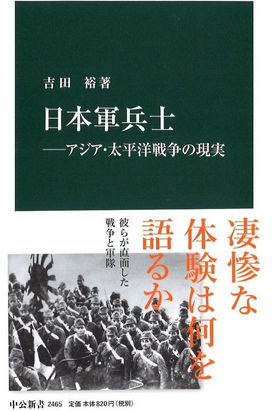
Yoshida’s award-winning book, Nihongun heishi (2017)
As is well known, in the decades immediately following the war, the horrors of the battlefield were taken up with powerful effect in Japanese literature and film. Takeyama Michio’s children’s novel, Biruma no tategoto (The Burmese Harp), for example, was published beginning in 1947 and was made into a film by director Ichikawa Kon in 1956.4 Ōoka Shōhei’s Nobi (Fires on the Plain), loosely based on Ōoka’s wartime experience as a military technician in the Philippines, was published in 1951 and was also made into a film by Ichikawa in 1959. Gomikawa Junpei’s six-volume novel, Ningen no jōken (The Human Condition), which relates the journey of an idealistic Japanese youth who becomes embroiled in the war as an Imperial Army soldier in Manchuria, was published beginning in 1956 and became the basis of a film trilogy directed by Kobayashi Masaki in 1959-61.
Following such early depictions of the war in film and literature, Japanese historiography on the Second World War began to appear in the 1960s.5 While the immediate postwar years saw many young people turn away entirely from military-related topics out of strongly-held antiwar beliefs, the Center for Military History at the National Institute for Defense Studies—a Ministry of Defense (Bōeichō)-operated think-tank founded in 1955—emerged as one of the few institutional hubs for war history research.6 The Center, many of whose members were former officers of the Imperial Japanese Army and Navy, began publishing detailed studies on Japan’s military campaigns in the mid-1960s, culminating in the massive 102-volume Senshi sōsho (1966-80). Written over the course of twenty-four years by a group of military officers-turned-officials who did not necessarily have historical training, the Bōeichō-commissioned project was meant to present an official version of the events of the war.7 As one might imagine, however, the work narrowly focused on the strategies and tactics of individual campaigns, offering the perspective of central command to the exclusion of that of soldiers in the field.8 Scholarly studies focusing on the experiences of the ordinary solider remained extremely rare, and military history (gunji shi) in general came to be seen as a highly specialized field populated mainly by those with prior military experience.9
There were also a number of professional historians who developed their own histories of World War II from within the academy. Fujiwara Akira (1922-2003), for example, used his experience as a former Imperial Army officer serving on the China front to produce Marxist-oriented studies influenced by the works of historians such as Inoue Kiyoshi (1913-2001) and Tōyama Shigeki (1914-2011).10 Hata Ikuhiko (1932-), on the other hand, drew upon postwar oral history interviews conducted with former elite officers of the Imperial Army and Navy under detention in Sugamo Prison, which allowed him to develop a unique brand of neo-nationalist scholarship.11 Ienaga Saburō (1913-2002), to take another example, recognized from early on the importance of the wartime experience of ordinary people, leading him to write the first historical overview of the Asia-Pacific War to take into account the perspectives of both soldiers and citizens.12 Furthermore, in the 1970s, Ōe Shinobu (1928-2009), a former cadet of the Imperial Army Air Academy, began producing rigorously researched studies on military history.13 The work of Ōe, who belonged to the group of scholars associated with Fujiwara Akira, helped to break down the barrier between Marxist and anti-Marxist historical scholarship.
While such scholars pioneered in developing new approaches to military history, soldiers’ war experiences still received relatively little attention. It was not until the 1990s that a major shift occurred with applying the methodologies of social history (shakaishi), people’s history (minshūshi), and local history (chiikishi) to the issues of war and the military. Notably, this was a movement led by a new generation of scholars who had no firsthand experience of war. Yoshida (b. 1954), who is among the senior members of this generation, views his main historiographical contribution as the reinterpretation (yomikae) of military history from the perspective of social history and people’s history.14 Through numerous works, he has sought to construct a bottom-up view of military history that takes into account not only the perspective of ordinary troops, but also their ties to broader society.15 In this regard, his work might be compared to that of his colleague Yoshimi Yoshiaki (b. 1946), whose now classic, Grassroots Fascism—originally published in 1987 under the title, Kusa no ne no fashizumu—has recently been translated by Ethan Mark and introduced in the Asia-Pacific Journal.16 Whereas Yoshida primarily focuses on the battlefield itself, Yoshimi combines the experience of ordinary soldiers with that of civilians on the home front. Both scholars highlight the day-to-day experiences of non-elite Japanese as active participants within the larger framework of the Asia-Pacific War and have helped to broaden the definition of both military history and social history.
Beyond the Japanese historiography, there have been a few attempts to describe the experience of Japanese commoners and ordinary soldiers in English. Among these, Haruko and Theodore Cook’s Japan at War: An Oral History (1992) is especially noteworthy, both for its content and the timing of its publication.17 Based on oral history interviews conducted in the late 1980s, the book offers a rare glimpse into how ordinary Japanese from different walks of life—military and civilian, men and women—perceived and remembered their wartime encounters in over sixty powerful individual vignettes. Writing at the end of the Shōwa period (1926-89), the Cooks benefited from a moment of national reflection about the bygone era that facilitated the collection of valuable firsthand testimonies about the war. Given the relatively unstructured manner of their sample selection, in which interviewees were solicited through newspaper ads and word-of-mouth, the voices represented are more diverse than the argument-driven examples chosen by Yoshimi in his Grassroots Fascism. Nevertheless, more than one third of the accounts describe the experiences of former soldiers who served on battlefields across China and the Pacific including several harrowing testimonies from the Battle of Okinawa. Because it is primarily a compilation of individual recollections rather than a sustained analysis of any single group, it is difficult to draw any systematic conclusions about the experience of Japanese soldiers as a whole.
More recently, English-language work on the war has focused on the home front, rather than the battlefront. Kenneth Ruoff’s Imperial Japan at its Zenith (2010), for example, highlights the importance of civic participation in sustaining the public fervor of the war years through the lens of tourism and consumerism.18 In Japan’s Carnival War (2019), Benjamin Uchiyama attempts to go beyond the familiar depictions of wartime Japan as a “dark valley” dominated by draconian state controls to emphasize the carnivalesque symbiosis (in the Bakhtinian sense) between official propaganda and actual cultural practice.19 In making his argument, Uchiyama considers the figure of the youth aviator-turned-kamikaze pilot as one of his key groups, offering an updated perspective on the cultural construction of one of the better-studied subgroups in Japanese military history.20 But the actual experience of the battlefield is not discussed. From the fields of theater and literary studies, James Brandon’s Kabuki’s Forgotten War (2009) and Sharalyn Orbaugh’s Propaganda Performed (2015) add to our understanding of the role played by different forms of popular entertainment—respectively, kabuki stage drama and kamishibai street theater—in mobilizing the domestic populace for the total war effort.21 The theme of popular mobilization is further echoed by Sabine Frühstück, whose Playing War (2017) explores the place of children in the ideological production of war, whether through the medium of war games or the exploitation of the “emotional capital” of images of children.22 Although still a work in progress, Sheldon Garon’s “transnational home front” project—to give another example—considers how the warring states of Japan, Germany, and Britain were actively investigating, emulating, and improving upon the defense and mobilization strategies of one another during World War II.23 In short, we now have a more detailed and nuanced picture of how various social groups and organizations on the home front—e.g. actors, artists, children, reporters, businesses, and religious groups—responded to the calls to contribute and commit themselves to the national cause.24
Along with the focus on home front affairs, the transnational approach as exemplified by Garon is another area in which there has been notable advance in recent English-language scholarship. Takashi Fujitani’s Race for Empire (2011), for example, engages in a transpacific comparative analysis of Japanese American soldiers who served in the U.S. army and Korean soldiers who were recruited or drafted into the Japanese army as imperial subjects during the Asia-Pacific War, highlighting the similarities between the ways in which the two regimes sought to manage their respective racialized minorities.25 Jeremy Yellen’s The Greater East Asia Co-Prosperity Sphere (2019), on the other hand, places the development of the titular Co-Prosperity Sphere vision in dialogue with its reception by political elites in the Philippines and Burma, thereby shedding light on the contested and negotiated nature of wartime imperialism.26 All of these works have situated Japan’s wartime experiences within broader currents of global history, yet they do little to illuminate the perspective of ordinary soldiers.27
In recent English-writing on the topic, perhaps the work that comes closest to Yoshida’s in terms of subject matter and sources is Lee Pennington’s Casualties of History (2015). In it, Pennington examines the history of wounded soldiers and physically disabled veterans of the Japanese army, who were known by the term shōi gunjin (“injured and sick servicemen”).28 In particular, his detailed description of the logistics of Japan’s field medicine operations—as told through the eyes of one combat amputee who was severely wounded during a “bandit suppression” campaign in north China in 1939—provides a compelling look at what ordinary Japanese soldiers experienced on the battlefield. Pennington pays close attention to the medical and societal treatment of the bodies of soldiers, as well as the institutional efforts to manage their physical and mental trauma through the creation of a state-sponsored welfare program for war-wounded veterans and their families.
Pennington’s study challenges common misconceptions about the low standards of emergency medicine provided by the Imperial Japanese Army, convincingly showing the sophisticated system of medical treatment and evacuation that was in place for wounded servicemen. Also revealing is his account of the Japanese government’s efforts to promote the image of disabled veterans as praiseworthy icons of sacrifice and bravery, a project of cultural reimagining that was subsequently reversed by the Allied Occupation’s abolition of the system of preferential treatment for military casualties that had been established during the war. Whereas Pennington focuses on soldiers who sustained debilitating injuries (specifically amputees), however, Yoshida takes a broader approach that addresses the ways in which the majority of troops encountered death on the battlefield, ranging from war wounds to disease, malnutrition, and drowning. Indeed, Yoshida’s focus on the grim realities of death, and the structural issues inherent in the Japanese military institution that contributed to such tragic outcomes, sets his work apart.
Research on the history of the Asia-Pacific War is a relatively new field that has only come into its own in recent years. Factors such as the unavailability of primary sources—including classified documents and materials confiscated by the U.S. military (which were later returned to Japan)—initially limited the scope of possible research topics. As a result, earlier studies tended either to produce overview histories of the entire war, or zoomed in on well-known, often controversial events such as the Nanjing Massacre, the “road” to Pearl Harbor, a handful of key strategic battles and campaigns, and perhaps the most widely debated of all, the atomic bombings of Hiroshima and Nagasaki. Their conclusions, moreover, became a proxy for ideological battles regarding the legitimacy of the war and the way in which it was brought to an end.
Lost among the political and moral debates were the stories of ordinary folk on whose shoulders the burdens of war disproportionately fell. The gradual declassification and publication of key historical documents, discovery of previously unknown private sources, and development of user-friendly digital databases, along with an increased interest in the lives of commoners, have greatly enriched the diversity of approaches and themes undertaken by scholars. Moving away from the grand narrative-style history centered on political and military leaders, recent scholarship has come to recognize that each individual group had its own unique stories, thus enabling a more sophisticated understanding of Japan’s wartime experience—as is reflected in the numerous studies featured in this review. Even then, however, the fate of ordinary soldiers and their unglamorous stints on the front lines have—with the notable exception of the student kamikaze pilots—remained a blind spot in the literature. It is to these men and their experiences that Yoshida turns, and through which we are able to gain an honest appreciation of the true costs of war.
Translated Text
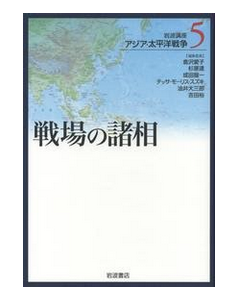
The edited volume containing Yoshida’s article, published by Iwanami Shoten
Ajia-Taiheiyō sensō 5: senjō no shosō (2006)
Introduction
The purpose of this article is to reconstruct the battlefield experience of the ordinary Japanese soldier during the Asia-Pacific War. This is a project that is entirely distinct from both the official military histories written from the viewpoint of the staff and officers who strategized in command rooms removed from the battlefield and the kind of accounts produced by Yasukuni Shrine and its affiliated museum, the Yūshūkan, whose sole purpose is to commend and console the spirits of the soldiers who died in battle. Although research of this kind was rarely undertaken by historians in the decades after the war, one contribution that deserves special mention is Kuroha Kiyotaka’s “Aspects of Death in the Fifteen-Year War: Of ‘Statistics’ and ‘Poems,’” published in the journal Shisō in August 1971.29 This pioneering work was written at a time when the sources available to historians were still extremely limited. Above all, my goal is to take up Kuroha’s call for “the study of the realities of death” (shinikata no jitsugaku), which he posited as a counterpoint to “the aestheticization of death” (shinikata no bigaku). Wherever possible, I hope to draw on my understanding of recent developments in the fields of social, local, and people’s history (minshūshi), and incorporate insights developed by scholars working on such topics as “the body,” “the family,” and “funerary rites.”
Of course, in examining the history of the Asia-Pacific War as a war of aggression, there is a need to pursue what might be called “the study of the realities of killing” (koroshikata no jitsugaku) alongside research on war crimes, but on this issue, I refer readers to the work of Kasahara Tokushi.30 Even in the “Emperor’s military,” with its dominant philosophy that “from the outset, there can be no expectation of returning alive,” there were, in fact, various ways for soldiers to choose “life.” They could, for example, remove themselves from battle by surrendering or deliberately injuring themselves, or volunteer for positions away from the front lines.31 In this regard, there is, no doubt, also a need for “the study of the realities of survival” (ikinokori no jitsugaku), but that too lies beyond the scope of this article.
1. The Characteristics of Military Mobilization
Competition with Labor Mobilization
First, I would like to look at the special characteristics of military mobilization in Japan. The first characteristic is the severe competition between military mobilization and labor mobilization necessary for wartime production, as a result of the underdevelopment of Japanese capitalism. As Ōe Shinobu has pointed out, because of the low level of technical capital composition (shihon no gijutsuteki kōsei) in Japanese industry, it was necessary to retain a large number of skilled workers in the workforce; this was especially true in the villages, where labor-intensive small-scale farming was dominant.32 For this reason, there arose fierce competition between military and industry for the recruitment of able-bodied men, leading to a military mobilization rate that was much lower than in the Western powers.
This situation can be observed in the system of draft deferment for reservists, originally introduced as a general draft deferment system in 1927 and revised following an amendment to the Army mobilization plan implemented in May 1943. According to this amendment, many technicians, laborers, and railroad and communications workers who formed the core of the wartime domestic labor force were subject to draft deferment.33 As a result, the total number of workers who received deferments was approximately 380,000 in 1943, 700,000 in 1944, and 850,000 in 1945. It is also interesting to note that Imperial Palace staff—including imperial household chamberlains, physicians to the emperor, palace police, and fire officers—as well as members of the Imperial Diet, and secretaries in charge of military affairs in town and village-level administration were subject to deferment under the same amendment.34
Favoritism toward Active-Service Soldiers
Because the Imperial Navy was, with the exception of the final months of the war, by and large a volunteer corps, most of the reservists called up during the war served in the Imperial Army. The Army, however, could not free itself from a mobilization ideology favoring active-service soldiers (gen’ekihei), resulting in a distrust of soldiers called up from the conscript reserves who did not have military experience. Once the Sino-Japanese War broke out, since most of the active-service soldiers were organized into an elite division in preparation for an anticipated clash with the Soviet Union, many special divisions, drawn from the ranks of the second reserves, were created and sent into battle in China. As a result, first reserve (yobieki) and second reserve (kōbieki) soldiers made up the majority of the Japanese troops in China.
The first and second reserve soldiers who had previously served in the military were relatively old, and many were married with a family. Because of this, they were not as physically strong, and many went into battle bearing anxieties about loved ones back home. Their morale, in other words, was not very high.
As the Sino-Japanese War developed into a protracted conflict without a clearly defined objective, the first and second reserve troops became the central troublemakers whose calculating, battle-hardened outlooks posed a fundamental challenge to military discipline.35 Out of a sense of despair and reckless self-abandon, such soldiers not only repeatedly committed acts of plunder, rape, arson, and murder against Chinese civilians, but also at times behaved violently and with contempt toward superior officers, posing a threat to military discipline.36 To address such issues, the central command moved to demobilize and repatriate first and second reserve troops in China, replacing them with active-service soldiers or younger soldiers from the conscript reserves. As a matter of fact, the percentage of active-service soldiers within the Army’s total forces significantly increased: 37.3% in 1937, 54.5% in 1938, 68.1% in 1939, 71.5% in 1940.37
Another factor that accelerated the discharge of first and second reserve troops was the population problem. Since many soldiers with families had been called up for service, the birth rate in 1938 dropped to 27.2 (births per 1,000 population), compared to 30.9 the previous year. Noting that the birth rate recovered to 29.4 in 1940 as a result of roughly 120,000 discharges in each of 1939 and 1940, clearly this demobilization contributed to restoring the birth rate.38 This was a factor that led to the sending of large numbers of active-service soldiers and young soldiers from the conscript reserves to the China front.39
2. The Body of the Mobilized Soldier
The Deterioration of Soldiers’ Physical Conditions
We shall consider next the physical conditions of the young men eligible for conscription. According to the physical examination records for young conscripts, there was no large difference in their average height or weight between 1935 and 1941: respectively 160.3 cm and 52.95 kg in 1935, versus 160.8 cm and 53.14 kg in 1941.40
However, according to a May 1942 report, “On the Physical Strength of Young Conscripts,” compiled by the Army Ministry’s Medical Bureau, the body-mass ratio (weight divided by height) of conscripts examined since 1939 exhibited a downward trend, eliciting concern from the central command.41 In the eyes of an anonymous Army Ministry official, the decrease in the body-mass ratio suggested that:
The young men these days have a poor physique; tall but skinny and weak looking. More and more men are coming to exhibit the weaknesses of an urbanite: thin chests, slender arms, and pale faces. This is extremely alarming.42
The official went on to state that he believed the reason for this state of affairs came from the “concentration of youth in cities, and especially the absorption of youth from the countryside into urban factories and other places with poor facilities to promote health.” Such problems were associated with the development of heavy industry and increased urban migration following the outbreak of the Sino-Japanese War.
Another factor affecting the physical condition of young men was the rapid upsurge in tuberculosis. Although Japan’s total mortality rate continued to decrease between 1932 and 1944, tuberculosis mortality, particularly for men ages 20 to 24 increased rapidly. According to Aoki Masakazu, this was due to the growth in the heavy and chemical industries, and the fact that the expanding military itself was becoming a hotbed for the mass infection of tuberculosis.43 Moreover, it was not until 1940 that X-ray radiography was introduced to the military’s physical examinations for conscripts.
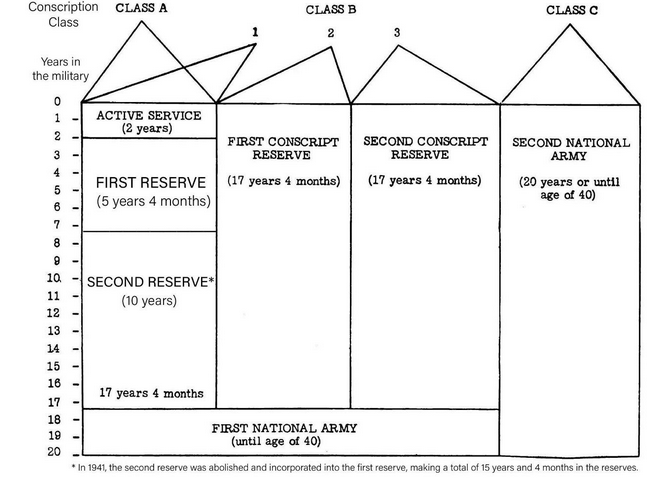
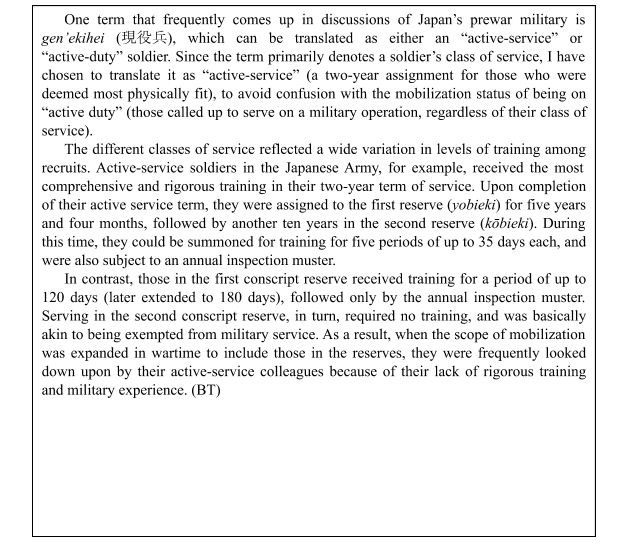
Figure 1. Classes of Service in the Imperial Japanese Army, circa 1940
Adapted from U.S. War Department, Handbook on Japanese Military Forces
(Washington, D.C.: U.S. Government Printing Office, 1944), 3. (BT)
Click to expand.
The largest problem, however, was that the military had no choice but to begin recruiting even those in poor physical condition to reach troop quotas. As has already been discussed, the expansion and prolongation of the Sino-Japanese War made the procurement of active-service soldiers and conscript reserves critical. This forced the military to reform its conscription system. The conscription system initially categorized youth into six categories based on a physical examination: Class A (kōshu), Class B-1 (dai-ichi otsushu), Class B-2 (dai-ni otsushu), Class C (heishu), Class D (teishu), and Class E (boshu) (see Figure 1). In theory, Class A and Class B conscripts were deemed fit for active service, while Class C conscripts were to serve in the National Army (kokumin heieki; a lower-ranking reserve force); Class D conscripts were deemed unfit for service, and Class E conscripts would be reexamined the following year. Before the outbreak of the Sino-Japanese War, roughly speaking, Class A conscripts entered into service as active-service soldiers, Class B-1 conscripts as first reserve troops, Class B-2 as second reserve troops, and Class C entered the second National Army. In practice, being assigned to the second reserve troops or the National Army was akin to being exempted from military service.
With the expansion and prolongation of the Sino-Japanese War and an increasing need for more troops, however, Class B-1 conscripts were mobilized as active-service soldiers, with Class B-2 conscripts entering the first reserve. As a result, by 1939, a Class B-3 category was newly instituted in order to fill the second reserve forces. The central command decided that, while not ideal, some Class C conscripts could be transferred to Class B-3 in order to mobilize them as reserve troops.44
In order to accommodate the growing demand for troops, standards for conscription were greatly reduced through revision of the Army physical examination rules in 1940. According to the aforementioned “About the Physical Strength of Young Men” (1942), this 1940 revision deemphasized the previous concern of examiners to “discover underlying illnesses or abnormalities,” and encouraged them to pass conscripts to Class B-3 or above, even if they were “ill or mentally unbalanced,” as long as such symptoms were “deemed not to interfere with their military duty.”
This revision not only resulted in recruits who were in poor health or physical condition, but many men with mental disabilities. At the Kōnodai Army Hospital—a military hospital, expanded following the Sino-Japanese War, which specialized in the treatment of mental disorders—the percentage of patients with intellectual disabilities grew from only 0.9% in 1938 to 13.9% by 1945. According to Asai Toshio, a military physician at Kōnodai Hospital who conducted “group mental examinations” for several units toward the end of the war, those with intellectual disabilities reached 3 to 4%, revealing a “high ratio of intellectually limited conscripts, even among those in Class A who appeared to be in good physical condition.” In response, Central command developed a standardized “group mental examination methodology” in 1944 with the help of the Army Military Medical School and Kōnodai Hospital, and partially implemented it in the conscription examination the following year.45
Deterioration in Military Provisions
One notable characteristic of Japan’s war footing was that the strengthening of wartime organization proceeded hand in hand with the deterioration in people’s standards of living. The government’s attempt to promote the rapid industrialization and militarization of society with limited resources had the effect of reducing people’s standards of living to the bare minimal level. Although a higher standard of provisions was maintained in the military than for civilians, even military rations deteriorated with the worsening war situation. According to a report submitted to the GHQ on September 5, 1945, by the Army Ministry, due to the “worsening war situation and the depletion of domestic food reserves,” the nominal daily provisions for the average soldier on the Japanese home islands (naichi) was reduced to 2,900 calories—the “actual caloric value” (jissai kyūyō netsuryō) measuring at 2,800 calories with a regional disparity of around 500 calories.46 The standard caloric intake recommended for mainland soldiers at the time was 3,400 calories. On the other hand, the “amount of labor required of each soldier had increased rapidly in preparation for the decisive battle on the mainland and fortification efforts,” which was estimated to require at least 3,200 calories per person. As a result, malnutrition became a persistent problem, with the soldiers’ prewar average body weight of 60 kg falling to 54 kg by the end of the war.
On January 15, 1945, Vice Minister of the Army Ministry Shibayama Kenshirō sent out a notice (Rikumitsu no. 149) calling attention to the “rapid decline in the physical strength of the domestic troops,” which “provided much cause for concern,” and led him to emphasize the maintenance of physical health and the necessity for a self-supporting system with regard to provisions. On January 26, he issued a directive (Rikumitsu no. 301) ordering troops on the home islands to be responsible for procuring 10% of staple foods, 30% of vegetables, and 5% of meat products on their own.47
However, setting up a system of self-sufficiency while preparing for a fight on the mainland was challenging, and individual soldiers ended up buying food from neighborhood farmers on the black market or, at times, resorted to stealing in order to stave off hunger. Manabe Motoyuki, a private first class who was drafted into the Shikoku Infantry Regiment, discusses the practice of soldiers buying black-market rice:
It was the Japanese military’s proud tradition to fully and thoroughly guarantee the livelihood of its soldiers; it was only thus that they could demand the soldiers’ undivided and absolute obedience…However, many soldiers were buying rice on the black market…Any rice purchased with one’s own funds is considered “personal property.” Once soldiers start depending on private property to support their daily livelihood, the military’s tradition loses its foundation. This is because personal provisions give birth to a personal mentality, producing fissures in the absolute obedience most cherished by the Japanese military.48
On the other hand, the situation was more grievous for troops stationed overseas. Once the Japanese forces lost command of the sea and air, their supply route was completely cut off. Let us look at a document produced in the final stages of the war by the Ōmori corps of the Fifth Division Eleventh Infantry Regiment, which fought various battles in New Guinea. “Since all squadrons within the corps transitioned to a complete self-supporting basis,” the physical strength of the troops has deteriorated, and the average body weight has dropped by 4 to 6 kilograms.49 By January 1945, the daily caloric intake was only around 1,700 calories. In order to address this situation, the document recommended adjusting the soldiers’ work so that they were not wasting energy on aimless tasks. In other words, it ordered troops not to use their labor preparing for the decisive battle but to focus exclusively on conserving energy. Needless to say, this could no longer be called an army.
The Late Mechanization of the Japanese Military
The “Imperial Army” was extremely slow to mechanize. The infantry, which comprised the “main combat force,” generally moved around on foot, and the primary mode of transportation for artillerymen and machine gun squadrons within infantry regiments was not car but horse. Even the transport corps, which was tasked with supplying food and ammunition, depended largely on transportation by horseback and horse-drawn carriage. When it came to movement and transport, the Japanese Army relied heavily on its foot soldiers and horses.
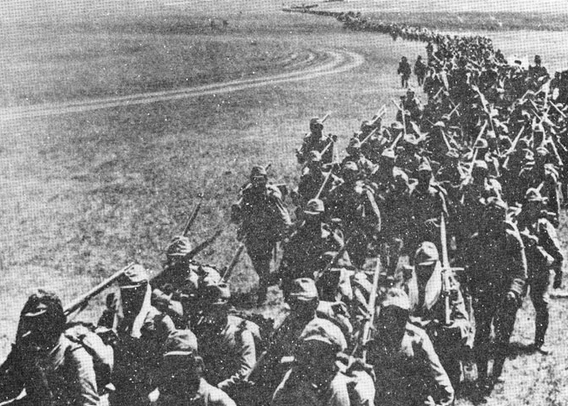
Japanese soldiers on the march, 1939.
For this reason, the full uniform and equipment load carried by foot soldiers on long marches—which included a helmet, knapsack, ammunition pouch, backup ammunition, and provisions—could reach up to 20 to 30 kilograms. For example, the load of an average rifleman serving in a company during the First Changsha Operation of September 1941 was 25.175 kg.50 According to a study by the Army Medical Corps, the “maximum efficient load was between 35 to 40% of one’s own body weight.”51 As the average body weight of prewar soldiers was roughly 60 kg, according to the aforementioned 1945 report to the GHQ, 25.175 kg already exceeded this recommended limit.
The outbreak of the Pacific War on December 8, 1941 made the soldiers’ burden even more demanding. Once the Allied forces began their counteroffensive in late 1942, Japan lost command of sea and air, rendering supplies by large-scale munition transport ships extremely difficult thereafter. Moreover, the transportation of combat units was prioritized over logistics units. This, combined with the character of isolated islands in the South Pacific and New Guinea, meant that Japanese supplies depended on so-called “man-powered carriage” (jinriki tansō). A study of the transport corps, Shichōheishi (1979), elaborates:
Especially on isolated islands as well as in New Guinea, which was similarly hard to navigate, even the motorcars that were brought onto land with much difficulty had a limited range of operation. In addition, many transport corps regiments left their horses behind, causing many battlegrounds to rely on man-powered carriage; it was virtually impossible to compete with the material superiority of the [American] enemy.52
Furthermore, the Japanese Army did not possess the mechanical engineering capability to rapidly clear undergrowth, construct airfields, and build basic infrastructure such as roads. As a result, the ammunition and provision load for each individual soldier increased, with a fully equipped foot soldier carrying upwards of 50 kilograms. This was also true on the China front, where Japanese forces had lost command of the air to the Americans, making supply by ground or rail transport difficult. This in turn increased foot soldiers’ physical burden.53
Most problematic was the fact that a substantial segment of the troops who were forced to undertake such grueling marches were young soldiers with weak physical condition. Furthermore, due to the extensive mobilization of forces, the ratio of active-service soldiers to reserves in the army had been greatly reduced after 1941. For example, the 27th Division, engaged in battle on the China front, received reinforcements of approximately 2,000 troops in October 1943. However, a military physician reported that “the majority had previously contracted tuberculosis, and their age, along with their inferior physical status, caused us great alarm.”54 The same division would go on to participate in Operation Ichi-Gō in April 1944; their condition at the start of the operation was described as follows.55
The troops all bore an excessively heavy equipment load, with individual soldiers carrying a total of 45 kilograms. If my memory is not mistaken, the average weight of a soldier at the time was around 52 kilograms. The majority of the troops were either soldiers from the conscript reserves or new recruits with only two months of experience; less than half were active-service soldiers who had received proper training.56
According to this testimony, the division’s soldiers carried loads that amounted to 87 percent of their body weight, making it natural that there would be stragglers during forced marches. Fujiwara Akira, who had participated in this operation as a company commander in the 27th Division, recalled that the “accommodation of stragglers was the most challenging problem for a company commander,” adding that, “since it had a direct impact on our military capability, the depletion of troop strength as a result of marches was the biggest headache for me as the commander.”57
Kume Shigezō, a regimental adjutant to the 236th Infantry Regiment who participated in the Battle of Hunan-Guangxi (湘桂作戦) in 1944, recounted that constant forced marches caused “a breaking point in the soldiers’ fatigue; many of the conscript reserves who joined us in Hengyang fell out while on the march, with some going so far as to commit suicide with grenades or rifles; it was heartbreaking.”58 Stories of troops driven to suicide by the forced marches appear frequently in soldiers’ memoirs, a testament to the grueling nature of the Army’s relentless marching.
At the same time, shoddy military boots increased the suffering of the marching soldiers. In a hot and humid environment, the sewing thread holding the footwear issued by the Japanese Army to hold the shoe together would come apart, causing the sole to peel off. Because of this, it was a common sight to see “[military boots] all falling apart as if they had their mouths open after each operation.”59 Many soldiers also developed blisters on their feet after being supplied ill-fitting military boots. Hori Hajime, a member of the 4th Trench Mortar Unit who marched some 6,500 km as part of Operation Ichi-Gō, recalled that he was only provided with three pairs of military boots during the entire operation. The first pair “developed holes after only two months of use, causing gravel to enter the shoes every time [we marched].”60 Once the worsening strategic situation prevented the arrival of supply trains, usage of military boots was restricted or banned altogether. In 1945 soldiers were ordered to “try not to wear military boots, and instead wear the cloth-shoes (haizu) used by the Chinese.”
The situation was even more grievous on the South Pacific front. According to Hirao Masaharu, an Imperial Navy lieutenant who served as a medical officer in the Solomon Islands, his commanding officer issued an order “prohibiting the use of military boots by all soldiers below the rank of captain, in order to save them for the final battle,” forcing many troops to go barefoot. “Our toes, which used to open up smartly like that of a human, became like that of a beast,” writes Hirao with much shock: “we suddenly went from being civilized people of the twentieth century to primitive men of the stone age.”61
This kind of deterioration also affected military uniforms. The “unusual attire” of army officers became more noticeable from around 1944—for example, when older reserve officers responded to a call-up wearing outdated uniforms from the Taishō period (1912-1926). With supply ships sunk by enemy attack, officers were forced to wear civilian clothing, uniforms of non-commissioned officers, or even uniforms taken from Allied soldiers in order to make-do.62
On the Southern Pacific front where supply lines were completely cut off, troops’ attire was often nothing less than bizarre. Mori Tetsuju, an accountant for the 18th Army, relates his experience in an essay titled, “Supplies in Operations in Eastern New Guinea.”
All the equipment by this time was handmade. We made everything from patrol caps, haversacks, mosquito nets (made by stitching gauze together in a double layer), belts, and eating utensils, and wore straw sandals or simply attached a separated shoe sole to our feet with string. We carried our possessions by crafting a bag out of tent material or other pieces of cloth and tying it to our backs, or used a farmer’s shoiko [a wooden frame used for backpacking a load]. Our “marching uniform” also came to include a waterproof apron worn over the backside, so that we could sit down in marshy fields at a moment’s notice.63
Other sources corroborate the fact that, “after the Battle of Lae-Salamua in 1943, the standard outfit of “hip-apron, cane, and shoiko became popularized as the “New Guinea-style” military uniform.64
3. The Multiple Realities of Death in War
The Sino-Japanese War Period
Next, I would like to examine in greater detail the manner in which soldiers died. First, let us look at full-scale conflict against China. Table 1 lists Japan’s military casualty statistics during the Sino-Japanese War (1937-1941). Although the incompleteness of the available records means there may be a significant margin of error, the number of wounded is almost two to three times the number of deaths. In the Russo-Japanese War, the number of wounded soldiers (130,203) in the Army outnumbered deaths (60,031) by roughly a factor of 2.2.65 From the perspective of the lethality of the enemy’s weapons the Sino-Japanese War was similar to the Russo-Japanese War.
Table 1. Casualties on the China Front
Combat death (a) | Death by disease (b) | Injury (c) | ca | ba+b×100 | |
1937, 1938 | 62,007 | 12,605 | 159,712 | 2.6 | 16.9 |
1939 | 30,081 | 9,338 | 55,979 | 1.9 | 23.7 |
1940 | 15,827 | 13,688 | 72,653 | 4.6 | 46.4 |
1941 | 12,498 | 12,713 | 35,389 | 2.8 | 50.4 |
(Created by the First Demobilization Ministry, December 1945)
Source: Rikusen gakkai senshi bukai, ed., Kindai Sensō Shi Gaisetsu (shiryōshū), (Tokyo: Rikusen Gakkai, 1984).
Notes: Combat deaths (a) do not include figures from Manchuria; it is not clear if this was also the case for the deaths by disease (b) and injury (c) statistics.
The issue of war deaths by disease (senbyōshi) is also important. Prior to the nineteenth century, war deaths by disease often greatly outnumbered combat deaths. During the Crimean War (1853-1856), the percentage of deaths by disease among in the French Army was 89.3% of total fatalities; for the Union Army in the American Civil War (1861-1865), the figure was 66.6%. In the First Sino-Japanese War (1894-1895), including the Japanese invasion of Taiwan, the percentage of deaths by disease among the total war fatalities was 89.4%. By the time of the Russo-Japanese War (1904-1905), however, improvements in military hygiene and sanitation and maintenance of a dependable supply line had resulted in this figure dropping to 26.3%.66 The Russo-Japanese War, in other words, was a watershed from an epidemiological standpoint. For the first time in military history combat deaths outnumbered deaths by disease.67
The ratio of war deaths by disease in the Sino-Japanese War, as shown by Table 1, was 16.9% in 1937-38, and 23.7% in 1939, thus not very different from the Russo-Japanese War. Once the war reached an impasse after 1940, however, the ratio of war deaths by disease jumped to 46.4%. By 1941, the number of deaths by disease overtook the number of combat fatalities. This was an inevitable outcome of the Japanese military repeatedly undertaking combat operations beyond its capabilities. It also proved to be an omen of what was to come.
War Deaths, Injuries, and Deaths by Disease
The Pacific War, which began in December 1941, had several distinctive characteristics. First, with the exception of the early successful campaigns, all direct Japanese military confrontations with Allied forces ended in crushing Japanese defeat. A postwar survey on naval hygiene by Isshiki Tadao, a Navy medical officer and major who worked in the Second Demobilization Ministry (Daini fukuinshō), indicated a total of 156,000 war deaths and 40,000 wounded for the Navy for the duration of the war. He provided the following explanation:
Although the wounded commonly outnumbered battle fatalities in previous campaigns by a factor of two to three, in this war the figures were completely reversed. There were approximately 3.5 times more combat deaths than wounded, resulting from advances in warfare such as the improvement in firearms and the fierceness of air strikes. This gives vivid expression to how relentless and cruel this war has been.68
These figures are clearly low (the Ministry of Health and Welfare puts the estimate of Navy war deaths at 457,800), and the Navy Command was almost certainly unable to accurately account for the number of wounded soldiers. Considering the rapid advances in military technology and the overwhelming gulf in war-making capacity between Japan and the Allied forces, however, it is highly probable that the number of deaths caught up with, and in some cases overtook, the number wounded.
Furthermore, this was the first war in which there were zero wounded soldiers in some battles. This phenomenon began in May 1943, in the series of gyokusai (fight to the death without surrender) battles starting with the Battle of Attu. In this engagement, all wounded soldiers who could walk were forced to participate in the final “banzai charge” through American lines, and those who were unable to move either had to commit suicide or be given a “final treatment” (shochi) by the medical officer or combat medic. Tatsuguchi Nobuo, a medical officer in training who died on Attu Island, wrote in his diary: “It has been decided that we will undertake a final charge, and that all inpatients are to commit suicide.”69 The Senjinkun (Code of Battlefield Conduct), issued in January 1941, prohibited Japanese soldiers from being taken prisoner by the enemy. Such peculiar “battlefield codes” (senjin dōtoku) led to this tragedy.
Some ex-soldiers indeed confessed to having administered “final treatments” to wounded and ill personnel. Ogawa Yasushi, for example, recollects his experience of “intravenously administering mercuric chloride” to wounded soldiers after having “first given them opium to numb their senses” during the January 1944 retreat in the Battle of New Britain. Ogawa regretted his actions; “If I depart for the nether world while concealing this truth,” he wrote, “I could not bear to face the Buddha, leading me to take up my pen.”70
The second major characteristic of this war was the large number of deaths by starvation. Of the 2.3 million total war dead (i.e. sum of combat deaths and deaths by disease) since the beginning of the Sino-Japanese War (1937), 1.4 million are estimated to have been fatalities caused by starvation due to malnutrition, or a more broadly defined category of “starvation” resulting from malaria and other diseases contracted because of nutritional immunodeficiency.71 From the perspective of the ratio of combat deaths to deaths by disease, the Japanese Army thus “reverted” to the levels recorded during the First Sino-Japanese War (1894-95).
The main reason why there were so many deaths by starvation was the severing of Japanese supply lines. The situation was especially dire for the garrisons at the South Pacific front which had been left behind enemy lines due to the U.S. military’s “island hopping” strategy. In a document produced by the General Staff Headquarters, Major Iwagoe warned against the dangers of “assuming that things can be worked out on the battlefield, without any thought given to supplying the units from the rear.”72 He further stated, “securing a communication and supply line at sea is vital to island operations,” concluding that, “marine logistics depend upon command of the air.” In the end, the loss of control of the air on the South Pacific front, combined with a lack of long-term strategic planning on the part of the military command, left deployed forces constantly under threat of starvation.
Soldiers on the China front did not fare much better. The U.S. Air Force’s advance into China cut supply lines and forced many physically compromised soldiers to undertake long marches—typified in Operation Ichi-Go—leading to severe physical deterioration. In terms of casualties, there were 11,100 combat deaths and 54,800 deaths by disease in 1942, 12,700 combat deaths and 65,100 deaths by disease in 1943, 11,300 combat deaths and 69,191 deaths by disease in 1944, and 8,900 combat deaths and 34,429 deaths by disease in 1945.73 Although deaths by disease are only estimates, and we cannot be sure if they include statistics from Manchuria, they nevertheless show that the number of deaths by disease skyrocketed after 1942, outnumbering combat fatalities by a factor of four to six. A considerable portion of these are thought to have been caused by a broadly defined “starvation.”
Underlying all of these developments was the fact that Japan’s military medicine and wartime hygiene infrastructure had fallen behind the times. Conduct regulations of Army field hospitals and sanitary corps had been based on wartime hygiene codes and guidelines established around the time of the Russo-Japanese War. The expansion of the Sino-Japanese War of 1937 naturally forced a reconsideration of the ways in which such issues were handled—rescue efforts on the front lines needed to be strengthened, and wounded soldiers needed to be treated as soon as possible after their injuries were sustained. A revision of the operations manual (sakusen yōmurei no. 3) in March 1940 reorganized the sanitary corps into a casualty evacuation detachment, and dispatched combat rescue detachments to the frontlines. Yet this still failed to effect changes in the wartime hygiene code or the Army’s overall war organization, leaving each division’s sanitary corps to enter the Pacific War ill-equipped to deal with the brutal realities of modern warfare.74
Slowness to adapt to the latest developments in military hygiene exacerbated the situation. As soon as the Pacific War began, a sizable number of the Japanese soldiers and officers serving in the South Pacific front contracted malaria. Shortages of medication such as quinine further accelerated this trend. In the words of the “Lessons Based on Operational Experiences in Eastern New Guinea,” sent to all army units by the Imperial General Headquarters in November 1943, “[In] combat units engaged in operational activity, after 1.5 months, symptoms of malaria began to appear; after 2.5 months, military strength was reduced by half; after 3.5 months, military strength was reduced to a third; after 5 to 6 months, only one-seventh of the soldiers could be said to be in good health.”75
Despite this state of affairs, the military failed to formulate timely countermeasures. The Health Bureau of the Army Ministry only published and distributed a “Manual for Malaria Prevention (For the Use of Commissioned Officers)” in August 1943, and the General Headquarters of the South Pacific army did not issue “Guidelines for Malaria Prevention in the South Pacific Army” until May 1945. Even the issue of countermeasures against malnutrition did not receive proper study until a full year after the February 1943 retreat from Guadalcanal.76
In contrast to the Japanese military’s failure to deal with the perils of malaria, the U.S. military successfully curbed the spread of infectious diseases through the use of the synthetic pesticide DDT.77 They similarly recognized early on that blood transfusion was critical for treating severely wounded soldiers, and established a system for sending large quantities of blood and blood products to the frontlines. The image of a medic conducting a blood transfusion in the midst of battle by stabbing a rifle into the ground by its bayonet and hanging a blood plasma bottle from the safety switch, came to symbolize the U.S. Army’s medical program.78 Japan was completely left behind on this front as well. Shiokawa Yūichi, a medical officer who served on the Burma Front from 1943, gave the following account: [p. 76-] “All the medical procedures I carried out on the battlefield were stopgap measures such as disinfecting wounds with antiseptic solution or applying a compression bandage to an injured joint; we never learned how to treat heavy bleeding at the Military Medical School. Neither was any thought given to blood transfusions.”79
Death by Drowning and Suicide Attack (tokkō)
The third characteristic of Japanese war deaths was the high level of “death by drowning” (kaibotsu) caused by the sinking of warships. According to Ikeda Sadae’s study of sunken warships during the Pacific War, the number of deaths by drowning totaled 182,000 Navy soldiers and paramilitary personnel, and 176,000 Army soldiers and paramilitary personnel.80 This amounts to 15.6% of the total casualties of all military and paramilitary personnel from the beginning of the Sino-Japanese War (2.3 million), and is 4.1 times the sum total of Army and Navy casualties of the Russo-Japanese War (88,133). In January 1945, the Army Division of the General Headquarters issued a circular on “How to Deal with Maritime Emergencies.” Compiled from interviews with the surviving members of transport ships that were sunk in the East China Sea, the document relates the tragic final moments on a sinking ship: “[There were] those who lost consciousness as soon as the enemy’s torpedo hit us; those who lost the will to survive after floating on the water for a while, realizing that they had a very slim chance of being rescued; those who attempted suicide to escape the pain of being submerged under water; those who began to hallucinate as a result of total exhaustion and fell into the ocean from the life raft; those who began to act violently out of mental imbalance; and those who passed away soon after they were rescued.”81
Although it is well-known that Allied submarine and aircraft effectively destroyed Japan’s sea transport network, internal factors also contributed to the large number of maritime casualties. As available shipping was reduced, individual vessels became “extremely overloaded.” This is why “a single sunken vessel caused a massive loss in one stroke.” The available tonnage to transport one person decreased from 3 to 5 tons in mid-1942 to 1.5 to 2 tons in mid-1943, and 0.5 to 1 ton by late 1943.82
The majority of the Army’s transport ships were actually requisitioned freighters, making them highly susceptible to sinking. The Allied forces used exclusive military transport ships or requisitioned passenger boats to transport troops, and a certain level of livability was taken into account. In contrast, Japanese transport ships were hastily modified freight vessels that used the main hold as the troops’ living quarters; soldiers slept in bunk beds, many of which were arranged in triple bunks called “silkworm shelves” (kaiko-dana). The only way to the deck—also the only emergency exit—consisted of a makeshift wooden staircase built at an extremely steep angle. Packing so many soldiers into such a confined space virtually guaranteed that many of them would not be able to make it out in the event of a torpedo attack, meaning that sinkings inevitably resulted in high casualties.83 According to Ōuchi, when listing the sunken transport vessels in the Pacific War in order of their death figures, the top thirty incidents account for 69,140 deaths. This alone would be roughly equivalent to the total number of Army deaths in the Russo-Japanese War.
The fourth characteristic of Japanese war deaths was the emergence of an extraordinary new type of death: tokkō. Tokkō [a shortened form of the Japanese term for “special attack”] refers to suicide attacks carried out by combat pilots crashing their planes directly into enemy warships. The first Kamikaze Tokkō Squadron was organized and launched by the Navy in October 1944 on the Philippines front, followed by the Army’s Banda and Fugaku Squadrons in November of the same year. Both the Navy and Army launched tokkō attacks in subsequent months, peaking during the Battle of Okinawa in March 1945. Tokkō attacks resulted in approximately 4,000 deaths. There were also marine tokkō by motorboats called “Shin’yō,” as well as underwater tokkō by manned torpedoes called “Kaiten.”
As the war situation worsened, the “tokkō spirit” was forced upon soldiers and officers. In September 1944, the Chief of the General Staff gave the following instructions to Yamashita Tomoyuki, Commander of the 14th Army Group as he was sent to the Philippines front, in a document titled “Strategies for a Certain Victory.”84 [p. 78-]
Against an enemy who now clearly has the upper hand, we will not be able to win using only ordinary methods. We must therefore break away from our conventional, lukewarm mindset and fully demonstrate our imperial army’s unique spirit of sacrifice for the nation. We must go forward in air, water, and on land, carrying the battle to the enemy and finding a way out of a fatal situation, using [suicide attacks] (tai-atari) to take down their warships and tanks, one by one. This is the method that will lead us to certain victory and strike terror into the enemy’s heart.
When the Army and Navy formulated their first joint plan of operations in January 1945 (“General Outlines of the Imperial Army and Navy Plan of Operations”) in anticipation of a decisive battle on the mainland, they made “surprise raids and tokkō attacks” an important element of the strategy.85 They had, it seems, run out of other options by this point.
I have thus far examined the different aspects of war death in some detail. It is worth noting before proceeding that commissioned and non-commissioned officers had a lower death rate than soldiers. Although it is difficult to prove this due to a lack of statistics that categorize war casualties according to rank, the first scholar to take up this issue was Fujiwara Akira.86 Discussing the Japanese garrison on Woleai Atoll—known in Japan as Mereyon Island—which had fallen behind enemy lines and was cut off from supplies, Fujiwara argued that there was an “undeniable correlation between the order of starvation and the individual’s rank” (Table 2). Sure enough, the lower the rank the higher the death rate, with ordinary soldiers having a death rate as high as 82 percent.
Table 2. Casualty Rates in the Woleai Atoll Garrison
Category | Combat death | Death by disease | Total deaths (%) | Survivors (%) | |
Imperial Army | Officer | 5 | 57 | 62 (33) | 126 (67) |
Warrant officer | 1 | 8 | 9 (23) | 30 (77) | |
NCO | 19 | 311 | 330 (64) | 185 (36) | |
Soldier | 107 | 1,911 | 2,018 (82) | 445 (18) | |
Subtotal | 132 | 2,287 | 2,419 (75) | 786 (25) | |
Imperial Navy | 175 | 2,206 | 2,381 (74) | 840 (26) | |
Total | 307 | 4,493 | 4,800 (75) | 1,626 (25) | |
Writer Sawachi Hisae has also focused on this issue, analyzing the case of the 59th Infantry Regiment, about which we have detailed personnel records: 4 deaths among commissioned officers (0.56% of the total), 41 deaths for non-commissioned officers (5.76%), and 667 deaths for soldiers (93.68%).87 This regiment suffered heavy casualties from disease and starvation while defending Palau due to compromised supply lines. Given the makeup of military personnel in the Army in 1943—4.6% commissioned officers, 13.7% non-commissioned officers, and 81.7% soldiers—the lower death rate for officers and higher rate for soldiers is striking.88
4. The Frontline and the Home Front
Troop Morale
Soldiers on the frontlines constantly reminisced about home while fighting, motivated at least partly by concern for the families they left behind. Safeguarding the livelihood of family members on the home front was thus important to prevent the deterioration of troop morale. State initiatives to ensure this took the form of social welfare from the Military Relief Act (gunji fujo hō), enacted in July 1937, and military support organizations such as the Shōbukai, as well as stipends or allowances paid by the companies at which soldiers were employed before being conscripted. National expenditure did not completely cover the livelihood of the families left behind, and not all former workplaces provided stipends to conscripts’ families. However, the government placed a much higher priority on military relief when compared to the Russo-Japanese War. Scholarship on the principles and practices of such military relief efforts has greatly expanded in recent years. One representative work can be found in Gunshi Jun’s 2004 book, Gunji engo no sekai (The World of Military Relief).89
Soldiers were also preoccupied with the “chastity” of their wives. According to a 1939 report published in a Justice Ministry publication, not only had there been a “gradual increase in such objectionable and deplorable acts as adultery and elopement among the wives of soldiers at the front,” but also “not a few acts of sexual aggression such as molestation and sexual assault by unscrupulous men.”90 With regard to the perspective of the wives of soldiers at the front or war widows, vivid testimony is provided in Kikuchi Keiichi and Ōmura Ryō’s 1964 work, Ano hito wa kaette konakatta (He Did Not Come Back).91
Given the effect that such issues might have on troop morale, the state felt the need to intervene. For example, even though adultery was a crime that could only be applied to women in prewar Japan, “the government started to punish men [who committed such acts] by charging them with breaking and entering.” As a result, the number of men arrested for breaking and entering grew noticeably during the war.92
Major Horiguchi Masao of the Kenpeitai [military police] also commented on the impact of home affairs on troop morale, stating that “[soldiers] are always concerned about the home front, especially news about their family…since one of the most frequently mentioned issues is the chastity of one’s wife and the treatment of family members left behind, we must be careful how to counsel them, as this will profoundly affect their morale.”93
A problem that further vexed soldiers was the livelihood of wives and children in the event of their death; many were particularly concerned with the one-time benefits and pensions paid to bereaved families. For example, since the civil code strongly privileged the (male) head of the household, there were cases in which the father of the war dead tried to abuse the system and take away the rights to welfare benefits from the wife by forcing her into a divorce. Another major problem was that common-law wives did not have the right to receive such benefits.
Fujii Tadatoshi, who analyzed the wills of war dead, points out that “many of the wills specified to their parents, who in many cases held the relevant rights, that the one-time benefits, insurance, and pension [that would arise in the event of death] should go to his wife.”94 As mentioned in the aforementioned 1939 report, the soldiers’ “first priority was to guarantee the livelihood of one’s wife and children,” and the second priority was to “secure a stable retirement for their parents.”
The life insurance cases examined by Fujii require additional explanation. At the time of the Russo-Japanese War, various stipulations existed with regard to the payment of insurance benefits, ranging from “the charging of special insurance fees and the reduction of the benefits, to the non-payment of the promised money.” The total number of cases that actually paid out death benefits during this war among all life insurance policies totalled only 2,462.95 Once the Sino-Japanese War began, however, life insurance companies faced pressure from the armed forces to unconditionally provide benefits to the families of war dead. Furthermore, they were required to provide a maximum insurance payout of 2,000 yen if the individual signed a new contract. Furthermore, from April 1943, following an arrangement among life insurance companies, all war deaths resulted in an automatic payment of insurance benefits. It was thus that life insurance became popularized during the period of total war. The number of contracts for all life insurance firms by the end of 1941 was 24,225,000.96
So important was this system that the government had no choice but to intervene to help resolve disputes related to one-time benefits and pensions. In May 1938, the state strengthened its relief administration by establishing military relief consultation centers in each municipality to deal with all issues related to war-bereaved families. The centers were run by committees consisting of officials, assembly members, and special members. One of their primary duties was the “resolution of disputes regarding the payment of benefits and pensions or household registration involving bereaved family members.” In January 1941, the military protection bureau (gunji hogo-in) sent out “Guidelines for Dealing with War-Bereaved Families” to each regional governor, recommending the placement of a “woman consultant who could provide earnest advice to bereaved families” under the auspices of the municipal home front contribution society.97
In 1939, the government passed the Personal Arbitration Act to resolve the increasing number of disputes over welfare pensions, and the 1940 revision of the Pension Act recognized the right to welfare benefits for common-law wives and children born out of wedlock—as long as they took measures to acquire legal status. In 1941, court approval became necessary for the removal of a name from the family register, thereby placing restrictions on the abuse of the rights of household heads.98 The government and military generally took a position supportive of the conscripted soldier’s wife out of concern for the troops’ morale. As a result, some have argued that this was partially responsible for the dismantling of the “household system” (ie).99
It is noteworthy that in the case of bereaved families, the military on occasion got involved directly. According to a 1976 history of the Kenpeitai, the military police was forced to deal with cases including “a divorce crisis resulting from complications in the relationship between a soldier’s wife and her mother-in-law,” “the issue of whether a war widow should remarry with one of the deceased soldier’s brothers,” “a dispute over divorcing a war widow,” and “problems related to the payment of pensions to the bereaved family.”100 The author observes that “it was inevitable that the military police were forced to arbitrate from a position sympathetic to the wife’s interest” in cases of one-time benefits and pensions, and that the wartime military police performed the function of an “ad hoc family court.”
The government also used censorship to keep home front troubles from reaching the attention of frontline soldiers. According to the official bulletin of the Books Division of the Home Ministry’s Police Affairs Bureau [the department responsible for prewar censorship], all newspaper articles and publications concerning destitution on the Home Islands, sexual violation of wives of soldiers at the front, or domestic disputes involving home front families, were either banned or redacted. This censorship was so severe that in January 1938, the novel Richigi mono by Satō Haruo featuring a protagonist who develops romantic feelings toward the wife of a soldier at the front, was banned from publication. Anticipating that the war would be protracted, the government issued a notice in July 1938 called “Guidelines for Newspapers,” which ordered publishers to “be careful of any topics that deal with the destitution of bereaved families, suicide, and scandals, as these have the potential to cause anxiety among soldiers at the front.”101
The Issue of the Remains of the War Dead
Another problem arose with the increasing number of war dead: bereaved families’ dissatisfaction concerning the sending home of their loved ones’ remains. Japanese funerary rites are carried out in the presence of the remains of the deceased, to which attendees pay respects.102 In the prewar period, since it was impossible for the bodies of soldiers who died in remote combat zones to be sent back, it became customary for their ashes to be returned. With the intensification of combat, however, the military could not afford to properly cremate each body, and it became common for soldiers to cut off their fallen comrades’ wrist or little finger in the midst of battle and send it home, cremated, after combat. This inevitably led to the sense on the part of the bereaved families that the remains of their loved ones were being handled with less consideration. This malaise was exacerbated by the fact that it took longer for the families to receive the remains after getting the official death notifications. A 1940 article in a publication by Kaikōsha, a club for Imperial Army officers, alluded to great unease concerning the treatment of the combat dead:
From the perspective of a bereaved family member, it goes without saying that soldiers’ remains are irreplaceable, and it is understandable for them to be concerned about the remains of their loved ones. However, one must also say that it reflects poorly on them to fixate on the issue of remains after their sons have gone off to war [knowing that they may not come back alive]; the reality of the battlefield is harsh, but that is the reality, so we must promote more understanding and awareness on the part of family members. There are also those who are dissatisfied with the handling of war dead remains or delay in sending them home, but the former is a groundless rumor that must be dispelled, and the latter is a problem that must be solved by increasing awareness of the realities of the battlefield.103
The military tried to address the issue by having soldiers prepare a lock of hair (ihatsu) in advance that could be used in lieu of bone remains (ikotsu). According to the “Notice Regarding the Additional Requirements of Troop Handbooks” issued in June 1939 by the Imperial Reservist Association, the military had mandated inclusion of an addendum in the Troop Handbooks (guntai techō) distributed to all reservists.104 The addendum instructed all conscripts to prepare a will in advance, and to “wrap up a lock of hair, a tooth, and a fingernail in paper and place it in your backpack.” It further warned, “these items will be subject to strict examination at the yearly inspection muster of reservists (kan’etsu tenko),” illustrating the importance the military attached to these mementos. The preparation of a will was likely meant to deal with the aforementioned issue of family disputes over welfare benefits.105
The situation regarding the remains of those killed in action took a turn for the worse following the outbreak of the Pacific War in December 1941. According to Niigata prefectural records, for example, it was so difficult to collect the remains after the Battle of Guadalcanal that “sand from the beaches of the island was taken home to be used in place of their remains.” When they could not even find something of this nature, locks of hair stored with the reserve troops were placed in the remains container (ikotsu bako) and sent to the family. If all else failed, the military simply sent home a remains container with a wooden memorial tablet (reiji/ihai) inside.106 As Ichinose Toshiya demonstrated clearly in his 2005 social history of the home front, in many cases the state could no longer guarantee traditional death ritual conventions.107 According to a 1997 report published by the Health and Welfare Ministry, the remains of only half of the 2.4 million overseas war dead—including civilians and those who died in the Battles of Iwo Jima and Okinawa—ever found their way back home.108
Conclusion
The tragic realities of war would deeply influence postwar Japanese pacifism. They disrupted the sense of solidarity between officers and soldiers. They also developed into a generalized antipathy toward militarism and war as well as arousing deep-seated suspicion of the self-serving claims of the state. The consciousness of postwar Japanese was, in short, rooted in antiwar sentiment stemming from these traumatic war experiences.
This pacifism, however, would face challenges from two different directions. First was the issue of war responsibility that resurfaced in the late 1980s. Following the end of the Cold War, people of various Asian countries started to denounce Japan for its wartime conduct. As a result, attitudes of Japanese people, based on their self-identification as victims of war, began to show signs of vulnerability. Second was the fact that the generation that had experienced war became a clear minority within Japanese society around the turn of the twenty-first century. The peace consciousness that had been bolstered by war experience could no longer be sustained by direct experience in war by the majority.109
The writing of this article was in many ways inspired by this transition. The reason why I emphasized the “study of the realities of death” was that, as part of a generation that has not experienced war, I wanted to reconstruct the harsh realities of the battlefield in my own way. Another reason was my desire to understand the “difficult deaths” faced by Japanese soldiers—a topic emphasized in Oda Makoto’s 1991 work—as a prerequisite to approaching the multilayered question of “victimhood” (higai) and “aggression” (kagai) [with regard to the Japanese war experience toward Asia].110
Having finished writing, however, I am struck by the many inadequacies of this approach. I am especially aware that I may have focused too much on the extreme conditions on the battlefield. In his study of battlefield memories, Tomiyama Ichirō has argued that “the battlefield is neither an abnormality nor a madness detached from our daily lives; rather, the mundane activities of everyday life prepare the conditions of the battlefield.”111 It is true that I should perhaps have placed greater emphasis on the relationship between normality (nichijō-sei) and abnormality (hinichijō-sei). Even on the battlefield, there is neither constant combat nor perpetration of war crimes. The backlash from former soldiers toward the “comfort women” controversy, for example, probably stems from the fact that what had been experienced as a normal part of life at the front was now being criticized as a war crime. I would like to continue thinking about the meaning of this issue in the future.
Acknowledgments: I would like to thank my doctoral advisor Daniel Botsman for the opportunity to undertake this translation as his research assistant in 2018-2019, as well as for his insightful comments on earlier drafts. I am grateful to Mark Selden for proposing the idea of the translator’s preface and improving the overall manuscript significantly with his thoughtful criticism and feedback. I am also indebted to Subo Wijeyeratne for his proofreading expertise. Finally, I wish to express sincere thanks to Professor Yoshida for his continuous guidance on matters related to wartime history, a generosity he has extended ever since my time as a Japan Foundation Fellow at Hitotsubashi University in 2015-2016, and to Iwanami Shoten for granting permission to publish the translation in this format. Throughout the text, annotations added by the translator are marked by my initials (BT).
Notes
Yoshida Yutaka, “Ajia-Taiheiyō sensō no senjō to heishi,” in Senjō No Shosō: Iwanami Kōza Ajia-Taiheiyō Sensō 5 (Tokyo: Iwanami Shoten, 2006), 59-86. Since his retirement from Hitotsubashi University in March 2020, Professor Yoshida has become the director of The Center of the Tokyo Raids and War Damage.
Yoshida Yutaka, Nihongun heishi: Ajia-Taiheiyō sensō no genjitsu (Tokyo: Chūō Kōron Shinsha, 2017).
Biruma no tategoto was nominated for the Academy Award for Best Foreign Language Film of 1956. Ichikawa later remade the movie in color with a new cast in 1985.
Although the 1950s did see the publication of a few books on the Asia-Pacific War, they were primarily eyewitness accounts written by former military officers. See Takagi Sōkichi, Taiheiyō kaisenshi (Tokyo: Iwanami Shoten, 1949); Hayashi Saburō, Taiheiyō sensō rikusen gaishi (Tokyo: Iwanami Shoten, 1951); Hattori Takushirō. Daitōa sensō zenshi (Tokyo: Masu Shobō, 1953), vols. 1-4.
This account of the development of postwar Japanese historiography on military history draws heavily on a guest lecture given by Yoshida at the Institute of Politics and Economy (Seiji keizai kenkyūjo) in September 2019. Yoshida Yutaka, “Sengo rekishigaku to gunjishi kenkyū: ‘Nihongun heishi’ o tegakari ni shite,” presentation notes, 20 September 2019. I have supplemented this with Fujiwara Akira, Tennō no guntai to Nicchū sensō (Tokyo: Ōtsuki Shoten, 2006).
Bōeichō bōeikenkyūsho senshi shitsu ed., Senshi sōsho, 102 vols. (Tokyo: Chōun Shinbunsha, 1966-1980); Toga Hiroshi, “Zen 102-kan kanketsu no ji,” Daitōa (Taiheiyō) sensō senshi sōsho furoku 102 (1980), 1-2.
Other characteristics of the work produced by the Center for Military History, originally known as the Office for War History (senshi shitsu), include its willingness to defend the decisions and actions taken by the prewar Japanese leadership, its bias toward central command, and the reproduction of institutional rivalries between the Imperial Army and Imperial Navy, owing to the initially large number of ex-Army officers within its ranks. Fujiwara, Tennō no guntai to Nicchū sensō, 230; Yoshida, “Sengo rekishigaku to gunjishi kenkyū,” 2.
One notable exception, as referenced by Yoshida in his introductory paragraph, is Kuroha Kiyotaka’s article published in the August 1971 issue of the journal Shisō. Kuroha based his analysis on a combination of statistical data and poems written by servicemen describing their battlefield encounters.
Hata Ikuhiko, Nitchū sensōshi (Tokyo: Kawade Shobō Shinsha, 1961); Hata Ikuhiko, Gun fashizumu undōshi: 3-gatsu jiken kara 2.26 go made (Tokyo: Kawade Shobō Shinsha, 1962).
Ienaga Saburō, Taiheiyō sensō (Tokyo: Iwanami Shoten, 1968). An English translation by Frank Baldwin is Ienaga Saburō, The Pacific War: World War II and the Japanese, 1931-1945, (New York: Pantheon Books, 1978). Yoshida points out that Ienaga’s work is limited to using the experience of ordinary soldiers to underline the Japanese military’s undemocratic and anti-rational tendencies. Yoshida, “Sengo rekishigaku to gunjishi kenkyū,” 2.
Yoshida Yutaka, Tennō no guntai to Nankin jiken: mō hitotsu no Nitchū sensō shi (Tokyo: Aoki Shoten, 1998); Yoshida Yutaka, Nihon no guntai: heishi tachi no kindaishi (Tokyo: Iwanami Shoten, 2002).
Yoshimi Yoshiaki, Grassroots Fascism: The War Experience of the Japanese People, trans. Ethan Mark (New York: Columbia University Press, 2015). The original is Yoshimi Yoshiaki, Kusa no ne no fashizumu: Nihon minshū no sensō taiken (Tokyo: Tokyo Daigaku Shuppankai, 1987).
Haruko Taya Cook and Theodore F. Cook, Japan at War: An Oral History (New York: The New Press, 1992; reprinted 2008). For a collection of translations of private diaries, see Samuel Hideo Yamashita, Leaves from an Autumn of Emergencies: Selections from the Wartime Diaries of Ordinary Japanese (Honolulu: University of Hawai’i Press, 2005). Yamashita followed this book up with Daily Life in Wartime Japan, 1940-1945 (Lawrence: University Press of Kansas, 2015), which attempted to construct a “history of everyday life” (Alltagsgeschichte) in wartime Japan using published diaries, letters, and memoirs. Through these works, Yamashita has allowed us to hear the forgotten voices of ordinary Japanese on the home front.
Kenneth J. Ruoff, Imperial Japan at Its Zenith: The Wartime Celebration of the Empire’s 2,600th Anniversary (Ithaca, N.Y.: Cornell University Press, 2010).
Benjamin Uchiyama, Japan’s Carnival War: Mass Culture on the Home Front, 1937-1945 (Cambridge, U.K.: Cambridge University Press, 2019).
As noted by Uchiyama, the kamikaze—known officially as the “special attack force” (tokkōtai)—represent one of the few areas concerning Japanese soldiers about which there is a sizable body of English-language scholarship. Some examples include Ivan Morris, The Nobility of Failure: Tragic Heroes in the History of Japan (New York: Holt, Rinehart and Winston, 1975); Emiko Ohnuki-Tierney, Kamikaze, Cherry Blossoms, and Nationalism: The Militarization of Aesthetics in Japanese History (Chicago: University of Chicago Press, 2002); M. G. Sheftall, Blossoms in the Wind: Human Legacies of the Kamikaze (New York: NAL Caliber, 2005); Emiko Ohnuki-Tierney, Kamikaze Diaries: Reflections of Japanese Student Soldiers (Chicago: University of Chicago Press, 2006), and chapter 6 of Yamashita, Daily Life in Wartime Japan, 1940-1945. See also Uchiyama, Japan’s Carnival War, 204-207.
James R. Brandon, Kabuki’s Forgotten War: 1931-1945 (Honolulu: University of Hawai’i Press, 2009); Sharalyn Orbaugh, Propaganda Performed: Kamishibai in Japan’s Fifteen Year War (Leiden: Brill, 2015).
Sabine Frühstück, Playing War: Children and the Paradoxes of Modern Militarism in Japan (Oakland, California: University of California Press, 2017). Frühstück’s book is not limited to the Asia-Pacific War and examines the series of modern wars beginning with the Sino-Japanese War of 1894-95.
While the book-length study is yet to be published, a concise summary of the project can be found in Sheldon Garon, “Transnational History and Japan’s ‘Comparative Advantage,’” The Journal of Japanese Studies 43, no. 1 (February 1, 2017): 65–92.
For an example of a recent dissertation that examines the wartime cooperation of Japanese Christian groups, see Bo Tao, “Imperial Pacifism: Kagawa Toyohiko and Christianity in the Asia-Pacific War” (Ph.D. diss., Yale University, 2020). Japanese Christians, who were particularly vulnerable to charges of “unpatriotic” conduct due to their adherence to a foreign religion, strove to prove their loyalty to the nation by staging wartime rallies, writing patriotic hymns, and organizing donation drives to help fund military aircraft.
Takashi Fujitani, Race for Empire: Koreans as Japanese and Japanese as Americans during World War II (Berkeley: University of California Press, 2011).
Jeremy A. Yellen, The Greater East Asia Co-Prosperity Sphere: When Total Empire Met Total War (Ithaca: Cornell University Press, 2019).
Fujitani does include the testimony of several Korean prisoners-of-war held captive by Allied troops. Even there, however, his main concern is with interrogating their motives for serving in the Japanese army, and not on their battlefield experiences per se. See Fujtani, Race for Empire, 239-298.
Lee K. Pennington, Casualties of History: Wounded Japanese Servicemen and the Second World War (Ithaca, New York: Cornell University Press, 2015).
Kuroha Kiyotaka, “15-nen sensō ni okeru senshi no shosō: ‘tōkei’ to ‘uta’ to,” Shisō, August 1971.
Kasahara Tokushi, “Chiansen no shisō to gijutsu,” in Senjō no shosō, Iwanami Kōza Ajia-Taiheiyō Sensō 5 (Tokyo: Iwanami Shoten, 2006), 215-244.
A conscript who had attained a middle school education had the option of applying to become an officer candidate (kanbu kōhosei) upon entering the Army. Those who passed the exam had a number of possibilities to serve away from the frontlines. An officer candidate in the accounting department (keiri bu), for example, was eligible to become a low-ranking officer dealing primarily with financial accounts. This was a relatively safe post in the Army. This, of course, required one to have obtained a middle school education, which was not the case for around 80 percent of the conscript population—which had little leeway in selecting their place of service. Yoshida, email communication to translator, 19 April 2020. For more on this issue, see Yoshida Yutaka, Nihon no guntai: heishi tachi no kindaishi (Tokyo: Iwanami Shoten, 2002). (BT)
Ōe Shinobu, Shōwa no rekishi 3: Tennō no guntai (Tokyo: Shōgakukan, 1982). While the need to retain farmers in the countryside was recognized by the state, it became more and more difficult to enforce this policy once the war situation necessitated a greater degree of mobilization. As a result, the remaining sources of labor in villages during the latter stages of the war consisted primarily of women, children, and the elderly. Yoshida, email communication to translator, 19 April 2020. (BT)
The intended target of the draft deferment system was industrial and factory workers, and the “laborers” mentioned here did not include farmers. Yoshida, email communication to translator, 19 April 2020. (BT)
Jōestu shishi hensan iinkai, ed., Jōetsu shi tsushi hen 5 (Jōestu-shi, Niigata: Jōestu-shi, 2004).
First and second reserve troops formed the majority of the Japanese military presence in China. This was due to the Japanese Army’s prioritization of the Soviet threat, which led them to permanently station active-service divisions at the Russian border. As a result, only “special divisions” (tokusetsu shidan) consisting primarily of older reserve soldiers were available for deployment to the China front. Fujiwara Akira, Tennō no guntai to Nitchū sensō (Tokyo: Ōtsuki Shoten, 2006), 15. (BT)
First and second reserve troops had previously undergone an intensive two-year regimen as active-service soldiers and looked down on officers called in from the conscript reserve ranks—whom they regarded as inferior because of their lack of proper training—as well as reserve officers and non-commissioned officers who were younger. Being older than the average soldier, many were also married and thus anxious about the family they left back home, inwardly resenting the fact that they had been recalled to duty. Due to this combination of a lack of respect for their immediate superiors and a concern for home front affairs, once the war became protracted and the prospect of an early return dissipated, some older reserve troops turned to acts of violence and atrocity, as well as insubordination toward superior officers. Yoshida, email communication to translator, 19 April 2020; Fujiwara, Tennō no guntai to Nitchū sensō, 15. (BT)
Active-service soldiers, who would have been in their early twenties at this point, typically did not have families, and therefore were sent to the front lines to replace older troops who did have families. The same policy was applied to younger soldiers in the conscript reserves. (BT)
Rikugunshō, Shōwa 10-nen chōhei jimu tekiyō (Tokyo: Rikugunshō, 1936); Rikugunshō, Shōwa 16-nen chōhei jimu tekiyō (Tokyo: Rikugunshō, 1942).
Rikugunshō Heibika ichi-kain, “Chōhei kensa yori mitaru kenpei taisaku no jūyōsei ni tsuite,” Kaikōsha Kiji Tokugō 824 (1943).
“Nihon busōgun no kenkō ni kansuru hōkoku,” Center for Military History (Senshibu), National Institute for Defense Studies.
“Kenpei taisakujō yori mitaru kyūyō jōshiki ni tsuite,” Koi Dai-5173 Squadron, Eisei kankei raikan tsuzuri, vol. 2, Center for Military History, National Institute for Defense Studies.
Dai 27-shidan eisei gyōmu yōhō,” Daitōa sensō rikugun eiseishi hensan shiryō, Center for Military History.
Operation Ichi-Gō (Ichi-gō sakusen, lit. “Operation Number One”), also known as tairiku datsū sakusen (“Continent Crossing Operation”), was a Japanese military campaign on the China front that took place in April-December 1944. It had two main objectives: to capture air bases in southeast China from which American bombers were launching attacks on Japanese shipping and naval assets, and to open a land route from China to French Indochina, which was under Japanese control at the time. The campaign mobilized 500,000 Japanese troops, 800 tanks, and 70,000 horses over 2,400 kilometers, and was the largest single military operation conducted by the Imperial Japanese Army. (BT)
As mentioned in the Translator’s Notes, soldiers from the first conscript reserve only received brief training totaling less than six months, while those from the second conscript reserve received no basic training. (BT)
Kume Shigezō, Sensō wa owatta (Not-for-sale item, 1991). The Battle of Hunan-Guangxi was part of the series of battles comprising Operation Ichi-Gō, which took place across three Chinese provinces (from north to south): Henan, Hunan, and Guangxi. (BT)
Bōeichō bōei kenshūsho senshi shitsu ed., Senshi sōsho hokutō hōmen rikugun sakusen 1 (Tokyo: Asagumo Shinbunsha, 1968).
Rikusen gakkai senshi bukai ed., Kindai sensō shi gaisetsu (Tokyo: Rikusen Gakkai, 1984). The combat casualties do not include those in Manchuria.
Rikujō jieitai eisei gakkō, Daitōa sensō rikugun eiseishi (Hitō sakusen) (Not-for-sale item, 1985).
Douglas Starr, Ketsueki no monogatari, trans. Yamashita Atsuko (Tokyo: Kawade Shobō Shinsha, 1999). The original work is Douglas Starr, Blood: An Epic History of Medicine and Commerce (New York: Alfred A. Knopf, 1998).
Ikeda Sadae, Taiheiyō sensō chinbotsu kansen itai chōsa taikan (Tokyo: Senbotsu itai shūyō iinkai, 1977).
Yamada Akira and Matsuno Seiya eds., Daihon’ei rikugunbu jōsō kankei shiryō (Tokyo: Gendai Shiryō Shuppan, 2005).
Bōeichō bōei kenshūsho senshi shitsu ed., Senshi sōsho daihon’ei rikugunbu 10 (Tokyo: Asagumo Shinbunsha, 1975).
Rikusen gakkai senshi bukai ed., Kindai sensō shi gaisetsu. Such death ratios were not necessarily a given, as can be seen in the high officer-to-enlisted soldier casualty rates of the British Army in WWI, where nearly half of all officers became casualties during the first year. Peter R. Mansoor and Williamson Murray, eds., The Culture of Military Organizations (Cambridge: Cambridge University Press, 2019), 168. (BT)
“Shina jihen ni okeru shussei (senshishō)-sha izoku kazoku no dōkō ni kansuru chōsa,” Shisō Geppō 55–56 (Tokyo: Bunsei Shoin, 1974).
Horiguchi Masao, “Senji ni okeru guntai naimu kyōiku no chakuganten,” Kaikōsha Kiji Tokugō 803 (1941).
Hayakawa Noriyo, “Kazokuhō no kaisei,” in Nihon No Jidaishi 26, ed. Yutaka Yoshida (Tokyo: Yoshikawa Kōbunkan, 2004). The law regarding the removal of family register names is Article 749, Clause 3 of the Civil Code.
Rikugunshō onshōka ichi kain, “Guntai kanbu to shite senbotsusha izoku shidōjō no sankō,” Kaikōsha Tokuhō 60 (1940).
Jōetsu shishi hensan iinkai, ed., Jōetsu shishi betsu hen 7 (Jōetsu-shi, Niigata: Jōetsu-shi, 2000).
Niigata ken minseibu engoka ed., Niigata ken shūsen shori no kiroku (Niigata-shi, Niigata: Niigata-shi, 1972).
