===
Introduction
- Good evening. Good evening to all and a warm welcome to yet another biography event.
I hope that by now, most of you or all of you have been vaccinated, and that all of us are still saying staying safe
and wearing masks where appropriate. And of course, reading 800-page biographies.
My name is Kai Bird and I am the director of the Leon Levy Center for Biography, a wholly unique institution
hosted by the Graduate Center of the City University of New York and founded by Shelby white
and the Leon Levy Foundation in the year 2007. I wanna thank Shelby for her steadfast support to the biography center.
It is her vision that makes this program possible. Please note that our next event
will be on July 8th at 6:00 p.m., when our very own Thad Ziolkowski,
our associate director will talk about his new book, "The Drop," a memoir about surfing and addiction.
He will be in conversation with Diane Cardwell and Michael Scott Moore.
Please mark your calendars and register for this free event on the Leon Levy website
and pass on the information to your friends. But tonight, we are here to celebrate my own new book,
"The Outlier: The Unfinished Presidency of Jimmy Carter." I started working on this biography six years ago,
and I have to confess that if the pandemic hadn't put us all into quarantine, I'd probably still be working on it.
Anyway, I'm delighted that we're able to persuade the great journalist and author Sam Roberts
to interrogate me about Jimmy Carter. A Brooklyn native, Sam Roberts has covered urban affairs
for the New York Times and the New York Daily News for more than 50 years as a reporter, columnist, and editor.
He is currently an obituary writer for the Times, and he hosted the New York Times Close Up,
the televised public affairs program since it originated in 1992 on New York 1 News,
and in its latest incarnation on CUNY TV. He has authored, co-authored, or edited 11 books,
including "The Brother," the untold story of the Rosenberg atom spy case,
"A History of New York in 101 Objects," "Who We Are Now: The Changing Face
of America in the 21st Century," and most recently, "Grand Central: How a Train Station Transformed America."
He is just a wonderful journalist and biographer. Please look for "The Outlier"
and these other books at bookshops.org, a site that will lead you to your local independent bookstore.
Sam and I will now be in conversation for about 40 minutes. And then we will take questions from our virtual audience.
Please click on the question box below to type in your questions. The chat box, you'll see it.
And Sam will be sure to get to as many as he can. We will try to end this program after about one hour.
And again, thanks to the Leon Levy Foundation (coughs) for funding this and all our other events.
And now, Sam Roberts, I submit myself to your interrogation. - Thank you, Kai.
About Kai Bird
And let me tell you a little bit about Kai, because he's too modest to talk about himself.
He is the author of a wonderful memoir, "Crossing Mandelbaum Gate:
Coming of Age Between the Arabs and Israelis." And of course, the Pulitzer Prize-winning biography,
"American Prometheus: The Triumph and Tragedy of J. Robert Oppenheimer,"
and biographies of John McCloy and McGeorge Bundy, and "The Good Spy: The Life and Death of Robert Ames."
And Kai, you said you first began thinking of this book in 1990.
You got to sign a contract just a couple of weeks before Carter was diagnosed
with what could have been a fatal disease. And it's fascinating to think
that Jimmy Carter will be 97 next fall. Here's a guy who was born when Calvin Coolidge
was the president of the United States. And with all the other biographies you did,
why Jimmy Carter? Why did he seem like such a compelling subject?
About Jimmy Carter
- Well, you're right. I first got interested in Carter in 1990.
I had just finished my first biography of John J McCloy,
the Wall Street lawyer. And in that book, I'd had to write a long chapter about the Iran hostage crisis.
And it inevitably compelled me to write about Jimmy Carter,
because he was the president during the hostage crisis. And it's a great, colorful story.
And it made me think, well, this guy is a president I don't really understand.
When I was a young man in my 20s as an assistant editor at The Nation, Jimmy Carter was president in the late '70s,
and I thought he wasn't liberal enough. Like a lot of Nation people, I think.
And yet, here he was in his ex-presidency doing a lot of interesting things with the Carter Center.
So I told my mentor, Victor Navasky,
that I was thinking of doing Carter as a presidential biography.
And he said, well, the way to organize and to explore this idea is to go down to Atlanta and do a magazine article for me
on what Jimmy Carter's doing with his ex-presidency. So I did that and I came away after two weeks,
I wrote the piece. It was a nice cover story about all the fabulous things he was doing. But- - And I'm sure Victor
paid you an enormous amount. - He paid me all of, I think, $175. (laughs)
But I came away from that experience thinking that it was too early,
and perhaps I was the wrong person to do Jimmy Carter. I didn't understand the South.
I didn't understand race. I didn't understand Southern Baptist.
And it made me think, maybe I should wait. And I went on to do other things.
But I was always curious about Carter. He seemed to be an enigma. I didn't know what made him tick.
And finally, in 2015, several books later, I came back to this subject, and you're right, Sam,
right after I persuaded Crown to sign me up to do the book, Carter had this amazing press conference
where he calmly walked in and announced that he had brain cancer,
and was probably dying within weeks, if not months. And I thought, well, I'll probably never
get a chance to interview him, but I did. He survived. He's cancer-free.
He's 96 now. He's still quite lively and his mind is all there.
He's slowing down, but he's still an intimidating personality.
Book reviews
- Let me point out that today is the publication date of the book. And there were some reviews that came in,
Timothy Naftali in the New York Times Book Review called this a landmark presidential biography.
Publishers Weekly said the result is a lucid penetrating portrait
that should spur reconsideration of Carter's much maligned presidency.
Kai, you said that because you didn't understand the south back then,
you approached this like a foreign correspondent. What did you mean? What did you do differently that way?
Interview with Jimmy Carter
- Well, if I had had my druthers, I would have moved down to Plains, Georgia,
and spent two or three years trying to figure out the culture
and the history of South Georgia, where he came from. But I couldn't persuade my wife to do that. (laughs)
She was unwilling to live in Plains, which is still a population of about 650 people.
But I did what biographers do. I dug into the archives and spent
a total of probably five solid months in the presidential library going box by box, folder by folder, copying,
these days, instead of using a Xerox machine, I used an iPhone to take pictures.
And I think I copied 20,000 pages of archival documents onto my iPhone.
And I interviewed scores of people, including Carter, and really dug into it.
And I have to say, Carter was a difficult interview.
He was polite and trying to be helpful, but he wasn't very much interested in the project
because his focus these days is on the Carter Center and wiping out Guinea worm disease
and bringing peace to Syria and things like that. And looking back to his presidency
is sort of the last thing on his agenda. But in my very first interview, I have to say,
I was fortunate enough to ask him one pertinent question. I asked him, "Where are the papers
of Charlie Kirbo, your personal lawyer? Because I don't see them in the archive."
and his eyes, his bright blue eyes lit up. And he says, "Well, that's curious.
Charlie wrote me all the time, memos and letters. And he was my closest friend from 1962 on."
When Carter ran for the state Senate in Georgia. And so he turned to his aide
and said we have to investigate this. And indeed, three days later, I got a phone call,
and they had found five boxes of the Charlie Kirbo papers in the attic of his widow's house.
And about six months later, I was allowed to have free access
to everything in those five boxes. And it was a rich source of material,
memos and letters from Kirbo, who was sort of, he was a South Georgia lawyer who was described to me
as the Atticus Finch of the Carter administration,
and just gave Carter all the political advice. And so it was a window into Carter's own mind.
Future biographers
- Well, that gives me a segue into something that really fascinates me about biography process.
What happens to future biographers when people don't write anything down anymore?
You had great access to the Carter diaries, not all of them, I think, the minority of them in fact,
but what happens when people write things down digitally, when Donald Trump crumples up papers
and throws them in the garbage? You said the diary was the greatest gift
that Carter could give a biographer.
How are biographers of the future gonna deal with the fact that so much is digital,
so much isn't written down, so many things that you had access to,
all those diaries that you quote, Kirbo's papers, Carter's diaries are just not gonna be available?
Accessing Carters diary
- Yeah, no, it's a tragedy. It's a real problem. I hope that people like you, Sam,
and other working journalists keep a record of their emails.
Maybe print them out, because that's the only way to really preserve them in a.
we're talking about a hundred years from now, the whole platform, the technology will change.
No, I don't know what's gonna happen. It's gonna be very difficult for a biographer to do what I did.
I not only had access to about 20% of Carter's presidential diary.
The rest of it, 80% is still closed. Unfortunately, I asked for permission,
but he was reluctant to open all that stuff up because of privacy concerns and the fact
that it had not gone through a declassification review. But I also got access to the diary
of several of his aides in the White House. Landon Butler very generously gave me access to his diary.
And, again, allowed me to sort of be a fly on the wall
to explain the mood and the emotions of,
the frustrations of these young 30-something aides who are working so hard to satisfy Carter.
It was invaluable. And I don't know how I would have written the book without this material.
So it's a major problem, you're right. - I always thought it was a little bit self-indulgent, but why do people keep diaries?
Why people keep diaries
- (laughs) Well,
it's I think the same reason that you and I write. We are trying- - And that's self-indulgent,
you're right. - We're trying to understand the world around us. And a diary is actually a very good way
to sort of have a little moment of self-reflection at the end of a busy and confusing day.
And you can see this in Carter's diary, which is just fabulous. He would dictate it at the end of each day,
almost religiously. And he would hand the cassette tape to his secretary
who would transcribe it the next morning, and then he would tape over the cassette tape again.
So there's no audio. I think he was worried about Richard Nixon and the Watergate tapes.
He didn't want to have an audio version. But his diary is very detailed
and self-reflective and critical and gossipy.
And at times, it's clear he's using it to vent his frustrations with Congress,
with his political opponents, with his foreign adversaries.
And so it's very rich for the biographer. - You quote Jim Wooten at the time
Jimmy Carters childhood
describing Carter as a quick silver bubble. A living, breathing, grinning paradox,
maddening for those who tried to define him. And then you say the defining mystery
of Carter was his childhood. How he nevertheless was molded into something
quite alien from Ms. South and racist culture.
Well, what's behind that mystery? How was he molded?
The mystery of Jimmy Carter
- Yeah, that was the real mystery about, how could a Southern White boy raised
in a tiny hamlet in South Georgia in the 1920s and '30s
with a father who believed in White supremacy, who believed in segregation, how did he escape from that?
How did he come out as a young man going to the Naval Academy already willing to treat African-Americans as equals?
And the mystery I think is solved in part by knowing a little bit about his mother, Miss Lillian,
The very colorful, talkative Miss Lillian. Some of us know from her appearances on "Johnny Carson"
and some of the other talk shows where she was famous for her one-liners.
But Miss Lillian was a Southern eccentric woman. And there is room in Southern culture for that tradition.
The women in particular could be a little offbeat, a little off territory, and she was tolerated.
Everyone knew in Plains that she had a different attitude about African-Americans,
and that she would attend church, but sometimes not. And she would drink her bourbon late at night.
And she would allow young Jimmy Carter to play with his African-American neighbors
who were his only child mates. So this is a young boy who is completely comfortable
in African-American culture. He could talk like them.
He empathized with them. And he, as a teenager, he became profoundly uncomfortable,
I think, with his knowledge of the racial divide, of the segregated society.
And it rankled him. So this is the source of Jimmy Carter's social liberalism,
and it's very profound. - The book is called "The Outlier."
Outlier vs outsider
What's the difference between an outlier and an outsider?
- Oh, well, that's a good question. (laughs) - Maybe there isn't any.
- I think there is. An outsider simply describes someone
who is outside the circle.
An outlier is someone in my mind that implies something more.
He is consciously choosing a different path.
And a path that is filled with, because it's a conscious decision,
it's filled with intelligence and it's well-informed. And this is Jimmy Carter.
He is a guy who I think he, I argue he,
without a doubt is the hardest working president we've had in the 20th century, and probably the most intelligent and well-read.
And he knew, in any setting, he was probably the smartest guy in the room.
And so he wasn't afraid to take sort of outlier positions if he thought that was the right thing to do.
So the word I like, it's a short, punchy title, and I think this captures him.
The truth originates with him
- He was also the most sanctimonious guy in the room. - (laughs) Without a doubt.
And that could be- - There's a great quote you have from Lester Maddox saying the reason he says he never lies
is because he thinks the truth originates with him. - Absolutely.
(laughs) That's a fair criticism, unfortunately, from Mr. Maddox.
All politics is sinful
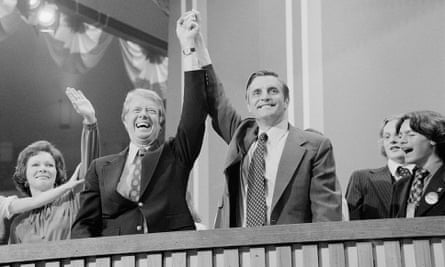
- Also, you quote Walter Mondale is saying Carter thought all politics was sinful.
Could you be a president thinking that all politics is sinful? - Well, maybe not, because after all,
he didn't get reelected. But this is the other paradox about Jimmy Carter.
After all, he did come from nowhere to win the White House and he was relentless.
And he knew exactly what was necessary politically to do to win those primaries,
to defeat Mo Udall and the other more liberal challengers
as such in the Democratic primaries in 1976. And he was ruthless.
The Gonzo journalist Hunter Thompson famously met him in 1974
when Carter gave the Law Day speech in Atlanta, and ripped into the legal profession,
and particularly Southern justice as practiced by Southern lawyers.
And Thompson was just astounded by Carter. He woke up from his boozy tea. (laughs)
He was imbibing in the middle of Carter's speech and began taping the speech.
And he later said that Carter was the meanest politician he'd ever encountered.
And what he meant was driven, just absolutely focused.
And Carter, but the mystery is,
coming back to your question, how could he be in the white house and regard politics as sinful?
Well, I argue in the book that in the '60s, among many other books that he read,
he read Reinhold Niebuhr. And it's odd that he would be influenced
by a liberal Protestant theologian from the East Coast establishment as such,
but he was very much attracted to Niebuhr's argument that the world is a sinful place
and that it needs to be mended. And that politicians in particular,
and leaders in the communities, need to use their positions of power to do good.
But you need to achieve power to be able to do good. So this allowed Carter to meld
his ambition with his religiosity. And he was very, in a way ashamed of his political ambition.
He knew as a Southern Baptist, that the worst sin was pride.
And he had a lot of pride in his intelligence and his ambition. And so Niebuhr allowed him to say,
"Okay, you do what's necessary to win power. But once you have power,
you have to turn your back on the political expediency and you have to learn to do the right thing.
And that's exactly how he tried to govern in the White House. - He was the most religious president, you say.
Religious rationalization
So was that a religious rationalization on his part?
- Well, rationalization, no, because he really believed it.
And people look at Carter's ex-presidency and say,
oh, well, he's been a fabulous ex-president, and he's done all these good humanitarian,
good works, and Habitat for Humanity and all, but he was a failed presidency.
Well, that doesn't understand the man.
He was both a decent ex-president, and he was actually a very decent president too.
And he was guided and motivated by his religion. And he was relentless in that.
Political losers
- You point out a whole litany of accomplishments that I think lots of people,
myself included, forgot, but then you say many of his proudest accomplishments were political losers,
and therefore, he sort of is looked upon as a failed president, a failed presidency,
in large part because he didn't get reelected. Why wasn't he able to capitalize on those accomplishments?
And why did he lose so badly? - Well, first of all, that 1980 election
The 1980 election
was closer than people remembered. The polls were actually within five percentage points
up until two weeks, 10 days before the- - But he only won, what, six states?
- Less, (laughs) but yeah, no, it was a landslide defeat, but up until the end there, he actually believed
he had a fighting chance against Ronald Reagan. But to answer your question, he actually, when he got into office,
he did what he thought was the right thing. He tackled the toughest issues
and often alienated his own political constituency. So he won the evangelical vote in 1976 by 75%, 80%,
but he lost it by a landslide in 80. Well, what had happened?
He had alienated evangelical Christians by insisting on a separation of church and state,
and insisting that White academies in the South that were popping up so that evangelical Christians
could send their kids to all White academies could not get tax-exempt status as educational institutions.
And Bob Jones University and other similar religious institutions could not get tax-exempt status.
So this was something that really alienated
evangelical leaders who turned against him. Jerry Falwell, and the Moral Majority,
which was just getting started, went out and campaigned hard against him. He did the same thing with Jewish Americans
who voted 72, 75% of them in '76 for Jimmy Carter.
And he lost a majority of them. He only won about 45% in 1980.
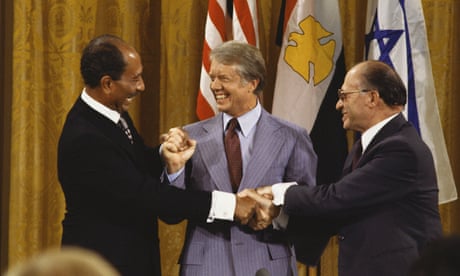
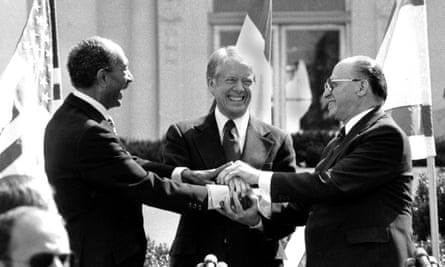
And this was despite the fact that he had done Camp David, he brought Anwar Sadat from Egypt
and Menachem Begin of Israel together in those famous 13 days at Camp David,
and forged a peace settlement. But he then proceeded to try to hold
Menachem Begin's feet to the fire over the question of a freeze on settlements in the West Bank.
And this was regarded by Jewish American leaders as an egregious act of pressure against Israel.
And they began to sort of, there was a whispering campaign that Jimmy Carter, well, he'd done Camp David, but he was anti-Israeli.
And in fact, he was just fearful that Israel, by building settlements in the West Bank,
was going to make a long-term, permanent peace process impossible.
And of course, we're living with those consequences today. - So- - Well, let me ask you about,
I'm sorry, go ahead. - I'm sorry? - Go ahead, I'm sorry. - So he lost the evangelical vote. He lost the Jewish vote.
He lost the Teddy Kennedy wing of the Democratic Party.
Largely, Kennedy challenged him over the healthcare issue. And both men, Kennedy and Carter had both campaigned
in support of national health insurance and national healthcare system, a comprehensive universal healthcare law.
But Carter, once he became president, realized that it was extremely expensive. And he, as a fiscal conservative,
was worried about the growing federal budget. And so he went to Kennedy and said, let's compromise on a universal
catastrophic health insurance system, a foot in the door for national healthcare.
And down the road, and hopefully in my second term, we'll get to universal health single payer plan,
which is what Kennedy wanted. Well, Kennedy refused to compromise. Carter refused to compromise.
Carter thought that Kennedy was using this as an issue to challenge him for the nomination.
And indeed, that's what happened. And he lost the support
of a lot of the liberal wing of the party, and Kennedy challenged him, won a lot of primaries,
but Carter again proving Hunter Thompson's argument about how ruthless and mean he could be.
Carter ran a tough campaign and he defeated Ted Kennedy,
but he was greatly weakened. And that was one of the reasons he went into the general election with Ronald Reagan in a weakened position.
Camp David
- Let me ask you about Camp David a minute. Did Begin lie to Carter about the settlements?
- Well, that's a very contentious issue. And most historians who've looked
at this have tried to argue that, well, there was a misunderstanding.
Carter didn't actually pin it down. And Begin never would have agreed
to a five-year freeze of the settlements. I argue based on the diaries and the memos
and Carter's own belief and Carter's own, you know, this is a man who pays attention to details.
He's a former engineer who famously managed
every little detail and read 300 pages of memos every day
in the White House and spent 12 hours a day working. He believed that he had gotten Menachem Begin
to agree to a five-year settlement of all, a five-year freeze of all settlement activity in the West Bank.
And there was a separate letter that said this. And Begin at the last minute substituted a different letter.
And this was after they had already scheduled the White House ceremony announcing the Camp David Accords,
and Carter and Stu Eizenstat and the other aides believed that they were gonna get the letter.
It never came. Carter believed that he had been deceived.
And he told his aides that he thought that Begin had lied to him. And I think he had good reason
to believe that he lied to him. And this explains his attitude in subsequent decades,
where he was so vociferously about warning the Israelis
that what they were doing with the settlements was digging a hole that was demographically
going to threaten the Jewish nature of the Israeli state. And it's been proven to be oppression in many ways, too.
Look at what's happening today. - Carter was also lied to about the condition of the shah,
Was Jimmy Carter naive
a lie that may have precipitated the hostage crisis. Does this mean he was naive?
- Well, I wouldn't use the word naive, but he was very much aware of the dilemma
that the shah posed after having been deposed
in a revolution that Carter had no control over. And replaced by a theocratic revolutionary regime
led by the Ayatollah Khomeini, the shah was in exile. And Carter refused to provide him asylum in America,
refused to let him have permission to visit America, because he was aware quite rightly
that this could provoke the revolutionary regime and the Iranian people to be even more anti-American
and perhaps to threaten our embassy. This is one of his diary entries.
He feared that if the shah came, they would take over the embassy again. And so he resisted, far from being naive,
he resisted a very concerted campaign by his national security advisors, Zbigniew Brzezinski,
by Henry Kissinger, by David Rockefeller, by John J McCloy. And this was not a simple lobbying operation.
This was a well-funded, concerted effort by Chase Manhattan Bank, and Milbank, Tweed, Hadley & McCloy,
the law firm that represented Chase. They codenamed it Project Alpha.
And they set up a schedule of who should lobby which Carter administration officials each week.
And they just pestered the hell out of the president for six months. And then they gave him the information that the shah
was ailing, was sick with cancer, and they needed treatment that could only
be provided in New York City at Sloan Kettering. This was not true, but Carter finally gave in,
probably when he realized that Cy Vance, his secretary of state, who had also resisted this pressure,
also finally told Carter, "Oh, I think we have to do the humanitarian thing and give the shah asylum."
And that of course, precipitated the hostage crisis that lasted for 444 days.
And that was really the final nail on the coffin for the Carter administration.
Bill Casey
- So when people read that and start to develop conspiracy theories
about who actually runs the government and the permanent government, and then they read what you write about Bill Casey
ending the hostage crisis, does that scare you?
- It does scare me. And I do write about what Bill Casey did.
And I did it with some trepidation, because as a historian, I don't like conspiracy stories.
Most of them are not true. Most of them are fun, but not true,
or interesting, but not true, but some of them are true. There was a conspiracy to assassinate Lincoln.
And when it comes to William Casey who was Reagan's national campaign manager
during the 1980 campaign, the allegation is that Bill Casey,
who was a former OSS veteran, who loved his time in running covert operations
out of London during World War II. Casey, the allegation is that Casey left the United States
in late July to attend a conference on the OSS in London, an academic conference, gave a paper,
but that it gave him a long weekend during which time he might've flown into Madrid, Spain
and met with a representative of the Ayatollah Khomeini to talk about the hostages,
to basically assure them that his candidate, Ronald Reagan would give them a better deal.
And this is very controversial. It was investigated by Congress in the October Surprise Task Force, headed by Lee Hamilton.
And they couldn't come to, they couldn't find any real hard evidence.
It was a mixed bag about whether Casey actually went to Madrid, Spain. But I write in "The Outlier"
about a memo that was found describing a cable from the Madrid embassy reporting
that Bill Casey is in town for purposes unknown.
And I think this is the smoking gun that proves that Casey actually did take the trip to Madrid, Spain,
did talk to the Iranians, did interfere with US foreign policy,
and probably prolonged the hostage crisis because he was worried about an October surprise,
a sudden release of the hostages. And in October, just before the election,
that would help Carter retain the White House. - I don't wanna make unfair accusations,
but wouldn't that be treasonous? - Some people might call this treasonous,
yes, but Bill Casey is long dead. He passed away of a brain tumor in 1987.
And yet, as he laid dying, the Iran-Contra scandal had exploded
in the Reagan administration. And if what I'm saying is true
that he began these negotiations with the Iranians in July of 1980,
this is the beginning of the Iran-Contra scandal. So it makes perfect sense.
rzezinski
- Fascinating too that you report that Brezhnev was senile when he invaded Afghanistan.
So you look at all these little quirks of history. Why do you think that Jimmy Carter
was ill-served by Brzezinski?
- Yes, I was just astounded.
When I went into the archives, and I spent a lot of time with Brzezinski's papers,
and Brzezinski was an academic,
a Polish American of aristocratic background. His father was a diplomat who had spent
his entire academic career writing about the Cold War and the dangers of the Soviet Union.
He was hired as national security adviser, and his memos to Carter, you can see in the archives,
he's relentless in trying to push Carter to be more confrontational with the Russians, to be tough,
to do something militaristic, to ham the Russians in.
And he saw the world, he saw any third world conflict, like Nicaragua or Somalia or Iran,
he saw it all through the prism of the Soviet Russian Cold War conflict.
And Carter resisted this. This is the surprising thing. He constantly rejected Brzezinski's advice.
You can see this in his memo. His marginal comments on Zbig Brzezinski's memos.
And they're acerbic comments. They're kind of snide comments.
And yet he tolerated Zbig, and I asked him why. And he said, Well, I always enjoyed arguing.
I liked being challenged by Zbig. He had a hundred ideas and he was very entertaining."
But Carter's more often than not cited and agreed with Cy Vance's worldview and his policies,
but he found Cy kind of boring and unimaginative
and just not very much fun to hang out with. So the only reason I can figure out
why Carter tolerated Brzezinski was that he was entertained by him,
even though he rejected his advice repeatedly until the very end, after the Afghan,
when the Russians invaded Afghanistan, he began to listen more to Brzezinski. And that's of course why Cy Vance resigned.
- Kai, you also pointed out another fascinating thing, which goes to show the role that personality plays
in politics and public decision-making that Carter empathized with Brzezinski
as a person of Polish heritage because he saw in polls,
some of the same similarities as people from the American South like himself.
- That's right. Yeah, and was Zbig Brzezinski liked that analogy a lot.
And there is some truth to it. The Polish aristocracy, like the Southern aristocracy,
well, they both knew defeat. They knew the cost of defeat,
and they came from cultures of defeat. And so they had a realistic view of the world.
a hard-nose understanding of real politic.
And so Brzezinski liked to make that analogy with Carter and Carter was sort of amused by it.
why was his presidency viewed as a failure
- He was a guy who you point out, few of his predecessors or successors
could boast that they had not lied, that they had not broken the law,
they had not taken the country to war. So why was his presidency viewed as a failed presidency?
- Well, the easy answer is that he didn't win reelection, and he ushered, by not winning reelection,
he ushered in an era of decades of sort of conservative,
neo-conservative political trends. And so that sort of cemented his position
as that sort of tipping point towards a conservative era.
But with the passage of time, it's quite extraordinary to sort of look
actually at what Carter accomplished. He had Democratic control of both the House and the Senate,
and he passed a lot of legislation, everything from deregulation of natural gas
to deregulation of the airline industry that allowed middle-class Americans to fly for the first time in large numbers.
He got through seat belts and airbag regulations
that saved 9,000 lives at least every year in America.
And on foreign policy, he just, the list is really quite astonishing. He passed the Panama Canal Treaty
and negotiated the salt too, arms control agreement.
He normalized relations with China. He passed the first major immigration reform
in several decades. He made human rights the center of American foreign policy
not only in a symbolic way, but in a way that cannot be ignored,
couldn't be ignored even by his more conservative successors.
So his presidency is actually quite consequential.
did Jimmy Carter have a 10year presidency
- Did he have a tin year in some respects? We'll put the killer rabbit episode aside,
but when he lusted in his heart and when he made his famous malaise speech
without, as you point out, using the word malaise, preaching to the American public,
were those things he regretted in retrospect? - You know, he laughs at the killer rabbit story.
And part of the reason that Carter
was so perplexing to many Americans was that precisely the fact that he was a Southern man.
They didn't understand the accent. And he was- - But was part of it
that they were Washington, Georgetown snobs, and don't understand it?
- And Carter did nothing to sort of woo the Georgetown set.
He routinely turned down dinner invitations from Katharine Graham,
the publisher of the Washington Post. And he wasn't the kind of guy who felt comfortable
going to a Georgetown cocktail party. He thought that was a waste of time.
And so he then set himself up to sort of exacerbate
his image as a Southern Georgia bumpkin. And the political cartoon has had a field day
making fun of his accent, his looks, his dress, and his Georgia boys, Hamilton Jordan and Jody Powell,
who were sort of in your face, Southern White boys who were defiant
against the norms of the Washington establishment. And so there was a little cultural dissonance
and snobbery that was involved. But the book is just,
I still laugh at some of the stories I hear, coming back to Charlie Kirbo,
his lawyer who refused to take a job in the White House because he said he couldn't afford it.
Well, he was a very wealthy, powerful Atlanta lawyer,
and he probably could have afforded it, but he he didn't like the idea of moving to Washington.
He stayed in Atlanta and would fly up every two weeks. And when Carter was campaign for the White House
and he heard that Jimmy Carter had made part of his stump speech,
I will never lie to you. He told Jimmy, "Well, there goes the liar vote." (laughs)
- I'll bet Carter wished that Bert Lance hadn't taking his job in the administration. - That's true.
Lance should have been given an appointment in the White House that didn't require Senate confirmation.
But even despite that, looking back on the quote Brundtland scandal,
it was kind of a molehill compared to the scandals
we had in the Reagan administration or the Clinton or even the Bush administration.
It was a tiny thing, and he was actually never convicted.
Otherwise, Hamilton Jordan went through
an investigation triggered by one Roy Cohn.
So there are many colorful stories associated with the Carter presidency and Carter does laugh
at the killer rabbit thing, which was hilarious. I write about it.
I think I got the full story, (laughs) but there was a rabbit that,
a swamp rabbit that swam up towards his rowboat
as he was fishing in a pond near his farm in Plains. And he gently used his oar to tap the water
to shoo the swamp rabbit away. But Jody Powell was the one who blew up the story,
sort of embellishing it as a rabbit that attacked the president. (laughs)
The press had a lot of fun with that story. - Speaking of Roy Cohn, we have a question from, I believe Judy Herbert.
Jimmy Carter on the 2020 election
The ex-president did a lot of monitoring of elections in other countries
around the world when he left office. Did he say anything at all about the 2020 election here?
And whether he thought that President Trump went absolutely overboard
in saying it was an unfair election? - Oh yeah, Carter has released a statement
saying that the election was fair, and he's actually quite happy with the election
of Biden who was an old political ally, the first senator to endorse him for president in '76.
And he was very unhappy with Trump, but he's had a long history of,
going back several decades now, about complaining about the nature
of American election laws and the campaign finances. He was very unhappy with the Citizens United decision.
And he thinks that money has taken over elections. And he's even questioned whether America is on the road
to no longer becoming a certifiable democracy, because not enough people are voting,
and money is controlling the process to a degree that makes it undemocratic.
Jimmy Carters populism
- You quote Tony Lewis is saying that Carter rechanneled an authentic modern voice
of that old American strain populism. How does that populism differ
from the populism people feared in the last election? - Right, no, there is right wing populism
and left wing populism. And Jimmy Carter was certainly a populist in the Southern tradition of progressive populism.
He came from this small town, as we all know, Plains, Georgia, but he was actually quite privileged in his growing.
His father owned several thousand acres of farmland. The Carters were probably
among the richest residents of Plains. And by the time Carter ran for president,
his peanut warehouse operation was really a small agricultural business, not just a peanut farm,
and it was worth several million dollars. And yeah, he had a small businessman's notion,
or sort of prejudice against corporate America. And he had a suspicion of wealthy Americans
and wealthy corporations getting tax breaks. He tried very hard as president
to introduce tax reform and failed. And his diary is filled with acerbic comments about this,
about the opposition he encountered from liberal congressmen, who scuttled his efforts at real tax reform.
So he was a populist, but he also was a fiscal conservative.
He had a suspicion of deficit funding. He didn't understand Keynes.
He really was deathly afraid of federal deficits.
And in the 1970s, when the country was struggling with stagflation,
he was very concerned about inflation. And he thought that there was a relationship between federal deficit spending and inflation.
So he was a populist, but he was concerned about good government and zero-based budgeting.
And so this made him, this was perplexing to standard sort of East Coast liberals
who didn't understand why he was so opposed to pork barrel spending.
Jimmy Carters literacy
- We also have a question from Suzanne Charle who says that she was working at the Times at the time,
and people thought Carter was a country bumpkin. Having gone to the school in the South.
she recognized that was something typical of Northerners. She asked them to read the text of the speeches,
and they found the arguments were succinct. The sentences were complete almost to the point
where you could hear the colons and semi-colons. So in fact, he was much more literate,
and this was a prejudice against Southerners on the part of Northerners.
- Right. - Did you find that to be true? - Oh, absolutely. And as a northerner,
I had to struggle with this bias myself. But Carter, since leaving the presidency,
has written 33 books. Now, some of them are books about flyfishing
and a book of poetry and a book about his faith.
And yet, some of them are very serious, well-written books. His childhood memoir,
"An Hour Before Daylight" is just lyrical. It's really well-written and evocative.
And it was a finalist for the Pulitzer Prize. This is a guy who knows how to write.
He's well-read, he loves poetry. He writes poetry himself.
And he, as I said, I think he was probably the most intelligent president we had in the 20th century.
Unfinished presidency
- "The Outlier" is subtitled, "The Unfinished Presidency of Jimmy Carter."
By now, almost 97, has he finished it? - (laughs) Well, I would say he would argue no.
That his work is undone. That he sort of used the Carter Center
as an extension of his presidency. He's trying to still bring peace
to the Middle East and solve the Syrian civil war. And he still is really concerned
about Israeli-Palestinian peace, and also healthcare issues in the third world,
and Africa, Guinea worm disease, and other diseases. These are all issues that he was concerned
about when he was president. And I think he regrets that he wasn't reelected,
because he thinks he could have gotten a lot more done during the second term.
And I think in retrospect, I liked the subtitle, because it also explains not only his attitude
about what happened in his first term, but it explains the rest of his life too,
which was sort of an unfinished presidency where he's carrying out his good works.
Rosalynn Carter
- Andrea Couture asks, how influential was Rosalynn Carter?
- Oh, Rosie, as he called her, was very influential. She, early in the administration,
pestered in so much about what was going on that he said, "Well, why don't sit in on the cabinet meetings?"
And so she did, and she would sit quietly. She wouldn't say anything, but she would sit in the back of the room,
on a chair, not at the table, and listen. And then they made a regular habit
of having lunch together on Tuesday afternoons, where she could pepper Jimmy with questions,
and also bring her agenda, telling him I think you should do X or Y.
It's also true that while Carter had this very strong aversion to doing anything
that was politically expedient, he constantly, when aides tried to tell him,
"Well, you should do X because it will help us politically," He said, "Don't talk to me about the politics.
I'll handle that. Tell me what should be done." Well, Rosie had a quite different view.
She wanted Carter to think about his reelection, and she didn't want him to go out of his way
to alienate various parts of his own political constituency.
So she was constantly badgering him to do the politically expedient thing.
And her judgment was actually quite on the mark. She was very astute. And this is a woman who never finished college,
who had a deathly fear in the beginning when he first went into politics
of ever standing up and giving a speech. It made her nauseous.
Well, she became a quite eloquent speaker, and he would send her on "Meet the Press"
or some of these big television shows. And she could be quite articulate and impressive.
Greatness
- How does a biographer measure greatness in his subject?
- Well, that's an elusive term. I'm not quite sure how you define it.
I guess in the case of Carter, I disagree with some of what he did,
and his political instincts, but I admire his willingness to take on major challenges.
He was willing to tackle the Panama Canal Treaty when everyone told him that this was
domestically just a political loser. And indeed, he lobbied and persuaded
enough senators to get it ratified, but seven of them who voted for the treaty in the next election were defeated.
And yet, he thought it was the right thing to do, because it would avoid the necessity of intervening
in a civil war in Panama or other civil disturbances
if something wasn't done to resolve the sovereignty issue of the Panama Canal.
He tackled the Middle East against everyone's advice. And you can criticize the Camp David Accords,
but they're still standing, and Egypt is still in a cold peace with Israel,
and it is the first step. And it still is the only standing treaty
that forms a vehicle for the future
if we're gonna ever have a real resolution of this conflict. So he was willing to take on big topics, and I admire that.
- Let me ask you one last question, Kai. Have you heard from President Carter about the book?
- (laughs) Well, no, but it's a little early. I just sent him a signed autograph copy, and he's in Plains.
He still is, his mind is still all there.
And I hear Rosalynn reads lots of books, particularly listens to audio books.
So I think they'll get to it. And I hope they'll enjoy parts of it.
But I know as a biographer that no living subject is entirely happy
with any book that is done about them. There's always, biography is an art,
it's not an objective profession. It's highly subjective.
And this is my story, my take on the Carter life and presidency, and not his.
And so of course, he's gonna have quibbles, and maybe issues with some of it,
but it's, on the other hand, it's a very sympathetic and admiring biography.
- Just like biographers are not happy with every review. But speaking of which, the reviews coming in,
as I mentioned earlier, Timothy Naftali in the New York Times calls this book,
"The Outlier," a landmark presidential biography. And our thanks to Kai Bird, the executive director
of the Leon Levy Center for Biography at the Graduate Center of the City University of New York.
And to all of you, thanks for joining us at this virtual biography center forum.
Thank you and good night. - Thank you, Sam.