Yoon’s Vision for South Korea as a Global Pivotal State: Is There Anything to It? > Articles |
Yoon’s Vision for South Korea as a Global Pivotal State: Is There Anything to It?
By John Nilsson-Wright
IN FEBRUARY 2022, Yoon Suk-yeol, then the candidate of the conservative People Power Party (PPP) for president of South Korea, called for a new foreign policy of “clarity and boldness” in an article in Foreign Affairs. He accused the liberal government of President Moon Jae-in of “timidity” and telegraphed his intention to transform South Korea into “a global pivotal state” that would place freedom, values and the support of international rules at the heart of its diplomacy.1 This new approach would involve strengthening alliance co-operation with the United States; enhancing trilateral ties among Washington, Seoul and Tokyo; a more critical stance toward China; and, replacing the Moon administration’s focus on North-South engagement with a priority toward North Korea of deterrence and defense policy.
Following Yoon’s inauguration in May 2022, his foreign-policy critique of the Moon administration became more pronounced. Writing in the Washington Quarterly in late 2022, Yoon’s deputy national security adviser, Tae-hyo Kim, accused the outgoing government of being in thrall to rigidly doctrinaire and overly ideological left-wing, pro-North Korean policymakers — the so-called 586 generation (those born in the 1960s, who went to university in the 1980s and are now in their 50s). Kim accused past left-wing administrations — not just Moon’s but those of Kim Dae-jung (1998-2002) and Roh Moo-hyun (2003-07) — of undermining ties with the US, placing too much stress on balancing between China and the US, being overly critical of Japan, placing ideology ahead of pragmatism and practicing appeasement toward both Pyongyang and Beijing.2
In December 2022, the Yoon administration unveiled its long-awaited new “Strategy for a Free, Peaceful and Prosperous Indo-Pacific Region.” The 44-page document appeared at first to make good on the claims of boldness and clarity that Yoon had foreshadowed earlier and on the need for pragmatism underscored in Kim’s article. The document trumpeted South Korea’s stance as an open-trading nation interested in future-oriented partnerships based on inclusivity, with both a regional and global focus. The three key principles of inclusivity, reciprocity and trust would be at the heart of the government’s foreign policy. The document noted that the new administration would “work with every partner that is aligned with our vision and principles of co-operation.”3
To give substance to this ambitious approach, the document noted nine core areas where the government would concentrate its policy efforts: building regional order; promoting the rule of law and human rights; strengthening non-proliferation and counter-terrorism efforts; expanding comprehensive security; building economic security networks; boosting co-operation in science and technology, especially in the digital domain; leading regional co-operation on climate change and energy security; fostering tailored development co-operation; and promoting mutual understanding through people-to-people exchanges.
GLOBAL CHALLENGES AND FEARS OF A US RETREAT
At first glance, the case for a fresh foreign-policy approach appears straightforward. The world is in the grip of geopolitical and geo-economic changes that are a source of great uncertainty. Ideological rivalry, particularly the division of the world into authoritarian and democratic states, looks to be growing. China under Xi Jinping embraces a revitalized form of Marxist-Leninist dialectical materialism that prompts visions of inevitable conflict with its democratic rivals.4 Russia under Vladimir Putin nurtures historical grievances, nostalgia and myth-laden notions of past greatness to justify a viciously aggressive policy of territorial revanchism. The energy shortages arising from the war in Ukraine, the persistent threat of climate change, the declining capacity of states hamstrung by populist politics to co-operate multilaterally, and the retreat into economic nationalism threatening to spark protectionism and undermine Bretton Woods-based free trade are all major sources of uncertainty.
Looming ominously in the background is the concern felt by many elites in East Asia and Europe that the US can no longer be counted on to play its traditional hegemonic role as the “indispensable superpower.”5 The transactional approach of the former Donald Trump administration has prompted fear that a future US Republican president, whether Trump or an equally nationalist figure (for example, Ron DeSantis), might embrace a renewed “America First” policy that could undermine longstanding US security and political commitments to East Asia. With more states in the region, most notably Japan, stepping forward as “tier 1 states,” in Mike Green’s words,6 and wanting to address instability, it is pertinent to ask if South Korea has the capacity to act in a manner that is proportionate, targeted and can realize its new ambition to be a global pivotal state.
DIPLOMATIC BOLDNESS
Speaking at the 77th United Nations General Assembly last September, President Yoon talked powerfully about the need for “solidarity and unity in safeguarding freedom and pushing our civilization forward.” He also made clear that South Korea was “committed to playing its due responsibility and role for the freedom of global citizens and prosperity of the global community.”7 In putting some flesh on the bones of this commitment, Yoon itemized the country’s success in combatting Covid-19 and its willingness to fund global health initiatives, contribute to combatting climate change, foster development and share digital technology with developing countries. Conspicuously absent from his remarks was any reference to North Korea or the challenges posed by a more assertive China.
A sympathetic reading of Yoon’s avoidance of some more familiar security issues might point to the UN as a venue for addressing broader themes. Moreover, bilaterally, such as in his meeting early in his presidency with US President Joe Biden in May 2022, Yoon was happy to focus, among other things, on the security threat from North Korea, human rights issues and the challenges posed by the war in Ukraine. Even on the sensitive issue of Taiwan, an area that South Korean presidents have tended to treat with caution, Yoon and Biden were fairly explicit, noting "... the importance of preserving peace and stability in the Taiwan strait as an essential and important element in security and prosperity in the Indo-Pacific region.”8
Yoon also has made good on his plans to strengthen US-South Korea-Japan trilateralism. There have been, in the last few months, a flurry of trilateral meetings between senior defense, foreign policy and intelligence figures from the three countries, most recently in February in Washington, when US Deputy Secretary of State Wendy Sherman met with the vice foreign ministers of Japan and South Korea. Last September saw the third meeting of the Extended Deterrence Strategy and Consultation Group (EDSCG), an important vehicle for providing reassurance to South Korea that Washington and Seoul will remain closely coordinated in deterring provocations from North Korea.
If further confirmation were needed of the improved dialogue among the three countries, one need only look at the co-operative statement issued by President Biden, President Yoon and Japanese Prime Minister Kishida Fumio at the ASEAN summit on Nov. 13, 2022 in Phnom Penh.9 Bilaterally, Japan and South Korea have also moved closer together, in part by facilitating high-level visits by senior officials, including most notably a visit to Seoul by former Japanese Prime Minister Taro Aso in November 2022.10 This trip, by a politician not noted for his sensitivity and diplomatic finesse on contentious historical issues, may have proven crucial in paving the way for a breakthrough on a sensitive dispute over forced colonial and wartime-era labor. On March 6, the Yoon administration announced a new plan to provide private sector compensation, funded initially by South Korean companies, for South Korean plaintiffs seeking redress for Japan’s colonial use of slave labor.11
SECURITY ASSERTIVENESS
The Yoon administration has also sought to deliver on its promise of enhanced security by promoting military partnerships. The South Korean navy participated in trilateral anti-submarine exercises with its US and Japanese counterparts in September 2022; in November, a South Korean combat ship participated in the Japanese Fleet Review for the first time in seven years;12 also in November, the South Korean and US air forces participated in joint exercises involving 240 aircraft, entitled Vigilant Storm, and intended to guard against North Korean threat.13 Nor is the military dimension limited to East Asia. On Feb. 13, South Korea and NATO officials met in Seoul for their first direct military consultative discussions exploring the options for enhanced security collaboration on the Korean Peninsula.14 The meeting will be followed by a similar meeting next year in Brussels and can be viewed as the natural extension of Yoon’s attendance at the NATO annual summit in Madrid on June 29, 2022.
Some of South Korea’s enhanced security activism is driven by the growing belligerence of North Korea, not only its massive increase in missile launches over the course of 2022-23 (more than 95 launches in 2022 alone), but also its aggressive nuclear brinkmanship, its claims (as yet unsubstantiated) of having acquired tactical nuclear weapons and warnings that it would consider first use of nuclear weapons against potential conventional armed threats from its neighbors.15
In the face of this threat, Yoon in early January hinted in unscripted remarks that South Korea might need to acquire its own independent nuclear deterrent or request the redeployment of US nuclear-armed forces on the Korean Peninsula, last deployed in South Korea before 1991. This remarkably frank departure from past policy, enshrined in the 1992 North-South Joint Declaration of the Denuclearization of the Korean Peninsula, reflects a growing nuclear populism in South Korea, on both the left and right, with over 70 percent of South Koreans expressing support for an independent nuclear deterrent.16 It may also reflect growing South Korean public resentment towards China in the face of Beijing’s coercive diplomatic and economic tactics following the deployment of US Terminal High-Altitude Area Defense (THAAD) anti-aircraft batteries to South Korea in 2017.
There seems little reason to question the activism and energy underpinning Yoon’s foreign policy. However, it is debatable whether this pragmatism is really new or especially innovative. Past South Korean presidents on the left and right have long stressed the novelty and creativity of their foreign-policy approaches. In fact, the one-term limit on the presidency guarantees that all new presidents will strive to roll out a new set of distinctive policies from day one.
FALSE IDEOLOGICAL DIVIDE
Moreover, the claim that the left-right divisions in South Korean politics translate into a rigid ideological dichotomy, as Kim Tae-hyo argues, is simply not supported by the historical record. It was Park Geun-hye, a conservative president and the daughter of the former dictator Park Chung-hee, who talked of a “strategic partnership” with China and travelled to Beijing in 2015 to attend the public celebrations marking the 70th anniversary of the end of World War Two.17 Similarly, the progressive President Roh Moo-hyun, in an effort to bolster ties with the US, dispatched South Korean military personnel to Iraq in 2003 as peacekeepers to support the US-led war against Saddam Hussein. South Korea’s long history of multilateral engagement and support for international norms is well-documented, and as recently as 2021, under the Moon presidency, South Korea was an enthusiastic participant in the G7 summit in Cornwall — further evidence that global South Korea has been a leitmotif of both progressive and conservative administrations.
EXCESSIVE PARTISANSHIP
There is arguably a danger in over-emphasizing the contrasts between left and right in foreign policy — a fetishizing of small differences that stem from the highly polarized nature of domestic politics in South Korea. Prior to being elected, Yoon served as the country’s prosecutor general, and some see in him a prosecutorial mindset that fuels a relentless, if not vindictive, tendency to use the full apparatus of the law to target political opponents. This creates a near-pathological tendency to view politics in zero-sum terms and to delegitimize one’s political opponents, a not uncommon occurrence on both sides of the political aisle in South Korea.18 It also raises important questions about how much policy bandwidth the government, including the president himself, may have for the complexities of foreign policy when so much energy is devoted to partisan point scoring.
With the left-leaning Democratic Party commanding a majority in the National Assembly, the Yoon administration is likely to face difficulties translating policies into law and may encounter strident opposition to some of its signature policy innovations, particularly on contentious issues such as historical tensions with Japan. The party’s leader, Lee Jae-myung, has already criticized the government for “humiliating” the South Korean victims of Japanese colonial domination.19
WHEN IS A PIVOT NOT A PIVOT?
The historian Paul Kennedy, as long ago as 1996, talked about the relevance of “pivotal states” in international politics but his allusion was to countries that had disproportionate influence in particular regions.20 Under Yoon, South Korea is embracing a global role, but in this larger context it is harder to visualize how the metaphor and the concept more generally might work. Where is the axis or fulcrum or pivot around which South Korea will translate its political, economic and diplomatic resources into meaningful outcomes at the global level? Where is the costing and commitment of financial resources to the ambitious, nine core issues listed in Yoon’s Indo-Pacific strategy — an approach that shares much with the New Southern Policy of the last administration and the attempt to enhance South Korea’s ties with Southeast Asia?
So far, there is limited evidence that either the Moon or Yoon administrations has had much impact in winning friends and influencing people within the region. South Korea’s approach to Southeast Asia is not insignificant, but it is often highly bilaterally focused (particularly toward Vietnam, the country’s third-largest trading partner) and has not yet boosted the country’s image or reputation as a major regional partner.21 Moreover, when it comes to engaging with local actors with problematic human rights records, such as Myanmar, it is still unclear how far Seoul is prepared with its promise to “work with every partner that is aligned with our vision and principles of co-operation.” When South Korea’s corporate and human rights interests are at odds, there is a distinct possibility that corporate concerns will win out.
LIMITS TO TRUST AND THE PERSISTENCE OF HEDGING
More generally, the core principles of inclusivity, reciprocity and trust may prove difficult for the Yoon administration to realize fully when policy aspirations encounter the challenge of deciding what to do in practice. In economic policy, corporate South Korea has been opposed to elements of the US Inflation Reduction Act, particularly as it relates to batteries and electric vehicles. These measures have been attacked by some South Korean officials as a “betrayal” that risks poisoning other aspects of the US-South Korea bilateral relationship and the Yoon administration has been actively lobbying governments in Europe to find ways of combatting the Biden administration’s trade protectionism.22
Even on China policy, the South Korean government continues to hedge in a manner that echoes the “dual alignment” strategy of the previous government. Given the premium placed on inclusivity, China is, perhaps unsurprisingly, not criticized in the Indo-Pacific strategy, in contrast to the approach of other countries such as the US, Japan and Canada, which have been far more explicit in identifying China as a “strategic challenge.”23 The Yoon administration is actively hoping to revitalize trilateral coordination among China, Japan and South Korea, making deliberate use of the trilateral secretariat based in Seoul. Strikingly, during the visit to Seoul and the region of then US House of Representatives Speaker Nancy Pelosi last August, Yoon chose not to meet with her, a decision that seemed motivated by a desire to avoid antagonizing Beijing after she visited Taiwan.
Even when it comes to today’s most immediate security challenge — the war in Ukraine — South Korea’s response has been ambivalent. On the one hand, it has been quick to back international sanctions against Moscow, but it has been unwilling to give military support to Kyiv directly, preferring instead to funnel aid indirectly by sending howitzers and tanks to neighboring Poland so that the Warsaw can pass the arms on to Ukrainian forces.24 This caution appears consistent with the relatively muted public and political response to President Volodymyr Zelensky’s online address to the National Assembly and reports that some in Seoul prefer to maintain a degree of equidistance between Russia and Ukraine.25
Tensions and limitations in translating policy ambition into workable foreign policy outcomes are also likely to be exacerbated by the absence of a tightly organized and regularized national security decision-making process (comparable to the National Security Council mechanisms in countries such as the US or Japan). This breeds a reliance on short-lived, ad hoc “special committees” and the dominance of personal advisers (often former academics) to the president, often eclipsing a relatively uninfluential foreign policy bureaucracy.26
The Yoon administration should be commended for its ambition and willingness to set out a comprehensive vision of desirable policy goals, and for its appetite to engage with the global community at multiple levels. But there is perhaps a more urgent need for the government to provide clarity and concrete policy priorities and less boldness. Too much preoccupation with crafting a distinctive message may undermine the government’s ability to deliver meaningfully over the long term and in a manner that will be sustainable across future administrations.
This article is based on a presentation and related discussion made at the East-West Center in Washington, DC, on Feb. 13, 2023. Funding for the research behind the paper was provided by the Korea Foundation and the Taejae Academy.
Notes
1 Yoon Suk-yeol, “South Korea Needs to Step Up,” Foreign Affairs, Feb. 8, 2022, www.foreignaffairs.com/articles/south-korea/2022-02-08/south-korea-needs-step
2 Tae-Hyo Kim & Bernard Rowan, 2022, “The Rise and Fall of South Korea’s 586 Generation: Implications for the US Alliance,” The Washington Quarterly, Vol. 45 No. 2, pp.23-38, doi.org/10.1080/0163660X.2022.2090759
3 “Strategy for a Free, Prosperous and Peaceful Indo-Pacific Region,” Government of the Republic of Korea, December 2022, www.mofa.go.kr/eng/brd/m_5676/view.do?seq=322133
4 See Kevin Rudd, “The Return of Red China: Xi Jinping brings back Marxism,” Foreign Affairs, Nov. 9, 2022, www.foreignaffairs.com/china/return-red-china
5 Hiroyuki Akita, “Why the world needs Indo-Pacific Charter,” Nikkei Asia, Feb. 11, 2023, asia.nikkei.com/Spotlight/Comment/Why-the-world-needs-Indo-Pacific-Charter
6 Mike Green, “The Real China Hands: What Washington can learn from its Asian Allies,” Foreign Affairs, Nov. 1, 2022, www.foreignaffairs.com/united-states/real-china-hands-what-us-can-learn-from-asian-allies
7 “President Yoon Suk Yeol, Keynote Speech at the 77th UN General Assembly,” Government of the Republic of Korea, Sept. 21, 2022, overseas.mofa.go.kr/eng/brd/m_5674/view.do?seq=320741
8 “United States-Republic of Korea Leaders’ Joint Statement,” The White House, May 21, 2022, www.whitehouse.gov/briefing-room/statements-releases/2022/05/21/united-states-republic-of-korea-leaders-joint-statement/
9 “Yoon announces summit with Biden, Kishida in Cambodia,” Joongang Daily, Nov. 10, 2022, koreajoongangdaily.joins.com/ 2022/11/10/national/politics/Korea-United-States-Japan/ 20221110155642901.html
10 Mari Yamaguchi, “Japanese ex-PM Aso to visit South Korea to improve ties,” AP News, Nov. 2, 2022.
11 Gabriele Ninvaggi and Jesse Johnson, “South Korea announces plan to resolve wartime labour dispute with Japan,” The Japan Times, March 6, 2023, www.japantimes.co.jp/news/2023/03/06/national/politics-diplomacy/south-korea-japan-wartime-labor-agreement/
12 “S. Korea takes part in Japanese fleet review for first time in 7 years,” Hankyoreh, Nov. 7, 2022, english.hani.co.kr/arti/english_edition/e_international/1066090.html
13 Nick Giurleo, “US and South Korea to begin Vigilant Storm air exercises,” Foreign Brief, Oct. 31, 2022.
14 Ji Da-gyum, “South Korea, NATO carve out path to step up military cooperation,” The Korea Herald, March 13, 2022, asianews.network/south-korea-nato-carve-out-path-to-step-up-military-cooperation/
15 Hyun-Binn Cho & Ariel Petrovics, 2022, “North Korea’s Strategically Ambiguous Nuclear Posture,” The Washington Quarterly, Vol. 45 No. 2, pp.39-58, doi.org/10.1080/0163660X.2022.2091874
16 Stephen Herzog & Lauren Sukin, “The Dueling Nuclear Nightmare Behind the South Korea President’s Alarming Comments,” Carnegie Endowment for International Peace, Jan. 25, 2023, carnegieendowment.org/2023/01/25/dueling-nuclear-nightmares-behind-south-korean-president-s-alarming-comments-pub-88879
17 Scott Snyder, “Why did Park Geun-hye mark the end of World War II in Beijing?” Forbes, Sept. 2, 2015, www.forbes.com/sites/scottasnyder/2015/09/02/why-did-park-geun-hye-mark-the-end-of-world-war-ii-in-beijing/?sh=53a5ae782d71
18 John Nilsson-Wright, “Contested Politics in South Korea: Democratic Evolution, National Identity and Political Partnership,” Chatham House Research Paper, July 28, 2022, www.chathamhouse.org/2022/07/contested-politics-south-korea
19 “DP’s Lee accuses Yoon administration of humiliating forced labor victims,” Joongang Daily, March 2, 2023, koreajoongangdaily.joins.com/2023/03/02/national/politics/lee-jaemyung-yoon-suk-yeol-wartime-labor/20230302094834562.html
20 Robert Chase, Emily Hill, Paul Kennedy, “Pivotal States and US Strategy,” Foreign Affairs, Jan/Feb 1996, www.foreignaffairs.com/articles/algeria/1996-01-01/pivotal-states-and-us-strategy
21 Andrew Yeo and Kuyoun Chung, “A relational approach to Indo-Pacific strategies: South Korea’s role in a networked regional architecture,” Asian Politics and Policy, Vol. 15, No. 1 (2023), pp.5-20, doi.org/10.1111/aspp.12678
22 Troy Stangarone, “Inflation Reduction Act roils South Korea-US relations,” The Diplomat, Sept. 20, 2022, thediplomat.com/2022/ 09/inflation-reduction-act-roils-south-korea-us-relations/
23 Jagannath Panda and Choong Yong Ahn, “South Korea’s Indo-Pacific Strategy: Quest for Clarity and Global Leadership,” The Diplomat, Jan. 16, 2023, thediplomat.com/2023/01/ south-koreas-indo-pacific-strategy-quest-for-clarity-and- global-leadership/
24 Josh Smith and Joyce Lee, “Seoul approved Poland’s export of howitzers with South Korean parts to Ukraine,” Reuters, March 8, 2023, www.reuters.com/world/seoul-approved-polands-export-howitzers-with-skorean-parts-ukraine-official-says-2023-03-08/
25 Anthony V. Rinna, “The Russia-South Korea Relationship after Russia’s Invasion of Ukraine and Implications for the US-ROK alliance,” Asia Policy, Vol. 18, No. 1, January 2023, pp.95-113.26 Jeffrey Robertson, “Future Proof? Korea’s Indo-Pacific Strategy and Presidential Initiative Longevity,” Korea Economic Institute, Jan. 9, 2023, keia.org/the-peninsula/future-proof-koreas-indo-pacific-strategy-and-presidential-initiative-longevity/
Showing posts with label Yoon's speech 2023. Show all posts
Showing posts with label Yoon's speech 2023. Show all posts
2023-05-02

Biden says that a nuclear attack from North Korea would mean 'the end' of its regime | Connecticut Public
Biden says that a nuclear attack from North Korea would mean 'the end' of its regime | Connecticut Public
Biden says that a nuclear attack from North Korea would mean 'the end' of its regime

By Anthony Kuhn,
Franco Ordoñez
Published April 26, 2023 at 6:09 AM EDT
Facebook
Twitter
LinkedIn
Email
Drew Angerer
/
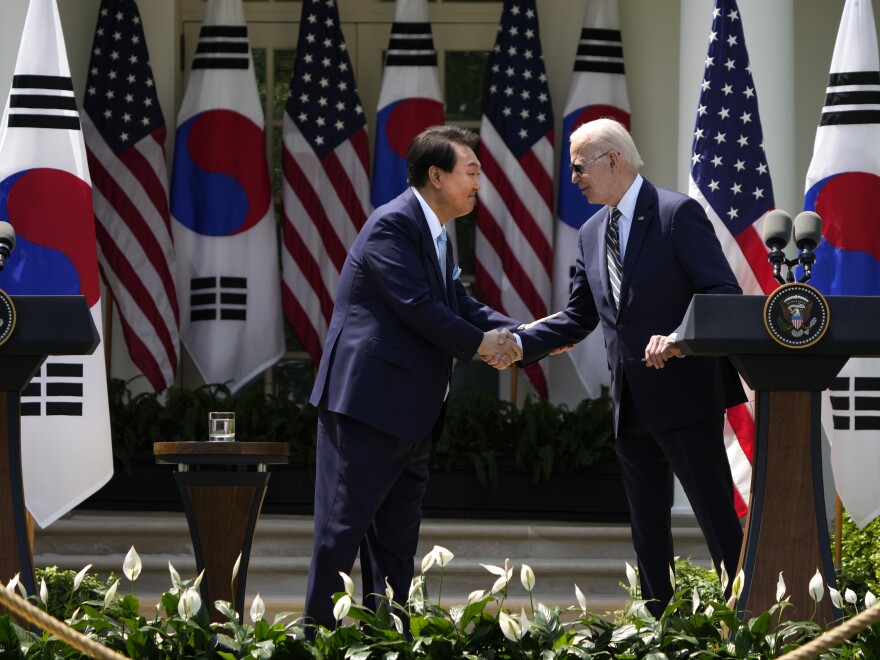
Getty ImagesPresident Biden and South Korean President Yoon Suk Yeol shake hands during a press conference in the Rose Garden at the White House.
Updated April 26, 2023 at 4:29 PM ET
President Biden on Tuesday said that any kind of nuclear attack from North Korea against South Korea or other U.S. allies would be met with an overwhelming response.
His remarks came during a state visit by by South Korean President Yoon Suk Yeol where the two leaders agreed to formalize a series to steps to try to deter North Korea.
"Look, a nuclear attack by North Korea against the United States or its allies ... or partners is unacceptable and will result in the end of whatever regime to take such an action," Biden said during a press conference with Yoon.
Biden said the United States plans to deploy a U.S. ballistic missile submarine to the western Pacific for the first time since the 1980s, to be followed by other U.S. military hardware.
Its part of what the two leaders called the "Washington Declaration," which establishes a consultative group to regularly discuss how to deter North Korea from using its nuclear weapons and plan responses to any actions — a group like what the U.S. had with European allies during the Cold War.
South Korea has been requesting and the U.S. has been promising to give Seoul a bigger say in how to deter North Korea, including more joint planning, consultation and intelligence sharing.
At the White House, Yoon said peace on the Korean Peninsula does not happen automatically.
"Our two leaders have decided to significantly strengthen extended deterrence of our two countries against North Korea's nuclear and missile threats so that we can achieve peace through the superiority of overwhelming forces, and not a false peace based on the goodwill of the other side," he said, through an interpreter.
The U.S. is stepping up joint military drills with South Korea, and the deployment of U.S. aircraft carriers, strategic bombers and submarines. In bilateral talks last November, U.S. Defense Secretary Lloyd Austin pledged to make such deployments a routine occurrence.
Washington has made it clear it will not redeploy tactical nuclear weapons to South Korea, as hawks in both countries have called for. President Yoon suggested in January that South Korea might have to acquire its own nuclear weapons, but the U.S. opposes the idea, and Yoon quickly backpedaled from his assertion.
As the declaration emphasizes U.S. commitments to defend South Korea, Seoul will in return reaffirm its commitment to the nuclear non-proliferation treaty.
North Korea this month tested a new solid fuel intercontinental ballistic missile, the latest addition to its growing nuclear arsenal. It has also revamped its nuclear doctrine to include the possibility of preemptive strikes.
South Koreans have long been inured to the threat from the North, but a jittery South Korean public has prompted Seoul to ask the U.S. for tougher deterrence measures. The announcements appear to be aimed at calming those jitters, by repackaging previous commitments or adding new material to existing policies.
NPR's Se Eun Gong contributed to this report in Seoul.
Copyright 2023 NPR. To see more, visit https://www.npr.org.
Biden says that a nuclear attack from North Korea would mean 'the end' of its regime
By Anthony Kuhn,
Franco Ordoñez
Published April 26, 2023 at 6:09 AM EDT
Drew Angerer
/
Getty ImagesPresident Biden and South Korean President Yoon Suk Yeol shake hands during a press conference in the Rose Garden at the White House.
Updated April 26, 2023 at 4:29 PM ET
President Biden on Tuesday said that any kind of nuclear attack from North Korea against South Korea or other U.S. allies would be met with an overwhelming response.
His remarks came during a state visit by by South Korean President Yoon Suk Yeol where the two leaders agreed to formalize a series to steps to try to deter North Korea.
"Look, a nuclear attack by North Korea against the United States or its allies ... or partners is unacceptable and will result in the end of whatever regime to take such an action," Biden said during a press conference with Yoon.
Biden said the United States plans to deploy a U.S. ballistic missile submarine to the western Pacific for the first time since the 1980s, to be followed by other U.S. military hardware.
Its part of what the two leaders called the "Washington Declaration," which establishes a consultative group to regularly discuss how to deter North Korea from using its nuclear weapons and plan responses to any actions — a group like what the U.S. had with European allies during the Cold War.
South Korea has been requesting and the U.S. has been promising to give Seoul a bigger say in how to deter North Korea, including more joint planning, consultation and intelligence sharing.
At the White House, Yoon said peace on the Korean Peninsula does not happen automatically.
"Our two leaders have decided to significantly strengthen extended deterrence of our two countries against North Korea's nuclear and missile threats so that we can achieve peace through the superiority of overwhelming forces, and not a false peace based on the goodwill of the other side," he said, through an interpreter.
The U.S. is stepping up joint military drills with South Korea, and the deployment of U.S. aircraft carriers, strategic bombers and submarines. In bilateral talks last November, U.S. Defense Secretary Lloyd Austin pledged to make such deployments a routine occurrence.
Washington has made it clear it will not redeploy tactical nuclear weapons to South Korea, as hawks in both countries have called for. President Yoon suggested in January that South Korea might have to acquire its own nuclear weapons, but the U.S. opposes the idea, and Yoon quickly backpedaled from his assertion.
As the declaration emphasizes U.S. commitments to defend South Korea, Seoul will in return reaffirm its commitment to the nuclear non-proliferation treaty.
North Korea this month tested a new solid fuel intercontinental ballistic missile, the latest addition to its growing nuclear arsenal. It has also revamped its nuclear doctrine to include the possibility of preemptive strikes.
South Koreans have long been inured to the threat from the North, but a jittery South Korean public has prompted Seoul to ask the U.S. for tougher deterrence measures. The announcements appear to be aimed at calming those jitters, by repackaging previous commitments or adding new material to existing policies.
NPR's Se Eun Gong contributed to this report in Seoul.
Copyright 2023 NPR. To see more, visit https://www.npr.org.
Yoon’s speech to Congress draws parallel between Russia’s invasion of Ukraine and Korean War | Stars and Stripes
Yoon’s speech to Congress draws parallel between Russia’s invasion of Ukraine and Korean War | Stars and Stripes
U.S.
Yoon’s speech to Congress draws parallel between Russia’s invasion of Ukraine and Korean War
By
DAVID CHOI
STARS AND STRIPES • April 27, 2023

South Korea’s President Yoon Suk Yeol addresses a joint session of Congress in Washington, Thursday, April 27, 2023. (Alex Brandon/AP)
South Korean President Yoon Suk Yeol on Thursday likened Russia’s invasion of Ukraine to North Korea’s attack against the South during the early 1950s as he commended the 70-year alliance between his country and the United States.
“Freedom and democracy are once again under threat,” he told U.S. lawmakers during a speech to a joint session of Congress. “When North Korea invaded us in 1950, democracies came running to help us. We fought together and kept our freedom.”
Since June, South Korea has shipped more than $100 million in aid to Ukraine in the form of vaccines, medical equipment, body armor and power generators.
Yet Yoon’s administration has denied sending lethal aid directly to Ukraine, citing its relationship with Russia. South Korea’s trade policies also mandate that exports must be for peaceful purposes and not “affect international peace, safety maintenance, and national security.”
Yoon’s speech on Capitol Hill — the first from a South Korean president since 2013 — was part of a U.S. visit that included a meeting and news conference at the White House, where he and President Joe Biden signed the Washington Declaration, a statement promising their two countries will “engage in deeper, cooperative decision-making on nuclear deterrence.”
The declaration reaffirms Washington’s commitment to defend Seoul by using “the full range of U.S. capabilities, including nuclear,” and states a North Korean nuclear attack against the South “will be met with a swift, overwhelming and decisive response.”
North Korea has fired 12 ballistic missiles in nine separate days of testing so far this year. In its last test on April 13, the regime fired what it described as a solid-fuel intercontinental ballistic missile into the Sea of Japan, or the East Sea.
In Yoon’s speech to U.S. lawmakers, he urged North Korea to “cease its provocations and take the right path” of denuclearization.
“My government will respond firmly to provocations,” Yoon said. “But at the same time, we will keep the door open for dialogue [with North Korea].”
South Korea’s path toward democracy and its status as the 10th largest economy in the world is a testament to the “mutually beneficial” relationship between Washington and Seoul, Yoon said.
He also vowed to “never forget the great American heroes who fought with us” and recounted the history of the Korean War and how “Korean and American soldiers stood shoulder to shoulder.”
“Korea’s freedom and democracy were on the brink,” Yoon said. “At that decisive moment, the U.S. did not look the other way.”
DAVID CHOI
David Choi is based in South Korea and reports on the U.S. military and foreign policy. He served in the U.S. Army and California Army National Guard. He graduated from the University of California, Los Angeles.
U.S.
Yoon’s speech to Congress draws parallel between Russia’s invasion of Ukraine and Korean War
By
DAVID CHOI
STARS AND STRIPES • April 27, 2023
South Korea’s President Yoon Suk Yeol addresses a joint session of Congress in Washington, Thursday, April 27, 2023. (Alex Brandon/AP)
South Korean President Yoon Suk Yeol on Thursday likened Russia’s invasion of Ukraine to North Korea’s attack against the South during the early 1950s as he commended the 70-year alliance between his country and the United States.
“Freedom and democracy are once again under threat,” he told U.S. lawmakers during a speech to a joint session of Congress. “When North Korea invaded us in 1950, democracies came running to help us. We fought together and kept our freedom.”
Since June, South Korea has shipped more than $100 million in aid to Ukraine in the form of vaccines, medical equipment, body armor and power generators.
Yet Yoon’s administration has denied sending lethal aid directly to Ukraine, citing its relationship with Russia. South Korea’s trade policies also mandate that exports must be for peaceful purposes and not “affect international peace, safety maintenance, and national security.”
Yoon’s speech on Capitol Hill — the first from a South Korean president since 2013 — was part of a U.S. visit that included a meeting and news conference at the White House, where he and President Joe Biden signed the Washington Declaration, a statement promising their two countries will “engage in deeper, cooperative decision-making on nuclear deterrence.”
The declaration reaffirms Washington’s commitment to defend Seoul by using “the full range of U.S. capabilities, including nuclear,” and states a North Korean nuclear attack against the South “will be met with a swift, overwhelming and decisive response.”
North Korea has fired 12 ballistic missiles in nine separate days of testing so far this year. In its last test on April 13, the regime fired what it described as a solid-fuel intercontinental ballistic missile into the Sea of Japan, or the East Sea.
In Yoon’s speech to U.S. lawmakers, he urged North Korea to “cease its provocations and take the right path” of denuclearization.
“My government will respond firmly to provocations,” Yoon said. “But at the same time, we will keep the door open for dialogue [with North Korea].”
South Korea’s path toward democracy and its status as the 10th largest economy in the world is a testament to the “mutually beneficial” relationship between Washington and Seoul, Yoon said.
He also vowed to “never forget the great American heroes who fought with us” and recounted the history of the Korean War and how “Korean and American soldiers stood shoulder to shoulder.”
“Korea’s freedom and democracy were on the brink,” Yoon said. “At that decisive moment, the U.S. did not look the other way.”
DAVID CHOI
David Choi is based in South Korea and reports on the U.S. military and foreign policy. He served in the U.S. Army and California Army National Guard. He graduated from the University of California, Los Angeles.
An Assessment of President Yoon’s State Visit to the White House
An Assessment of President Yoon’s State Visit to the White House
An Assessment of President Yoon’s State Visit to the White House

Photo: Chip Somodevilla/Getty Images
Critical Questions by Victor Cha
Published May 1, 2023
South Korean president Yoon Suk Yeol’s visit to the White House on April 26 was the fifth meeting with President Biden since their first summit held in Seoul in May 2022. The two leaders have built a good rapport through their continued engagement on the sidelines of the NATO Summit last summer, UN General Assembly in New York City this past fall, and the Association of Southeast Asian Nations (ASEAN) Summit in Phnom Penh last November.
Q1: What is the significance of Yoon being granted a state visit?
A1: A state visit is the highest honor bestowed by the White House on a visiting head of state. This was only the second such visit offered by the Biden administration (the other was to France) in large part because 2023 marks the 70th anniversary of the U.S.-Republic of Korea (ROK) alliance. The Biden administration also wishes to show strong support for Yoon’s foreign policy agenda which has shifted to deepening strategic ties with the United States and away from the hedging strategy of the previous administration.
Q2: What was the biggest takeaway from the summit?
A2: Aside from setting a high bar for musical performances by future world leaders at the White House, the main deliverable of the summit was the Washington Declaration. The declaration is the closest the alliance has come to a shared decisionmaking framework for the use of nuclear weapons in Korea, and effectively has committed the two allies to a nuclear planning group in the establishment of the Nuclear Consultation Group (NCG). NCG activities will include joint nuclear planning and execution concerning U.S. nuclear operations in a contingency, as well as exercising with U.S. Strategic Command. The United States also will maintain a regular rotation of air- and sea-based nuclear capable assets, starting with a nuclear ballistic missile submarine to South Korea for the first time since 1981. While this is not tantamount to the return of tactical nuclear weapons to the peninsula (as advocated by some), it does represent a presence of nuclear capable assets around the peninsula for deterrence and assurance purposes. The declaration is a significant document that sharpens the meaning and execution of the U.S. nuclear guarantee and will sit alongside the 1953 Mutual Defense Treaty.
Nevertheless, like most major documents or statements, the Washington Declaration has met some criticism in South Korea both from progressives and conservatives. The progressive opposition party has denounced the summit outcomes for warmongering and some from the conservative camp have criticized Yoon’s reaffirmation of South Korea’s nonnuclear status and compliance with the Non-Proliferation Treaty (NPT) during the summit. Neither criticism really holds water. Rather than warmongering, the Washington Declaration tries to address South Korean concerns that nuclear deterrence may not be strong enough to prevent North Korea from disturbing the peace. Yoon's statement on the NPT is simply a reiteration of existing South Korea policy, and is a responsible statement given all the loose talk and polling lately regarding nuclear weapons in South Korea. To have expected him to disavow the NPT during the summit would have been absurd.
Q3: Besides North Korea and extended deterrence, were there other noteworthy deliverables for the alliance?
A3: Yes, a lot. The two leaders used the 70th anniversary of the alliance to highlight and build the so-called New Frontiers agenda of the relationship. First, Biden and Yoon both featured the global nature of the alliance providing not just private goods to each party but also public goods for the world. Biden supported Yoon’s new global agenda, including hosting the next Democracy Summit, partnering with NATO (as member of NATO Asia-Pacific partners), and partnering with the G7. Yoon made about the boldest statements for an Asian leader on Ukraine, featured at the top of the joint statement, condemning Russia for war and for attacks against civilians and civilian infrastructure. The reference to attacks on civilians lines up with previous conditions Yoon has laid out for sending lethal equipment to Ukraine. Yoon has little room to maneuver under the current law, but his inclinations on this issue are clear as evidenced in this document and in his speech before a joint session of Congress.
Second, the two leaders used the summit to make significant progress on several New Frontier issues. There was a new joint statement on U.S.-ROK cooperation in quantum information science and technology and a new high-level Next Generation Critical and Emerging Technologies Dialogue (led by national security advisers). The two sides also agreed to establish a U.S.-ROK Strategic Cybersecurity Cooperation Framework. And it appears as though some streamlining of export controls policies will allow for more collaboration in space, that will facilitate more commercial and governmental cooperation in space. The two sides also affirmed continued cooperation on artificial intelligence (AI), biotechnology, medical products using AI, and biomanufacturing.
Q4: What are the takeaways on North Korean denuclearization and trilateral relations with the United States, Korea, and Japan?
A4: Biden and Yoon reiterated their commitment to diplomacy and denuclearization of North Korea, which was expected. The two put more emphasis, however, on human rights abuses in North Korea and also made explicit reference to aspirations for Korean unification in the joint statement, which was not seen in U.S. joint statements with the previous government.
On Japan, Biden made reference to Yoon’s “political courage” and leadership to take the initiative to improve South Korea's relations with Japan. This has become a regular adulation by White House officials regarding Yoon’s efforts with Japan. Behind the scenes, White House officials have expressed some frustration with the tepid response from Tokyo on the forced labor compensation deal and hope that Kishida will use an upcoming visit to South Korea in early May to do more. Biden and Yoon also made reference to economic security dialogues bilaterally and trilaterally with Japan. The latter suggests U.S. acceptance of a Yoon-proposed 2+2+2 on economic security.
Q5: How will China react to the U.S.-ROK summit?
A5: China will respond negatively to the summit. Yoon agreed to regularize anti-submarine and missile defense exercises, information-sharing, interdiction, anti-piracy, and also the Humanitarian Assistance and Disaster Relief (HADR) trilateral exercises with the United States and Japan. The commitment to missile defense exercises, China would say, is a violation of the “three no’s” agreement of the previous administration. The United States and South Korea also made a very strong (and new) statement on opposing economic coercion which clearly refers to China (though unnamed). South Korea also agreed to a new and strong statement on opposing any changes to the status quo in the Taiwan Straits through use of force, as well as “unlawful maritime claims, the militarization of reclaimed features, and coercive activities” in the South China Sea. All of these are new major statements that will surely anger China, as they demonstrate a clear shift by South Korea to the United States and away from the previous hedging strategy.
Q6: Were there any big deliverables on economic/trade issues?
A6: The Biden administration’s acknowledgment of the intent to work closely with the Yoon government on the Inflation Reduction Act (IRA), CHIPS and Science Act, and export controls suggests that going forward, there might be more consultation with Korea and other key partners on rule-making rather than unilateral disclosures. Yet there was no sense that any new measures had been offered at this summit.
On climate change, both sides reiterated their Nationally Determined Contributions under the Paris Agreement. They also remained committed to nuclear energy cooperation, but no apparent resolution was reached on the legal dispute between Westinghouse and KEPCO, which will hold up any further collaboration.
Victor Cha is senior vice president for Asia and Korea Chair at the Center for Strategic and International Studies (CSIS) in Washington, D.C.
Critical Questions is produced by the Center for Strategic and International Studies (CSIS), a private, tax-exempt institution focusing on international public policy issues. Its research is nonpartisan and nonproprietary. CSIS does not take specific policy positions. Accordingly, all views, positions, and conclusions expressed in this publication should be understood to be solely those of the author(s).
© 2023 by the Center for Strategic and International Studies. All rights reserved.
TagsKorea
An Assessment of President Yoon’s State Visit to the White House
Photo: Chip Somodevilla/Getty Images
Critical Questions by Victor Cha
Published May 1, 2023
South Korean president Yoon Suk Yeol’s visit to the White House on April 26 was the fifth meeting with President Biden since their first summit held in Seoul in May 2022. The two leaders have built a good rapport through their continued engagement on the sidelines of the NATO Summit last summer, UN General Assembly in New York City this past fall, and the Association of Southeast Asian Nations (ASEAN) Summit in Phnom Penh last November.
Q1: What is the significance of Yoon being granted a state visit?
A1: A state visit is the highest honor bestowed by the White House on a visiting head of state. This was only the second such visit offered by the Biden administration (the other was to France) in large part because 2023 marks the 70th anniversary of the U.S.-Republic of Korea (ROK) alliance. The Biden administration also wishes to show strong support for Yoon’s foreign policy agenda which has shifted to deepening strategic ties with the United States and away from the hedging strategy of the previous administration.
Q2: What was the biggest takeaway from the summit?
A2: Aside from setting a high bar for musical performances by future world leaders at the White House, the main deliverable of the summit was the Washington Declaration. The declaration is the closest the alliance has come to a shared decisionmaking framework for the use of nuclear weapons in Korea, and effectively has committed the two allies to a nuclear planning group in the establishment of the Nuclear Consultation Group (NCG). NCG activities will include joint nuclear planning and execution concerning U.S. nuclear operations in a contingency, as well as exercising with U.S. Strategic Command. The United States also will maintain a regular rotation of air- and sea-based nuclear capable assets, starting with a nuclear ballistic missile submarine to South Korea for the first time since 1981. While this is not tantamount to the return of tactical nuclear weapons to the peninsula (as advocated by some), it does represent a presence of nuclear capable assets around the peninsula for deterrence and assurance purposes. The declaration is a significant document that sharpens the meaning and execution of the U.S. nuclear guarantee and will sit alongside the 1953 Mutual Defense Treaty.
Nevertheless, like most major documents or statements, the Washington Declaration has met some criticism in South Korea both from progressives and conservatives. The progressive opposition party has denounced the summit outcomes for warmongering and some from the conservative camp have criticized Yoon’s reaffirmation of South Korea’s nonnuclear status and compliance with the Non-Proliferation Treaty (NPT) during the summit. Neither criticism really holds water. Rather than warmongering, the Washington Declaration tries to address South Korean concerns that nuclear deterrence may not be strong enough to prevent North Korea from disturbing the peace. Yoon's statement on the NPT is simply a reiteration of existing South Korea policy, and is a responsible statement given all the loose talk and polling lately regarding nuclear weapons in South Korea. To have expected him to disavow the NPT during the summit would have been absurd.
Q3: Besides North Korea and extended deterrence, were there other noteworthy deliverables for the alliance?
A3: Yes, a lot. The two leaders used the 70th anniversary of the alliance to highlight and build the so-called New Frontiers agenda of the relationship. First, Biden and Yoon both featured the global nature of the alliance providing not just private goods to each party but also public goods for the world. Biden supported Yoon’s new global agenda, including hosting the next Democracy Summit, partnering with NATO (as member of NATO Asia-Pacific partners), and partnering with the G7. Yoon made about the boldest statements for an Asian leader on Ukraine, featured at the top of the joint statement, condemning Russia for war and for attacks against civilians and civilian infrastructure. The reference to attacks on civilians lines up with previous conditions Yoon has laid out for sending lethal equipment to Ukraine. Yoon has little room to maneuver under the current law, but his inclinations on this issue are clear as evidenced in this document and in his speech before a joint session of Congress.
Second, the two leaders used the summit to make significant progress on several New Frontier issues. There was a new joint statement on U.S.-ROK cooperation in quantum information science and technology and a new high-level Next Generation Critical and Emerging Technologies Dialogue (led by national security advisers). The two sides also agreed to establish a U.S.-ROK Strategic Cybersecurity Cooperation Framework. And it appears as though some streamlining of export controls policies will allow for more collaboration in space, that will facilitate more commercial and governmental cooperation in space. The two sides also affirmed continued cooperation on artificial intelligence (AI), biotechnology, medical products using AI, and biomanufacturing.
Q4: What are the takeaways on North Korean denuclearization and trilateral relations with the United States, Korea, and Japan?
A4: Biden and Yoon reiterated their commitment to diplomacy and denuclearization of North Korea, which was expected. The two put more emphasis, however, on human rights abuses in North Korea and also made explicit reference to aspirations for Korean unification in the joint statement, which was not seen in U.S. joint statements with the previous government.
On Japan, Biden made reference to Yoon’s “political courage” and leadership to take the initiative to improve South Korea's relations with Japan. This has become a regular adulation by White House officials regarding Yoon’s efforts with Japan. Behind the scenes, White House officials have expressed some frustration with the tepid response from Tokyo on the forced labor compensation deal and hope that Kishida will use an upcoming visit to South Korea in early May to do more. Biden and Yoon also made reference to economic security dialogues bilaterally and trilaterally with Japan. The latter suggests U.S. acceptance of a Yoon-proposed 2+2+2 on economic security.
Q5: How will China react to the U.S.-ROK summit?
A5: China will respond negatively to the summit. Yoon agreed to regularize anti-submarine and missile defense exercises, information-sharing, interdiction, anti-piracy, and also the Humanitarian Assistance and Disaster Relief (HADR) trilateral exercises with the United States and Japan. The commitment to missile defense exercises, China would say, is a violation of the “three no’s” agreement of the previous administration. The United States and South Korea also made a very strong (and new) statement on opposing economic coercion which clearly refers to China (though unnamed). South Korea also agreed to a new and strong statement on opposing any changes to the status quo in the Taiwan Straits through use of force, as well as “unlawful maritime claims, the militarization of reclaimed features, and coercive activities” in the South China Sea. All of these are new major statements that will surely anger China, as they demonstrate a clear shift by South Korea to the United States and away from the previous hedging strategy.
Q6: Were there any big deliverables on economic/trade issues?
A6: The Biden administration’s acknowledgment of the intent to work closely with the Yoon government on the Inflation Reduction Act (IRA), CHIPS and Science Act, and export controls suggests that going forward, there might be more consultation with Korea and other key partners on rule-making rather than unilateral disclosures. Yet there was no sense that any new measures had been offered at this summit.
On climate change, both sides reiterated their Nationally Determined Contributions under the Paris Agreement. They also remained committed to nuclear energy cooperation, but no apparent resolution was reached on the legal dispute between Westinghouse and KEPCO, which will hold up any further collaboration.
Victor Cha is senior vice president for Asia and Korea Chair at the Center for Strategic and International Studies (CSIS) in Washington, D.C.
Critical Questions is produced by the Center for Strategic and International Studies (CSIS), a private, tax-exempt institution focusing on international public policy issues. Its research is nonpartisan and nonproprietary. CSIS does not take specific policy positions. Accordingly, all views, positions, and conclusions expressed in this publication should be understood to be solely those of the author(s).
© 2023 by the Center for Strategic and International Studies. All rights reserved.
TagsKorea
Biden-Yoon Summit: A Nuclear South Korea Is a Dangerous Miscalculation
Biden-Yoon Summit: A Nuclear South Korea Is a Dangerous Miscalculation
A Nuclear South Korea Is a Dangerous Miscalculation
At their upcoming summit, Biden needs to let Yoon know there would be consequences for breaking Seoul’s nonproliferation promises.

U.S. President Joe Biden has a tough task before him this week as he prepares to meet with South Korean President Yoon Suk-yeol. The countries face the shared threats of an increasingly capable nuclear North Korea as well as a likely significant nuclear buildup by China. The need for close cooperation on these and other international challenges, including Russia’s war in Ukraine and developing clean energy for climate change, could not be more urgent. That’s why it is especially concerning that some in South Korea are publicly entertaining the idea of the country developing its own nuclear weapons.
Even Yoon joined in when he said in January that if North Korea’s nuclear threat grows, South Korea would consider building its own arsenal. He later walked back these comments, but they attracted international attention, as it is incredibly rare for a country—let alone a democracy allied with the United States—to publicly muse about developing nuclear weapons.
It isn’t only Yoon who has flirted with the nuclear option. Oh Se-hoon, the mayor of Seoul and a potential future presidential contender, also called for the development of these weapons to address South Korea’s security needs. Though politicians have the biggest platforms on this issue, some of the strongest voices advocating for nuclear weapons emanate from prominent South Korean think tanks. Public opinion polls show high popular support for an indigenous nuclear arsenal, though that could change as the downside risks penetrate the public debate. A few polls and remarks from private citizens should not be given excessive credibility, but loose talk from leaders has consequences, and it’s time for South Korea to tighten up if it wants to continue playing a major leadership role in the global system. Biden needs to take advantage of the upcoming summit to make this clear.
The threats to Yoon’s country are real, but a South Korean nuclear weapons program is not the answer. The pursuit of these weapons by Seoul—a stalwart of the global nonproliferation regime and a country protected by the U.S. defense treaty and nuclear umbrella—would needlessly rupture some of the country’s most important geopolitical relationships. It would isolate South Korea, challenge its role as a major technology exporter in the global economy, and jeopardize both the U.S.-South Korean alliance and South Korea’s role as a major geopolitical player—not to mention increase nuclear risks in the region.
South Korea’s nuclear debate—and its extended deterrence relationship with the United States—has only become more complicated in light of Russia’s invasion of Ukraine. Some South Korean observers have made the questionable claim that Russian President Vladimir Putin’s nuclear threats have deterred direct U.S. military involvement in Ukraine and wondered whether North Korea might successfully employ the same tactics against the United States should it engage in conflict against the South. Moreover, it was only a few years ago that then-U.S. President Donald Trump attempted to coerce larger South Korean defense contributions by threatening to withdraw troops from the peninsula. The damage Trump did to confidence in U.S. security assurances in various geographies should not be underestimated. As a result, and despite considerable efforts by the Biden administration to repair the damage, South Korea is scrutinizing whether it can count on future U.S. presidents to uphold the alliance and the security guarantee it provides.
But South Korea will not solve its national security challenges by developing a nuclear deterrent. Doing so would instead invite new challenges and trigger consequences that would stymie Seoul’s rise as a global leader and imperil both economic prosperity and national security in the process. The South Korean government and its people must fully understand these dangers before they consider such a risky course.
READ MORE

Will South Korea Export Its Military Might to Ukraine?
The question looms large over a meeting between Biden and the South Korean leader this week.

South Korea Could Get Away With the Bomb
The global norm against nuclear proliferation is strong, but Seoul’s political and economic ties are stronger.

The U.S. Will Trade Seattle for Seoul
Cold War archives reveal why South Korea doesn’t need its own nuclear weapons to deter the North.
The global nonproliferation regime is designed with consequences in mind—many of which are steep. The United States has played an instrumental role in creating and sustaining this system. Since the mid-1960s, the United States has worked rigorously within this system to prevent nuclear proliferation to adversaries and allies alike. This policy should be no different for South Korea.
Washington has several tools at its disposal should South Korea breach its Nuclear Nonproliferation Treaty (NPT) obligations, enrich or reprocess any material provided by the United States under its civil nuclear cooperation arrangement, or receive enrichment or reprocessing technology from other sources. Should South Korea cross any of these red lines, the United States could, for example, terminate its nuclear energy cooperation with South Korea and end certain types of military sales and economic assistance, including U.S. credits or loans to South Korea. If South Korea went all the way and tested a nuclear device, the United States would be required under the 1977 Glenn Amendment to cease defense sales and the export of certain key technologies to a nuclear South Korea. Unlike the previous example, there are no waivers for Glenn Amendment sanctions, meaning that even if a future U.S. administration were reluctant to penalize Seoul, it would still be required to enact them.
Some of the harshest consequences would fall on Seoul’s energy sector. South Korea’s nuclear energy program—which provides nearly 30 percent of the country’s electricity—relies on the import of uranium fuel and would thus be impacted severely by the international response. That’s because countries that provide nuclear fuel as part of the Nuclear Suppliers Group would be required under international guidelines to cut South Korea off from these supplies if it abandons its safeguards agreement with the International Atomic Energy Agency, and many might choose to halt assistance even if South Korea did not cross that threshold. Beyond domestic energy supply, Seoul’s ambitious plan to be a leading nuclear reactor exporter, one of Yoon’s key policy goals, would be unlikely to succeed. Nuclear power has become more widely accepted as an important tool for combating climate change, and it is poised to expand in many parts of the world. South Korean nuclear reactor technology, with U.S. supply chain support, has already been deployed successfully in the United Arab Emirates, and failure to capitalize on this demonstrated success will likely open the way to more Russian and Chinese influence in the Middle East and beyond.
China, South Korea’s neighbor and largest trading partner, would be strongly opposed to a nuclear South Korea and would likely ratchet up military and economic pressure to prevent such a development. These sanctions would almost certainly go beyond those levied by Beijing following Seoul’s deployment of a U.S. missile defense system in 2017—an action that cost South Korea billions of dollars.
Most visibly, South Korea’s prestige and influence also would suffer tremendously if it decided to build nuclear weapons. It’s hard to see how a South Korea mired in controversy over a nuclear weapons program would be permitted to host major international meetings or attend a NATO summit, as Yoon did last year.
Instead of embarking on this pathway, which serves neither South Korea’s nor the United States’ interests, the countries should use the upcoming White House summit to further invest in their now 70-year-old alliance to address emerging challenges in ways that advance, rather than undermine, nuclear stability and nonproliferation. That means strengthening extended deterrence, including by tighter coordination of U.S. and South Korean military capabilities, and improved planning and communications mechanisms for peacetime and crises. It also means continuing to work toward an eventual nuclear weapons-free peninsula through renewed diplomacy with North Korea. For the United States, it means finding ways to manage strategic competition and avoid nuclear risks with China, however daunting those tasks may seem.
For his part, Yoon should use the summit to publicly reaffirm South Korea’s commitment to the NPT. Biden should applaud that commitment given the country’s worrisome security environment and, in return, reiterate the importance the United States attaches to its mutual defense obligations.
The security challenges facing Seoul and Washington are real—but so are the opportunities for advancing their deeply rooted alliance based on shared values and interests. South Korea’s pursuit of nuclear weapons would be a dangerous miscalculation. It’s a scenario neither country should countenance.
Ernest J. Moniz is co-chair and CEO of the Nuclear Threat Initiative. He served as the 13th U.S. energy secretary, from 2013 to January 2017. Twitter: @ErnestMoniz
Subscribe to:
Posts (Atom)