Showing posts with label Arundhati Roy. Show all posts

2025-09-07

Listening to Grasshoppers - Arundhati Roy

Listening to Grasshoppers - Wikipedia

Listening to Grasshoppers

From Wikipedia, the free encyclopedia
Listening to Grasshoppers
First edition
AuthorArundhati Roy
PublisherHamish Hamilton
Publication date
2009
Publication placeIndia

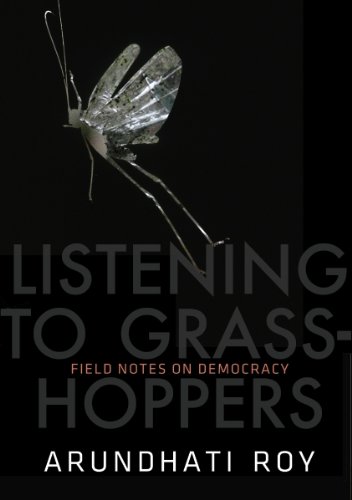
Listening to Grasshoppers: Field Notes on Democracy (2009) is a collection of essays written by Booker Prize winner Arundhati Roy. Written between 2002 and 2008, the essays have been published in various left-leaning newspapers and magazines in India. The first edition of the book consists of eleven essays with an introduction by Roy was published by Hamish Hamilton in India.

Reviews

Financial Times remarked about Roy over the book, "There is little doubt that Roy, with her eloquence, concern for the poor, and personal magnetism, is an important voice in the Indian public sphere. But the danger is that her extreme views – and her fierce hostility to a liberalisation programme that many Indians credit with dramatic improvements in their own lives – will alienate those whose support will be essential in India's struggle for social justice in the years ahead."[1]

Nirmalya Dutta harshly criticised her at Freepress Journal and wrote, "Roy should've stuck to writing fiction instead of creating fiction in news. That febrile imagination would’ve been better served creating genocidal maniacs in a Rowling-type literary tour de force than imagining genocides in the real world."[2]

Hindustan Times also reviewed the book, "The collection is thought-provoking, well-researched and worth reading. But in retrospect, the thin line between reportage, editorial writing, sermonising and the fine art of non-fiction essay writing seems to overlap too frequently in the anthology."[3]


eferences

 "Listening to Grasshoppers". www.ft.com. Retrieved 2021-08-02.

 "Arundhati Roy - the author who cried genocide". Free Press Journal. Retrieved 2021-08-02.

 "Arundhati's book takes a hard look at democracy". Hindustan Times. 2009-07-23. Retrieved 2021-08-02.


Categories: Indian essay collections

2009 non-fiction books

Books about politics of India

21st-century Indian books

Essay collections by Arundhati Roy

Hamish Hamilton books

=

eferences

=

Kindle$15.99
Available instantly
Hardcoverfrom $26.26
Paperback$24.99


Arundhati Roy

Listening to Grasshoppers: Field Notes on Democracy Kindle Edition
by Arundhati Roy (Author) Format: Kindle Edition


4.5 4.5 out of 5 stars (247)

This series of essays examines the dark side of democracy in contemporary India. It looks closely at how religious majoritarianism, cultural nationalism and neo-fascism simmer just under the surface of a country that projects itself as the world's largest democracy.

Beginning with the state-backed pogrom against Muslims in Gujarat in 2002, Arundhati Roy writes about how the combination of Hindu Nationalism and India's Neo-liberal economic reforms which began their journey together in the early 1990s are now turning India into a police state. She describes the systematic marginalization of religious and ethnic minorities - Muslim, Christian, Adivasi and Dalit, the rise of terrorism and the massive scale of displacement and dispossession of the poor by predatory corporations. The collection ends with an account of the of the August 2008 uprising of the people of Kashmir against India's military occupation and an analysis of the November 2008 attacks on Mumbai.

The Dark Side of Democracy tracks the fault-lines that threaten to destroy India's precarious democracy and send shockwaves through the region and beyond.
Read less


Print length

284 pages
From other countries

Kindle Customer

5.0 out of 5 stars Arundhati Roy continues to enlighten and inform on all issues ...

Reviewed in the United States on 11 April 2015

Verified Purchase

Arundhati Roy continues to enlighten and inform on all issues of importance to me and many others Her writing is exquisite!. She continues to go to remote places, places under siege, and at some risk to her own health and safety. Her courage and sense of purpose are admirable and one hopes she will continue to discover, analyze and write. Her wisdom is much needed and not appreciated enough.

One person found this helpful

Report


Arun

5.0 out of 5 stars Disturbing,but a must read

Reviewed in India on 28 May 2018

Verified Purchase

What a courageous book! You must have a guts to write such book. Raising several questions on how this so called democracy is being functioned and that too with enormous facts and figures. It is a chilling experience to read the real stories of 2001 parliament attack and how that was mishandled or rather deliberately mishandled.Still some hope exists that some people like her are still alive in this country who can fight against injustice.

3 people found this helpful

Report


Adelaide.123

5.0 out of 5 stars Brilliant polemic

Reviewed in the United Kingdom on 13 January 2014

Verified Purchase

This is a wonderful book. Roy scrupulously details the miscarriages of justice in her own country; injustices we should all know about. These range from simple government ignorance to endorsement of genocide.

I feel that the book serves as a crashcourse in Indian politics; a topic which I am ashamed to say I knew very little about. I strongly recommend this book to anyone with an interest in politics, Indian culture, religion, or someone who would like to acquire a plethora of new information. It is our duty as readers to know this.

2 people found this helpful

Report


Subbu

5.0 out of 5 stars Listening to grasshoppers: Field notes on Democracy

Reviewed in the United Kingdom on 24 October 2012

Verified Purchase

Listening to Grasshoppers: Field Notes on Democracy Good and very realistic presentations with thorough in-depth analysis of issues in the pseudo-democratic country called India! great work is the least I could say

One person found this helpful

Report


SK

5.0 out of 5 stars Excellent book

Reviewed in India on 9 November 2023

Verified Purchase

Excellent book that one must read to know what's happening behind the curtain of the Indian political scenario.

Report


Okienoah

5.0 out of 5 stars Field Notes on Democracy: Listening to Grasshoppers

Reviewed in the United States on 17 November 2009

Verified Purchase

Excellent book to read and ponder about the human behavior. Instead of harmonious living, religion plays a horrible role throughout the world. I wish democracy changed some of the human behavior, but so far, it did not. Field Notes on Democracy: Listening to Grasshoppers I am an avid reader of Arundhati Roy's books.

One person found this helpful

Report


Lokesh Bag

5.0 out of 5 stars Amazing book

Reviewed in India on 8 February 2018

Verified Purchase

Great book about democracy in India and its loopholes.. a must read.... It will open your eyes on media and government , political motives etc
==
BlackJack21

4.0 out of 5 stars Please Listen to the Grasshoppers:

Reviewed in the United States on 10 October 2012

Verified Purchase

In "Field Notes on Democracy" Arundhati Roy argues that India resembles a pseudo-democracy considering Muslims are being slaughter and relegated to second class citizen status, and since 9/11 the Indian government has used this U.S. tragedy as an excuse to further their genocidal program against these people. According to Roy, "The Muslim community has seen a sharp decline in its fortunes and is now at the bottom of the social pyramid, along with Dalits and Adivasis." The Adivasis are the indigenous inhabitants of India, while the Dalits are the oppressed. This is all transpiring because of the ideology of the Hindu Rashtra, which means Hindu nation.

Political parties such as Vishwa Hindu Parishad, Bajrang Dal, Shiv Sena, and the Bharatiya Janata Party are pushing their extreme rightwing agenda upon the general populace, and Arundhati Roy's essays emphatically thrust this issue to the surface, calling for immediate action. The main point she makes throughout this book is if India continues its political/sociological backslide; then democracy (mob-rule) as they perceive it will metastasize "into something dangerous," which means it will become a Failed State.

Most of the time when we contemplate on what a Failed State is we think of countries such as Afghanistan, Pakistan, and Somalia, we rarely look at countries such as India. Roy compares what's happening to Muslims and other groups in India to the 1915 Armenian genocide orchestrated by the Ottoman Turkic in Anatolia. The Armenians were the largest Christian minority living under their rule at the time.

Some examples of Indian governmental malfeasance, which Arundhati dares to point out are "the massacre of three thousand Sikhs in Delhi in 1984 and the massacres of Muslims in Mumbai in 1993 and in Gujarat in 2002." She compares the 2002 Gujarat massacre to other genocides such as Congo, Rwanda, and Bosnia, and even though Arundhati states the loss of life in Gujarat pales in comparison, her analogy needs to be emphasizes. The mass slaughter started because of "an unsolved crime-the burning of a railway coach in which fifty-three Hindu pilgrims were burned to death." Arundhati claims that the Indian squads of armed killers, organized by fascist militias were backed by the Gujarat government, which in-turn orchestrated the mass slaughter of two thousand Muslims. Muslim businesses, shrines and mosques were also destroyed, while women were gang-raped and burned alive. She also claims that the Indian government celebrates this sanguineous atrocity with pride. I would think this would cause trepidations in the International Community considering how unstable India is appearing to be.

Nonetheless, there are actual cases of the government allowing the people to starve to death even though India's "GDP growth rate is phenomenal, unprecedented." According to Roy, in 2003 "Reports of starvation and malnutrition (came) in from across the country." "The government allowed sixty-three million tons of grain to rot in its granaries. Twelve million tons were exported and sold at a subsidized price (and) the Indian government was not willing to offer the Indian poor" any. Furthermore, 47 percent of Indian children suffer from malnutrition and 46 percent are stunted, while 40 percent of rural population's grain absorption levels equal that of sub-Saharan Africa. "An average rural family eats about (220 pounds) less food in a year than it did in the early 1990's." Also India is suffering from mass privatization as nearly 70 percent of the rural population is being disenfranchised by this circumstance. The country of India has fallen even further into a state of entropy since the British no-longer occupy the region, and its feud with Pakistan isn't helping matters either.

Arundhati Roy details the events of the November 2008 Mumbai terrorist attacks, which were devastating, but she points out that there were other attacks equally devastating in nature. In the same year the cities and towns of "Ahmadabad, Bangalore, Delhi, Guwahati, Jaipur and Malegaon have all seen serial bomb blast in which hundreds of ordinary people have been killed and wounded." What she articulated throughout her essays is that the Indian parliamentary system isn't working in the interest of the people. She writes about accused terrorist such as Mohammad Afzal, S.A.R. Geelani and others being put on trial for the December 13, 2001 attack on the Parliament House in New Delhi and how the trials nearly ended in a kangaroo court scenario.


Overall, the essays are an eye-opener, from Governmental corporate fraud, media complicity, and the discombobulating of Democracy in India. Arundhati goes for the jugular; however, if you're not familiar with India's history then I suggest catching up on it before tackling this book. Moreover, two of the essays in this book appear in her previous books.


Chapter one: "Democracy Who's She at Home?" appears in her book "War Talk."

Chapter two: "How Deep Shall We Dig?" appears in her book "An Ordinary Person's Guide to Empire."


So, if you recently read those essays in her previous books then feel free to skip the first two chapters.

Just be cognizant of the fact, "Field Notes on Democracy Listening to Grasshoppers" is a dated work so these essays are not current. Some of them are dated as far back as ten years ago.


I hope Roy will continue to keep us informed on what's transpiring in India in the near future.


Other Books that should be read along this one are as follows:


John Pilger: "Freedom Next Time, Resisting the Empire"


Tariq Ali: "The Clash of Fundamentalisms"


Tariq Ali: "Speaking of Empire and Resistance"


Tariq Ali: "The Duel Pakistan on the Flight Path of American Power"


Christopher Hitchens: "God is not great"


Noam Chomsky: "Failed States and the Assault on Democracy"


Noam Chomsky: "Hegemony or Survival"


The Club of Rome: "Limits to Privatization How much is Too Much of a Good Thing"


I also highly recommend watching Patrick Swayze's movie "City of Joy" to learn a little about India's culture and rural infrastructure.

5 people found this helpful

Report


Rudi

4.0 out of 5 stars The unholy truth about India's democracy

Reviewed in the United Kingdom on 2 June 2010

Verified Purchase

Arundhati Roy peels the gloss of India's success, a valuable insight in India's democracy. You will see through a lot of media trickery and governmental statements after reading this book. Recommended.

4 people found this helpful

Report


peter shaw

5.0 out of 5 stars Five Stars

Reviewed in the United Kingdom on 18 June 2017

Verified Purchase

Good service, book a bit heavy going.

Report


==


From other countries


Shraddha upadhyay

4.0 out of 5 stars To question or not to question.

Reviewed in India on 3 August 2015

Verified Purchase

If you are inquisitive to get different perspective of the conditions that were prevailing in the past decade you should read such books. It enhance your questioning or analysing power. And certainly at the end you have your opinion about such issues. It was a nice experience reading this book' listening to grasshopper'

8 people found this helpful

Report


Chris

5.0 out of 5 stars Enlightening!!

Reviewed in the United States on 9 December 2011

Verified Purchase

Read this book and A Feast For Lambs with group. I just couldn't believe the picture of India I was reading in this book. This book really opened my eyes to the plight of the tribals and low castes in India. It's hard to believe all these politician-inspired genocides still take place like on a yearly basis in India. Makes you wonder why we do business with a country that still practice caste slavery and uses extreme violence to silence the underprivileged. I also recommend A Feast for Lambs by Thind, a powerful look at Hindu terrorism in the 80s A Feast for Lambs .

2 people found this helpful

Report


R1z

5.0 out of 5 stars I like arundhati's writing

Reviewed in India on 16 February 2016

Verified Purchase

Great book and fantastic writing. fast read and you will finish in one day even if you dont read much. I ordered all her other books as well.

The book talks about things which the common public has ignored. It is a good narrative against the main stream.

4 people found this helpful

Report


Enrique Romero

5.0 out of 5 stars Five Stars

Reviewed in the United States on 23 May 2017

Verified Purchase

great essays on the politics of india and the region. Great Book

Report


संजय @ बसेरा

3.0 out of 5 stars A Must Read Book

Reviewed in India on 26 August 2016

Verified Purchase

Book has mainly self reflection based on social and political events. The author is expert in writing any type of literature. It is a good thing that explicit analysis at least in one view is what reader gains through the reading.

5 people found this helpful

Report


StarStruck

5.0 out of 5 stars Beyond awesome

Reviewed in the United States on 16 May 2010

Verified Purchase

Arundhati Roy is one of the great thinkers of our time. This book exlains the world in ways most of us never thought. The knowledge learned in Fieldnotes on Democracy changed my views of democracy. PLEASE, everyone read it.

One person found this helpful

Report


SFT

5.0 out of 5 stars a must read

Reviewed in the United States on 17 November 2009

Verified Purchase

Arundhati Roy writes of the horrendous crimes against humanity in our times with such prose and elegance that one is capable of enduring the information. She deserves the highest honors for Her work.

6 people found this helpful

Report


Shahnawaz. Ahmed

5.0 out of 5 stars Interesting book

Reviewed in India on 4 March 2020

Verified Purchase

I continuously read 20 pages since I got the book.its interesting.

Report


P. Divakaran

4.0 out of 5 stars Indian Democracy exposed!

Reviewed in the United States on 7 June 2010

Verified Purchase

A collection of essays on behind the screen happenings of the largest democracy on earth!. Its worth a reading, whether you believe in or not in what Arundhathi say. One can feel the courage, anger and sarcasm on every page of this book. No wonder why corporate media and politians in Indian don't like her.

3 people found this helpful

Report


ARAFAT

5.0 out of 5 stars Worth reading

Reviewed in India on 1 January 2018

Verified Purchase

This is worth your time especially for those who has the courage to confront bitter truths. Arundhati Roy has very vividly explained the fault lines in our system.

One person found this helpful

Report


==

2025-09-06

‘The Interview’: Arundhati Roy on How to Survive in a ‘Culture of Fear’ - The New York Times

‘The Interview’: Arundhati Roy on How to Survive in a ‘Culture of Fear’ - The New York Times


The Interview

Arundhati Roy on How to Survive in a ‘Culture of Fear’Credit...Nishanth Radhakrishnan and Zishaan A Latif for The New York Times


Share full article


194


By Lulu Garcia-NavarroAug. 30, 2025


As we get older, we often struggle to understand the impact our parents have had on our lives. For the author Arundhati Roy, that process happened after her mother’s death in 2022 and resulted in her new memoir, “Mother Mary Comes to Me,” which will be published on Sept. 2. “I couldn’t write anything else until I wrote this,” she told me. “I was shocked by the quality of my grief.”

The book is partly a chronicle of Roy’s complex relationship with her mother, Mary Roy. Mary’s bouts of “clawing lashing fury,” as Roy describes them, scarred both her and her brother. But there was another side to Mary: her work fighting for education and women’s rights in India, which Roy greatly admired. The book, though, is not just about Roy’s mother. It is also a search for the roots of Roy’s own evolution into a writer determined to expose the pain and suffering of the world.

Roy has spent her career writing about the rich lives and deep struggles of marginalized and oppressed people in India. Her Booker Prize-winning first novel, “The God of Small Things,” made her an international literary star when it came out in 1997 — a celebrity that made her very uncomfortable, she told me. While she did publish a second novel in 2017, Roy spent most of the years after the Booker Prize writing articles about a range of injustices, from India’s caste system to the treatment of Muslims, especially in the India-administered portion of Kashmir. Because of that work and her political activism, Roy has been targeted repeatedly by India’s government under the populist leader Prime Minister Narendra Modi.

When we spoke twice earlier this month, we started by talking about her mother and her memoir but ended up discussing the cost of speaking out and the parallels she sees between India under Modi and America under President Trump.

Your mother was a very complicated and difficult person, as you describe her. While I was reading your book, it reminded me of a quote by the writer Czeslaw Milosz, who wrote, “When a writer is born into a family, the family is finished.” Did you struggle with how much to reveal about your mother and your family? When you write something like this, you choose what you write and what you won’t write. But I know that this doesn’t work as literature if you’re trying to present some acceptable version of yourself or of her. Then you might as well not do it. But it wasn’t so much of a struggle because what was incredible about her was that there was a part of her that hammered me but then it also created me. There was this public part of her, which was so extraordinary, so I could never settle on what I really thought or felt. The entire range was a challenge to me as a writer: Can I put down this unresolvable character?

Arundhati with her brother and mother in front of their house in Tamil Nadu in the early 1960s. Credit...From Arundhati Roy


Let’s talk about that public part of her before we get to her as your mother. Tell me about who she was outside of your relationship. She belonged to the Syrian Christian community in Kerala, which is a tiny but privileged community that’s insulated from the wildness and the poverty of the rest of India. But she married outside the community and then got divorced, which was absolute taboo. She started a small school initially in the rented premises of the Rotary Club. I used to think of it as a sliding, folding school because we had to sweep up all the stubs and the coffee cups of the men and put out our furniture, and they would come the next day and mess it up again. Then ultimately she built this beautiful school, which still runs. I studied there too in the early years.

But what she’s equally well known for is that when she left her husband, my father, we lived in this tiny little cottage [in Tamil Nadu] that used to belong to her very cruel father, who was dead by then. Her mother and her older brother came there, and they asked us to leave the house and said that, according to the Travancore Christian Succession Act, a daughter can inherit a quarter of her father’s property or 5,000 rupees, whichever is less. So we were literally going to be turfed out onto this road in the middle of the night by my grandmother and my uncle. We ran to the lawyer, and he told us that law applies in Kerala but not in Tamil Nadu. So we weren’t kicked out, but she nurtured this humiliation and kept it to herself for a long time. When she could afford to, she filed an appeal to the Supreme Court challenging this law, calling it unconstitutional. And the Supreme Court actually struck it down with retrospective effect and made it equal inheritance for everybody.

So there’s that side of your mother. You start the book, though, discussing how you were raised by her. Your early life was one of hardship, poverty, instability and abuse, both verbal and physical. I should ask before we continue, is “abusive” the word that feels right to you in describing your relationship to her? I flinch. I didn’t use any of these words in the book. If it was a single thing that one was dealing with — if it was just abuse or just violence or just one thing that you could settle on and decide how to feel about it, that’s one thing. But I had a schism in me very early. Even as a young child, I could see that her anger against me and my brother was somehow connected to what she herself was going through. So one half of me was taking the hits and the other half was taking notes. That, in a sense, made me a writer very early, where you’re trying to understand, Why is she doing this to me?

Some of the moments that were hardest to read about were when she would berate you, belittle you. You tell a story about being on a plane for the first time when you were about 6 years old. Can you recount that story? My mother had an older sister who was very different from the rest of the family. She was married to a pilot who worked in Indian Airlines, and she had a proper house and a proper husband and proper children. Because this uncle of mine was a pilot, we had free tickets to get on a plane, which we had never been on. And on the plane, I asked my mother how come her sister was so much thinner than her. My mother was a very severe asthmatic, and at the time she was on steroids and had become very overweight. She just turned on me in a fury and mimicked me. She had this way of mimicking my baby way of speaking, and that used to just rip through me. And then she said, By the time you’re my age, you’ll be three times my size. And, of course, very quickly, she said, I’m your mother and your father and I love you double. So you forgive her, and yet you’re shredded. That was the constant thing that you had to manage, that something would tear you up and then stitch you back together, then tear you up, then stitch you back together.


Credit...Nishanth Radhakrishnan for The New York Times


You write that her mimicking you and calling you names made you feel that “I swirled like water down a sink and disappeared.” I think that anyone who has had a difficult parent, which I have, can identify with that line. Did you think that you had to disappear when she was attacking you? Yeah. She was the only parent and also the only person in a society and in a family that makes it clear that you’re not part of it. So she’s all you have. I mean, there are no relatives. There are no neighbors. There’s just nobody. So I welded myself to her when I was very young. And then exploded apart when I was older.

She had these terrible attacks of asthma, and she used to keep telling me, I’m going to die, and you better figure out what you’re going to do. Who’s going to look after you? And so I became like her lung. I used to breathe for her. My body was an extension of her body. And then when I was 16 and I went to architecture school and I walked into those lawns and watched all the students, I knew that I would be fine. I would be able to work. I would be able to survive. I wouldn’t die if she died. I didn’t have to breathe for her. And she sensed that the valiant organ child of hers, the lung, suddenly was breathing for itself. That generated a whole lot of hostility. But I don’t want this to end up like some litany of horrors about her because as I keep saying in the book, I had huge admiration for her too.

You talk about the battles that she was fighting even within the school, how she taught women and men to look at gender dynamics in a completely different way. You tell a story about her making the boys parade around in bras because one of them had disrespected one of the girls. Not parade around, but she learned that they were making fun of the girls because they’d started wearing bras. So she said, Go to my cupboard and get my bra. And then she showed them. She said, This is a bra, this is what it’s for, and if it excites you so much, you can keep mine. It changes the pH balance of what goes on between boys and girls when the girls know that there’s someone who’s got their back.

In the book you describe India as the land of son worshipers. You also describe how harsh your mother was with your brother in particular. She would call him a male chauvinist pig when he was only a child. When he was a teenager, she said to him, “You’re ugly and stupid, you should kill yourself.” You write that the way she treated him was like she was punishing him for the sins of the world, and that complicated your own views of feminism. How did that play out for you? My brother is one of the most amazing people that I know. My brother’s the one that asked me, “I don’t understand how you can be so upset about her death after everything that she did to us.” And I understand that it’s very puzzling for him and perhaps even hurtful that I don’t hate her. I think it’s because I see that her public battles were making space for women in ways that included making space for me. But at the same time, just because you’re a feminist doesn’t make you a great person. Feminism doesn’t have only to do with women’s rights. It has to do with a way of looking at the world in which men and women are equal and men and women are respectful of each other. It doesn’t mean disrespecting a lovely man, which is what I saw happening with my brother. It affected me deeply.

What have the conversations around this book been like? Has he read it? He has read it, and it was hard initially for him to read, because maybe he thought he had put it behind him. But then he wrote to me saying, I’m laughing and crying and I can’t breathe and if I die, it’ll be your fault. He did say, I don’t understand why you feel so much about her. I said I can’t hate her because there is so much of her in me, I’d have to hate myself.

There is this other moment that really struck me. You and your brother are being sent to boarding school. And you write that your brother got a report from school that said “average student,” and your mother beat him with a ruler until it broke. And in the morning, she turned to you and gave you a hug because your report card had been good and said that you were brilliant. And you wrote, “On the occasions when I am toasted or applauded, I always feel that someone else, someone quiet, is being beaten in the other room.” That stopped me in my tracks. I think the sentence after that is, “If you stop to think about it, it’s true, someone is.” When you get applauded and rewarded and everybody claps and you know that somebody you love and somebody quiet has been beaten — to me that expands far beyond my brother and me. It expands into the country that I live in now or the world. I might be a writer with whatever is conventionally known as success. But the things I write about and the people that I write about are being beaten, even as we speak today. They are being starved in Gaza, they are being broken, they’re being occupied. And so what does it mean when you are applauded, when your heart belongs in the whole world?

Roy after winning the Booker Prize for her debut novel “The God of Small Things” in 1997.Credit...Stefan Rousseau/Associated Press


When you wrote that section and were thinking about that incident and how it applies to your life, was it a sense of discovery? No, I don’t think that the process of writing this made me understand it deeper. I wrote it because I understood it. In order to survive or to make sense of my life, I’ve had to think and think and think about all these things. When I won the Booker Prize, there was more than one half of me that was thinking, What does it mean to be this best-selling novelist in this country where people can’t read, in this country hurtling toward what we have now? So there was hardly a moment for me to feel great about myself before things started to unravel quickly. Even the celebration of me had this whole nationalistic fervor, which I despised at that time, in ’97. So I was very quickly kicked off that pedestal, and I kicked myself off it too. I always have this feeling that those of us who’ve been very unsafe as children, we seek out the unsafe. We seek out the lack of security, and if you have security, you blow it up.

You’ve risked your security many times in your career. You are under legal threat in India for your writing and things that you’ve said. What do you think the role of writers and creators is at a moment when there is censorship and people are trying to shut you down? Whether it’s in the Soviet Union or whether it is in East Germany or in the darkest places and times, writers have managed to survive. Their work has survived. For me it’s very important to understand that I just can’t keep striking the same note again and again. You have to change it up, you have to experiment, you have to insist that your work is not just a reaction to what’s happening to you. Your work is a thing in and of itself, a way of positing another vision of the world. And that’s a challenge because you can’t do it as a manifesto, hitting everybody on the head with some ideological hammer. You’ve got to do it beautifully. Somebody told me the other day, “Oh, the reason I like your writing is because you write as though they’ve already killed you. [Laughs.] You don’t hold back.”
Sign up for The Interview Hosts David Marchese and Lulu Garcia-Navarro talk to the world’s most fascinating people. Get it sent to your inbox.

Just in the past few days, the Indian regional government of Kashmir has banned one of your books. The book is “Azadi,” which was published in 2020. It’s about the fight in India-controlled Kashmir and the concepts behind freedom and authoritarianism more broadly. The directive said that your book and others — yours wasn’t the only one that was targeted — would “deeply impact the psyche of youth by promoting a culture of grievance, victimhood and terrorist heroism.” Why do you think your book was included in that list, and what’s your response to that more broadly? My response is to not respond, because I don’t know. It sounds like some list they got out of ChatGPT. You never know why these things happen when they happen. When they target me now, I just don’t say anything, because you never know whether they really mean it or it’s just some side game to distract from something. I have no idea, so I’m not really going to say much about it.

You are currently under threat of arrest in India for comments you made about Kashmir in 2010. Do you feel comfortable explaining your position? And can you tell me a little bit about the status of that legal case? I really don’t want to talk about it, actually, because it just increases the risk of something being taken out of context and something blowing up. It’s dormant right now, so I just let it be.

Image
Roy participates in a demonstration held by the National Alliance of People’s Movement, in New Delhi in 2006. The demonstration opposed letting agricultural land be used for a car factory.Credit...Manish Swarup/Associated Press


Even the manner in which you’re responding, which is that you do not want to address this because of the fear of legal repercussions, what does that say? Well, I think in America you’re beginning to head in that direction. Ours started a long time ago, and one has to learn how to navigate it. And the reason that I don’t talk about it is because I would much rather write what I want to write than have some controversy about something you say off the cuff. It’s like they’re always trying to trip people up and trying to prevent you from thinking clearly. This culture of fear is everywhere here. People are arrested for things they say on Facebook, on Twitter, or what they don’t say. In the U.S., it seems new to you, but we have been living with this, and it’s increasingly becoming normalized. It’s a very disturbing situation, especially for Muslims, where it doesn’t stop with just court cases and jail. It goes on to lynching and murder and social boycotts and economic boycotts and homes being bulldozed. You meet people who have stories that you can’t look away from.

You touched on this a little, and so I would love to hear your thoughts on how you view parallels between the Hindu-nationalist movement in India and the MAGA movement here in the United States. There are a lot of parallels. One of the first things that happened when Modi came to power was demonetization — this direct hit on the economy, where he said 500-rupee notes were illegal, like, overnight. If you look at the attack on citizenship, the attack on universities, the attack on students, the attack on Rohingyas, the continuous uncertainty, the fact that you might be ambushed by anything at any time — it’s so similar that you wonder, is there a playbook or is it just osmotic authoritarian behavior? The ruling party is confused with the government and all of it is confused with one man. So you’re seeing that in the U.S., and I look at it in shock. You thought that there was a mechanism in place, there were checks and balances in place. But clearly there isn’t a way of handling someone who’s completely out of control. The way statisticians are being fired for giving out figures that the authoritarian doesn’t agree with — same thing here, you can’t believe any of the government figures on economics because everything that doesn’t suit the ruling establishment is dismissed, it’s thrown away, and a new picture is put in its place.

The one big difference is that in India, the mainstream media has completely compromised. It’s not just rolled over, it is actually an organ of the authoritarian state. It’s actually calling for people’s arrest or making up lies. And of course America is sitting on top of a crumbling world. Whatever Trump does affects the whole world, whereas here, it just affects this country.


Why do you think authoritarian leaders go after people like you, people who deal in ideas? When you said there’s a playbook, we’ve seen that in places all around the world. From time immemorial.

But as someone who’s the subject of that kind of censure, I’m wondering why you think it happens. They are terrified of people who they feel can communicate, not just cerebrally, but emotionally. However small they are, and even however little access they have to the mainstream or to the thundering, pulpit-thumping television anchors, they know there are some people who people eventually do listen to. They know who is read. They know who is loved. They also know who is not invested in the things that everyone else is invested in — fame and money and awards. There are a lot of people like that who they know will not bow down. We are just people who look at things and say it how it is.

This interview has been edited and condensed from two conversations. Listen to and follow “The Interview” on Apple Podcasts, Spotify, YouTube, iHeartRadio, Amazon Music or the New York Times Audio app.

===

Lulu Garcia-Navarro is a writer and co-host of The Interview, a series focused on interviewing the world’s most fascinating people.
A version of this article appears in print on Sept. 7, 2025, Page 11 of the Sunday Magazine with the headline: Arundhati Roy Knows Where America Is Headed. Order Reprints | Today’s Paper | Subscribe
See more on: U.S. Politics, Donald Trump, Narendra Modi

Read 194 Comments
Share full article


194

2025-09-05

Mother Mary Comes To Me: Roy, Arundhati: Amazon.com.au: Books

Mother Mary Comes To Me eBook : Roy, Arundhati: Amazon.com.au: Books

Kindle $19.99
Audiobook
Hardcover$45.52
Paperback  $27.75


Follow the author

Arundhati RoyArundhati Roy
Follow


Mother Mary Comes To Me 
by Arundhati Roy (Author) 


Chapters
  1. Gangster15:07
  2. Fugitives13:27
  3. The Cosmopolitans10:21
  4. ‘I Love You Double’08:05
  5. The Sliding-Folding School08:55
  6. Federico Fellini and the Kottayam Santa14:11
  7. Collateral09:33
  8. The Naxalites12:48
  9. I’m All for the Unconquered Moon03:15
  10. Laurie Baker and the Bald Hill17:19
  11. Joe, Jimi, Janis and Jesus10:41
  12. ‘How’s That Crazy Mother of Yours?’21:28
  13. ‘You’re a Millstone Around My Neck’19:18
  14. ‘Doesn’t She Sound Like That Person in The Exorcist ?’19:32
  15. In Which Jesus Marries a Japanese Parcel14:54
  16. Cake Walkin’ Baby13:13
  17. In the Shade of Hazrat Nizamuddin Auliya10:14
  18. ‘What’s So Funny?’19:45
  19. They’re Gonna Put Me in the Movies16:14
  20. ‘Have You Ever Considered Becoming a Writer?’21:05
  21. Mama Bear, Papa Bear41:00
  22. The Exquisite Art of Failure14:02
  23. Flying Rhinos and the Banyan Tree18:28
  24. In Which Annie Gives It Those Ones14:38
  25. Blasphemy10:16
  26. ‘You Are Not Showing India in a Proper Light’10:26
  27. The Band Breaks Up11:36
  28. The Great Indian Rape-Trick12:50
  29. The God of Small Things40:27
  30. Things Fall Apart15:11
  31. Mobile Republic07:24
  32. Rally for the Valley25:06
  33. More Trouble with the Law17:11
  34. Jailbird17:41
  35. My Seditious Heart11:26
  36. A Home of My Own05:05
  37. Utmost Happiness07:12
  38. Madam Houdini and the Nothing Man44:26
  39. Walking with the Comrades29:10
  40. ‘Her Birth Certificate Was an Apology from God’11:11
  41. Retreat13:17
  42. A Declaration of Love28:59
Closing Credits01:01
===
In her memoir, Mother Mary Comes to Me, Arundhati Roy presents a candid and complex portrait of her relationship with her formidable mother, Mary Roy. The book is a poignant reflection on her life, sparked by the death of her mother in 2022. Roy recounts how her mother, a single parent in a conservative society, was both a "shelter" and a "storm," a revolutionary figure who fought for women's rights and education, but whose volatile nature and unconventional parenting shaped Roy's life in profound and often difficult ways.

The memoir traces Roy's journey from a childhood in Kerala marked by her mother's fierce independence and at times, "brutal journalistic brevity" in her interactions, to her own path as a writer and political activist. The narrative seamlessly weaves together the personal and the political, showing how her mother's battles—including a landmark legal case to secure inheritance rights for Christian women—influenced her own critical and rebellious spirit.

Roy's writing is characterized by the same lyrical prose and sharp political clarity found in her celebrated novels, The God of Small Things and The Ministry of Utmost Happiness. However, in this memoir, she adds a new layer of raw, personal honesty. She explores the paradoxes of her love for her mother, acknowledging the cruelty she endured while also crediting her mother with fostering the independence and strength that allowed her to become the person and the writer she is today.

Ultimately, Mother Mary Comes to Me is not just a memoir of a mother-daughter relationship, but an ode to freedom, a tribute to the "thorny love" that shapes us, and a testament to the enduring legacies of two extraordinary women.
===

===

4.8 4.8 out of 5 stars (8)

The incredible first memoir from the Booker-winning radical icon Arundhati Roy, author of The God of Small Things

Arundhati Roy’s first work of memoir, this is a soaring account, both intimate and inspiring, of how the author became the person and the writer she is, shaped by circumstance, but above all by her relationship to her extraordinary, singular mother Mary, who she describes as ‘my shelter and my storm’.

Distraught and even a “little ashamed” at the intensity of her response to the death of the mother she ran from at age eighteen, Arundhati began to write Mother Mary Comes to Me. The result is this astonishing, disconcerting, surprisingly funny chronicle—unique and simultaneously universal, of the author’s life, from childhood to the present, from Kerala to Delhi.

With the scale, sweep, and depth of her novels and the passion, political clarity, and warmth of her essays, Mother Mary Comes to Me is an ode to freedom, a tribute to thorny love and savage grace—a memoir like no other.

377 pages

2025-08-30

The God of Small Things - Wikipedia

The God of Small Things - Wikipedia


The God of Small Things

From Wikipedia, the free encyclopedia
The God of Small Things
First edition
AuthorArundhati Roy
Cover artistSanjeev Saith
LanguageEnglish
GenreNovel
PublisherRandom House (USA)
Random House of Canada (Canada)
HarperCollins (UK)
RST IndiaInk & Penguin Books (India)
Publication date
15 March 1997
Publication placeIndia
Media typePrint (hardback & paperback)
AwardsBooker Prize (1997)
ISBN0-06-097749-3
OCLC37864514
Followed byThe Ministry of Utmost Happiness (2017) 

The God of Small Things is a domestic fiction written by the Indian author Arundhati Roy. It is a story about childhood experiences of the fraternal twins whose lives are destroyed by the "Love Laws" prevalent in the 1960s in KeralaIndia. The novel explores how small, seemingly insignificant occurrences, decisions and experiences shape people's behavior in deeply significant ways. The novel also explores the lingering effects of casteism in India and British colonialism in India, and has become a staple in postcolonial literature. The novel won the Booker Prize in 1997.

The God of Small Things was Roy's debut novel, published in 1997. It was followed by the 2017 publication The Ministry of Utmost Happiness twenty years later. Roy began writing the manuscript for The God of Small Things in 1992 and finished four years later, in 1996, leading to its publication the following year. The potential of the story was first recognized by HarperCollins editor Pankaj Mishra, who sent it to three British publishers. Roy received a £500,000 advance, and the rights to the book were sold in 21 countries.

Background

Inspiration

Arundhati Roy

Arundhati Roy, after being involved with making films and writing screenplays, popularly In Which Annie Gives It Those Ones and Electric Moon, "wanted to do something where I didn't have to deal with people; I wanted to do something alone." She bought a computer and soon figured out how to use it. She noted she didn't know she was writing a novel.[1] Roy took inspiration from her childhood experiences in Aymanam, a village in the Kottayam district of KeralaIndia, where she led an unprotected child's life. Being an "adult child", Roy observed and remembered what she sensed in the village and "said everything I wanted to say at that point of time" through writing the novel.[2][3][1]

Writing

Roy began writing her first novel on her computer in 1992 in New Delhi, though the first few months she "was just fooling around before I realized what was happening and got down to writing the book properly" and completed it in 1996.[1][4][5] Without a plan, she enjoyed that her writing "kept surprising" her and was unsure if she would ever finish it.[1] She didn't tell to her friends or her husband Pradip Krishen about her writing, "afraid she would talk the tale out". Krishen adored when she showed him her final draft.[6] She "wrote it out of sequence. I didn't start with the first chapter or end with the last chapter. I actually started writing with a single image in my head: the sky blue Plymouth with two twins inside it, a Marxist procession surrounding it. And it just developed from there. The language just started weaving together, sentence by sentence."[7]

Roy stated that she never rewrote a written sentence in the novel and that arranging the plot took time, "but was never painful."[8] Roy said that the novel is semi-autobiographical. For instance, she modelled some of her characters from those she knew in real life, like her mother Mary Roy as Ammu, her maternal grandfather P.V. Issac as Pappachi, her uncle George Issac as Chacko, his ex-wife Cecilia Philipson as Margaret Kochamma just to say a few.[9] Roy's mother confirmed she was very similar to the character Ammu, however, she was never involved with a man of lower caste, as was the case in the book is another instance.[10]

Training as an architect influenced her writing. One day, she "woke up and sketched the plot graphically with a series of drawings. That's when I understood what I was getting at."[6] Writing the novel was "about design" and "like architecture" for her. She told Salon in 1997:

"In buildings, there are design motifs that occur again and again, that repeat—patterns, curves. These motifs help us feel comfortable in a physical space. And the same works in writing, I've found. For me, the way words, punctuation and paragraphs fall on the page is important as well—the graphic design of the language. That was why the words and thoughts of Estha and Rahel, the twins, were so playful on the page... I was being creative with their design. Words were broken apart, and then sometimes fused together. 'Later' became 'Lay. Ter.' 'An owl' became 'A Nowl.' 'Sour metal smell' became 'sourmetal smell.'"[7]

Title

The novel's title was conceived at "the very last minute" while the manuscript was going to press. Speaking to HarperCollins, Roy said: "One of the chapters was called The God of Small Things, I don't know how that happened, ... When I read the book now I can't believe the amount of references there are to small things, but it was absolutely not the case that I started with the title and built the novel around it."[1]

Publication

The God of Small Things was published by various publishers in 1997. The potential of the story was first recognized by HarperCollins editor Pankaj Mishra, who sent it to three British publishers. The rights for the novel were auctioned by her British agent, David Godwin, for $250,000 in the UK and $160,000 to Random House in New York. Godwin was alerted by Mishra, who took the manuscript along on a train trip and "overcome with excitement, broke the journey midway to telephone his congratulations to Roy." Godwin, after reading a sample chapter in London, "booked the first flight to India on impulse ... and signed her up on the spot". Roy was paid $1.6 million in advance. She felt pressure to live up to her massive advance, but she said, "It's their business risk, ... I trust my book."[6][11]

Plot

The story is set in AyemenemKerala, with a disjointed narrative shifting between 1969 and 1993. Rahel and Estha, fraternal twins, reunite in 1993. Ammu Ipe, their mother, marries Baba to escape her father and returns to Ayemenem after leaving her abusive husband. Chacko, Ammu's brother, returns from England after his divorce. The family home includes Baby Kochamma, Pappachi's sister, who remained unmarried due to unrequited love. She manipulates events to cause misfortune.

The death of Margaret's second husband in a car accident prompts Chacko to invite her and their daughter, Sophie, to spend Christmas in Ayemenem. On the road to the airport, the family encounters a group of Communist protesters who surround the car and humiliate Baby Kochamma. Rahel thinks she sees amongst the protesters Velutha, an Untouchable servant who works for the family's pickle factory. Later at the theater, Estha is sexually molested by the "Orangedrink Lemondrink Man", a vendor working at the snack counter. Rahel's claim of seeing Velutha in the Communist mob leads Baby Kochamma to associate him with her humiliation. Rahel and Estha develop a bond with Velutha, while Ammu is drawn to him, sparking a forbidden romance. Velutha is depicted as sympathetic but faces tragedy due to his caste and relationship with Ammu. When Velutha's father exposes their affair, Ammu is locked up, and Velutha is banished. Ammu blames the twins for her plight, leading them to flee with their cousin Sophie. Their boat capsizes and Sophie drowns; Margaret and Chacko return to find Sophie dead on the sofa.

It didn't matter that the story had begun, because Kathakali discovered long ago that the secret of the Great Stories is that they have no secrets. The Great Stories are the ones you have heard and want to hear again. The ones you can enter anywhere and inhabit comfortably. They don't deceive you with thrills and trick endings.

— The God of Small Things

Baby Kochamma accuses Velutha of Sophie's death, leading to his brutal beating and arrest by the police. The twins witness this traumatic event. The chief of police, aware of Velutha's Communist ties, fears unrest if the wrongful arrest is exposed. He threatens Baby Kochamma for falsely accusing Velutha. To save herself, Baby Kochamma manipulates Estha and Rahel into implicating Velutha in Sophie's murder. Velutha dies from his injuries. Despite Ammu's attempts to tell the truth, Baby Kochamma convinces Chacko that Ammu and the twins are responsible for Sophie's death. Chacko ejects Ammu from the house, separating Estha from her forever. Ammu dies alone in a motel at 31. Rahel moves to America to attend university but returns to Ayemenem after a tumultuous life. She reunites with Estha, who has lived a solitary, mute existence with Baby Kochamma. They have sex. Despite their reunion, their lives remain sorrowful. The novel concludes with a reflection on Ammu's and Velutha's love affair.

Characters

Major Characters

  • Estha, the male protagonist of the novel; Rahel's twin brother, a serious, intelligent and somewhat nervous child, who experiences trauma leading to his silence, chosen by Baby Kochamma to accuse Velutha, deeply connected to his sister despite separation.
  • Rahel, the female protagonist of the novel; Estha's younger sister by 18 minutes, a partial narrator characterized as intelligent and impulsive, grappling with social discomfort and treated as lesser than her brother, later becoming something of a drifter, training as an architectural draftsman and experiencing a failed relationship with an American.
  • Ammu, the twins' strict mother, who marries an alcoholic to escape from home, divorces him due to violence, and has a cataclysmic affair with Velutha, causing her children to fear losing her love.
  • Velutha, a smart Paravan caste carpenter at the Ipe family's pickle factory, deeply involved in the local Communist movement, has a forbidden affair with Ammu and faces brutal punishment, with a paralyzed brother named Kuttapen.
  • Chacko, Estha's and Rahel's maternal uncle, who meets Margaret at Oxford, marries her and has a daughter, Sophie, whose death is pivotal to the story.
  • Baby Kochamma (named Navomi Ipe), the antagonist of the novel; the twins' maternal great aunt, educated and embittered, harboring unrequited love for an Irish Catholic priest and spite for her niece's children, condemning them to misery.

Supporting Characters

  • Sophie Mol, only daughter of Chacko and Margaret Kochamma, but raised by Margaret and stepfather Joe. She is Estha's and Rahel's half-British cousin. After Joe dies, she and Margaret return to Ayemenem. The twins befriend her for a short period before her death. Her visit and her tragic drowning define the pivotal events in the novel.
  • Margaret Kochamma, Sophie Mol's English mother and Chacko's ex-wife. She is a waitress at a cafe when Chacko first meets her. She divorces Chacko shortly after Sophie Mol is born as he is lazy. She falls in love with Joe, and after Joe dies, she and Sophie Mol return to Ayemenem which is eventually regretted after Sophie Mol died.
  • Mammachi (named Soshamma "Sosha" Ipe), the twins' grandmother and mother of Ammu and Chacko. She is a hard-working, strict and reserved woman who started Paradise Pickles & Preserves, a pickle factory, all by herself. She was partially blind when the twins came to Ayemenem. Before Chacko intervened, she suffered domestic abuse from Pappachi, who would always beat her.
  • Pappachi (named Shri Benaan John Ipe), Rahel's and Estha's late grandfather, an Imperial Entomologist at Pusa Institute in Delhi, discovered a new species of moth, but grew bitter when no moth species he discovered was named after him. He would beat Mammachi with a brass vase every night until Chacko told him to stop. After that, he buys himself a blue Plymouth that he doesn’t allow anyone to drive.
  • Kochu Maria, a short and ugly servant and cook who lives in the Ayemenem House and usually watches television all day with Baby Kochamma. She doesn't speak English. Whenever the twins speak English around her, she thinks they're making fun of her.
  • Baba, the twins' absent father and ex-husband of Ammu. He is a tea estate assistant manager in Assam. After Ammu marries Baba, she learns that he is an alcoholic and an uncontrollable liar and later grows abusive. Ammu leaves him with the children due to his alcoholism, and when he tries to give Ammu to his boss.
  • Vellya Paapen, Velutha's father, was on good terms with Mammachi and her family and is grateful to her because she bought him a glass eye when he lost his left eye in an accident. He witnessed Velutha's illicit affair with Ammu and revealed it to Mammachi, and he even offered to kill his son, but Mammachi sent him away.
  • Kuttapen, Velutha’s older brother, is paralyzed from the waist down. He stays in the family hut and calls to the young kids who pass him daily. He tells Estha and Rahel how to fix their boat one day and warns them about going in the river.
  • Chella, Velutha's mother, who dies of tuberculosis during the four years when he is mysteriously gone from Ayemenem.
  • Father Mulligan, A priest who was in Ayemenem when Baby Kochamma was a young woman and fell in love with him; originally an Irish monk, he rejects the church to become a follower of Vishnu, and is not interested in Baby Kochamma but keeps in touch with her until his death.
  • Mr. Hollick, Baba's boss at the Assam tea estate, offers to let Baba keep his job if he sends Ammu to his house every night to sleep with him, which leads to their divorce.
  • Larry McCaslin, Rahel’s American ex-husband and a scholar; they meet in Delhi when she's in college studying architecture. Rahel eventually moves to the United States with him, but their relationship ends once he realises Rahel cannot emotionally connect to him.
  • Joe, Margaret Kochamma’s second husband; He dies in an accident, causing Margaret and Sophie to Ayemenem to grieve with Chacko and seek refuge with his relatives.
  • Comrade K. N. M. Pillai, the leader of the Communist Party in Ayemenem, does not like the fact that Velutha is a Communist, because he does not want to be allied with him. He turns Velutha away on the night of his death and is therefore the last to see him before the police beat him.
  • Kalyani, wife of Comrade K. N. M. Pillai and mother of Lenin, will not allow Untouchables in her home.
  • Lenin, Comrade K.N.M. Pillai's and Kayani's son, named after Marxist leader Vladimir Lenin. He is around the same age as Estha and Rahel and is very intelligent.
  • Latha, the niece of Comrade K. N. M. Pillai, visits them from the nearby city of Kottayam; they are proud of her elocution skills and have her recite for Chacko when he comes to their home.
  • Inspector Thomas Mathew, a calculating and politically savvy policeman who leads the investigation into Sophie Mol's death and Estha and Rahel's "abduction." He sent the police force to beat Velutha after Baby Kochamma made a false statement against Velutha. He threatens Baby Kochamma when it becomes apparent that there is no basis for her case against Velutha. He only mildly regrets Velutha’s death, to protect himself and the police force from looking bad. He sexually harasses Ammu when she later goes to him to set the record straight.
  • Miss Mitten, a "born again" missionary from Australia and a friend of Baby Kochamma; the twins dislike her as they feel like she insults their intelligence and treat her rudely. Roy acknowledged that at the age of five, her first coherent written sentence was "I hate Miss Mitten and I think her gnickers [sic] are torn" that she included in the novel as well. She said, "It was about this Australian missionary lady, who kept telling me 'I can see Satan in your eyes'."[6]
  • Reverend E. John Ipe, husband of Aleyooty Ammachi and father of Pappachi and Baby Kochamma, is a priest in the Syrian Christian Mar Thoma church in Ayemenem. He is known as "Punnyan Kunju" (which translates to "The Little Blessed One" in English) because an important spiritual leader, the patriarch of Antioch, blessed him as a child.
  • Aleyooty Ammachi, wife of Reverend Ipe, the great-grandmother of Estha and Rahel; her portrait in the Ayemenem House shows a serious, somewhat sorrowful woman.
  • Kari Saipu, known as the Black Sahib, is an Englishman who became more Indian than English; he is the owner of the abandoned History House across the river from the Ipe estate, which has been empty in the years following his suicide due to the loss of his lover, a young boy.
  • Orangedrink Lemondrink Man, a skeezy older man who runs the refreshment counter at Abhilash Talkies. He lures Estha behind the counter with a cold drink when Estha is in the lobby by himself and molests him. He then threatens to come and find him in Ayemenem if Estha ever tells anyone what he forces him to do. The incident haunts Estha well into his adulthood.
  • Murlidharan, a homeless, insane war veteran who has no arms and is often seen sitting naked on signs around Ayemenem. He carries the keys to his last residence around his waist expectantly.
  • Dr. Verghese Verghese, the local doctor and main pediatrician in the city of Kottayam, near Ayemenem; he once sewed up Kochu Maria's split earlobe. Rahel has to go see him when she gets a foreign object stuck up her nose. He tends to feel up the local moms in inappropriate ways.

Techniques

Roy uses various techniques to represent the children's viewpoints and their innocence. One technique she employs is the capitalization of certain words and phrases to give them significance (for example, "Because Anything Can Happen To Anyone"). The children also restate things that adults say in a phonetic way, separating and recombining words. This echoes the children's way of looking at the world, distinct from the perspective of the grown-ups who surround them. Roy often uses metaphors that feature elements that are more prominent in the lives of children, such as toothpaste, secrets, or portable pianos. They place significance on words and ideas differently from the adults, thereby creating a new way of viewing the world around them. They pick up on certain feelings and ideas that the adults around them either fail or refuse to recognize, and give new significance to things that the adults ignore for their own purposes.

The children use and repeat these phrases throughout the story so that the phrases themselves gain independence and representational meanings. When writing, Roy said, "Repetition I love, and used because it made me feel safe. Repeated words and phrases have a rocking feeling, like a lullaby. They help take away the shock of the plot -- death, lives destroyed or the horror of the settings -- a crazy, chaotic, emotional house, the sinister movie theater."[7]

Another way she plays with language is to join words together without punctuation, which we see in the description of the 'Orangedrink Lemondrink man' or 'bluegreyblue eyes'. This subversion of the usual rules of syntax and grammar not only places us in a child's view of the world, but it also draws attention to the role of language in colonialism. By corrupting standard use of English (the colonial language of India) Roy is rebelling against colonial influence still present in India, represented by characters such as Margaret Kochamma and Chacko who always speak correctly.

Roy also employs a disjointed, non-sequential narrative style that echoes the process of memory, especially the resurfacing of a previously suppressed, painful memory. The story of three different generations is told simultaneously going back and forth in time.[12]

The uncovering of the story of Sophie's death, concurrently with the forward-moving story of Rahel's return to Ayemenem and reunion with Estha, creates a complex narrative that emphasizes the difficulty of the subject of the story and the complexity of the culture from which the story originates. Time is rendered somewhat static as parts of one narrative line are intertwined through repetition and non-sequential discovery. This is also part of the way Roy uses real-life places and people that she has shifted and altered for use in the story. The story's many elements come together to construct a diverse look at one instance of Indian culture and the effect of the caste system on life and love during a time of post-colonialism. As the children try to form their own identities, naming and renaming themselves in the process, Roy places in parallel the effect of the process by intertwining the past and the present.

This process also echoes the progression of the Indian people, like that of all cultures that try to find ways to maintain their traditions in a time of increasing globalization.

Possible autobiographical elements

The God of Small Things is a work of fiction but some critics have tried to find autobiographical parallels in the novel, while at the same time warning against drawing any simplistic connections between the novel and the writer's life.[13] Some of the similarities between Roy's life and that of the characters she creates include her own Syrian Christian and Hindu lineage; the divorce of her parents when she and her brother were very young; her return to the family home in Ayemenem after her mother's divorce; and her education in an architectural school, to name a few.[13] Some critics also attribute the political awareness manifested in The God of Small Things to Roy's early life-influences from her mother, who was an activist and feminist.[13]

Reception

The God of Small Things received stellar reviews in major American newspapers such as The New York Times (a "dazzling first novel",[14] "extraordinary", "at once so morally strenuous and so imaginatively supple"[15]) and the Los Angeles Times ("a novel of poignancy and considerable sweep"[16]), and in Canadian publications such as the Toronto Star ("a lush, magical novel"[17]). Time named it one of the best books of the year.[18] Critical response in the United Kingdom was less positive, and the awarding of the Booker Prize caused controversy; Carmen Callil, a 1996 Booker Prize judge, called the novel "execrable", and The Guardian described the contest as "profoundly depressing".[19] In India, the book was criticised especially for its unrestrained description of sexualityE. K. Nayanar,[20] then Chief Minister of Roy's home state Kerala, voiced criticism about the book's depiction of women and sex, and she had to answer charges of obscenity.[21] Some critics have pointed out that the reader reviews of this book on bookseller websites are so extremely opposed at times that it is difficult to imagine readers are talking about the same book.[22]

The book has since been translated into Malayalam by Priya A. S., under the title Kunju Karyangalude Odeythampuran (Malayalamകുഞ്ഞുകാര്യങ്ങളുടെ ഒടേതമ്പുരാൻ).[2] [23]

In 2014, the novel was ranked in The Daily Telegraph as one of the 10 all-time greatest Asian novels.[24] On 5 November 2019, the BBC News listed The God of Small Things on its list of the 100 most influential novels.[25] Emma Lee-Potter of The Independent listed it as one of the 12 best Indian novels.[26]

In 2022, the novel was included on the "Big Jubilee Read" list of 70 books by Commonwealth authors, selected to celebrate the Platinum Jubilee of Elizabeth II.[27]

In 2013, Talkhiyaan, a Pakistani television series based on the novel, was aired on Express Entertainment.

The band Darlingside credits the novel as the inspiration for their song "The God of Loss".[28]

References

  1.  "Interview with Arundhati Roy: How Small Things Grow into Something Far Greater"HarperCollins. 7 May 1997. Archived from the original on 13 October 1997. Retrieved 29 December 2024.
  2.  Basheer, K. P. M. (3 January 2012). "Estha, Rahel now speak Malayalam"The Hindu. Retrieved 20 July 2015.
  3.  Barsamian, David (16 July 2007). "Interview with Arundhati Roy"The Progressive. Retrieved 29 December 2024.
  4.  Roy, Amitabh (2005). The God of Small Things: A Novel of Social Commitment. Atlantic. pp. 37–38. ISBN 978-81-269-0409-9.
  5.  Roy, Arundhati (1998). The God of Small Things. HarperPerennial. p. 321. ISBN 9780060977498.
  6.  Sachdeva, Maanya (8 April 1997). "Goddess of Small Things"The Independent. Retrieved 21 February 2024.
  7.  Jana, Reena (30 September 1997). "Arundhati Roy"Salon.com. Retrieved 28 December 2024.
  8.  Gani, Martin. An Interview with Arundhati Roy, the Author of The God of Small Things . online pdf here: https://www.sosyalarastirmalar.com/articles/an-interview-with-arundhati-roy-the-author-of-the-god-of-small-things.pdf
  9.  Abraham, Vinu (26 October 1997). "Ayemenem country"The Week. Retrieved 6 January 2025.
  10.  "There's something about Mary – Times of India"The Times of IndiaArchived from the original on 17 August 2016. Retrieved 16 December 2017.
  11.  J. Cooper, Kenneth (19 October 1997). "FOR INDIA, NO SMALL THING"The Washington Post. Retrieved 6 April 2025.
  12.  Lipson Freed, Joanne (2011). "The Ethics of Identification:: The Global Circulation of Traumatic Narrative in Silko's Ceremony and Roy's The God of Small Things". Comparative Literature Studies48 (2): 219–240. doi:10.5325/complitstudies.48.2.0219JSTOR 10.5325/complitstudies.48.2.0219S2CID 146663259.
  13.  Tickell, Alex (2007). Arundhati Roy's The God of Small Things. London New York: Routledge Taylor and Francis Group. pp. 13ISBN 978-0-415-35842-2.
  14.  Kakutani, Michiko (3 June 1997). "Melodrama as Structure for Subtlety"The New York Times.
  15.  Truax, Alice (25 May 1997). "A Silver Thimble in Her Fist"The New York Times.
  16.  Eder, Richard (1 June 1997). "As the world turns: rev. of The God of Small Things"Los Angeles Times. p. 2. Archived from the original on 4 June 2011. Retrieved 18 January 2010.
  17.  Carey, Barbara (7 June 1997). "A lush, magical novel of India". Toronto Star. p. M.21.
  18.  "Books: The best of 1997"Time. 29 December 1997. Archived from the original on 6 March 2008. Retrieved 18 January 2010.
  19.  "The scene is set for the Booker battle". BBC News. 24 September 1998. Retrieved 18 January 2010.
  20.  Kutty, N. Madhavan (9 November 1997). "Comrade of Small Jokes"The Indian Express. Archived from the original on 5 June 2000. Retrieved 18 January 2010.
  21.  Bumiller, Elisabeth (29 July 1997). "A Novelist Beginning with a Bang"The New York Times. Retrieved 18 January 2010.
  22.  Tickell, Alex (2007). Arundhati Roy's The God of Small Things. UK USA Canada: Routledge Taylor and Francis Group. pp. xiii. ISBN 978-0203004593.
  23.  "BBC toasts Indian literature".
  24.  "10 best Asian novels of all time"The Telegraph. 22 April 2014. Retrieved 6 December 2020.
  25.  "100 'most inspiring' novels revealed by BBC Arts"BBC News. 5 November 2019. Retrieved 10 November 2019The reveal kickstarts the BBC's year-long celebration of literature.
  26.  Lee-Potter, Emma (5 August 2020). "12 best Indian novels that everyone needs to read"The IndependentArchived from the original on 18 June 2022. Retrieved 23 December 2020.
  27.  "The Big Jubilee Read: A literary celebration of Queen Elizabeth II's record-breaking reign". BBC. 17 April 2022. Retrieved 15 July 2022.
  28.  Boilen, Bob (29 October 2015). "First Watch: Darlingside, 'God of Loss'". NPR. Retrieved 25 April 2017The character Velutha is tangled in a web of familial, cultural and romantic loyalties. The lyrics for 'The God of Loss' were inspired by Velutha's attempts to preserve his humanity in the face of those competing forces.
  • Ch'ien, Evelyn. "The Politics of Design: Arundhati Roy". In Weird English. Harvard University Press, 2004.

Further reading

  • Arundhati Roy's The God of Small Things: Critique and Commentary, by R. S. Sharma, Shashi Bala Talwar. Published by Creative Books, 1998. ISBN 81-86318-54-2.
  • Explorations: Arundhati Roy's the God of small things, by Indira Bhatt, Indira Nityanandam. Published by Creative Books, 1999. ISBN 81-86318-56-9.
  • The God of Small Things: A Saga of Lost Dreams, by K. V. Surendran. Published by Atlantic Publishers & Distributors, 2000. ISBN 81-7156-887-4Excerpts
  • Arundhati Roy's The God of small things: a reader's guide, by Julie Mullaney. Published by Continuum International Publishing Group, 2002. ISBN 0-8264-5327-9.
  • Reading Arundhati Roy's The God of Small Things, by Carole Froude-Durix, Jean-Pierre Durix. Published by Editions universitaires de Dijon, 2002. ISBN 2-905965-80-0,.
  • Arundhati Roy's The god of small things: a critical appraisal, by Amar Nath Prasad. Published by Sarup & Sons, 2004. ISBN 81-7625-522-X.
  • Derozio To Dattani: Essays in Criticism, by Sanjukta Das. Published by Worldview Publications, 2009. ISBN 81-86423-19-2
  • The God of Small Things: A Novel of Social Commitment, by Amitabh Roy. Published by Atlantic Publishers & Distributors, 2005. ISBN 81-269-0409-7Excerpts
  • Arundhati Roy's The god of small things, by Alex Tickell. Published by Routledge, 2007. ISBN 0-415-35843-4Excerpts
  • Caste and The God of Small Things Emory University.
  • The God of Small Things, Chapter One – Paradise Pickles and Preserves The New York Times