Showing posts with label Jimmy Carter. Show all posts

2025-01-07

Jimmy Carter’s Ruinous Neoliberal Legacy | The Nation

Jimmy Carter’s Ruinous Neoliberal Legacy | The Nation

Economy
Today 10:30 am
Jimmy Carter’s Ruinous Neoliberal Legacy

The Democratic president led an ambitious agenda to replace New Deal guarantees of security and fairness with bogus models of “perfect competition.”
Jonathan Schlefer
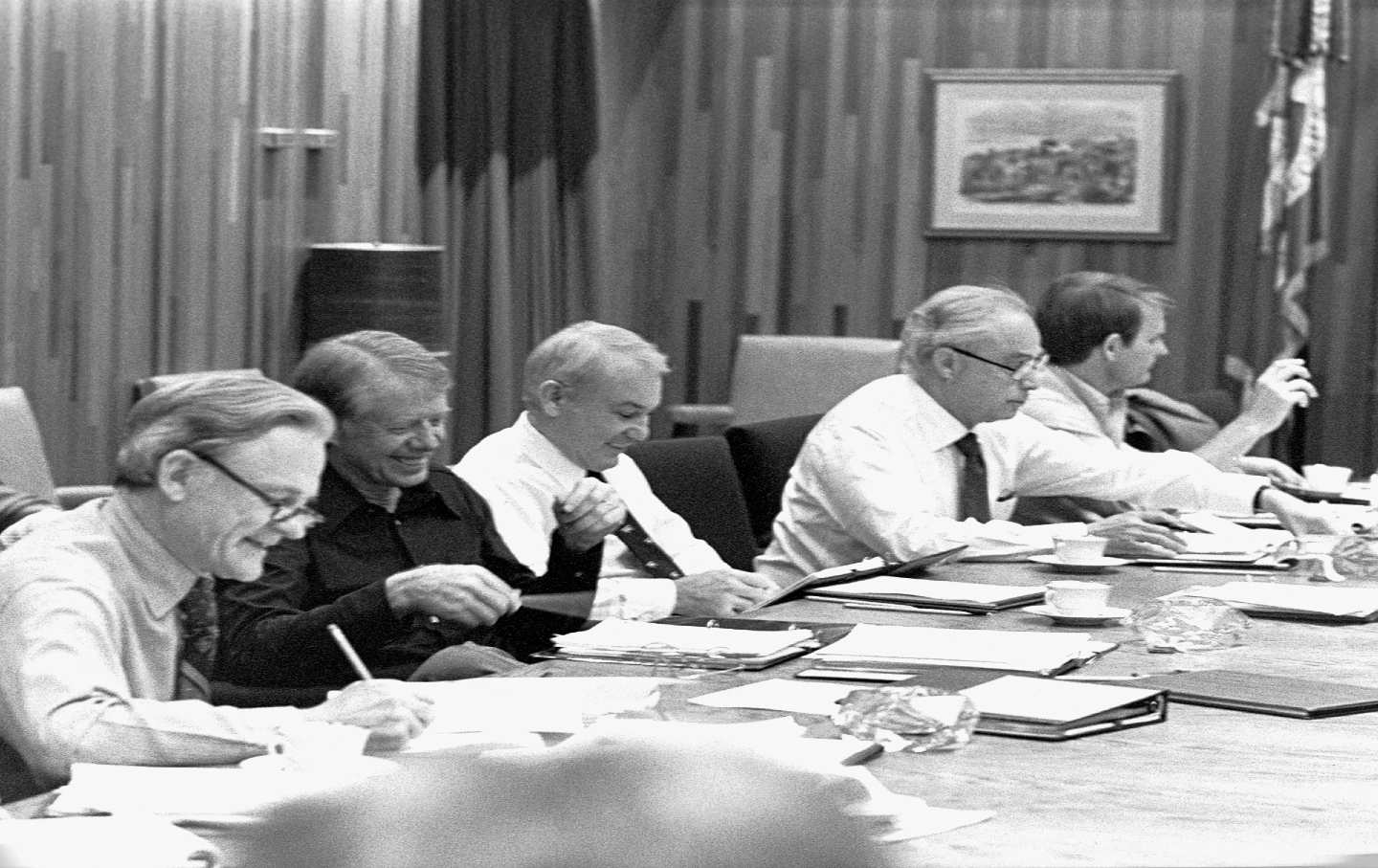

Jimmy Carter meets with cabinet members to discuss energy and inflation policy in 1979.(© CORBIS / Corbis via Getty Images)


As our president-elect shouts demands and vows revenge against anyone who irritates him, left or right, the media’s hagiographies of Jimmy Carter surely reflect a collective longing for what was a more decent, less brutish era. Perhaps Carter was, in fact, the best ex-president there ever was, working for peace and human rights around the world.


But as president, Carter spurred the nation, even the world itself, toward the dark place we find ourselves in today. Turning sharply toward neoliberalism (before that term was commonplace) and weaponizing markets, he set the US economy on its path toward lousy working-class wages and steeper financial crises. If he hadn’t, maybe Donald Trump would still be a reality-TV star.

Granted, when he took office in 1977, Carter faced a host of problems: two oil crises, the collapse of the stable Bretton Woods international economic system, and gathering malaise rooted in conditions of “stagflation”—high unemployment combined with spiraling prices and interest rates. His response drew on an emerging consensus in the country’s power elite, which found a common refrain in a study released by the Trilateral Commission, a conclave headed up by the banker David Rockefeller. The commission identified “an excess of democracy” as the dark force behind the intersecting crises of ungovernability and inflation across the globe.

Appointing Trilateral Commission members in key posts, including Paul Volcker as chair of the Federal Reserve and Zbigniew Brzezinski as national security adviser, Carter implemented a policy of more markets and less politics. He seemed almost to have taken a page from Paul Samuelson’s best-selling macroeconomic textbook Economics, which lauded “the remarkable efficiencies produced by perfect competition when it is able to operate.”

Thus the Democrat Jimmy Carter—not Republicans Richard Nixon or Ronald Reagan—first discarded New Deal policies that had long sustained growth and raised wages for all workers. He spurned Keynesianism, deregulated industries from airlines to banking, and fatally abandoned a labor-reform bill that unions saw as vital to their survival.

It’s easy to presume that history had to unfold the way it did. But this history did not. For one thing, the case for supposed efficiencies of competitive markets was falling apart even as Carter and his advisers espoused it. The doubters included establishment authorities such as Kenneth Arrow and Gerard Debreu, who won the Nobel Prize for their model of a perfectly competitive economy. Insistently told by economic officials that more-perfect competition dogmatically “works,” always and everywhere, the meticulous theorist Frank Hahn of Cambridge University would sigh, “Just so might an ancient Roman have spoken about the oracles.”


For another thing, as Michael Piore and Charles Sabel of MIT argued in The Second Industrial Divide, a turn to global Keynesianism was a plausible response to challenges of the 1970s. It would have required, among other things, the International Monetary Fund to supply patient loans and advanced nations to provide more aid and to poor nations to build their economies. Their stronger economies would have then supported critical growth in global demand, generating jobs and reducing the unemployment that had spread across the Global North.

Popular"swipe left below to view more authors"Swipe →
Jimmy Carter’s Ruinous Neoliberal LegacyJimmy Carter’s Ruinous Neoliberal Legacy

Dave Zirin
Current Issue

At least some powerful actors accepted such a turn. “It is paradoxical that industrialized countries—most of which are not using their productive potential to the full—are hesitating to increase their financial aid to poor countries,” said Jacques de Larosière, managing director of the International Monetary Fund, in 1979: “This is despite the fact that such aid would result in increased global demand and thus contribute to a reactivation of world trade and a recovery of production.”

At the helm of the world’s most powerful economy, a more imaginative Carter might have pushed this approach. Instead, he appointed Volcker, who could imagine no way to fight inflation other than jacking up interest rates to almost 20 percent—a move that produced the deepest US recession since the 1930s, while doubling or tripling poor nations’ debt payments, sucking desperately needed resources from their productive economies.

It’s easy to forget the breadth of Carter’s neoliberal turn. Alfred E. Kahn, whom Carter tapped to run the Civil Aeronautics Board, told anyone in earshot that airplanes are just “marginal costs with wings” and deregulated the industry in 1978. Fares were supposed to fall as airlines charged for desirable seats, time until departure, checked bags, and virtually every other air-travel amenity.

A system of regulated airlines, competing on technological advance, was transformed into a hub-and-spoke Jurassic Park. The regional carrier Allegheny Airlines, which Kahn relied on for his commute from Pennsylvania to Washington, folded. As aeronautic engineering improved, average fares had fallen in real dollars from 1963, the first year for which the US Bureau of Labor Statistics has data on them, until 1978. Contrary to deregulatory myth, they surged twice as fast as overall inflation from 1978 to 1983. By 2000, consumer prices had risen 164 percent from their 1978 levels—while airfares spiked 436 percent.

Boasting that deregulation would bring trucking “into the free enterprise system,” Carter turned a good job into a grueling one, as drivers worked longer hours to recoup lost pay, sometimes falling asleep at the wheel and dying in exhaustion-fueled crashes. Meanwhile, the self-described “pragmatic monetarist” Volcker not only trashed de Larosière’s hopes for poor countries but also triggered an incipient crisis of US savings-and-loan banks: The Fed’s aggressive deregulation of lending practices let the S&L make ever-more-desperate double-or-nothing bets. The whole system collapsed in crisis during the Reagan administration.

Carter also hewed to the new orthodoxies of neoliberalism in labor relations. Early on in his term, he scuttled a key labor reform bill that could have won passage from a Democratic Congress. First, he insisted that the bill not interfere with state “right-to-work” laws, common in the South, which weaken unions by letting workers reap benefits without having to join or pay dues.


The rest of the bill would have bolstered enforcement of existing labor laws. Employers often found it cheaper to flout the provisions of federal labor law and—maybe—pay modest penalties years later. For example, the textile mill J.P. Stevens, whose workplace abuses were chronicled in the 1979 movie Norma Rae, fired 191 workers for organizing and, after an extended court battle, was finally forced to pay the $1.3 million due them.

The reform would have expanded the National Labor Relations Board to resolve a backlog of 19,000 cases. It would have also blocked employers from undermining representation elections with endless delay, raised penalties for illegally firing union activists, barred firms from government contracts if they broke labor law, and strengthened punishment for the tactic of refusing to bargain.

In 1978, Carter pushed through the Senate two unpopular Panama Canal treaties that business interests viewed as crucial for transport, but, facing a business blitz against the modest labor reform bill, he let it die. In 2023, men of all races with only a high school degree earned $1.91 an hour less, in real dollars, than their forebears had in 1978. Women with only a high school degree earned $2.30 more than women workers did back then, but, since they started from a miserly base, it was still $5.32 less than men earned.

This appalling data is only part of the story. Wages were further squeezed as goods essential to any dignified existence improved but also cost more in real dollars. To take just one representative example, a mid-range Chevrolet gets far better mileage now than in the 1970s and has many new features, but also costs very roughly 40 percent more in real dollars. When you’re that pressed, a little inflation bites, as does fear of undocumented immigrants taking jobs at lower wages.

Beginning in 1874, some of the brightest minds in economics tried to model how a perfect-competition economy such as neoliberalism imagines would work, but each generation found conceptual and mathematical blunders in its predecessor’s efforts. Finally, in 1954, Kenneth Arrow and Gerard Debreu seemed to have found El Dorado.

Making assumptions that plausibly capture the idea of perfect competition, they proved that some set of prices reflect ideal market conditions—the point at which consumers freely choose to buy exactly the same goods that firms freely choose to sell. Businesses always get the return on investments they expect, and all workers who want employment at market wages effortlessly find it. Arrow and Debreu justly won the Nobel prize for an amazing intellectual and mathematical achievement.

In this best of all possible market worlds, no one can do better by making a willing trade with anyone else. Sure, you can rob the drug store, or unions can force employers to raise pay, but these are not willing trades. An economy operating on this perfect market model is said to be “optimal.”

Economists conceded that such an economy can be unfair: The poor may have nothing to trade that could better their lot, and the rich may find nothing they want to trade for what they have. A government might therefore interfere for reasons of fairness, perhaps doling out welfare to keep the poor from starving, but it is admonished to do as little as possible. It should especially avoid creating market “imperfections” such as by legislating minimum wages or letting unions boost wages. Such interventions, the neoliberal cognoscenti held, create unemployment and undermine production.

These conclusions rather startled Kenneth Arrow. He said he always believed the famous model “was not a good description of the economy.” He just wanted to set forth the exact conditions you’d need to create a perfectly competitive equilibrium. He later agreed that actual economies are complex systems, and he hadn’t the remotest idea what model might underlie them.

But the Arrow-Debreu model does teach a powerful lesson. It shows what conditions must not exist in a competitive market economy. There can be no bubbles or crashes (markets are forever tranquil), no unemployment (willing workers always find jobs recompensing their skills), no advertising (it would be useless, since firms can’t affect market prices one way or another and are able to sell as much as they want at those prices), and no stock exchange (everyone knows the values of all firms). There isn’t even a role for money. The persistent domination of these actual forces in economies underlines how perfect competition was never going be anything other than a reverie.

But suppose, for the sake of argument, all those wildly implausible conditions were met. Now another problem arises: Arrow-Debreu can’t show how markets could ever move an economy to the envisioned equilibrium because, in the model, it’s forever there. Scrambling high and low for plausible market mechanisms that might move an economy to the state of placid equilibrium, theorists found none. And should an economy happen to land there, markets would yank it away.

The analyst who, in 1974, destroyed the last hope for Arrow-Debreu stability—for modeling how markets might move an economy to the competitive ideal—was Gerard Debreu. Milton Friedman’s “monetarism”—a thin story about how the money supply should rule atop a perfectly competitive economy—was bought wholesale by Volcker and, presumably, the president who appointed him. The MIT theorist Frank Fisher once asked Friedman how he responded to Arrow-Debreu instability. “Markets are obviously stable,” Friedman retorted, “and if they aren’t, we’re all wasting our time.” Fisher thought the remark about wasting time rather perceptive.

In presenting her economic plan last August 16, Kamala Harris promised to create “an opportunity economy” where “everyone can compete,” cut “needless bureaucracy,” lower prices by penalizing “opportunistic companies that exploit crises,” go after pharmacy middlemen that manipulate drug costs, and give new homebuyers $25,000 subsidies. Some of these ideas are sensible, and some are ridiculous, but they’re all part of the warmed-over legacy of Jimmy Carter. Surveying the real-world wreckage in a top-heavy, increasingly unequal American political economy, Harris and her advisers presented an all-too familiar laundry list of policy recommendations predicated on the old Arrow-Debreu model of competitive equilibrium. All remains balmy in this best of all possible markets; we simply have to tweak it around the edges to create more incremental fairness.

If Democrats want to win, let alone govern, they need to fundamentally rethink the economy. They could do worse than recall the postwar “Treaty of Detroit,” as Fortune magazine dubbed it. Every few years during the 1950s and ’60s, the United Auto Workers or Steelworkers struck a bargain raising wages in line with productivity plus inflation. This baseline agreement spread as unionized firms accepted it, other firms followed to forestall unionization, and Congress raised minimum wages.

Political decisions—not an imaginary market equilibrium—thus apportioned income between profits and wages. Profits were actually higher across the advanced nations than they are today, but, among other things, top tax rates of up to 91 percent on rich individuals kept them from amassing exorbitant fortunes. Rising earnings of the middle and working classes sustained demand and growth. That Elon Musk and a clutch of other billionaires are now awaiting Senate confirmation in the second Trump term would have been an unthinkable throwback to Robber Baron governance.

To be sure, other injustices and inequalities still prevailed: The New Deal legacy continued to promote segregation, leaving Black agricultural and domestic workers in poverty, and labor leaders backed fierce immigration crackdowns. Yet the half-century legacy of Jimmy Carter makes it painfully clear that our politics and our productive lives alike have been deeply disfigured by the fatal decision to toss aside the Treaty of Detroit in favor of the fever dream of a perfect competition economy.

Submit a correction
Send a letter to the editor
Reprints & permissions


Jonathan SchleferJonathan Schlefer is a former senior researcher in political economy at the Harvard Business School and a former editor in chief of MIT’s Technology Review. He is also the author of “The Assumptions Economists Make” (Belknap/Harvard, 2012).


2025-01-04

Excerpt: 'A Remarkable Mother' : NPR

Excerpt: 'A Remarkable Mother' : NPR

We Can Have Peace in the Holy Land 2010: Carter, Jimmy

We Can Have Peace in the Holy Land eBook : Carter, Jimmy: Amazon.com.au: Books


Jimmy CarterJimmy Carter
Follow


We Can Have Peace in the Holy Land Kindle Edition
by Jimmy Carter (Author) Format: Kindle Edition


4.3 4.3 out of 5 stars 50


President Carter has been a student of the biblical Holy Land all his life. For the last three decades, as president of the United States and as founder of The Carter Center, he has studied the complex and interrelated issues of the region's conflicts and has been actively involved in reconciling them. He knows the leaders of all factions in the region who will need to play key roles, and he sees encouraging signs among them.

Carter describes the history of previous peace efforts and why they fell short. He argues persuasively that the road to a peace agreement is now open and that it has broad international and regional support. Most of all, since there will be no progress without courageous and sustained U.S. leadership, he says the time for progress is now. President Barack Obama is committed to a personal effort to exert that leadership, starting early in his administration.

This is President Carter's call for action, and he lays out a practical and achievable path to peace.
==
Product description

Review
"Its most important intended reader should take seriously Carter's advice to pursue peace." -The New York Times Book Review


About the Author
Jimmy Carter was the thirty-ninth President of the United States, serving from 1977 to 1981. In 1982, he and his wife founded The Carter Center, a nonprofit organization dedicated to improving the lives of people around the world. Carter was awarded the Nobel Peace Prize in 2002. He is the author of thirty books, including A Full Life: Reflections at Ninety; A Call to Action: Women, Religion, Violence, and Power; An Hour Before Daylight: Memoirs of a Rural Boyhood; and Our Endangered Values: America's Moral Crisis.

Publisher ‏ : ‎ Simon & Schuster UK (18 February 2010)
Language ‏ : ‎ English
Print length ‏ : ‎ 256 pages
Best Sellers Rank: 1,013,551 in Kindle Store (See Top 100 in Kindle Store)81,254 in Social Sciences (Books)
925,433 in Kindle eBooksCustomer Reviews:
4.3 4.3 out of 5 stars 50


About the author
Follow authors to get new release updates, plus improved recommendations.

Follow

Jimmy Carter


James D. Carter, who is known as Jimmy to his friends, IS NOT THE FORMER PRESIDENT. Jimmy was born in Milwaukee, Wiscosin before the other one ran for office.

He lives in Wisconsin with his best friend and wife Karen. His spiritual journey to maintain sanity progresses one day at a time, it has passed through time as an art teacher, artist, and insurance agent.

The stories that dwell in his head and heart have finally started emerging. The Element is his first novel. His next book, coming out in late 2012 is entitled Dear Mr. Lincoln. It is a historic supernatural/thriller.


Top reviews


Gordon

5.0 out of 5 stars An urgent issue: Peace and justice in the Holy Lands
Reviewed in Canada on 3 October 2013
Verified Purchase

Jim Carter communicates with experience, insight and a passionate commitment to peace. I found his personal encounters with key players and organizations to be enlightening. The vexing issue of the settlements is explained in a helpful manner. However, the reader becomes frustrated by the provocative actions of the government of Israel and the overall apathy toward negotiations with Palestinians. I am very grateful to President Carter for his leadership and dedication to building peace in this troubled area. Highly recommended!!!

Report


Anna H. Bedford

5.0 out of 5 stars Peace Is Possible--Perhaps
Reviewed in the United States on 5 September 2009
Verified Purchase

Writing in his usual modest style, Nobel Peace Laureate former President Jimmy Carter lays out the history of political and diplomatic events in Israel/Palestine since 1948. In the first 12 chapters, he provides a clear and even-handed summary that favors no country--including the U.S.--over another. He makes a strong case for engaging Israel/Palestine's neighbors, Egypt, Jordan, Syria, Lebanon, in any solution of an apparently intransigent situation.He does not praise or blame, but simply lays out the facts gleaned from first-hand experience.
In the 13th chapter and the 5 enormously insightful appendices that follow, he lays out the agenda for peace. Jimmy Carter understands the deep need of both Israelis and Palestinians to live in peace and safety. He believes that the moment of decision is close, and that strong, unbiased U.S. presidential leadership willing to deal with both Fatah and Hamas is vital.Despair in lack of progress will lead to disaster: one state instead of the majority-desired two-state solution.
I am using this book for group discussion. It's great for that, although it provides no discussion guide. The 5 maps are terrific, although I would have liked more. That, and the fact that he does not mention the plight of ancient Christian communities in the region,might be the only reason not to give this book 5 stars.

Read less
Report


CG

4.0 out of 5 stars A non-partisan review of this book.
Reviewed in the United States on 18 February 2009
Verified Purchase

Too many of the reviews here are politically motivated. My goal here is to step back and write an objective review about the book only, politics aside.

This book is genuine, intelligently written, and has a well-thought out premise backed by Jimmy Carter's decades of experience working with key leaders on all sides of the Middle-East peace process. The political tide in the United States has turned, and the timing of this book is no mistake: Carter is hoping take advantage of the change to encourage another attempt of peace in the Holy Land.

The main body of the text provides a relevant history of peace efforts in the Middle-East. I found this review to be quite helpful. It reads much easier and more interesting than "The Blood of Abraham," Carter's 1985 detailed history of the various groups involved in the Middle-East. The reason I rated this book as 4 stars instead of 5 is because there really isn't a lot of new information or ideas for those who are well-read on Carter. But I can still highly recommend this book since most people out there haven't read lots of Carter.

Carter recounts the trial-and-error Camp David negotiation process that he used as President in 1978. He reminds us of the bickering and accusations made by both sides, but also the compromises they were ultimately able to agree upon. Carter's role was to lay down and enforce some rules, be willing to ad lib, be determined, and to act as friend and intermediary to both sides.

Carter is not getting any younger, and I think the take-home message is clear. This is an urgent issue that still requires a lot of hard work. Too many lives are being lost everyday on all sides. The Camp David Accords, the Oslo Accords, and other agreements were ground-breaking in their day, but time marches on. It's up to our generation and our country to go to work and use our influence in the pursuit of peace. The process will be difficult and may seem impossible at times. With this book, Carter urges us to try.

Read less
Report


W. Price

5.0 out of 5 stars Jimmy Carter rules!Reviewed in the United States on 8 June 2014
Verified Purchase

I was a kid during his Presidency and actually wore a Halloween outfit as the man during his term. However, then I couldn't tell you what his politics were and now I could care less what they were. I just know he has done a lot of good work since...that he will be known for as much as he is for his presidency. I think he is a brave man to speak up on the Isreal / Palestine issues and not take the popular side of the pair. I hope he has many more years to do the good work he does. Got this book, because I am half way through the previous one...and like it, so I got this to follow-up on his view of the issues around the Holy Land.

Report


Jonathan Zasloff

3.0 out of 5 stars Informative and well-intentioned, but naive
Reviewed in the United States on 3 February 2009
Verified Purchase

This really is less a book about the Israeli-Palestinian conflict and more a book about Jimmy Carter. Those who are searching for his peace plan will not find it until the last few pages of the book; instead, we get a fairly interesting history of his own interest in the region and many of his recent activities at the Carter Center. Fair enough, but perhaps the book could have had a better title.

In any event, who is the Carter that we find? Certainly not the anti-semite or anti-Israel zealot that some would have you believe. Carter clearly believes that were Israel to remove its West Bank settlements, a peace deal could be reached. But he strongly defends the existence of the state of Israel, and is careful to emphasize the fact that Israel is democracy. Indeed, that is part of the problem, Carter believes: the vibrancy of Israel's political democracy means that small parties representing settler interests are able to block negotiations because they can threaten to bring down the government. Of particular interest is a revelation that I had never seen before: Carter relates that during a recent trip to the region, Israel's deputy prime minister, the ultra-orthodox Eli Yishai, wanted to negotiate with Hamas about captured Israeli soldier Gilad Shalit, but Hamas refused to see him. So much for the idea that it is all Israel's fault.

No--the Carter you see here is committed and well-intentioned: a genuine lover of Israel. He is also extraordinarily naive. For all the (justified) attention he gives to the noxious Israeli settlements, he gives virtually no attention to the issue that really killed the 2000-01 negotiations: the Palestinian demand for a "right of return" to Israel itself -- a demand that, if satisfied, would destroy the Jewish state. Outside of Sari Nusseibeh, no major Palestinian leader or public figure has agreed to relinquish this demand (unlike the many Israeli leaders who have called for evacuating West Bank settlements.). Perhaps this is because they feel they cannot say it in order to keep a bargaining chip. But Carter does not even acknowledge the issue.

It's not that Carter thinks the Palestinians are right about this: at the end of the book, when he sets forth his peace plan, he (finally) states quite clearly that Palestinian refugees should only have a right of return to the Palestinian state, and any who do not return should get monetary compensation. But why does Carter think that the Palestinians, who believe this right to be a sacred principle, will suddenly give it up? He doesn't say; indeed, he doesn't even think it's an issue. It's almost as if he thinks, "oh yes, by the way, that has to go." But why would the Palestinians accept it? And if they wouldn't accept it, how can there be a peace deal? He repeatedly references the Arab League's "acceptance" of Israel in the 2002 Saudi initiative, and that initiative was indeed an important development. But the Saudi initiative also insisted on the right of return. Isn't that a problem? Again, the silence is deafening.

The reader can expect as much after reading the first part of the book. There, Carter reflects on the use of the term "apartheid" in the title of his previous book. He explains that he only meant it as referring to conditions in the territories, not Israel itself. He notes that the use of the term to describe these conditions is often used in Israeli journalism (an overstatement, but true enough), and when he published the book, it did not dawn on him that it would receive the reaction it did, that American supporters of Israel might not take kindly to the idea that Israel itself is an apartheid state or that Israel in any way could be compared to the apartheid regime. He now admits that it was a mistake. You think?

And that's what makes the book so frustrating. Here is a very good man, who cares deeply about both Israelis and Palestinians, who is frustrated that a deal hasn't been reached, and has faith -- a sincere, compassionate, abiding faith -- that a deal can be reached. Since the deal hasn't been reached, he will show us the way. But it never seems to occur to him that there are real, significant issues between the parties, that it's not just that they ran out of time, and that real, serious, painful concessions must be made by both sides that they might not be ready for.

And because of that, he cannot really give us a clear idea of what, precisely, the United States should do. As much as he understands people, he doesn't seem to understand political forces -- a strange condition for a man who was, after all, elected President of the United States (and maybe the reason he wasn't re-elected). He seems to think that if only those terrible settlers would get out of the way (and they are truly terrible), then everything would be okay. I hope he's right. But he gives us little reason to believe him.

For those who know little about the region, the book is okay. He has some anti-Israel biases, but they are not strong, at least not in this book. But for those who really want the details of the region, of peacemaking, of the obstacles on both sides, you won't find much here. You are much better off just reading the online English version of the Israeli newspaper Ha'aretz: [...]

I note that although this book averages 3 stars, the majority of reviews are either 5 stars or 1 star. So it goes.

Read less
Report
See more reviews

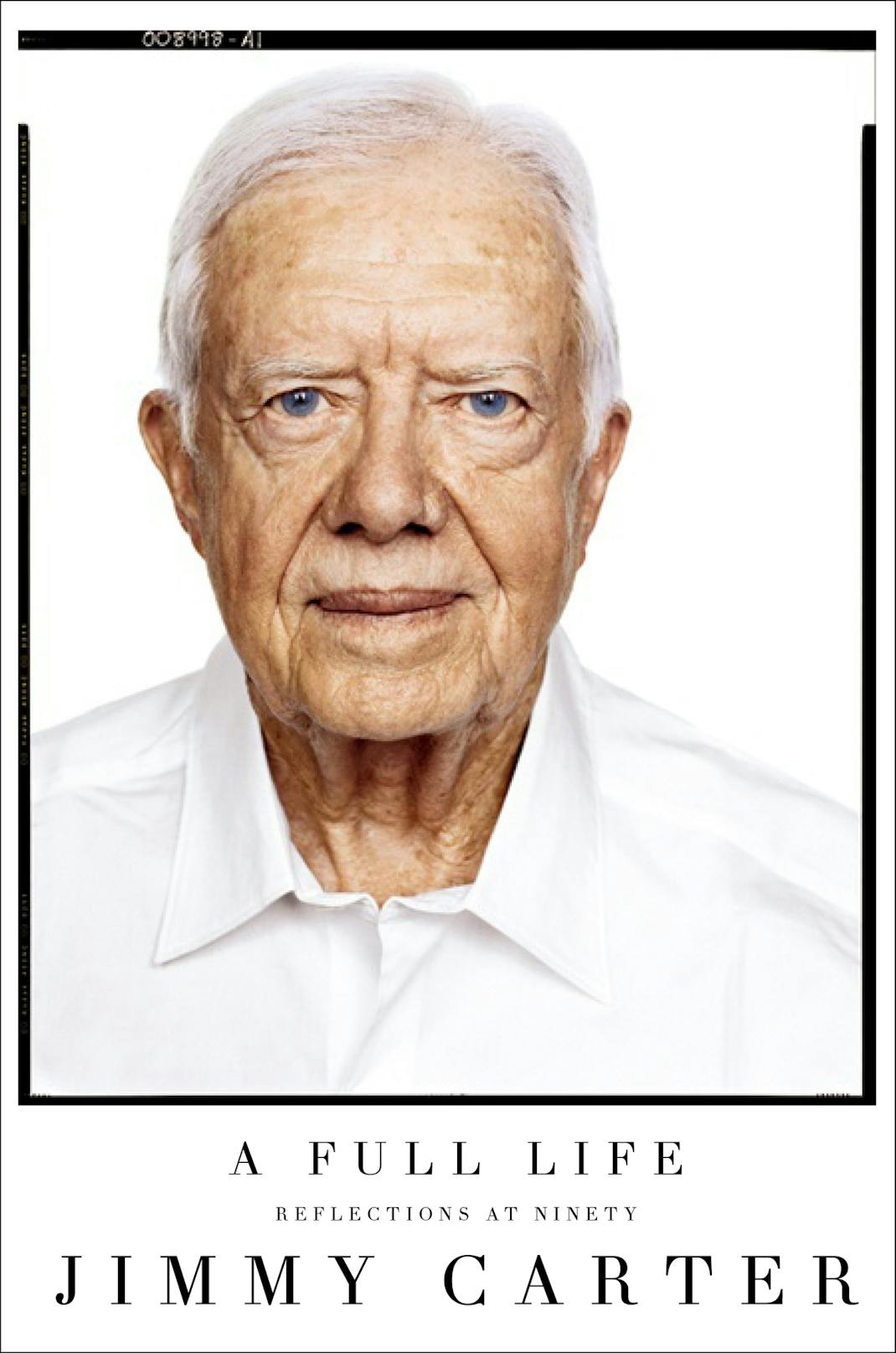
A Full Life - Wikipedia Jimmy Carter Age 90 2015

A Full Life - Wikipedia

A Full Life


From Wikipedia, the free encyclopedia
A Full Life: Reflections at 90
AuthorJimmy Carter
LanguageEnglish
SubjectAutobiography
Published2015 (Simon & Schuster)
Publication placeUnited States
Media typePrint (hardcover), Audiobook (Audio CD)
Pages272
ISBN978-1-5011-1563-9

A Full Life: Reflections at 90 is a memoir written by Jimmy Carter, the 39th President of the United States, released on July 7, 2015. The book is a collection of reflections and memories, including his upbringing, political career, and humanitarian efforts.[1][2][3][4]

Contents

[edit]

The book begins with President Carter's childhood and early life in the Georgia countryside. It covers his early political career, including his service in the Georgia Senate and his run for the governor's office.[4] The book also provides an in-depth look at President Carter's time in the White House and the difficulties he faced.[4] He divides these difficulties into two categories: "Issues Mostly Resolved" and "Problems Still Pending". The first group includes topics such as Rhodesia, the B-1 bomber, the rescue of New York City and Chrysler, and the end of the Cold War. He touches on the significant SALT II Treaty. Among the issues that remain unresolved, Carter highlights drugs, special interests, the potential for nuclear war, and intelligence agencies. He speaks about Presidents Ronald Reagan, George H.W. Bush, George W. Bush, and Bill Clinton objectively but does not fully absolve them for their actions.[2] The book continues to Carter's post-presidential life, including his work with The Carter Center, his efforts to promote peace and health, and his pastimes: painting, fishing and woodwork.[5]

Critical reception

[edit]

Upon its release, A Full Life received positive reviews from both critics and readers alike. Many praised Carter for his honesty and straightforwardness in sharing his experiences and reflections. The book was also commended for its historical significance and its contributions to the understanding of modern American politics. Despite some criticism for its lack of depth on certain topics, the book was widely considered to be a fitting tribute to Jimmy Carter's life and legacy.


References[edit]
^ A Full Life: Reflections at Ninety. Simon & Schuster. 7 July 2015. ISBN 978-1-4423-9105-5. Retrieved 17 August 2015.
^ Jump up to:a b "Jimmy Carter talks about his legacy and new book, 'A Full Life: Reflections at 90' - LA Times". Latimes.com. 16 July 2015. Retrieved August 13, 2015.
^ "Books by President Jimmy Carter and Rosalynn Carter - Carter Center Books". Cartercenter.org. Archived from the original on August 12, 2015. Retrieved August 13, 2015.
^ Jump up to:a b c Josiah Kamau (2015-07-31). "Review: 'A Full Life: Reflectinons at Ninety,' by Jimmy Carter; no apologies". StarTribune.com. Retrieved 2015-08-25.
^ Rowley, Alice. "'A Full Life': Jimmy Carter's 'Reflections at Ninety' are intimate and illuminating". Pittsburgh Post-Gazette. Retrieved 2023-02-03.


show
v
t
e
Jimmy Carter


show
v
t
e
Grammy Award for Best Audio Book, Narration & Storytelling Recording


This article about a biographical or autobiographical book on an American politician is a stub. You can help Wikipedia by expanding it.


Categories: Books by Jimmy Carter
Political autobiographies
American autobiographies
2015 non-fiction books
Books about Georgia (U.S. state)
Simon & Schuster books
Books written by presidents of the United States
American politician book stubs


=====


Review: 'A Full Life: Reflections at Ninety,' by Jimmy Carter; no apologies

NONFICTION: Best viewed as a supplement to "Keeping Faith: Memoirs of a President," Jimmy Carter's new memoir provides more information and insights about his personal life and values than on U.S. politics and public policy.


By GLENN C. ALTSCHULERFor the Minnesota Star Tribune
July 31, 2015 at 8:56PM

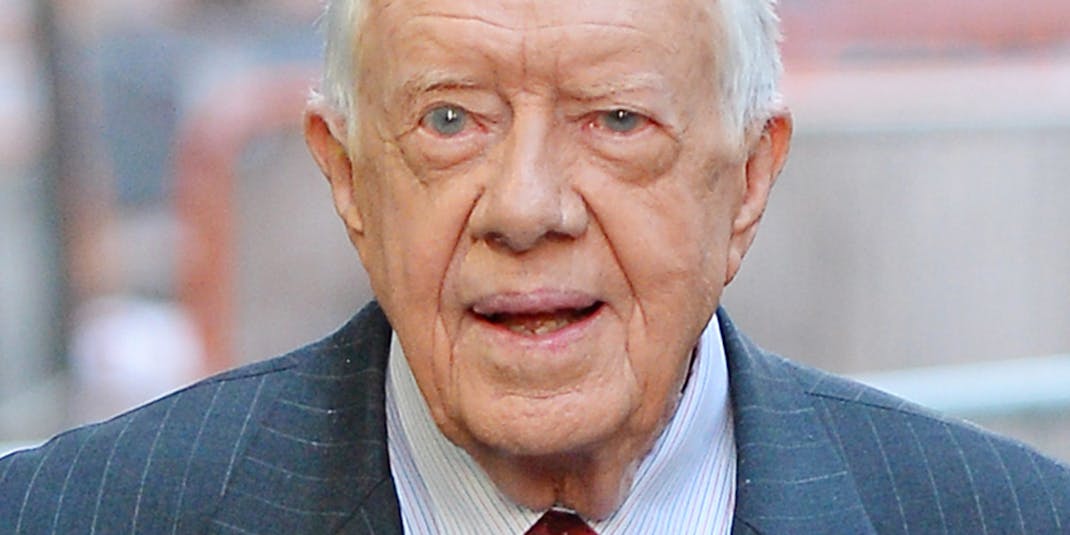
NEW YORK NY - NOVEMBER 05: Former President Jimmy Carter sighting on November 5, 2013 in New York City. (Photo by Josiah Kamau/BuzzFoto/FilmMagic) (Laurie Hertzel — BuzzFoto/FilmMagic/The Minnesota Star Tribune


Thirty-five years after he lost his bid for a second term as president, Jimmy Carter remains active and outspoken. Through the Carter Center, he engages in conflict resolution, monitors elections and promotes arms control, environmental reform, education and global health. He works for Habitat for Humanity. He has written more than two dozen books, including "Palestine: Peace Not Apartheid." And he has been awarded the Nobel Peace Prize.


In "A Full Life," Carter reflects on nine decades of experiences, including his upbringing in rural Georgia; his stint as a naval officer, working for Hyman Rickover in developing nuclear energy; his success as a peanut farmer; his fight against racial discrimination; his political career as state senator, governor of Georgia and in the White House, and his varied and voluminous accomplishments.


Best viewed as a supplement to "Keeping Faith," his memoir of his tenure in the Oval Office, "A Full Life" provides more interesting information and insights about Carter's personal life and values than about U.S. politics and public policy.


Indeed, Carter devotes just a few pages to the Camp David accords and the Iran hostage crisis and does not discuss the problem of "stagflation" or acknowledge the downside to deregulation. Nor does he accept responsibility for his travails in office.


The news media, he writes, suspected that he "had something unsavory to hide" and could not abide having a governor from the Deep South as president. He maintains that women's rights activists and labor leaders, "with whom I felt most friendly and whom I attempted to help," caused him the most trouble.


On less overtly political issues, Carter lets his guard down. He indicates, for example, that he cannot now understand or justify his failure to consult Rosalynn, his wife, early in their marriage on decisions affecting the family, including resigning from the Navy, dividing his father's estate and running for political office. He confesses that arguments with Rosalynn during the drafting of their book, "Everything to Gain," grew so heated that they communicated only through harsh e-mails and ultimately decided to label each paragraph "J" or "R."


As "A Full Life" makes clear, Carter retains resentments. Ted Kennedy, he suggests, may have kept him from being re-elected. Ronald Reagan instructed diplomats not to assist him or acknowledge his presence. President Obama has kept his distance, Carter speculates, because he fears a backlash from pro-Israeli American Jews.


Jimmy Carter is a remarkable man who can legitimately look back on a remarkably productive life. Even at age 90, however, this decent and deeply religious man is not always able to forget — or forgive.


Glenn C. Altschuler is the Thomas and Dorothy Litwin professor of American studies at Cornell University.

"A Full Life," by Jimmy Carter (The Minnesota Star Tribune)

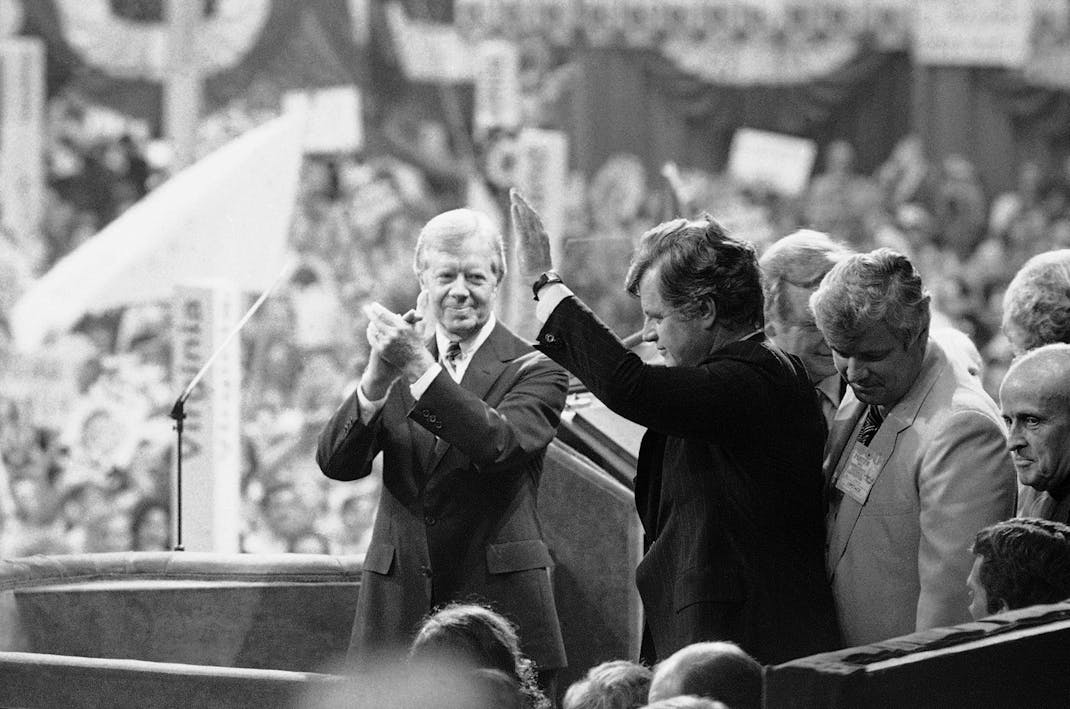
President Jimmy Carter applauded Ted Kennedy at the Democratic National Convention in 1980, but he suggests that Kennedy kept him from being re-elected. (The Minnesota Star Tribune)

===


A Full Life: Reflections at Ninety Paperback – Illustrated, 19 July 2016
by Jimmy Carter (Author)
4.4 4.4 out of 5 stars 1,641


In his major New York Times bestseller, Jimmy Carter looks back from ninety years of age and “reveals private thoughts and recollections over a fascinating career as businessman, politician, evangelist, and humanitarian” (Booklist).

At ninety, Jimmy Carter reflects on his public and private life with a frankness that is disarming. He adds detail and emotion about his youth in rural Georgia that he described in his magnificent An Hour Before Daylight. He writes about racism and the isolation of the Carters. He describes the brutality of the hazing regimen at Annapolis, and how he nearly lost his life twice serving on submarines and his amazing interview with Admiral Rickover. He describes the profound influence his mother had on him, and how he admired his father even though he didn’t emulate him. He admits that he decided to quit the


Navy and later enter politics without consulting his wife, Rosalynn, and how appalled he is in retrospect.

In his “warm and detailed memoir” (Los Angeles Times), Carter tells what he is proud of and what he might do differently. He discusses his regret at losing his re-election, but how he and Rosalynn pushed on and made a new life and second and third rewarding careers. He is frank about the presidents who have succeeded him, world leaders, and his passions for the causes he cares most about, particularly the condition of women and the deprived people of the developing world.

“Always warm and human…even inspirational” (Buffalo News), A Full Life is a wise and moving look back from this remarkable man. Jimmy Carter has lived one of our great American lives—from rural obscurity to world fame, universal respect, and contentment. A Full Life is an extraordinary read from a “force to be reckoned with” (Christian Science Monitor).


===


===


===

From other countries
L. West 5.0 out of 5 stars Five star review Reviewed in the United States on 27 December 2023 Verified Purchase "A Full Life: Reflections at Ninety" is a literary treasure and a true testament to a life well-lived. This five-star review is a heartfelt acknowledgment of the profound impact this memoir has had on me.
Jimmy Carter's reflective journey through his remarkable life is not just a memoir; it's an invaluable source of wisdom, humility, and inspiration. Carter's storytelling is not only eloquent but also deeply authentic, offering readers an intimate look into the experiences that shaped his extraordinary journey.
The narrative is rich with anecdotes, insights, and lessons learned from a life dedicated to service, leadership, and unwavering principles. Carter's humility and integrity shine through every page, making this memoir a beacon of hope and a guiding light for those who aspire to make a positive impact on the world.
The storytelling is both poignant and charming, weaving together personal and historical moments that have defined Carter's legacy. From his childhood in rural Georgia to his presidency and beyond, the memoir provides a comprehensive and engrossing account that resonates with authenticity.
What sets "A Full Life" apart is its universal appeal. Regardless of one's political affiliations, the book transcends partisan divides, offering universal truths about the human experience. Carter's reflections on family, faith, love, and service are relatable and profoundly moving.
The prose is beautifully crafted, reflecting Carter's deep appreciation for language and storytelling. Each chapter unfolds like a conversation with an old friend, making it a joy to read and savor. The narrative flows seamlessly, keeping the reader engaged and invested in every aspect of Carter's life.
In conclusion, "A Full Life: Reflections at Ninety" is a literary masterpiece that resonates with warmth, wisdom, and a profound sense of purpose. It's a book that enriches the soul and leaves a lasting impression on the reader. I wholeheartedly give it five stars and recommend it to anyone seeking a captivating and enlightening journey through the life of one of America's most admired leaders. 13 people found this helpful Report

Rajesh Nair 5.0 out of 5 stars Excellent Visage Reviewed in India on 26 July 2017 Verified Purchase Excellent visage of a great person who went beyond the conventional to make the world a better place ! 2 people found this helpful Report
Amanda 5.0 out of 5 stars Amanda Reviewed in France on 20 January 2016 Verified Purchase I lived in the USA whilst he was President and all thought he was weak but I never thought so. This book shows that he is one of the most caring and genuine people to have "ruled" in the US. I hope he will be remembered for all that he has done. Good reading. 3 people found this helpful Report
Jean-Guy Rens 5.0 out of 5 stars One feels a little better while reading this book Reviewed in Canada on 1 September 2015 Verified Purchase Jimmy Carter gives us his view on the facts of his life, since childhood in the segregated South to his days at the head of the Carter Center and it is facinating to be given such a privilege. Everything is his life is extraordinary -- since his days in a submarine to his presidency and his humanitarian action which earned him a Nobel Prize. Everything he did is explained with clarity as being "ordinary" and "simple". Jimmy Carter illustrated this book with naive paintings that are surprisingly effective: his portraits look like real people, his landscapes look like nature. With lucidity, he apparaises his craft: "I realized many years ago that I do not have any special talent as an artist or craftsman, but with a lot of study and practice I have become fairly proficient." Jimmy Carter writes like he paints, with proficiency. This is not great literature, but one discovers behind the written word an author as a "gentleman". What is presented as common sense is, actually, dignity, fairness, kindness. It is such a rare feeling, that it is worth reading every page. Another detail: one feels a little better while reading it! 3 people found this helpful Report
Amazon Customer 4.0 out of 5 stars Indians May not relate much campared to the Americans Reviewed in India on 3 November 2019 Verified Purchase Very good Book about a persons life from son of a farmer to the President of America One person found this helpful Report

MICHELE 5.0 out of 5 stars A Fantastic Read Reviewed in France on 5 May 2018 Verified Purchase "A Full Life" written by an amazing gentleman, very much matches the title it is given. Jimmy reflects on his extraordinary life with calm, humor & humility. I highly recommend Jimmy's 30th book. Customer image One person found this helpful Report Translate review to English
Rafe Mair 4.0 out of 5 stars Age cannot wither ... Reviewed in Canada on 23 August 2015 Verified Purchase Jimmy Carter's presidency improves with the time. He certainly did not have that great political necessity, good luck. Since his presidency he has been one of the more remarkable people on the planet. The good he has done is extraordinary. I had the good fortune to interview President Carter many years ago on his book on flyfishing, a hobby we shared. I was told by my producer that the deal wise that I not ask Mr. Carter any questions about politics. I replied "I never make deals like that – if you think I'm going to miss this opportunity you got another think coming!" We talked about fishing and his excellent little book and I close with a question about the release of the hostages on the day Ronald Reagan was sworn into office and asked his reaction at this point. President Carter gave me a thorough, gracious, articulate answer without showing the slightest indication of annoyance. His current book shows a few signs of age around the edges, not surprising considering he was 90 when he wrote, it but for all that is a hell of a good read. In fact it makes an excellent fairly quick biography of a man who will stand very high indeed when full assessment of his time is made. 2 people found this helpful Report

Luke Williams 4.0 out of 5 stars A Truly Decent Man Reviewed in the United Kingdom on 10 September 2016 Verified Purchase Jimmy Carter was one of the greatest Presidents that America has ever had. He believed in taking greater moral responsibilities in both domestic and foreign affairs, even though the media would frequently see past this and give him a hard time for bucking the Establishment, as well as disloyal members of his own party such as Ted Kennedy standing against him. Internationally, Carter was able to normalise relations with China, take strong standpoints on Russian repression, and reduce proliferation of nuclear weapons; domestically, he achieved such policies as compensating Native Americans in land disputes, and protecting Alaskan natural sites from oil exploitation. Right-wing Presidencies since Carter have sadly repealed some of his progressive policies, such as Ronald Reagan criminalising thousands of drug users instead of helping them with their addictions, and George W. Bush overturning intelligence agency legislation in order to condone personal privacy invasions. Carter and his wife now run the Carter Centre which has achieved great things such as peace negotiations, monitoring to ensure free and fair elections, building homes for underdeveloped communities, and helping to reduce the spread of tropical diseases. This book gives a succinct autobiographical overview of Carter’s life, and although it is not as detailed as some erudite biographies, this makes it more accessible for casual readers. My main criticisms would be that Carter spends too much time extolling the virtues of his religion – which sometimes led him into poor decision-making – and his negativity concerning the Obama administration is unfounded. Of course Carter made mistakes – his failure to confront the Shah of Iran would ultimately be his Presidential downfall – but if more political leaders had his moral integrity, the world would be a better place. 6 people found this helpful Report

Prima 4.0 out of 5 stars Honorable Reviewed in the United States on 26 October 2024 Verified Purchase Condition of the book(s) was very good. President Carter’s 100th Birthday was earlier this month (10/1/24) 🎉Reading this during his centurion milestone alongside an impending Presidential election (Harris & Trump) has been insightful & inspirational. Makes me yearn for a time in America when we worked with ethic, partnered for the better and cared about the fate of our neighbor(s.) I was a young child when he was in office and grew up hearing he was a “weak” president. I disagree after reading this. His wife Roselyn was behind many of the decisions he had to make (they didn’t always agree & backed each other up.) She was an active First Lady. A genuine portrayal of his lived experience(s.) Respect to President Carter for being an Honorable American, Honorable Veteran, Honorable Family Man and Humanitarian. A good Human. 6 people found this helpful Report

===


===