Showing posts with label Creel. Show all posts

2025-12-22

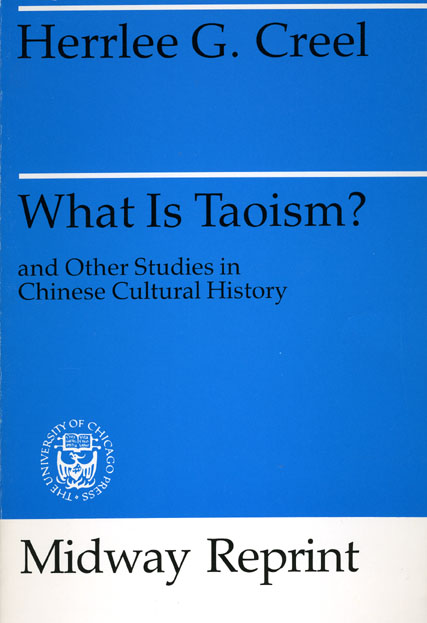
What Is Taoism?: and Other Studies in Chinese Cultural History, Creel

What Is Taoism?: and Other Studies in Chinese Cultural History, Creel


 Save Cover Previewfor What Is Taoism?

Paper
$37.00

ISBN: 9780226120478
Published September 1982
REQUEST AN INSTRUCTOR COPYfor What Is Taoism?
Find this book in a library: What Is Taoism?
Rights and Permissionsfor What Is Taoism?

What Is Taoism?
and Other Studies in Chinese Cultural History


Herrlee Glessner Creel
What Is Taoism? traces, in nontechnical language, the history of the development of this often baffling doctrine. Creel shows that there has not been one “Taoism,” but at least three, in some respects incompatible and often antagonistic. In eight closely related papers, Creel explicates the widely used concepts he originally introduced of “contemplative Taoism,” “purposive Taoism,” and “Hsien Taoism.” He also discusses Shen Pu-hai, a political philosopher of the fourth century B.C.; the curious interplay between Confucianism, Taoism, and “Legalism” in the second century B.C.; and the role of the horse in Chinese history.
Read Lessabout What Is Taoism?


200 pages | 6 x 9 | © 1982

Asian Studies: East Asia

History: Asian History

Religion: South and East Asian ReligionsReviews
Table of contents


Table of Contents

Preface
1. What Is Taoism?
2. The Great Clod
3. On Two Aspects in Early Taoism
4. On the Origin of Wu-wei
5. The Meaning of Hsing-ming
6. The Fa-chia: “Legalists” or “Administrators”?
7. The Beginnings of Bureaucracy in China: The Origin of the Hsien
8. The Role of the Horse in Chinese History
Index

Herrlee G. Creel - Wikipedia

Herrlee G. Creel - Wikipedia


Herrlee G. Creel

From Wikipedia, the free encyclopedia
Herrlee G. Creel
BornJanuary 19, 1905
Chicago, Illinois, United States
DiedJune 1, 1994 (aged 89)
Palos Park, Illinois, United States
Alma materUniversity of Chicago
Scientific career
FieldsChinese philosophyhistory
InstitutionsUniversity of Chicago
Chinese name
Traditional Chinese顧理雅
Simplified Chinese顾理雅
Transcriptions

Herrlee Glessner Creel (January 19, 1905 – June 1, 1994) was an American Sinologist and philosopher who specialized in Chinese philosophy and history, and a professor of Chinese at the University of Chicago for nearly 40 years. A prolific author, on his retirement Creel was praised by his colleagues as an innovative pioneer on early Chinese civilization, and as one who could write for specialists and general public with cogency, lucidity, and grace.[1] Creel was known for his early work on Confucius, the history of Chinese thought, and his unsurpassed study and translation of Shen Buhai.[2][3]

Early years

Herrlee G. Creel was born on January 19, 1905, in Chicago, Illinois,[4] taking up journalism after high school. He attended the University of Chicago as an undergraduate, studying in philosophy and the history of religion. He graduated with a Ph.B. degree in 1926. He become interested in the teachings of Confucius after graduation, studying Chinese with a Chinese student.[5] He continued on at Chicago as a graduate student studying Chinese philosophy, earning an AM in 1927, followed by a PhD in 1929 with a dissertation entitled "Sinism: A Study of the Evolution of the Chinese World-view".[6][5]

He began his postdoctoral career as an assistant professor of psychology at Lombard College from 1929 to 1930. He was awarded fellowships by the American Council of Learned Societies (1930–1933), the Harvard-Yenching Institute (1931–1935) and the Rockefeller Foundation (1936, 1945 –1946).[2] With the support of Harvard-Yenching he visited China from 1932-1935 to study inscriptions with the Chinese scholar Liu Jie (1901-1977).[5] In 1936 he accepted a post at the University of Chicago, where he was an instructor in Chinese history and language until he was appointed assistant professor of early Chinese literature and institutions in 1937.

Creel was one of the founders of the university's Far Eastern studies program in the 1930s and had a major role in building its Far Eastern Library. He ordered some 5,000 books a year from dealers in China. In 1939, with support from the Rockefeller Foundation, he returned to China, then in the grips of the Second Sino-Japanese War, with the city of Beiping (Beijing) occupied by the Japanese Army. He bought more than 75,000 volumes for the library, especially those dealing with the pre-modern period.[2]

Creel was promoted to the rank of associate professor in 1941 and full Professor in 1949. He served as a Lieutenant Colonel of military intelligence in the United States Army from 1943 to 1945 during the Second World War. He remained as a professor until 1964, becoming the Martin A. Ryerson Distinguished Service Professor of Chinese History until 1974, when he published his Shen Pu-Hai.

Societies and publishing

Creel was a member of the Committee on Chinese Studies of the American Council of Learned Societies, a member of its Committee on Far Eastern Studies, and the President of the American Oriental Society. He was also a member of the Association for Asian Studies as well as a member of the American Philosophical Society.

The most influential of Creel’s books include The Birth of China (1936), the first detailed account of the significance of the archaeological excavations at Anyang, which quickly attracted global interest; Studies in Early Chinese Culture (1937) which was an influential collection of monographic essays; Literary Chinese by the Inductive Method, vols. I–III (1938–52), a groundbreaking and controversial attempt to teach literary Chinese through carefully glossed excerpts of standard classical texts; Newspaper Chinese by the Inductive Method (1943), an effort to apply identical pedagogical techniques to the analysis of Chinese newspapers; Confucius, the Man and the Myth (1949), a critical analysis of the philosopher ConfuciusChinese Thought from Confucius to Mao Tse-tung (1953), a survey of Chinese thought; The Origins of Statecraft in China, Vol. 1: The Western Chou Empire (University of Chicago Press, 1970), a judicial account of the polity of the Western Zhou dynastyWhat is Taoism? and Other Studies in Chinese Cultural History (University of Chicago Press, 1970) and Shen Pu-hai: A Chinese Political Philosophy of the Fourth Century B.C. (1974), a monograph on Shen Buhai, an early Chinese specialist in administrative technique.

Style and legacy

Creel was especially known for Confucius: The Man and the Myth (1949), which argued that Confucius had been misunderstood because legend had obscured the facts of his life and his ideas. Creel held that Confucius was a reformer and an individualist, as well as a democratic and revolutionary teacher.[2]

From the start of his career in the 1930s, Creel was an outspoken proponent of the theory that Chinese characters are inherently ideographic in nature.[7] He was opposed by sinologists Peter A. Boodberg and Paul Pelliot, who believed that phonetic principles played a large role in the early history of Chinese characters.[8] The scholar John DeFrancis objected to Creel's position, which he called "the ideographic myth."[9] Creel in the 1930s set out to correct the widespread idea that a phonological system of writing, such as an alphabet, which represents sounds, was superior to an ideographic one, such as Chinese. The debate has continued many decades later without either side being able to discredit the other.[10]

Creel's language textbooks were controversial because they introduced students to Chinese using classical texts, not the modern language.[11]

Creel died at his home in Palos Park, Illinois, after a long illness, on June 1, 1994, at the age of 89.

Selected works

  • Creel, H. G. (1936). The Birth of China. London: Jonathan Cape. Rpt. New York: John Day, 1937; New York: Frederick Ungar: 1954.
  • ——— (1937). Studies in Early Chinese Culture: First Series. Baltimore: Waverly Press.
  • ——— (1936). "On the Nature of Chinese Ideography". T'oung Pao32 (1): 85–161. doi:10.1163/156853236X00056.
  • ——— (1938–52). Literary Chinese by the Inductive Method, 3 vols. Chicago: University of Chicago Press.
  • ——— (1949). Confucius, the Man and the Myth. New York: John Day. Rpt. under title: Confucius and the Chinese Way, New York: Harper, 1960.
  • ——— (1953). Chinese Thought from Confucius to Mao Tse-tung. Chicago: University of Chicago Press.
  • ——— (1970). What is Taoism? and Other Studies in Cultural History. Chicago: University of Chicago Press.
  • ——— (1970). The Origins of Statecraft in China, vol. 1. Chicago: University of Chicago Press.
  • ——— (1974). Shen Pu-hai. Chicago, London: The University of Chicago Press.

Notes

  1.  Roy (1996), p. 95.
  2.  Saxon (1994).
  3.  Pines (2024), p. 16,57.
  4.  Roy 1996, p. 1356; Tsien 2011, p. 241.
  5.  Tsien (2011), p. 241.
  6.  Roy (1996), p. 94.
  7.  Creel (1936), p. 85.
  8.  Honey (2001), p. 297-298.
  9.  John DeFrancis, The Ideographic Myth," Pinyin (no date)
  10.  Gu, Ming Dong (2013). Sinologism: An Alternative to Orientalism and Postcolonialism. London; New York: Routledge. ISBN 9780415626545.p. 190-191
  11.  Roy (1996), p. 97.

References

Chinese Thought From Confucius To Mao Tse Tung

Chinese Thought From Confucius To Mao Tse Tung


Chinese Thought from Confucius to Mao Tse-tung
BY H. G. CREEL
==

==


==
From the United States

T
4.0 out of 5 stars Good, brief, readable synopsis
Reviewed in the United States on December 14, 2008
Format: Paperback
Published in 1953, this book is a bit dated, but it's a good, brief and readable synopsis of Chinese philosophy's history and main concepts. It starts off a bit weakly, with rather broad generalizations about Chinese thought and culture and a less-than critical take on Confucius, apparently treating the entire Analects as representing reliable records of his statements. It's generally believed these were compiled over a long period, with some material neither originating with Confucius nor representing his thought. A couple chapters are markedly Taoist and even anti-Confucian, but Creel only mentions them in passing, suggesting they can be reconciled with Confucian thought. It's hard to see how, but Creel doesn't elaborate. No doubt Creel knew his subject well and the simplistic impression is due to brevity, but a caveat or two would have helped.

However, Creel becomes considerably more critical regarding both texts and concepts as he moves on to Mo Tzu, Mencius, the Taoists, Hsun Tzu, the Legalists, etc. There's still simplification, but this can't be avoided in such a short work, and his combining philosophical with political history is quite helpful. This is particularly true as Chinese philosophy has often had a pronounced political orientation (even Taoism, in reacting against this focus), as many of the leading thinkers served in government or aspired to, and as the state and emperors have typically aligned themselves publicly with a particular philosophy (with varying degrees of sincerity).

Another strength is the book's inclusion of post-classical philosophy, continuing through the Communist state's establishment. It's hard to find brief, popular works on Chinese philosophy that cover its entire history, much less ones that do it well and place ideas in historical and political context (Fung Yu-Lan's Short History may be another, but I've just started it). Necessarily the result is a synopsis rather than treatment in depth, but Creel does this quite well. In little space he sheds considerable light on the philosophical eclecticism of the Han Dynasty, Buddhism's introduction to China and its evolution and impacts there, neo-Confucianism, reactions against it, and Western influence.

This background is helpful in trying to understand China's difficulties and struggles during the twentieth century, and Creel gives a very plausible explanation for the quick and fairly widespread acceptance of Communism by both the Chinese people and the intellectuals. At the end of the book he lapses again into some breezy generalizations and perhaps a touch of romanticizing, although not without some useful insights. Overall it's a very good book and one wishes Creel were available for a final word on China today.
6 people found this helpful
Helpful
Report

Jordan Bell
5.0 out of 5 stars A reliable and well written book to start with
Reviewed in the United States on February 2, 2011
Format: Paperback
The schools of thought that Creel covers are: Chinese thought before Confucius, the schools of Confucius, Mo Tzu, Mencius, the Taoists, Hsun Tzu, the Legalists, the Buddhists, and neo-Confucianism. Creel points out general characteristics of Chinese though. What was most striking to me is that Chinese philosophy has focused much more on how people should live in society than on metaphysics or epistemology.

This book is very smoothly and carefully written. Creel explains the beliefs and history of different schools of Chinese thought. This book is a model for condensing a scholarly topic or field into a book that can be understood and enjoyed by non-specialists. I had initially tried reading Fairbank's history of China, which has a much broader focus, but I did not enjoy reading that. It was more consciously scholarly, which I don't like for an introduction to a subject. I would rather get some evaluations by someone who is qualified to give those evaluations, and then in my further reading I can develop my own opinions. Creel makes short and cogent comments on the thinkers whom he discusses and the historical periods he discusses.

The book is a history of Chinese thought, but reading it gave me some notion of the political history of China. Either before or after reading this book it would be useful to one who wants to learn about China to read a book on the social and political history of the country. And for one who wants to study Chinese philosophy in greater detail, this book at least gives outlines that can be filled in later. In reading it, I feel that I got a fixed idea of who the main players in Chinese philosophy are, and what the main characteristics of Chinese thought are. In particular, that metaphysics was much less important than in Western thought also, not much talk about what happens after death.

"To escape from the world becomes more and more difficult. Most of the Chinese have never tried to. Instead, they have looked for ways in which it is possible to dwell with other people without being irritated by them, and to live in the world without being oppressed by it." (p. 8) The biggest use of a knowledge of China is to see how people living in another civilization independent of European civilization behaved and thought. "We are too close to ourselves; we cannot get outside our own skins and our own civilization.... One way to get some light on this question is to see how other peoples, who have different social habits and live under different circumstances, have solved the same problems." (p. 8)

There are English translations in the series Everyman's Library, Penguin Classics and Oxford World's Classics of many of the authors discussed in Creel's book, like Arthur Wayley, The Analects of Confucius , D. C. Lau, Mencius (Penguin Classics) , Martin Palmer, The Book of Chuang Tzu (Penguin Classics) , etc.
Helpful
Report

Colin McLarty
3.0 out of 5 stars Not a bad book
Reviewed in the United States on October 1, 2009
Format: PaperbackVerified Purchase
If you want to learn about classical Chinese thought you can do that here. It is breezy, readable, and not absurd. I think Arthur Waley: Three Ways of Thought in Ancient China is very much better for this. Waley is equally accessible, and equally old-fashioned or dated, but gives deeper information on the ideas and is more passionately involved with them.

As to the later ideas, notably Mao, you might expect much from a book that says "In the hundred years from mid-nineteenth to mid-twentieth century China has changed more profoundly than in the previous two thousand years" (p. 235). But this part is just 20 pages long. It is much better than the earlier parts. It is more vigorous and more informative. I do not know any single short source that is better. But of course there are many much better longer intellectual and political histories of twentieth century China.

Creel shows a serious misunderstanding when he says "to most Western readers a page that is sprinkled with Chinese names becomes rather forbidding," and his back cover promises "the text is not cluttered with Chinese names." First, the problem is not only with Chinese names. It is wearing to read any book that introduces four or five new names on each page and gives each one a brief paragraph before moving on. And, second, Creel often does this himself, despite his promise, often citing the historian Yulan Feng as source. Feng is often transcribed as Fung. He wrote a two volume History of Chinese Philosophy in the 1930s, in Chinese, still widely used, and he wrote a one volume SHORT HISTORY OF CHINESE PHILOSOPHY largely aimed at westerners but still much longer than this book by Creel. Both available from Amazon, they are more demanding than this by Creel or the book by Waley mentioned above.

Creel was a great expert, at the University of Chicago, and it was no easy thing in terms of the political situation to write a book like this in the US in 1953. But the result is not a very good book.
2 people found this helpful
Helpful
Report

Future Watch Writer
5.0 out of 5 stars One of the best books on Chinese political philosophy
Reviewed in the United States on October 5, 2006
Format: Paperback
By far the best study ever written of Chinese philosophy. Particular attention should be paid to Chapters VII, VIII and IX to understand the Asian mind. The influence of the totalitarian vision of Legalism on Chinese thought for thousands of years is not fully understood. The Chinese Empire, created in 221 B.C., was a fusion of Legalism and Confucianism. Chairman Mao was a great admirer of the first Chinese Emperor, who hated Confucianism and was a total Legalist. Indeed, modern "Communism" in China is really very much a continuation of some past trends. Check my Listamania list for more books on Legalism.
Helpful
Report

Sponsored 
Need customer service?
‹ See all details for Chinese Thought From Confucius to Mao Tse-tung
Confucius: The Man and the Myth: Creel, H G:

Confucius: The Man and the Myth: Creel, H G: 9781436715911: Amazon.com: Books


https://archive.org/details/confuciusmanmyth00cree/page/n9/mode/2up

Confucius: The Man and the Myth Hardcover – June 13, 2008
by H G Creel (Author)
5.0 5.0 out of 5 stars   (4)
See all formats and editions

Confucius: The Man and the Myth is a book written by H. G. Creel that explores the life and teachings of the ancient Chinese philosopher, Confucius. The book delves into Confucius' background, upbringing, and the cultural and political context in which he lived. It also examines the various interpretations of Confucianism throughout history and how his teachings have influenced Chinese society and beyond. The author offers a critical analysis of Confucius' philosophy and challenges some of the popular myths and misconceptions that have surrounded him. The book provides a comprehensive and engaging overview of Confucius' life and legacy, making it an essential read for anyone interested in Chinese history, philosophy, and culture.This scarce antiquarian book is a facsimile reprint of the old original and may contain some imperfections such as library marks and notations. Because we believe this work is culturally important, we have made it available as part of our commitment for protecting, preserving, and promoting the world's literature in affordable, high quality, modern editions, that are true to their original work.
===
Print length
376 pages
From the United States

Amazon Customer
5.0 out of 5 stars Great book by a great team
Reviewed in the United States on January 10, 2020
Verified Purchase
Learned a bunch about Confucius was not aware of, as well as gleaned a deep understanding of the context of the Analects and much of what it taught. Impressed half-way though.
One person found this helpful
Helpful
Report

dcodol
5.0 out of 5 stars Nice book
Reviewed in the United States on May 15, 2019
Verified Purchase
Book was what I expected. Reading
Helpful
Report

The Doc
5.0 out of 5 stars The Best Book to Read on Confucius!
Reviewed in the United States on July 31, 2015
Originally published under the this title, and later reprinted under the title, Confucius and the Chinese Way (Harper Torchbooks, The Cloister Library, TB 63) , this is a thoughtful study (by one of the leading Sinologists of this century) of Confucius, his era, and the contemporary relevance of his thought. Any book this old (the original version was published in the 40's, I think) is a little out of date. And Creel sometimes succumbs to the temptation to read Confucius as a proto-Deweyan pragmatist-democrat. But Creel still has many insights into the teachings of "the Master," and gives an engaging (if speculative) portrait of his life. This is still the best book-length secondary study of Confucius I know of in English.
2 people found this helpful
Helpful
Report

Samuel H. Milligan
5.0 out of 5 stars Confucius Uncluttered
Reviewed in the United States on August 1, 2007
My mother pointed out to me when i was a teenager that religion is inherently cruel, and that if I wanted an ethical system without cruelty, I would haved to develop one on my own. Over the years I ended up with a sort of basic Confucianism based on the five cardinal virtues--human-heartedness, righteousness, proper social conduct, wisdom and sincerity.

So I was pleased to learn that Creel had, in stripping Confucianism of centuries of accretion, got back to pretty much the same thing. Nothing mystical or other-worldly--just a basic system of social ethics that promises a life of productive contentment.

I regret that I came across this book too late to write Creel to thank him.
2 people found this helpful
Helpful
Report
====