Showing posts with label Metaxas. Show all posts

2017-10-28

Eric Metaxas :: Have you heard the Eric Metaxas Show? Highlights Ahead!

Eric Metaxas :: Have you heard the Eric Metaxas Show? Highlights Ahead!

Monday, June 8: Eric's Weekend, Joseph Kim & Geoff Tunnicliffe
The Eric Metaxas Show
Eric takes listener calls (don't miss the call at 26:30) and shares the details of his unbelievable weekend in the city. Listen here.
Joseph KimGeoff Tunnicliffe
 North Korean refugee Joseph Kim shares his harrowing escape story as told in his book Under the Same Sky and NBC's "A.D. the Series." Consultant Geoff Tunnicliffe discusses bringing the Bible to life for modern audiences. Listen here!
    

1708 Eric Metaxas - NKorean Christians suffer unspeakably

Eric Metaxas
15 August ·


North Korean Christians suffer unspeakably. Remember them in your prayers.


Freed Christian Pastor Describes North Korean Labor Camp Conditions
Rev. Hyeon Soo Lim, the Christian pastor who last week was freed and returned home to Canada, revealed what he had to suffer through at the North Korean labor…
CHRISTIANPOST.COM


LikeShow More ReactionsComment
Share
Top comments
1k1k
352 shares
21 comments
Comments

Write a comment...


Iris Griffiths Wow! What a story. You said it well, Eric: Christians do suffer unspeakably under this hateful regime. So grateful for this dear Pastor's release.


LikeShow More Reactions · Reply · 8 · 15 August at 07:33Manage

2 Replies


Elisabeth Elledge Martin While his suffering sounds awful, his punishments sound mild, compared to what I've heard these people endure in that hell hole. So happy he made it home. I live for the day the citizens are freed.


LikeShow More Reactions · Reply · 3 · 15 August at 07:37Manage

Ljubomir Baćović Perhaps many things would change if the pressure from the US would be removed. It is not difficult to be most isolated nation when you are in fact being most isolated by others.


LikeShow More Reactions · Reply · 15 August at 08:53 · EditedManage

Daun Vick This man has suffered greatly. I pray that he can be healed in body, mind and spirit.


LikeShow More Reactions · Reply · 5 · 15 August at 08:11Manage

Linda Graves Prayers or the people of North Korea and all those being persecuted throughout the world.


LikeShow More Reactions · Reply · 1 · 15 August at 07:59Manage

Walt Scamehorn Yup. Socialism n communism hates God. Remember that. Choose the right side. Light.


LikeShow More Reactions · Reply · 1 · 15 August at 07:53Manage

Jill Stirling Top of the mist persecuted in the world. Such endurance. God bless this man. Thanks Eric.


LikeShow More Reactions · Reply · 15 August at 09:56Manage

James Neathery Pray for those who a hastily packing up and moving out of Pyongyang and other cities. All US citizens must be out by 8/26.


LikeShow More Reactions · Reply · 16 August at 08:39Manage

Renee Collins Clark


LikeShow More Reactions · Reply · 7 · 15 August at 07:16Manage

Cheryl Houston I pray for the North Koreans every day!


LikeShow More Reactions · Reply · 5 · 15 August at 07:15Manage

Vicki Nelson Always keep them in my prayers.


LikeShow More Reactions · Reply · 15 August at 08:31Manage

Jeremy Mapa Awesome!


LikeShow More Reactions · Reply · 15 August at 09:09Manage

Heide San Nicolas 🙏💗🙏


LikeShow More Reactions · Reply · 1 · 15 August at 07:49Manage

Margaret Sauer Prayers for the N K and others in prison.


LikeShow More Reactions · Reply · 15 August at 23:57Manage

Sandy Mitchell Prayers


LikeShow More Reactions · Reply · 15 August at 11:43Manage

Barbara Kamps I worry about ALL North Koreans


LikeShow More Reactions · Reply · 16 August at 07:22Manage

Jamie Soper Prayers for any forced worker.


LikeShow More Reactions · Reply · 15 August at 08:35Manage

Jim Hall Did you thank Justin for the part he played? Sunny Ways!!


LikeShow More Reactions · Reply · 16 August at 07:28Manage

B.j. Smith 🛐


LikeShow More Reactions · Reply · 15 August at 08:36Manage

Vivienne McKinney 🙏🏻


LikeShow More Reactions · Reply · 15 August at 19:50Manage

View 1 more comment
------------------------


Freed Christian Pastor Describes North Korean Labor Camp Conditions
Share On Facebook Share On Twitter

By Stoyan Zaimov , Christian Post Reporter | Aug 14, 2017 1:59 PM
Video Player

Play
Mute
Loaded: 0%
Progress: 0%
Remaining Time-0:20Fullscreen
North Korea plans for 'unimaginable strike' on U.S.


KCNA/FILE PHOTO VIA REUTERSPastor Hyeon Soo Lim have been released by the North Korean government for humanitarian reasons.

Rev. Hyeon Soo Lim, the Christian pastor who last week was freed and returned home to Canada, revealed what he had to suffer through at the North Korean labor camp where he was held.

"During the winter, I had to dig holes that measured one meter wide and one meter deep," Lim said on Sunday upon his return to Light Korean Presbyterian Church in Mississauga, Ontario.

"The ground was frozen. The mud was so hard that it took two days to dig one hole. It was incredibly challenging. My upper body was sweating. My fingers and toes were frostbitten," he recalled, according to The Globe and Mail.

As Reuters reported, Lim was held for more than two years in North Korea after originally being sentenced to hard labor for life in December 2015, accused of attempting to overthrow Kim Jon Un's regime.

Lim spoke before his church on Sunday for the first time since his release. He thanked the Canadian government for its assistance, including National Security Adviser Daniel Jean, who visited North Korea to ask for his freedom.

"It's a miracle for me to be here today," the pastor said in Korean. "I always knew Canada was a very warm and compassionate nation, but through my ordeal I really began to grasp that very deeply."

Lim further revealed that he suffered from "overwhelming loneliness" while in prison, explaining that he ate 2,757 meals in isolation and worshiped alone for 130 Sundays.

Additionally, he read more than 100 books and watched many propaganda films about North Korea's history, which he said allowed him to "grasp and gain a deeper understanding of the 70-year history that formed the nation."

The pastor was made to confess to "indescribable treason" back in 2015 for writing biblical phrases and the name of his church on sacks of food, which the government said represented efforts to try and overthrow the Kim regime.

Senior Pastor Jason Noh said that he was not sure what Lim's role at the church will now be, but said that the congregation's "prayers were answered."

"It was incredible. We've been waiting for this moment to come. I had tears of joy," Noh said.

"He's been alone, praying and planning for the past two and a half years. He's a visionary. There are a lot of things he wants to do," he added.

Persecution watchdog groups have long described North Korea as the worst persecutor of Christians in the world, outlawing and punishing any expression of faith.

"Essentially, North Korea is the most oppressive regime in the world; it is certainly the most closed, isolated country in the world. It's a regime that stands accused by the U.N.'s own Commission of Inquiry of crimes against humanity," Benedict Rogers, East Asia Team Leader at Christian Solidarity Worldwide, told The Christian Post in an interview in March.

"Those crimes against humanity include the incarceration of 100,000 to 200,000 prisoners, who are jailed because of political crimes, and are subjected to the worst forms of torture, slave labor, denial of medical care, sexual violence, and in some instances execution."

Considering The Real Price Of War, Even With North Korea (Daniel A. Morris) | Political Theology Today


Considering The Real Price Of War, Even With North Korea (Daniel A. Morris) | Political Theology Today


Considering The Real Price Of War, Even With North Korea (Daniel A. Morris)
17 Oct, 2017 Current Events 0 Comments War and Peace

This month marked the 16th anniversary of the United States’ invasion of Afghanistan. With every day that passes, that conflict sets a new record in the category of “longest lasting American war.” And for many of these 16 years, we as a nation have simultaneously carried on other conflicts, as well. Considering those facts, it seems hard to believe that we still do not appreciate the costs and risks of war. But, judging from President Trump’s rhetoric on North Korea and conservative Christians’ general silence in response, what other conclusion can be drawn?

The just war tradition, which has roots in Christian thought and which many American Christians ostensibly embrace, has historically taught the importance of weighing the goals and possible benefits of war against the likely risks and costs. Reflection on these factors takes place under the jus ad bellum criterion of proportionality, as Michael Walzer notes in Just and Unjust Wars (129.)

As President Trump rattles his sword at North Korea, we must ask ourselves if we have actually considered the price of such a war. There are human costs to our already depleted military. There will be financial burdens. There will be diplomatic crises in our relations with other nations, especially China. And there will be a severe moral cost if and when parties to the conflict use weapons incapable of discriminating between combatants and non-combatants. Is there a possible positive outcome that could justify all these burdens for the United States?

But the just war tradition has also suggested that we in the United States are increasingly unable to appreciate and understand the costs of war, let alone weigh them against benefits. Paul Ramsey thought that the logic of nuclear deterrence isolated American citizens from the real costs of war.

For Ramsey, the “free world taxpayer” desperately needed to (but simply could not) understand what modern military conflict entails. This detached figure, he argued, in his book The Just War “must be told in no uncertain terms that his unexamined reliance on deterrence of total war by threat of total war and mutual homicide policies are themselves of a piece with his unwillingness to prepare for any real trial of strength. He must be told that he is in mortal danger precisely because at every level of warfare he is so completely non-political and unpurposive” (235).

Ramsey believed that American citizens had become content to pay taxes in support of the military, vote every so often, and hide behind weapons that we hoped would never hurt us. This posture fails to reckon adequately with the true costs of war, especially when that war involves nuclear weapons. Ramsey’s words should serve as a wake-up call for American citizens today.

Daniel Bell has made a similar argument about our inability to understand the costs of war. While Ramsey identified nuclear deterrence and the “taxpayer” mentality as causes of our detachment from the costs of war, Bell believes drone technology is partly to blame. Weaponized drones make it morally easier to kill people. They remove combatants from the theater in which they meet each other in the flesh. In the process, it is more possible and likely for someone deploying fatal force to minimize the human value of his or her target.

Seeing a person face to face conveys the weight of killing more readily than seeing a person through a screen at a distance of thousands of miles. For Bell, drones lead us to think of human life as cheap and to become sloppy in our commitment to moral standards in war. Weaponized drones, Bell writes, “make it easier to dismiss the moral responsibility to carefully distinguish combatants from non-combatants and to restrict the amount of force and killing to only what is necessary to pursue the just cause of the war.”

If nuclear deterrence and drone warfare have made us incapable of understanding the moral costs of war, to say nothing of weighing them well, President Trump’s comments on North Korea show our moral detachment and ineptitude at their logical conclusion. His improvised “fire and fury” statement demonstrated a complete lack of understanding about proportionality and the costs of war. It also exhibited ignorance of other jus ad bellum criteria such as “aim of peace” and “last resort.”

His descent into a name-calling contest with Kim Jong Un shows the same tendencies, except with less dignity. His treatment of Guam as bait shows a gratuitous disregard for innocent lives. And after all that, Trump scorned diplomacy and de-escalation, which were strategies apparently being pursued by Rex Tillerson, his Secretary of State. After Tillerson attempted to open new lines of communication with North Korea, Trump tweeted that Tillerson was “wasting his time.” Trump seems incapable of weighing the costs of war, and this inability has enormously high stakes for people across the globe. The phenomenon of moral detachment that Ramsey saw in nuclear deterrence and Bell sees in drone warfare has reached its peak in a man with five draft deferments threatening nuclear war as improvisation.

These moments show moral detachment and ineptitude in the context of war that should trouble any society, especially one that thinks of itself as “Christian.” And yet, conservative American Christians have been silent in response. What, for example, has Eric Metaxas, who has written about the plight of North Korean Christians, to say about escalating tensions with North Korea and the increasing possibility of a nuclear encounter? He had a lot to say in support of Trump during the presidential campaign.

Those words come with great responsibility, especially after Trump’s victory. But he is silent on the heightened tension with between the United States and North Korea, despite the fact that each moment moves us closer to using weapons that cannot make the most basic distinction in the ethics of war, between combatants and non-combatants. The time has come for Metaxas and others to repent and speak up. American Christians must remind themselves that war carries costs and to denounce any rhetoric that forgets this basic fact.
---------
Daniel A. Morris is an independent scholar living in Northfield, Vermont. In 2015, his book Virtue and Irony in American Democracy: Revisiting Dewey and Niebuhr, was published with Lexington Books. His research in Christian ethics and American religious history has appeared in The Journal of Religion, Soundings, and Journal of Religious Ethics. He is the author of Virtue and Irony in American Democracy: Revisiting Dewey and Niebuhr (Lexington Books, 2015).
-------------
Tags: Daniel Bell, Donald Trump, featured, just war tradition, Michael Walzer, North Korea, nuclear deterrence, Paul Ramsey, Rex Tillerson

Eric Metaxas Defends Trump on Immigration and Refugees - The Atlantic

Eric Metaxas Defends Trump on Immigration and Refugees - The Atlantic

An Evangelical Christian Defends Trump’s First Week in Office

The radio-show host Eric Metaxas believes protesters and the media are overreacting to the president’s executive order on refugees and immigration.
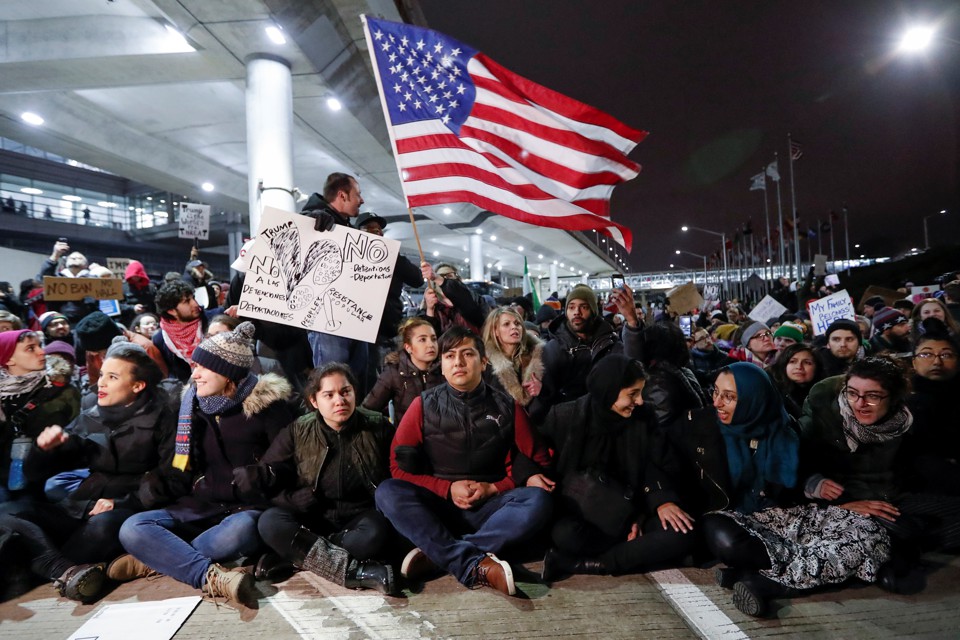
Protesters gather at O'Hare airport in Chicago.Kamil Krzaczynski / Reuters

EMMA GREEN
JAN 30, 2017


Want to receive exclusive insights from The Atlantic—while supporting a sustainable future for independent journalism? Join our new membership program, The Masthead.

Depending on where you were this weekend, America’s crowds might have told you very different things about the state of the country. On Saturday and Sunday, thousands of people gathered at a dozen major international airports and in the streets to protest the president’s executive order on immigration and refugees. But on Friday, thousands more gathered on the National Mall for the March for Life, more in celebration than protest. Many felt encouraged, they said, about recent progress toward ending abortion, crediting Trump with taking steps on this issue during his very first week in office.
RELATED STORY


Where Christian Leaders Stand on Trump's Refugee Policy

One of the speakers at the March for Life, Eric Metaxas, is a conservative evangelical talk-show host who wrote a book about Dietrich Bonhoeffer, the German Lutheran pastor who was detained and executed by the Nazis. During the campaign, he came out as a supporter and defender of Trump. When I spoke with him right after the election, he said he suspected that in time, Trump’s opponents “will see he is not the person they feared.”

Backstage at the March for Life on Friday, Metaxas told me he is feeling “tremendously encouraged” by Trump’s actions so far, particularly on abortion. By that point, drafts of the president’s executive action on immigrants and refugees were already circulating, and we discussed that as well: “When Trump says America first, it doesn’t mean cheering for America only,” Metaxas said. In general, he feels that the media has unfairly demonized the president, he said, and “we’re going to have to wait and see what he does.” Our conversation, edited for length and clarity, is below.


Emma Green: How are you feeling?

Eric Metaxas: I feel encouraged, tremendously encouraged. People on the pro-life side have never been merely advocating for an issue. [They have been] advocating for a fair debate. I think the science has so changed the debate that it will change the views of most Americans. I really think we’re at that point with sonogram imagery and a lot of the science that’s coming out, it’s getting harder and harder to deny that [a fetus] is a person.

I’m encouraged that because of Vice President Pence and President Trump and Kellyanne Conway, the truth will out.

Green: What have been your perceptions of President Trump so far?

Metaxas: He’s been shockingly, and perhaps even ironically, the most pro-life president in the history of the republic.

Green: Why do you say “ironically”?

Metaxas: “Ironically” because he is widely perceived as being anything but a social conservative. Somebody who has had three wives and who has been pro-choice most of his life is not the person you’d expect to advocate for the unborn.

But he’s 70 years old. I think he has a sense of the weight of his new position. He has genuinely done something many Never Trumpers scoffed that he would never do: Be faithful to his campaign statements on this issue. That alone is newsworthy. In one week, he has called out ABC News for not covering this March and encouraged people who have been laboring in the trenches. And also, the fact that he’s deputized the vice president and Kellyanne Conway to be speaking at the March today—it’s utterly astounding. Everyone here is profoundly encouraged.


“Trafficking in cliches about ‘love’ over ‘hate’ will not bring morality or sanity to our foreign or domestic policy.”

Green: A lot of people are worried about refugees and immigration right now. Does this connect to the pro-life movement—standing up for families and people who have been persecuted on the basis of religion?

Metaxas: It’s all the details. You can err on either side of this. We’ve always been the most generous nation in the world when it comes to caring for those outside of our borders. The question is in the details: How do we keep the nation safe at the same time?

When Trump says America first, it doesn’t mean cheering for America only. It means if you want to care for your neighbors, you have to make sure that you are yourself, first, healthy. Just like they say on the plane: Take your own mask first before you help the person next to you. You’re both going to drown or die if you don’t take care of yourself.

Trump errs on the side of bluster sometimes for effect, but I don’t think that the people who voted for him, most of them, would ever be for not caring for immigrants or refugees. People in the church know it’s our obligation. The only question is how.

Green: If you had to give a general sense of how you’re feeling about the president right now, what his presidency means for the church and for America, what would you say?

Metaxas: Tremendously hopeful. I’ve never seen a president do what he said he was going to do so clearly and so rapidly in my life. The days of business as usual are over—that has been corroborated by the facts of the recent week. Any American would have to be happy and hopeful about that.


Green: But there are a lot of Americans who aren’t happy and hopeful.

Metaxas: If I sat down and talked to them, I would say … it’s an amazing thing to have an American politician, much less the president, actually saying what he means so that he actually act on it fairly quickly. It’s shocking, and genuinely hopeful for politics in America.

“Here’s one thing the media and all of us should learn: Trump is not wrong nearly as much as everybody says he’s wrong.”

Green: But take for example Sean Spicer’s first-ever press conference with the press corps. He used it to berate the media for lying about Trump—

Metaxas: I think a fair-minded person 100 percent gives him a pass. Say you are Donald Trump, and you tried to make the case that you’re pro-everybody, but people have demonized you as racist over and over again. And then Timemagazine scandalously—underscored, scandalously—reports something that is not true, that they should have triple-checked because of the incendiary nature of what they were saying. Trump probably just got hot-blooded about it, and said, “Here it is, I’ve been in office for a day, and they’re putting something out which is so defamatory, and by the way, it’s not even true.”

I would give Sean Spicer a pass. I wasn’t happy about what he said. But I just thought, “Given the context, no wonder they’re crazy angry.” It was a bad start, but I kind of understood how it happened.


Green: Evangelical Christians, as a group, are committed to the idea that there is a truth that can be firmly established. But at times, this does not seem to be Trump’s worldview. Take voter fraud—a claim he has repeated with no evidence to back it up.

Metaxas: I’m dying to see what this investigation will turn up. Here’s one thing the media and all of us should learn: Trump is not wrong nearly as much as everybody says he’s wrong. In the end, often, what he’s said has been corroborated. I don’t think it’s a bad idea to look into it. It undermines democracy even if there’s a perception of voter fraud.

Green: But isn’t there a perception of widespread voter fraud in large part because the president of the United States keeps saying it?

Metaxas: There’s this perception on both sides. You’ve heard people on the Democratic side saying there’s voter suppression. We can’t have a functioning republic with either the perception of voter fraud or voter suppression. It’s healthy to look into it. If he ends up having egg on his face, tough luck for him.

Green: But don’t you think it’s damaging for him to repeat this, or for Sean Spicer to repeat this, without having any evidence to support it?

Metaxas: I’m willing to give him the benefit of the doubt thus far because I, and many Americans, have been unfortunately trained by the press in recent years not to take their side automatically anymore. They have tremendously undermined themselves. The New York Times, which I’ve read my whole life, has never in my life stooped to these levels of partisanship. They’re so out of touch that they think it’s journalism. They’re going to have to understand that Americans don’t take them or mainstream media as seriously as they once did. They’ve hurt themselves. And the media has to repair the damage.


“I know that most of the people in the media have genuine contempt for Trump voters.”

Green: You’re a student of the Holocaust. You know, more than most, how damaging it can be to levy accusations at the press and undermine that institution. In Nazi Germany, they were called the Lügenpresse—the lying press.

Metaxas: But what if it is? Press advocacy for Hillary Clinton was nothing less than scandalous. As an American, I was sickened. They’re destroying themselves. They’re destroying a vital institution of the republic.

Green: But a lot of people on the left blamed the media for over-covering the email scandals. They say the media brought Hillary Clinton down. Don’t you think the press gets criticism from both sides?

Metaxas: I don’t think that is true. I would state boldly that the mainstream media heavily covered for Hillary and for Obama. To do that is nothing less than scandalous. It’s sickening to me. I take little joy in it.

I went to Yale. I’m a writer. I know that world. I live in Manhattan. I know that most of the people in the media have genuine contempt for Trump voters. They elected the president of the United States. That’s not “some people.” That’s the American voter who elected the president of the United States.

The people in the media, the people at The New York Times—they don’t know anybody who doesn’t think the way they do. Or they think that if you think [differently], you’re some sort of exotic beast and they’d love to get a look at you. That’s lazy journalism. They need to work overtime to get in touch with those people and stop demonizing them and stop sneering at them.


* * *

After we spoke at the March for Life on Friday, I emailed Metaxas to get further thoughts on Trump’s executive order on immigrants and refugees, since that became a huge topic of news over the weekend. Here’s our exchange:

Green: Do you support Trump's executive order on immigration and refugees?

Metaxas: As far as I can tell from my limited reading, the order is not what so many are saying it is. David French in the National Review had the most clarifying article on it, making it quite clear that President Obama essentially did the same thing, but at the time the media entirely gave him a pass, which sadly was often the case during his eight years. I think it’s largely because of the media’s witting and unwitting collusion in carrying President Obama's water that we now have Trump as our president, although that’s another story, of course. Many people seem too angry to think clearly about this.

So yes, I am very worried about the outrage over this executive order and the fury at Trump in general, because there seems to be more smoke and noise than what would be very helpful clarification. Trafficking in cliches about “love” over “hate” will not bring morality or sanity to our foreign or domestic policy. Who doesn’t prefer “love” over “hate”? The real question is what are the policies that we adopt, and how can they best reflect love and generosity, while still protecting our citizens. There is no substitute for that rational conversation. But the idea that borders are somehow “hateful” is so inane I find myself deeply concerned for my nation. If we cannot understand the fundamentals of what it means to be a sovereign nation, how can we ever see when nationalism actually veers into real jingoism? How can we see the difference between a healthy patriotism and a selfish tribalism? If saying “I love America” means “I hate other countries,” we have fallen into an Orwellian death spiral in which language is useless and power is the only language. That state is called “mere anarchy,” and in such conditions no one suffers more than the poor and the disenfranchised.

“If the president is nothing but a bogeyman and piñata, we cast ourselves ... in the roles of everlasting flailers.”

Green: Do you think the temporary ban on refugees and limits on immigration from certain countries lines up with the vision of the church as you understand it?

Metaxas: If one is looking coldly at the facts, one cannot help but realize that we are now holding Trump to a standard to which we did not hold President Obama. A temporary ban on immigration is a temporary ban on immigration. It is not the demonization of any group. It is a sober decision that is meant to help us make further sober decisions in future. If the ban is enacted ham-handedly, that’s another story, and I’m sure it has been in a few instances. But a soupcon of grace in all of this will go a very long way. Who doesn’t love to feel morally superior? But many of us are now using whatever Trump does as an excuse to exercise indignation. Not doing that would be smarter for all concerned. If the president is nothing but a bogeyman and piñata, we cast ourselves not in the roles of responsible citizens, but in the roles of everlasting flailers, which cannot end well.

Green: And finally, do you think Christians should get priority over other groups in consideration for refugee status?

Metaxas: Generally speaking, absolutely not, because nothing could justify that, and no Christian could give a biblical reason for that. But what is happening now is another case. It is like affirmative action, in which past errors are being redressed. Obama’s policy toward persecuted Christians was bizarrely hostile to them, and our new president took note of that and is doing what he can to bring them to safety, as he said he would during the election. If that had been done in the last four years, Trump wouldn’t need to do it now. America elected him and he is the president. If our understanding of this nation and that office are so enfeebled as to make dealing with the current situation impossible, we will harm both dramatically and perhaps fatally. That should give us pause.

ABOUT THE AUTHOR

EMMA GREEN is a staff writer at ​The Atlantic, where she covers politics, policy, and religion.
Twitter

IF YOU CAN KEEP IT: THE FORGOTTEN PROMISE OF AMERICAN LIBERTY


IF YOU CAN KEEP IT: THE FORGOTTEN PROMISE OF AMERICAN LIBERTY 

Eric Metaxas, author, speaker, radio host, addresses the 2016 Western Conservative Summit audience about the importance of reclaiming America’s goodness.
 ----
If you care about the world, you have to care about America. If you have the idea that, “America is going to hell and it’ll be good for America, the church will thrive under persecution,” that’s not a Biblical view. It’s like being glad that somebody is suffering because it will be good for their soul. We don’t rejoice in suffering, we want to help people. We need to care about this country and then we can care about the world. You’ve always known that America is a beacon of freedom to the world. It’s basically been our mission to be a blessing to the world. I would argue that God has mightily blessed this nation specifically so we can be a blessing to the world. In fact, we have exported freedoms to the world. We’ve sent treasure and we’ve spilled blood on foreign fields. That is who we are, and it’s the idea upon which we were founded. 

We are being Hollowed Out from Within I’ve just written a book called If You Can Keep It. I’ve never felt as passionate about anything I have written before. That includes my Bonhoeffer book. I feel like a man on a mission with this book because our country is in serious danger of becoming America in name only. Sometimes you face an existential crisis and you can see it for what it is. The Revolutionary War was an existential crisis. This is a different kind of existential crisis. We’re being hollowed out from within. We are not having our freedoms taken away at gunpoint, we are allowing them to evaporate, and we are becoming America in name only. 
And that will be the greatest tragedy in the history of the world because we have been blessed beyond all measure for purposes beyond our own shores. We have been a beacon of freedom to people around the world, people in the gulag, lucky to find a rat to eat. When Ronald 
Reagan said, “Mr. Gorbachev, tear down this wall,” those people found courage and hope. That is the power we have had on the world stage. We have been a hope to those without hope and without freedom. And we can be proud of the fact that we have given hope to people beyond 
our shores. 


My parents came to this country in the 1950s, my dad came from Greece and my mom from Germany. They met in an English class in New York City. They wanted to become Americans, they became Americans, and they raised my brother and me to love our country. When they passed the Statue of Liberty on those ships, they got choked up because they knew this 
“Dr. Franklin, what have you given us? A monarchy or a republic?” Now, she wasn’t being coy. It was a world of monarchies at that time. But the Founder’s chose liberty, and he said, “A republic madam, if you can keep it.” 

Faith, Freedom, and Virtue

Sometimes we think that’s cute. “If you can keep it, haha.” It’s a haunting thing, because he knew that ‘we the people’, might not be able to keep it. He and the Founders understood that what they had created, this treasure of self-government and liberty, was fragile. It would require so much of its citizens that they might well not keep it. It is easy to be governed from above or from without. You need to do nothing except stay out of trouble. But if you want to govern yourself, it takes more.
So those words that Franklin spoke, “If you can keep it,” are chilling because for about 200 years, rather miraculously, we kept it very well. It is the last 40 or so years we have not been keeping it. We’ve been running on fumes. 
My new book was influenced by Os Guinness and his book, A Free People’s Suicide. Os talks about something called a golden triangle of freedom, which is the idea that freedom requires virtue, is real. Immigrants are leaving hopelessness Treasure of  virtue requires faith, and faith in turn to come to a place where there is hope. This requires freedom. 


40 or 50 years, we have not been teaching these things in our schools, and we certainly do not see it in the media. And that’s why I wrote this new book starting with Ben Franklin’s famous phrase, “If you can keep it.” 
A Republic, Madam

What the Founders created at Independence Hall in Philadelphia was something genuinely miraculous. Many of them wrote that it seemed a miracle what they were able to do, to create a way for people to govern themselves which had never been done in the history of the planet. They created something called a constitution, think of the audacity of that idea. People around the world goggled in awe at the idea that a group of people on the coast of a continent had formed a government whereby the people would be genuinely free to govern themselves.

It was a wild idea, and they did not know if it would work. Actually, they knew it might fail. In fact, when Benjamin Franklin came out of the building, a woman said to him, requires people to govern themselves. You don’t steal because somebody is pointing a gun at you, you don’t steal because it is wrong. That’s called virtue. All of the Founders understood that without virtue, self-government and the liberties we enjoy are not possible. When I heard Os Guinness talk about this, I was sickened because I realize that this idea at the very heart of the American experiment was unknown to me. Jefferson, Franklin, all of the Founders said that virtue is utterly crucial to the kind of self-government they were proposing. So in order for us to keep it, as Franklin said, we needed to be basically a virtuous populace. 

So freedom requires virtue and virtue requires faith. Faith and virtue are linked. It doesn’t mean that every person of faith is virtuous or that every virtuous person is a person of faith but that communities full of faith tend to be more virtuous, tend to govern themselves more effectively. When revival broke out under the preaching of George Whitefield, Benjamin Franklin observed that those communities where 
was real for me growing up. But in the last Self-Government Freedom, which is to say self-government, 


revival broke out, crime went down. Franklin knew that what Whitefield was preaching created a populace of faith and virtue and those people were able to govern themselves infinitely more effectively than any other group of people. 
The Founders understood the dynamic that freedom requires virtue, virtue requires faith, and that faith requires freedom. If faith is coerced, if it is not utterly free, it is not real faith. You cannot force faith. It has to be free. And when the people are free to believe or not believe, to go to that church or 
had this largely negative narrative. And so we’ve not loved our country. We’ve not taught our children to love their country. 
There is a wrong kind of patriotism and there is a right kind of patriotism. There is a right kind of healthy selfregard and pride. To be constantly despising yourself is a sick thing. And the narrative among the cultural elites has been to focus on what’s wrong with the country. And those people believe they’re right. They’re not necessarily evil, but here’s the 

that church, then faith is real. Then, they will The 
be people of virtue. Then, they will be able to govern themselves. So religious freedom is at Greatness the very heart of the Founder’s vision. of America problem, they’re wrong. There is no question that the God of the universe, that the God of the Scriptures has had His hand on this country. Our secular 

Repent of Our Sins, Embrace the Good 

For 40 or 50 years, we have not been keeping the republic. We’ve not been teaching these things. We’ve bought into the negative narrative and we talk about all the bad things America has done. Now, there is nothing healthier than facing what you’ve done wrong so that you can repent of it. But if you are with somebody who just wants to say we’re bad, that’s a problem. We need to talk about the greatness of America and what it has meant to people in the world. People like my parents dreamed of coming to this great nation and raising their children here. They understood this. But for 40 or 50 years we’ve version of things is willfully ignorant. There are numerous things that have happened in our history that point to God’s hand. The Founder’s saw it, Abraham Lincoln wrote about it. We have not been blessed for nothing, we have been blessed to be a blessing to the world. When we say give me your tired, your poor, your huddled masses yearning to be free, we do that because that is who we are. It’s a fundamentally Biblical idea. 

America Blessed to Bless Others
Alexis de Tocqueville wrote about the idea that America is great because America is good. That’s a Biblical concept, 

Centennial Review ▪ September 2016 ▪ 3

right? That you do God’s will, do what God asks you to do, and He will take care of you because He loves you and wants to bless you. This country needs to understand that we have been blessed to be a blessing. 
in the history of the world before 1776, are Teach glorious stories of our past, of the heroes who meant for everybody in the world. So when 
George Bush said that everybody should be Virtue died and bled for the freedoms we enjoy. To free, he was right. The problem is, you can’t take those things for granted is nothing less just award people this fragile, complicated Again than a horrible sin. And we’ve basically taken 
thing and expect them to know what to do with it. They need to be prepared for it. And this country, largely as a result of English law, 
largely as a result of customs and mores, and also as a result of the preaching of George Whitefield for four decades, was able to handle this treasure of freedom.

We Need to Keep the Republic

By the way, Benjamin Franklin, somebody we think of as a French Enlightenment deist, was not. When he was in the constitutional convention, tell me if you’ve heard this in public school, things were not going well. It was not normal for them to be able to pull off creating a constitution. They got so desperate that Benjamin Franklin gave a speech, I quote it in my book, where he beseeches the assembly them for granted with the help of the media, with the help of academia, we’ve not passed them along. The Constitution is not enough. The people need to keep the republic. Franklin knew that if the people don’t keep the republic, the republic goes away. And when the light goes out of liberty and the America experiment, there isn’t a second or a third hanging around to replace it. What we have is an inestimable treasure given to us by the God of the Universe for His purposes in history. If we want America to be great again, America must be good again. We must teach virtue again, and we must teach heroism and self-sacrifice, and all the things that the Founders knew not to be optional or extra-credit but to be absolutely foundational to who we are and to the 
American experiment in history. 

We must not allow people to tell us that our patriotism is a selfish kind of patriotism. We need to love this country. We need to say with humility, we are blessed and we want to use our blessings for the whole world. We want to bring freedom to the whole world. Our freedoms, these extraordinary treasures that never existed 

to pray. To go to the Almighty whose hand was involved miraculously in their creation during the times of the Revolution and to beg Him to open the door so that they could create this Constitution and bring this new way of being in the world. 

This 2016 election is a symptom of where we are. For 40 years we have not been keeping the republic. And I’m here to blow a trumpet folks, and to say to America, we need to keep the republic. We need to get busy, we need to remind ourselves of the 

 ==============

If You Can Keep It: The Forgotten Promise of American Liberty by Eric Metaxas. Available at cibookclub.com. 

Eric Metaxas is a New York Times #1 bestselling author, host of a nationally syndicated radio show, founder of Socrates in the City: Conversations on the Examined Life, and keynote speaker at the 2012 National Prayer Breakfast.

Centennial Review ▪ September 2016 ▪ 2

Eric Metaxas encourages Americans to reflect on our country’s sins but to also embrace the good aspects that make our country great. 


Centennial Review ▪ September 2016 ▪ 4

CENTENNIAL REVIEW is published monthly by the Centennial Institute at Colorado Christian University. The authors’ views are not necessarily those of CCU. Designer, Justin Jones. Illustrator, Benjamin Hummel. Subscriptions free upon request. Write to: Centennial Institute, 8787 W. Alameda Ave., Lakewood, CO 80226. Call 800.44.FAITH. Or visit us online at centennial.ccu.edu.
Please join the Centennial Institute today. As a Centennial donor, you can help us restore America’s moral core and prepare tomorrow’s leaders. Your gift is tax-deductible. Please use the envelope provided. Thank you for your support.
- Jeff Hunt, Director
Scan this code with your smartphone to read this and previous issues online.
===========


Centennial Institute
Colorado Christian University 8787 W. Alameda Ave. Lakewood, CO 80226
Return Service Requested

Centennial Institute sponsors research, events, and publications to enhance public understanding of the most important issues facing our state and nation. By proclaiming Truth, we aim to foster faith, family, and freedom, teach citizenship, and renew the spirit of 1776. 

IF YOU CAN KEEP IT by Eric Metaxas | Kirkus Reviews


IF YOU CAN KEEP IT by Eric Metaxas | Kirkus Reviews


IF YOU CAN KEEP IT
The Forgotten Promise of American Liberty
by Eric Metaxas


KIRKUS REVIEW


God blesses America, the author contends.

Admitting that “the idea that God had chosen this nation for great things does not sit comfortably with modern sensibilities,” Metaxas (Lecturer at Large/The King’s Coll.; Seven Women: And the Secret of Their Greatness, 2015, etc.) nevertheless makes a faith-based argument for American exceptionalism. 

He believes that the Founding Fathers incorporated into the Constitution the Golden Triangle of Freedom: “freedom requires virtue; virtue requires faith; and faith requires freedom,” an idea articulated by British social critic Os Guiness. Metaxas exhorts Americans today to revitalize freedom by behaving virtuously, insisting on virtuous leaders, and recognizing the significance of Judeo-Christian religion in the nation’s identity and destiny. “There are certain populations in Europe whose unbelief is only equaled by their ignorance and debasement,” writes the author, 

“while in America, one of the freest and most enlightened nations in the world, the people fulfill with fervor all the outward duties of religion.” 

Metaxas is convinced that God has played “a central role” in America’s history.” “What we have are gifts from God,” he writes, “intended for us to steward in such a way as to bless as many people as possible.” 

Americans, therefore, must take up God’s mission to share democratic ideals with the whole world. 

Among the historic events that he believes God influenced was the writing of the Constitution, in which the Fathers conceded, “the finger of the Almighty might indeed have been involved.” Acknowledging that the nation has not always acted virtuously, the author encourages citizens to celebrate love of country through the arts (he cites the movie Mr. Smith Goes to Washington as both critical and inspiring); rituals (celebrating Flag Day); and memorizing poetry, such as “Paul Revere’s Ride.”


A controversial view of America’s past and future that will appeal to Christian readers.

---
Susie Bailey Combee ·
Youngsville, PA
This is one of most enlighteing books regarding the history of America I have read in a very long time. I believe it should be a study in every high school in America! Our history seems to be lost on our youth.
Like · Reply · 2 · Jul 30, 2016 7:40am


Carole Conaway ·
University of New Haven
To read this book is an eye opener about what our forefathers gave us and what we have done to it. Eric Metaxas is very prolific about his country and the way the people who live in it are placing it in jeopardy. This book should be required reading in our schools.

 Our children have no clue about what we can lose unless our way of thinking is changed. Read this book...it will not only freighten you, but make realize just what we can and will lose if changes are not made.

Our children are our future. If they are not aware of what is at stake, then we have lost. Why this book is not read as a text in our schools is a loss for all of us.
Like · Reply · Dec 23, 2016 2:07am

Stop threatening nuclear catastrophe, US warns N Korea | USA News | Al Jazeera


Stop threatening nuclear catastrophe, US warns N Korea | USA News | Al Jazeera


Stop threatening nuclear catastrophe, US warns N Korea
16 hours ago


James Mattis, centre, and South Korean Defence Minister Song Young-moo look into North Korea from the DMZ on Friday [Jung Yeon-je via AP]

MORE ON NUCLEAR WEAPONS
Disarming the worldyesterday
China helpful, Russia hurtful on US N- Korea policyyesterday
North Korea: Nuclear war may break out at 'any moment'last week
Anguish in Iran as Trump balks at nuclear deallast week


The United States does not want war with North Korea, the US military chief said on the demilitarised zone metres away from the communist state, as he warned Pyongyang to stop threatening "catastrophe" with its nuclear weapons.

James Mattis made the brief comments standing next to South Korean Defence Minister Song Young-moo on Friday, describing Kim Jong-un's leadership as an "oppressive regime" that mistreats its people while its neighbour to the south offers a vibrant democracy.

"Our goal is not war but rather the complete, verifiable, and irreversible denuclearisation of the Korean Peninsula," Mattis was quoted as saying by South Korea's Yonhap news agency at Panmunjom village.

The United States has about 30,000 American troops stationed in South Korea, a remnant of the 1950-1953 war on the peninsula that has never officially ended, with only an armistice agreement signed.

Song said North Korea can never use its nuclear weapons. "If it does, it will face retaliation by the strong combined force of South Korea and the US," he warned.

North Korea must to return to dialogue between the two Koreas, Song added.

The threat of nuclear war has escalated in recent months as President Donald Trump has intensified his rhetoric against Kim's regime, including saying he would "totally destroy" North Korea if it threatened the US or its allies.

Pyongyang responded by threatening to detonate a nuclear weapon in the atmosphere after its sixth and most powerful underground nuclear test last month.