Middle East
Scott AndersonScott Anderson
Follow
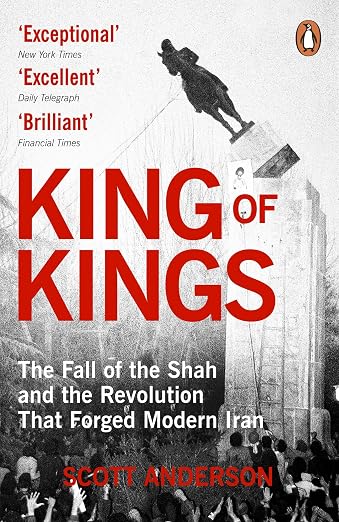
King of Kings: The Fall of the Shah and the Revolution That Forged Modern Iran
by Scott Anderson (Author) Format: Paperback
4.6 4.6 out of 5 stars (1,369)
A spellbinding narrative history of the 1979 Iranian Revolution and its devastating consequences by the Sunday Times bestselling author of Lawrence in Arabia.
THE NEW YORK TIMES BESTSELLER
NEW STATESMAN, ATLANTIC AND WALL STREET JOURNAL BOOK OF THE YEAR
'A brilliant tale of greed, paranoia and hubris... a good place to start for anyone seeking to understand the current crisis' Financial Times
'If you want to understand the turmoil in Gaza, Syria and beyond, the Iranian Revolution of 1979 is a good place to start' The Times
'Excellent' Telegraph
'Exceptional' New York Times
A spellbinding narrative history of the 1979 Iranian Revolution and its devastating consequences by the Sunday Times bestselling author of Lawrence in Arabia.
Before the revolution, the Shah of Iran seemed invincible. The world watched in awe as he commanded a huge army and oversaw an economy awash with billions of dollars of oil revenues. The regime's secret police had crushed communist opposition and the Shah appeared to have bought off the conservative Muslim clergy inside the country. On the international stage, Iran had become an invaluable ally to the West during the Cold War.
But village streets spoke of a different country - people derided the Shah as an American lackey and blamed him for economic inequality, for spending recklessly on lavish parties and for ignoring the Muslim majority. When a volcanic religious revolution erupted, led by a fiery cleric named Ayatollah Khomeini, the Shah was forced off the throne and into exile. How did it all go so wrong?
Brilliantly brought to life by the Sunday Times bestselling author Scott Anderson, this gripping behind-the-scenes narrative reveals how the Iranian Revolution was as world-shattering an event as the French and Russian revolutions, and how its repercussions are still felt around the world today. In the Middle East, in India, in Southeast Asia, and now in Europe and the United States, the hatred of economically-marginalized, religiously-fervent masses for a wealthy secular elite has led to violence and upheaval - and Iran was the template.
'Gripping... Anderson does an excellent job of narrating the extraordinary events of the revolution'
Spectator
'Told with clarity and directness. It is unlikely that a more authoritative account of this torrid period will ever be written'
Observer
'A sweeping, gripping book, one that makes past times and dead people (often weird, complex and evil) spring to life with its narrative verve and attention to detail... Riveting... Compelling'
Wall Street Journal
'Timely... a lively tale of palace intrigue'
New Yorker
'The most compelling account yet of the revolution in Iran... Outstanding'
Eugene Rogan, author of The Fall of the Ottomans
'Thrilling... the gold standard account of the Shah's fall... An epic and heart-breaking tragedy'
Azadeh Moaveni, author of Guest House for Young Widows
'A masterfully told account... A must-read' Steve Coll, Pulitzer Prize winning author of Ghost Wars
'Delivers remarkable new insights into one of history's least understood upheavals' Kim Ghattas, author of Black Wave
'Thrilling and fully authoritative' Azadeh Moaveni, award-winning author of Lipstick Jihad and Guest House for Young Widows
'Important and riveting' Sebastian Junger, bestselling author of In My Time of Dying and Tribe
512 pages
Popular Highlights in this book
What are popular highlights?
Previous page
By the time the war ended, some two million Persians, or nearly 20 percent of the population, had died from starvation or disease, giving neutral Persia the awful distinction of having suffered a higher death rate in World War I than any combatant nation.
Highlighted by 479 Kindle readers
Over the span of the shah’s rule, per capita income had increased a phenomenal twenty times over, the literacy rate had quintupled, and the average lifespan of an Iranian had more than doubled from twenty-seven to fifty-six.
Highlighted by 352 Kindle readers
“Michael, do you think we actually planned to have a revolution? We were just as surprised as anyone.”
Highlighted by 260 Kindle readers
Next page
From the brand
Product description
===
Translate all reviews to English
From Australia
Saint Quentin
5.0 out of 5 stars Exceptional history.
Reviewed in Australia on 16 May 2026
Format: KindleVerified Purchase
The author has penned an insightful and very detailed account of what was one of the most significant country-political times in modern history. The Sha of Persia/Iran created a period of ineptitude and division in one of the middle east’s most volatile countries, Iran. At times, the reading becomes complicated with all of the “players”, but overall a story which should be read by all today, as one of the reasons we are where are in the world at present. Well done, SA.
Helpful
Report
Amazon Customer
5.0 out of 5 stars A wonderful book - history at its best
Reviewed in Australia on 21 March 2026
Very prescient book given current events. Beautifully written, honest and informative. Anderson is a splendid writer and his experience and interest in Iran comes out in his writing. Excellent read.
Helpful
Report
From other countries
Cancerdoc
2.0 out of 5 stars Interesting background but poorly edited, disappointing
Reviewed in India on 24 September 2025
Format: KindleVerified Purchase
Relies heavily on a few sources with multiple repetition. Could have been edited down by 30-50% to make it a livelier read. Dwells a lot on bureaucratic infighting within the Carter administration, but at the end of it, the Shah remains a two-dimensional figure. His terminal illness (?CLL) and death post splenectomy are discussed perfunctorily or not at all. The role of the French Govt is touched upon but never really explored in much depth; it is taken at face value that French doctors visited Iran to treat the Shah, but this played no role in the decision to have Khomeini stay in Paris. Maybe I expected too much from a biography, but it is disappointing when a Wikipedia read is more interesting than several hundred pages...
Report
Fatima Ra
1.0 out of 5 stars Would not recommend this book!
Reviewed in Germany on 2 September 2025
Format: HardcoverVerified Purchase
This book is biased and only fuels racism against Iranians. A book written by someone that has only traveled to Iran for a few days as a 6 year old?! … the author is not a historian either.
I just finished reading the book “The Fall From Heaven” by Andrew Scott Cooper. He offers a fresh perspective on the dramatic events of 1977-1979 but also reveals some new facts uncovered thanks to newly declassified materials from that era.
Would not recommend this book.
Report
BMJ
5.0 out of 5 stars Astonishingly good
Reviewed in the United Kingdom on 10 July 2026
Format: KindleVerified Purchase
Gripping, I could not put it down. I vaguely remember the hostage crisis as a kid, but this explains events before and after brilliantly.A must-read with a prescient final sentence.
Absolutely marvellous.
Report
A. Vallejo Nagera Deroulede
5.0 out of 5 stars ¿Como fue la revolución islámica de Irán?
Reviewed in Spain on 8 June 2026
Verified Purchase
Apasionante lectura. Total recomendación. Muy útil para entender el Irán de hoy.
Report
Translate review to English
Erwin
4.0 out of 5 stars Poor quality of paper
Reviewed in Belgium on 21 November 2025
Format: HardcoverVerified Purchase
Bad paper quality
Report
Darius S.
5.0 out of 5 stars A Gripping, Edge-of-Your-Seat Work of Non-fiction
Reviewed in the United States on 2 September 2025
Verified Purchase
This is one of the most gripping books I've read in a long time. As an American born of Iranian descent, I've always of course been interested in the past of my ancestral motherland and how it came to be in the dire straights that Iran finds itself in today. Afterall, it is due to the Iranian revolution that my parents (seperately) ended up in the United States, met here, and started a family leading to yours truly.
Despite my immense interest in the modern history of Iran, many books and articles I've read (or tried to read) on the matter are written like textbooks. Dry pages of facts. It is difficult to read them for more than 20 minutes at a time (especially for one with ADHD such as myself) before getting bored, but in King of Kings, it seems that Scott Anderson has masterfully penned a gripping page-turning suspense novel that just happenes to all be completely true.
I devoured this book in 4 days and could scarsley put it down. It so completely consumed my psyche that I was even dreaming about it's subject matter during that 4 day span. A must read for any Iranian, Iranian-American, student of history, or just anybody that loves a well-written, edge-of-your-seat story of intrigue. Highly recommend.
Report
Amazon Customer
1.0 out of 5 stars Recieved damaged product, awful experience
Reviewed in India on 14 September 2025
Verified Purchase
Customer image
Customer image
Report
Joe Zhang
5.0 out of 5 stars I enjoyed the book
Reviewed in Canada on 22 April 2026
Verified Purchase
Very through and interesting
Report
Angusian
5.0 out of 5 stars Ringside seat at the revolution
Reviewed in the United Kingdom on 13 September 2025
Format: HardcoverVerified Purchase
Never has Incompetence of American foreign service been revealed oin this truly breathtaking account of the fall of the Shah, the revolution that swept across Iran and and subsequent humiliation of 'the Great Satan'.
In an almost hour by hour account of events, minutely documented from official sources Scott Anderson takes the reader through the errors of American policies. Individual arrogance on the part of the foreign service, ignorance of what was going on outside the developed, Americanized bubble of Tehran and a refusal to listen to those with language skills who were able to hear and interpret the groundswell of discontent and visceral hatred of the Pahlavi dynasty.
A completely absorbing account of the causes of revolution in Iran, an exposure of the ruthless hatred and vengeance of a religious maniac and a warning to all of America's flawed approach to foreign policy.
Report
pat in NC
5.0 out of 5 stars insightful history
Reviewed in the United States on 26 May 2026
Verified Purchase
The details in the book give insight into the history of a failed dictatorship. It almost seems like a satire and gives one pause about how blind governments can be. The blindness of the US government is astounding; have we learned anything from this history? the book is highly readable and a lesson for all of us.
Report
Mounir Dahdah
4.0 out of 5 stars An excellent albeit biased account of the Shah of Iran’s rise and fall.
Reviewed in the United States on 2 October 2025
Verified Purchase
While based on thorough research, interviews and documents, the book is peppered with adjectives and analysis that clearly indicate the author being anti-Shah. With that being said, it’s an excellent read.
Report
Nicholas Lake
4.0 out of 5 stars Detailed analysis of the Iran revolution, particularly from the US point of view
Reviewed in the United Kingdom on 30 August 2025
Format: KindleVerified Purchase
Interesting detail on the end of the Shah's rule in Iran, particularly strong on the serious shortcomings of US intelligence, analysis and policy
Report
Andrew Az
4.0 out of 5 stars A good book but only from a US angle
Reviewed in Canada on 10 November 2025
Verified Purchase
The book was overall well written. However, the book was from a US angle. The book did not discuss the social and economic achievements of the Shah in a manner that they deserved. Also, while the Shah was an authoritarian, he was using his power to modernize Iran. Although the book mentioned these briefly, they needed more attention. Certain parts of the book were badly researched. For example, He kept referring to Yazdi as a moderate within the regime who was against the killings by the new Kangaroo courts. That is not true. Yazdi was very proud of it and very proudly said to US TV that “there would be hundreds of executions “ and reporter asked him to repeat it as the reporter thought he misunderstood Yazdi. Yazdi repeated it very proudly with a smile. Another example was his review of the Qajar dynasty and Ahmad Shah. For Qajar Dynasty, he could speak to professor Hedayat at Yale to better understand their role in maintaining Iran’s sovereignty and integrity. Also, Ahmad Shah was the only Iranian monarch who actually believed in the constitutional monarchy. He also refused to sign the 1919 Anglo-Persian treaty. The book missed both points about him.
Report
V. Ramesh
2.0 out of 5 stars Too long
Reviewed in India on 8 December 2025
Format: KindleVerified Purchase
I was looking for a book which would cover the Iranian revolution quite briefly. This book might be a reference document for scholars, but it was too long and draggy for me.
Report
Kiran Chaturvedi
5.0 out of 5 stars King of Kings by Scott Anderson
Reviewed in the United States on 28 June 2026
Verified Purchase
This book is a delicious desert for history buffs like myself. The author has this amazing knack of tying up political, social, cultural and human aspects in an astonishingly interesting way. It is one of the most unbiased views of American mishandling of events in Iran and how our politicians never seem to learn from past errors. A must read to understand the present debacle we are facing again in Iran.
Report
Dr Turhan Wishart
5.0 out of 5 stars How Not To Run A Country!
Reviewed in the United Kingdom on 10 May 2026
Format: HardcoverVerified Purchase
A must read to understand old and modern Persia.
Report
Canopus
5.0 out of 5 stars A primer on History
Reviewed in the United States on 22 March 2026
Verified Purchase
With all the crap going on, and the so called "news" issuing agendas vs fact, I have always been a fan of good old fashion "book learnin". Since so major of the historical accuracy of today's news is, well, "massaged and adjusted" I began to search for good material. I have read the biographies and histories on every President and conflict since the French-Indian War, but need to read more recent histories to learn. More recent histories are harder to find with accuracy, since many files have not been released or declassified, but thee is still good stuff out there.
This in my opinion is a good one. It is extremely detailed from first hand, individuals especially which is important. No classified files..but first hand reports from all sources with little politics.
With all the stuff going on, this is an important book to help you fill in the history that is so important. You will be surprised by the number of people who think anything that happened prior to the year 2000 is not important. And it shows. A recommended read.
Report
Theresa
5.0 out of 5 stars About the Shah of iran
Reviewed in the United Kingdom on 3 February 2026
Format: HardcoverVerified Purchase
I really enjoyed this. Well researched, lots of detail. The writer has a great style and it's easy to read. Loved it.
Report
Patrick Merrigan
5.0 out of 5 stars King of kings
Reviewed in the United Kingdom on 23 February 2026
Format: KindleVerified Purchase
Fantastic book, very well detailed.
Report
Brian Lewis
5.0 out of 5 stars Downfall of the Shah of Iran
Reviewed in the United States on 29 August 2025
Verified Purchase
This is a remarkable account of the collapse of the monarchy in Iran. I think one of the book's great strengths is that the focus is very tightly on the ground in Iran, as the events unfold.
We do get views of Jimmy Carter and the Ayatollah Khomeini (the author is NOT a fan of either one) but the focus of the book, the meat and potatoes, if you will, is on people in the field or directly on the case. These include Henry Precht, the State Department's Iran expert; Robert Huyser and Gary Sick on the American side and Abraham Yazdi and Amir Abbas Hoveyda on the Iranian side. The American ambassador to Iran, William Sullivan comes off as ineffective, foolish and a big part of the problem. The Shah's wife, Queen Farah is a primary source for much of the information about the royal family.
King of Kings is a reporter's book, not primarily foreign policy analysis like America and Iran by John Ghazvinian.
I will say I was expecting the takeover of the American embassy in Tehran to play a bigger, earlier role in the book. It is discussed in an epilogue, but Anderson's viewpoint here is that the embassy takeover was the result of the events he discusses. For an in-depth account of that, try Mark Bowden's Guests of the Ayatollah.
Highly recommended. One of the best written and researched history books I have read in some time.
Report
Andrew Desmond
4.0 out of 5 stars Iran's Twentieth Century Nightmare
Reviewed in the United States on 13 December 2025
Verified Purchase
It’s probably fair to say that the Shah of Iran’s reign was always built on shaky foundations. His fall was probably pre-ordained. Having said that, the manner of his downfall was spectacular and the replacement regime has proved to be nothing less than a totalitarian theocratic nightmare. Scott Anderson’s “King of Kings” provides a detailed account of the rise and fall of the house of Pahlavi.
The Shah was an almost accidental king who never understood the Iranian people. His reign coincided with the arrival of a massive injection of wealth from the rise in the price of oil which Iran has in abundance. Arguably, it was this sudden wealth that contributed to the Shah’s fall. The modernisation of Iran clashed with the country’s deep religious roots. The result was the emergence of an unlikely and unpleasant religious fanatic, Ruhollah Khomeini. Iran is still feeling the consequences of this roiling unrest and subsequent revolution to the present day; even after the passage of almost fifty years.
Scott Anderson’s book is an enthralling account of the events in Iran in the 20th century. At times, the book almost reads like a thriller. It’s very well written and has a sense of immediacy about it. One does not have to be versed in Iranian history or politics to appreciate the book. Rather, the book simply speaks for itself and drags the reader along for the ride.
Report
Kindle Customer
5.0 out of 5 stars Learned a lot
Reviewed in the United States on 5 June 2026
Verified Purchase
Very good book and I learned much history and detailed events of Iran in light of today current conflicts. Would recommend this book for anyone seeking more on Iranian history.
Report
Mr. D. J. Williams
5.0 out of 5 stars 1971-Cyrus.
Reviewed in the United Kingdom on 2 February 2026
Format: HardcoverVerified Purchase
Worked in Iran 1971/2.Excellent book.
Report
Charles Salmans
5.0 out of 5 stars Fall of a Weak Shah of Iran was Unforeseen by Clueless US Policy Makers
Reviewed in the United States on 14 May 2026
Verified Purchase
The Shah of Iran came to power in 1953. Iran’s elected leader, Mohammed Mossadegh, was ousted in a British- and American- sponsored coup because he threatened nationalization of Iran’s oil reserves, then controlled by the British.
The Shah, who claimed to be the inheritor of a fabricated 2,500-year-old dynasty, was placed on the throne as a figurehead to be controlled by western interests.
The Shah, as author Scott Anderson chronicles, soon became the favorite of the West. He was seen as leader of the most socially progressive nation in the Middle East, standing as a bulwark against Soviet Communism. It didn’t hurt that he bought an astonishing amount of American military equipment (rising to 50% of American arms sales worldwide). But these were funds that might otherwise have been spent to raise the standard of living across the country and broaden the popularity of his regime.
While the Shah shrouded himself in all the trappings of imperial power, reveling in the pomp and protocol of the royal court, Anderson argues that he was in fact personally weak and indecisive.
It appeared that the Shah was succeeding in modernizing Iran and bringing its citizens unprecedented prosperity. Per capita income under the Shah increased 20 times, the literacy rate increased five times, and lifespan doubled from age 27 to age 56. Socially, women enjoyed greater freedom than anywhere in the Islamic world.
But these benefits largely affected urban Iranians in Tehran, and the Shah was isolated from those outside the capital who remained religiously conservative and in many cases did not benefit from the rising prosperity and infrastructure improvements that were life-changing for those in cities.
Meanwhile, a seemingly marginal cleric, the Ayatollah Khomeini, was one of many religiously conservative ayatollahs who were critical of the modernization efforts of the Shah. The Shah had many opportunities to isolate Khomeini through alliances with other clerics. He could easily have had Khomeini killed. This included an offer from Saddam Hussein to do the deed in 1978 when Khomeini was in exile in Iraq, and later that year when Iranian generals begged to carry out an assassination. The Shah also dithered when advisors suggested that Khomeini could be marginalized if there was outreach to the more moderate religious leaders.
When Khomeini took refuge in a village outside Paris, it seemed to most that his influence in Iranian affairs was finished. But unpredicted factors strengthened his influence. First, in the pre-Internet era, he recorded his militant sermons on small audio cassettes that were distributed throughout Iran. Rather than being isolated, Khomeini was the most prominent voice of religious conservatism. Second, his location in France became a place of pilgrimage for those who were drawn by his message and who opposed the Shah. Third, a westernized Iranian, Ebrahim Yazdi, became a disciple and interpreted Khomeini’s messages in a way that were reassuring to the West. Incredibly, no one in the U.S. State Department obtained the militant cassettes being distributed throughout Iran and had them translated from their original Farsi.
A young foreign service officer, Michael Metrinko, was one of the few foreign service officers posted outside Tehran. He was fluent in Farsi and tried to warn his superiors of the widening threat to the regime. His reports were buried and at the last minute he was excluded from a key policy review meeting in Washington. Another voice in Washington was sounding the alarm. Gary Sick, the chief National Security Officer in charge of Iranian Affairs, raised concerns about the Shah’s standing with his people and his grip on power but the view was not popular.
Perhaps Anderson’s most scathing criticism is for the American ambassador at the time, William Sullivan, who was insulated and out of touch with broad currents of Iranian opinion. He brushed aside concerns about the Shah’s hold on power.
Astonishingly, few in the American embassy in Tehran were fluent in Farsi. “In lurching into an Iranian fiasco, the Carter administration was to replicate many of the errors that had typified its behavior before: ignorance, inattentiveness, wishful thinking,” Anderson observes.
In the final days, the Shah was ill with undisclosed terminal cancer, and dithered even as he finally accepted the need to leave the country. Despite advice to the contrary, President Carter eventually decided to let the Shah enter the U.S. for cancer treatment, a decision that enraged Iranian militants and led to the attack on the American embassy and the seizure of American diplomats.
Yazdi, the Ayatollah’s spokesman to the West, first persuaded Khomeini to order the release of the diplomatic hostages, only to see him reverse the decision. Disillusioned, the man who had done so much to assuage western concern about the Ayatollah, was forced to resign and lost any influence.
Anderson has written a gripping story with a great many inside details about how Iran, seemingly one of the most liberal countries in the Middle East, was to fall to religious extremism. It is also an indictment of a State Department that was completely isolated from the country they were asked to understand linguistically and culturally in order to recommend policy that served American interests. It is a pertinent contemporary indictment as the Trump administration is finding it difficult to find an off-ramp as the Strait of Hormuz is closed by an uncompromising Iranian regime.
Report
Nick
3.0 out of 5 stars Mediocre
Reviewed in the United States on 19 June 2026
Verified Purchase
This was a pretty frustrating book for me, honestly. It feels like an artifact from the 2000s, ripped forward in time to 2025-26. It's a painstakingly centrist view of the events and people involved that glosses over a lot of detail about the Shah's regime as well as the Revolutionary coalition. There is some good information in here for people new to the subject, but for someone with a basic background on it I can't recommend King of Kings.
Probably because there is just a lot more source material to draw on, the Shah and his courtiers and advisors are well-drawn. The author spares very little in his portrait of the Shah as a diffident, bumbling tyrant severely lacking in self awareness. In contrast, the portrait of Khomeini seems like a caricature drawn from nothing but hearsay and stereotypes, including the conclusion that he's just plain evil. I'm looking for more than that here. Surely, this man and his revolution must be motivated and animated by something more complex than "he's evil." If Khomeini is just generally evil, what of the Shah in this calculus? (It's just not a serious way of looking at anything.)
There is an honestly quite hack and orientalist thread woven throughout much of the book about the unique character of Shia Islam. It really felt like a mid 2000s/GWOT throwback with this idea of Shia as basically super-Muslims. These Shia are just so passionate! Only a Shia population, the author tells us, is so primed for mass public demonstration due to their religious practice. (Could it also be possible, dear author, that the Iranians were able to organize and coordinate their demonstrations because they cared a lot about it, and are normal and competent people? Think on that.) The details of why Iranians were so fed up with their government as to do a revolution in the first place are not well drawn. The stance of the book is more so that the Shah essentially fumbled a good thing through his incompetence and hubris, casting him sort of as a hapless victim of history. The author lets the Shah off the hook for a lot of the reasons WHY his people came to hate him so much. For instance the author mentions an issue like SAVAK, the much-feared and ever-present secret police, and also tries to qualify that it's really not as bad as you might think. The book discusses the nature and role of the communist Tudeh party, but does not mention the neo-Nazi SUMKA party, with whom Tudeh would have been fighting in the streets in 1953, even one time. (In a book that explicitly discusses the role of conspiracy theorizing in Iranian culture during this period, it seems like a huge gap to leave out SUMKA, which was thought to varying degrees to be funded and supported by SAVAK, the CIA, the Iranian military and/or the Shah himself...) Like I said, there is a lot of texture missing from this book.
On a page-by-page level, this feels kind of bloated because most chapters end on a cliffhanger-esque note, and then the first third of the next chapter rehashes much of what you just read about in the preceding one. Non fiction book chapters are often written to be semi-independent, I get that. But this page-turning, urgent construction is just not a good fit for how the chapters themselves are written.
Report
Steven M. Leonard
5.0 out of 5 stars The Road to Revolution
Reviewed in the United States on 5 May 2026
Verified Purchase
With everything going on in the Middle East today – and to be fair, for pretty much the past 50 years – you can never read enough about Iran and the history that helped shape our present experience. I recently picked up a copy of Scott Anderson's 𝘒𝘪𝘯𝘨 𝘰𝘧 𝘒𝘪𝘯𝘨𝘴: 𝘛𝘩𝘦 𝘐𝘳𝘢𝘯𝘪𝘢𝘯 𝘙𝘦𝘷𝘰𝘭𝘶𝘵𝘪𝘰𝘯 — 𝘈 𝘚𝘵𝘰𝘳𝘺 𝘰𝘧 𝘏𝘶𝘣𝘳𝘪𝘴, 𝘋𝘦𝘭𝘶𝘴𝘪𝘰𝘯 𝘢𝘯𝘥 𝘊𝘢𝘵𝘢𝘴𝘵𝘳𝘰𝘱𝘩𝘪𝘤 𝘔𝘪𝘴𝘤𝘢𝘭𝘤𝘶𝘭𝘢𝘵𝘪𝘰𝘯, his 2025 narrative history of the slow march to revolution and the role America played in that event.
The book opens on New Year's Eve, 1977, with a scene that reads like a dark comedy: President Jimmy Carter standing beside Shah Mohammad Reza Pahlavi at a state dinner in Tehran and toasting him as a symbol of stability. Fourteen months later, the Shah fled Iran in exile, driven out by a volcanic religious revolution. That irony symbolized by the toast is central to the Anderson's storytelling. American leaders saw what they wanted to see.
That story that follows is one of a dictator blind to the disdain of his subjects and a superpower lumbering into disaster. The narrative shifts between the Shah's gilded court, the American embassy, and the revolutionary fires building around Ayatollah Khomeini – the inevitable collision of royal hubris, wishful thinking, and religious fervor and political unrest. Intelligence agencies recorded Khomeini's speeches but never bothered to translate them, while the U.S. continued to prop up a weak and despised ruler.
Three key themes are weaved through the book. First, the catastrophic cost of assuming that adversaries share your values, rationality, and interests. Second, the institutional failure of intelligence when it serves policy rather than challenging it. Third, the long-held anger over the CIA-led coup of Prime Minister Mohammad Mosaddegh in 1953. Those three fueled the rise of religious nationalism among the economically-marginalized, religiously-fervent masses.
Probably the most important and relevant lesson for today is one that Anderson weaves into nearly every chapter: military and geopolitical power cannot substitute for genuine understanding of the society you are engaging. That's a lesson that we just seem to learn again and again.
Put 𝘒𝘪𝘯𝘨 𝘰𝘧 𝘒𝘪𝘯𝘨𝘴 on your #reading list. If not for today, maybe the next cease-fire hiatus.
Customer image
Report
Kindle Customer
5.0 out of 5 stars Oh what we didn’t know was brewing.
Reviewed in the United States on 14 July 2026
Verified Purchase
Interesting book. We lived in Tehran from Sept 1975 to January 1978.
Report
Ted Weihe
5.0 out of 5 stars Carter
Reviewed in the United States on 23 May 2026
Verified Purchase
As a carter political appointed I thought he did a good job in the NSC and State conflicting policies. At least carted was right about not bring the Shal into the US. Only carter kept us out of war of presidents of the century. While defeated for re-election he kept his word to avoid sang major war. Iran is part of that legacy especially given the Trump administration's attack on Iran
Report
Evan Brown
5.0 out of 5 stars King of Kings stands a top the heap.
Reviewed in the United States on 14 June 2026
Format: HardcoverVerified Purchase
A page turner. Beautiful articulation. This book makes the reading of history as appealing as it is revealing. Bravo!!!
Report
Orco
5.0 out of 5 stars Mohammad Reza Shah, Emperor of Iran BEFORE THE CRAZIES TOIK OVER IN 1979
Reviewed in the United States on 11 June 2026
Verified Purchase
Excellent book about a great political figure and loyal friend of the United States, the late Shah of Iran
Report
pluvious
5.0 out of 5 stars Yes
Reviewed in the United States on 21 May 2026
Verified Purchase
Stellar. Engrossing. Get it
Report
Pierfrancesco Di Giuseppe
4.0 out of 5 stars Worth reading
Reviewed in the United States on 13 March 2026
Verified Purchase
Great reading, well written and documented
However, too focused on the human side of the Shah .. I doubt another man would have changed events, likely would only cause a larger bloodshed
Report
Robert B. Lamm
5.0 out of 5 stars History Masquerading as Thriller
Reviewed in the United States on 20 January 2026
Verified Purchase
King of Kings is a non-fiction history of the downfall of the Shah of Iran masquerading as a thriller. It's both a Greek tragedy with an inevitable ending and an incredible yet true record of the ongoing cluster-****s by all sorts of people, including the American government. The story takes any number of twists and turns, all leading to the inexorable end of the last man to sit in the "Peacock Throne," and with few exceptions the ride is gripping.
I note that some of the four-star reviews of this book question the author's anti-shah bias, but there's a huge difference between bias and informed negative judgment, and Anderson's slant on things seems legitimate. And sufficient for someone like me who doesn't have sufficient knowledge to question his judgment.
A fine book of history.
Report
Pierre
5.0 out of 5 stars Fascinating background to present events
Reviewed in the United States on 9 March 2026
Verified Purchase
Scott Anderson’s King of Kings about the Iranian Revolution of 1979 has suddenly become deeply relevant. Published just last August when the author had no inkling of the current war, the book nevertheless reveals much pertinent information about America’s many missteps as Iran devolved into bloody revolution. Journalistically written and featuring details from some of the last surviving participants, King of Kings (a translation of the Shah’s official title) will help you understand the deep background to today’s war.
Report
P J Talbot
5.0 out of 5 stars Really readable
Reviewed in the United Kingdom on 28 April 2026
Format: PaperbackVerified Purchase
Absolute page turner, didn't believe it would be a enthralling as I'd heard... it was!
Report
Alice Bidois
5.0 out of 5 stars Thorough and Entertaining
Reviewed in the United States on 28 February 2026
Verified Purchase
I have read history books that were equally thorough in their research, but never as entertaining to read. I just can't put it down. I wish I had not been pushed to read it by the present events, and my heart goes to the people of Iran who are, yet again, the victims of rulers blind with their own hubris, whether they are Iranian or American.
Report
Constance Anderson
5.0 out of 5 stars Must read for today’s headlines
Reviewed in the United States on 12 April 2026
Verified Purchase
Any reader who wants a deeper understanding of the dim prospects for the U.S. and its current fiasco in Iran should start here.
Report
Tim Wilson
5.0 out of 5 stars Gripping, sweeping account of the events leading to the Islamic Revolution
Reviewed in the United States on 17 February 2026
Verified Purchase
An absolutely rivetingly-written and well-researched book! I was consistently impressed by Scott Armstrong's ability to keep the reader engaged with his narrative style across (at least) three distinct yet interwoven themes: the neglect shown by the Shah's dictatorship; U.S. foreign policy blunders in Iran; and the rise of the Islamic revolutionary forces - all ultimately coalescing into the 1979 revolution. This is a master work, spellbinding and richly informative.
Report
Rumpelstilzchen
5.0 out of 5 stars Apparently a good book
Reviewed in the United States on 2 March 2026
Verified Purchase
The recipient said it is very well written and they can't put it out of their hands and read it whenever they have time. The recipient knows their way around Middle East/ Iranian politics, so it was a good choice of present for them. The recipient recommended it to me - but I'll probably just look at the pictures...
Report
Jahanshah Jomehri
5.0 out of 5 stars Failure of US Government was massive among several administrations.
Reviewed in the United States on 6 March 2026
Verified Purchase
It is a very well-written book. Have a dictionary close by, since there are a few words in every chapter that you would need to look up. Some of the Persian words did not have the correct pronunciation, but it was close enough. Failure of the CIA and bad decisions are pointed out.
Report
Amazon Customer
5.0 out of 5 stars Excellent reading of such an important piece of history in the Middle East
Reviewed in the United States on 8 March 2026
Verified Purchase
Thorough account of the Iranian revolution that is so much to date 47 years later. The change that the iranian people sought after did not turn out the way it was supposed to be for them. Though history repeats itself....
Report
Carlos
5.0 out of 5 stars Iran king
Reviewed in the United States on 13 April 2026
Verified Purchase
Great book on Shah of Iran and his reign
Report
Ken Nelson
5.0 out of 5 stars Downfall
Reviewed in the United Kingdom on 8 April 2026
Format: KindleVerified Purchase
Great book. So appropriate to read now
Very easy to read.
Report
Ron Andersen
5.0 out of 5 stars The book was true to its title
Reviewed in the United States on 14 February 2026
Verified Purchase
I'm 85 and lived through the Shaw's reign. A brother and sister-in-law lived in Iran as he trained Iranian pilots. I'm a news freak and knew basic facts at the time. It was both a pleasure and a lament to learn more about Mohammad Reza Pahlavi.
Report
History Lover
5.0 out of 5 stars King of Kings
Reviewed in the United States on 22 December 2025
Verified Purchase
Excellent and amazing, just like his other books! A must read for history buffs.
If Trump could read, this book will help him understand that like Khomeini of Iran, Maduro will never agree to be an American puppet leader and let Trump take his country's oil and other natural resources to salvage the declining US economy under all of Trump's policies. Continuing seizure of Venezuela's oil tankers will make Maduro a stronger leader and will incite violence against Americans both overseas and domestically.
Report
Sue Smith
5.0 out of 5 stars King of kings
Reviewed in the United Kingdom on 3 April 2026
Format: PaperbackVerified Purchase
Great - loved the book
Report
Jackie
5.0 out of 5 stars King Of kings: a timely book on Iran
Reviewed in the United States on 16 March 2026
Verified Purchase
The author is an expert on this topic. This is an in-depth look into current Iran.
Report
Neesah
5.0 out of 5 stars Fantastic book on Iran
Reviewed in the United States on 4 March 2026
Verified Purchase
Excellent detailed book about Iran’s 1979 revolution. If you’re interested in learning about US Iranian relations this is a must read.
Report
Oregon Doc
5.0 out of 5 stars THE IRANIAN REVOLUTION FROM A DIFFERENT PERSPECTIVE. HIGHLY RECOMMENDED
Reviewed in the United States on 12 January 2026
Verified Purchase
This is a highly enjoyable account of the Iranian revolution and our inept involvement (there wasn't much), using first person accounts not previously available. Once started, it is hard to put down, even though we know full well how it all ends.
Report
Dean
5.0 out of 5 stars No bombs for Iran
Reviewed in the United States on 17 August 2025
Verified Purchase
I will leave it others who have described this book quite well. My takeaway is that I surprisingly support Trump and Nethanyahu's decision to bomb Iran's nuclear facilities. (I say surprising because I don't generally support either of them.) There is nothing more dangerous than a state with nuclear capabilities whose leaders claim they are led by divine providence and believe that human life pales in significance to the afterlife. Just one example from the book: Khomeini asking 75 men to don white garments an act as martyrs for the "cause" in a demonstration. Iran should never have a nuclear device and if periodic bombings are necessary, so be it.
Report
David E
5.0 out of 5 stars King of Kings
Reviewed in the United Kingdom on 13 January 2026
Format: HardcoverVerified Purchase
Having read this brilliantly researched and detailed book I now know so much more about the Iranian revolution and how the Shah was deposed. Sadly history in current times seems to have brought turmoil back to Iran.
Report
Amazon Customer
5.0 out of 5 stars a fun read
Reviewed in the United States on 1 December 2025
Verified Purchase
Not a description that I thought would be remotely plausible for the story of the Iranian revolution. This is a terrific book, a fast read, page Turner, and I love the proportions as well relegating the last act, the hostage situation as an epilogue where it feels, it belongs in the long arc of history
Report
elikosh
5.0 out of 5 stars Best book on the Iranian revolution
Reviewed in the United States on 20 February 2026
Verified Purchase
Well researche and writte, best book about the causes of the Iranina revolution
Report
Whispering Wind
4.0 out of 5 stars Interesting
Reviewed in the United States on 11 August 2025
Verified Purchase
Author while diligently footnoting his comments has one or two inconsistencies as opposed to documented differing comments of the past.
He briefly mentioned the Pahlavi Foundation. The King went to great lengths gifting its wealth to the people. This act could not be highjacked by the clerics but it was. The Shah wrote about this in his book.
Report
Christian Schlect
5.0 out of 5 stars The Fall of the Shah
Reviewed in the United States on 9 August 2025
Verified Purchase
Why did Iran explode some fifty years ago? Readers interested in that historical question, as well as those simply wanting to acquire background to why Iran is still today an enemy of the United States, will find this an excellent book.
Readers will learn much about acute human and institutional failings by the United States in its diplomacy with Iran. (The acronym "SNAFU" comes to mind.)
Scott Anderson writes with talent and knowledge. He gives the reader a well-told story of an epic event, blending the personal stories of key players with overall factual analysis.
Report
MysteronMan
5.0 out of 5 stars Simply outstanding
Reviewed in the United Kingdom on 29 December 2025
Format: HardcoverVerified Purchase
Absolutely outstanding writing and deeply informative. I’ve been fascinated by Iran my whole life and this is just amazingly well researched and covered the depths of detail we simply could. It know at the time.
Report
Em Kay 1
1.0 out of 5 stars Sadly disappointing
Reviewed in the United States on 3 December 2025
Verified Purchase
I bought this book with significant enthusiasm, as I was looking for new insight about the collapse of the Shah’s regime.
In short, I find this book wanting in significant ways. Frustrating actually. There were significant fantastic snippets, where anyone with some basic understanding of what happened during the Shah’s reign, easily ascertains them to be remote from reality.
The book allocates the precious opening pages to George Braswell, a Baptist missionary who volunteers to go to Iran in the late 1960s. As one read the book, aside from some scant and superficial references back to Braswell, one has to wonder as to why this character was even introduced.
There are many references to the minister of court, Alam, where the author, without a tinge of cynicism, recites some interaction between the minister and the king and then surmises (rather guesses) by saying Alam “ probably said” to the king, or Alam “probably did” etc., etc., etc. No references. Purely fictitious.
The more I read the more I was reminded of Edmund Morris book about Reagan, where he embedded an imaginary observer and relied on this imaginary persons interpretations and fictional observations.
Just one quote in the first chapter serves as proof of many fantastic and unbelievable quotes that follow (bottom of page 21)… “in 1970, Iran’s foreign minister was in the habit of going one better than the hand, kissing ritual upon meeting the shop, instead prostrating himself on the office carpet in order to kiss his shoes,…“
This, aside from one of the frequent shortcomings of the book, where the author does not provide any reference, this is beyond highly suspect, and I will hazard to say a complete fabrication. The minister of foreign affairs from 1966 till 1971 was Ardeshir Zahedi, the King’s son-in-law. Anyone with even a rudimentary understanding of the history of that era knows full well that this is nonsense. Meaningless twaddle.
The epilogue lacks any meaningful analysis, or even a thoughtful synthesis of what occurred during this tumultuous period.
It saddens me to say that this book will sorely disappoint anyone interested in gaining any new insight into a supposedly beacon of stability in the region that collapsed so fantastically and who lost what in Iran and (most importantly) why.
Report
Richard W. Wise, Author:: Redlined: A Boston Novel
5.0 out of 5 stars Why was the U.S. caught flat-footed by the Iranian revolution?
Reviewed in the United States on 25 August 2025
Verified Purchase
Another historical homerun for Scott Anderson. We are, by now, used to Anderson's meticulously researched, historical accounts. I was particularly interested in Anderson's discussion of why the U.S. was caught flat-footed by the Iranian revolution. Our foreign service is living in a bubble. Vietnam, Iran, Iraq and Afghanistan. The book goes a long way in explaining why so many U. A. foreign adventures in nation-building turn out so badly. A wake up call!
Report
Jack D McCue MD
5.0 out of 5 stars Captivating history of enduring relevance and interest. Great book.
Reviewed in the United States on 31 December 2025
Verified Purchase
Captivating. Amazing research from an author with a great ability to communicate. If only all history were this well-written!
Report
cnn60
5.0 out of 5 stars Excellent book, absolutely engrossing
Reviewed in the United States on 8 December 2025
Verified Purchase
This is such a great book. It provides a thoroughly engrossing, well-researched history of the last shah of Iran and the Iranian Revolution. The subtitle really says it all.
Report
NGH123
5.0 out of 5 stars Quality of the book
Reviewed in the United States on 6 January 2026
Verified Purchase
The first book was defectived. Amazxon replaced it in no time with a perfect one.
Report
SSG
5.0 out of 5 stars How US got it so wrong
Reviewed in the United States on 18 January 2026
Verified Purchase
Provides the insight into what went down. Illuminating
Report
Karen Kampwirth
5.0 out of 5 stars Impressive research
Reviewed in the United States on 20 December 2025
Verified Purchase
Fascinating book, with lots of brand new details on the events leading to the fall of the Shah.
Report
DFK
5.0 out of 5 stars True to history
Reviewed in the United States on 26 January 2026
Verified Purchase
Wonderful and factual
Report
Jonathan Osbourne
5.0 out of 5 stars Great book
Reviewed in the United Kingdom on 9 December 2025
Format: HardcoverVerified Purchase
Accurately comprehensively composed as it were in the media of that era, fortunate to have the knowledge of a major revolution, who was around at the time.
Report
Bob Atanassoff
5.0 out of 5 stars Thorough, insightful, knowledgeable
Reviewed in the United States on 26 December 2025
Verified Purchase
Outstanding book on the history of U.S.-Iran relations.
Report
texan
5.0 out of 5 stars fascinating
Reviewed in the United States on 22 November 2025
Verified Purchase
Grateful to Anderson for excellent research and writing. I will definitely be discussing and recommending to lots of history buffs.
Report
peg flynn
5.0 out of 5 stars captivating read, could not put it down.
Reviewed in the United States on 17 September 2025
Verified Purchase
Well written, easy to follow. It should be read by anyone who wants a career in diplomacy. I was an adult when all this happened and it answered a lot of questions people had about the bungling Carter administration.
Report
Show 10 more reviews
==
==
==

No comments:
Post a Comment