audiobook
https://www.everand.com/audiobook/638325756/Identity-and-Violence-The-Illusion-of-Destiny
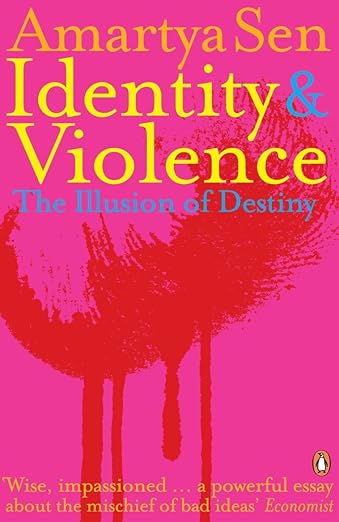
Roll over image to zoom in
Amartya Kumar SenAmartya Kumar…
Follow

Amartya SenAmartya Sen
Follow
Identity and Violence: The Illusion of Destiny Kindle Edition
by Amartya Sen (Author) Format: Kindle Edition
4.5 out of 5 stars 200
Part of: Issues of Our Time (7 books)
The world may be more riven by murderous violence than ever before, yet Nobel Laureate Amartya Sen argues in this sweeping philosophical work that its brutalities are driven as much by confusion as by inescapable hatred.
Sen argues in his new book that conflict and violence are sustained today, no less than the past, by the illusion of a unique identity. Indeed, the world is increasingly taken to be divided between religions (or 'cultures' or 'civilizations'), ignoring the relevance of other ways in which people see themselves through class, gender, profession, language, literature, science, music, morals or politics, and denying the real possibilities of reasoned choices.
Roll over image to zoom in
Amartya Kumar SenAmartya Kumar…
Follow
Amartya SenAmartya Sen
Follow
Identity and Violence: The Illusion of Destiny Kindle Edition
by Amartya Sen (Author) Format: Kindle Edition
4.5 out of 5 stars 200
Part of: Issues of Our Time (7 books)
The world may be more riven by murderous violence than ever before, yet Nobel Laureate Amartya Sen argues in this sweeping philosophical work that its brutalities are driven as much by confusion as by inescapable hatred.
Sen argues in his new book that conflict and violence are sustained today, no less than the past, by the illusion of a unique identity. Indeed, the world is increasingly taken to be divided between religions (or 'cultures' or 'civilizations'), ignoring the relevance of other ways in which people see themselves through class, gender, profession, language, literature, science, music, morals or politics, and denying the real possibilities of reasoned choices.
In Identity and Violence he overturns such stereotypes as the 'the monolithic Middle East' or 'the Western Mind'. Through his penetrating investigation of such subjects as multiculturalism, fundamentalism, terrorism and globalization, he brings out the need for a clear-headed understanding of human freedom and a constructive public voice in Global civil society. The world, Sen shows, can be made to move towards peace as firmly as it has recently spiralled towards war.
Read less
Read less
====
From other countries
Tristan Sherwin
5.0 out of 5 stars A powerful, thought-provoking argument
Reviewed in the United Kingdom on 22 April 2019
Amartya Sen’s *Identity And Violence* is probably one of the most thought-provoking and persuasive books I’ve read.
The general premise of his essay is to highlight the divisive and potentially incendiary effects that can transpire when we reduce an individual’s identity to a sole category, such as religion, nationality, language etc., instead of recognising, and celebrating, that individuals are defined by a plurality of affiliations.
In his concluding chapter, Amartya Sen neatly summarises how this illusion of singular identity easily serves the agendas of those with violent purposes:
“The advocacy of a unique identity for a violent purpose takes the form of separating out one identity for special focus, and it proceeds from there to eclipse the relevance of other associations and affiliations through selective emphasis and incitement... The specific identity that is separated out for special action is, in most cases, a genuine identity...: a Hutu *is* indeed a Hutu, a “Tamil tiger” is clearly a Tamil..., and a gentile German with a mind poisoned by Nazi philosophy is certainly a gentile German. What is done to turn that sense of self-understanding into a murderous instrument is (1) to ignore the relevance of all other affiliations and associations, and (2) to redefine the demands of the “sole” identity in a particularly belligerent form. This is where the nastiness as well as the conceptual confusions are made to creep in.” (p.176).
Sen, throughout this book, demonstrates how many of our social theories—even those working to tackle terrorism and violence—still fall into the trap of forcing people into singular identities, and how these theories are readily useable for “accentuating sectarian exclusion” and “warmly welcomed by leaders of social confrontation and violence.” The answer, Sen powerfully suggests, is to invoke the richness of the many identities that humans have.
A definite must read!
—Tristan Sherwin, author of *Love: Expressed*
4 people found this helpful
===
clauwau
5.0 out of 5 stars Refreshing views of the global perspective
Reviewed in Canada on 16 January 2017
Verified Purchase
This book may not be for everyone. It is by far an academic book but it reads extremely well. While the main idea of plural identities is repeated perhaps too often, the author makes very convincing arguments, while refraining from identifying "who is wrong and who is right". His ideas might be interpreted as utopian but it is an utopia that we must collectively achieved. The book opens the mind to a better world.
===
Carlos Allende
5.0 out of 5 stars A must read
Reviewed in the United States on 14 September 2017
Verified Purchase
A little longer that it should have been, yes, but quite insightful and an eye opener. This would be a better world if we followed Sen's recommendations of not constraining people to a sole identity.
3 people found this helpful
===
Nazariya
5.0 out of 5 stars How to make sense of the 'messages of hate' bombarded at us everyday and why they are created by uninformed/mis-informed people?
Reviewed in India on 23 July 2016
Verified Purchase
This is an extremely relevant and timely book that looks at the reasons for the growth of the 'right wing sentiment' across the world. And what can we and our democratic institutions do to reverse it. We already know Dr. Amartya Sen as a brilliant economist, but here, you will meet Dr. Sen, the social philosopher. You will be informed by his humane voice of reason how the per-conceived notions about our own identities can narrow our point of view about ourselves (and others too!) How can we make informed decisions about our politics/political leaders/policies/our personal tastes, with such narrow points-of-view?
Our newspapers/TV everyday are full of reportage about hate crimes/terror attacks and even referendums, elections in which candidates and political parties are asking specific groups (their identities defined by nationality, religion, language, ethnicity, etc.) to be vary and 'suspect' of the 'other'.
For eg. - If somebody is American and loves Japanese comics, Indian and Jazz music, Mexican food, European architecture, French films, Japanese electronics : Will we say that he/she is doing contradictory things? Or such tastes shouldn't be allowed! (How absurd does that sound!) Can't such a person be completely at peace with all his tastes and yet be also 'American' (Or from anywhere else!)). Where is the contradiction? Dr. Sen's reasoning shows how each one of us has multiple identities in the present day world and we are so much the better for it. Today, because of such identities we are richer (in every way) and inter-connected. Finally, I would just add ' this book will help you see your own perceptions more accurately and how you see others too! (And when they do the same to you ' you are very offended!). It's absolutely worth your time.
2 people found this helpful
Report
Lauren
5.0 out of 5 stars Great Read
Reviewed in the United States on 29 April 2014
Verified Purchase
By far my favorite non-fiction, Sen really dissects the tendency not only toward societal movements that inflict violence but also by individuals based on the constructs of identity.
One person found this helpful
====
TB
4.0 out of 5 stars Badly printed wonderful book
Reviewed in India on 9 August 2021
Verified Purchase
The book is of course brilliantly written and one of the finest books that Sen has written. However the printing quality was awful. This doesn't look like a Penguin publication. It is like a locally produced pirated print. Paper quality is horrible. Not at all reader friendly.
One person found this helpful
===
Amit Dixit
5.0 out of 5 stars Good book related to my own experience
Reviewed in India on 13 July 2021
Verified Purchase
Very good book. It will give you an idea about how our identity shapes violence. It also discusses role of reason and choice in selecting from our multitude of identities. I have faced this problem during my industrial experience when I lost my job just because I am brahmin. The marwari owners politicized the culture in such a way that it became anti-brahmin work environment. All my other identities got lost in the confusion and it became very difficult to work.
3 people found this helpful
Report
=====
Identity and Violence: The Illusion of Destiny
By Amartya Sen
Norton, 2006, 224 pp.
Reviewed by G. John Ikenberry
May/June 2006
Published on May 1, 2006
Why is the world racked by barbarity and violence? In this provocative little book, the Nobel laureate economist argues that the causes are as much distorted identities as nasty intentions. When people acquire a strong and exclusive sense of belonging to a single group, Sen notes, the conditions ripen for conflict and violence; when shrunken and shorn of its layered complexity, identity can kill -- Hutus massacre Tutsis, for example, when they no longer see themselves also as Rwandan, African, laborers, and human beings. Sen suggests that sectarian hatreds around the world -- in places such as Kosovo, Bosnia, Rwanda, Timor, Israel, Palestine, and Sudan -- are ignited or exacerbated by illusions of unique and choiceless identities, leading Sen to take issue with Samuel Huntington's "clash of civilizations" thesis. When civilizations conflict it is because of a failure -- often a cultivated failure -- to appreciate the true diversity of identities that infuse them. Sen eloquently describes the dangers of this flattening of human identity. He is less clear, however, about how to nurture a global environment where the richness and multiplicity of identities can thrive.
====
Identity and Violence : Illusions of Destiny — By Amartya Sen — A review
Posted by Vish Mangalapalli on April 21, 2008
My alma mater – FMS Delhi – boasts the presence of some venerated educational institutions like Delhi School of Economics (DSE) and St.Stephens in its neighbourhood. It was natural that students of these institutions also came to FMS to pursue a business degree and this resulted in an informal network of friends in these places. DSE and Stephens had a great culture of guest lectures and interested parties from FMS gate crashed these lectures.
One such lecture into which some of us gate crashed was Prof. Amartya Sen’s lecture on aspects of Game Theory. The problem that Prof. Sen was tackling that day was: What happens to a rational donkey equidistant from two haystacks? He then went onto resolve the “assinine” problem through techniques of Game Theory. It is a different matter that I did not understand the lecture beyond the initial proposition. He was not yet a Nobel Laureate then but carried a whispered respect of being next in line for Nobel in Economics. This was in 1994 and we had to wait for another four years to see the Nobel prize being awarded to Prof. Sen. Personally, I felt a surge of pride for all the obvious reasons when I got to hear that Prof. Sen won a Nobel in economics. Barring an article here and there and his penetrating essay “Tagore and his India” — I did not venture to read anything of Prof. Sen, although I managed to collect a few books of his. Then came “Argumentative Indian” (and a superb introduction to it by Sunil Khilnani (..of The Idea of India fame) in The Hindu) and this was followed by “Identity and Violence : Illusions of Destiny“. I managed to read this book over the weekend and should say that it is one of those rare books that is perspective changing.
9/11 is part of our collective lexicon now. Among the many other drastic negatives that it wrought on the world, the most important has been sharpening and thrusting the role of identities of individuals and communities to the centerstage in a much more forceful way than it is necessary and warranted. What this seems to have done is to provide a toehold or platform from where violence, discrimination and stereotyping based on selective identities has started to get legitimised. The progress of this legitimisation has been at the expense of suppressing the natural tendencies for people and communities to have multiple simultaneous identities. It is the role of these identities and the need for understanding and vigorously getting them into the mainstream as a remedial measure for a lot of world’s ills, the subject matter of Amartya Sen’s book “Identity and Violence : Illusions of Destiny”
The first three chapters viz. Violence of Illusions: Identity based thinking, Making sense of Identity: Pluraltiy of Identity, Civilizational Confinement set a firm context for the book and the subsequent chapters elaborate and discuss the themes in detail. Prof. Sen makes it clear from the word go that an individual can have multiple identities simultaneously and none of them be mutually exclusive. However, in dealing with plural identities people have adopted 2 extreme approaches. The first extreme of pendulum being Identity Disregard — where all identities get relegated to non existence. This is very evident in the fundamental assumptions and generalisations one gets to see in the area of a majority of social science theories especially in economics around rational agent or economic man. The other extreme of the pendulum being Singular Affiliation where only one identity gets a continued emphasis despite the context alteration. Both lead to problems i.e. of vapid generalisations or straightjacketing of people in society. Even while acknowledging the importance of plural identities, Prof. Sen goes out of his way to emphasise that a specific identity need not have a durable importance and will have to change along with the changing social context. And that in almost a majority of situations people do have freedom in choosing the relative importance of a specific identity. Having said that Prof. Sen quickly acknowledges that there are specific situations where the freedom of choosing ones identity in the eyes of others gets very limited leeway e.g. the perception of a landless labourer in the eyes of his armed landlord in Bihar. Prof. Sen goes onto emphasise that choices can also be made from encumbered positions that one happens to occupy and that one needs to be aware of the ability to exercise choice.
In the lively essay Civilizational Confinement, Prof. Sen goes onto discourage in no uncertain terms the approach to limiting identities to civilizations as was popularised by Samuel Huntington in his now famous book viz. “The Clash of Civilizations“. There are multiple bases that Prof. Sen points out to debunk this approach of which the most important being that there has been a continuous exchange between civilizations and so no one can and should claim exclusive ownership for what have come to be ideas that are now believed to have originated from their civilizations. For example there is an impression that Tolerance, Democracy, Science are typical values having origins in so called Western Civilizations. Prof. Sen debunks this as a myth and emphasises that many of these values have also been practiced in civilizations that thrived in Asia (India, China), Iran and Africa. On specific conflicts that one gets to see today e.g. Tamil vs. Sinhalese, Prof. Sen goes onto say that it has become a sort of fashion to abstract what should be limited to contemporary political processes and machinations into higher historical paradigms — ascribing weight and intellectual soundness which they do not deserve in the first place. Cultivated theory, Prof Sen, feels can bolster uncomplicated bigotry. His words on the mistake of seeing India as a Hindu Civilization and thereby denying the syncretic nature of various influences are an eye opener. In a very gentlemanly manner Prof. Sen disagrees with both the approaches of theorists who believe in inevitable clash of civilizations and proponents of civilizational amity — for both in his view have accepted and given into identities that can be firmly tied to civilizations
With this as a background Prof. Sen turns his eye on the topic of Religious Affiliations and Muslim History — where he provides the reader with any number of examples from the past where Muslim rulers despite being Muslims have subscribed to the right of people to have multiple identites and thereby gently draws the reader to the point of futility of a religion centered analysis of people as a helpful way of understanding humanity. He also castigates the American approach to fight Islamic radicalism especially while undermining of the role of civil society all over the world. Also he specifically deplores the role of western Goverments in not going beyond the Shia and Sunni differences in the muslim world when actually the diversity, outlook and temperament of the Muslim world is vastly wide.
In the chapter called West and Anti West, Prof. Sen focuses on the role of colonialism in defining identities. The natural fallout in the colonised mind is to have both disaffection and admiration for the colonising power and thereby developing a reactive self perception. This perception has a tendency to gravitate towards rejection of democracy and personal liberty, distorted reading of intellectual and scientific history of the world, support for growth of religious fundamentalism and even international terrorism. In a nice example he dwells on the behaviour of leading lights of the earlier stages of independence movement of India in limiting the intellectual identity to the spiritual dimension leaving out the material dimension. This has been so because in a sense they have accepted the superiority of the colonising power in the area of material. The fall out of this being the neglect or rejection of critical areas related to education, science and development. Elsewhere in Asia this reactive self perception has led to the articulation of so called “Asian Values” of discipline, obedience and order as distinct from the western values of personal liberty and freedom. Prof. Sen argues that this kind articulation does not have any firm basis. He also cautions the western nations that they have immense responsibility for their past deeds as colonial powers in Africa and the need to help Africa build institutional mechanisms to enable root taking of democracy and freedom
In the chapter, Culture and Captivity, Prof. Sen debunks the myth of cultural determinism which in his opinion has been engendered by hazy perceptions of cultures combined with fatalism about the dominating power of culture. This led to ( in Prof. Sens words) the creation of imaginary slaves of illusory forces. The identities that got created on account of this cultural determinism have unleashed tremendous amount of cruelty all over the world. Prof. Sen points out 2 classic examples of imagined truths and real policies. Firstly, the behaviour of Britain during the Irish Potato Famine, driven by the impression that women in Ireland cannot cook anything beyond potatoes and hence their over dependence on potato as the main ingredient in a Irish meal leading to shortages coupled with the perception of laziness of Irish people. Or that of the tendency of Indians to multiply in uncontrolled numbers leading to famine situations in Bengal. However the reality as we know today lies elsewhere. While acknowledging the role of the potency of culture, Prof. Sen also explains that culture needs to be placed in a broad framework and that culture is a) not uniquely significant factor in determining identities but that it is one among the many factors b) is not homegeneous and hence a need to have a caution in broad brushing c) is not still d) interacts with other social determinants. Given these Prof. Sen cautions that it is important to be able to clearly decide before swaying between either extremes of complete cultural liberty and cultural conservatism
In another chapter called Globalisation and Voice, Prof. Sen talks about the progress of globalisation and various voices against and for it. I have kind of understood that Prof. Sen talks about compassionate globalisation which should be combined with judicious policy making. However, I could not understand the linkages between globalisation and identities despite reading this topic twice over.
The penultimate chapter deals with the experience of various western countries with multi culturalism. Prof. Sen deplores the idea of practice of plural monoculturalism as a virtue when the need of the hour is true multiculturalism. While praising Britains’ experimentation with multiculturalism, Prof. Sen also deplores the British Govt’s attitude to encourage faith based schools for people and also putting the religious leaders of different faiths as spokepersons for the respective practitioners leading to automatic association of identities with religion. In an inspiring section in this chapter, Prof. Sen also elaborates the insistence of Gandhiji on the need for plural identities and equal representation to all involved in his negotiations with the British rulers. It is my conjecture that India’s predicament of the past and present with respect to managing multiculturalism can also become a pressing predicament for Britain (if it is already not) or for that matter any other western country with signifcant migrant populations
The last chapter ends with a caution around the penalities of solitarist identity illusion and also a very hopeful message of creating a harmonious world
The only aspect of the book that disappointed me was the lack of reference or citation to specific public policy instruments that have been successfully employed in combating the deleterious effects of identity politics.
All in all “Identity and Violence : Illusions of Destiny” is a illuminating and sensitive book and Prof. Sen comes out as a great mind, a great academecian and humanitarian. It is a tragedy that such humanising views never get the wide attention they deserve in public discourse, forums or media.
An afterthought: I wonder what would the reaction of right wing politicians be when they read this book
Share this:
==
Summary Contents
Insights from Chapter 1
Insights from Chapter 2
Insights from Chapter 3
Insights from Chapter 4
Insights from Chapter 5
Insights from Chapter 6
Insights from Chapter 7
Insights from Chapter 8
Insights from Chapter 9
==
Insights from Chapter 1
#1
The sense of identity can be a source of strength and confidence, but it can also be a source of exclusion and even violence. It can help us warmly welcome others, but it can also lead to the exclu-
sion of others.
#2
The world is full of examples of how identity conflicts can lead to violence. For example, the Sudanese Islamic identity combined with exploitation of racial divisions to lead to the raping and killing
of unarmed victims in the south of that militarized polity.
#3
We must recognize the power of competing identities to challenge the force of a bellicose identity. We must also understand that none of our identities is supreme, and that we can choose which
ones we want to be a part of and which ones we want to ignore.
#4
The existence of choice does not mean that there are no constraints restricting choice. Every choice in any field is made within particular limits. The freedom to determine our loyalties and priorities
between the different groups to which we may belong is a particularly important liberty that we should recognize, value, and defend.
#5
When we want to be seen in a certain way, we may have a hard time convincing others to see us in that way. The assertion of human commonality has been a part of resistance to degrading attri-
butions in different cultures at different points in time.
#6
The foundations of degradation include not only descriptive misrepresentation, but also the illusion of a singular identity that others must attribute to the person to be demeaned.
#7
The use of reasoning may be replaced by uncritical acceptance of conformist behavior, which typically has conservative implications. The unquestioning acceptance of a social identity may not al-
ways have traditionalist implications.
#8
The Clash of Civilizations thesis is based on the idea that humanity can be preeminently classified into distinct and discrete civilizations, and that the relations between different human beings can
be seen without any loss of understanding in terms of relations between different civilizations.
#9
The limitations of such civilization-based thinking can be just as treacherous for programs of dialogue among civilizations as they are for theories of a clash of civilizations.
#10
The West’s approach to global terrorism and conflict is particularly ham-handed because it relies on religious classification to define people, which then tends to make the Western response to glob-
al terrorism and conflict peculiarly blunt.
#11
The response to Islamic fundamentalism and terrorism is also complicated when people fail to distinguish between Islamic history and the history of the Muslim people. While it is true that Islam,
as a religion, does not obliterate the choice to be tolerant of heterodoxy, it is also true that many Muslims do not share this tolerance.
#12
While Akbar was free to pursue his liberal politics without ceasing to be a Muslim, that liberality was not mandated by Islam. Aurangzeb could deny minority rights and persecute non-Muslims with-
out failing to be a Muslim.
#13
The insistence on a single, unchanging human identity not only diminishes us all, but it also makes the world much more volatile. The alternative to the divisivity of one preeminent category is not
any unrealistic claim that we are all the same.