Showing posts with label Robert Kagan. Show all posts

2022-12-02

2016 Why America Must Lead by Robert Kagan

Why America Must LeadAn Essay by Robert Kagan

https://www.bushcenter.org/catalyst/leadership/why-america-must-lead


WINTER 2016
ISSUE 01
Leadership


WINTER 2016
ISSUE01Twitter

Why America Must LeadAn Essay by Robert Kagan

As world powers jockey for position on the global stage, Americans debate the role their country should play. Dr. Kagan presents his case for an involved America.
Robert Kagan

The liberal world order that was created in the aftermath of the Second World War is today being challenged by a variety of forces — by powerful authoritarian governments and anti-liberal fundamentalist movements, as well as by long-term shifts in the global economy. Great power competition has returned.

In Europe, Russia has launched the first cross-border invasion of a neighboring country since World War II. In East Asia, China is expanding its reach as a military power, seeking both economic and strategic hegemony at the risk of destabilizing that critical region. In the Middle East, Iran is expanding its influence and Islamic jihadists have gained control of more territory.

In the face of this turmoil, many Americans have come to doubt whether there is anything the United States can do or should do in response. Many assume either that it doesn’t matter very much what happens beyond America’s shores or that the United States no longer has the wisdom or capacity to shape events and prevent others from doing what they please.

Only seven years ago, pundits were talking of a “post-American world,” with a declining United States and a remarkable “rise of the rest.” These days, however, that prognosis appears to have been at best premature.


Only seven years ago, pundits were talking of a “post-American world,” with a declining United States and a remarkable “rise of the rest.” These days, however, that prognosis appears to have been at best premature.

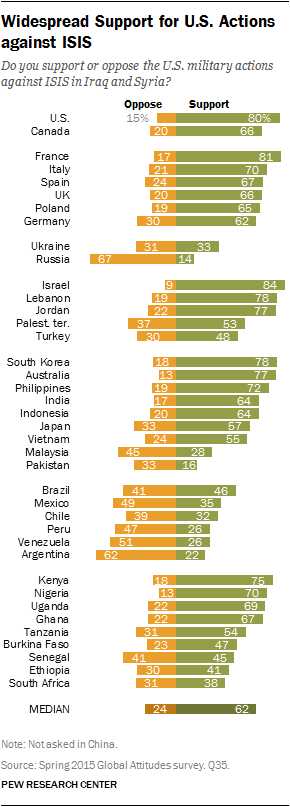
America has substantially recovered from the Great Recession, while the once-heralded “rise of the rest” has stalled. Many around the world who once decried American overseas involvement as “hegemonic” now seek greater American engagement in international affairs.
Pew Research Center: Support for U.S. Actions against ISIS

Among the American public, too, there are signs of greater receptivity to a more active American global role. What is missing for most Americans, however, is a sense of strategy and purpose in American foreign policy.

During the Cold War, fear of the Soviet Union and international communism did not always produce agreement on policy but did provide an answer, for most, as to why the United States needed to play an international role and what that role should be. Today, our political leaders need to remind Americans that our fundamental interests are still best served by upholding the world order — economic, political, and strategic — that was established at the end of the Second World War and that was further strengthened and entrenched by the revolutions of 1989. Americans need to recognize their nation’s central role in maintaining the present international order and muster the will to use their still formidable power and influence to support that order against its inevitable challengers.


What will this require? Above all, it means working to shore up all three pillars – politics, economics, security — of what has made the American-led world order so remarkable. There is a tendency to separate politics, economics, and security — “ideals” from “interests,” support for democracy from defense of security — but in the present world order they have all been related.

Start with the reality that a world order that supports freedom will only be supported by free nations. Supporting democracy is not just a matter of keeping faith with our own values. It is a matter of national security. Americans and other free peoples who benefit from and support the present world order therefore have an interest in supporting democracy where it exists and in pressing for greater democratic reforms in the world’s authoritarian nations, including the two great power autocracies.


Supporting democracy is not just a matter of keeping faith with our own values. It is a matter of national security.

In their economic policies, Americans need to continue promoting and strengthening the international free trade and free market regime. This, of course, means setting their own economy back on a course of sustainable growth. It means doing a better job of educating and training Americans to compete with others in an increasingly competitive international economy. It means providing a healthy environment for technological innovation.

But it also means resisting protectionist temptations and using American influence, along with other free-trading nations, to push back against some of the tendencies of state capitalism in China and elsewhere. Gaining congressional approval of the Trans-Pacific Partnership, or TPP, and then moving to agreement on the Transatlantic Trade and Investment Partnership with Europe, are critical, and not only for their economic benefits. They also are a critical step in knitting the democratic world more closely together.


But it also means resisting protectionist temptations and using American influence, along with other free-trading nations, to push back against some of the tendencies of state capitalism in China and elsewhere.

In Asia, especially, this is more much than a trade issue. Although the United States stands to benefit from the agreement, it is, above all, a strategic issue. The United States and China are locked in a competition across the spectrum of power and influence.

Militarily, the Chinese seek to deny American access to the region and hope thereby to divide the United States from its allies. Economically, China would like to turn Asia into a region of Chinese hegemony, where every key trade relationship is with Beijing. In such a world, the United States is a net loser — providing costly security to allies but not much else, while China reaps the economic rewards and grabs the hearts and minds, and pocketbooks, of regional players.

Finally, there is the matter of American hard power. What has been true since the time of Rome remains true today: there can be no world order without power to preserve it, to shape its norms, uphold its institutions, defend the sinews of its economic system, and keep the peace. Military power can be abused, wielded unwisely and ineffectively. It can be deployed to answer problems that it cannot answer or that have no answer. But it is also essential. No nation or group of nations that renounced power could expect to maintain any kind of world order.

If the United States begins to look like a less reliable defender of the present order, that order will begin to unravel. It remains true today as it has since the Second World War that only the United States has the capacity and the unique geographical advantages to provide global security. There can be no stable balance of power in Europe or Asia without the United States. And while we can talk about soft power and smart power, they have been and always will be of limited value when confronting raw military power.

Despite all of the loose talk of American decline, it is in the military realm where U.S. advantages remain clearest. Even in other great power’s backyards, the United States retains the capacity, along with its powerful allies, to deter challenges to the security order. But without a U.S. willingness to play the role of providing balance in far-flung regions of the world, the system will buckle under the unrestrained military competition of regional powers.


Without a U.S. willingness to play the role of providing balance in far-flung regions of the world, the system will buckle under the unrestrained military competition of regional powers.

Today, as a result of the Budget Control Act and a general unwillingness to spend adequately on defense, America’s ability to play this vital role is coming increasingly under question. Current defense spending has created a readiness crisis within the armed forces. Only a handful of Army brigades are available for use in a crisis.

The army is about to be forced to cut 40,000 soldiers from its active force. There are too few ships to provide a U.S. presence in the multiple hotspots that have sprouted up around the world. As the bipartisan, congressionally-mandated National Defense Panel has argued, the U.S. military must be able to deter or stop aggression in multiple theaters, not just one, even when engaged in a large-scale war. It needs to be able to fight ISIS and deter Iran in the Middle East, deter Russia in Europe and Syria, and in Asia deter North Korea and maintain stability in the face of a rising China.

Consider the threat now posed by Iran. Whatever one thinks about the recently-concluded nuclear deal, any serious strategy aimed at resisting Iranian domination also requires confronting Iran on the several fronts of the Middle East battlefield.

In Syria, it requires a determined policy to remove Iran’s close ally, Basher al-Assad, using U.S. air power to provide cover for civilians and creating a safe zone for Syrians willing to fight. In Iraq, it requires using American forces to push back and destroy the forces of the Islamic State so that we do not have to rely, de facto, on Iranian power to do the job.

Overall, it requires a greater U.S. military commitment to the region, a reversal of both the perceived and the real withdrawal of American power. And therefore it requires a reversal of the downward trend in U.S. defense spending, which has made it harder for the military even to think about addressing these challenges, should it be called upon to do so.

The challenge we face today is to decide whether this liberal world order is worth defending and whether the United States is still willing to play the role of its principal champion. The answer to both questions ought to be “yes,” but it will require a renewal of American leadership in the international system, economically, politically, and strategically.

It will also require a renewed understanding of how important and unique the present liberal world order is, both for Americans and for peoples all across the globe. The simple fact is that for all the difficulties and suffering of the past 70 years, the period since the end of World War II has been unique in the history of the human race.


The period since the end of World War II has been unique in the history of the human race. Democratic government, once rare, has spread to over 100 nations around the world, on every continent, for peoples of all races and religions.

There has been an unprecedented growth in prosperity. Billions have been lifted out of poverty. Democratic government, once rare, has spread to over 100 nations around the world, on every continent, for peoples of all races and religions. Although the period has been marked by war, peace among the great powers has been preserved. There has been no recurrence of the two devastating world wars of the first half of the 20th century.

This world order has been a boon for billions around the world, but it has also served American interests. Any other world order, one in which the United States had to cede power and influence to China and Russia, or what is more likely, a descent into disorder, is unlikely to serve Americans’ interests as well.

Leave your feedback with The Catalyst editors


Robert KaganSenior Fellow, Project on International Order and Strategy at the Brookings Institution

ロバート・ケーガン - Wikipedia 로버트 케이건

ロバート・ケーガン - Wikipedia

로버트 케이건

출처: 무료 백과사전 '위키피디아(Wikipedia)'
로버트 케이건

로버트 케이건 (Robert Kagan, 1958년 9월 26일 - )은 미국 의 역사가 , 정치사 가, 정치평론가. 네오콘 의 대표적인 논자. 브루킹스 연구소 상석 펠로우, 조지타운 대학 초빙 교수(전공은 역사학 ). 전문 분야는 미국 근대 정치사, 특히 미국의 안보 문제와 외교 정책에 관한 연구.

아버지는 예일 대학 명예 교수 로 고대 그리스사 연구자의 도널드 케이건 . 아내는 외교관 의 빅토리아 누랜드 . 누랜드와의 사이에 두 아이가 있다.

내력 편집 ]

아테네 출생. 예일 대학 졸업 후, 케네디스크 에서 석사 학위 , 아메리칸 대학 에서 Ph.D. 취득.

1983년에 잭 켐프 의 외교 정책 고문, 1984년부터 1986년까지 미국 국무성 정책국에 근무해 , 조지 슐츠 의 스피치 라이터를 맡고, 1986년부터 1988년까지 국무성 미주국에 근무. 1997년에 미국 신세기 프로젝트 의 공동발기인이 된다.

1997년부터 2010년까지 카네기 국제평화재단 상석연구원과 조지타운대학 초청교수를 맡아 2010년부터 브루킹스 연구소 상석연구원. 2008년 미국 대통령 선거에서는 공화당 대통령 후보인  맥케인의 외교 정책 고문을 맡았지만, 케이건 자신은 소위 리버럴 호크 를 자임하고 있으며 , [1] 민주당의 힐러리 클린턴 과 존 켈리 의 외교 고문도 맡았다 [2] [3] .

논조 편집 ]

2002년에 「정책・리뷰」지에 발표한 논문 「힘과 약점」 속에서, 냉전 후의 세계에서 군사력을 중시하는 미국인과, 그것을 거의 고려하려고 하지 않는 유럽인의 세계관이 "화성인과 금성인"만큼 다르다고 논하고, 더 이상 미국은 유럽에 아무 것도 기대하지 않는다고 미유럽 관계의 변화를 결론함으로써 정치적으로도 큰 논의를 일으켜 네오콘 의 논객으로서 일약 각광을 받게 되었다.

저서 편집 ]

단저 편집 ]

  • A Twilight Struggle: American Power and Nicaragua, 1977-1990 , (Free Press, 1996).
  • 낙원과 권력: 신세계 질서의 미국과 유럽 , (Knopf, 2003).
야마오카 요이치 역 「네오콘의 논리――미국 신보수주의의 세계 전략」( 광문사 , 2003년)
  • 위험한 국가 , (Knopf, 2006).
  • 역사의 귀환과 꿈의 끝 , (Knopf, 2008).
이즈미 유코 역 「민주국가 VS 전제국가――격돌의 시대가 시작된다」( 토쿠마 서점 , 2009년)
  • 미국이 만든 세계 , Alfred A. Knopf, 2012.
『미국이 만들어낸 "훌륭함"지금의 세계』, 후루무라 치히코역, 비즈니스사 , 2012년

공동 편집 편집 ]

  • 현재의 위험: 미국 외교 및 국방 정책의 위기와 기회 , William Kristol 과 공동 편집 , (Encounter Books, 2000).

출처 편집 ]

  1.  개입주의자 부흥을 위한 이라크의 열린 문, 역사가의 말, Jason Horowitz, New York Times, 2014년 6월 15일
  2. ^ "클린턴 장관의 외교 정책위원회의 취임 회의". 2012년 2월 19일에 확인함.
  3. ^ 현재 이사회 구성원", 국무부 웹페이지. 2015년 3월 29일에 확인함.

외부 링크 편집 ]


ロバート・ケーガン

出典: フリー百科事典『ウィキペディア(Wikipedia)』
ロバート・ケーガン

ロバート・ケーガン(Robert Kagan、1958年9月26日 - )は、アメリカ合衆国歴史家政治史家、政治評論家。ネオコンの代表的論者。ブルッキングス研究所上席フェロー、ジョージタウン大学招聘教授(専攻は歴史学)。専門分野はアメリカ近代政治史、特にアメリカの安全保障問題と外交政策に関する研究。

父はイェール大学名誉教授で古代ギリシア史研究者のドナルド・ケーガン。妻は外交官ビクトリア・ヌーランド。ヌーランドとの間に2子がいる。

来歴[編集]

アテネ生まれ。イェール大学卒業後、ケネディスクール修士号アメリカン大学Ph.D.取得。

1983年にジャック・ケンプの外交政策顧問、1984年から1986年までアメリカ国務省政策局に勤務しジョージ・シュルツのスピーチライターを務め、1986年から1988年まで国務省米州局に勤務。1997年にアメリカ新世紀プロジェクトの共同発起人となる。

1997年から2010年までカーネギー国際平和財団上席研究員とジョージタウン大学招聘教授を務め、2010年からブルッキングス研究所上席研究員。2008年のアメリカ大統領選挙では共和党大統領候補であるジョン・マケインの外交政策顧問を務めたが、ケーガン自身は所謂リベラルホークを自任しており[1]、民主党のヒラリー・クリントンジョン・ケリーの外交顧問も務めた[2][3]

論調[編集]

2002年に『ポリシー・レビュー』誌に発表した論文「力と弱さ」の中で、冷戦後の世界において軍事力を重視するアメリカ人と、それをほとんど考慮しようとしないヨーロッパ人の世界観が「火星人と金星人」ほど異なってしまっていると論じ、もはやアメリカはヨーロッパに何事も期待していないと米欧関係の変化を結論したことで、政治的にも大きな議論を巻き起こし、ネオコンの論客として一躍脚光を浴びることとなった。

著書[編集]

単著[編集]

  • A Twilight Struggle: American Power and Nicaragua, 1977-1990, (Free Press, 1996).
  • Of Paradise and Power: America and Europe in the New World Order, (Knopf, 2003).
山岡洋一訳『ネオコンの論理――アメリカ新保守主義の世界戦略』(光文社, 2003年)
  • Dangerous Nation, (Knopf, 2006).
  • The Return of History and the End of Dreams, (Knopf, 2008).
和泉裕子訳『民主国家VS専制国家――激突の時代が始まる』(徳間書店、2009年)
  • The World America Made, Alfred A. Knopf, 2012.
『アメリカが作り上げた"素晴らしき"今の世界』、古村治彦訳、ビジネス社、2012年

共編著[編集]

  • Present Dangers: Crisis and Opportunity in American Foreign and Defense Policy, co-edited with William Kristol, (Encounter Books, 2000).

出典[編集]

  1. ^ Events in Iraq Open Door for Interventionist Revival, Historian Says, Jason Horowitz, New York Times, June 15, 2014
  2. ^ "Inaugural Meeting of Secretary Clinton's Foreign Affairs Policy Board". Retrieved 2012-02-19.
  3. ^ Current Board Members", State Department webpage. Retrieved 2015-03-29.

外部リンク[編集]


What to Do About North Korea | American Enterprise Institute - AEI

What to Do About North Korea | American Enterprise Institute - AEI

What to Do About North Korea

By Dan Blumenthal | Robert Kagan

May 26, 2009

The North Korean launch of its Taeopodong-2 missile and its second nuclear test have laid bare the paucity of President Obama’s policy options. They have exposed the futility of the six-party talks and, in particular, the much-hyped myth of China’s value as a partner on strategic matters. The Obama administration claims that it wants to break with the policies of its predecessor. This is one area where it ought to.

After decades of diplomacy and “probing” Pyongyang’s intentions, one thing is clear: Kim Jong Il and his cronies want nuclear weapons and the means to deliver them. What will dissuade them? Isolation and more punitive sanctions would make sense if China and Russia would go along. But they haven’t, and they won’t.

We would support military action against North Korean missiles and missile sites, if we had prepared ourselves over the past few years to protect our allies against possible North Korean retaliation
. Former defense secretary William J. Perry and current defense undersecretary Ashton B. Carter recommended this course of action in The Post a few years ago. But the supposedly bellicose Bush administration didn’t take such action, and the odds of this administration doing so are even smaller.
The United States has little choice but to wait until the emergence of a leader who can make the strategic decision to abandon the nuclear weapons program.

For several years, this lack of attractive options has driven many to look to the Chinese for help. Advocates of warm engagement with the Chinese have been the most enthusiastic promoters of this approach, less, we suspect, out of concern for solving the North Korea problem than to prove the worth of close cooperation with Beijing. North Korea, they have tirelessly claimed, is one of those common strategic interests that the United States and Beijing allegedly share.

This proposition has been discredited. Sure, in theory China could pressure Kim to give up his weapons–it has the power and influence. But the fact is, China doesn’t want to. Beijing is content to live with a nuclear and anti-Western North Korea. While China fears a collapsed North that would flood its struggling Northeast with refugees, it also fears a unified, democratic, prosperous Korea allied with the United States. China wants a puppet state in North Korea, which is why, far from joining in sanctions, it steadily increases its economic investment there.

Given these realities, the United States probably has little choice but to wait out Kim until the emergence of a leader who can make the strategic decision to abandon the nuclear weapons program. In the meantime, Washington should embark on a three-pronged approach. First, it should enhance its deterrent to protect itself, South Korea and Japan. That means, above all, bolstering American and allied missile defenses and deterrent capabilities. Unfortunately, it is precisely American missile defense capabilities that the Obama administration is now cutting–despite the growing missile threat from North Korea and Iran. Second, it should strengthen multilateral efforts to stem North Korean proliferation, including more active efforts at interdiction and freezing bank accounts used to fund proliferation. Third, it should give up on the six-party talks. If it ever proves useful to talk to Pyongyang–a big “if”–let’s do so directly.

The ultimate American aim should be to help bring about a unified Korean Peninsula and not cede influence over the two Koreas to Beijing. The current diplomatic arrangements have permitted China to set the political agenda while quietly increasing its leverage over the North. But Washington doesn’t need to go through Beijing to get to Pyongyang. Direct negotiations between the United States and North Korea, in close consultation with Japan and South Korea, are better than working through a middleman who has no desire or interest in closing the deal. Both Japan and South Korea would welcome greater U.S. engagement with the North. Seoul wants reassurance that it will not shoulder the burden of unification by itself. Japan wants U.S. protection and a guarantee that Washington will have some presence on the peninsula for the long term.

If we decide to talk again, American diplomacy should expand beyond nuclear talks to begin preparing for the outcome it wants: a democratic, unified and eventually nonnuclear Korea. As Korea expert Andrei Lankov has suggested, America’s new approach could include the opening of cultural, educational and economic exchanges with the North. Western experts should be encouraged to teach at North Korean universities; North Koreans should be allowed to study in the West; and the United States, Japan and South Korea should undertake cooperative economic projects in the North. The United States should also open more radio and television broadcasts from South Korea and the West. In short, Washington’s diplomacy with North Korea should focus on measures that raise North Koreans’ standard of living and exposure to the West. This would keep our focus on long-term strategic objectives. And who knows? Maybe a new American approach to North Korea will provide an added benefit: If China sees its prominence diminished in North Korean diplomacy, maybe it will finally have some reason to act more forcefully in disarming Kim.

Dan Blumenthal is a resident fellow at AEI. Robert Kagan is a senior associate at the Carnegie Endowment for International Peace.


Dan Blumenthal
Senior Fellow

Robert Kagan

Latest Work
November 02, 2022
Op-Ed
‘Spies and Lies’ Review: The Myth of the ‘Peaceful Rise’
October 20, 2022
Report
How China Views It: Sino-American Technology Competition
October 18, 2022
Op-Ed
Xi Jinping’s Strategy of Conflict

Tags:
China | Kim Jong Il | missile | North Korea | Pyongyang | Russia | Testing | weapons
Related
Article

May 01, 2009

The Erosion of U.S. Power in Asia
By Dan Blumenthal
Article

May 20, 2009

Get Ready for Another North Korean Nuke Test
By John R. Bolton
Article

May 26, 2009

Pyongyang Has a Strategy–Do We?
By Nicholas Eberstadt
Article

June 16, 2009

How to Help North Korea’s Refugees
By Paul Wolfowitz
Article

June 29, 2009

Our Decaying Nuclear Deterrent
By Richard Perle | Jon Kyl
Article

October 23, 2009
Foreign Affairs
What to Read on North Korean Politics
By Nicholas Eberstadt
Article

January 25, 2010

Bad Korea Moves
By Nicholas Eberstadt
Book

December 01, 2004

A New International Engagement Framework for North Korea?
By Nicholas Eberstadt | Lee Young-sun | Ahn Choong-yong
Event

April 08, 2009

Testing the Obama Administration: Implications of a North Korean Missile Launch
By Nicholas Eberstadt | Michael Auslin
Report

March 03, 2009
American Enterprise Institute
The North Korean Paradox and the Subversive Truth
By Andrei Lankov

2003 This Too Shall Pass: A Response to Kagan's Power and Weakness

(PDF) This Too Shall Pass: A Response to Kagan�s Power and Weakness


This Too Shall Pass: A Response to Kagan's Power and Weakness
September 2003 German Law Journal 4(9)

Authors:

Rebecca M. Bratspies
CUNY School of Law


Download full-text PDF


Citations (1)References (12)


Abstract
Robert Kagan's essay Power and Weakness is a masterful articulation of the neo-conservative vision. That said, it is surely the essay's fabulous timing, rather than its content, that has set the international law community abuzz. The vision itself is not new–it has been circulating for at least a decade.


Public Full-text 1


Content uploaded by Rebecca M. Bratspies
Author content
Content may be subject to copyright.


SECIAL ISSUE


This Too Shall Pass: A Response to Kagan’s Power and
Weakness.

By Rebecca M. Bratspies

*
* Visiting Associate Professor of Law at Michigan State University-Detroit College of Law. She would like to thank Professor Russell Miller and Dr. Peer Zumbansen for organizing the German Law Journal’s
Symposium on the “New Transatlantic Tensions and the Kagan Phenomenon.” She would also like to
thank Michigan State University-DCL for financial support.
-----


“It occurs to me that I am America I am talking to myself again”[1]

Robert Kagan’s essay Power and Weakness
is a masterful articulation of the neo-conservative vision.

That said, it is surely the essay’s fabulous timing, rather than
its content, that has set the international law community abuzz. The vision itself is
not new--it has been circulating for at least a decade.
4
What has changed are the circumstances. With the Bush Administration choosing unilateralist paths on may
important international issues, and, in particular, waging an aggressive war in Iraq
against express and unwavering opposition from most of the world– including our
Cold-War allies France and Germany; our post-Cold War strategic partners Russia
and Mexico; not to mention Canada, China, and the population of most of the
world
5

1 Allen Ginsburg, America, published in HOWL AND OTHER POEMS, The Pocket Poet Series #4 p. 32 (1980)
2 Robert Kagan, Power and Weakness, 113 POLICY REVIEW
(June/July 2002)
<http://www.policyreview.org/JUN02/kagan.html> (visited 14 August 2003). All citations are to the printer friendly version available on this website.

3 The Bush Administration is larded with neo-conservatives including: Paul Wolfowitz, Donald Rumsfeld, Richard Perle, I. Lewis Libby, Elliot Abrams, Zalmay Khalilzad and Vice-President Dick Cheney. For the past decade, the most prominent voices of neo-conservativism have included the Weekly Standard Magazine, and two Washington “think tanks:” the Project for a New American
Century, and the American Enterprise Institute. Many of the Project for a New American Century’s founders, and American Enterprise Institute members and fellows, including Cheney, Rumsfeld, Wolfowitz, and Libby, now occupy top government positions. 

The central thesis of the neo-conservative ideology they espouse is a belief in American exceptionalism. This belief manifests as contempt for multilateralism and a belief that, in light of America’s overwhelming unipolar power, the United States
cannot allow itself to be tied down by international agreements that diminish its freedom of action.
Instead, neo-conservatives argue that the United States should vigorously use its vigorously to reshape the world by doing all it can to impose democracy on other countries--including by force if necessary.
Neo-conservatives thus envision a benevolent hegemony backed by an American willingness to use decisive military force, with or without allies.
 

For a tour of neoconservative ideology, see, Bruce Murphy, Neoconservative Clout Seen in U.S. Iraq Policy, Milwaukee Journal Sentinel, (April 6, 2003); James Allen, A Classicist’s Legacy: New Empire Builders, New York Times (May 4, 2003).


4 Indeed, one incident from the first Bush administration highlights how long these ideas have been in circulation, and how little traction they had gained before September 11, 2001. In 1992, Policy Paul Wolfowitz and Lewis Libby, then obscure pentagon political appointees, drafted the Defense Planning Guidance on America’s military posture to the world. (hereafter “1992 DPG”) See,Patrick Tyler, Pentagon Drops Goal of Blocking New Superpowers, New York Times, (May 23, 1992). As initially
drafted, the document committed the United States to blocking the emergence of any future global
competitor, and explicitly indicated that the United States would adopt a course of unilateralism. Id.
Essentially the document proposed pax Americana with the United States establishing permanent
military dominance over much of Eurasia. In response to a public outcry (both domestic and
international) the final version of the document softened this language beyond recognition, and instead
indicated that the United States was committed to its allies and partners, and that diplomatic and
economic tools were on a par with military power. Id. In short, the country squarely rejected Kagan’s
unilateralist approach. Despite this rejection, Wolfowitz’s draft version of the 1992 DPG lived on. For
example, the draft 1992 DPG was embraced as the starting point for the Project for a New American
Century’s 2000 report entitled Rebuilding America's Defenses, available at
http://freedom2008.com/blog/archives/PNAC/PNAC.pdf, coauthored by among others, six key
defense and foreign policy officials now serving in the Bush administration. With the advent of the
second Bush administration, came the elevation of a group of neo-conservatives to positions of power.
For example, Wolfowitz is now Deputy Secretary of Defense. These officials have revived the 1992 DPG,
and have relied on Rebuilding America’s Defenses as the blueprint for this Administration’s unilateralist
foreign policies. American unilateralism is thus a deeply ideological policy choice of the current
administration, rather than the “natural” outgrowth of the world as it exists. 

890 [Vol. 04 No. 09, GERMAN LAW JO U R N A L


– Kagan’s essay offers a seemingly “neutral” and non-ideological
justification for American actions. With its oft repeated focus on the “natural”
consequences of what Kagan calls “power,” Power and Weakness presents a world in which America has no choice but to act as it did in Iraq,or for that matter, with
regard to the International Court of Justice. More importantly, Kagan offers a
world where America cannot and ought not be swayed by world opinion,especially not as voiced by the European Union. This normalization of the current
administration’s ideology may be comforting to true believers, but is entirely
unpersuasive to those outside the fold. A reader who does not easily swallow
Kagan’s narrow conceptions of “power” and “weakness” will not be moved by his
subsequent characterization of how “weak” and “strong” parties “inevitably”
interact. Thus, although his essay has provoked a great deal of discussion, it
ultimately adds little in the way of insight.


5 The United States, Great Britain and Spain withdrew a United Nations Security Council Resolution authorizing the use of force in Iraq after France, Russia, Germany, Mexico and Pakistan made it clear that they would vote against the resolution. In addition to diplomatic opposition, there were worldwide protests objecting to the war. For a sampling of the various protests, see, e.g., Egypt Protest, Voice of America (March 6, 2003) (reporting that over 1 million protested in Cairo); Tony Pugh, Washington Thronged by Antiwar Protestors, Phila. Inq. (March 16, 2003); Antiwar Protestors Take to the Streets, Eur. Wall St. J. (March 21, 2003); Brian Whitmore, Europe Sees Wave of Antiwar Protest, Boston Globe (March 21, 2003); Caroline Alphonso, Antiwar Protests Erupt Across the Globe, Globe & Mail (March 21, 2003); Antiwar Protestors Rally in Germany and Italy, L.A. Times (March 25, 2003); Jeremy Wagstaff, Jakarta Antiwar Protest Draws over 100,000, Stays Peaceful, Asian Wall St. J. (March 31, 2003); Thousands of People Reported Staging Anti-war Protest in Bulgaria, BBC (March 31, 2003); Antiwar Protests Intensify in Japan as Iraq War Begins, Asian Pol. News (March 25, 2003). These protests occurred in “coalition of the willing” states as well as in states opposed to the war. See, e.g., James R. Haggerty, UK Leaders Argue in Line with US Stance on Iraq but British Public Disagrees, Wall St. J. (Feb. 18, 2003) (reporting more than a million antiwar protestors in Rome, a million in London, 660,000 in Madrid and half a million in Berlin); At Least 200,000
Protest in Australia, L.A. Times, (feb. 17, 2003); Beth Carney, Britons March Against the War, Boston Globe (March 23, 2003); Robert Tomsho, Civil Disobedience Snarls Several American Cities, Big Rallies in Spain, Greece, Wall. St. J. (March 21, 2003)


In Power and Weakness, Kagan advances a very particular vision of “power”–who
has it, who values it and who does not. Though he never bothers to define what he
means by power, he clearly subscribes to Mao Zedong’s belief that “power grows
from the barrel of a gun.” Power involves something Kagan calls “strength,”
another term he does not define. Despite the lack of definitions, his meanings are
crystal clear. For Kagan, both strength and power are based on military capability,
and nothing else. Kagan asserts that strength, and therefore power, is something
that America has, and that Europe lacks. It is this lack of military capability that
Kagan calls “weakness.”

According to Kagan, this dichotomy between “weak” Europe and “strong”
America drives most of the current social and political disputes between the United
States and Europe. For him, a European vision of international law, and its role in
solving international disputes is “a natural [that word again] consequence[] of the
transatlantic power gap,” 6 and of Europe’s “psychology of weakness.”
7


In making this argument, Kagan identifies what he proclaims as the “inevitable”
mindset of America’s post-Cold War status as the lone superpower–the propensity
to use its overwhelming military strength.
8
He then projects this mindset back in time, and casts it as the decisional framework during the Cold War. While a
fervent belief in military superiority was certainly one strand of Cold War thought,
it was no more than that–one part of a larger, much more complicated debate.
Kagan does concede that during the Cold War many Americans shared what he
calls the “European” conviction that détente was the proper approach towards the
Soviet Union, but only as a passing note. He makes no mention that a majority of
Americans viewed nuclear war as an unwinnable lose/lose prospect despite United
States military superiority, 9 and instead believed that the very fact of those

6 Kagan, p. 4
7 Kagan, p. 4
8 Kagan, p. 3
9 During the cold war, mutually assured destruction meant that a nuclear war could have no winners.


weapons made the world more dangerous rather than less so.
10
Instead, Kagan moves right back into his argument that cooperation is the tool of the weak and
never looks back. Lost in his ahistorical vision is any inkling that choices were
made then, and continue to be made today, let alone how deeply ideological those
choices were.

Indeed, much of the Power and Weakness seems an attempt to bury ideological
underpinnings–to project the neo-conservative vision as somehow post-ideological
and beyond the petty squabbling of politics. In Power and Weakness consequences
flow “naturally” from an a priori status as “strong” or “weak.” Thus, for Kagan, it is
only Europe’s military weakness that has produced “a powerful European interest
in inhabiting a world where strength doesn’t matter, where international law and
international institutions predominate. . . ..”
11
Although not quite Panglossian,
(Kagan does not claim this is the best of all possible worlds, merely that it is the
only possible world) this characterization is intended to create an impression of
inevitability –as though the Hobbesian United States and the Post-Modern Europe
he describes are the only possible alternatives.

To that end, Kagan repeatedly blurs the distinction between American actions
grounded solidly within the framework of international institutions and law with
an American capacity to take unilateral actions in disregard of international law.
For example, Kagan identifies the 1989 invasion of Panama, the 1991 Gulf War, and
interventions in Somalia, Haiti, Bosnia and Kosovo as support for his contention
that the end of the cold war left the United States “free to intervene practically
wherever and whenever it chooses.”
12
In doing so, he writes as though each of
those actions reflected American unilateralism.

Quite to the contrary! The first Bush administration took great care to act within
the United Nations framework during the first Gulf War, and the Clinton
administration did not act unilaterally in Somalia, Bosnia and Kosovo (where
dragged kicking and screaming might be a better description of United States

10 For example, in 1984 large majorities of Americans were "convinced that it is time for negotiations, not
confrontations" with the Soviet Union. See, The people, the debt and Mikhal, 47 Bulletin of Atomic
Scientists (November 1991) available at http://www.thebulletin.org/issues/1991/n91/n91krass.html;
see also, Dainiel Yankelovich, and John Doble, The public mood: Nuclear weapons and the U.S.S.R. 63  33-46 (1986); Greg Diamond and Jerald Bachman, High School Seniors and the Nuclear Threat, 1975-1984: Politics and Mental Health Implications of Concern and Despair, 15 International Journal of
Mental Health 210-241 (1985); Bernard M. Kramer, S. Michael Kalick, and Michael A. Milburn, Attitudes toward nuclear weapons and nuclear war: 1945-1982, 39 Journal of Social Issues 7-24 (1983).
11 Kagan, p. 6.
12 Kagan, p. 3


involvement.) Hardly a compelling case for Kagan’s “unipolar moment,”
particularly given the questionable degrees of success attributable to these various
interventions. This matters quite a bit. By characterizing all these actions as
evidence for his theory about how “strong” America “naturally” acts, Kagan
finesses the overwhelmingly ideological choices the current administration has
made with regard to international law and institutions.

Putting aside the dubious accuracy of his characterizations, to accept Kagan’s
portrayal, one must first accept that military force is the only form of power
Kagan’s analysis admits no room for the power of ideas– the will to freedom and
the longing for justice. This is one of his biggest mistakes. Kagan’s view of
“power” fundamentally misreads the lessons from the breakup of the Soviet Union.
Until the day of its demise, the Soviet Union maintained an awesome military
might.
13
Facets that play no role in Kagan’s “weakness” calculus--a lack of
economic power, ideological power and social legitimacy -- led to its demise, rather
than any lack of what Kagan calls “power.” In short, the Berlin Wall came down,
not because of any inherent Kaganesque “weakness” or opposing American
“power,” but because of what Václav Havel called “the power of the powerless”
14

a non-violent cooperative form of power that has brought down many dictatorial
regimes around the world.
15


Kagan uses this platform of what he calls “European weakness” as justification for
his assertion that the United States must unilaterally assume the role of
international sheriff enforcing peace and justice through the muzzle of a gun.
16

Such a vision is a flat rejection of the rule of law. A self-appointed sheriff is a
vigilante. Kagan seems to have forgotten the founding principle of democracy: the
power to lead can only be granted, it cannot be seized. Indeed, democracy seem to
be no more than an inconvenience for Kagan. Unilateralism, by contrast, avoids the

13 For example, in 1989, the Soviet armed forces were the world's largest military establishment, with
nearly 6 million troops in uniform, 1,400 intercontinental ballistic missiles (ICBMs), 300 launch control
centers, twenty-eight missile bases, and the largest submarine ballistic missile force in the world. In
addition, the Soviet Union was spending an estimated US$1 billion annually on scientific research into
advanced technologies with potentially great ASAT and ABM applications, including ground-based
laser, particle beam, radio frequency, and kinetic energy weapons. See, Library of Congress, Soviet
Union—A Country Guide, available at http://memory.loc.gov/frd/cs/sutoc.html.

14 VACLAV HAVEL, THE POWER OF THE POWERLESS: CITIZENS A GAINS THE STATE IN CENTRAL-EASTERN EUROPE (1990). The essay The Power of the Powerless was written in 1978.

15 Not only did the form of power Havel describes end dictatorial regimes of East Germany, Hungary
and many other eastern European states, it is also closely related to the Philippines people power,
Ghandi’s drive to free India, and countless past and present democracy struggles around the world.

16 Kagan, p. 6


messy inconvenience of persuading others to one’s course of action and working to
build common ground—or worse, making compromises. Unspoken is Kagan’s
assumption that if Europe had more weapons, it would line up precisely where
Kagan puts the United States. In fact, a re-armed Europe is his preferred solution to
the current cross-Atlantic tensions.
17
He admits no possibility that Europe chose to
have fewer weapons, not because it embraced weakness but because was hewing to
a different vision of power.

This overly narrow conception of power is a fundamental flaw in Power and
Weakness. It prevents Kagan from engaging with the obvious alternative to his
analysis-- the possibility that a European belief in international law may be the
cause, rather than the effect, of what he views as a widening “power” gulf between
the United States and Europe. Once we acknowledge that military might is not the
only source of power, that there is also power in a well-educated, healthy citizenry
committed to the ideas of democracy, then the choices Kagan ascribes to Europe
and the United States suddenly look very different. Rather than European reliance
on international law being a product of military weakness, Europe’s relative lack of
military capability may instead be the result of a decision to cultivate other forms of
domestic and international power. The mere fact that Kagan has no room for
power of this stripe, and in fact contemptuously dismisses it as weakness, cannot
satisfy this objection. The mere naming of certain forms of power as weakness does
not actually make it so.

Kagan’s description of the European and United States response to Saddam
Hussein reveals how many assumptions one must swallow in order to accept his
thesis. He makes an analogy to two men in the woods with a bear–one armed with
a knife and the other with a gun.
18
For Kagan it is inevitable and “natural” that the
man with the knife will “lie low and hope the bear never attacks”
19
and that the
man with the gun will shoot the bear.
20
In short the man with the knife is really
“the man without a gun.” He has no choice but to “put out of [his] mind that
which [he]can do nothing about.”
21
Kagan plainly believes that the only difference
between the two men is that one has a gun-- if the men traded weapons, he
assumes they would trade behaviors as well. In Kagan’s world, there is a “natural”
state of affairs, and everyone sees the same threats.

17 Kagan, p. 12
18 Kagan, p. 8.
19 Kagan, p. 8.
20 Id.
21 Id.


Nowhere in the analogy or the subsequent discussion of European and American
responses to Saddam Hussein, does Kagan even admit the possibility that the first
man may have gone into the woods with a knife precisely because he is not afraid
of bears. Those of us who live in the Western United States know that most bears,
most of the time, pose no threat to humans. One can have a healthy respect for the
violent potential that a bear represents while still feeling no need to attack or fear
every bear in the forest. Under those circumstances a gun would be superfluous,
and a desire to eradicate bears might suggest a dangerously violent temperament,
not to mention an unkindness towards animals.

Kagan then claims that because of the United States’ power, Iraq poses more of a
threat to it than to the rest of the world. In other words, the mere fact of having a
gun makes the first man more vulnerable to a bear? Such a reading not only defies
logic, it also undercuts Kagan’s entire justification for having a gun in the first
instance—to protect against bears. Kagan spends pages demonstrating his view
that it is American power that acts as a guarantor of safety. He then claims that
because the United States has more power, it is more vulnerable to petty dictators
like Saddam Hussein. The way out of this dilemma, according to Kagan, is through
America’s unfettered use of the overwhelming power that created the unique
vulnerability in the first place. This recipe for perpetual violence is completely
unacceptable.

While Saddam Hussein’s brutal regime had few admirers, in Europe or elsewhere,
it was a failure of American diplomacy–something thing Kagan dismisses as
weakness–that splintered the 60-year-old European and American alliance that we
commonly refer to as ''the West.'' Americans and Europeans have an
overwhelming common interest in seeing democracy, peace and prosperity spread
through the Middle East and the rest of the world. Rather than drawing on that
common interest to build an ever-stronger alliance of mutual support, the United
States’ coupled high-handed pressuring tactics with a series of unsubstantiated and ever-changing justification for war 22 in a manner that alienated our friends and empowered our enemies. Surely no one mourns the Baath regimes demise, 23
but if “regime change” was purchased at the expense of a permanent rift between the  United States and its closest allies, will the war have made the world safer or more dangerous? The Bush Administration’s open contempt for the United Nations
Charter and its dismissal of any need to conform American conduct to international humanitarian or legal standards-- the logical outgrowth of Kagan’s ideas of power—set a troubling precedent that will surely come back to haunt us.

22 In his State of the Union speech, President Bush clearly accused Saddam Hussein of posing an imminent threat
to the United States by stockpiling chemical and biological weapons in defiance of the United Nations. 2003 State
of the Union Address, available at http://www.whitehouse.gov/news/releases/2003/01/20030128-19.html. These
weapons allegedly included: over 25,000 liters of anthrax; more than 38,000 liters of botulinum toxin; 500 tons of
sarin, mustard and VX nerve agent; upwards of 30,000 munitions capable of delivering chemical agents. He also
accused Saddam Hussein of seeking significant quantities of uranium, and attempting to purchase high-strength
aluminum tubes suitable for nuclear weapons production. The President was repeating allegations that various
administration officials had been making for almost a year. See, The Bush Administration on Iraq's Weapons
of Mass Destruction Capabilities August 2002-July 2003, compiled by the Carnegie Endowment for
International Peace, available at http://www.ceip.org/files/projects/npp/resources/iraqintell/adminquoteshtml.htm
The nuclear allegations were rapidly discredited by the Director General of the International Atomic Energy Agency as based on forged documents. See, Dr. Mohamed ElBaradei, The Status of Nuclear Inspections in Iraq: An Update, available at http://www.iaea.or.at/worldatom/Press/Statements/2003/ebsp2003n006.shtml;
Senator Requests FBI Probe of Forged Iraq Documents, USA TODAY
(March 14, 2003). In his March 7,2003 presentation to the Security Council, Dr. ElBaradei also refuted aluminum tubes allegation. Id.; see also,Dana Milbank and Walter Pincus, Bush Aides Disclose Warnings From CIA: Oct. Memos Raised Doubts
on Iraq Bid , WASHINGTON POST (July 23, 2003) (indicating that three months before the State of the Union Address, the CIA had warned the White House that those very nuclear weapons allegations were unsubstantiated.).
The other weapons allegations proved to be old information recycled in alarmist accents. See, Joseph Cirincione
and Dipali Mukhopadhyay, Follow the Threat Assessments, Carnegie Endowment for International Peace (July
03, 2003), available at http://www.ceip.org/files/nonprolif/templates/article.asp?NewsID=5022. Indeed, months of
diligent searching in post-war Iraq has failed to uncover any such weapons. President Bush also specifically stated
that the United States had evidence of links between Saddam Hussein and al Qaeda. Those allegations have never
been substantiated, and in fact, most experts agree that Saddam Hussein did not have links to al Qaeda.


Kagan is also wrong about weakness. Weakness, like power, is a nuanced
proposition, not merely a state of “unpower” that grows from a lack of military
might. After all, it is only Kagan’s bellicose assumption that the person with the
gun is better prepared to confront a bear. A gun might provide protection against a
bear, but perhaps not. Much rests on the skill of the person wielding the weapon.
Guns have been known to give a false sense of security to inexperienced marksmen.

In fact, I would offer Kagan an alternative story—that told to me by a safari guide.
The safari guide leads groups of tourists on photo-safari’s through the African
plains. He guide is armed, but only as a safety precaution. He brings tourists to
various watering holes, and if the conditions are safe, permits the tourists to get out of the car to walk among the animals. A certain kind of visitor always wants to go closer to the lions. The guide usually responds “ Sure, we can go closer, but first I am going to leave the gun here in the car.” The tourists protest “we are not going close to the lion without the gun” but the guide responds “well, I’m not shooting that lion. Keep that in mind before you approach an animal that might turn dangerous.”


23 For a discussion of this question, see, Jurgen Habermas, Interpreting the Fall of a Monument, 

There is a lesson here. Kagan must be careful that his embrace of force as the
answer to elusive threats does not turn into overconfidence. Hubris is also
weakness, and it leads one down the path towards nemesis.

Hypothetical bears aside, Kagan’s analysis highlights the dangers of universalizing
what he claims as the American perspective as though it were the only possible
Anerican perspective. In fact, this perspective is hotly contested within the United
States. Power and Weakness reads as a refusal to recognize that there are choices
about investment in military as opposed to social spending, and that those choices
may be grounded in differing conceptions about what poses a threat to safety, and
about what actions are likely to maximize security. Interestingly, Kagan accuses
Europe of dangerously universalizing its own experience 24
but refuses to recognize
that tendency in himself. This refusal rests squarely on Kagan’s belief that there is
one “natural” and “inevitable” answer. Anyone who deviates from this “natural”
and therefore “right” answer, must be weak.

Similarly, in the world Kagan describes, it is unimaginable that the United States
might choose a different path while it possesses unmatched military power. That
Kagan cannot, or will not, allow for alternative visions of power is deeply
troubling. He allows no space for Americans to hold differing perspectives. To
reject the “natural” and “inevitable” outcome of power, as apparently only “a small
segment of the American elite” does, 25
would be at best foolish and at worst
seditious. Kagan’s analysis thus provides disturbing fodder to those who would
tag those Americans who disagree with recent choices that the country has made,
not only with regard to Iraq, but also the Kyoto Protocol, the International Criminal
Court, and the ABM Treaty (to name only a few) as unpatriotic or “with the
terrorists.” 26


24 Kagan, p. 7
25 Kagan, p. 18.
26In a September 20, 2001 address to a joint session of Congress, President Bush announced: "Every
nation, in every region, now has a decision to make. Either you are with us or you are with the
terrorists." The full text of this speech is available at
http://www.whitehouse.gov/news/releases/2001/09/20010920-8.html. The President subsequently
repeated this statement many times. See, e.g., Remarks by the President to the George Marshall ROTC
Award Seminar on National Security, Virginia Military Institute, April 17, 2002, available at
http://www.whitehouse.gov/news/releases/2002/04/20020417-1.html.; Remarks by the President In
Announcement on Financial Aspects of Terrorism, November 8, 2001, available at
http://www.whitehouse.gov/news/releases/2001/11/20011107-4.html.; Remarks on Improving
Counterterrorism Intelligence, February 14, 2003 available at 2003 WL 13972993. Although this so-called
Bush Doctrine was initially directed at foreign policy, Administration officials rapidly began using that
same rhetoric domestically. White House spokesperson Ari Fleischer told Americans to "watch what
they say." When civil libertarians began to protest the curbing of constitutional rights, Attorney General
John Ashcroft offered a forbidding rejoinder: "To those who scare peace-loving people with phantoms of


Finally, and perhaps most problematically, Kagan’s characterization of Europe and
the United States reads like an unconvincing reprisal of the now-discredited claims
of sui generis “Asian Values.” During the 1980s and 1990s Lee Kwan Yew of
Singapore, Le Peng of China and Mahathir Mohammad of Malaysia spearheaded a
series of political and cultural claims that political freedom and individual liberty
were Western concepts alien to the peoples of Asia, Instead, the claim was that
“Asians” had a unique value system based on cooperation within a hierarchical
social order and that the very act of questioning human rights abuses in Asia was
therefore cultural imperialism.27
Largely an attempt to justify authoritarian regimes, this argument found great resonance with neo-conservatives, and was prominently featured in Samuel Huntingon’s The Clash of Civilizations.28
These essentialist claims for “Asian Values” included almost verbatim the arguments Kagan now makes with regard to Europeans. But, where Kagan characterizes Europeans as “approach[ing] problems with greater nuance and sophistication.
They try to influence others through subtlety and indirection,”29
Asian Values proponents would reserve those identical characteristics for Asians. Indeed, replace the word “Europeans” with “Asians”, and Kagan’s argument could have been made by Singapore’s Lee Kuan Yew himself. The most interesting thing about lost liberty, my message is this: Your tactics only aid terrorists." The USA Patriot Act, which gave the government extensive new powers to spy, interrogate and detain those suspected of aiding terrorism, adds a further troubling dimension to this rhetoric labeling dissent as a form of treason.


27 See, e.g., Kishore Mahbubani, The Pacific Way, 74 FOREIGN AFFAIRS
(Jan/Feb 1995); Fareed Zakaria, Culture is Destiny: A Conversation with Lee Kuan Yew, 73 FOREIGN AFFAIRS 109-26 (Mar/Apr 1994); Koh, "Does East Asia Stand for Any Positive Values?" INTERNATIONAL HERALD TRIBUNE, December 11-12,
1993. For an excellent response debunking these claims for “Asian Values”, see, Kim Dae Jung, Is Culture Destiny? The Myth of Asia's Anti-Democratic Values: A response to Lee Kuan Yew, 73 FOREIGN AFFAIRS 189-94
(Nov/Dec 1994) (Kim Dae Jung later became the President of South Korea); see also, Martin Lee, Testing Asian Values, New York Times, January 18, 1998); Amartya Sen, Human Rights and Asian Values: What Lee
Kwan Yew and Le Peng Don’t Understand About Asia, 217 NEW REPUBLIC
(July 14, 1997). Sen accuses
“Asian Values” proponents of selectively revising history to suit their political objectives and of
ahistorically extrapolating backwards from the present to support their claims. Kagan is similarly
selective in his use of the past to support his vision of the present and his plan for the future. Indeed,
much the same way Asian Values advocates tried to ignore the fact that the democratic governments of
Thailand, South Korea, Taiwan and the Philippines squarely rejected their contentions that “Asian
Values” should trump human rights and constitutional guarantees, Kagan ignores the many strains of
American thought that reject his vision for a unipolar world.

28 Samuel P. Huntington, The Clash of Civilizations, 72 FOREIGN AFFAIRS (Summer 1993). In this article, Harvard Professor Samuel P. Huntington articulated his vision of the post Cold War world—a vision
that focused on the global ramifications of persistent cultural divisions. Huntington projected that
Confucian civilization and Islamic civilization would increasingly be in conflict with the West and
would thus be a major source of global instability. The article was later turned into a book entitled THE CLASH OF CIVILIZATIONS
(1996).
29 Kagan, p. 2.

-----

Kagan’s essentialist simplifications is that a decade ago, the advocates of Asian
Values were attributing exactly the opposite characteristics to Europe and
Europeans.30

They were wrong and so is Kagan. The pigeon-holing that classifies
Europeans as post-modern and Americans as proud of their military prowess is as
foolishly simplistic as earlier attempts to classify Asians as group-oriented and
Westerners as individualistic. In short, we have heard this nonsense before, and it
too shall pass.


30 See e.g., Bilahari Kausikan, Asia’s Different Standard, 92 FOREIGN
AFFAIRS 21 (Fall 1993); Fareed Zakaria,
Culture is Destiny: A Conversation with Lee Kuan Yew, 73 FOREIGN
AFFAIRS 109-26 (Mar/Apr 1994). For an
excellent scholarly exploration of the claims for Asian Values, see Chaihark Hahm, Law, Culture and the Politics of Confucianism, 16 Colum. J. As. L. 253 (2003).

Citations (1)

References (12)


======

See discussions, stats, and author profiles for this publication at: https://www.researchgate.net/publication/43308493
This Too Shall Pass: A Response to Kagans Power and Weakness
Article  in  German Law Journal · September 2003
DOI: 10.1017/S2071832200016515 · Source: OAI
 
CITATION READS
1 513
1 author:
Rebecca M. Bratspies
CUNY School of Law
65 PUBLICATIONS   381 CITATIONS   
SEE PROFILE
Some of the authors of this publication are also working on these related projects:
Urban Environmental Justice View project
The Human Right to a Healthy Environment View project
All content following this page was uploaded by Rebecca M. Bratspies on 21 May 2014.
The user has requested enhancement of the downloaded file.
 
 
SPECIAL ISSUE   
 
 
This Too Shall Pass:  A Response to Kagan’s Power and Weakness. 
 
By Rebecca M. Bratspies* 


“It occurs to me that I am America I am talking to myself again”1 
 
Robert Kagan’s essay Power and Weakness2 is a masterful articulation of the neoconservative vision.3  That said, it is surely the essay’s fabulous timing, rather than its content, that has set the international law community abuzz.   The vision itself is not new--it has been circulating for at least a decade.4  What has changed are the 
                                                 
* Visiting Associate Professor of Law at Michigan State University-Detroit College of Law.  She would like to thank Professor Russell Miller and Dr. Peer Zumbansen for organizing the German Law Journal’s Symposium on the “New Transatlantic Tensions and the Kagan Phenomenon.”  She would also like to thank Michigan State University-DCL for financial support. 
1 Allen Ginsburg,  America, published in HOWL AND OTHER POEMS, The Pocket Poet Series #4 p. 32 (1980) 
2 Robert Kagan, Power and Weakness, 113 POLICY REVIEW (June/July 2002) 
<http://www.policyreview.org/JUN02/kagan.html> (visited 14 August 2003).  All citations are to the printer friendly version available on this website.  
3 The Bush Administration is larded with neo-conservatives including: Paul Wolfowitz, Donald 
Rumsfeld, Richard Perle, I. Lewis Libby, Elliot Abrams, Zalmay Khalilzad and Vice-President Dick 
Cheney.  For the past decade, the most prominent voices of neo-conservativism have included the 
Weekly Standard Magazine, and two Washington “think tanks:” the Project for a New American Century, and the American Enterprise Institute.  Many of the Project for a New American Century’s founders, and American Enterprise Institute members and fellows, including Cheney, Rumsfeld, Wolfowitz, and Libby, now occupy top government positions.  The central thesis of the neo-conservative ideology they espouse is a belief in American exceptionalism.  This belief manifests as contempt for multilateralism and a belief that, in light of America’s overwhelming unipolar power, the United States cannot allow itself to be tied down by international agreements that diminish its freedom of action.  Instead, neo-conservatives argue that the United States should vigorously use its vigorously to reshape the world by doing all it can to impose democracy on other countries--including by force if necessary.  Neo-conservatives thus envision a benevolent hegemony backed by an American willingness to use decisive military force, with or without allies.  For a tour of neoconservative ideology, see, Bruce Murphy, Neoconservative Clout Seen in U.S. Iraq Policy, Milwaukee Journal Sentinel, (April 6, 2003); James Allen, A Classicist’s Legacy: New Empire Builders, New York Times (May 4, 2003). 
4 Indeed, one incident from the first Bush administration highlights how long these ideas have been in circulation, and how little traction they had gained before September 11, 2001.  In 1992, Policy Paul Wolfowitz  and Lewis Libby, then obscure pentagon political appointees, drafted the Defense Planning 
Guidance on America’s military posture to the world. (hereafter “1992 DPG”)  See,Patrick Tyler, 
 
circumstances.  With the Bush Administration choosing unilateralist paths on may important international issues, and, in particular, waging an aggressive war in Iraq against express and unwavering opposition from most of the world– including our Cold-War allies France and Germany; our post-Cold War strategic partners Russia and Mexico; not to mention Canada, China, and the population of most of the world5– Kagan’s essay offers a seemingly “neutral” and non-ideological justification for American actions.  With its oft repeated focus on the “natural” consequences of what Kagan calls “power,” Power and Weakness presents a world in which America has no choice but to act as it did in Iraq,or for that matter, with regard to the International Court of Justice.  More importantly, Kagan offers a world where America cannot and ought not be swayed by world opinion, 
                                                                                                                             
Pentagon Drops Goal of Blocking New Superpowers, New York Times, (May 23, 1992).  As initially drafted, the document committed the United States to blocking the emergence of any future global competitor, and explicitly indicated that the United States would adopt a course of unilateralism.  Id.  Essentially the document proposed pax Americana with the United States establishing permanent military dominance over much of Eurasia.  In response to a public outcry (both domestic and international) the final version of the document softened this language beyond recognition, and instead indicated that the United States was committed to its allies and partners, and that diplomatic and economic tools were on a par with military power.  Id.  In short, the country squarely rejected Kagan’s unilateralist approach.  Despite this rejection, Wolfowitz’s draft version of the 1992 DPG lived on.  For example, the draft 1992 DPG was embraced as the starting point for the Project for a New American Century’s 2000 report entitled Rebuilding America's Defenses, available at http://freedom2008.com/blog/archives/PNAC/PNAC.pdf, coauthored by among others, six key defense and foreign policy officials now serving in the Bush administration.  With the advent of the second Bush administration, came the elevation of a group of neo-conservatives to positions of power.  For example, Wolfowitz is now Deputy Secretary of Defense.  These officials have revived the 1992 DPG, and have relied on Rebuilding America’s Defenses as the blueprint for this Administration’s unilateralist foreign policies.  American unilateralism is thus a deeply ideological policy choice of the current administration, rather than the “natural” outgrowth of the world as it exists. 

  
5 The United States, Great Britain and Spain withdrew a United Nations Security Council Resolution authorizing the use of force in Iraq after France, Russia, Germany, Mexico and Pakistan made it clear that they would vote against the resolution.  In addition to diplomatic opposition, there were worldwide protests objecting to the war.  For a sampling of the various protests, see, e.g., Egypt Protest, Voice of America (March 6, 2003) (reporting that over 1 million protested in Cairo); Tony Pugh, Washington 
Thronged by Antiwar Protestors, Phila. Inq. (March 16, 2003); Antiwar Protestors Take to the Streets, Eur. Wall 
St. J. (March 21, 2003); Brian Whitmore, Europe Sees Wave of Antiwar Protest,  Boston Globe (March 21, 
2003); Caroline Alphonso, Antiwar Protests Erupt Across the Globe, Globe & Mail (March 21, 2003); Antiwar 
Protestors Rally in Germany and Italy, L.A. Times (March 25, 2003); Jeremy Wagstaff, Jakarta Antiwar 
Protest Draws over 100,000, Stays Peaceful, Asian Wall St. J. (March 31, 2003); Thousands of People Reported 
Staging Anti-war Protest in Bulgaria, BBC (March 31, 2003); Antiwar Protests Intensify in Japan as Iraq War Begins, Asian Pol. News  (March 25, 2003).  These protests occurred in “coalition of the willing” states as well as in states opposed to the war.  See, e.g., James R. Haggerty, UK Leaders Argue in Line with US Stance on Iraq but British Public Disagrees, Wall St. J. (Feb. 18, 2003) (reporting more than a million antiwar protestors in Rome, a million in London, 660,000 in Madrid and half a million in Berlin); At Least 200,000 Protest in Australia, L.A. Times, (feb. 17, 2003); Beth Carney, Britons March Against the War, Boston Globe 
(March 23, 2003); Robert Tomsho, Civil Disobedience Snarls Several American Cities, Big Rallies in Spain, Greece, Wall. St. J. (March 21, 2003) 


especially not as voiced by the European Union.  This normalization of the current administration’s ideology may be comforting to true believers, but is entirely unpersuasive to those outside the fold.  A reader who does not easily swallow Kagan’s narrow conceptions of “power” and “weakness” will not be moved by his subsequent characterization of how “weak” and “strong” parties “inevitably” interact.  Thus, although his essay has provoked a great deal of discussion, it ultimately adds little in the way of insight.  
 
In Power and Weakness, Kagan advances a very particular vision of “power”–who has it, who values it and who does not.  Though he never bothers to define what he means by power, he clearly subscribes to Mao Zedong’s belief that “power grows from the barrel of a gun.”  Power involves something Kagan calls “strength,” another term he does not define.  Despite the lack of definitions, his meanings are crystal clear.  For Kagan, both strength and power are based on military capability, and nothing else.  Kagan asserts that strength, and therefore power, is something that America has, and that Europe lacks.  It is this lack of military capability that Kagan calls “weakness.”   
 
According to Kagan, this dichotomy between “weak” Europe and “strong” 
America drives most of the current social and political disputes between the United States and Europe.  For him, a European vision of international law, and its role in solving international disputes is “a natural [that word again] consequence[] of the transatlantic power gap,”  and of Europe’s “psychology of weakness.”7   
 
In making this argument, Kagan identifies what he proclaims as the “inevitable” mindset of America’s post-Cold War status as the lone superpower–the propensity to use its overwhelming military strength.   He then projects this mindset back in time, and casts it as the decisional framework during the Cold War.  While a fervent belief in military superiority was certainly one strand of Cold War thought, it was no more than that–one part of a larger, much more complicated debate.  Kagan does concede that during the Cold War many Americans shared what he calls the “European” conviction that détente was the proper approach towards the Soviet Union, but only as a passing note.  He makes no mention that a majority of Americans viewed nuclear war as an unwinnable lose/lose prospect despite United States military superiority,  and instead believed that the very fact of those weapons made the world more dangerous rather than less so.   Instead, Kagan moves right back into his argument that cooperation is the tool of the weak and never looks back.  Lost in his ahistorical vision is any inkling that choices were made then, and continue to be made today, let alone how deeply ideological those choices were.  
 
Indeed, much of the Power and Weakness seems an attempt to bury ideological underpinnings–to project the neo-conservative vision as somehow post-ideological and beyond the petty squabbling of politics.    In Power and Weakness consequences flow “naturally” from an a priori status as “strong” or “weak.” Thus, for Kagan, it is only Europe’s military weakness that has produced “a powerful European interest in inhabiting a world where strength doesn’t matter, where international law and international institutions predominate. . . ..”   Although not quite Panglossian, (Kagan does not claim this is the best of all possible worlds, merely that it is the only possible world) this characterization is intended to create an impression of inevitability –as though the Hobbesian United States and the Post-Modern Europe he describes are the only possible alternatives.   
 
To that end, Kagan repeatedly blurs the distinction between American actions grounded solidly within the framework of international institutions and law with an American capacity to take unilateral actions in disregard of international law.  For example, Kagan identifies the 1989 invasion of Panama, the 1991 Gulf War, and interventions in Somalia, Haiti, Bosnia and Kosovo as support for his contention that the end of the cold war left the United States “free to intervene practically wherever and whenever it chooses.”12  In doing so, he writes as though each of those actions reflected American unilateralism.   
 
Quite to the contrary!  The first Bush administration took great care to act within the United Nations framework during the first Gulf War, and the Clinton administration did not act unilaterally in Somalia, Bosnia and Kosovo (where dragged kicking and screaming might be a better description of United States involvement.)   Hardly a compelling case for Kagan’s “unipolar moment,” particularly given the questionable degrees of success attributable to these various interventions.  This matters quite a bit.  By characterizing all these actions as evidence for his theory about how “strong” America “naturally” acts, Kagan finesses the overwhelmingly ideological choices the current administration has made with regard to international law and institutions. 
 
Putting aside the dubious accuracy of his characterizations, to accept Kagan’s portrayal, one must first accept that military force is the only form of power   Kagan’s analysis admits no room for the power of ideas– the will to freedom and the longing for justice.  This is one of his biggest mistakes.  Kagan’s view of “power” fundamentally misreads the lessons from the breakup of the Soviet Union.  Until the day of its demise, the Soviet Union maintained an awesome military might.   Facets that play no role in Kagan’s “weakness” calculus--a lack of economic power, ideological power and social legitimacy -- led to its demise, rather than any lack of what Kagan calls “power.”  In short, the Berlin Wall came down, not because of any inherent Kaganesque “weakness” or opposing American “power,” but because of what Václav Havel called “the power of the powerless” – a non-violent cooperative form of power that has brought down many dictatorial regimes around the world.  
 
Kagan uses this platform of what he calls “European weakness” as justification for his assertion that the United States must unilaterally assume the role of international sheriff enforcing peace and justice through the muzzle of a gun.   Such a vision is a flat rejection of the rule of law.  A self-appointed sheriff is a vigilante.  Kagan seems to have forgotten the founding principle of democracy:  the power to lead can only be granted, it cannot be seized.  Indeed, democracy seem to be no more than an inconvenience for Kagan.  Unilateralism, by contrast, avoids the messy inconvenience of persuading others to one’s course of action and working to build common ground—or worse, making compromises.  Unspoken is Kagan’s assumption that if Europe had more weapons, it would line up precisely where Kagan puts the United States.  In fact, a re-armed Europe is his preferred solution to the current cross-Atlantic tensions.   He admits no possibility that Europe chose to have fewer weapons, not because it embraced weakness but because was hewing to a different vision of power.   
 
This overly narrow conception of power is a fundamental flaw in Power and Weakness.  It prevents Kagan from engaging with the obvious alternative to his analysis-- the possibility that a European belief in international law may be the cause, rather than the effect, of what he views as a widening “power” gulf between the United States and Europe.  Once we acknowledge that military might is not the only source of power, that there is also power in a well-educated, healthy citizenry committed to the ideas of democracy, then the choices Kagan ascribes to Europe and the United States suddenly look very different.  Rather than European reliance on international law being a product of military weakness, Europe’s relative lack of military capability may instead be the result of a decision to cultivate other forms of domestic and international power.  The mere fact that Kagan has no room for power of this stripe, and in fact contemptuously dismisses it as weakness, cannot satisfy this objection.  The mere naming of certain forms of power as weakness does not actually make it so.   
 
Kagan’s description of the European and United States response to Saddam Hussein reveals how many assumptions one must swallow in order to accept his thesis.  He makes an analogy to two men in the woods with a bear–one armed with a knife and the other with a gun.18  For Kagan it is inevitable and “natural” that the man with the knife will “lie low and hope the bear never attacks”   and that the man with the gun will shoot the bear.   In short the man with the knife is really “the man without a gun.”  He has no choice but to “put out of [his] mind that which [he]can do nothing about.”   Kagan plainly believes that the only difference between the two men is that one has a gun-- if the men traded weapons, he assumes they would trade behaviors as well.  In Kagan’s world, there is a “natural” state of affairs, and everyone sees the same threats.  
 
Nowhere in the analogy or the subsequent discussion of European and American responses to Saddam Hussein, does Kagan even admit the possibility that the first man may have gone into the woods with a knife precisely because he is not afraid of bears.  Those of us who live in the Western United States know that most bears, most of the time, pose no threat to humans.  One can have a healthy respect for the violent potential that a bear represents while still feeling no need to attack or fear every bear in the forest.  Under those circumstances a gun would be superfluous, and a desire to eradicate bears might suggest a dangerously violent temperament, not to mention an unkindness towards animals.   
 
Kagan then claims that because of the United States’ power, Iraq poses more of a threat to it than to the rest of the world.  In other words, the mere fact of having a gun makes the first man more vulnerable to a bear?  Such a reading not only defies logic, it also undercuts Kagan’s entire justification for having a gun in the first instance—to protect against bears.  Kagan spends pages demonstrating his view that it is American power that acts as a guarantor of safety.  He then claims that because the United States has more power, it is more vulnerable to petty dictators like Saddam Hussein.  The way out of this dilemma, according to Kagan, is through America’s unfettered use of the overwhelming power that created the unique vulnerability in the first place.  This recipe for perpetual violence is completely unacceptable.   
 
While Saddam Hussein’s brutal regime had few admirers, in Europe or elsewhere, it was a failure of American diplomacy–something thing Kagan dismisses as weakness–that splintered the 60-year-old European and American alliance that we commonly refer to as ''the West.''  Americans and Europeans have an overwhelming common interest in seeing democracy, peace and prosperity spread through the Middle East and the rest of the world.  Rather than drawing on that common interest to build an ever-stronger alliance of mutual support, the United States’ coupled high-handed pressuring tactics with a series of unsubstantiated and ever-changing justification for war  in a manner that alienated our friends and empowered our enemies.  Surely no one mourns the Baath regimes demise,23 but if “regime change” was purchased at the expense of a permanent rift between the United States and its closest allies, will the war have made the world safer or more dangerous?  The Bush Administration’s open contempt for the United Nations Charter and its dismissal of any need to conform American conduct to international humanitarian or legal standards-- the logical outgrowth of Kagan’s ideas of power—set a troubling precedent that will surely come back to haunt us.    
 
Kagan is also wrong about weakness.  Weakness, like power, is a nuanced proposition, not merely a state of “unpower” that grows from a lack of military might.  After all, it is only Kagan’s bellicose assumption that the person with the gun is better prepared to confront a bear.  A gun might provide protection against a bear, but perhaps not.  Much rests on the skill of the person wielding the weapon.  Guns have been known to give a false sense of security to inexperienced marksmen.   
 
In fact, I would offer Kagan an alternative story—that told to me by a safari guide.  The safari guide leads groups of tourists on photo-safari’s through the African plains.  He guide is armed, but only as a safety precaution.  He brings tourists to various watering holes, and if the conditions are safe, permits the tourists to get out of the car to walk among the animals.  A certain kind of visitor always wants to go closer to the lions.  The guide usually responds “ Sure, we can go closer, but first I am going to leave the gun here in the car.”  The tourists protest “we are not going close to the lion without the gun” but the guide responds “well, I’m not shooting that lion.  Keep that in mind before you approach an animal that might turn dangerous.”  
 
                                                                                                                             
Agency as based on forged documents.  See, Dr. Mohamed ElBaradei, The Status of Nuclear Inspections in 

Iraq: An Update, available at http://www.iaea.or.at/worldatom/Press/Statements/2003/ebsp2003n006.shtml; 
Senator Requests FBI Probe of Forged Iraq Documents, USA TODAY (March 14, 2003).  In his March 7, 
2003 presentation to the Security Council, Dr. ElBaradei also refuted aluminum tubes allegation.  Id.; see also, Dana Milbank and Walter Pincus,  Bush Aides Disclose Warnings From CIA: Oct. Memos Raised Doubts on Iraq Bid , WASHINGTON POST (July 23, 2003) (indicating that three months before the State of the Union Address, the CIA had warned the White House that those very nuclear weapons allegations were unsubstantiated.).  The other weapons allegations proved to be old information recycled in alarmist accents.  See, Joseph Cirincione and Dipali Mukhopadhyay, Follow the Threat Assessments, Carnegie Endowment for International Peace  (July 03, 2003), available at http://www.ceip.org/files/nonprolif/templates/article.asp?NewsID=5022.  Indeed, months of diligent searching in post-war Iraq has failed to uncover any such weapons.  President Bush also specifically stated that the United States had evidence of links between Saddam Hussein and al Qaeda.   Those allegations have never been substantiated, and in fact, most experts agree that Saddam Hussein did not have links to al Qaeda.    
23 For a discussion of this question, see, Jurgen Habermas, Interpreting the Fall of a Monument, 4 GERMAN LAW JOURNAL 7 (1 July 2003) <http://www.germanlawjournal.com>. 
There is a lesson here.  Kagan must be careful that his embrace of force as the answer to elusive threats does not turn into overconfidence.  Hubris is also weakness, and it leads one down the path towards nemesis.    
 
Hypothetical bears aside, Kagan’s analysis highlights the dangers of universalizing what he claims as the American perspective as though it were the only possible Anerican perspective.  In fact, this perspective is hotly contested within the United States.  Power and Weakness reads as a refusal to recognize that there are choices about investment in military as opposed to social spending, and that those choices may be grounded in differing conceptions about what poses a threat to safety, and about what actions are likely to maximize security.  Interestingly, Kagan accuses Europe of dangerously universalizing its own experience  but refuses to recognize that tendency in himself.  This refusal rests squarely on Kagan’s belief that there is one “natural” and “inevitable” answer.  Anyone who deviates from this “natural” and therefore “right” answer,  must be weak.  
 
Similarly, in the world Kagan describes, it is unimaginable that the United States might choose a different path while it possesses unmatched military power.  That Kagan cannot, or will not, allow for alternative visions of power is deeply troubling.  He allows no space for Americans to hold differing perspectives.  To reject the “natural” and “inevitable” outcome of power, as apparently only “a small segment of the American elite” does,  would be at best foolish and at worst seditious.  Kagan’s analysis thus provides disturbing fodder to those who would tag those Americans who disagree with recent choices that the country has made, not only with regard to Iraq, but also the Kyoto Protocol, the International Criminal Court, and the ABM Treaty (to name only a few) as unpatriotic or “with the terrorists.”    
 
Finally, and perhaps most problematically, Kagan’s characterization of Europe and the United States reads like an unconvincing reprisal of the now-discredited claims of sui generis “Asian Values.”  During the 1980s and 1990s Lee Kwan Yew of Singapore, Le Peng of China and Mahathir Mohammad of Malaysia spearheaded a series of political and cultural claims that political freedom and individual liberty were Western concepts alien to the peoples of Asia,  Instead, the claim was that “Asians” had a unique value system based on cooperation within a hierarchical social order and that the very act of questioning human rights abuses in  Asia was therefore cultural imperialism.27   Largely an attempt to justify authoritarian regimes, this argument found great resonance with neo-conservatives, and was prominently featured in Samuel Huntingon’s The Clash of Civilizations.28  These essentialist claims for “Asian Values” included almost verbatim the arguments Kagan now makes with regard to Europeans.  But, where Kagan characterizes Europeans as “approach[ing] problems with greater nuance and sophistication.  They try to influence others through subtlety and indirection,”29 Asian Values proponents would reserve those identical characteristics for Asians.  Indeed, replace the word “Europeans” with “Asians”, and Kagan’s argument could have been made by Singapore’s Lee Kuan Yew himself.  The most interesting thing about 
                                                                                                                             
lost liberty, my message is this: Your tactics only aid terrorists."  The USA Patriot Act, which gave the government extensive new powers to spy, interrogate and detain those suspected of aiding terrorism, adds a further troubling dimension to this rhetoric labeling dissent as a form of treason.  
27 See, e.g., Kishore Mahbubani, The Pacific Way, 74 FOREIGN AFFAIRS (Jan/Feb 1995); Fareed Zakaria, 
Culture is Destiny: A Conversation with Lee Kuan Yew, 73 FOREIGN AFFAIRS 109-26 (Mar/Apr 1994); Koh, 
"Does East Asia Stand for Any Positive Values?" INTERNATIONAL HERALD TRIBUNE, December 11-12, 
1993.  For an excellent response debunking these claims for “Asian Values”, see, Kim Dae Jung, Is Culture 
Destiny? The Myth of Asia's Anti-Democratic Values: A response to Lee Kuan Yew, 73 FOREIGN AFFAIRS 189-94 
(Nov/Dec 1994) (Kim Dae Jung later became the President of South Korea); see also, Martin Lee, Testing 
Asian Values, New York Times, January 18, 1998); Amartya Sen, Human Rights and Asian Values:  What Lee 
Kwan Yew and Le Peng Don’t Understand About Asia, 217 NEW REPUBLIC (July 14, 1997).  Sen accuses “Asian Values” proponents of selectively revising history to suit their political objectives and of ahistorically extrapolating backwards from the present to support their claims.  Kagan is similarly selective in his use of the past to support his vision of the present and his plan for the future.  Indeed, much the same way Asian Values advocates tried to ignore the fact that the democratic governments of Thailand, South Korea, Taiwan and the Philippines squarely rejected their contentions that “Asian Values” should trump human rights and constitutional guarantees, Kagan ignores the many strains of American thought that reject his vision for a unipolar world.  
28 Samuel P. Huntington, The Clash of Civilizations, 72 FOREIGN AFFAIRS (Summer 1993).  In this article, Harvard Professor Samuel P. Huntington articulated his vision of the post Cold War world—a vision that focused on the global ramifications of persistent cultural divisions.  Huntington projected that Confucian civilization and Islamic civilization would increasingly be in conflict with the West and would thus be a major source of global instability.  The article was later turned into a book entitled THE CLASH OF CIVILIZATIONS (1996). 
29 Kagan, p. 2. 
Kagan’s essentialist simplifications is that a decade ago, the advocates of Asian 
Values were attributing exactly the opposite characteristics to Europe and 
Europeans.   They were wrong and so is Kagan.  The pigeon-holing that classifies Europeans as post-modern and Americans as proud of their military prowess is as foolishly simplistic as earlier attempts to classify Asians as group-oriented and Westerners as individualistic.  In short, we have heard this nonsense before, and it too shall pass.