March 2, 2026
Michael Hudson
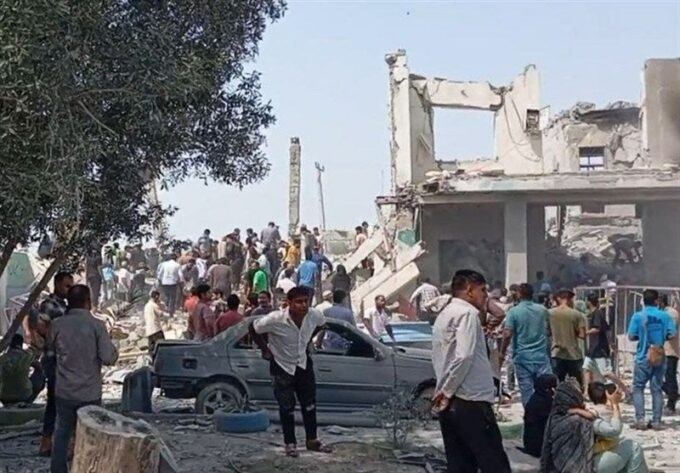
The aftermath of an airstrike on Shajareh Tayyebeh school. Photograph Source: Tasnim News Agency – CC BY 4.0
Last Friday, the mediator of the U.S. and Iranian nuclear negotiations in Oman, that country’s foreign minister Badr Albusaidi, pulled the rug out from President Trump’s deceptive pretense, threatening war with Iran because it had refused his demands that it give up what he claimed was its drive to build its own atom bomb. The Omani foreign minister explained on CBS’s Face the Nation that the Iranian team had agreed not to accumulate enriched uranium and offered “full and comprehensive verification by the IAEA.”
This new concession was a “breakthrough that has never been achieved any time before. And I think if we can capture that and build on it, I think a deal is within our reach” to achieve an “agreement that Iran will never, ever have a nuclear material that will create a bomb. This is, I think, a big achievement.”
Pointing out that this breakthrough “has been missed a lot by the media,” he emphasized that by calling for “zero stockpiling,” it went far beyond what had been negotiated during President Obama’s administration, because “if you cannot stockpile material that is enriched, then there is no way you can actually create a bomb.”
Ayatollah Ali Khamenei – who already had issued a fatwa against doing any such thing, and had repeated this position year after year – called Iran’s Shi’a leaders and military chief to discuss ratification of the agreement to cede control of its enriched uranium in order to prevent war.
But any such capitulation was precisely what neither the United States nor Israel could accept. A peaceful resolution would have prevented the long-term U.S. plan to consolidate and weaponize its control over Middle Eastern oil, its transportation and the investment of its oil export revenues, and to use Israel and al Qaeda/ISIS as its client armies to block independent oil-producing countries from acting in their own sovereign interests.
Israeli intelligence apparently alerted the U.S. military to suggest that the meeting at the Ayatollah’s compound offered a great chance to decapitate the leading decision makers all together. This followed the U.S. military handbook advice that killing a political leader whom the U.S. deems to be undemocratic will liberate popular dreams of regime change. That was the hope of bombing President Putin’s country residence last month, and it was in line with the U.S. recent Starlink attempt to mobilize popular opposition for revolution in Iran.
The joint U.S.-Israeli attack makes it clear that there is nothing that Iran could have conceded that would have deterred the long-standing U.S. drive to control Middle Eastern oil and using Israel and ISIS/Al Qaeda client armies to prevent sovereign nations in the region from emerging to take control of their oil reserves. That control remains an essential arm of U.S. foreign policy. It is the key to the U.S. ability to hurt other economies by denying them access to energy if they do not adhere to U.S. foreign policy. This insistence on blocking the world’s access to energy sources not under American control is why the U.S. has attacked Venezuela, Syria, Iraq, Libya and Russia.
The attack on negotiators (the second time America has done this to Iran) is a perfidy that will go down in history. It was to prevent Iran’s intended move to peace, before its leaders could have disproven Trump’s false claim that Iran had refused to give up its desire to obtain its own atom bomb.
It would be interesting to know how many of Trump’s insiders placed big bets that oil prices will soar when markets open on Monday morning. The markets last week were vastly underestimating the risk of closing the Straits of Hormuz and the Oil Gulf. U.S. oil companies will make a killing. China and other oil importers will suffer. U.S. financial speculators also will make a killing, because their oil production is domestic. This fact may even have played a role in the U.S. decision to end the world’s access to Middle Eastern oil for what promises to be a lengthy period.
The trade and financial disruption, in fact, will be so worldwide that I think we can think of Saturday’s attack on Iran as the true trigger of World War III. For most of the world, the imminent financial crisis (to say nothing of the moral outrage) will define the next decade of international political and economic restructuring.
European, Asian and the Global South countries will be unable to obtain oil except at prices that make many industries unprofitable and many family budgets unaffordable. The rise in oil prices will also make it impossible for Global South countries to service their dollar debts falling due to Western bondholders, banks and the IMF.
Countries can save themselves from having to impose domestic austerity, currency depreciation and inflation only by recognizing that the U.S. attack (supported by Britain and Saudi Arabia, with ambiguous Turkish acquiescence) had ended the U.S. unipolar order – and with it the dollarized international financial system. If this is not recognized, acquiescence will continue until it becomes unsustainable in any case.
If this is the inaugural real battle of World War III, it is in many ways a final battle to decide what World War II was all about. Will international law crumble as a result of the unwillingness of enough countries to protect the rules of civilized law supporting the principles of national sovereignty, free from foreign interference and coercion from the 1648 Peace of Westphalia to the UN Charter? And with regard to wars that inevitably are to be waged, will they spare civilians and non-belligerents, or will they be like Ukraine’s attack on its Russian-speaking population in its eastern provinces, Israel’s genocide against ethnic Palestinians, Wahabi religious cleansing of non-Sunni Arab populations, or indeed the Iranian, Cuban and other populations under U.S.-sponsored attack?
Can the United Nations be saved without freeing itself and its member countries from U.S. control? An early litmus test of where alliances are sorting out will be which countries join the legal move to declare Donald Trump and his cabinet war criminals. Something more than the present ICC is needed, given the U.S. Government’s personal attacks on ICC judges who found Netanyahu guilty.
What is required is a Nuremberg-scale trial against the Western military policy that has been seeking to plunge the entire world into political and economic chaos if it does not submit to the U.S.-unipolar ruler-based order. If other countries do not create an alternative to the US-European-Japanese-Wahabi offensive, they will suffer what U.S. Secretary of State Rubio called (in his recent Munich speech) a resurgence of the Western history of conquest to the basic principles of international law and equity.
An alternative requires restructuring the United Nations to end the U.S. ability to block majority resolutions. In view of the fact that U.N. Secretary-General Antonio Guterres has said that it may be bankrupt by August and have to close its New York City headquarters, this is a propitious time to move it out of the United States itself. The U.S. has banned Francesca Albanese from entering the United States as a result of her report describing Israeli genocide in Gaza. There can be no rule of law as long as control over the U.N. and its agencies remains in U.S. hands and those of its European satellites.
Michael Hudson’s new book, The Destiny of Civilization, will be published by CounterPunch Books next month.
==
==
Michael Hudson
The Shanghai Cooperation Organization and BRICS 2025: Eurasia’s Re-alignment in the face of Late Stage Barbarism
September 8, 2025Why America is at War With Iran
June 23, 2025What Are the Origins of the Money We Use Today?
March 7, 2025Trump’s Balance-of-Payments War on Mexico, and the Whole World
January 27, 2025We Need a New Political Vocabulary
July 8, 2024US Cryptocurrency as an Offshore Banking Center
June 17, 2024Some Myths Regarding the Genesis of Enterprise
May 24, 2024Modern Interpretations of Clean Slates
May 21, 2024Seven Features of Ancient Enterprise
May 17, 2024Property and Debt in Ancient Rome
April 17, 2024How Elite Infighting Made the Magna Carta
April 8, 2024Debt Forgiveness in the Bronze Age
March 11, 2024Were the Biblical Prophets Anti-Semitic?
November 20, 2023IMF Showdown with China in Morocco
October 13, 2023Why the Bank Crisis isn’t Over
March 15, 2023The Dollar Devours the Euro
April 8, 2022The End of Dollar Hegemony
April 1, 2022America’s Real Adversaries are Its European and Other Allies
February 11, 2022Did the Squad Give Away Their Bargaining Power?
November 9, 2021Is This the End of the Unreformable Democratic Party?
November 5, 2021The Vocabulary of Neoliberal Diplomacy in Today’s New Cold War
September 13, 2021A Debt Jubilee is the Only Way to Avoid a Depression
March 23, 2020The Democrats’ Quandary: In a Struggle Between Oligarchy and Democracy, Something Must Give
February 25, 2020What the US Wants in the Near East: an Interview With The Saker
January 10, 2020America Escalates Its “Democratic” Oil War in the Near East
January 6, 2020Break Up the Democratic Party?
September 13, 2019Global Warming and U.S. National Security Diplomacy
August 6, 2019The Coming Savings Writedowns
July 29, 2019U.S. Economic Warfare and Likely Foreign Defenses
July 22, 2019Trump’s Trade Threats are Really Cold War 2.0
June 14, 2019An Interview the Saker on Venezuela
February 8, 2019Trump’s Brilliant Strategy to Dismember U.S. Dollar Hegemony
February 1, 2019==
==
==
==

No comments:
Post a Comment