The US-Israeli strategy against Iran is working. Here is why
Every aspect of Iran’s ability to project regional power is being successfully degraded.

By Muhanad Seloom
Published On 16 Mar 202616 Mar 2026
14 mins

Two weeks into Operation Epic Fury, the dominant narrative has settled into a comfortable groove: The United States and Israel stumbled into a war without a plan. Iran is retaliating across the region. Oil prices are surging, and the world is facing another Middle Eastern quagmire. US senators have called it a blunder. Cable news has tallied the crises. Commentators have warned of a long war.
The chorus is loud and, in some respects, understandable. War is ugly, and this one has imposed real costs on millions of people across the Middle East, including the city I live in.
Recommended Stories
list of 4 itemslist 1 of 4
No, MAGA is not divided on the Iran warlist 2 of 4
‘US and Israel have taken majority of Iran’s ballistic missile capability’list 3 of 4
Why the Iranian regime did not collapse after Khamenei’s assassinationlist 4 of 4
Strait of Hormuz: Which countries’ ships has Iran allowed safe passage to?end of list
But this narrative is wrong. Not because the costs are imaginary, but because the critics are measuring the wrong things. They are cataloguing the price of the campaign while ignoring the strategic ledger.
When you look at what has actually happened to Iran’s principal instruments of power – its ballistic missile arsenal, its nuclear infrastructure, its air defences, its navy and its proxy command architecture – the picture is not one of US failure. It is one of systematic, phased degradation of a threat that previous administrations allowed to grow for four decades.
I write this from Doha, where Iranian missiles have triggered alerts for residents to take shelter and Qatar Airways has started operating evacuation flights. I lived through four years of war in Baghdad.
I have worked for the US Department of State and advised defence and intelligence agencies in multiple countries. I have no interest in cheerleading for war.
But I have spent my academic career studying how states authorise the use of force through intelligence institutions, and what I see in the current campaign is a recognisable military operation proceeding through identifiable phases against an adversary whose capacity to project power is collapsing in real time.
An arsenal built over decades, dismantled in days
Iranian ballistic missile launches have fallen by more than 90 percent from 350 on February 28 to roughly 25 by March 14, according to publicly available data. Drone launches tell the same story: from more than 800 on Day 1 to about 75 on Day 15.
The figures drawn from US and Iranian military statements differ in detail but converge on the trajectory. Hundreds of Iranian missile launchers have been rendered inoperable. According to some reports, 80 percent of Iran’s capacity to strike Israel has been eliminated.
Iran’s naval assets, fast-attack craft, midget submarines and mine-laying capabilities are being liquidated. Its air defences have been suppressed to the point at which the US is now flying nonstealth B-1 bombers over Iranian airspace, a decision that signals near-total confidence in air dominance.
The campaign has moved through two distinct phases. The first suppressed Iran’s air defences, decapitated its command and control, and degraded its missile and drone launch infrastructure. By March 2, US Central Command announced local air superiority over western Iran and Tehran, achieved without the confirmed loss of a single American or Israeli combat aircraft.
The second phase, now under way, targets Iran’s defence industrial base: missile production facilities, dual-use research centres and the underground complexes where remaining stockpiles are stored. This is not aimless bombing. It is a methodical campaign to ensure that what has been destroyed cannot be rebuilt.
Iran now faces a strategic dilemma that tightens every day. If it fires its remaining missiles, it exposes launchers that are promptly destroyed. If it conserves them, it forfeits the ability to impose costs of the war. Missile and drone launch data suggest Iran is rationing its remaining capacity for politically timed salvoes rather than sustaining operational tempo.
This is a force managing decline, not projecting strength.
The nuclear threshold that previous US presidents accepted
Much of the criticism of the US-Israeli campaign focuses on its costs while treating the status quo ante as if it were cost-free. It was not.
Iran entered 2026 with 440kg of uranium enriched to 60 percent purity – enough, if further enriched, for as many as 10 nuclear weapons. Before the June strikes, Tehran was less than two weeks away from enriching enough uranium for one nuclear bomb, according to US intelligence assessments. At that time, the International Atomic Energy Agency acknowledged that Iran’s accumulation of near-weapons-grade material had no clear civilian justification.
The current campaign has damaged further the Natanz nuclear facility. The one in Fordow remains inoperable. The defence industrial facilities that would be needed to reconstitute enrichment capacity are being systematically targeted.
Reasonable people can disagree about whether diplomatic alternatives were fully exhausted, the Omani-mediated negotiations in February showed real progress, and there are legitimate questions about whether Washington walked away too soon.
But the critics’ implicit alternative, continued restraint while Iran inched towards a nuclear weapon, is the policy that produced the crisis in the first place. Every year of strategic patience added centrifuges to the enrichment halls and kilogrammes to the stockpile.
The limits of military force against a nuclear programme are real, and as others have argued elsewhere, strikes can destroy facilities but cannot eliminate knowledge. The 440kg of enriched uranium remains unaccounted for.
A successor regime of any political colour will inherit a strategic environment in which the case for nuclear deterrence has been strengthened, not weakened. These are genuine long-term risks. But they are arguments for a comprehensive post-conflict diplomatic architecture, not arguments against the campaign itself.
The Strait of Hormuz: Iran’s wasting asset
The closure of the Strait of Hormuz is dominating the critical commentary. US Senator Chris Murphy has called it evidence that President Donald Trump misjudged Iran’s capacity to retaliate. CNN has described it as proof that the administration has lost control of the war’s escalation.
The economic pain is real: Oil prices have surged, a record 400 million barrels of oil will be released from global reserves, and Gulf states are facing drone and missile strikes on their energy infrastructure.
But this framing inverts the strategic logic. Closing the strait was always Iran’s most visible retaliatory card, and always a wasting asset. About 90 percent of Iran’s own oil exports pass through Kharg Island and then the strait.
China, Tehran’s largest remaining economic partner, cannot receive Iranian crude while the strait is shut. Every day the blockade continues, Iran severs its own economic lifeline and alienates the one major power that has consistently shielded it at the United Nations. The closure does not just hurt the global economy; it accelerates Iran’s isolation.
Meanwhile, the naval assets Iran needs to sustain the blockade – fast-attack boats, drones, mines, shore-based antiship missiles – are being degraded daily. Its naval bases at Bandar Abbas and Chahbahar have been severely damaged.
The question is not whether the strait reopens but when and whether Iran retains any naval capacity to contest it. Critics compare the challenge of escorting a hundred tankers daily to an impossible logistical burden. But you do not need to escort tankers through a strait if the adversary no longer has the means to threaten them. That is the operational trajectory.
A proxy network that is fragmenting, not expanding
The regional escalation – Hezbollah resuming attacks on Israel, Iraqi militias striking US bases, Houthis issuing threats in the Red Sea – is cited as the clearest evidence of US-Israeli strategic failure. The war is spreading, the critics say, just as it did in Iraq. This misreads the dynamics of Iran’s alliance network.
My research on how states authorise proxy violence identifies four layers of control: strategic legitimation, operational coordination, financial-logistical distribution and deniability calibration. The current campaign has disrupted all four simultaneously.
The assassination of Supreme Leader Ali Khamenei eliminated the apex of the authorisation pyramid. His son Mojtaba’s appointment as his successor, a dynastic transfer without precedent in the Islamic Republic, signals institutional fragility, not continuity. The Islamic Revolutionary Guard Corps (IRGC) command structure has been decapitated at multiple levels – the acting defence minister was among those killed.
When proxies launch retaliatory attacks across the region, this is not evidence of an expanding network; it is evidence of predelegated response authority, which is what a centralised command system activates when it anticipates its own destruction.
Predelegation is a sign of desperation, not strength. It means the centre can no longer coordinate. The attacks will continue, but they will become increasingly uncoordinated, strategically incoherent and politically costly for the host states where these groups operate.
Qatar and Bahrain are arresting IRGC operatives. Kuwait and Saudi Arabia are intercepting Iranian drones over their own territory. The regional environment that sustained Iran’s proxy architecture, including the grudging tolerance by Gulf states fearful of Iranian retaliation, is being replaced by active hostility.
Hezbollah is weaker than at any point since 2006, degraded by more than a year of Israeli operations before this campaign began. Iraqi militias retain the ability to launch attacks, but they are doing so into a region where they face increasing isolation.
The Houthis in Yemen possess independent capability but lack the command integration with Tehran that transforms militia activity into strategic effect. What the critics described as an expanding regional war is better understood as the death spasm of a proxy architecture whose authorising centre has been shattered.
A clear endgame
The most politically potent criticism is that the administration has no endgame. Trump’s own rhetoric has not helped: the oscillation between “unconditional surrender” and hints at negotiation, between regime change and denial of regime change, feeds the impression of strategic incoherence. Only 33 percent of American respondents in a recent Reuters-Ipsos poll said the president had clearly explained the mission’s purpose.
But the endgame is visible in the operational phasing, even if the rhetoric obscures it. The objective is the permanent degradation of Iran’s ability to project power beyond its borders through missiles, nuclear latency and proxy networks.
Call it strategic disarmament. This is closer to the approach of the Allies to Germany’s industrial war-making capacity in 1944-1945 than to the US war on Iraq in 2003. The analogy is imperfect: Strategic disarmament without occupation requires a verification and enforcement architecture that no one has yet proposed, but the operational logic is the same.
No one is proposing to occupy Tehran. The question is what happens when the bombing stops, and here the critics raise a legitimate concern, which Murphy articulated concisely after a classified briefing: What prevents Iran from restarting production?
The answer requires a post-conflict framework that does not yet exist in public: a verification regime, a diplomatic settlement or a sustained enforcement posture. The administration owes the American public and its regional partners a clear account of what that framework would look like.
Advertisement
But the absence of a public diplomatic blueprint does not mean the military campaign is failing. It means the campaign is ahead of the diplomacy, a sequencing problem, not a strategic one. The military conditions for a durable settlement – Iranian missile capacity too degraded to rebuild quickly, nuclear infrastructure inaccessible, proxy networks fragmented – are being created right now.
War is ugly, but the war strategy is working
None of this minimises the human costs. More than 1,400 civilians have been killed in Iran, a moral burden the US and Israel will carry. Oil price spikes are hurting every economy on Earth. At least 11 US service members have been killed. I live with these sirens every day, as does everyone across the Gulf. The costs are real, they are serious, and any accounting that ignores them is dishonest.
But the critics are making a different error: They are treating the costs of action as if the costs of inaction were zero. They were not. They were measured in the slow accretion of a threat that, left unchecked, would have produced exactly the crisis everyone claims to fear: a nuclear-armed Iran capable of closing the Strait of Hormuz at will, surrounded by proxy forces that could hold the entire region hostage indefinitely.
Seventeen days in, Iran’s supreme leader is dead, his successor is reportedly wounded and every principal instrument of Iranian power projection – missiles, nuclear infrastructure, air defences, the navy, proxy command networks – has been degraded beyond near-term recovery. The campaign’s execution has been imperfect, its public communication poor and its post-conflict planning incomplete. War is never clean. But the strategy – the actual strategy, measured in degraded capabilities rather than cable news cycles – is working.
The views expressed in this article are the author’s own and do not necessarily reflect Al Jazeera’s editorial stance.
Muhanad Seloom
Muhanad Seloom is Assistant Professor of International Politics and Security at the Doha Institute for Graduate Studies and an Honorary Research Fellow at the University of Exeter.
===
Philip Greenspun’s Weblog
A posting every day; an interesting idea every three months…
Iran war progress analysis from Al-Jazeera
While a lot of Americans, including the New York Times, seem enthusiastic about the idea that the U.S. is losing the war against Iran, Al-Jazeera publishes a perspective from a professor in Doha… “The US-Israeli strategy against Iran is working. Here is why”:
“When you look at what has actually happened to Iran’s principal instruments of power – its ballistic missile arsenal, its nuclear infrastructure, its air defences, its navy and its proxy command architecture – the picture is not one of US failure. It is one of systematic, phased degradation of a threat that previous administrations allowed to grow for four decades. … An arsenal built over decades, dismantled in days … The campaign has moved through two distinct phases. The first suppressed Iran’s air defences, decapitated its command and control, and degraded its missile and drone launch infrastructure. … The second phase, now under way, targets Iran’s defence industrial base: missile production facilities, dual-use research centres and the underground complexes where remaining stockpiles are stored. … Iran now faces a strategic dilemma that tightens every day. If it fires its remaining missiles, it exposes launchers that are promptly destroyed. … Much of the criticism of the US-Israeli campaign focuses on its costs while treating the status quo ante as if it were cost-free. It was not. … Closing the strait was always Iran’s most visible retaliatory card, and always a wasting asset. About 90 percent of Iran’s own oil exports pass through Kharg Island and then the strait. … The question is not whether the strait reopens but when and whether Iran retains any naval capacity to contest it. … the endgame is visible in the operational phasing, even if the rhetoric obscures it. The objective is the permanent degradation of Iran’s ability to project power beyond its borders through missiles, nuclear latency and proxy networks. … the critics are making a different error: They are treating the costs of action as if the costs of inaction were zero. They were not. They were measured in the slow accretion of a threat that, left unchecked, would have produced exactly the crisis everyone claims to fear: a nuclear-armed Iran capable of closing the Strait of Hormuz at will, surrounded by proxy forces that could hold the entire region hostage indefinitely.”
I’m not sure if Muhanad Seloom is correct, but the fact that A-10 Warthogs are now operating in Iran suggests that he is. Speaking of the Hog, here’s a photo from the 2024 Stuart, Florida air show:
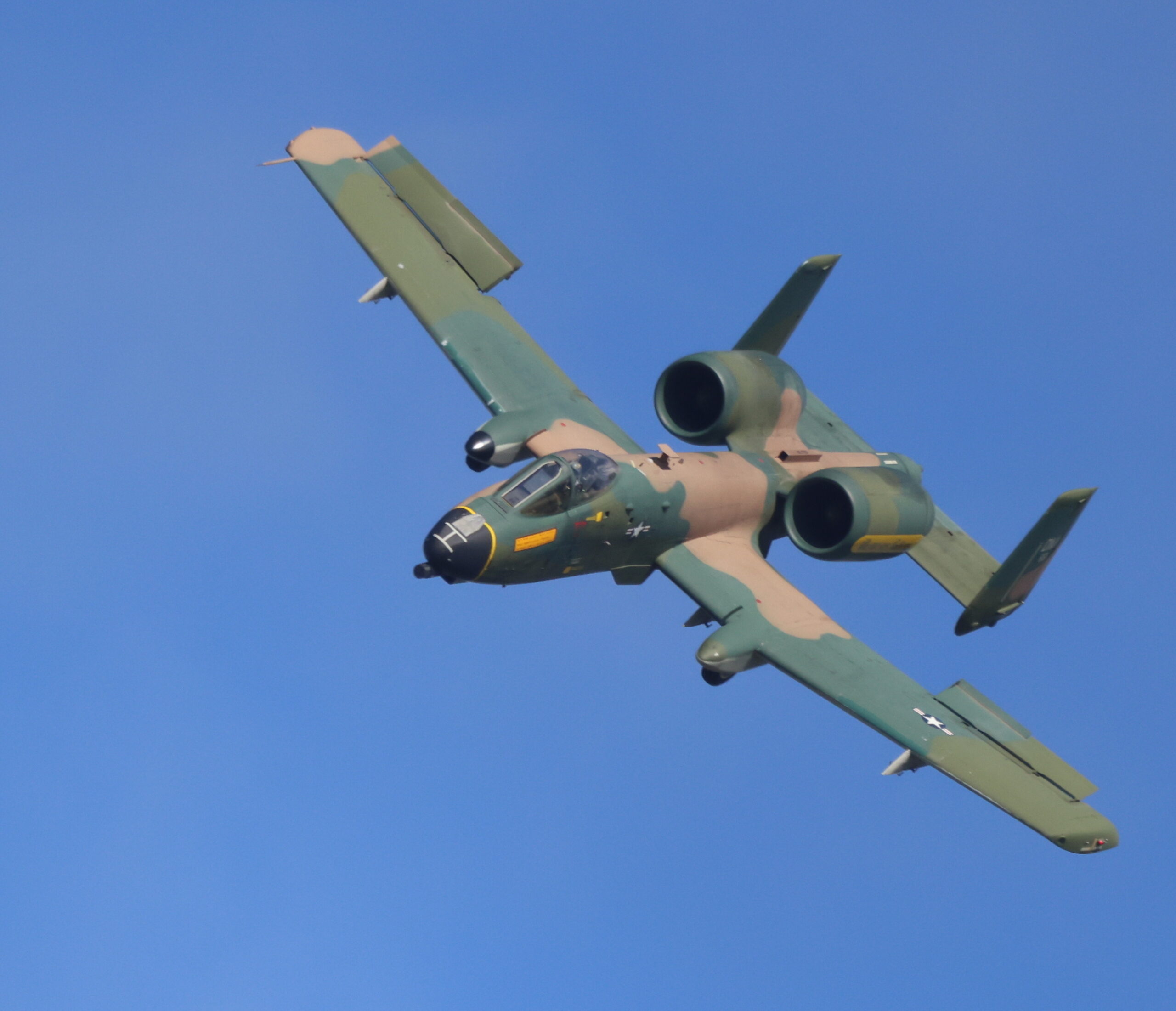
Prof. Seloom seems to assume that the Islamic Republic stays in power and that the U.S. stops its regular bombing runs, thus giving Iran the opportunity to rebuild its military:
No one is proposing to occupy Tehran. The question is what happens when the bombing stops, and here the critics raise a legitimate concern, which Murphy articulated concisely after a classified briefing: What prevents Iran from restarting production?
Maybe the answer is that there are some adversaries who are indifferent to being bombed and, therefore, you have to keep bombing them every few days indefinitely, e.g., use satellites and drones to see if they’ve managed to rebuild some military capability and, if so, take it out immediately. Wait for a new leader to show up in public and drop a missile on his head. Certainly you can’t let the enemy rebuild its air defenses.

If the administration was straightforward with the current status, I think it would be this:
– We killed some leadership, but it was replaced by leaders that are basically the same
– We destroyed most of their missiles, planes, ships, etc, but didn’t destroy any more of their (early) nuclear program
– To destroy their nuclear program, we would need to put soldiers on the ground, go through tunnels, etc, but we’re not willing to do that.
– To replace their leadership, we would need to put soldiers on the ground, which again we’re not willing to do.
– If they rebuild any of their conventional weapons, we’re in a good place to attack again later
– But if we want to stop their nuclear program or replace the regime later, we’ll need to do later what we’re not willing to do today.
Before the attack, Iran thought that if they could absorb massive damage and stay standing, they would be the ultimate winner because the US would quickly lose interest and leave.
That’s looking like a decent prediction of the situation.
* By the way, I’m fine with the “mowing the grass” strategy. I’m most bothered by using expensive (and hard to replace, it seems) weapons in an optional war.
We’re using $4M patriots to shoot down $20k drones and burning through a stockpile of weapons that is difficult to replace.
The Patriots first in the first 3 days around Iran were more than Ukraine fired since the start of their war with Russia.
The tomahawk missiles fired will take years to replace.
Can you imagine being China or Russia, eyeing Taiwan and Ukraine, watching Trump burn through weapons on Iran that may leave us unable to mount a sustained defense anywhere else for years?
It’s a tremendous gift.
Are we sure Trump doesn’t work for Russia? Because this, combined with removing the sanctions on Russian oil, would make Trump Russia’s employee of the year.
Why do we need “boots on the ground” to prevent Iran from building nuclear weapons? If we disable their oil industry (the source of the government’s money) and their electric power generation how are they going to run nuclear weapons labs and factories?
Why would it take years to replace weapons? From February 2026, https://www.rtx.com/news/news-center/2026/02/04/rtxs-raytheon-partners-with-department-of-war-on-five-landmark-agreements-to-exp describes a deal to make 1,000 Tomahawks per year. Only about 4,000 have been made since 1983 so that’s a significant ramp-up.
From December 2025, https://www.csis.org/analysis/depleting-missile-defense-interceptor-inventory describes “The U.S. Army’s decision to increase its objectives for Patriot PAC-3 MSE interceptor procurement from 3,376 to 13,773 total missiles”
Regardless of how many interceptors we have, bombing the missile factories in Iran seems like a great way to reduce the number of interceptors required. If Iranians can’t make missiles anymore who is going to be producing mass quantities of missiles and shooting them at us? The Chinese are historically at least mostly peaceful. The Russians are busy in Ukraine.
David, your comments are all so astute! Just to ease your rightful concerns and to look on the bright side, there is a silver lining to the absolute disaster and utter destruction that Trump the fool has welcomed on America, as you have so expertly described (never mind Phil’s low-IQ rebuttals). By ensuring the utter destruction and capitulation of America to Russia and China that you smartly articulate, Trump has condemned America to the outcome it truly deserves, namely a society that despises and rejects everything about the evils of Western Civilization. I can’t think of a more satisfying outcome, can you? Allahu Akbar!
@Baroke Obummer
Why should Islam trust you, didn’t you develop this?
https://en.wikipedia.org/wiki/Disposition_Matrix
I think the real problem, as Phil has pointed out so many times, is hypocrisy.
You’re a fool…..all Iran needs is few thousand 7000 dollar drones, and your oil infrastructure will be toast…..don’t forget oil burns!
So if you think it’s a one way street you’re sadly mistaken. Also, Iran is 92 million people strong, it’s not sheikdom. It will rebuild and it will pay back its debt to the Gulfies.
Anon: I know that I’m a fool, but the above analysis is from Professor Muhanad Seloom, not from me!
That said, I don’t know how Iran would be able to get its drones to the U.S. (you mentioned “your oil infrastructure”). Iran had a drone carrier ship, but my understanding is that it was blown up and sunk. As far as I know, Iranian drones don’t have the range to make it across the Atlantic Ocean. Could Iran attack its Arab neighbors? I guess so, but presumably the Iranian military was at its strongest 2.5 weeks ago and still didn’t accomplish much. Iran’s large population might be more of a liability than an asset. If the U.S. gets serious enough about winning to disable Iran’s oil production and electricity grid then Iranians will have to spend almost all of their time and energy on food production.
Anon, you are spot on! Phil is an utter fool. Your comment that Iran is “92 million strong” is so perceptive because events of the last few months have proven that every single one of them supports the Peaceful Islamic regime (don’t believe the polls you may read because they are CIA misinformation). If only the monster Trump was a high IQ Harvard graduate like me (where I studied Black Studies Plagiarism with the renowned Claudine Gay) and had taken the approach I invented, in large part sending the regime billions of dollars as a gesture of our love for Peaceful Islam. Allahu Akbar!
Thank you, Barack, and I hope that you’ll join me in working with Ali Larijani to make sure that the evil Trump regime is punished for its attack on the peaceful Islamic Republic. https://x.com/alilarijani_ir/status/2032128759042646170?s=20
Philip,
Re: nuclear weapons:
– Before the invasion, Trump told us that Iran was just days away having a nuclear weapon. And that a decent amount of nuclear material was still out there.
– I haven’t heard Trump say anything about destroying their nuclear weapons again. Did I miss it? All the talk I hear is about conventional weapons being destroyed.
– In briefings to the Senate Intelligence committee, Democrats are being told that the goal of getting rid of those weapons is no longer in the plan, likely because they are deeply buried, and not reachable by aircraft.
This tells us they want to destroy the tanks, boats, planes, etc., and hope for a solution on the nuclear weapons later.
Is there any other explanation?
Re: China being peaceful. They’ll be peaceful until they’re not. They’re willing to take Taiwan by force, right?
Re: Russia staying busy. Ukraine is desperate for Patriots because they use them to blunt Russian attacks
https://kyivindependent.com/ukraine-to-receive-35-patriot-interceptors-in-coming-weeks-media-reports/
We shouldn’t be able to complain if the Chinese take Taiwan because we’re officially on record as saying we don’t support Taiwanese independence. From 2023: https://nypost.com/2023/06/19/blinken-ruffles-feathers-by-stating-us-does-not-support-taiwan-independence-after-meeting-chinas-xi/
I don’t see what’s logically inconsistent in what you say that Trump has said. Iran has some enriched uranium. To turn that into working atomic bombs will require some work. If all of their military vehicles, oil production, and electric power generating plants are disabled then how do they build bombs using what they have? They might not even be able to move on the surface of their country in order to get to their underground nuclear facilities. A drone or an A-10 can just circle and wait for someone to approach by car or truck.
Regarding Ukraine, I don’t have an answer. It seems like a pointless stalemate. I don’t think Patriots will make any difference to that conflict.
It’s a strange world we live in when Al-Jazeera has more interesting and more balanced articles than our own media.
> our own media
Our? That’s the great thing about modern times. Journalists of yore asked, “Who, what, when, where, and why?” then wrote a story. Now they ask, “Which radical pole are my readers on? What conspiracy do they believe?” and the story writes itself (now, literally, with AI).
@phil who cares what Al-Jazeera and NYT says. As a supporter of this war, Trump and his policies you/we only care what FOX news says. What is FOX news saying?
Boots on the ground in Iran would be an epic mistake. Which is why Trump will do it sooner or later.
From a purely military perspective, Iran can keep the strait closed as long as they want. If the Houtis, not even a proper government, despite being heavily bombed (another useless action by Trump) could close the Red Sea for almost two years, Iran can close the straight for decades. It is a war of attrition. Iran has optimised the production of cheap drones. Forget about missiles. Doesn’t matter how many missile launch sites they destroy, they’ll just launch Shaheds from the back of a truck. Even if you destroy all Shahed factories (a big if), a couple of guys in a small boat and an RPG will stop any tanker. A small chance of that and insurance costs will go through the roof, which will still lead to high oil prices. Not to mention all the anti-ship missiles that Iran has also developed over decades, and which they haven’t used much yet.
Why doesn’t President Bone Spurs send the largest navy in the world to secure the strait, and instead tries to bully his former allies to do it for him? Because it’s really dangerous and would lead to many casualties.
Politically, Iran has been preparing for this war for decades. Doesn’t matter how many leaders you kill, there are so many fanatics and levels of redundancy that they’ll always be replaced by someone similar. Only Trump was stupid enough to fall for it. The only thing that he has achieved (other than depleting his own ammo) was to rally even the anti-government Iranians against the US. Iran has an educated population, relatively sophisticated indigenous technology, and geographically it is more challenging than Afghanistan. Ground attacks in Iran would make fighting the Taliban like a walk in the park. While the government is widely hated, and the population mostly not religious fanatics, the Persian civilization has spanned millennia and people strongly identify with it. They would not take it lightly to be invaded by a Western country. They will fight for every stone and inch of land, much harder than Trump and his government of dunces can imagine.
> Iran can close the straight for decades.
But as we learned several days ago from Mr. Hamm, America is a net petroleum exporter, and will be forever, so we don’t care. Let other countries keep it open. Iran blocking the straight is a good thing, less money flowing into the Middle East means less of their radical influence on our politics.
/ignore
@Neo Hippy. Absolutely agree that less oil from the middle east means less of the radical Muslim influence on the world. However, there are several reasons why you should care about having the strait open.
First, in the US oil is a commodity and prices are set globally. Blocking middle eastern oil will increase US oil prices in the same way as it does for other countries. Why should US producers sell domestically when international customers will pay much more? This is why gas prices are increasing in the US as well, and will keep in increasing in the weeks and months to come. If you want to avoid that, then you need to impose export controls, and will end up with a country that is much closer to Russia or Iran as a consequence.
Second, the cheap items (and also not so cheap) that are the mainstay of our society and built in Asia, will suffer from more expensive oil. A lot of industrial production in Asia and elsewhere depends either directly on oil or energy generated by oil. So increasing the oil price everywhere will lead to higher prices of everything, everywhere.
The only way to fix the dependency on middle eastern oil is to reduce the dependency on oil, overall. Incredibly, China as usual is playing the long game and heavily invested in renewables and electric cars. Oil is now a much smaller part of their economy than it was 10 years ago. (Meanwhile, Trump is punishing the renewable industry in the US and making it more dependent on oil.) As the war in Ukraine has shown, renewable energy is much more resilient in the face of attacks and (except hydro) often lacks concentrated targets that are easier to bomb, unlike coal, oil, or gas.
@Jarle and NH
Cool, let’s write a proposal to the Gates Foundation and Thunberg Foundation to fund a “Great Neocons for Order in the Middle East” (GNOME) think-tank, to nobly study alternate energy and materials. They ought to be able to scrape $200M in change from the couch (and divert it from Africa). I’m sure Big Oil wouldn’t mind us meddling. Together, we are united. /sarcasm (As if I need to tag it, around here.)
Jarle, who wants boots on the ground in Iran? Maybe limited special forces operation to destroy nuclear material supply or take over oil wells concentrated in Arab Khusistan, there will not be much resistance there. Europe not participating because, unlike Canada, SA built up financial sector and manage financing of cross-country pipeline, from Gulf to Red Sea, bypassing Strait of Hormux and the Hooties, and can sell oil to Europe. Shaheed are nocks-off Israeli 25 years old drones that use Chinese-made engines and electronics, US and Israel know how to protect ships from.them. If regime in Iran does nor change or US and Gulf Arabs do not take over Iran’s oil, all US needs to do is to level Iran’s oil infrastructure, and bye-bye Chinese -made components, and Iran threats. Good luck to surviving mullahs buy anything in China with Iranian reals. Check their exchange rate.
Think that after European refusal just to patrol Hormuz with their frigates or corvettes NATO is done. After involving US in pro-islamist regime change wars in Libia and former Yugoslavia and benefitting from American ballistic missile defenses, including from Iranian threats, only minority of Americans will want to do anything with NATO, and many American deep-state militarusts will have a second thought as well.
Iran is a rough place to practice medicine without insurance preauthorization:
https://www.dailymail.co.uk/news/article-15650113/Horrific-gang-rape-torture-ordeal-Iranian-nurses-Medics-subjected-brutal-sex-attacks-revenge-caring-wounded-rioters-one-victim-begging-surgeons-let-die.html
The mane heartbreak was the destruction of the last airworthy F-14’s to accomplish basically nothing. Suspect we’re heading for a speedy withdrawal when the world is minutes from running out of oil, Trump declares victory, the Ayatollah declares victory & Hegseth resigns.
Lion, I’m confused from where the “withdrawal” you reference would be from? Wouldn’t that require us to have already invaded?
Thanks, lion. Since you’re concerned about the world running out of a natural resource maybe you can pick up where Paul R. Ehrlich left off (died a few days ago) with his prescient Population Bomb book! See also https://en.wikipedia.org/wiki/Simon%E2%80%93Ehrlich_wager
I remember in the ’70s and ’80s when “experts” continuedly warned us that the world was only decades away from running out of food and water, and that if nothing was done, WWIII was a sure thing. I also remember The Day After [1], which scared to hell Americans with the idea that we were on the brink of nuclear war, driven by yet another “crazy” president of that times.
I also remember in the ’70s and ’80s not feeling the need to constantly worry about saying the wrong thing, using the pronoun, or being labeled with something like ADHD. I remember walking the streets, even at night, in neighborhoods considered dangerous, without the same fear of being shot or robbed. And I remember that when I got into a fight with other teenagers, a stranger would step in and break it up, rather than stand by and film live broadcast.
[1] https://en.wikipedia.org/wiki/The_Day_After
@Jarle, I don’t follow your logic.
You said, “From a purely military perspective, Iran can keep the strait closed as long as they want.”
That is not accurate. Iran relies heavily on oil exports moving through the Strait to fund its government, military, and leadership. Prolonged disruption would collapse its own economy. Given its limited economic export and unrest, they cannot sustain a closer of the Strait even if booming stops today.
You also said, “China … heavily invested in renewables and electric cars”
This too is not accurate. China is not investing in renewables, they remains one of the world’s largest consumers of coal and continues to rely on it heavily. But yes, they are producing cheap electric cars, by stealing Western technologies, as they always do, and using their massive workforce to manufacture them at low cost, supported by heavy government subsidies, as they always have.
@David, Since the 1979 Iranian Revolution, every U.S. leader, of both parties, and nearly every Western leader has been saying, “something must be done about Iran.” And now that something has been done, they are standing by and criticizing it.
This move against Iran is Netanyahu’s plan, and he convinced Trump to joining him. Personally, I believe taking down Saddam, in the second Iraq war was a big mistake. Saddam had kept Iran in check, and Khomeini kept Iraq in check, for the rest of the world. By removing Saddam, we effectively created a new ally for Iran. Over time, if Iran and Iraq play their cards right and becomes strategic allies, they would dominate the Arab world and with it, control oil of the world.
George: Don’t forget all of the Followers of Science who said that oil prices needed to be higher to discourage consumption and climate change. Now that oil prices actually are higher (though not as high as they were during the Biden administration), the climate change alarmists are inconsolable.
New York Times today is mourning Ali Larijani, Man of Peace. Less than a month ago, https://www.nytimes.com/2026/02/22/world/middleeast/iran-larijani-khamenei-pezeshkian.html said “He was in charge of crushing, with lethal force, the recent protests demanding the end of Islamic rule.”
Phil, I recommend you start following Will Schryver (ex USA miliatry) on X for well-argued counter-arguments to the viewpoints that you seem to be currently disposed to follow
https://x.com/imetatronink
Thanks. I don’t know enough about war or Iran to know whether to agree with Prof. Seloom or not. I do find it implausible that we’re losing when Iran’s leaders keep getting killed and when all that Iran seems to be able to do is attack civilians sporadically (like the Germans did to London during The Blitz). But I also think we still could lose just by giving up because we don’t have the stomach to do anything that inconveniences Iranian “civilians” (30-50% of whom are big regime supporters?). That would leave the Islamic Republic in charge with oil revenues, electric power, and everything else they need to rebuild quickly.
Being ex-military doesn’t give a person special insight. Jimmy Carter was a Navy officer and he handed Iran to Muslim theocrats, allowed them to take our embassy hostage, etc.
Will Schryver posts….
https://x.com/imetatronink/status/2034006163868762385?s=20 he says “This brief analysis underscores why I have long argued that the US could not win a war of attrition against Iran.”
That seems absurd. The US economy is about 60X larger than the Iranian economy. Admittedly we waste a huge percentage of GDP on Minnesota day cares and our defense procurement isn’t efficient, but we still have way more money and the most important military input is money (can be used to buy weapons from efficient producers worldwide, if nothing else).
In https://x.com/ProfessorPape/status/2033750432573473044?s=20 he says “Iran is more powerful now than before the war — it controls the price of world oil and more likely to fracture the US coalition than US is to grow it. Stunning gains in 17 days”
Having lost control of its airspace and with most of its top leaders killed, I don’t see how Iran is more powerful every day! I’m not sure why we care about “the price of world oil”. Trump could shut off exports from the US and insulate our domestic prices from the world market. We’re the world’s largest oil producer and a net exporter. The Europeans and Asians might suffer with $200/barrel prices, but if our producers can’t export why would the domestic price be different from what it was in February?
I can see why Trump-haters might like this guy because he says that the Trump-initiated war effort is doomed.
“Iran is more powerful now than before the war — it controls the price of world oil and more likely to fracture the US coalition than US is to grow it. Stunning gains in 17 days”
Ahh, I love this, I really do!
Are the so-called “experts” now admitting that Iran was too weak and stupid all these years to influence oil prices through control of the Strait, and that it needed the “help” of Israel and the U.S. to suddenly become “powerful”? Shouldn’t those so-called “experts” suggest which nation should be next to get “help” from Israel and U.S.?
Phil, that 2nd X link was from Professor Robert Pape (perhaps Schryver quote-posted it).
Professor Pape was interviewed on (conservative UK website) Unherd yesterday.
https://www.youtube.com/watch?v=aQuApsJK0gM
It’s a 34 minute segment, expanding on his recent X posts, including that one you linked. (The interviewer pushes back on some of the points and claims he makes.)
Callum: sorry about that confusion. I guess Will Schryver reposted the Prof. Pape tweet. Still, he wasn’t posting it with a comment of the form “look how wrong this professor is”!
Look at some of the Unherd interview with Pape. Pape seems to think that Vietnam is the best analogy and that whoever is running Iran and hasn’t been killed is using Ho Chi Minh’s outlast the enemy strategy. I don’t think the analogy holds. Iran is an urbanized country with no tree cover. If the U.S. takes out oil production and electric power, I don’t see how the Iranians will be able to anything military. The Iranians can’t just sit in their rice paddies and wait for the U.S. to be exhausted, as the North Vietnamese did. The precision of current U.S. weapons combined with the disloyalty of some fraction of the Iranian population also makes it much tougher for the Iranian regime to survive. A political opponent of Ho couldn’t call in his current GPS coordinates and then watch as he evaporated.