Greater Israel

| This article is part of a series on |
| Conservatism in Israel |
|---|
 |


"Greater Israel" (Hebrew: ארץ ישראל השלמה, romanized: Eretz Yisrael HaShlema) is an expression with several different biblical and political meanings over time. It is often used, in an irredentist fashion, to refer to the historic or desired borders of the State of Israel.
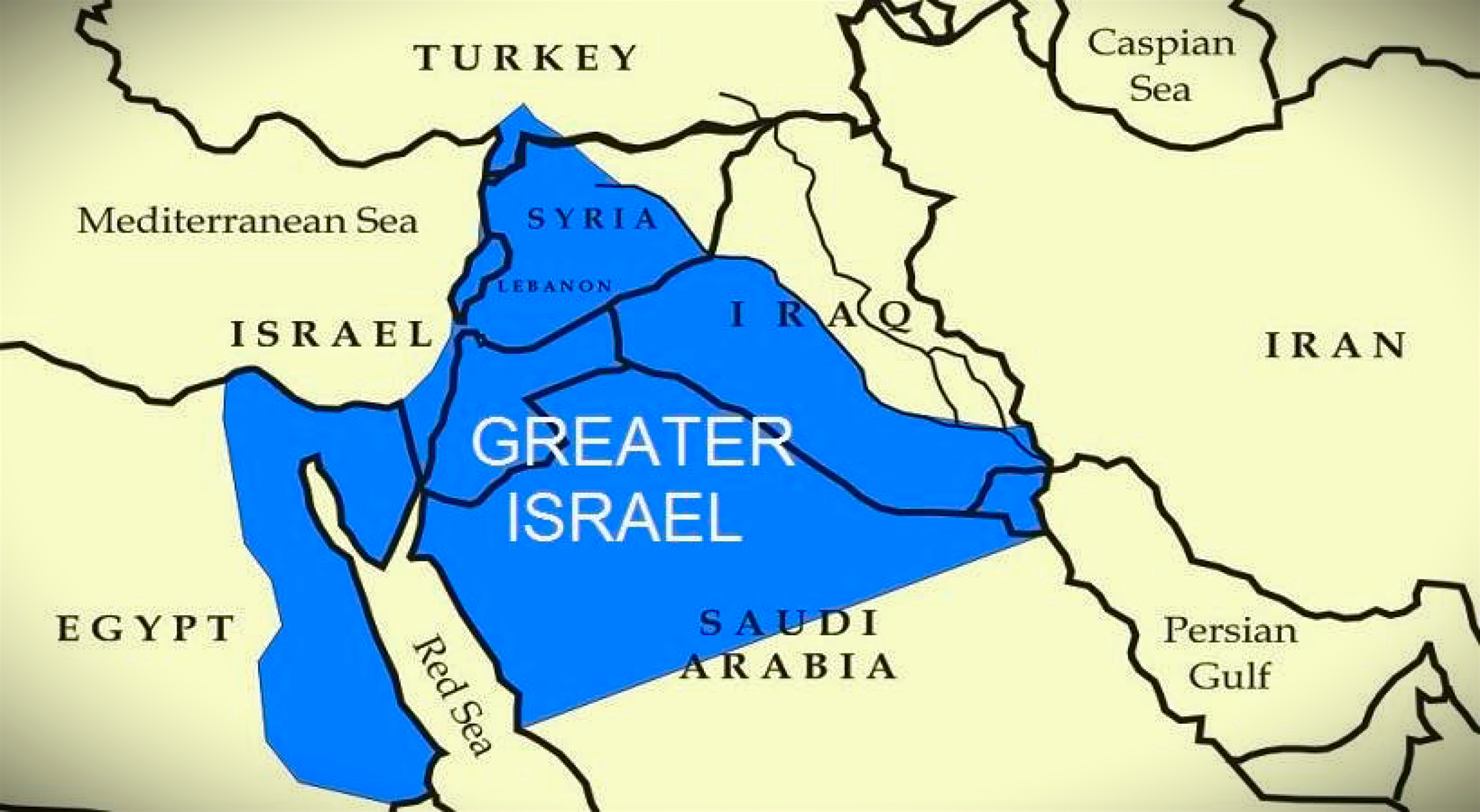
Territorial claims of Israeli Nationalist or Zionist movements have varied, depending on the time period and different groups of proponents such as Labor Zionist, Revisionist Zionist, or Religious Zionist groups.[1] There are two different primary uses of the term Greater Israel – one referring more narrowly to the area internationally recognized as part of the State of Israel along with the Golan Heights, West Bank, and Gaza Strip; and a second definition referring to the much larger region stretching from the river Nile to the Euphrates.[2]
History
Early Zionism
.jpg)
Theodore Herzl, one of the founders of Zionism, was influenced by the Tanakh in his thinking on the borders for a Jewish State in Palestine. In the words of professor of history H.S. Haddad: "Herzl's idea of the geographical extent of the Jewish state was derived from the biblical romance of the Davidic Kingdom."[3]
William Hechler, an English Christian Zionist, also influenced Herzl's thinking on the matter,[4] and Theodore Herzl recorded in his diary that:
The Land of Israel in Jewish history and religion
_(14803713123).jpg)
The Land of Israel (Hebrew: אֶרֶץ יִשְׂרָאֵל, Modern: ʾEreṣ Yīsraʾel, Tiberian: ʾEreṣ Yīsrāʾēl) is the traditional Jewish name for an area of the Southern Levant. Related biblical, religious and historical English terms include the Land of Canaan, the Promised Land, the Holy Land, and Palestine. The definitions of the limits of this territory vary between passages in the Hebrew Bible, with specific mentions in Genesis 15, Exodus 23, Numbers 34 and Ezekiel 47. Nine times elsewhere in the Bible, the settled land is referred as "from Dan to Beersheba", and three times it is referred as "from the entrance of Hamath unto the brook of Egypt" (1 Kings 8:65, 1 Chronicles 13:5 and 2 Chronicles 7:8).
The Bible contains three geographical definitions of the Land of Israel:
- The first definition (Genesis 15:18–21) seems to define the land that was given to all of the children of Abram (Abraham), including Ishmael, Zimran, Jokshan, Midian, etc. It describes a large territory, "from the brook of Egypt to the Euphrates".
- A narrower definition (Numbers 34:1–15 and Ezekiel 47:13–20) refers to the land that was divided between the original Twelve tribes of Israel after they were delivered from Egypt.
- A wider definition (Deuteronomy 11:24, Deuteronomy 1:7) indicating the territory that will be given to the children of Israel slowly throughout the years, as explained in Exodus 23:29 and Deuteronomy 7:22).[citation needed]
These biblical limits for the land differ from the borders of established historical Israelite and later Jewish kingdoms, including the United Kingdom of Israel, the two kingdoms of Israel (Samaria) and Judah, the Hasmonean Kingdom, and the Herodian kingdom. At their heights, these realms ruled lands with similar but not identical boundaries.
Judaism defines the land as where Jewish religious law prevailed and excludes territory where it was not applied.[6] It holds that the area is a God-given inheritance of the Jewish people based on the Torah, particularly the books of Genesis, Exodus, Numbers and Deuteronomy, as well as Joshua and the later Prophets.[7] According to the Book of Genesis, the land was first promised by God to Abram's descendants; the text is explicit that this is a covenant between God and Abram for his descendants.[8] Abram's name was later changed to Abraham, with the promise refined to pass through his son Isaac and to the Israelites, descendants of Jacob, Abraham's grandson.
Professor of history H.S. Haddad writes that "Although there are different delineations of the boundaries of the Promised Land in the Bible, the locus of Eretz Israel is clear and constant. Whether it is defined as "from Dan to Beersheba" and "from the desert to the sea" or, more often, from the Nile to the Euphrates, Jerusalem is the centre around which these circles of varying size are drawn."[9]
Kingdom of Israel
- The Kingdom of Israel (united monarchy) (1047–931 BCE), was the kingdom established by the Israelites and uniting them under a single king.
- The Kingdom of Israel (northern kingdom) (930–c.720 BCE), was the kingdom of northern Israel after the breakup of the united monarchy of the Kingdom of Israel.
- The Kingdom of Judah (930–587 BCE), was the southern Jewish kingdom after the breakup of the united monarchy of the Kingdom of Israel.
Second Temple period
Return to Zion (Hebrew: שִׁיבָת צִיּוֹן or שבי ציון, Shivat Tzion or Shavei Tzion, lit. 'Zion returnees') is an event recorded in Ezra–Nehemiah of the Hebrew Bible, in which the Jews of the Kingdom of Judah—subjugated by the Neo-Babylonian Empire—were freed from the Babylonian captivity following the Persian conquest of Babylon. In 539 BCE, the Persian king Cyrus the Great issued the Edict of Cyrus allowing the Jews to return to Jerusalem and the Land of Judah, which was made into a self-governing Jewish province known as Yehud under the new Persian Achaemenid Empire.
The Second Temple period or post-exilic period in Jewish history denotes the approximately 600 years (516 BCE–70 CE) during which the Second Temple stood in the city of Jerusalem. It began with the return to Zion and subsequent reconstruction of the Temple in Jerusalem, and ended with the First Jewish–Roman War and the Roman siege of Jerusalem.
Palestine under British rule 1917–1948
Balfour Declaration

The Balfour Declaration was a public statement issued by the British Government in 1917 during the First World War announcing that it "viewed with favour" the establishment of a "national home for the Jewish people" in Palestine, then an Ottoman region with a small minority Jewish population. The declaration was contained in a letter dated 2 November 1917 from the United Kingdom's Foreign Secretary Arthur Balfour to Lord Rothschild, a leader of the British Jewish community, for transmission to the Zionist Federation of Great Britain and Ireland. The text of the declaration was published in the press on 9 November 1917.
On the military front in Palestine, the Sinai and Palestine campaign was part of the Middle Eastern theatre of World War I, taking place between January 1915 and October 1918. It brought Palestine under British control that ended with the Armistice of Mudros in 1918, leading to the cession of Ottoman Syria that included most of western Palestine.
During British Mandate for Palestine

Early Revisionist Zionist groups such as Betar and Irgun Zvai-Leumi regarded the territory of the Mandate for Palestine, including Transjordan, as Greater Israel.[10]
In 1937, the Peel Commission recommended partition of Mandatory Palestine. In a letter to his son later that year, David Ben-Gurion stated that partition would be acceptable but as a first step. Ben-Gurion wrote that
The same sentiment was recorded by Ben-Gurion on other occasions, such as at a meeting of the Jewish Agency executive in June 1938,[14] as well as by Chaim Weizmann.[13][15] Ben Gurion said:
Of the Peel Commission's partition plan Zionist leader Chaim Weizmann stated "I know that God promised Palestine to the children of Israel, but I do not know what boundaries He set. I believe they were wider than the ones now proposed and may have included Transjordan."[17][18]
During early period of the State of Israel
Joel Greenberg writing in The New York Times notes: "At Israel's founding in 1948, the Labor Zionist leadership, which went on to govern Israel in its first three decades of independence, accepted a pragmatic partition of what had been British Palestine into independent Jewish and Arab states. The opposition Revisionist Zionists, who evolved into today's Likud party, sought Eretz Yisrael Ha-Shlema—Greater Israel, or literally, the Whole Land of Israel (shalem, meaning complete)."[19] The capture of the West Bank and Gaza Strip from Jordan and Egypt during the Six-Day War in 1967 led to the growth of the non-parliamentary Movement for Greater Israel and the construction of Israeli settlements. The 1977 elections, which brought Likud to power also had considerable impact on acceptance and rejection of the term. Greenberg notes:
Yitzhak Shamir was a dedicated proponent of Greater Israel and as Israeli Prime Minister gave the settler movement funding and Israeli governmental legitimisation.[20]
Movement for Greater Israel and Gush Emunim
The Movement for Greater Israel (Hebrew: התנועה למען ארץ ישראל השלמה, HaTenu'a Lema'an Eretz Yisrael HaSheleima), also known as the Land of Israel Movement, was a political organisation in Israel during the 1960s and 1970s which subscribed to an ideology of Greater Israel. The organization was formed in July 1967, a month after Israel captured the Gaza Strip, the Sinai Peninsula, the West Bank, and the Golan Heights in the Six-Day War. It called on the Israeli government to keep the captured areas and to settle them with Jewish populations.[citation needed] Despite the decrease in support of a Jewish homeland stretching from "the River of Egypt to ... the River Euphrates" among the Religious Zionists, Gush Emunim persisted in that belief in the 1970s and 1980s.[21]
Today
Today the term "Greater Israel" is generally used among Israelis to refer to the territory of the State of Israel and the area internationally recognized as the Palestinian territories, which together form the combined territory of the former Mandatory Palestine minus Trans-Jordan (modern-day Jordan), which was already separated from Palestine by the British in the early 1920s. However, because of ambiguity and controversy surrounding the term, those areas are instead often referred to as the Land of Israel.[citation needed] Some Israelis still interpret "Greater Israel" to include the Golan Heights and Sinai Peninsula, or even as a promise of dominion over the entire area from the Nile River (in modern Egypt) to the Euphrates River (which flows through today's Turkey, Syria, and Iraq).[2][22] In the present day, the Hardal section of the Religious Zionist movement has brought back claims of a Jewish homeland extending from "the River of Egypt to ... the River Euphrates".[23]
In the 2000s, the annexation of the West Bank and Gaza Strip was part of the platform of the mainstream Israeli Likud party, and of some other, often more extreme Israeli political parties.[24] On September 14, 2008, Israeli Prime Minister Ehud Olmert, formerly of Likud, remarked that "Greater Israel is over. There is no such thing. Anyone who talks that way is deluding themselves",[25] making this statement just two days before privately reaching out to the Palestinian President with a comprehensive plan that ultimately never was implemented.[26]
Meir Kahane, an ultra-nationalist Knesset member, who founded the American Jewish Defense League and the banned Israeli Kach party, worked towards Greater Israel and other Religious Zionist goals. Kach,[27][28] Tehiya,[29][30] and the National Religious Party[31][32] are parties which supported the idea of a Greater Israel.
In March 2023, the Israeli Finance Minister Bezalel Smotrich, leader of the far-right Religious Zionist Party, spoke at a Paris memorial behind a podium featuring a 'Greater Israel' map including Trans-Jordan. This speech has led to tensions with Jordan, while his spokesperson attributed the symbol's presence to the organizers of the event, which was dedicated to a man connected to the Irgun (see above for Irgun emblem). In response to the diplomatic controversy, Israel's Foreign Ministry stated that Israel adheres to the 1994 peace treaty and respects Jordan's sovereignty.[33][34][35]
In August 2025, Israeli prime minister Benjamin Netanyahu said in an interview with i24NEWS that he was on a "historic and spiritual mission" and that he is "very" attached to the vision of Greater Israel, which includes Palestinian areas and possibly also places that are part of Jordan, Egypt, Syria, and Lebanon.[36][37] He stated that the generation of his parents was responsible for establishing the state, and it is now his duty, as well as that of his generation, to guarantee the survival of this state (Greater Israel).[38] In response to Netanyahu's statements, the foreign ministers from Arab and Muslim nations denounced his assertion regarding "Greater Israel" as a blatant infringement of international law. The nations that expressed this condemnation included Saudi Arabia, Algeria, Bahrain, Bangladesh, Chad, Comoros, Djibouti, Egypt, Gambia, Indonesia, Iraq, Jordan, Kuwait, Lebanon, Libya, Maldives, Mauritania, Morocco, Nigeria, Oman, Pakistan, Palestine, Qatar, Senegal, Sierra Leone, Somalia, Sudan, Syria, Turkey, the United Arab Emirates, and Yemen.[39]
Proposed inclusion of areas beyond the borders of the Mandate
Israeli Finance Minister Bezalel Smotrich has suggested that Israel is destined to expand to include Jordan, and even beyond, to parts of Syria, Lebanon, Jordan, Egypt and even Iraq. In a documentary film by Arte in 2024, Smotrich said “it is written that the future of Jerusalem is to expand to Damascus.”[40][41] This view has support in some parts of Israeli society. Israel’s incursions into Jordan and Syria has intensified international concerns that some actors in Israel are pursuing expansion into other countries.[42]
In 2024 Daniella Weiss said "We know from the Bible that the real borders of Greater Israel are the Euphrates and the Nile".[43]
In February 2026, Mike Huckabee, the United States Ambassador to Israel, told conservative talk-show host Tucker Carlson in an interview that it would be "fine" if Israel took over the entire middle east.[44]
In academia
Hillel Weiss, a professor at Bar-Ilan University, has promoted the "necessity" of rebuilding the Temple and of Jewish rule over Greater Israel.[45][46][47] Francesca Albanese and Amos Goldberg have said that an aim towards a Greater Israel is a factor during the Gaza genocide.[48][49] According to Yoav Di-Capua, one of the beliefs of the Hardal movement is "the obligation to retrieve the biblical land of Israel in its entirety as a pre-requisite for collective redemption which heralds the arrival of the Messiah".[50]
Controversies
It has been suggested that the blue strips of the Israeli flag represent the Nile and Euphrates as the boundaries of Eretz Isra'el as promised to the Jews by God according to religious scripture.[51] This claim was at a time made by Yasser Arafat,[52] Iran, and Hamas.[53] However, Danny Rubinstein points out that "Arafat ... added, in interviews that he gave in the past, that the two blue stripes on the Israeli flag represent the Nile and the Euphrates. ... No Israeli, even those who demonstrate understanding for Palestinian distress, will accept the ... nonsense about the blue stripes on the flag, which was designed according to the colours of the traditional tallit (prayer shawl) ..."[54]
The 10 agorot controversy was a conspiracy theory[55][56] put forth by Palestine Liberation Organization chairman Yasser Arafat at a specially convened session of the UN Security Council in Geneva on 25 May 1990. At the session, Arafat claimed that the obverse design of an Israeli ten agorot coin contained a map of Greater Israel.[55][57]
According to Nadav Shelef, a minority of Religious Zionist groups supported a Jewish homeland extending from "the River of Egypt to ... the River Euphrates" in 1925, whereas modern-day such groups changed the claims to present-day Israel, the Golan Heights, Gaza Strip, and West Bank by 2005.[58] However, the Hardal section of the Religious Zionist groups still supports "the River of Egypt to ... the River Euphrates" claims.[23]
See also
- "The East Bank of the Jordan" (also known as "Two Banks has the Jordan"), a poem by Ze'ev Jabotinsky that became the slogan and one of the most famous songs of Betar
- Yinon Plan
- A Clean Break: A New Strategy for Securing the Realm
- Christian Zionism
- Muslim Zionism
- Revisionist Maximalism
- Proposed Israeli annexation of the West Bank
- From the river to the sea
- Israeli occupation of Southern Lebanon
- Israeli occupation of the Sinai Peninsula
References
- Shelef 2018, p. 5
- "What is the 'Greater Israel' movement?". The Week. 18 October 2024. Retrieved 29 January 2025.
- Haddad, H. S. (1974). The Biblical Bases of Zionist Colonialism. Journal of Palestine Studies, 3(4), 97–113. https://doi.org/10.2307/2535451
- Haddad 1974: "It was a Christian Zionist, a fundamentalist minister, Rev. Hechler, Chaplain to the British Embassy in Vienna, who gave Herzl the biblical definitions of the boundaries of the prospective state."
- Marvin Lowenthal's translation of The Diaries of Theodore Herzl (New York: Dial Press, 1956), p. 124 [citation copied from Haddad 1974]
- Rachel Havelock, River Jordan: The Mythology of a Dividing Line, University of Chicago Press, 2011 p.210.
- "Exodus 6:4 I also established my covenant with them to give them the land of Canaan, where they resided as foreigners". Bible.cc. Retrieved 2013-08-11.
- "Gen 15:18–21; NIV; - On that day the LORD made a covenant". Bible Gateway. Retrieved 2013-08-11.
- Haddad, H. S. (1974). The Biblical Bases of Zionist Colonialism. Journal of Palestine Studies, 3(4), 97–113. https://doi.org/10.2307/2535451
- Pappé, Ilan (1994). The Making of the Arab–Israeli Conflict, 1947–1951. London: I.B.Tauris. p. 21. ISBN 978-1-85043-819-9.
- Letter from David Ben-Gurion to his son Amos, written 5 October 1937, Obtained from the Ben-Gurion Archives in Hebrew, and translated into English by the Institute of Palestine Studies, Beirut
- Morris, Benny (2011). Righteous Victims: A History of the Zionist-Arab Conflict, 1881-1998. Knopf Doubleday Publishing Group. p. 138 Quote: "No Zionist can forgo the smallest portion of the Land Of Israel. [A] Jewish state in part [of Palestine] is not an end, but a beginning. … Our possession is important not only for itself … through this we increase our power, and every increase in power facilitates getting hold of the country in its entirety. Establishing a [small] state … will serve as a very potent lever in our historical effort to redeem the whole country". ISBN 9780307788054.
- Finkelstein, Norman (2005), Beyond Chutzpah: On the Misuse of Anti-semitism and the Abuse of History, University of California Press, p. 280, ISBN 9780520245983
- Quote from a meeting of the Jewish Agency executive in June 1938: "[I am] satisfied with part of the country, but on the basis of the assumption that after we build up a strong force following the establishment of the state, we will abolish the partition of the country and we will expand to the whole Land of Israel." in
Masalha, Nur (1992), Expulsion of the Palestinians: The Concept of "Transfer" in Zionist Political Thought, 1882-1948, Inst for Palestine Studies, p. 107, ISBN 9780887282355; and
Segev, Tom (2000), One Palestine, Complete: Jews and Arabs Under the British Mandate, Henry Holt and Company, p. 403, ISBN 9780805048483 - From a letter from Chaim Weizmann to Arthur Grenfell Wauchope, High Commissioner for Palestine, while the Peel Commission was convening in 1937: "We shall spread in the whole country in the course of time ... this is only an arrangement for the next 25 to 30 years." Masalha, Nur (1992), Expulsion of the Palestinians: The Concept of "Transfer" in Zionist Political Thought, 1882-1948, Inst. for Palestine Studies, p. 62, ISBN 9780887282355
- Howard M. Sachar History of Israel from the rise of Zionism to our Time pp. 207-208
- Lewis, G. (2009). Balfour and Weizmann: The Zionist, the Zealot and the Emergence of Israel. United Kingdom: Bloomsbury Publishing
- Chaim Weizmann, Trial and Error: The Autobiography of Chaim Weizmann (1949), Volume 2
- Greenberg, Joel (22 November 1998). "The World: Pursuing Peace; Netanyahu and His Party Turn Away from 'Greater Israel'". The New York Times. Retrieved 31 January 2019.
- Mordechai Bar-On (2004) A Never-Ending Conflict: A Guide to Israeli Military History Greenwood Publishing Group, ISBN 0-275-98158-4 p 219
- Shelef 2018, p. 76: "Gush Emunim's ability to appeal credibly to the old map image of the homeland as extending from 'the River of Egypt to ... the River Euphrates,' despite its decline among the rest of the Religious Zionist movement, is a function of the fact that evolution is a story of shifts in frequency distributions."
- Stein, Adrian (8 Jan 2024). "Greater Israel—From the Euphrates to the Nile". The Times of Israel. Retrieved 5 June 2025.
- Shelef 2018, p. 80: "While the change progressed widely among Gush Emunim's constituency, it is not yet finished, nor is it irreversible. The old map image is still available in the repertoire of Religious Zionism. This leaves an opening for a new attempt to successfully reenergize the old map image where Gush Emunim failed. Indeed, the Hardal wing of the movement (see chapter 6) has revived the claim to the land from "the River of Egypt to ... the River Euphrates" as part of its bid for the leadership of Religious Zionism. To the extent that it succeeds, the claim to the biblical map image as the appropriate extent of the state of Israel will become more prominent within the movement once again."
- "Likud - Platform". www.knesset.gov.il. Retrieved 2008-09-04.
- Ha'aretz 14 September 2008 Olmert: There's no such thing as 'Greater Israel' any more. By Barak Ravid. "Prime Minister Ehud Olmert on Sunday reiterated his position that the vision of Israel holding onto the West Bank and Gaza Strip as part of its sovereign territory was finished."
- Adams, Paul (2025-02-24). "The two-state solution map that promised to solve Middle East crisis". BBC. Retrieved 2025-03-19.
- The SAGE Encyclopedia of Terrorism, Second Edition. SAGE Publications. 2011. p. 321.
- Politics of Terrorism A Survey. Taylor & Francis. 2010. p. 166.
- Pedahzur, Ami (2012). The Triumph of Israel's Radical Right. Oxford University Press. p. 101.
- Atkins, Stephen E. (2004). Encyclopedia of Modern Worldwide Extremists and Extremist Groups. Greenwood Press. p. 316.
- Yishai, Yael. "Israeli Annexation of East Jerusalem and the Golan Heights: Factors and Processes." Middle Eastern Studies, vol. 21, no. 1, 1985, pp. 45–60. JSTOR, http://www.jstor.org/stable/4283045. Accessed 27 Mar. 2023.
- "National Religious Party: Greater Israel, Religious Status Quo". Haaretz. 22 December 2002.
- Lazaroff, Tovah (March 20, 2023). "Smotrich violated Israel-Jordan peace treaty with expanded Israel map - Amman". Jerusalem Post. Retrieved November 5, 2023.
- Schwaeber-Issan, Cookie (24 March 2023). "Why does Finance Minister Bezalel Smotrich think he can bring about the Greater Israel dream?". All Israel News.
- Samuels, Ben (March 20, 2023). "Israeli Ambassador to Jordan Summoned After Top Minister Showcases Map of 'Greater Israel'". Haaretz. Retrieved 16 August 2025.
- "Netanyahu says he backs 'Greater Israel', which includes parts of Jordan and Egypt". Middle East Eye. 13 August 2025. Retrieved 13 August 2025.
- "Netanyahu says he's on a 'historic and spiritual mission,' also feels a connection to vision of Greater Israel". The Times of Israel. 12 August 2025.
- "Netanyahu says he's on a 'historic and spiritual mission,' also feels a connection to vision of Greater Israel". Times of Israel.
- "Arab, Islamic foreign ministers condemn Netanyahu's 'Greater Israel' remark". Arab news.
- "Smotrich calls for 'bit by bit' Israeli expansion to Damascus". The New Arab. 2024-10-10. Retrieved 2025-06-10.
- "Israel: Extremists in Power". ARTE. 2025-06-10. Retrieved 2025-06-10.
- Muaddi, Qassam (2024-12-17). "Inside 'Greater Israel': myths and truths behind the long-time Zionist fantasy". Mondoweiss. Retrieved 2025-06-10.
- Omer, Atalia (2025). "Turning Palestine into a Terra Nullius : On Amalek and "Miracles"". Journal of Genocide Research: 17. doi:10.1080/14623528.2025.2504737.
- Mancini, Ryan (21 February 2026). "Huckabee claims it would be 'fine' if Israel took all of Middle East".
- Haaretz "Weiss versa" by Avi Garfunkel, 30 January 2004
- "Website Disabled". friendvill0104.homestead.com. Archived from the original on 7 May 2019. Retrieved 31 January 2019.
- Brown, Matt (4 May 2007). "Rabbis call for re-establishment of Jewish court". Retrieved 31 January 2019 – via www.abc.net.au.
- Albanese, Francesca (1 October 2024). Report of the Special Rapporteur on the situation of human rights in the Palestinian territories occupied since 1967, Francesca Albanese: Genocide as colonial erasure (Report). United Nations Special Rapporteur on the occupied Palestinian territories. pp. 20–22. Archived from the original on 20 July 2025.
- Goldberg, Amos (15 October 2024). "The Problematic Return of Intent". Journal of Genocide Research: 9. doi:10.1080/14623528.2024.2413175.
- Di-Capua, Yoav (2024). "Genocidal Mirroring in Israel/Palestine". Journal of Genocide Research: 3. doi:10.1080/14623528.2024.2361978.
- Genesis 15.18: "The Lord made a covenant with Abram, saying unto thy seed have I given this land from the river of Egypt [the Nile] unto the great river, the River Euphrates."
- Playboy Interview: Yasir Arafat, Playboy, September 1988.
- Raczka, Witt (2015-11-30). Unholy Land: In Search of Hope in Israel/Palestine. Rowman & Littlefield. ISBN 9780761866732.
- Rubinstein, Danny. Inflammatory legends, Haaretz, November 15, 2004.
- Pipes, Daniel (1998). The Hidden Hand: Middle East Fears of Conspiracy. St Martin's Press. p. 50. ISBN 0312176880.
- Yasir Arafat: A Political Biography: A Political Biography, Barry Rubin. Page 241
- Rowley, Gwyn (April 1991). "The Areal Extent of Israel: Passions, Prejudices and Realities". GeoJournal. 23 (4): 383–386. Bibcode:1991GeoJo..23..383R. doi:10.1007/bf00193612. JSTOR 41145122. S2CID 189889311.
- Shelef 2018, pp. 5–7
Sources
- Shelef, Nadav G. (2018). Evolving Nationalism: Homeland, Identity, and Religion in Israel, 1925–2005. Cornell University Press. ISBN 978-1-5017-2987-4.
External links
- For The Land and The Lord: The Range of Disagreement within Jewish Fundamentalism, by Ian Lustick, chapter V and chapter VII (accessed 12 October 2005).

대이스라엘


The Blogs
Shaike Komornik
Journalist, Commentator on Middle East IssuesFollow
The Blogs
My Blog
About MeApply for a Blog
The “Greater Israel” Idea: History and Modern Implications
Aug 27, 2025
1
Please note that the posts on The Blogs are contributed by third parties. The opinions, facts and any media content in them are presented solely by the authors, and neither The Times of Israel nor its partners assume any responsibility for them. Please contact us in case of abuse. In case of abuse,
Report this post.

The idea of “Greater Israel” has never been a central concept in the history of the Zionist movement, not even after the establishment of the State of Israel.
This idea is based on the historical–religious conception of the Jewish people as a nation returning to its biblical homeland stretching “from the sea to the river,” and sometimes even beyond the river.
The roots of this vision can be found in the Bible, in rabbinic religious thought, and in the early national literature of the Zionist movement.
With Israel’s takeover of the West Bank, Gaza Strip, East Jerusalem, and the Golan Heights in the June 1967 War, the idea shifted from an abstract vision into a political program for certain right-wing Jewish currents.
During the early decades of Zionism, the political debate was mainly between pragmatic currents, which constituted the majority and sought to establish a Jewish state within any possible borders, and ideological currents that regarded relinquishing any part of the land as undermining the essence of national redemption.
But only after 1967, with the return of Jewish control over East Jerusalem, the West Bank, Gaza, and the Golan Heights, did the idea of “Greater Israel” regain momentum within the Israeli right. Movements such as Gush Emunim pushed for intensive settlement in these territories, viewing it as a historical and moral duty.
By contrast, the realist current within Zionism, represented by leaders such as David Ben-Gurion, and later Yitzhak Rabin and Shimon Peres, believed that controlling the whole of Greater Israel was politically and demographically unfeasible. Ruling over millions of Palestinians without granting them full civil rights would place Israel before a dilemma: either undermine its democratic character or forfeit its Jewish majority.
Moreover, retaining these territories has provoked, and continues to provoke, strong international opposition, keeping Israel in constant confrontation with the global community.
The clash between the vision of “Greater Israel” and pragmatic thinking has been a main dividing line in Israeli politics since the 1970s. Menachem Begin, who had once believed in the indivisibility of the land, signed the peace treaty with Egypt that included withdrawal from Sinai, a move considered by some of his supporters as a betrayal. Later came the Oslo Accords and attempts at a final settlement with the Palestinians, which deepened the rift between the ideological and pragmatic camps.
In recent decades, it has become increasingly clear that the idea of “Greater Israel” is not viable in our time.
First, demographically, the millions of Palestinians in the West Bank and Gaza make the vision of a clear Jewish majority between the sea and the river highly doubtful.
Second, politically, maintaining control over all the territories threatens Israel’s standing in the world and isolates it internationally.
Third, from a security perspective, imposing full sovereignty over all areas could ignite unending violence, undermine stability, and drain Israel’s economic resources.
Instead of this comprehensive vision, realism has gained strength, advocating gradual solutions, regional arrangements, and preserving the Jewish–democratic identity of the state while ensuring its security.
The idea of Greater Israel remains a source of inspiration for certain ideological circles, but as a foundation for the policy of a modern sovereign state, it is no longer achievable.
In conclusion, the idea of Greater Israel still exists as a dream among a certain Jewish ideological current, and perhaps this is why Prime Minister Benjamin Netanyahu has declared his solidarity with it.
Yet demographic, political, and security realities impose the recognition that it is not feasible today and contradicts the democratic character of the State of Israel.
As an idea, it may survive in public discourse, but pragmatic Zionism continues to set the agenda.
About the Author
Former news editor in the IBA radio in Arabic and chief editor for the digital platforms in Arabic on both IBA and IPBC. He has written many articles in Arabic, English and Hebrew on various topics. He has academic degrees in Middle Eastern history, Member of the presidency of the Israeli Press Council, Member of the board of directors of the Journalists Association Jerusalem, Member of the board of directors of the Israeli Translators Association.
==
==
https://www.aljazeera.com/news/2026/2/26/what-is-greater-israel-and-how-popular-is-it-among-israelis
What is Greater Israel, and how popular is it among Israelis?
Recent US and Israeli comments on ‘Greater Israel’ trigger regional concerns over sovereignty and territorial expansion.
Listen to this article | 6 mins
 Israel's Prime Minister Benjamin Netanyahu has shown little respect for the sovereignty of Israel's neighbours. [File: Toby Melville/Reuters]
By Al Jazeera Staff
Published On 26 Feb 2026
Recent comments by United States and Israeli officials supporting the concept of a “Greater Israel” have raised alarm bells across the region and shed light on a vision once only rarely publicly spoken about.
An interview aired last week by the American right-wing podcaster Tucker Carlson with US ambassador to Israel Mike Huckabee started the current furore. Carlson, an influential figure who has been vocally critical of Israel over the past year, repeatedly asked Huckabee whether he supported Israel controlling all the land between the Nile River in Egypt and the Euphrates River in Iraq.
Recommended Storieslist of 3 items
list 2 of 3Poland charges ex-intel chiefs for using Israel’s Pegasus spyware
list 3 of 3India’s Modi tells Israel’s Knesset: ‘No cause justifies killing civilians’end of list
Huckabee, a Christian Zionist, would not disavow the belief that the Bible promised that land to Israel – even though it now encompasses all or part of Egypt, Iraq, Jordan, Lebanon, Saudi Arabia and Syria.
“It would be fine if they took it all,” Huckabee said, leading to anger from those countries and others in the region, many of which are close US allies.
Then, speaking on Monday, Israeli opposition leader Yair Lapid said that he would support “anything that will allow the Jews a large, broad, strong land and a safe haven for us”.
“Zionism is based on the Bible. Our mandate over the land of Israel is biblical, [and] the biblical borders of the land of Israel are clear … Therefore, the borders are the borders of the Bible,” the apparently secular Israeli politician said.
So what is Greater Israel exactly? And is it really an ultimate goal for some Israeli politicians?
Defining Greater Israel
The most expansionist claim for a Greater Israel is based on a biblical verse (Genesis 15:18-21), which narrates God making a covenant with Abraham that promises his descendants the land between the Nile and the Euphrates.
That would include the Jewish people, with the tribes of Israel believed to be descended through Abraham’s son, Isaac. But it would also include the children of another of Abraham’s sons, Ishmael (Ismail), regarded as the forefather of the Arabs.
Other definitions based on different biblical verses are narrower in their territorial scope and specify that the land of Israel would be promised to the tribes of Israel descended from Isaac.
How has Israel worked to achieve expansion?
The current state of Israel emerged from the British Mandate for Palestine in 1948. The mandate, created by the League of Nations in the wake of World War I and the occupation of Palestine by the British, geographically limited Israel upon its creation.
The 1948 war that followed the end of the mandate led to Israel taking control of all of Mandatory Palestine, with the exception of the West Bank and the Gaza Strip.
But Israel soon expanded by force – in 1967 it defeated Arab forces and took control of the West Bank and Gaza, as well as Egypt’s Sinai Peninsula, and Syria’s occupied Golan Heights. Israel continues to occupy all of those regions, with the exception of the Sinai, which it returned to Egypt in 1982.
Since then, Israel has ignored international law and continued occupying Palestinian and Syrian land, and has shown little respect for its neighbours’ sovereignty, occupying more land in Syria, as well as in Lebanon.
How popular is the idea of Greater Israel?
This needs to be broken down into two separate concepts – the expansion of Israel into the territory that immediately borders it, and the most extreme definition of Greater Israel: between the Nile and the Euphrates.
In terms of expansion into its immediate surroundings, Israeli Jews by and large support the annexation of East Jerusalem, which is occupied Palestinian territory, and the Golan Heights.
The Israeli government continues to move towards the de facto annexation of the occupied West Bank. Israeli politicians vary in how open they are in their support for the formal annexation of the West Bank, but most mainstream Israeli politicians are supportive of the illegal Israeli settlements in the territory.
An expansion of Israeli settlements into Gaza is not as popular, but is supported by far-right Israeli parties.
A Greater Israel, including parts of Jordan, or the most irredentist definition between the Euphrates and the Nile, is more controversial. Pre-1948, many Zionists sought not just Palestine but also Jordan for their future state – one of the most important Zionist armed groups at the time, the Irgun, even included the map of both Palestine and Jordan in its emblem.
But after the foundation of Israel this took a back seat, and open calls for a vastly expanded Israel were largely restricted to the fringes. But those fringes – far-right figures like Bezalel Smotrich and Itamar Ben-Gvir – are now in government, reflecting a wider radicalisation within Israeli society itself.
That means the Israeli ‘mainstream’, politicians such as Prime Minister Benjamin Netanyahu and centrists like Lapid, are either more open in their support for some form of Greater Israel beyond the West Bank, or less willing to publicly oppose it.
How threatened do regional countries feel?
Regional states have said that the annexation of the West Bank would be a red line, but have been unable to reverse Israel’s occupation.
Hints at a wider expansion have led to an angry reaction from Arab countries. This goes further back than Huckabee’s recent comments. For example, Jordan condemned Smotrich – Israel’s finance minister – when he gave a speech in 2023 at a podium that displayed a map that showed Jordan as part of Israel.
And Huckabee’s support for Greater Israel was roundly condemned by more than a dozen states, including Saudi Arabia, Egypt and Turkiye.
For Arab and Muslim states, the anger at the comments partially emanates from the sense of a lack of respect towards the sovereignty of regional states by a US official. But it also highlights fears that the balance of power in the region is weighted towards an Israel that is increasingly willing to attack across the Middle East, and has little interest in peace.
Even if the takeover of the land between the Nile and the Euphrates is not feasible, a region where Israel is the primary hegemon will likely lead to more attacks, more wars, and, if Israel determines it necessary, more occupation of land.
==
==
The Greater Israel Project: What It Is, Why It Matters... and How Trump’s Gaza Remarks Fit Into the Puzzle
From biblical prophecy to modern geopolitics, the controversial vision of a "Greater Israel" has shaped regional tensions for decades. Given Trump’s Gaza comments, what's coming for the Middle East?
Samuel Robinson Kephart
Feb 06, 2025
Editor’s Note: I’ve already gotten some semi-argumentative feedback about the existence of a so-called “Greater Israel.” As a result, I’ve added an Addendum at the far bottom of this newsletter that describes “Greater Israel” and how as a contemporary geopolitical concept it ties to the Biblical “Promised Land.”
The Greater Israel Project: A Deep Dive Into the Controversial Vision Shaping the Middle East
The concept of "Greater Israel" has long been a flashpoint in the Israeli-Palestinian conflict… and broader Middle Eastern geopolitics.
Thanks for reading VaxxFacts.info! Subscribe for free to receive new posts and support my work.
Rooted in biblical interpretations and expansionist ideologies, it has fueled regional tensions and sparked debates about Israel’s territorial ambitions.
But what exactly IS the "Greater Israel" project… and how does it connect to recent developments, including President Trump’s remarks on rebuilding Gaza?
Let’s break it down.
What Is the "Greater Israel" Project?
At its core, the "Greater Israel" project is an ideological vision that seeks to expand Israel’s borders to encompass what proponents believe to be the biblical "Promised Land."
This territory, as described in the Torah, includes not only modern-day Israel but also the West Bank, Gaza, and parts of Lebanon, Syria, Jordan, Iraq, and even Turkey.
The term has evolved over time, with different groups interpreting it in varying ways.
For some, it means extending Israeli sovereignty over the West Bank (referred to by some as "Judea and Samaria") and the Golan Heights.
For others, it encompasses a far more expansive vision, stretching from the Nile River in Egypt to the Euphrates River in Iraq—a swath of land that would dwarf the current State of Israel.
This ideology has been embraced by Israel’s political right, particularly the Likud Party, which has dominated Israeli politics since 1977.
The 2018 "Nation State of the Jewish People" law further codified this vision, affirming the Jewish people’s "exclusive and inalienable right" to all parts of the land, including contested areas like the West Bank.
Who Supports It?
The "Greater Israel" concept has found support among both religious and secular right-wing nationalists in Israel.
Far-right figures like Finance Minister Bezalel Smotrich have openly advocated for expanding Israel’s borders… even suggesting that parts of Jordan, Lebanon, and Syria should fall under Israeli control.
Smotrich’s controversial remarks have drawn condemnation from neighboring countries and raised concerns about the project’s implications for regional stability.
The ideology also resonates with certain Christian Zionist groups in the United States who see the establishment of a "Greater Israel" as a fulfillment of biblical prophecy. This alignment has helped solidify support for the project among some American political leaders… further entangling U.S. foreign policy in the region.
What Does It Mean for the West Bank and Gaza?
The "Greater Israel" vision has direct consequences for the West Bank and Gaza, territories that are central to the Israeli-Palestinian conflict.
Roughly 650,000 Israeli settlers currently live in unauthorized settlements in the West Bank and East Jerusalem… areas that are internationally recognized as part of a future Palestinian state under the two-state solution.
These settlements are considered illegal under international law and have been condemned by the United Nations as a "flagrant violation" of Israel’s obligations. However, the Netanyahu government and its far-right allies have continued to support and expand these settlements, emboldened by the "Greater Israel" ideology.
In Gaza, the situation is even more complex.
Gaza, which has been under Hamas control since 2007, is often viewed by proponents of "Greater Israel" as a security threat rather than a potential part of the envisioned biblical land. This perspective has shaped Israel’s approach to Gaza, including its military operations and blockade policies.
Trump’s Remarks on Gaza: A Connection to "Greater Israel"?
President Trump’s recent comments on clearing the war rubble and rebuilding Gaza have raised eyebrows and sparked speculation about their ties to the "Greater Israel" project.
While Trump did not explicitly mention the underlying ideology, his remarks about redeveloping Gaza and ensuring its "demilitarization" align with broader goals of reshaping the region’s geopolitical landscape.
Critics argue that Trump’s approach to Gaza—much like his administration’s policies in the West Bank—reflects a tacit endorsement of the "Greater Israel" vision.
By focusing on Gaza’s reconstruction while sidelining Palestinian political aspirations, Trump’s plan could further entrench Israeli control over the territory… effectively rendering it a non-sovereign entity within a larger Israeli sphere of influence.
This interpretation is bolstered by Trump’s close ties to figures like Jared Kushner, who’s been instrumental in shaping U.S. policy in the Middle East.
Kushner’s alignment with the Chabad-Lubavitch movement, which has its own eschatological vision tied to the "Greater Israel" project, adds another layer of complexity to this new Trump administration’s approach.
The Broader Implications
The "Greater Israel" project is not just a domestic issue for Israel—it has far-reaching implications for the entire Middle East and beyond.
By challenging the internationally supported two-state solution and pursuing expansionist policies, Israel risks further destabilizing an already volatile region.
For the United States, the project presents a dilemma.
While successive administrations have supported Israel’s right to exist and defend itself, the "Greater Israel" vision complicates efforts to broker peace and maintain alliances with Arab states. Trump’s remarks on Gaza, viewed through this lens, suggest a continuation of policies that prioritize Israeli interests over Palestinian sovereignty.
Where to Now: A Vision of Conflict or Coexistence?
The "Greater Israel" project remains a deeply divisive and controversial vision.
For its proponents, it represents the fulfillment of a divine promise and a guarantee of security for the Jewish people.
For its critics, it is a dangerous expansionist ideology that undermines peace and perpetuates conflict.
As the Middle East continues to grapple with the fallout from decades of war and occupation, the question of how to reconcile these competing visions remains unanswered.
Trump’s remarks on Gaza, while not explicitly tied to the "Greater Israel" project, highlight the ongoing tensions and the challenges of finding a path forward.
In the end, the future of the Middle East will depend on whether its leaders can move beyond ideological ambitions and embrace a vision of coexistence… one that respects the rights and aspirations of all its peoples.
What you need to know about Donald Trump's Gaza plan
The “Greater Israel” Plan Has a Colossal Reach
Real estate mogul-turned-president Trump’s ‘owning Gaza’ remark sparks firestorm
What is Greater Israel?

Greater Israel: the Zionist's ultimate plan
Just a few hours after the fall of Bashar Al-Assad, and Damascus was finally freed from dictatorship rule, Israel began its invasion of Syria, appearing to be tied to its long-term vision of a Greater Israel—one rooted in both Zionist ideology and strategic military objectives. Despite international law, including UN Resolution 242, which demands Israel…
Read more
a year ago · 8 likes · The Pomegranate Journal
Netanyahu revives the Greater Israel plan
==
==

No comments:
Post a Comment