Buddha Mountain (film)
| Buddha Mountain | |
|---|---|
 | |
| Directed by | Li Yu |
| Starring | Sylvia Chang Fan Bingbing Chen Bolin |
| Cinematography | Zeng Jian |
| Edited by | Zeng Jian, Karl Riedl |
| Music by | Peyman Yazdanian |
Production companies | Laurel Films Huaxing Real Estate |
| Distributed by | Golden Scene |
Release dates |
|
Running time | 104 minutes |
| Country | China |
| Language | Mandarin |
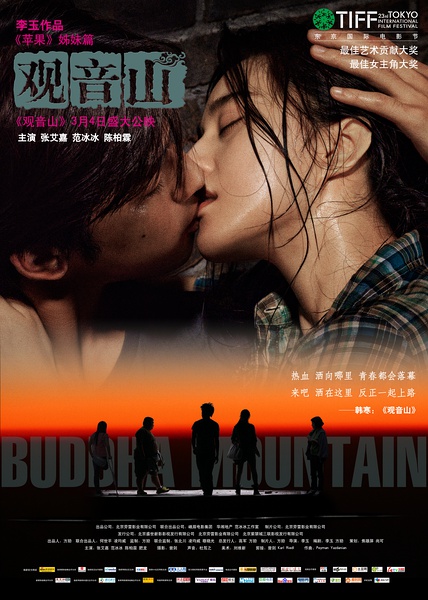
Buddha Mountain is a 2010 drama film directed by Li Yu and starring Sylvia Chang, Fan Bingbing and Chen Bolin. It was produced by Laurel Films, a small independent production company owned by Fang Li and based in Beijing. Laurel Films also produced Li Yu's previous film Lost in Beijing.
This film chronicles the lives of three youths who have no intention of sitting exams and getting into universities and a retired Chinese opera singer who is mourning the death of her son. The film explores themes of teenage confusion, angst, and rebellion and the impermanence of life.
Plot[edit]
When singing onstage at a pub, Nan Feng (Fan Bingbing) hits a man in the crotch as she swings a speaker around, creating tension between her and the pub owner. Following this Nan Feng, her friends Ding Bo (Chen Bolin), and Fatso eat and drink by the roadside.
The next day, Fatso is bullied by a group of teenagers, and Nan Feng confronts them, smashing a bottle over her head and forcing another girl to kiss her.
Eventually, Nan Feng, Ding Bo, and Fatso decide to live with a woman named Teacher Chang, who has recently lost her son. The man who was injured by Nan Feng demands compensation. To pay for this, they take money from Miss Chang and replace it with paper money that is meant to be burnt for their ancestors.
Nan Feng, Ding Bo, and Fatso repair the car in which Teacher Chang's son died whilst on the way to a birthday meal with his girlfriend. On a trip in this car, they stop at a destroyed building. A flashback sequence reveals that this building was destroyed by the 2008 Sichuan earthquake. They take a picture with the help of a monk, standing in the ruins of the Buddha temple.
Nan Feng sees Ding Bo kissing another girl at a night-club and grows jealous. She returns to Teacher Chang for comfort. By day, Nan Feng, Ding Bo, Fatso and Teacher Chang go to the destroyed Buddha temple where they help with repairs and hang a bell. During the evening, they share a conversation where the monk reveals that his master's body is the real temple. Teacher Chang says she has done all she has to do and has no regrets, after happily knowing Nan Feng and the others have mended their personal lives
The next morning, Nan Feng and his friends seek Teacher Chang, but find her standing on the opposite cliff top. Nan Feng looks down to see a train passing by and, when she raises her head, she finds Teacher Chang has disappeared. The trio believe Teacher Chang has jumped off the cliff to reunite with her husband and son.
Fatso, Nan Feng and Ding Bo (who are now dating) take a train and ride home, where they realise their youth is slowly coming to an end and must slowly accept adulthood. Nan Feng is reminded of Teacher Chang’s words: “Loneliness is not forever, but being together is”, as the film ends.
Awards[edit]
| Year | Group | Award | Result |
|---|---|---|---|
| 2010 | 23rd Tokyo International Film Festival[1] | Best Actress – Fan Bingbing | Won |
| Best Artistic Contribution – Li Yu | Won | ||
| 2011 | Casa Asia Film Week[2] | Best Film | Won |
| 18th Beijing College Student Film Festival[3] | Best Actress – Fan Bingbing | Won |
Alternate versions[edit]
This film's release in China consisted of a version different from the version seen at Tokyo International Film Festival. The deleted content include the forced demolitions and the beginning scenes (Sylvia Chang's role originally, was at the beginning of the film. She had an appearance during a scene in the Beijing Opera Troupe but her position in the troupe is replaced by another actor, so she was frustrated when the three youngsters first meet her. This clip is deleted so the role of teacher chang could be more complete). Director Li Yu stated that the deletion was not the request of the State Administration of Radio, Film, and Television, instead, it was simply to make the whole movie rhythm better and overall narrative smoother.[4]
Reception[edit]
The film received generally positive reviews from critics. The film was a financial success, with a domestic gross of more than 70 million RMB.[5][6] The Hollywood Reporter criticized this film could easily have been a rote, melodramatic weeper but is saved from that fate by some astute writing, strong performances and an almost utter dearth of expected devices and although there are jumps in the growth of the characters, it's hard to find serious fault when the film has such an intense veracity otherwise.[7] The Variety wrote younger thesps also impress, particularly Fan, who makes Nan Feng both childlike and fearsome. Chen's Ding Bo is less detailed, but scenes with the character's father (producer/co-writer Fang Li) give the thesp opportunity to explore greater emotional depths.[8]
References[edit]
- ^ "23rd Tokyo International Film Festival List of Winners". 31 October 2010. Retrieved 7 October 2012.
- ^ "Buddha Mountain, Best Film at Casa Asia Film Week". 12 June 2011. Retrieved 7 October 2012.
- ^ "第18届大学生电影节完全获奖名单". 28 April 2011. Retrieved 7 October 2012.
- ^ "《观音山》首映 李玉:删了5分钟与审查无关". ifensi.com. 25 February 2011. Archived from the original on January 25, 2013. Retrieved 12 October 2012.
- ^ "《观音山》票房破七千万". qingdaonews.com. 15 April 2011. Retrieved 7 October 2012.
- ^ "观音山》以七千万票房收官". nddaily.com. 15 April 2011. Archived from the original on 19 April 2011. Retrieved 7 October 2012.
- ^ Elizabeth Kerr (25 October 2010). "Buddha Mountain--Film Review". hollywoodreporter.com. Retrieved 7 October 2012.
- ^ Russell Edwards (31 March 2011). "Buddha Mountain". variety.com. Retrieved 7 October 2012.
External links[edit]
Review: Buddha Mountain (2010)
Buddha Mountain
观音山
China,2010, colour, 2.35:1, 104 mins.
Director: Li Yu 李玉.
Rating: 8/10.
Loosely-built drama of three youngsters and a retired opera singer is deceptively impressive.
 STORY
STORY
Chengdu, Sichuan province, China, 2009. Three young, inseparable friends while away the sweaty summer together in the provincial capital: Ding Bo (Chen Bolin), an unregistered motorbike courier who’s estranged from his train driver father (Fang Li); Fei Zao (Fei Long), his fat friend from school days with whom he shares lodgings; and Nanfeng (Fan Bingbing), an outwardly tough young woman from a small town outside Chengdu who sings in a bar. Needing to find new accommodation, the three answer an advertisement by retired Beijing Opera performer Chang Yueqin (Zhang Aijia) – a lonely widow who is still grieving from her son’s death in a car accident a year ago – and move into two rooms in her top-floor flat. Ding Bo attends his widowed father’s wedding to a younger woman, Wang Juan (Liu Jie), but gets drunk and creates a scene. Nanfeng hears she is being sued for RMB20,000 by a customer (Yuan Ze) she accidentally injured at the bar one night, and Ding Bo uses money he finds hidden by Chang Yueqin in her bedroom to pay the amount. Chang Yueqin is visited one evening by her dead son’s crippled girlfriend, Lin Yue (Jin Jing), whom she still blames for the accident; Lin Yue wants to patch things up, but Chang Yueqin bawls her out. When Chang Yueqin attempts suicide by cutting her wrists, the trio rush her to hospital in the nick of time. They start to replace the money stolen from Chang Yueqin’s secret stash, and take her on an outing one day to Guanyin Shan (Buddha Mountain), where they help to repair a small Buddhist temple. Gradually, relations between Chang Yueqin and the youngsters start to improve, and Chang Yueqin attains a new peace of mind. But then Nanfeng falls out with Ding Bo when she sees him making out with a girl at a party.
REVIEW
A loosely woven web of emotions that builds to a suprisingly moving finale, this fourth feature by director Li Yu 李玉 could easily be retitled Lost in Chengdu, a looser, southern cousin to her last movie, the only slightly less impressive Lost in Beijing 苹果 (2007). Shot through with an identical sense of spiritual drift, and an underlying need by its characters to form family-like groups to replace real blood ties, Buddha Mountain again shows Li’s documentary background in its realistic portrayal of contemporary China without falling into the arty-ennui trap of many of her indie colleagues. Though the film has been marketed in China as a vehicle for 29-year-old Mainland actress Fan Bingbing 范冰冰 (who also starred in Lost in Beijing just prior to her diva transformation) and Taiwan moody-boy Chen Bolin 陈柏霖, it’s actually grounded by superb playing from top-billed Taiwan veteran Zhang Aijia 张艾嘉 [Sylvia Chang], in one of the best performances of her 40-year career.
As a retired Beijing Opera singer still grieving over the death of her son, Zhang provides the film’s emotional centre, around which the three youngsters – played by Fan, Chen and Fei Long 肥龙 – flutter like moths. Embittered, lonely and grumpy, Zhang’s character is first exploited by the rootless trio but later helped and finally envied as she attains a spiritual release they so desperately need in their own lives. A beautifully understated scene in which Fan’s outwardly tough bar-singer seeks solace with the older woman in bed one night is among the most affecting in the film, and typical of the way in which it communicates much through little dialogue.
The movie can be faulted for its patchwork construction and lack of backgrounding: Zhang’s character, which could easily have filled an entire film, sometimes seems sidelined in favour of the less interesting youngsters, and the sexually vague relationship between Chen and Fan’s characters is weakly explained in a late-on scene. The script by Li and indie producer Fang Li 方励 (Lost in Beijing; Summer Palace 颐和园, 2006; plus Li’s second feature, Dam Street 红颜, 2005) requires the viewer to fill in narrative gaps, takes valuable time out for montages (such as the youngsters joy-riding on a train to the mountains), throws in actual footage of the 2008 Sichuan earthquake for no justifiable reason, and blithely ignores details like Chen’s character having a strong Taiwan accent when he’s apparently been raised in Sichuan. (Zhang adopts more of a Mainland accent for her character.)
Gradually, however, the fluid, impressionistic feel becomes the film’s strongest card, as things move towards an ending that’s purely metaphysical – and feels absolutely right in the circumstances. Li has come a long way as a director since her awkward debut, lesbian drama Fish and Elephant 今年夏天 (2001), and her burnished, Euro-style Dam Street. With Lost in Beijing and Buddha Mountain she’s carved a personal style that seems random but is technically very assured – just for starters, witness the scene of a close escape by two characters on a railway line. Occasional use of warm music by Iranian composer Peyman Yazdanian (Summer Palace) binds the movie together at key points, and handheld photography by Zeng Jian 曾剑 (Lost in Beijing, Summer Palace) makes discreet play with light within a naturalistic palette.
Chen is okay, and less mumbly than in many of his movies, and Fei Long very likable as the fatty of the group. But it’s Fan who again shows she can be more than just an exotic clotheshorse when she wants to be – especially in a memorable early scene in which she avenges an insult to one of the group. Without overdoing the spunk, she’s entirely believable as an ambitious smalltown girl who’s moved to the big city to support her dysfunctional family back home. Other roles are fleeting, though Jin Jing 金晶 is touching as the (genuinely crippled) girlfriend of the dead son and producer Fang is fine as the traindriver father.
The film’s Chinese title means “Guanyin Mountain” rather than “Buddha Mountain”, with Guanyin being a Buddhist goddess who assumes the sorrows of the world – a crucial element in the characters’ filmic journey.
CREDITS
Presented by Laurel Films (CN).
Script: Li Yu, Fang Li. Original story: Fang Li, Li Yu. Photography: Zeng Jian. Editing: Zeng Jian, Karl Riedl. Music: Peyman Yazdanian. Art direction: Liu Weixin, Li Jun. Sound: Du Zegang, Du Duzhi.
Cast: Zhang Aijia [Sylvia Chang] (Chang Yueqin, the retired opera singer), Fan Bingbing (Nanfeng), Chen Bolin (Ding Bo), Fei Long (Fei Zao/Fatso), Jin Jing (Lin Yue, girlfriend of Chang’s dead son), Fang Li (Ding Bo’s father), Liu Jie (Wang Juan, his second wife), Bao Zhenjiang (Buddhist temple monk), Zhou Jing (Zhou Jing, the Peking Opera performer), Shen Wen (Wang, the Peking Opera director), Li Di (bar owner), Yuan Ze (Zhao Bo, the injured bar customer), Chen Yu (bar singer), Shi Minfang (Nanfeng’s mother), Wang Guoyu (Nanfeng’s father), Ding Juan (home party host), Huang Gongwang (grandfather), Duan Bowen (gang leader), Lisi Danni (gang girl), Xie Tian (community policeman), Li Huijuan (Chang’s neighbour), Xiang Xue (club girl), Huang Ting (property developer), Wu Xiaorong (Lin’s mother), Zhu Pingkang (Lin’s father), Hong Wenxuan (funeral-money seller), Wang Ting, Hu Panke, Guan Yue (Nanfeng’s former classmates), Yin Yiwei (abused car owner), Liu Wenguang (wedding MC), Zeng Jian (motorcycle customer).
Premiere: Tokyo Film Festival (Competition), 24 Oct 2010.
Release: China, 4 Mar 2011.
(Review originally published on Film Business Asia, 23 Apr 2011.)
==========================
관음산(영화)
중국어 백과사전 Wikipedia
관음산
길이 100분(중국 본토)
105분(국제판)
원산지 중국 본토
출시일 중국2011년 3월 4일
발행자 북경 Shengshixinying 영화 텔레비전 배급 유한 회사
Beijing Laurel Films Co., Ltd.
북경 자금성 Sanlian 영화 텔레비전 배급 유한 회사
박스 오피스 7200만 위안
" Guanyin Mountain "(영어: Buddha Mountain )은 2011년에 개봉한 중국 드라마 영화로 Li Yu 가 감독 하고 Zhang Aijia , Chen Bolin , Fan Bingbing 이 공동 주연을 맡았습니다 . 표현의 주제는 젊음의 성장, 삶의 목적지, 사랑의 조건을 탐구하는 것입니다 [1] .
이 영화에는 두 가지 버전이 있는데, 하나는 국제 버전(즉, 도쿄 영화제에서 상영된 버전)이고 다른 하나는 약간의 변경을 거쳐 중국 본토에서 개봉된 버전입니다.
시놉시스
이야기의 배경은 쓰촨 성 청두 에 있습니다 . Nanfeng, Ding Bo, Zao Zao는 세 명의 좋은 친구로 비슷한 경험을 가지고 있거나 시험에 실패하거나 대학 입시를 거부하여 대학에 가지 않아 부모와 긴장된 관계로 이어졌습니다 . 고향을 떠나 부모의 속박에서 벗어나 독립된 삶을 살기를 간절히 바랐다.
세 사람은 집을 빌렸기 때문에 은퇴한 북경 오페라 배우인 집주인 Chang Yueqin을 알게 되었습니다 . 세 사람은 집주인과 많은 갈등을 겪었지만 사랑하는 사람을 잃고 고통 속에 살아온 장웨친의 은밀한 과거를 차츰 알게 됐다. 마찰과 소통의 과정에서 두 당사자의 관계도 점차 변화했습니다. 갈등을 격퇴하는 것에서 이해와 배려로, 두 세대는 서로를 받아들이고 그에 따라 그들의 운명도 바뀌었습니다.

No comments:
Post a Comment