"스위스의 중립주의는 빛 좋은 개살구" NYT
등록 2023.03.13
스위스 정체성 근간이라지만 지켜진 적 없어
군수산업 소멸하면 강군 통한 중립 유지 불가능
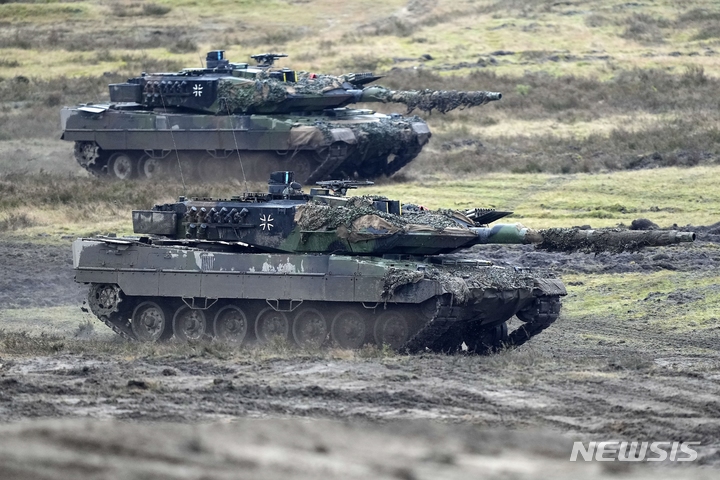
[아우구스도르프(독일)=AP/뉴시스] 독일 레오파르트 2 탱크 2023.2.24
[서울=뉴시스] 강영진 기자 = 서방이 사용하는 무기를 생산하는 스위스에서 자국 생산 무기의 우크라이나 지원을 금지하는 법률을 개정할 지를 두고 큰 논란이 벌어지고 있다고 미 뉴욕타임스(NYT)가 12일(현지 시간) 보도했다.
다음은 기사 요약.
===
===
우크라이나 전쟁은 동유럽 국가들에겐 코 앞의 전쟁이며 서부 유럽 국가들도 전쟁을 실감하고 있다. 유럽 한 복판에 자리한 스위스에선 고귀한 이상을 고수하려는 조바심이 일고 있다. 스위스가 자랑해온 중립 전통을 둘러싸고 의회에서 치열한 논쟁이 벌어지는 것이다. 유럽에서 전쟁이 벌어지는 새로운 시대에 중립이 무슨 의미가 있느냐는 주장이 대두한 때문이다.
스위스는 유럽국들이 우크라이나에 지원하는 무기의 탄약을 대량 생산하고 있다. 우크라이나에 지원될 예정인 독일제 레오파르트 2 탱크까지도 생산한다.
스위스는 자국 생산 무기를 우크라이나 등 분쟁 당사국에 지원할 수 없도록 금지하는 엄격한 법을 가지고 있다. 이 법이 스위스 군수산업의 경쟁력을 약화시키는 대목이 논쟁을 일으켰다. 무기 회사들이 금지법 때문에 유럽 각국 무기 수출이 어려워질 수 있다고 호소하자 중립 전통을 고수해야 한다는 의견이 함께 불거진 것이다.
스위스의 중립 전통은 수백 년 동안 지켜져 온 것이다. 870만 국민의 90% 이상이 지지하는 정책으로 스위스 정체성의 근간이다. 수도 제네바에 유엔과 국제적십자사 본부가 있는 스위스의 국민들은 스스로를 평화 중재자로 자부한다.
그러나 러시아 제재에 미온적인 스위스에 대해 주변 국가들은 스위스의 이상주의가 장삿속과 다르지 않다고 본다.
비밀 고수로 각종 불법 자금을 유치해온 은행으로 악명이 높은 스위스에는 지금도 해외 유출 자산이 가장 많이 몰려 있다. 전 세계 유출 자산의 4분의 1에 달하며 블라디미르 푸틴 러시아 대통령 측근 부호들의 자산이 포함돼 있다.
역사적으로 스위스가 중립 정책을 취해온 것은 전쟁에 휘말리기 않기 위해서였다. 중세 시대부터 근대 초까지 가난했던 스위스는 유럽 각지의 전쟁에 용병을 보냈다. 바티칸 스위스 경비병이 대표적이다. 스위스 중립 역사 전문가 사차 잘라 베른대 교수는 “중립을 지켜야 한다는 생각은 당초 양쪽 모두에 참여한다는 의미였다”고 했다.
스위스에서 중립성 개념이 생겨난 것은 나폴레옹이 각종 전쟁을 일으킨 뒤다. 유럽 강국들이 강국들 사이에 중립 지대를 설치해야 한다는 생각을 갖게 된 것이다. 이후 1907년 헤이그 협약에서 명문화되면서 현재의 스위스 중립주의가 만들어졌다. 협약은 중립 국가들이 전쟁 당사국들을 똑같이 멀리함으로써 전쟁에 개입하지 않도록 규정했다. 무기를 판매하는 경우에도 전쟁 당사자 양측에 모두 팔아야만 하도록 했고 중립국은 자국 영토가 전쟁에 이용되지 않도록 보장해야 했다. 이 때문에 스위스에선 강력한 군사력을 갖춰야 중립을 유지할 수 있다는 개념이 만들어졌다. 지금 논란이 벌어지는 핵심이다.
군수 산업 지지자들은 이 부문 근로자수가 1만4000명에 불과하고 스위스 국내총생산(GDP)의 1%도 생산하지 못하지만 군사력 유지를 위해 중요하다고 주장한다. 군수 산업이 수출 없이는 생존할 수 없다는 주장이다.
예컨대 스위스 탄약회사 외를리콘-뷔를레는 독일제 자주대공포 게파르트가 사용하는 탄약을 생산하는 유일한 회사다. 독일이 게파르트를 우크라이나에 지원하자 스위스는 탄약 수출을 중단했다.
그러자 유럽 각국의 군수 업체들이 스위스에서 핵심 부품을 생산하는 것을 꺼리기 시작했다. 외를리콘-뷔를레의 모회사인 독일 기업 라인메탈이 국내에 탄약 공장 설립하겠다는 의향을 밝혔다. 스위스 군수 산업이 2-3년 뒤 수출 물량을 생산할 수 없게 되는 것이다.
올해 초 스위스의 친 기업 정당인 자유민주당이 수출금지법을 우회하는 방안을 제시했고 의원들 대부분이 받아들였다. 스위스의 민주주의 가치를 공유하는 나라들에게 스위스제 무기를 재수출하는 것을 허용하는 방안이다.
그러나 지난주 최대 정당인 스위스인민당이 노골적인 우크라이나 지원법이라며 중립 주의에 위배된다고 반발했다.
이후 의회에서는 6가지의 다른 방안이 논의됐지만 어느 하나도 올해 안에 스위스 생산 탄약이 우크라이나에 전달되지 못하도록 하는 내용이었다.
서방국들은 스위스의 무기 전용 허용이 상징적일 뿐이라고 말한다. 그러나 스위스가 수십 년 동안 북대서양조약기구(NATO)의 혜택을 입어 왔으면서 돕지 않는다고 비판한다.
스위스 곳곳에 우크라이나 국기가 펄럭인다. 지원에 반대하는 의원들조차 러시아를 침략국이라고 비난하길 주저하지 않는다. 그러면서도 중립성을 완화하는데 반대하고 있는 것이다. 심지어 일부 보수적 의원들은 헌법에 엄격한 중립성을 명기하기 위한 국민투표를 제안하는 서명 운동을 벌이고 있다.
미국과 유럽에선 스위스가 러시아에 대한 제재를 적극적으로 이행하지 않는다는 의심을 하고 있다. 스위스는 80억 달러 상당의 러시아 자산을 압류했다. 스위스 당국에 따르면 스위스에 있는 러시아 자산이 493억 달러지만 다른 나라들은 2000억 달러에 달할 것으로 본다.
스위스의 중립성은 철저하게 지켜진 적이 없다. 2차 대전 당시 스위스는 나치 독일의 편의를 봐줬고 냉전 시대에는 소련과 교역을 중단했었다.
역사학자 잘라는 역사적으로 스위스의 중립성이 명확한 개념인 때가 없었다고 말한다. 그는 “중립적이라고 말하는 건 독실한 기독교 신자라고 말하는 것과 똑같다. 독실한 신자라는 게 무슨 의미가 있고 중립성이 무슨 의미가 있느냐?”고 반문했다.
==
러시아 제재에 미온적인 스위스에 대해 주변 국가들은 스위스의 이상주의가 장삿속과 다르지 않다고 본다.
비밀 고수로 각종 불법 자금을 유치해온 은행으로 악명이 높은 스위스에는 지금도 해외 유출 자산이 가장 많이 몰려 있다. 전 세계 유출 자산의 4분의 1에 달하며 블라디미르 푸틴 러시아 대통령 측근 부호들의 자산이 포함돼 있다.
서방국들은 스위스의 무기 전용 허용이 상징적일 뿐이라고 말한다. 그러나 스위스가 수십 년 동안 북대서양조약기구(NATO)의 혜택을 입어 왔으면서 돕지 않는다고 비판한다.
역사적으로 스위스가 중립 정책을 취해온 것은 전쟁에 휘말리기 않기 위해서였다. 중세 시대부터 근대 초까지 가난했던 스위스는 유럽 각지의 전쟁에 용병을 보냈다. 바티칸 스위스 경비병이 대표적이다. 스위스 중립 역사 전문가 사차 잘라 베른대 교수는 “중립을 지켜야 한다는 생각은 당초 양쪽 모두에 참여한다는 의미였다”고 했다.
스위스에서 중립성 개념이 생겨난 것은 나폴레옹이 각종 전쟁을 일으킨 뒤다. 유럽 강국들이 강국들 사이에 중립 지대를 설치해야 한다는 생각을 갖게 된 것이다. 이후 1907년 헤이그 협약에서 명문화되면서 현재의 스위스 중립주의가 만들어졌다. 협약은 중립 국가들이 전쟁 당사국들을 똑같이 멀리함으로써 전쟁에 개입하지 않도록 규정했다. 무기를 판매하는 경우에도 전쟁 당사자 양측에 모두 팔아야만 하도록 했고 중립국은 자국 영토가 전쟁에 이용되지 않도록 보장해야 했다. 이 때문에 스위스에선 강력한 군사력을 갖춰야 중립을 유지할 수 있다는 개념이 만들어졌다. 지금 논란이 벌어지는 핵심이다.
===
Swiss neutrality New York Times
===
War in Ukraine Puts Centuries of Swiss Neutrality to the Test
The Alpine state makes arms that Western allies want to send to Kyiv. Swiss law bans this, driving a national debate about whether its concept of neutrality should change.
 A Leopard 2 tank during a Swiss military exercise in November. Some of the tanks are made in Switzerland, as is ammunition for some other Western weapons.Credit...Arnd Wiegmann/Reuters

By Erika Solomon
Erika Solomon, based in Berlin, traveled to the Swiss capital, Bern, to report and write this story.
March 12, 2023
===
In Eastern Europe, Ukrainians are in the trenches. Farther west, European capitals are grappling with a new order in which war is no longer theoretical. Yet, tucked away in the heart of the continent, the Swiss are fretting over loftier ideals.
In Switzerland’s capital, nestled beneath snow-capped mountains, inside parliamentary chambers of stained glass and polished wood, the debate is over the country’s vaunted legacy of neutrality — and what neutrality even means in a new era of war for Europe.
Switzerland, it turns out, has an arms industry that makes badly needed ammunition for some of the weapons that Europeans have supplied to Ukraine, as well as some of the Leopard 2 main battle tanks they have promised.
But it also has strict rules on where those weapons can go — namely a law, now the subject of heated debate, that bans any nation that purchases Swiss arms from sending them to the party of a conflict, like Ukraine.
The war is testing Swiss tolerance for standing on the sidelines and serving the world’s elite on equal terms, putting the country in a bind of competing interests.
Its arms makers say their inability to export now could make it impossible to maintain critical Western customers. European neighbors are pulling the Swiss in one direction, while a tradition of neutrality pulls in another.
“Being a neutral state that exports weapons is what got Switzerland into this situation,” said Oliver Diggelmann, an international law professor at the University of Zurich. “It wants to export weapons to do business. It wants to assert control over those weapons. And it also wants to be the good guy. This is where our country is stumbling now.”
Image
 Firearms on display at a collector’s fair in Lucerne, Switzerland, in 2019. The Swiss arms industry depends on exports, analysts say. Credit...Alexandra Wey/EPA, via Shutterstock
Switzerland has managed to cling to neutrality for centuries and through two world wars. It is a position supported by 90 percent of its 8.7 million people, who uphold it as a national ideal. Hosts to the United Nations and the Red Cross in Geneva, they see themselves as the world’s peacemakers and humanitarians.
War in Ukraine Puts Centuries of Swiss Neutrality to the Test
The Alpine state makes arms that Western allies want to send to Kyiv. Swiss law bans this, driving a national debate about whether its concept of neutrality should change.
A Leopard 2 tank during a Swiss military exercise in November. Some of the tanks are made in Switzerland, as is ammunition for some other Western weapons.Credit...Arnd Wiegmann/ReutersBy Erika Solomon
Erika Solomon, based in Berlin, traveled to the Swiss capital, Bern, to report and write this story.
March 12, 2023
===
In Eastern Europe, Ukrainians are in the trenches. Farther west, European capitals are grappling with a new order in which war is no longer theoretical. Yet, tucked away in the heart of the continent, the Swiss are fretting over loftier ideals.
In Switzerland’s capital, nestled beneath snow-capped mountains, inside parliamentary chambers of stained glass and polished wood, the debate is over the country’s vaunted legacy of neutrality — and what neutrality even means in a new era of war for Europe.
Switzerland, it turns out, has an arms industry that makes badly needed ammunition for some of the weapons that Europeans have supplied to Ukraine, as well as some of the Leopard 2 main battle tanks they have promised.
But it also has strict rules on where those weapons can go — namely a law, now the subject of heated debate, that bans any nation that purchases Swiss arms from sending them to the party of a conflict, like Ukraine.
The war is testing Swiss tolerance for standing on the sidelines and serving the world’s elite on equal terms, putting the country in a bind of competing interests.
Its arms makers say their inability to export now could make it impossible to maintain critical Western customers. European neighbors are pulling the Swiss in one direction, while a tradition of neutrality pulls in another.
“Being a neutral state that exports weapons is what got Switzerland into this situation,” said Oliver Diggelmann, an international law professor at the University of Zurich. “It wants to export weapons to do business. It wants to assert control over those weapons. And it also wants to be the good guy. This is where our country is stumbling now.”
Image
Firearms on display at a collector’s fair in Lucerne, Switzerland, in 2019. The Swiss arms industry depends on exports, analysts say. Credit...Alexandra Wey/EPA, via ShutterstockSwitzerland has managed to cling to neutrality for centuries and through two world wars. It is a position supported by 90 percent of its 8.7 million people, who uphold it as a national ideal. Hosts to the United Nations and the Red Cross in Geneva, they see themselves as the world’s peacemakers and humanitarians.
But Western nations today see Swiss hesitation — both over exports and over sanctions against Russia, which Western diplomats suspect Switzerland is not doing enough to enforce — as evidence that the country’s motivation is less idealism than business.
The State of the WarTesting Swiss Neutrality: The Alpine nation makes arms that Western allies want to send to Ukraine. Swiss law bans this, driving a national debate about whether its concept of neutrality should change.
Kupiansk: Months after Russian soldiers were driven out of the town in Ukraine's Kharkiv region, Ukrainian authorities are stepping up efforts to evacuate civilians amid relentless Russian shelling.
Bakhmut: Ukraine insisted that its forces were fending off relentless Russian attacks in Bakhmut, even as Western analysts said that Moscow’s forces had captured most of the embattled city’s east and established a new front line cutting through its center.
Switzerland, whose banks are notorious for secrecy and have often been accused of laundering money for the world’s kleptocratic class, is still the world’s biggest center for offshore wealth. That includes about a quarter of the global total, no doubt serving many Russian oligarchs allied with President Vladimir V. Putin.
A senior Western official, who did not want to be identified because he was negotiating with the Swiss, said the status quo left Western diplomats feeling Switzerland was pursuing “a neutrality of economic benefit.”
Months of hand-wringing have not endeared the Alpine nation to neighbors.
“Everybody knows this is hurting Switzerland. The entire E.U. is annoyed. The Americans are upset. The resentment comes from the Russians too. We all know this is hurting us,” said Sacha Zala, a historian of Swiss neutrality at the University of Bern. “But it shows just how deep this belief in neutrality goes in our heads.”
To historians, Switzerland’s neutrality has had far more to do with waging war than avoiding it.
Image
 The Swiss Guard at the Vatican in October. The force is a relic of an era when Swiss mercenaries were leased out across Europe.Credit...Ludovic Marin/Agence France-Presse — Getty Images
From the Middle Ages to the early modern era, the then-impoverished Alpine cantons that make up today’s Switzerland leased out mercenaries in wars across Europe. Many made weapons to go with those armies; the Swiss Guard of the Vatican is a relic of that era.
“The earlier idea of neutrality was the neutrality to serve both sides,” said Mr. Zala.
Swiss neutrality began to be formalized after the Napoleonic wars, when European powers agreed it could create a buffer between regional powers.
ADVERTISEMENTContinue reading the main story
It was further codified in The Hague Convention of 1907 — the basis for today’s Swiss neutrality. The convention required neutral states to refrain from waging war, and to maintain an equidistance between warring parties — they could sell weapons, for example, but only if they did so for all sides of a conflict. It also obliges neutral countries to ensure their territories are not used by warring forces.
This led to what the Swiss call “armed neutrality” — a commitment not just to neutrality, but to maintaining the ability to protect it. The latter is what critics now argue is under threat.
Supporters of the Swiss weapons industry agree it has no major economic impact for the country. Employing 14,000 people, it makes up less than 1 percent of G.D.P. But they say it is critical to armed neutrality.
“Armed neutrality needs soldiers, weapons, equipment — and an arms industry. Our neutrality has to be armed, otherwise it’s useless,” said Werner Salzmann, a member of the conservative Swiss People’s Party.
The Swiss defense industry depends on exports, he said, and could not survive without them.
One crucial role Switzerland plays is for Germany, one of Ukraine’s biggest military backers. The Swiss company Oerlikon-Bührle is effectively the only producer of ammunition for the Gepard, a self-propelled antiaircraft gun of which Berlin has sent dozens to Ukraine. The Swiss have so far blocked German efforts to buy fresh ammunition.
Image
 Chancellor Olaf Scholz of Germany atop a Gepard military vehicle at a training area in Oldenburg, Germany, last year. Switzerland has blocked German efforts to buy new ammunition. Credit...Pool photo by Morris Macmatzen
Europeans and major defense industry players are growing wary of making weaponry or critical parts in Switzerland. Rheinmetall, the German arms maker that owns the Swiss company, plans to open a factory to make those rounds in Germany.
“For the next two to three years, we will still be producing because of old contracts we have to fulfill,” said Matthias Zoller, a spokesman for the arms industry at Swissmem, a trade group. “But we have no orders coming in. The export market will just be dead.”
Early this year, Switzerland’s pro-business Free Democrats devised a legal loophole that most lawmakers seemed to accept: They would allow countries that shared Switzerland’s democratic values to re-export Swiss-made armaments.
But last week, the Swiss People’s Party, the largest in Parliament, rejected the bill, seeing it as too nakedly a measure meant for Ukraine — and therefore, a violation of neutrality.
Swiss lawmakers have since scrabbled together six counterproposals. But none of them make it possible for Swiss weapons to reach Ukraine within a year.
Western countries acknowledge that Swiss contributions would be largely symbolic. But they argue that although Switzerland has for decades benefited from being effectively protected by NATO, surrounded by member states, it has shown no willingness to help those states now.
Thierry Burkart, the Free Democrat who drafted the initial bill, said Switzerland could no longer afford to ignore this frustration. “We are embedded in Western partnerships — not in the sense of a binding NATO alliance, but because the West is where our values are also shared,” he said. “That doesn’t mean that we are not neutral, but we should not be blocking aid among Western countries.”
In Swiss cities, many buildings hang Ukraine’s blue and yellow flag. Sympathy is evident. Even most lawmakers against looser export rules openly call Russia the aggressor state. Yet that has not eased their stance on neutrality.
Instead, some conservative politicians are gathering signatures to bring about a referendum on making an even stricter interpretation of neutrality part of Switzerland’s Constitution.
Image
 Demonstrators gathered in Bern, Switzerland, to support Ukraine after Russia invaded last February.Credit...Arnd Wiegmann/Reuters
“There are only two options — that’s it,” said Walter Wobmann, a conservative lawmaker promoting the initiative. “Can you be half pregnant? You can only be pregnant, or not. Either we’re neutral, and we go with that all the way. Or we go into an alliance,” such as NATO. “Which is it? Switzerland has to decide.”
Then there are the sanctions against Russia, which Washington and Europe worry Switzerland is failing to vigorously enforce.
The Swiss have frozen only 7.5 billion Swiss francs, around $8 billion, of Russian assets. That is a small proportion of what the Swiss economics ministry says is roughly $49.3 billion of Russian assets in the country. European officials suspect the total may be higher, up to $200 billion.
Even so, when Switzerland imposed its sanctions, Russia’s foreign minister, Sergey V. Lavrov, accused the nation of abandoning its neutrality.
Swiss neutrality, Mr. Burkart of the Free Democrats argued, only works if it is flexible and if the rest of the world believes in it. The Swiss made accommodations with the Nazis in World War II, and with the Americans by cutting back trade with the Soviet Union in the Cold War.
Switzerland’s history, argued the historian Mr. Zala, is the best argument for why neutrality has never been so clear a concept as many believe.
“Saying you’re neutral is like saying you’re a good Christian,” he said. “What does it actually mean? What’s a good Christian? And what is neutrality?”
===

No comments:
Post a Comment