CHAPTER XIV
SHIPS ATTACKED BY WHALES
After I left Alaska the Tyee Company put into service a wooden whale ship called the Sorenson, which in 1910 was sunk by a finback. The animal had been struck by one iron and, suddenly going into its death flurry, began charging madly in every direction.
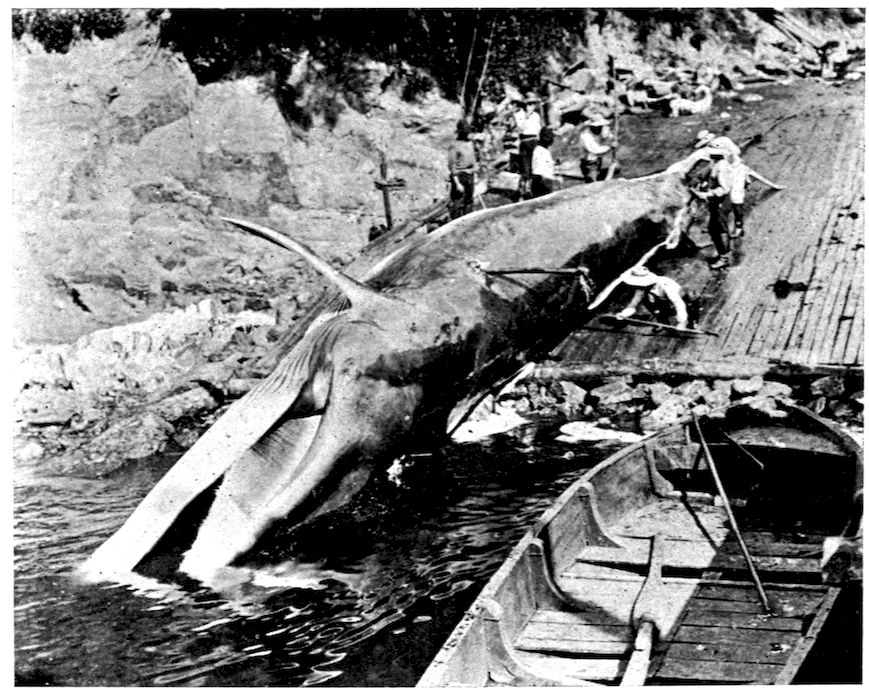 The long slender body of a finback lying on its side; the outer edges of the whalebone plates in the mouth are well shown.
176In one of its wild dashes the sixty-ton whale, coming at a speed of probably twenty-five knots per hour, drove straight into the ship, crushing her side like an eggshell and tearing her almost apart. The vessel filled so rapidly that the crew were hardly able to get a small boat over before she went down. Later the men were all rescued.
J. G. Millais, Esq., says of the finback:
Space will not allow me to give any of the numerous stories of the exciting hunts to which one listens in the galley and the cabin of the Atlantic Finwhalers, but they prove that the chase of this great Whale calls for the sternest courage and readiest resource.
To stand up in a tiny “pram” amidst a whirl of waters and lance a fighting Finback is no child’s play, and requires that six o’clock in the morning pluck that the Norsemen possess in a high degree. Many accidents have occurred to the boat crews when engaged in “lancing,” and one or two to the steamers themselves.
The whaler Gracia, belonging to Vadso, was sunk by a Finner in 1894 in the Varanger Fjord. In 1896 the Jarfjord was sunk in ten minutes by one of these Whales charging it, when about sixty miles north of the North Cape. A heavy sea was running at the time, and the crew crowded into two small prams, which would probably have been overwhelmed had not Captain Castberg, hunting in another steamer, come to their rescue.[7]
7. “The Mammals of Great Britain and Ireland.” By J. G. Millais. Longmans, Green, & Co., p. 271.
Without doubt practically all ships which have been injured or sunk by whales have been struck by accident. Just before a whale dies it goes into what is 177called the death flurry and dashes wildly about in every direction. If a ship or boat happens to be near it stands an excellent chance of being rammed, for the animal is utterly blind in its rushes.
The sperm is an exception to the rule of purely accidental attacks, however, for there are many well authenticated instances of whales of this species, while only slightly wounded and not in the death flurry, deliberately sinking boats and even three-hundred- or four-hundred-ton vessels.
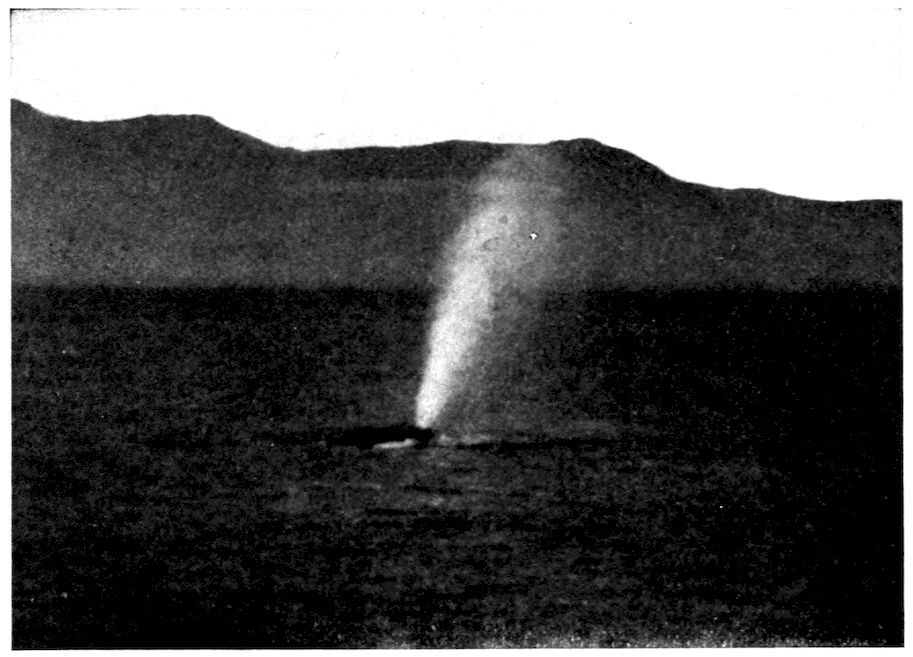
The spout of a finback whale. The column of vapor rises to a height of about twenty feet.
Almost every deep-sea whaleman has stories to tell of “rogue” sperms, which are usually old bulls that have sought a solitary life either from choice or ostracism from the main herd. Such animals are often vicious 178and sometimes turn furiously upon the boats when struck with an iron.
The “devilfish,” or California gray whale, had a bad reputation among the whalers of fifty years ago, for when attacked upon its breeding grounds it is said to have fought fiercely for the protection of its young. Under such circumstances its actions would undoubtedly be very different from what I have observed when gray whales were killed near Korea, where we had no more trouble than with other species.
At sea it is often impossible to distinguish the blue and finback whales by the way they blow. The columns of vapor are much alike under ordinary circumstances, except that the spout of the blue whale is usually somewhat higher than is the finback’s. However, much depends upon the size of the animal, since a large finback will often blow as strongly as a small blue whale. But if not far away the blue whale may be easily known by the light gray-blue color of its body, for it contrasts strongly with the dark slate upper parts of the finback which, when dripping with water, often look almost purplish. The Norwegian name blahval was given to the greatest of all living creatures because of the distinctly bluish color of its body. The Newfoundland and American whalemen call the animal “sulphur-bottom,” a most inappropriate name, for there is no suggestion of yellow on its body. The Japanese know it as shiro-nagasu (the white finback).
The diving movements of the two species are also similar except that in rare instances a blue whale will 179draw out its flukes when sounding, while a finback never does. Each one ascends obliquely, delivering the spout as soon as its head appears at the surface, and each slowly revolves, lifting its body high out of the water as it goes down. But the finback is more regular in its movements when traveling than is its larger relative. Then it will swim as straight as an arrow, not varying a quarter of a point from its course, and blow at regular intervals.
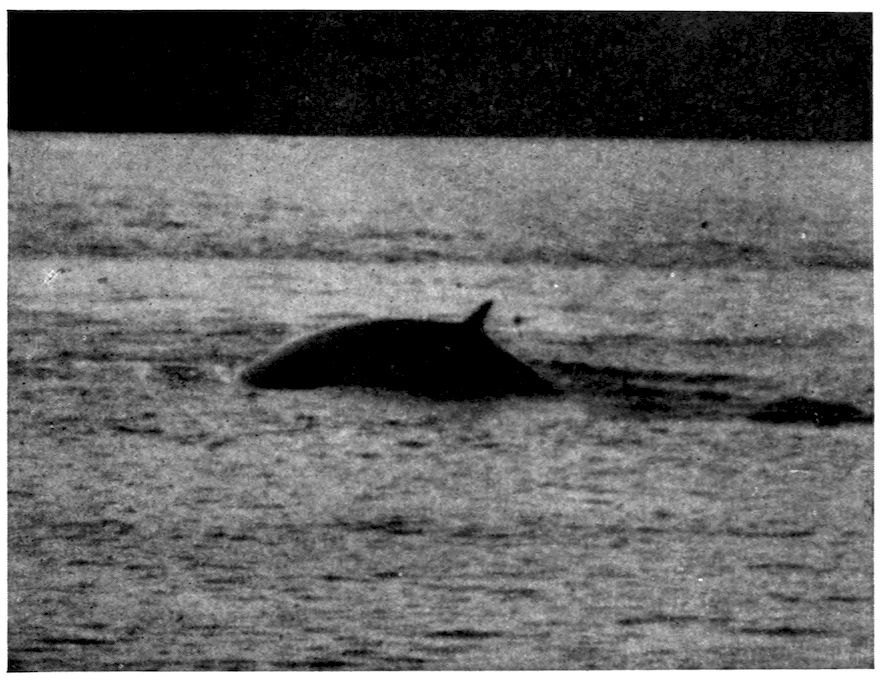
A finback whale “sounding” or taking the “big dive.”
The blue whale, even when not frightened, spouts very irregularly. Under ordinary circumstances it will blow from eight to fifteen times at a rising and always with a tremendous noise. The sound is a metallic, 180whistling roar which can be heard at a distance of three or four miles if there is a fog or the sea is calm. I always have a feeling of admiration when watching either a blue or finback whale, for the magnificent brutes move in a slow and dignified way as though conscious that they are the largest and most imposing animals of ancient or modern times.
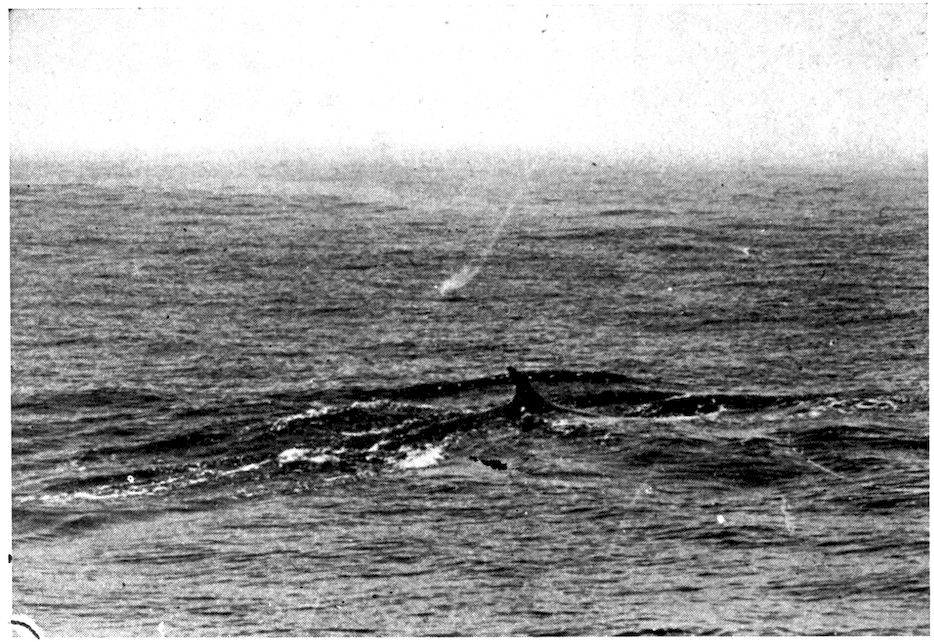
When sounding the finback sinks lower and lower until the dorsal fin disappears; this is the last part of the body to leave the surface. This species never draws out the flukes as do the humpback, sperm and right whales.
As a supplement to my own experiences while hunting finbacks in Alaska, I have taken the liberty of quoting a portion of J. G. Millais’ description of killing a whale of this species off the Shetland coast, for it shows most admirably what real excitement one can have even in modern whaling:
181At 7:30 it was bitterly cold, when Captain Stokken again stood beside the gun, and we were in full pursuit of a large female Finback that seemed tamer than the rest. Eventually, in its final “roll,” the Whale raised itself about ten yards from the gun, and the whaler tipping the muzzle downwards, fired and struck the quarry under the backbone.
At first the Finback was rather quiet, and then it began to run, the strong line rushing out at a speed of about fifteen knots. When some two miles of rope had gone over the bow I turned to Captain Stokken and said, “How much line have you got?”
“About three mile,” was the curt reply.
“But when that three mile goes, what then?”
“Oh, well,” was the imperturbable answer, “then I check line, and we see which is strongest, Whale or rope. Perhaps harpoon draws out.”
In the course of a minute the Captain gave the order to check the line. The strain now became terrific, the two-inch rope straining and groaning as if it would burst. At the same moment the little steamer leaped forward and raced over the seas at about twelve miles an hour. There was a feeling of intense exhilaration as we rushed northwards, the spray flying from our bows as the ship leaped from crest to crest in the heavy swell.
I have enjoyed the rushes of gallant thirty- and even forty-pound salmon in heavy water on the Tay—the supreme moments in an angler’s life—but that was mere child’s play to the intense excitement which we experienced during the next three hours. To be in tow of a wild Whale is something to remember to one’s dying day. You feel that you are alive and that you are there with the sport of kings. No wonder the Norwegians are full of life; the men, from the captain to the cook, run to their several tasks with eyes and hearts aflame. This is a calling which will stir the blood of the dullest clod, and to men who are one and all 182the finest seamen in the world is the very life and essence of the Viking nature.
Three hours of this fierce race went on, and the Whale seemed as if it would take us to Iceland. The gallant Finback was as fresh as ever when the captain gave the order, “Quarter speed astern.” With a tremendous strain on the rope and the churning of the backward driving screw our speed was at once reduced to ten knots. It was marvelous, the strength of that animal. The minutes and even the hours fled by, still the great Cetacean held on its northward course without a check.
Three hours passed; then came the order “Half speed astern,” and we were down to six knots, the vessel and the Whale still fighting the battle for the mastery.
In another hour the Whale showed visible signs of weakening when “Full speed astern” brought matters to a standstill. The machinery of man and the natural strength of the beast still worried on for another hour, and then we saw the steamer moving backwards, the Whale was done, and could pull no more.[8]
8. “The Mammals of Great Britain and Ireland.” By J. G. Millais. Longmans, Green, & Co., pp. 272–273.
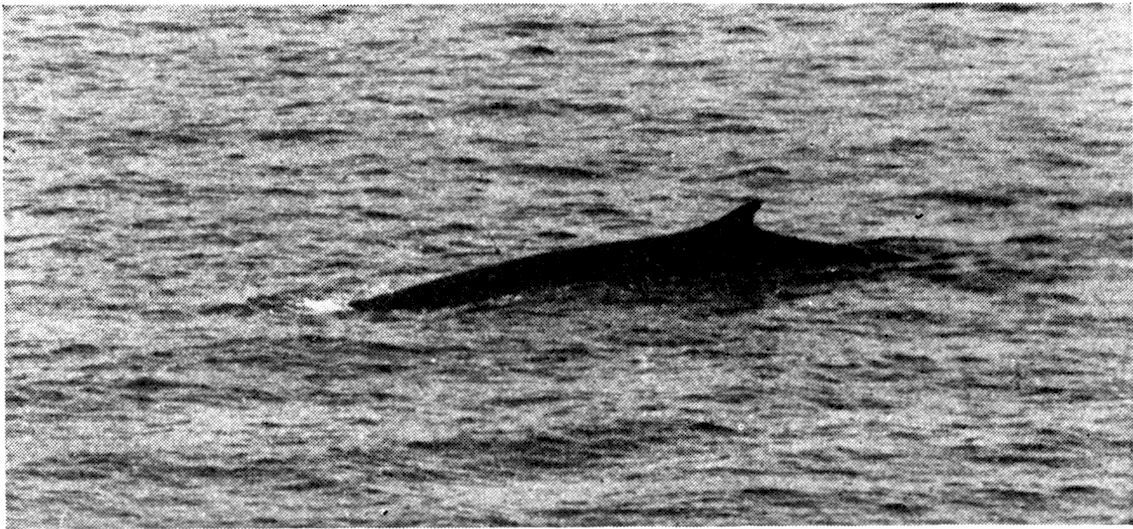
A finback taking an “intermediate” or “surface” dive.
183Although the blue and finback whales of the Atlantic and Pacific have been given different names, yet there is little doubt but that each is represented in all oceans by a single cosmopolitan species.
Apparently no definite barriers exist to curtail the wanderings of the fin whales (Balænopterinæ), for they seem to be indifferent alike to tropic or Arctic temperatures and travel where they will. Probably the presence or absence of the little shrimp which forms their food is one of the greatest determining factors of their movements.
In most oceans whales live under very similar conditions and naturalists are gradually coming to recognize that the laws of geographical separation which hold universally good for land mammals are not equally true in the case of cetaceans. In other words, if any group of land mammals is separated from others of its kind by impassable barriers such as water, mountains, deserts, etc., it will gradually develop changes in structure or external appearance due to differences of climate, food, or other conditions of environment.
But this is not true of the fin whales for the conditions under which they live in the North Pacific are very similar to those in the North Atlantic; consequently, even if the animals of the two oceans never mingled, they could probably continue to reproduce themselves without material change for an almost indefinite period. But there is strong evidence to show that all the fin whales do travel from one ocean to another by way of Capes Horn and Good 184Hope and, since the tropic waters of the Equator are not an effective barrier, wander from the borders of the Antarctic far up into the North Pacific and Atlantic, or vice versa.
The sperm whale is also a cosmopolitan wanderer, but the right whales apparently do not cross the Equator which, as Lieutenant Maury remarks, acts to them like a “belt of fire.” The bowhead is found only in the Arctic regions.
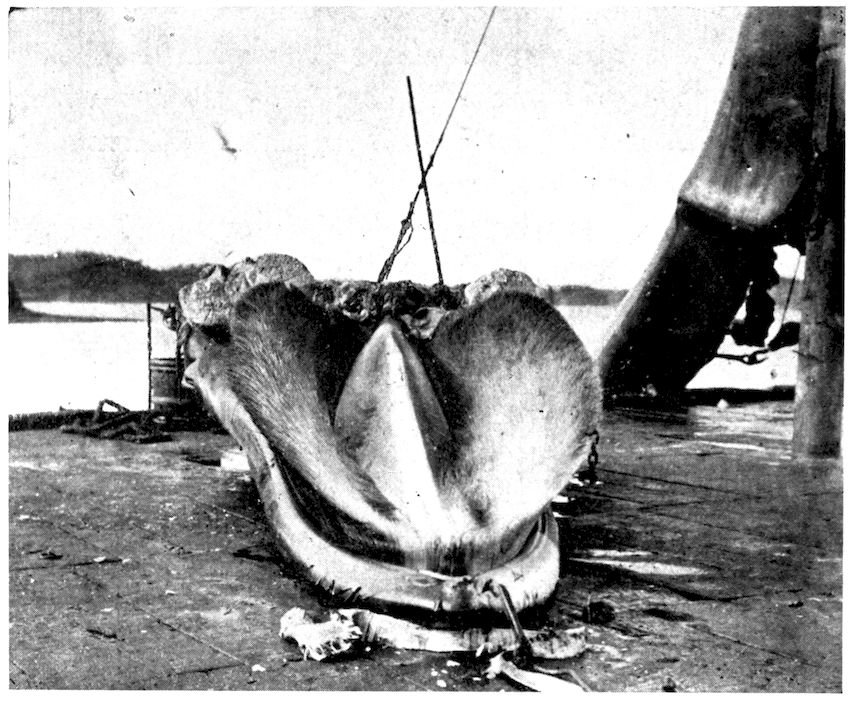
The upper jaw of a finback whale, showing the bristles on the inner edges of the baleen plates.
Strangely enough, if whales are driven away from inland waters they seldom return, and others will not take the places of those which have been killed. This 185has been demonstrated on the American west coast to the considerable financial loss of both the Tyee Company of Alaska and the (former) Pacific Whaling Company of Victoria, British Columbia.
The Tyee Company erected a station on the southern end of Admiralty Island, sixty miles from the open sea, and although when operations were first begun finback and humpback whales were there in hundreds, they were soon all killed and the vessels had to hunt “outside.”
The Pacific Whaling Company spent many thousands of dollars building a station at Nannaimo, on the east coast of Vancouver Island, expecting to capture a sufficient number of whales in the bay and straits to supply their factory. Their hopes were not realized, however, for after two or three seasons’ work there were no more whales to kill and the station had to be moved near the open sea.
It seems to be true that in all parts of the world the blue and humpback whales first leave the feeding grounds and that the finback and sei whales will remain longer than any other, even when persistently hunted.
CHAPTER XV
REDISCOVERING A SUPPOSEDLY EXTINCT WHALE
Half a century ago, on the Pacific coast of America, each year a whale appeared as regularly as the season itself; first in December, traveling steadily southward to the warm California lagoons, and again in May heading northward for the ice-filled waters of the Arctic Ocean. It came close inshore, nosing about among the tentacle-like ropes of kelp and sometimes wallowing in the surf which broke among the rocks.
The Siwash Indians along the coast awaited the coming of this whale with the same eagerness with which the Egyptians hail the rising of the Nile, for to them it meant a time of feasting and of “potlatch.” In their frail dug-out canoes they hung about the kelp fields, sending harpoon after harpoon into its great gray body as the animal rose to breathe, until it finally turned belly up and sank. It was a matter of only a day or so then before the barnacle-studded carcass, distended with the gases of decomposition, floated to the surface and was towed to the beach by the watchful natives.
As the years went by, however, the whales became more wary, fewer and fewer coming into the kelp 187fields, until finally they ceased altogether and passed up and down the coast on their annual migrations far out at sea where they were safe from the deadly harpoons of the hunters.
But the whales, for all their astuteness, were not free from persecution. During the winter, when they came into the shallow water of the California lagoons to bring forth their young, the American whaling ships came also, and the animals, held by mother love, were killed by hundreds.
However, they were not always slaughtered without making a fight to save their babies, and because they frequently wrecked the boats and killed the crews they gained the title of “devilfish,” and as such are generally known throughout the Pacific rather than by the more formal name of California gray whale, which was bestowed upon them in 1868 by Professor Cope.
The American fishery did not last long for continual slaughter on their breeding grounds soon so depleted the numbers of the gray whales that the hunt was no longer profitable, and the shore stations which had been established at various points along the coast finally ceased operations altogether. For over twenty years the species had been lost to science and naturalists believed it to be extinct.
In 1910, while in Japan, I learned from the whaling company of the existence of an animal known as the koku kujira, or “devilfish,” which formed the basis of their winter fishery upon the southeastern coast of Korea.
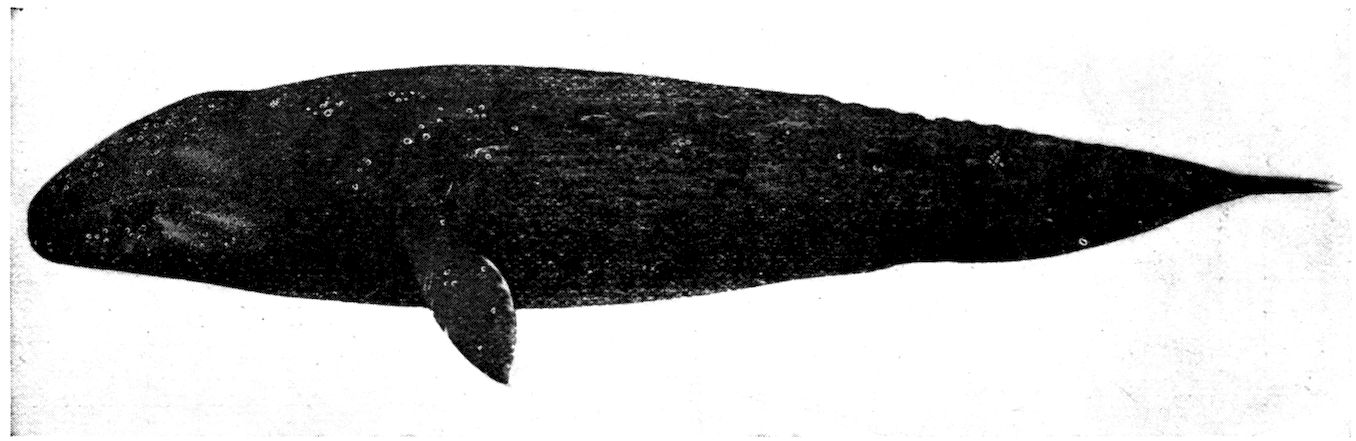
The side view of a model of a gray whale in the American Museum of Natural History prepared under the direction of the author from studies made in Korea.
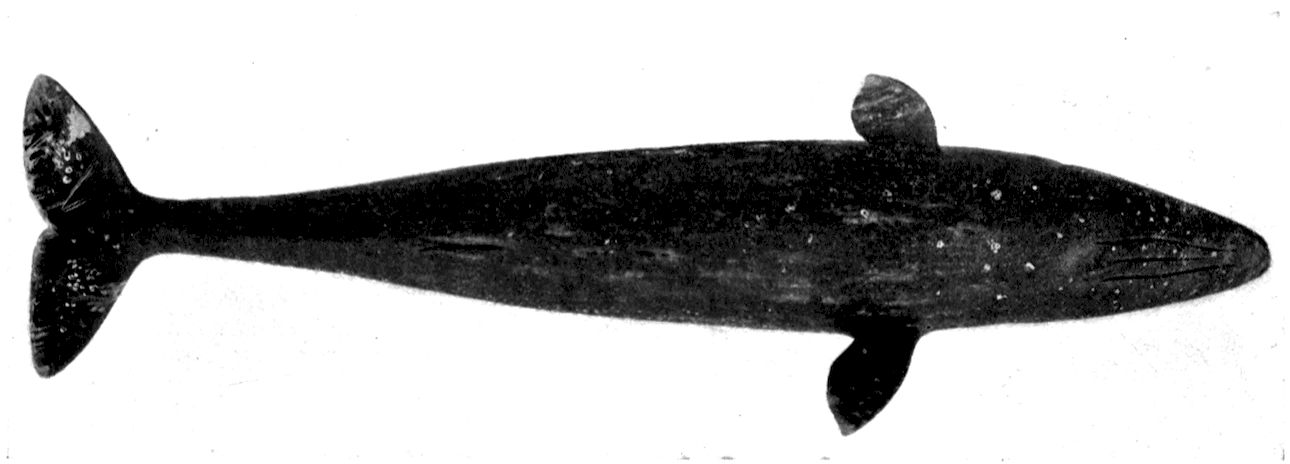
A ventral view of the gray whale model. Note the three furrows in the throat.
190The descriptions indicated that the koku kujira would prove to be none other than the lost California gray whale, and I determined to investigate it at the earliest opportunity. Consequently during the winter of 1911–12, I returned to the Orient and spent the months of January and February at the station of the Toyo Hogei Kaisha at Ulsan, a small village on the southeastern coast of Korea.
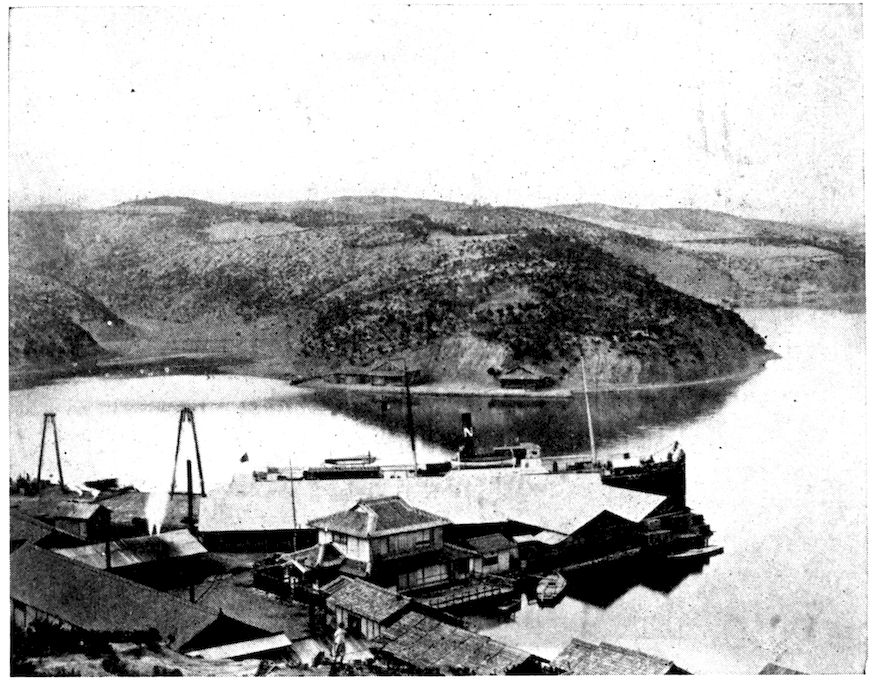
The whaling station at Ulsan, Korea.
I shall never forget my introduction to Korea by way of the Japan Sea. We left Hakata on the night of January 4, in a little transport chartered by the whaling company to carry meat and blubber to the markets. The vessel had a tiny, very dirty cabin aft, 191just large enough for three persons, into which five Japanese and myself were packed. It was bitterly cold outside and such a tremendous sea was running that the cabin deck was flooded every few moments, keeping us wet to the skin. After a twenty-three-hour trip, late in the afternoon we ran up the bay which cuts deeply into the peninsula of Korea forty miles north of Fusan.
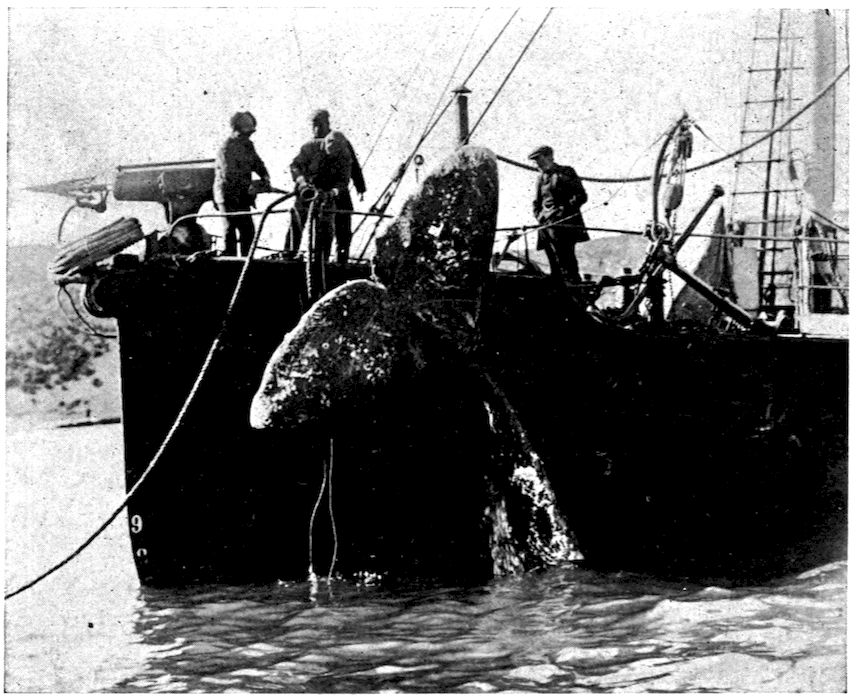
“At the port bow hung the dark flukes of a whale, the sight of which made me breathe hard with excitement.”
As we pulled up to the long wharf at the whaling station I could see numbers of white-robed figures running about like goats on the hills behind the houses or standing in limp, silent groups gazing in my direction. 192The audience, however, regarded me with no greater curiosity than I looked at them, for the Korean is at all times peculiar in appearance and especially so when in full dress.
He wears a long white coat with flaring skirts, enormous baggy trousers gathered at the ankle with a green or purple band, and atop his head is perched a ridiculous little hat made of horsehair with a sugar-loaf crown and a straight brim. The hat must be tied under his chin to keep it in place, but at times it slips over one ear and gives its wearer a singular resemblance to “Happy Hooligan.” His hair is gathered in a knot on the top of his head, and the few straggling wisps of mustache or beard which he manages to grow are as carefully tended as a rare flower. He is never seen without his long-stemmed pipe, and a tobacco pouch always dangles at his belt.
The natives of Ulsan appeared to derive never ending amusement from me and my work. They were living an utterly lazy, aimless life and although they never seemed to know where the next meal was coming from they looked content and well enough fed. Numbers were always hanging about the station waiting to pick up any scraps of whale meat left by the cutters, and all day long the children, each with a little basket, poked about among the cracks in the wharf, now and then gleaning a handful of flesh and blubber, which would help to keep life within their bodies.
After I had secured the skeleton of a gray whale and had piled the bones, partially cleaned, in the station yard, the Koreans descended upon them like a 193flock of vultures. With a knife or a bit of stone they scraped each bone, cleaning it of every ounce of meat. At first this seemed to me a splendid arrangement, but suddenly I discovered that some of the smaller bones themselves were disappearing and realized that my skeleton was slowly but surely being boiled for soup.
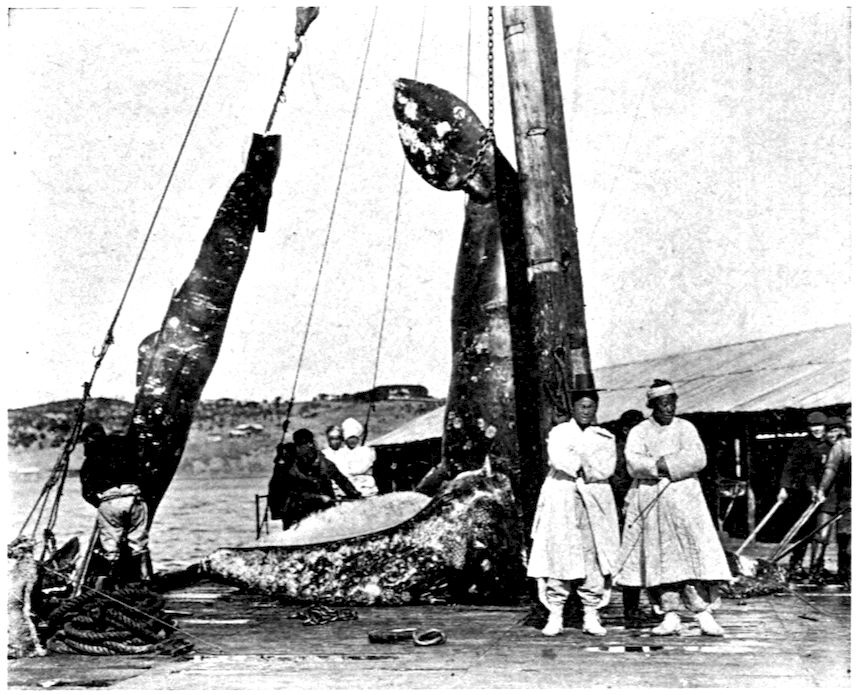 Cutting in a gray whale. The head is lying on the wharf and two Koreans are standing beside it. They wear long white coats, enormous baggy trousers and a horsehair hat.
It did not take long to issue an edict against all Koreans in reference to my whale, but the matter did not end there. The pile of toothsome bones was too great a temptation and whenever I happened to be out of sight some white-gowned native was sure to steal up and leave with a bone under his coat.
194I finally discovered a very effective, and I think highly original, way to stop the stealing. In my equipment there was a 22-caliber rifle and several hundred B. B. caps, the bullets from which would just about penetrate the thick, wadded trousers of a Korean.
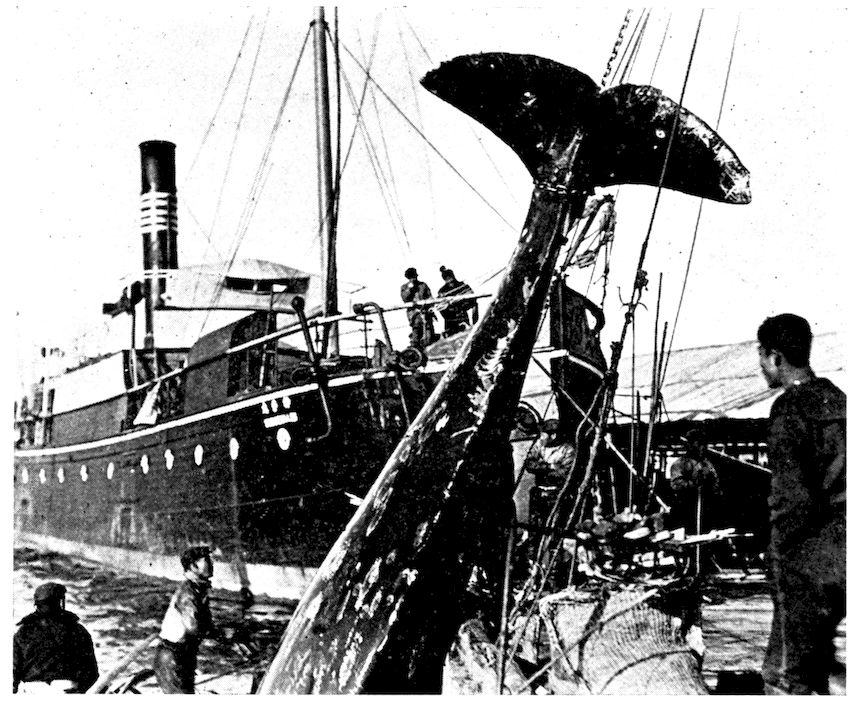
“When the winch began slowly to lift the huge black body out of the water, a very short examination told me that the koku kujira really was the long-lost gray whale.”
I made a hole in the shojo, the paper screen of the Japanese house where I was living, and sat down to watch. In a short time a Korean stole up to the pile of bones and bent over to pick out one which he could carry. I drew a fine bead on the lower portion of his anatomy and when the rifle cracked the native made a 195jump which would have brought him fame and fortune could it have been duplicated at the New York Hippodrome. It is hardly necessary to say that he dropped the bone. In a very short time every Korean in the village knew that a visit to that skeleton generally entailed difficulty in sitting down for several days afterward and the whale was left unmolested.
On the day of my arrival at Ulsan the four whaling ships which hunted from the station were all lying in the harbor, for the gale had made cruising outside impossible. As soon as we landed I met my friend, Captain H. G. Melsom of the S. S. Main, one of the best gunners who has ever hunted in the East. Captain Melsom was the first man to learn how to take the devilfish in Korean waters, because for many years the habit of the animals of keeping close inshore among the rocks baffled the whalers. He learned how to trick the clever whales and hang about just outside the breakers ready for a shot when they rose to blow. From Captain Melsom I learned much of the devilfish lore and many evenings on his ship, the Main, did I listen to his stories of whales and their ways.
I shall never forget the intense interest with which I waited for my first sight of a gray whale. On the next day after my arrival at Ulsan I had started across the bay in a sampan to have a look at the village with Mr. Matsumoto, the station paymaster. We had hardly left the shore, when the siren whistle of a whale ship sounded far down the bay and soon the vessel swept around the point into view. At the port bow hung the dark flukes of a whale, the 196sight of which made me breathe hard with excitement, for one of two things must happen—either I was to find that here was an entirely new species, or else was to rediscover one which had been lost to science for thirty years. Either prospect was alluring enough and as the vessel slowly swung in toward the wharf and a pair of great flukes, the like of which I had never seen before, waved in front of me, I realized that here at last was what I had come half around the world to see.
When the winch began slowly to lift the huge black body out of the water, a very short examination told me that the koku kujira really was the long-lost gray whale and not a species new to science. But it was not the gray whale of Scammon’s description, for this white-circled, gray-washed body was very little like the figure he had published in his book, “The Marine Mammalia.”
Many new things were learned during the succeeding months of studying this strange animal, but chief among them were the facts that the gray whale differs so strongly from all others that it must be placed in a family of its own; also that it is the most primitive of all existing large cetaceans and is virtually a living fossil.
CHAPTER XVI
HOW KILLERS TEAR OUT A GRAY WHALE’S TONGUE
The gray whales, as well as other large cetaceans, have only two enemies—man and one of their own kind, the orca or killer whale. Although twice the size of the killers and correspondingly strong, when one of the orcas appears the devilfish become terrified and either wildly dash for shore or turn belly up at the surface, with fins outspread, paralyzed by fright.
A few days after my arrival at Ulsan, three gray whales were brought to the station, one of which had half the tongue torn away; teeth marks clearly showed in the remaining portion and Captain Hurum, who had killed the animals, told me that it was the work of killers.
There were seven gray whales in the school, he said, and shortly after he began to hunt them fifteen killers appeared. The whales became terrified at once and he had no difficulty in killing three of the seven. When the orcas gathered the whales turned belly up and made not the slightest attempt to get away. A killer would put its snout against the closed lips of the devilfish and endeavor to force the mouth open and its own head inside. This extraordinary method of attack was corroborated by Captain Johnson, who 198had been hunting the same school of gray whales, and, moreover, by all the whalemen at the station, who had witnessed it upon many other occasions.
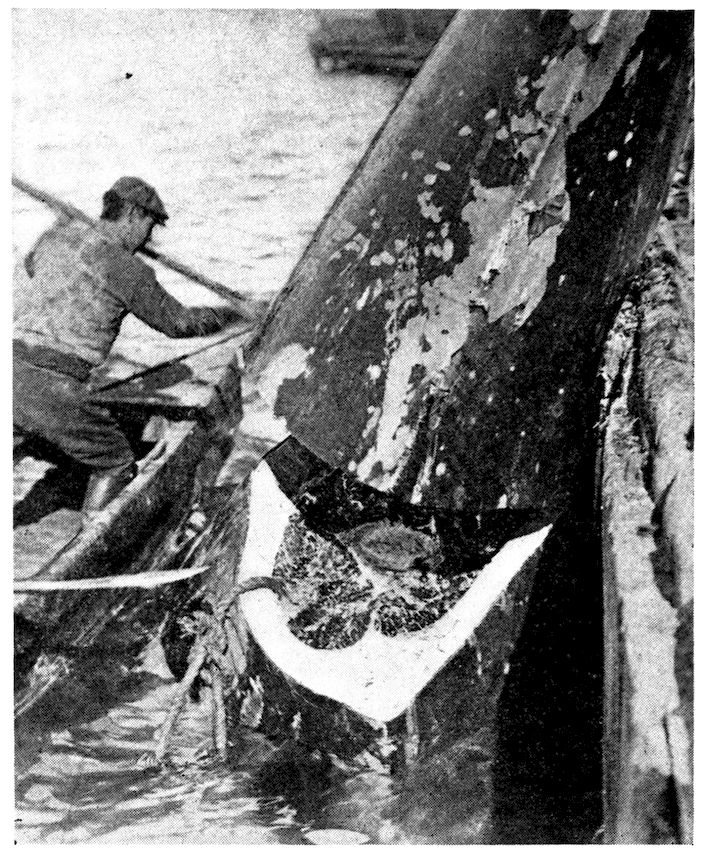
Cutting through the body of a gray whale. The thick layer of blubber surrounding the red meat is well shown.
Of thirty-five gray whales which I examined especially, seven had the tongues eaten to a greater or less extent and one had several large, semicircular bites in the left lower lip. The killers do not confine their attention entirely to the tongue for almost every whale which was brought in had the tips and posterior edges 199of the fins and flukes more or less torn; in several specimens fresh teeth marks were plainly visible where the fin had been shredded as the whale drew it out of the orca’s mouth.
Although none of the gray whales exhibited teeth marks on other parts of the body, undoubtedly some of them are killed by the orcas. A female killer which was brought in had several pieces of flesh in its stomach, besides a strip of whalebone three inches long. I could not positively identify the latter but believe it to have been from a small devilfish. A male killer was taken at the same time by Captain Hurum, who told me that in the animal’s death flurry it had thrown up two great chunks of flesh.
Captain Melsom brought a gray whale to the station one day and I found that the tongue was almost gone. He said he had passed a school of killers in the morning and later, after steaming about fifteen miles, had killed the devilfish. A short time afterward, a long distance away, he saw the fins of a school of killers which were coming at full speed straight for the ship. They circled about the vessel and one of them forced open the mouth of the dead whale to get at the tongue. Captain Melsom fired at the killer with his Krag rifle and when struck the animal lashed out with its flukes, smashing the ship’s rail, and then disappeared.
As soon as orcas appear, if the gray whales are not paralyzed by fright, they head for shore and slide in as close as possible to the beach where sometimes the killers will not follow them. The devilfish will 200actually get into such shallow water as to roll in the wash and will even try to hide behind rocks. The orcas are not afraid of ships and will not leave the whales they are chasing when the vessels arrive, thus giving much assistance to the human hunters.
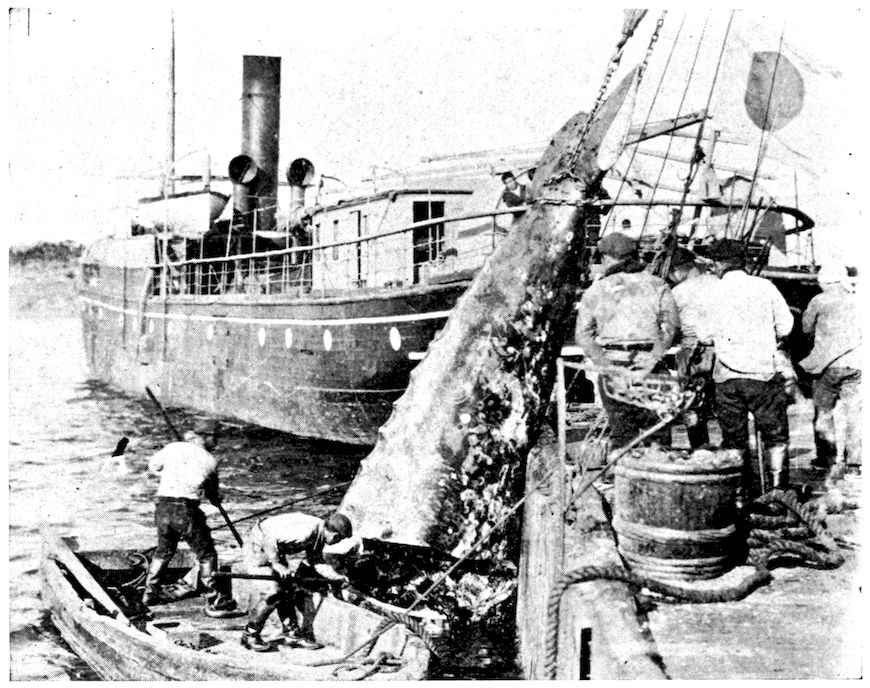
The posterior part of a gray whale. Note the scalloped dorsal ridge of the peduncle and the white markings along the sides.
Captain Johnson, of the Rex Maru, brought to the station at Ulsan a gray whale which had been shot in the breast between the fins. He had first seen killers circling about the whale which was lying at the surface, belly up, with the fins outspread. The animal was absolutely paralyzed by fright. The vessel steamed up at half speed and Johnson shot at once, the 201iron striking the whale squarely between the flippers.
The gray whales live in such constant terror that when porpoises are playing about a single animal, as frequently happens, it will sometimes become terrified and dash madly for the shore, thinking that the killers have appeared.
I have never personally witnessed it, but the gunners tell me that a pod of gray whales can be stampeded much like a herd of cattle. If three or four ships are near each other when a school of devilfish are found, they draw together, each vessel going at full speed, while the sailors beat tin pans and make as much noise as possible. The whales at once dive, but as soon as they rise to spout the vessels rush at them again. The devilfish go down once more but do not stay under long, ascending at shorter and shorter intervals until finally they are plowing along at the surface.
The animals are “scared up,” as the gunners say, and become terrified to such a degree that everything is forgotten except the desire to get away—and even the means of doing that. It is not always possible to stampede a herd, for often the whales will disappear at the first sound and not rise again until a long distance away. If killers are about, it is very easy for the ships to stampede a herd of gray whales.
Even if the devilfish do exhibit considerable stupidity when danger from orcas threatens, at other times they are the cleverest and most tricky of all large whales. One day Captain Melsom, on the S. S. Main, was hunting a gray whale in a perfectly smooth sea. 202The animal had been down for fifteen minutes when suddenly a slight sound was heard near the ship and a thin cloud of vapor was seen floating upward from a patch of ripples which might have been made by a duck leaving the surface. The whale had exposed only the blowholes, spouted, refilled the lungs, and again sunk, doing it almost noiselessly. The gunners assert that this is quite a usual occurrence when a single gray whale is being hunted.
One of the most interesting things in the life history of the devilfish is the annual migration which occurs as regularly as the seasons. In no other large cetacean is there anything like the migrating instinct which carries the gray whales from the icy waters of the north three thousand miles to the south to seek the warm lagoons of California and Korea in which to raise their young.
On both sides of the Pacific the migrations take place at almost the same time. Along the Korean coast near the end of November single pregnant females appear, traveling steadily southward; a little later both males and females are seen; and finally only males bring up the rear, all having passed by January 25th.
When going south almost every female is found to be carrying young nearly ready for birth, and all are hurrying straight ahead as though anxious to arrive at the breeding grounds as soon as possible. The devilfish again pass Ulsan, Korea, on the northward trip, about the middle of March, and by May 15 have disappeared.
203A comparison of these observations and those made by Scammon on the California coast show that the migration periods of both herds correspond closely and that the breeding grounds are in very nearly the same latitude.
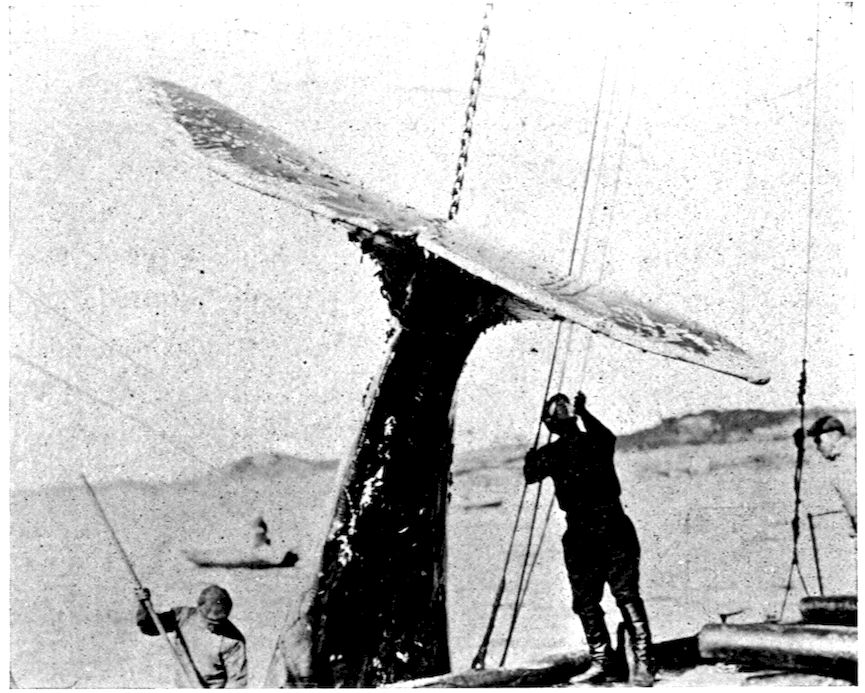
The flukes of a gray whale. The edge of the flukes of this species is very thick, but in most whales it is exceedingly thin.
As yet it is impossible to state whether or not the Korea or California herds mingle in the north during the summer. Information gathered from the whalers tends to show that a large part of the former school summers in the Okhotsk Sea, and a large part of the latter in the Bering Sea and farther north. Individuals of the two herds may mingle and interbreed during 204their sojourn in the north, but it is probable that whales which have been born near either the Korea or California coasts will find mates among the members of their own herd during the southern migration, and return annually to their birthplace. It is quite conceivable that the case of the gray whale may be like that of the fur seal, where it has been shown conclusively that members of the American and Japanese herds do not mingle in the north although separated by comparatively few miles of water.
Because of its regular migrations, the period of gestation of this species can be more nearly determined than that of any other large whale, and is about one year. Mating appears to take place in the south during December or early January, and the calf is ready for delivery at the same time the following winter; probably calves are born but once in two years. The length of the gray whale calf at birth is between twelve and seventeen feet and undoubtedly its size is much more than doubled during the first year after birth.
The devilfish is a shore-loving species and on its annual migrations always prefers to cruise along close to the beach. When unmolested it swims about four or five miles an hour and cannot exceed nine miles even when badly frightened and doing its best to get away.
At times the whales will go in so close to the shore that they are actually rolling in the surf, and seem to enjoy being pounded by the breakers. Scammon has 205observed the same habit in the California specimens and says:
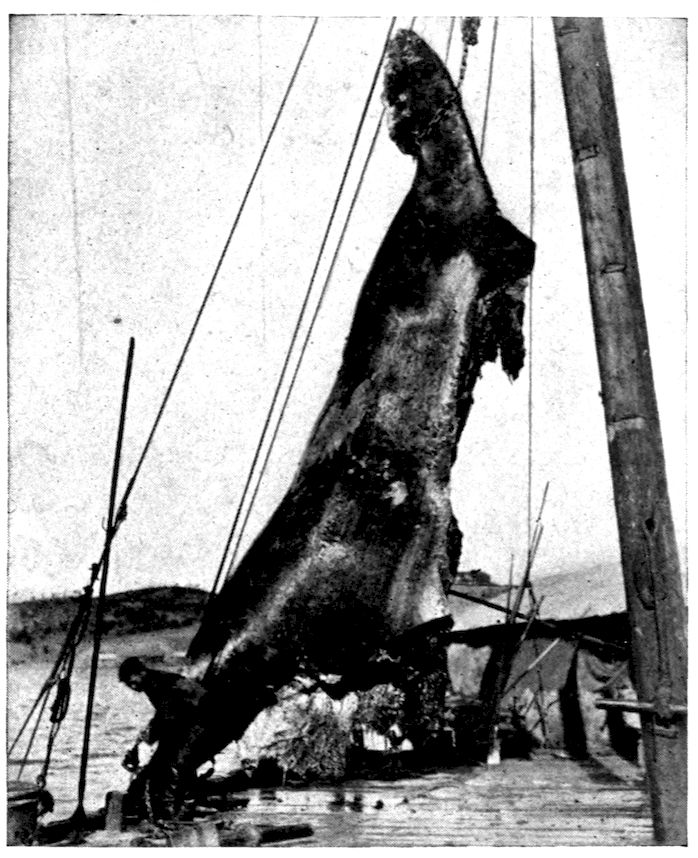
A strip of blubber from the back of a gray whale with the short flipper at the end of it.
About the shoals at the mouth of one of the lagoons, in 1860, we saw large numbers of the monsters. It was at the low stage of the tide, and the shoal places were plainly marked by the constantly foaming breakers. To our surprise we saw many of the whales going through the surf where the depth of water was barely sufficient to float them. We could discern in many places, by the white sand that came to the surface, that they must be near or touching the bottom.
One in particular lay for half an hour in the breakers, 206playing, as seals often do in a heavy surf; turning from side to side with half extended fins, and moved apparently by the ground-swell which was breaking; at times making a playful spring with its bending flukes, throwing its body clear of the water, coming down with a heavy splash, then making two or three spouts, and again settling under water; perhaps the next moment its head would appear, and with the heavy swell the animal would roll over in a listless manner, to all appearances enjoying the sport intensely. We passed close to this sportive animal, and had only thirteen feet of water.[9]
9. (l. c., p. 24.)
Often, when being hunted, the Korean whales would swim into water so shallow that the ships could not follow, and remain there until the men had given up the chase.
CHAPTER XVII
SOME HABITS OF THE GRAY WHALE
Although the stomachs of a great number of gray whales were carefully examined, I could never discover what constitutes their food, and no one else seems to have had better success. In every case the stomach was more or less filled with dark green water in which the only solid materials were bits of kelp, a little seaweed, and small masses of light green gelatinous material.
The stomachs of two individuals contained a number of waterworn pebbles and several small pieces of what appeared to be finely shredded flesh still connected by its fibers; this certainly was not fish. It is probable that the kelp, seaweed, and pebbles had been taken in with other material and were not swallowed intentionally.
All the gunners assert that when the gray whales appear at Ulsan on their migrations they are invariably traveling straight ahead and apparently not stopping to feed. This information, combined with the fact that little except water could be found in the stomachs, lends strong support to the theory that when upon their annual migrations the devilfish do not feed at all, and during the winter draw for nourishment upon the fat of their thick blubber. This is true 208of the fur seal during the breeding season, and of other water mammals. When the male fur seals arrive upon the “rookeries” at the Pribilof Islands to await the coming of the females, their bodies are covered with layer upon layer of fat. During the following four months the bulls do not leave the land and neither eat, drink nor sleep while they guard their harems, subsisting upon the fat which has been stored up on their bodies. When the animals leave in the fall to spend the winter at sea, they have become so thin through their self-enforced fasting that they are mere skeletons of their former well-fed selves.
Scammon says that in the spring the blubber of the devilfish is dry and yields but comparatively little oil, as would be the case if the animals had fasted during the winter. I have no personal information as to this because in Korea these whales are not killed on their northward migrations. So many other and more valuable species can be taken during the spring that the devilfish are allowed to depart unmolested. If they do feed while on their migrations, the food in their stomachs would certainly have been discovered when the animals were cut in at the stations.
The male devilfish at all times shows strong affection for the female, and when a school of males, led by one or two females, is found, if one of the latter is wounded, often the bulls refuse to leave until the cow is dead.
Captain Melsom tells me that while hunting a pair of devilfish near Ulsan he shot the female, and the male would not leave his dead consort, keeping close 209alongside and pushing his head over her body. Later he struck the male with a harpoon, but did not get fast, and even then it returned and was finally killed.
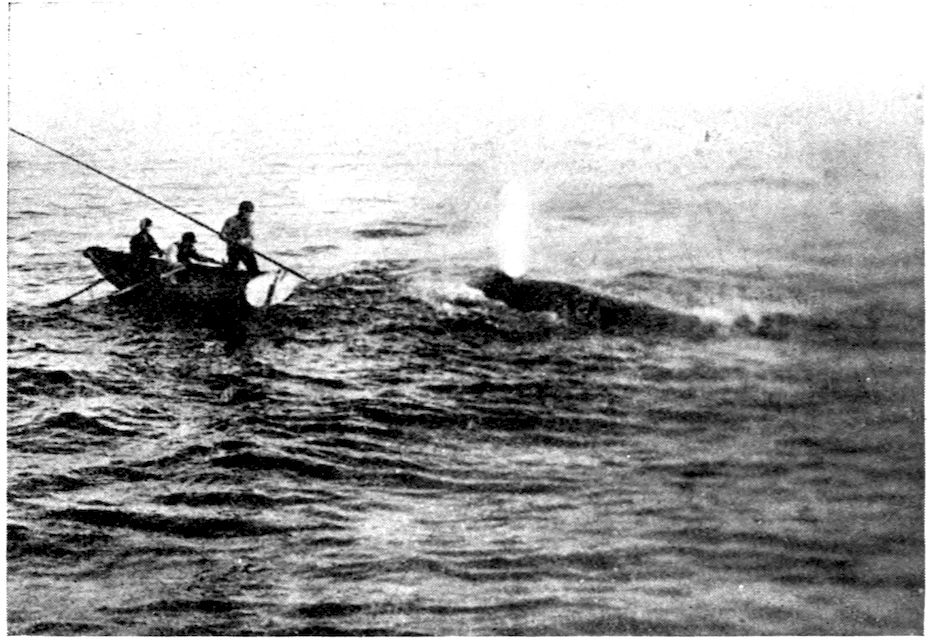
Captain Melsom about to lance a gray whale from the pram.
Scammon says that when attacked in the lagoons with their young the devilfish would turn furiously upon the boats, and that almost every day injuries to the crews were reported. He gives an interesting account of two gray whales which, in February, 1856, were found aground in Magdalena Bay:
Each had a calf playing about, there being sufficient depth for the young ones, while the mothers were lying hard on the bottom. When attacked, the smaller of the two old whales lay motionless, and the boat approached near enough to “set” the hand lance into her “life,” dispatching the animal at a single dart. The other, when approached, would 210raise her head and flukes above the water, supporting herself on a small portion of the belly, turning easily and heading toward the boat, which made it very difficult to capture her.
It appears to be their habit to get into the shallowest inland waters when their cubs are young. For this reason the whaling ships anchor at a considerable distance from where the crews go to hunt the animals, and several vessels are often in the same lagoon.[10]
10. (l. c., p. 25.)
The whalemen in Korea, where the hunting is done from small steamships by the Norwegian method, do not regard the animals as especially dangerous. They seldom lance one from the pram, as is frequently done with other whales, because the devilfish seem to be very sensitive to pain and as soon as the iron penetrates the body the animal will raise itself in the water, throwing its head from side to side and sometimes lashing about with its flukes and flippers.
Probably if the gray whales were hunted on their breeding grounds about the southern end of Korea, they would be found to be dangerous even to the vessels themselves, but I doubt if more so than other species under similar conditions.
Most whales are subject to diseases of various kinds and the devilfish is no exception. One specimen was brought to the station at Ulsan with all the flesh on the left side of the head badly decomposed and in some places entirely gone, leaving the bone exposed; what remained hung in a soft, green evil-smelling mass. The whale had evidently suffered considerably 211from the disease, for it was very thin and the blubber was dry.
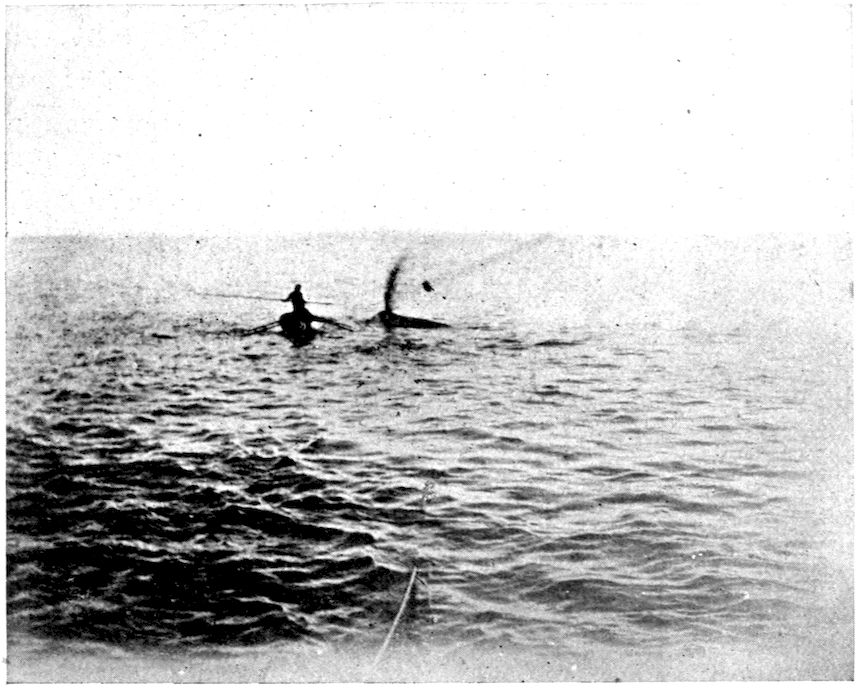
After the death stroke. The lance has penetrated the lungs and the whale is spouting blood.
A second specimen had a large swelling on the ventral ridge of the peduncle, which, upon being opened, proved to be a large capsular tumor about one foot in depth and of a like diameter. The skin upon the snout of a third individual was drawn into small circular patches, leaving large sections of the blubber exposed.
The entire body of the devilfish is thickly infested with “whale lice” and barnacles. The former resembles a diminutive crab and by means of the sharp claws 212on its feet fastens itself firmly on the soft skin of the whale. Wherever there is an injury or abrasion of any sort, quantities of these parasites cluster and breed.
On the snout and top of the head the skin is usually roughened, or cornified, much like the “bonnet” of the right whale, this being caused by the attacks of the whale lice. If one of these parasites is placed upon the hand it begins slowly to raise the body upon the front legs, driving its claws into the flesh, and in a short time will be firmly fastened and can only be removed with difficulty. The whale lice are crustaceans and have been named Cyamus scammoni after Captain Charles M. Scammon, who first discovered them upon the gray whales of California.
Besides whale lice the devilfish are the hosts of hard, shell-like barnacles known as Cryptolepas rhachianectei. These imbed themselves deeply on all parts of the body and sometimes are found in large clusters. Whenever a barnacle becomes detached a circular, grayish pit remains; this becomes white as the wound heals, and the scar is exactly like that produced on the humpback by the barnacle Coronula diadema. Without doubt these parasites cause the whale a great deal of annoyance and the animals probably rub themselves against rocks in endeavors to scrape them off.
The hairs on the devilfish are longer and are distributed more uniformly over the entire head than in the case of any other whale. This is an exceedingly interesting and important fact and, together with many other anatomical characters, indicates that the gray 213whale is a very primitive species which is more like its ancient, fossil ancestors than any other existing large cetacean.
The presence of hairs upon whales and dolphins is evidence that when the animals lived upon the earth, millions of years ago, they must have been entirely covered with hair as are ordinary land mammals. The hair of most whales is confined to the snout and chin but in the devilfish it is distributed in irregular rows over the top and sides of the head.
The hair on cetaceans is in a degenerate condition and does not possess at the base a gland (sebaceous) for the secretion of oily matter to supply it with nourishment and lubrication as in land mammals. It seems probable that the loss of hair in cetaceans is largely due to their aquatic life, because the blubber performs the function of hair in keeping the animals warm and an outer covering is no longer needed; also most land mammals need hair to protect their tender skins from bruises and abrasions but for a whale this is unnecessary.
The manatee, or sea cow, an entirely aquatic mammal, has lost nearly all hair, and in the walrus it has become very much reduced; the latter animal spends almost all its time in the water, coming out but comparatively seldom to sleep upon the smooth ice; and in addition to the blubber it has developed an exceedingly tough skin. It is true that seals all possess blubber, and some an additional coat of thick soft fur, but they are not as yet exclusively aquatic; although much of their life is spent in the water, they still come 214upon the land for extended periods during the breeding season and need hair for protection from the rough rocks upon which they rest, rather than for warmth.
The blubber of the devilfish is thick and fat and varies in color from red to flesh-pink. Because of this difference the Japanese recognize two kinds of gray whale—the aosaki (red blubber) and the shirosaki (white blubber), but this is merely an individual difference and certainly is not sufficient ground for specific distinction.
The Japanese consider the meat and blubber of the devilfish to be of poorer quality for eating than that of any other baleen whale. In the winter, during December and January when the price is at the highest, the blubber sells for about 4 sen (2 cents) per pound and the red meat at 10 sen (5 cents).
CHAPTER XVIII
THE WOLF OF THE SEA
Although the killer whale has no great commercial value, it is often brought in at the shore stations and figures so prominently in all deep-sea life that to omit it from any book on whaling would be a grave error.
The killer is the wolf of the sea and like the land wolves hunts in packs of twenty or more individuals which will attack and devour almost anything that swims. Every whaleman has stories to tell of the strength and ferocity of these sea terrors, but I think that the incident witnessed by Captain Robert F. Scott and published in the journal of his last ill-fated expedition is one of the most remarkable experiences of which I have ever known. It is so interesting that I have quoted it in full:
Thursday, January.—All hands were up at 5 this morning and at work at 6. Words cannot express the splendid way in which everyone works and gradually the work gets organized. I was a little late on the scene this morning, and thereby witnessed a most extraordinary scene.
Some 6 or 7 killer whales, old and young, were skirting the fast floe edge ahead of the ship; they seemed excited and dived rapidly, almost touching the floe. As we watched, they suddenly appeared astern, raising their snouts out of water. I had heard weird stories of these beasts, but had never associated serious danger with them. Close to the water’s edge lay the wire and stern rope of the ship, and our two Esquimaux dogs were tethered to this.
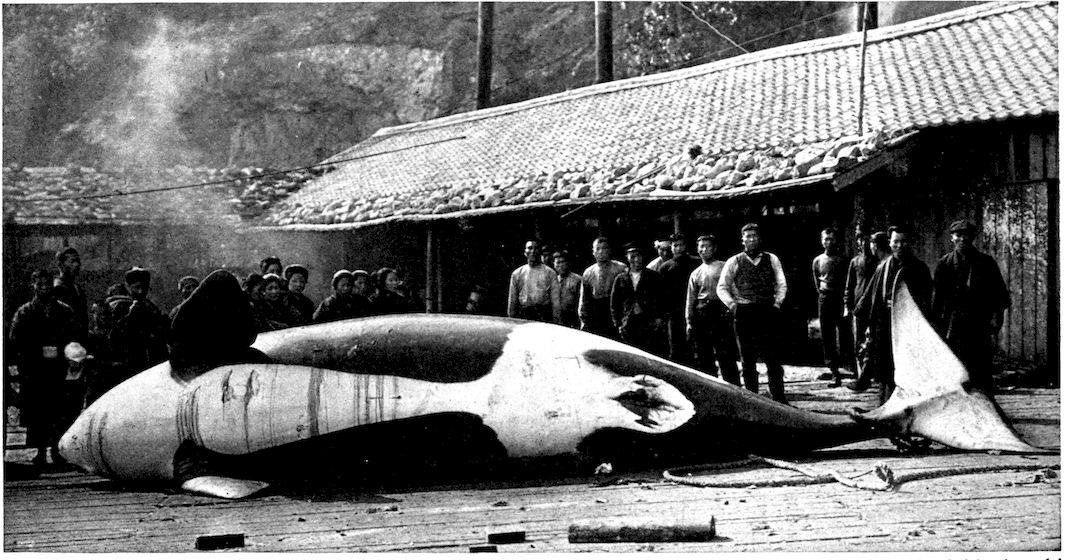
“The killer is the wolf of the sea and like the land wolves hunts in packs of twenty or more individuals which will attack and devour almost anything that swims.” This specimen, taken at Oshima, Japan, was twenty-six feet in length, and its skeleton was sent to the American Museum of Natural History.
217I did not think of connecting the movements of the whales with this fact, and seeing them so close I shouted to Ponting, who was standing abreast of the ship. He seized the camera and ran toward the floe edge to get a close picture of the beasts, which had momentarily disappeared. The next moment the whole floe under him and the dogs heaved up and split into fragments. One could hear the “booming” noise as the whales rose under the ice and struck it with their backs.
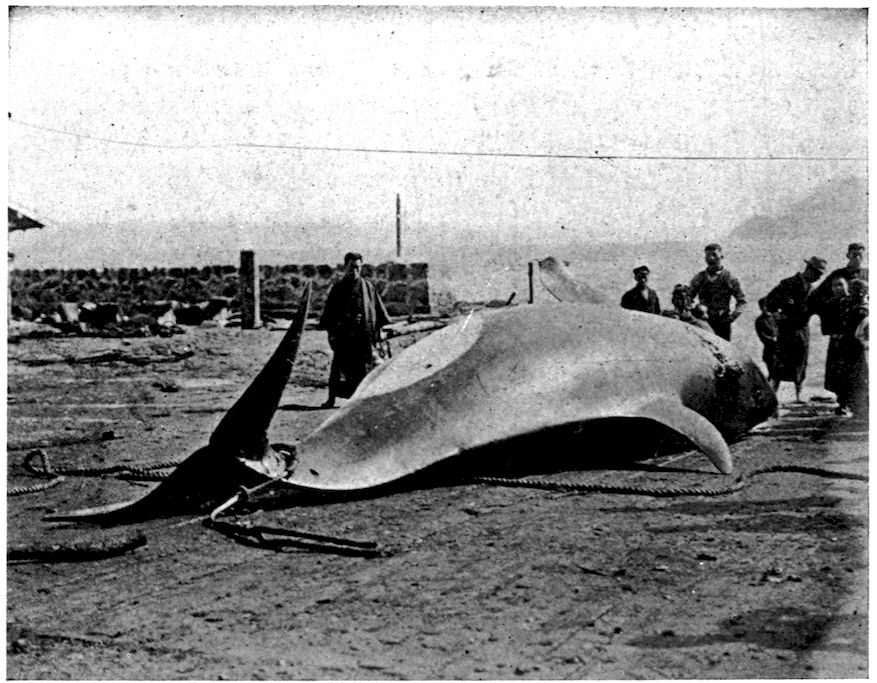
A posterior view of a killer showing the high dorsal fin. In the male the dorsal is over six feet in height but in the female it is only four feet.
218Whale after whale rose under the ice, setting it rocking fiercely; luckily Ponting kept his feet and was able to fly to security. By an extraordinary chance also, the splits had been made around and between the dogs, so that neither of them fell into the water. Then it was clear that the whales shared our astonishment, for one after another their huge hideous heads shot vertically into the air through the cracks which they had made. As they reared them to a height of 6 or 8 feet it was possible to see their tawny head markings, their small glistening eyes, and their terrible array of teeth—by far the largest and most terrifying in the world. There cannot be a doubt that they looked up to see what had happened to Ponting and the dogs.
The latter were horribly frightened and strained to their chains whining; the head of one killer must certainly have been within 5 feet of one of the dogs.
After this, whether they thought the game insignificant, or whether they missed Ponting is uncertain, but the terrifying creatures passed on to other hunting grounds, and we were able to rescue the dogs, and, what was even more important, our petrol—5 or 6 tons of which was waiting on a piece of ice which was not split away from the main mass.
Of course, we have known well that killer whales continually skirt the edge of the floes and that they would undoubtedly snap up any one who was unfortunate enough to fall into the water; but the facts that they could display such deliberate cunning, that they were able to break ice of such thickness (at least 2½ feet), and that they could act in unison, were a revelation to us. It is clear that they are endowed with singular intelligence, and in future we shall treat that intelligence with every respect.[11]
11. “Scott’s Last Expedition.” Arranged by Leonard Huxley. New York, 1913, Vol. I, pp. 65–66.
Dr. Charles H. Townsend, Director of the New 219York Aquarium, tells of an interesting experience on the Pribilof Islands, which illustrates the terror in which the killers are held by other water mammals. He was collecting a number of the great Steller’s sea lions for the Smithsonian Institution and was shooting the animals, which were on land, with a repeating rifle.
The sea lions began rushing toward the water in terror when suddenly the high dorsal fin of a killer whale appeared a few fathoms offshore. The sea lions stopped short and could not be forced into the water, preferring to face the unknown danger of the rifle rather than certain death in the jaws of an enemy which from earliest babyhood they had been taught to fear.
The killer belongs to the dolphin family, of which it is the largest member, reaching a length of from twenty to thirty feet. These animals are found in almost every ocean of the world and, although several species have been described, probably there is but one, Orca orca. The dorsal fin of the male is six feet high while that of the female is but three and one-half or four feet, and this has led to the naming of specimens which have proved to be only the male and female of the same species.
Killers will apparently eat anything that swims and fish, birds, seals, walrus, whales, and porpoises are all equally acceptable. Their capacity is almost unbelievable, and there is a record of thirteen porpoises and fourteen seals being taken from the stomach of a twenty-one-foot specimen.
220Dr. Wilson speaks of killers in the Antarctic as follows:
Of the whales, the most prominent of all are the Killers, or Orca whales, which scour the seas and the pack-ice in hundreds to the terror of seals and penguins. The Killer is a powerful piebald whale of some fifteen feet in length. It hunts in packs of a dozen, or a score, or sometimes many scores. No sooner does the ice break up than the Killers appear in the newly formed leads of water, and the penguins show well that they appreciate the fact by their unwillingness to be driven off the floes.
From the middle of September to the end of March these whales were in McMurdo Strait, and the scars that they leave on the seals, more particularly on the Crab-eating seal of the pack-ice, afford abundant testimony to their vicious habits. Not one in five of the pack-ice seals is free from the marks of the Killer’s teeth, and even the Sea Leopard, which is the most powerful seal of the Antarctic, has been found with fearful lacerations.
Only the Weddell Seal is more or less secure, because it avoids the open sea. Living, as it does, quite close inshore, breeding in bights and bays on fast ice some ten or twenty miles from the open water, it thus avoids the attacks of the Killer to a large extent.[12]
12. “The Voyage of the Discovery,” 1905, App., p. 470.
In Japan killers are abundant, especially near Korea, and I have seen numbers of the animals in the Bering Sea and along the coast of Vancouver Island. The Japanese call the killer “takamatsu” and in various parts of America it is known as the orca, thresher, or grampus. The two latter terms are especially confusing and inappropriate, for the name thresher properly 221belongs to a shark and grampus to a species of porpoise (Grampus griseus).
The trident-shaped area of white, the white spots behind the eyes, and the enormous dorsal fin are very conspicuous on the black body, and the animal may be recognized at a long distance; fœtal specimens have orange-buff where the adult is white.
The killer can swim at a tremendous speed and because of the nature of its food the sounds and bays along the coast which swarm with every variety of marine life are more frequently its feeding grounds than the open sea.
Scammon says that the killer is a menace to even the full-grown walrus, especially when pups are with their parents. He states that sometimes the young walrus will mount upon its mother’s back to avoid the killer and that then “the rapacious orca quickly dives, and, coming up under the parent animal, with a spiteful thud throws the young one from the dam’s back into the water, when in a twinkling it is seized, and, with one crush, devoured by its adversary.”[13]
13. (l. c., p. 92.)
The killer’s habit of forcing open a whale’s mouth and eating the tongue from the living animal, is an extraordinary method of attack which has long been recorded by the whalemen who hunted the Arctic bowhead. I must confess, however, that I had always been skeptical as to the accuracy of this report until my own experiences with the gray whales in Korea, where its truth was clearly demonstrated.
222Another story which is undoubtedly purely mythical, although it has astonishingly wide credence, is that of “the swordfish and the thresher.” It is said that a swordfish with a killer will attack a large whale, prodding the animal from below with its “sword” and preventing it from diving, while the killer tears out the tongue.
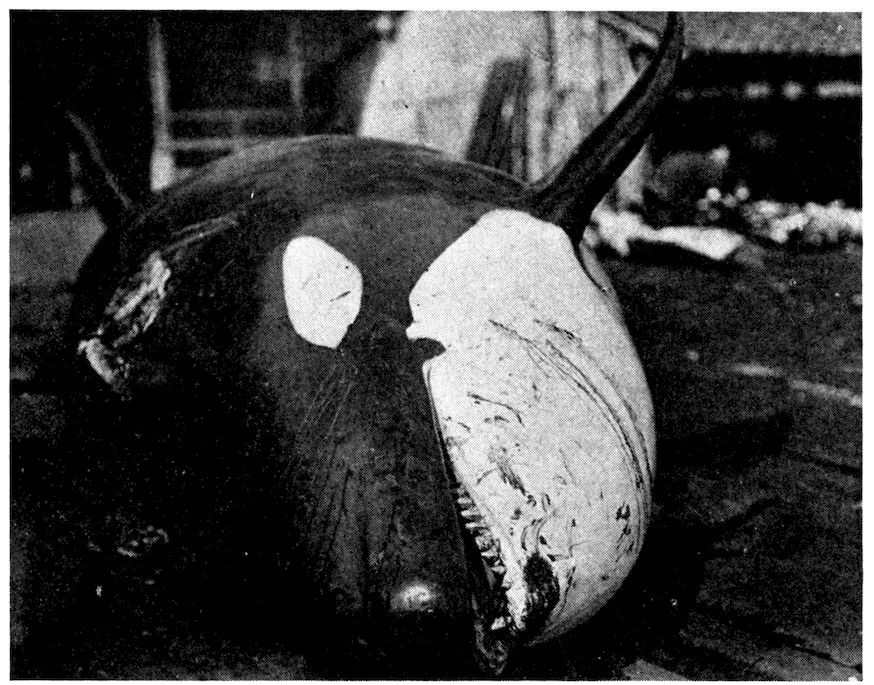
An anterior view of a killer. The heavy teeth and the white spot just behind the eye are well shown.
I have personally interviewed a number of men who were reported to have witnessed such a combat, but have never yet found one who had seen a swordfish, or had any evidence of one being there, although the killer could easily be seen. They usually defend 223their story by saying that a swordfish must have been below, otherwise the whale would have sounded. Undoubtedly what prevents the whale from diving is the fact that it becomes paralyzed with fright and so utterly confused that it is unable to escape.
An orca probably could not kill a large whale alone, but single individuals undoubtedly cause all the fin whales great annoyance by biting off the tips of their flukes and flippers; at least two-thirds of the whales brought to the stations had the flukes or flippers injured. I have a photograph of a young finback whale with the flipper torn and mangled and plainly showing a killer’s teeth marks.
The sperm whale is probably the only marine animal which is more than a match for a herd of killers. The enormous lower jaw of a sperm whale presents an array of teeth even more formidable than those of the orca, and I greatly doubt if the killer could succeed in terrifying this whale; it is significant that the flukes and flippers of sperms are practically always free from injuries.
Like other members of the dolphin family, the killer has twelve teeth in both jaws and they may be readily distinguished from those of the sperm whale by their smaller size and flatter basal portion.

No comments:
Post a Comment