Why only Japan is criticized for honoring its war dead
Time to move on: Let the nation honor its soldiers who died for their country without shame
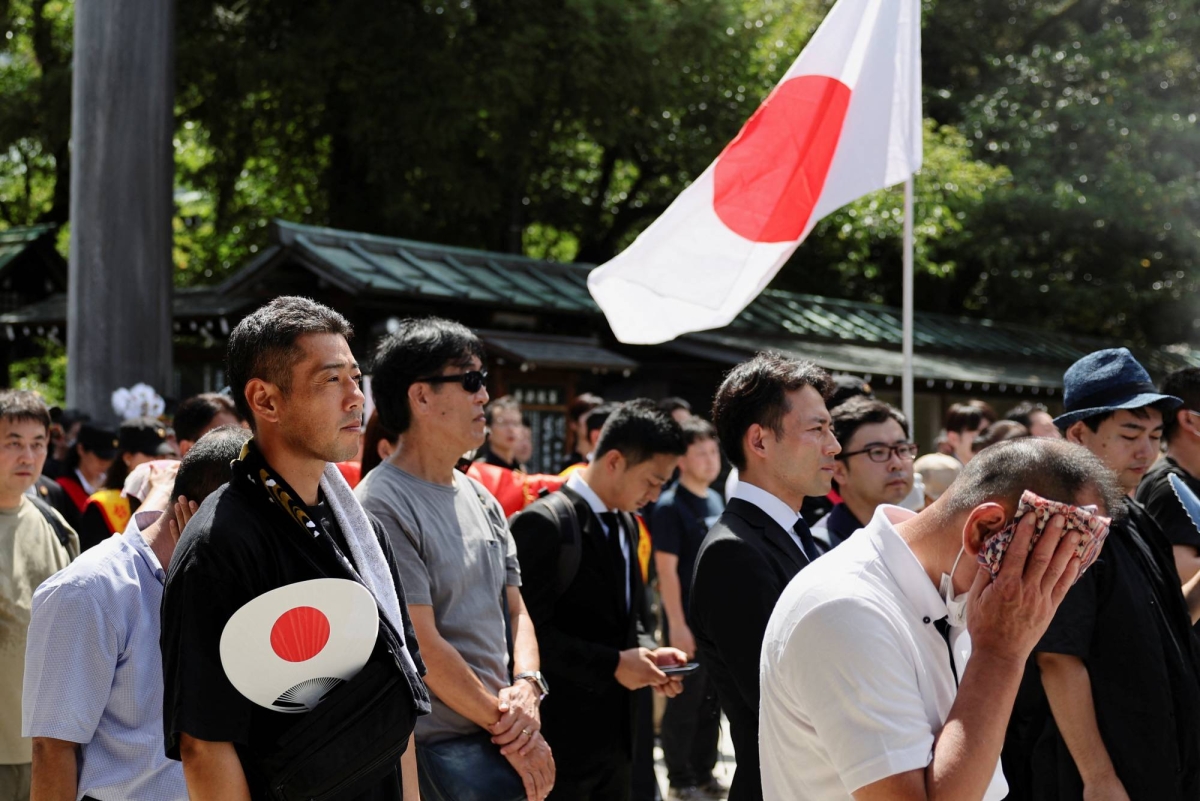
People pray during a visit to Yasukuni Shrine in Tokyo on Aug. 15, the 79th anniversary of Japan's surrender during World War II. | REUTERS
By Edo Naito
Contributing writer
SHARE/SAVE
Jun 20, 2025
===
The United States recently celebrated its Memorial Day, a national holiday when Americans commemorate and honor those who served their country, especially those who made the ultimate sacrifice.
The U.S. honors the ultimate sacrifice regardless of whether the war was just, later judged a mistake or involved actions that could be seen as war crimes. The focus is on the individual’s act of service.
Arlington National Cemetery has a section for those who lost their lives in the U.S. Civil War of 1861 to 1865, including those who rebelled against the U.S. at that time.
Almost all countries I know of have a holiday like Memorial Day or special places designate to honor those who made the ultimate sacrifice — except Japan. Yasukuni Shrine is meant to serve that purpose, but political pressure from neighboring countries has made it difficult for many Japanese to pay their respects there.
This August marks eight decades since the end of World War II. Is it finally time for the Japanese to be free to commemorate and honor those who gave their lives for their country?
Former U.S. President Barack Obama participated in two very different memorials, one with Prime Minister Shinzo Abe at the Hiroshima Atomic Bombing Memorial in May of 2016, and then a few months later, with Abe at the Pearl Harbor Memorial in December of that same year. These are two seminal events in the history of U.S.-Japan relations.
There have been similar acts of contrition and forgiveness related to World War II. Japan is often, and unfavorably, compared to West German Chancellor Willy Brandt’s famous spontaneous act of falling to his knees — a Roman Catholic sinner-like genuflection — at the Warsaw Ghetto Memorial in December of 1970.
This gesture was, he admitted later, completely spontaneous but was seen as an act of sincere contrition by Germany for the Holocaust against the Jews and as a broader act of reconciliation. It was historical, even if serendipitous.
Even France maintains a war memorial for its soldiers and civilians who died during the First Indochina War (1946–1954), a conflict fought to preserve its colonial rule over French Indochina, a region in Southeast Asia that included Vietnam, Cambodia and Laos. Beginning in the mid-1980s, with full support from Hanoi, more than 24,000 sets of remains of French soldiers and civilians buried in Vietnam were repatriated and laid to rest at the memorial. Since 2005, June 8 has been designated as a national day of homage for the French who died in Indochina.
Some estimates put the number of Vietnamese soldiers and civilians killed at several hundred thousand, with both sides committing war crimes. France has never issued a formal apology nor ever paid reparations for the war or the colonial period.
The Netherlands also fought a war from 1945 to 1949 to retain its colony in the Dutch East Indies, now Indonesia. Indonesian deaths in that conflict are estimated in the hundreds of thousands as well, while Dutch deaths are estimated at 5,000 or more.
In 2020, Dutch King Willem-Alexander offered the first royal apology for "excessive violence" by Dutch forces before a visit to Jakarta. When Mark Rutte was prime minister in 2022, a formal inquiry revealed the Dutch state condoned the systematic use of extrajudicial executions, torture and other war crimes, which led to him, the current secretary-general of NATO, issuing the first formal apology to Indonesia for the actions of the Dutch military and intelligence services. Indonesia has never received reparations for the war.
In contrast, Japanese leaders, including the emperor and prime ministers since around the mid-20th century have issued dozens of apologies for the suffering inflicted on the nation's neighbors during Japan's own colonial period.
Japan has also paid billions of dollars in reparations to the countries it is accused of harming. It followed that with tens of billions more in overseas development grants, no- or low-interest loans, technology grants and foreign direct investment to those neighbors as part of its effort to show sincere remorse.
The victims of war are the only ones who can forgive, and no one has a right to ask them to forget, however far into the distant past.
Today, Japan has strong, positive and forward-looking relationships with every government in the region except two: the Chinese Communist Party and the pro-China, pro-North Korea progressives in South Korea.
Their two nations have also received repeated apologies, reparations and development assistance from Japan over the decades. Yet for domestic political reasons, the governments there continue to claim that nothing Japan has said or done has been sufficient or sincere.
They demand something unique that the Vietnamese, Indonesians, Poles and other victims of 20th-century wars do not. These groups also continue to use their propaganda megaphones to try to shame Japan for honoring its war dead, as most countries do according to their own customs.
For some reason, honoring Japan's war dead at Yasukuni Shrine has drawn the greatest attention.
For several decades after World War II, from 1945 to 1985, these governments did not object to Japanese political leaders — including prime ministers, the emperor and other members of the imperial family — visiting the Yasukuni Shrine. The intention was to offer their respects to the spirits, not the physical remains, of those who died serving Japan since 1869 in all of the nation's wars.
This changed after the then chief priest of Yasukuni Shrine decided in the late 1970s, without notifying the Japanese government, to add the names of 14 individuals convicted of Class-A war crimes — namely, Japan’s wartime political and military leaders — to the shrine’s rolls.
Still, professor Kazuo Sato of Aoyama Gakuin University noted that with the release of all prisoners by 1958 under the San Francisco Peace Treaty framework, the issue of war crimes was formally resolved and the criminal classifications were effectively nullified, something many Japanese are not aware of.
However, it was only after Prime Minister Yasuhiro Nakasone’s visit on the 40th anniversary of the end of the war that China and two Koreas decided to make Yasukuni a controversial diplomatic issue that continues to this day.
What changed to make Nakasone’s visit in the mid-1980s a major issue? Perhaps it was the outbreak around the same time of student protests in both South Korea — the Gwangju Uprising against the military dictatorship of President Chun Doo-hwan — and later in China, where students demanded political liberalization and greater freedoms from the Chinese Communist Party. These protests, which continued up to the Tiananmen Square crackdown, may have prompted the authorities in Beijing and Chun’s regime to shift attention away from themselves by pursuing policies that focused criticism on Japan.
Like every other country that has gone to war, Japan does not need permission from Beijing or left-wing parties in South and North Korea to honor its war dead according to Japanese customs and practices. There comes a time when a nation should no longer hold back from doing what it knows is right simply to appease manufactured outrage.
Japan should continue to calmly reflect on its history, commit to never repeating the mistakes of the past, never forget the pain and suffering it inflicted on its neighbors, never stop feeling deep remorse and never expect forgiveness from any of the victims if that is not in their hearts.
In accordance with Shinto beliefs, the Japanese believe that all of the spirits of the war dead have gathered at Yasukuni Shrine. All Japanese should be free to honor those who made the ultimate sacrifice for its country.
Now is the time.
Edo Naito is a commentator on Japanese politics, law and history. He is a retired international business attorney and has held board of director and executive positions at several U.S. and Japanese multinational companies.
KEYWORDSYasukuni SHRINE, China, South Korea, North Korea, China-Japan Relations, South Korea-Japan relations, WAR DEAD, WAR CRIMES, WWII, SHINTO

No comments:
Post a Comment