North Korea: The Politics of Unconventional Wisdom
by Han S. Park, 2002
North Korea: The Politics of Unconventional Wisdom Hardcover – 31 March 2002
by Han S. Park (Author)
Despite isolation, an impoverished economy, mass starvation, and the challenge of leadership succession, North Korea's socialist state continues to survive. Han Park explores the reasons for this resilience, concentrating on the implications of mass beliefs and political ideology for the country's political life. Park begins with an examination of Juche, or self-reliance, the ideology that so pervasively penetrates the entire spectrum of North Korean society and guides political behavior at all levels. Drawing on personal interviews and on-site observations, he finds a belief system that is comparable to a theology, and a society that exhibits many characteristics of a religious community. In this context, he discusses regime legitimacy, the economy, foreign and defense policy, and the politics of reunification, as well as the regime's reaction to the market forces of globalization. It is Juche, Park concludes, that is the locus of North Korea's political culture, central to understanding its politics and policies. Though far from proposing a single-factor explanation of the North Korean system, he demonstrates convincingly that an understanding of the country's doctrine of self-reliance is essential to an understanding of the country itself.
North Korea: The Politics of Unconventional Wisdom
By Han S. Park
Read preview
Synopsis
Despite isolation, an impoverished economy, mass starvation, and the challenge of leadership succession, North Korea's socialist state continues to survive. Han Park explores the reasons for this resilience.
Excerpt
Many kinds of polities and states have experimented with many different types of governments over the course of human history. Of those that may be classified as undemocratic, some have been more authoritarian, and others have been more closed, contained, rigid, and ideological. Yet no system has crystallized all the above characteristics into its polity more completely than the Democratic People's Republic of Korea (North Korea).
Since the inception of the current regime, especially after the Korean War (1950– 1953), North Korea has developed a breed of socialism vastly deviant from Marxism-Leninism or, for that matter, almost any other system known in political history.
Scholars and observers of North Korea have found striking similarities between today's North Korea and what was depicted in George Orwell's famous novel 1984.
Written in 1949, the novel described what human society would be like in the year 1984 and predicted rule by a tyrannical government that employed surveillance, purges, brainwashing, and personality cults in order to perpetuate control.
However, a growing number of people who are knowledgeable about North Korea acknowledge that the country is not entirely misguided. North Korea and its sympathizers assert that the system is relatively devoid of the kinds of social ills typically found in developing capitalist societies; namely, income inequality, moral decay, environmental deterioration, and overreliance on external resources.
Political activists and radical students in South Korea, as well as some circles of overseas Koreans, profess their belief that North Korea is largely nationalistic, welfare-oriented, and sincere about national reunification.
Leaving moral judgment aside, one is struck by the resilience of the system and the remarkable stability of state power. How many socialist . . .
Introduction 1
1 The Perception Approach 7
2 The Advent and Evolution of Juche Ideology 17
3 The Philosophical Principles of Juche 31
4 The Creation of a Theocracy 41
5 Juche Education: Agents and Methods 51
6 Conditioning the Human Mind 61
7 Juche as a Way of Life 75
8 Juche in Domestic Politics 85
9 Foreign and Unification Policy 99
10 Inter-Korean Relations: A Legitimacy War 117
11 The Unconventional Wisdom in Negotiating Behavior: The Weapons Controversy and Beyond 133
12North Korea Sees Itself: Perceptions of Policy Goals, Strategies, and Tactics143
North Korea: The Politics of Unconventional Wisdom Hardcover – 31 March 2002
by Han S. Park (Author)
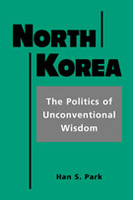
Despite isolation, an impoverished economy, mass starvation, and the challenge of leadership succession, North Korea's socialist state continues to survive. Han Park explores the reasons for this resilience, concentrating on the implications of mass beliefs and political ideology for the country's political life. Park begins with an examination of Juche, or self-reliance, the ideology that so pervasively penetrates the entire spectrum of North Korean society and guides political behavior at all levels. Drawing on personal interviews and on-site observations, he finds a belief system that is comparable to a theology, and a society that exhibits many characteristics of a religious community. In this context, he discusses regime legitimacy, the economy, foreign and defense policy, and the politics of reunification, as well as the regime's reaction to the market forces of globalization. It is Juche, Park concludes, that is the locus of North Korea's political culture, central to understanding its politics and policies. Though far from proposing a single-factor explanation of the North Korean system, he demonstrates convincingly that an understanding of the country's doctrine of self-reliance is essential to an understanding of the country itself.
North Korea: The Politics of Unconventional Wisdom
By Han S. Park
Read preview
Synopsis
Despite isolation, an impoverished economy, mass starvation, and the challenge of leadership succession, North Korea's socialist state continues to survive. Han Park explores the reasons for this resilience.
Excerpt
Many kinds of polities and states have experimented with many different types of governments over the course of human history. Of those that may be classified as undemocratic, some have been more authoritarian, and others have been more closed, contained, rigid, and ideological. Yet no system has crystallized all the above characteristics into its polity more completely than the Democratic People's Republic of Korea (North Korea).
Since the inception of the current regime, especially after the Korean War (1950– 1953), North Korea has developed a breed of socialism vastly deviant from Marxism-Leninism or, for that matter, almost any other system known in political history.
Scholars and observers of North Korea have found striking similarities between today's North Korea and what was depicted in George Orwell's famous novel 1984.
Written in 1949, the novel described what human society would be like in the year 1984 and predicted rule by a tyrannical government that employed surveillance, purges, brainwashing, and personality cults in order to perpetuate control.
However, a growing number of people who are knowledgeable about North Korea acknowledge that the country is not entirely misguided. North Korea and its sympathizers assert that the system is relatively devoid of the kinds of social ills typically found in developing capitalist societies; namely, income inequality, moral decay, environmental deterioration, and overreliance on external resources.
Political activists and radical students in South Korea, as well as some circles of overseas Koreans, profess their belief that North Korea is largely nationalistic, welfare-oriented, and sincere about national reunification.
Leaving moral judgment aside, one is struck by the resilience of the system and the remarkable stability of state power. How many socialist . . .
-------------
Introduction 1
1 The Perception Approach 7
2 The Advent and Evolution of Juche Ideology 17
3 The Philosophical Principles of Juche 31
4 The Creation of a Theocracy 41
5 Juche Education: Agents and Methods 51
6 Conditioning the Human Mind 61
7 Juche as a Way of Life 75
8 Juche in Domestic Politics 85
9 Foreign and Unification Policy 99
10 Inter-Korean Relations: A Legitimacy War 117
11 The Unconventional Wisdom in Negotiating Behavior: The Weapons Controversy and Beyond 133
12North Korea Sees Itself: Perceptions of Policy Goals, Strategies, and Tactics143
13System Stability and Vulnerability161
14Conclusion: The Challenges Ahead175
Bibliography181
Index185About the Book194

No comments:
Post a Comment