The Japanese Colonial Legacy in Korea, 1910–1945: A New Perspective George Akita
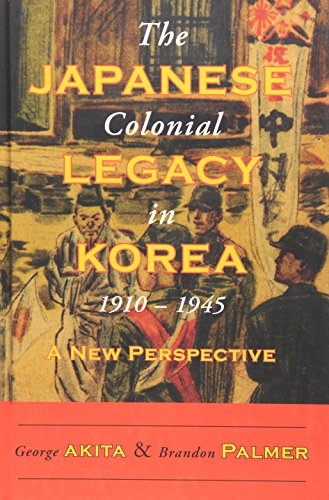
The Japanese Colonial Legacy in Korea, 1910–1945: A New Perspective
George Akita
Hardback: $85.00
ISBN-13: 9781937385712
Published: February 2015
You must register to use the waitlist feature. Please login or create an account
Paperback: $40.00
ISBN-13: 9781937385705
Published: February 2015Add to Cart
Additional Information
MerwinAsia
232 pages
About the Book
The Japanese Colonial Legacy in Korea reexamines Japan’s policies in Korea from 1910 to 1945. The authors contend that Japan’s policies were moderate considering the magnitude of the colonial endeavor and were proportional when compared to the imperialist practices of Western nations. Drawing on recent scholarship, this study effectively contributes to the growing field of historical revisionism in Korean colonial history. Historical remembrance in South Korea unabashedly portrays the colonial era in a wholly negative light; The Japanese colonial regime is presented as an authoritarian regime that exploited the innocent Korean people. In some cases, academic circles in Asia and America have adopted positions that mirror the Korean historical paradigm.
Dr. Akita and Dr. Palmer challenge the pro-Korean nationalist narrative by using a plethora of archival documents written by the highest echelons of Japan’s leadership. These documents, written by men such as Yamagata Aritomo and Hara Kei, reveal the origins and reasonableness of Japanese colonial policies, especially when shown in light of Japan’s strong legalist tradition. A more nuanced view of Japan’s rule in Korea is achieved by juxtaposing it to the Europeans’ record in Asia and Africa. Furthermore, this work highlights various ways that Japan’s colonial interlude contributed to South Korea’s postwar industrialization.
===
Hardcover
—
Paperback
$55.34
Other Used and New from $49.30


Print length
232 pages
Brandon PalmerBrandon PalmerDiscover more of the author’s books, see similar authors, read book recommendations and more.Discover more of the author’s books, see similar authors, read book recommendations and more.See more on the author's page
Product details
Publisher : MerwinAsia (February 28, 2015)
Language : English
Paperback : 232 pages
Customer Reviews:
4.1 4.1 out of 5 stars (8)
Top reviews from the United States
16 people found this helpful
Helpful
DeepThinkingReader
5.0 out of 5 stars This book deserves much needed recognitionReviewed in the United States on February 2, 2019
Professor George Akita has had a remarkable career as a leading expert on modern Japanese history, and while this book is something he wrote in his twilight years, it reflects just how much the term ‘revisionism’ has been used and abused by the new breed of scholars with an obvious objective to criticize and defame Japan through their writings whenever possible. While it may be in vogue to denigrate the colonialists and occupiers of the past, objectivity must be the cornerstone of any academic work if it is to be deemed of any value.
In this book, the fact that Japan allowed voting in the Hangul language for Koreans living in Japan (page 56) is just one example of how greatly different Japan was from Western colonialists in the treatment of the colonized. Such arrangement makes Japan many decades ahead of any other nation on this planet to engage in what people call ‘diversity’ and ‘inclusion’ today.
Professor Akita cites many scholarly works to stress that modernization was definitely a priority once Japan annexed Korea. While there “were only seven or eight primary schools operating in Seoul…” in 1904, government-run primary schools increased the number of students from 20,100 in 1920 to 901,200 by 1937 (page 105). This drastic change in public school enrollment cannot be dismissed as just a scheme to indoctrinate the poor subjects by a bellicose, military empire. So much material presented in this book reinforces how backward Korea had been before Japan’s Annexation (refer to Isabella Lucy Bird’s Korea and Her Neighbors: https://amzn.to/2WCVGcs), and the great strides in modernization that transpired during the Annexation (refer to The New Korea by Alleyne Ireland: http://yeoksa.blog.fc2.com/blog-category-57.html). Naturally, what we enjoy as fundamental rights today was conferred to the Korean population during these years, and it is indisputable that people benefited from this new environment, becoming entrepreneurs of all sorts due to greater access to education and opportunities as well as capitalizing on a modernized infrastructure. The rich material in this book describing the advancement made in the several decades of the Annexation deserves examination, whether one embraces the unprecedented ‘Japanese brutality’ viewpoint or not.
What has been identified as the “national historical narrative” fueled by zealous nationalism should not repudiate objectivity based on facts, especially when there is so much abundance of historical facts. South Korean scholars including An Byeong-jik, Lee Young-hoon, and Park Yu-ha have been virtually treated like criminals for their works that challenge the national historical paradigm (letter of request to withdraw indictment of Prof. Park by S. Korean court: https://parkyuha.org/archives/5757). Scholars from all over the world ought to unite and rediscover academic integrity founded on fairness, objectivity, and respect for the truth rather than scoring points for momentary political expediency. Professor Akita has given academia a courageous battle cry to do just that.
Read less
8 people found this helpful
HelpfulReport
See more reviews
===
===
Hardcover
—
Paperback
$55.34
Other Used and New from $49.30
Print length
232 pages
Brandon PalmerBrandon PalmerDiscover more of the author’s books, see similar authors, read book recommendations and more.Discover more of the author’s books, see similar authors, read book recommendations and more.See more on the author's page
Product details
Publisher : MerwinAsia (February 28, 2015)
Language : English
Paperback : 232 pages
Customer Reviews:
4.1 4.1 out of 5 stars (8)
Top reviews from the United States
16 people found this helpful
Helpful
DeepThinkingReader
5.0 out of 5 stars This book deserves much needed recognitionReviewed in the United States on February 2, 2019
Professor George Akita has had a remarkable career as a leading expert on modern Japanese history, and while this book is something he wrote in his twilight years, it reflects just how much the term ‘revisionism’ has been used and abused by the new breed of scholars with an obvious objective to criticize and defame Japan through their writings whenever possible. While it may be in vogue to denigrate the colonialists and occupiers of the past, objectivity must be the cornerstone of any academic work if it is to be deemed of any value.
In this book, the fact that Japan allowed voting in the Hangul language for Koreans living in Japan (page 56) is just one example of how greatly different Japan was from Western colonialists in the treatment of the colonized. Such arrangement makes Japan many decades ahead of any other nation on this planet to engage in what people call ‘diversity’ and ‘inclusion’ today.
Professor Akita cites many scholarly works to stress that modernization was definitely a priority once Japan annexed Korea. While there “were only seven or eight primary schools operating in Seoul…” in 1904, government-run primary schools increased the number of students from 20,100 in 1920 to 901,200 by 1937 (page 105). This drastic change in public school enrollment cannot be dismissed as just a scheme to indoctrinate the poor subjects by a bellicose, military empire. So much material presented in this book reinforces how backward Korea had been before Japan’s Annexation (refer to Isabella Lucy Bird’s Korea and Her Neighbors: https://amzn.to/2WCVGcs), and the great strides in modernization that transpired during the Annexation (refer to The New Korea by Alleyne Ireland: http://yeoksa.blog.fc2.com/blog-category-57.html). Naturally, what we enjoy as fundamental rights today was conferred to the Korean population during these years, and it is indisputable that people benefited from this new environment, becoming entrepreneurs of all sorts due to greater access to education and opportunities as well as capitalizing on a modernized infrastructure. The rich material in this book describing the advancement made in the several decades of the Annexation deserves examination, whether one embraces the unprecedented ‘Japanese brutality’ viewpoint or not.
What has been identified as the “national historical narrative” fueled by zealous nationalism should not repudiate objectivity based on facts, especially when there is so much abundance of historical facts. South Korean scholars including An Byeong-jik, Lee Young-hoon, and Park Yu-ha have been virtually treated like criminals for their works that challenge the national historical paradigm (letter of request to withdraw indictment of Prof. Park by S. Korean court: https://parkyuha.org/archives/5757). Scholars from all over the world ought to unite and rediscover academic integrity founded on fairness, objectivity, and respect for the truth rather than scoring points for momentary political expediency. Professor Akita has given academia a courageous battle cry to do just that.
Read less
8 people found this helpful
HelpfulReport
See more reviews
===
Top reviews from the United States
TPI
5.0 out of 5 stars INVALUABLE! Historians' Perspective on a Controversial Topic
Reviewed in the United States on January 26, 2019
Verified Purchase
Scholars George Akita & Brandon Palmer present a brief, yet insightful, examination of colonial rule of Korea under Imperial Japan and its legacy, focusing primarily on the "national historical narrative" currently promulgated by many Koreans today. This narrative asserts that Japanese colonial rule was amongst the most brutal in human history and absolutely nothing beneficial resulted from Japanese rule. But, is this widely-disseminated paradigm accurate? The authors expose that this narrative misrepresents and neglects many aspects of Japanese rule and is thus far from accurate.
In this regard, Akita & Palmer's book is much needed and vitally important in the very fact that it challenges a narrative that many people – even many scholars – are afraid to or unwilling to question. The book sheds light by analyzing Japanese governance of Korea not solely from the perspective of pro-Korea/anti-Japan ideologues, but from the viewpoint of multiple scholars, including several Korean scholars, as well as from the perspectives of those who lived in Korea during that period.
The authors compare Japanese colonial rule to that of other colonial powers of that era: namely, Great Britain, France, Imperial Germany, Portugal, the Netherlands, Belgium, and the United States (regarding the Philippines). Although proponents of the Korean national historical paradigm espouse evocative terms such as "brutal" and "ruthless" to label Japanese rule, impartial analyses reveal that Japanese rule of Korea to be arguably more benign than many of the colonial powers mentioned above.
Further, the book succinctly reviews Japan's principles of colonial governance, examining politics, education, social reforms, industrial and infrastructure development, and implementation of judicial and penal systems. This examination reveals that many of the systems created during the colonial period were kept and not discarded by S. Korea in the post-colonial period, clearly indicating that they were not all bad.
The authors approach the topic like detectives, carefully defining terms and focusing on verifying claims via logical analyses and diligent checking of primary sources. These analyses reveal that many of the claims from the national historical perspective exaggerate what happened, present selective facts, take events out of context, or are anecdotal. The comfort women narrative is an illustrative example, where many key facts have been omitted or misrepresented by activists.
Although the middle sections of the book delve into tangential topics, the book's cogency picks up in the latter half. The authors offer a caution by quoting Amos Oz, an acclaimed Israeli author and peace advocate, who stated: "Whoever ignores the existence of varying degrees of evil is bound to become a servant of evil... Let us not give in to the temptation of simplification."
The authors empathize with and readily acknowledge that the Korean people felt pain, humiliation and anger at being ruled by another nation. During this period, Japanese administrators guided the building of infrastructure, such as schools, universities, hospitals, libraries, railways, roads, industries, telephone/telegraph lines, power stations, sanitation, and brought modernity. From 1910 to 1945 under Japanese rule, the Korean population doubled, and vastly more people attended schools, including women. Life expectancy of Korean people rose from twenty-six years to forty-two years. The authors assert that, from the Japanese administrators' perspective, "assimilation was intended, over time, to bring equality, enfranchisement, and progress to the Korean people."
The book briefly summarizes the widespread poverty, illiteracy, hardships, and morass under the corrupt and self-serving Korean Yi Dynasty that had immediately preceded Japanese rule.
The book mentions the thesis that wounded pride and the humiliation of being ruled by a foreign power (and the resultant anger) are at the core of the Korean national historical paradigm, rather than the magnitude of "brutality," which the authors demonstrate was no worse than that of other imperial powers. As humiliation is one of the most – perhaps the most – painful of all human emotions, it provides an explanation for the intensity of the anti-Japan narrative.
Another significant point raised is the disturbing fact that academicians in S. Korea who have publicly attempted to present a more objective perspective often face severe public criticism, many to the point of being forced to resign or publicly disgraced, squelching open and honest discussion of the colonial era in Korea.
Those seeking justice should be cautious of accepting the allegations made against Japan on face value, and be wary of echoing incendiary terms such as "brutal," without providing context or illuminating the practices of other colonial powers, such as France, Belgium, and others.
Given the one-sided and inflammatory nature of the historical perspective currently being disseminated globally, a book like this – though cursory – is essential. Hopefully, more historians and scholars will have the courage to write, in depth, on this topic from a neutral perspective based on researched facts and with context, so that unfounded hatred is not passed from generation to generation.
4.5 out of 5 (rounded to 5).
Read less
16 people found this helpful
Helpful
Report
DeepThinkingReader
5.0 out of 5 stars This book deserves much needed recognition
Reviewed in the United States on February 2, 2019
Professor George Akita has had a remarkable career as a leading expert on modern Japanese history, and while this book is something he wrote in his twilight years, it reflects just how much the term ‘revisionism’ has been used and abused by the new breed of scholars with an obvious objective to criticize and defame Japan through their writings whenever possible. While it may be in vogue to denigrate the colonialists and occupiers of the past, objectivity must be the cornerstone of any academic work if it is to be deemed of any value.
In this book, the fact that Japan allowed voting in the Hangul language for Koreans living in Japan (page 56) is just one example of how greatly different Japan was from Western colonialists in the treatment of the colonized. Such arrangement makes Japan many decades ahead of any other nation on this planet to engage in what people call ‘diversity’ and ‘inclusion’ today.
Professor Akita cites many scholarly works to stress that modernization was definitely a priority once Japan annexed Korea. While there “were only seven or eight primary schools operating in Seoul…” in 1904, government-run primary schools increased the number of students from 20,100 in 1920 to 901,200 by 1937 (page 105). This drastic change in public school enrollment cannot be dismissed as just a scheme to indoctrinate the poor subjects by a bellicose, military empire. So much material presented in this book reinforces how backward Korea had been before Japan’s Annexation (refer to Isabella Lucy Bird’s Korea and Her Neighbors: https://amzn.to/2WCVGcs), and the great strides in modernization that transpired during the Annexation (refer to The New Korea by Alleyne Ireland: http://yeoksa.blog.fc2.com/blog-category-57.html). Naturally, what we enjoy as fundamental rights today was conferred to the Korean population during these years, and it is indisputable that people benefited from this new environment, becoming entrepreneurs of all sorts due to greater access to education and opportunities as well as capitalizing on a modernized infrastructure. The rich material in this book describing the advancement made in the several decades of the Annexation deserves examination, whether one embraces the unprecedented ‘Japanese brutality’ viewpoint or not.
What has been identified as the “national historical narrative” fueled by zealous nationalism should not repudiate objectivity based on facts, especially when there is so much abundance of historical facts. South Korean scholars including An Byeong-jik, Lee Young-hoon, and Park Yu-ha have been virtually treated like criminals for their works that challenge the national historical paradigm (letter of request to withdraw indictment of Prof. Park by S. Korean court: https://parkyuha.org/archives/5757). Scholars from all over the world ought to unite and rediscover academic integrity founded on fairness, objectivity, and respect for the truth rather than scoring points for momentary political expediency. Professor Akita has given academia a courageous battle cry to do just that.
Read less
8 people found this helpful
===

No comments:
Post a Comment