2020-06-30

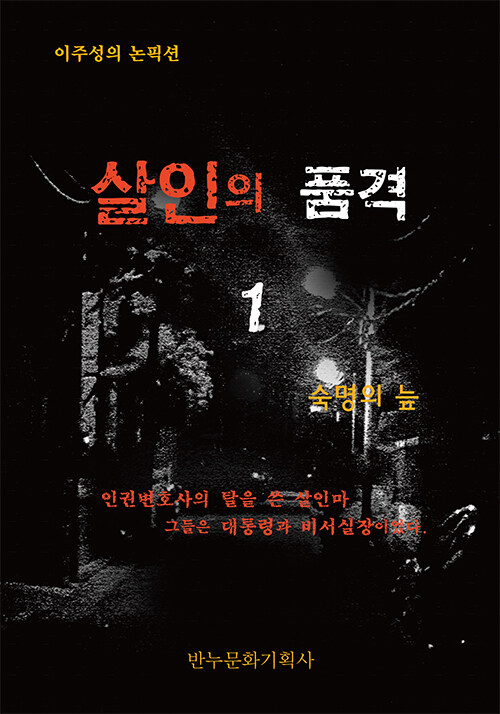
알라딘: 살인의 품격 1

알라딘: 살인의 품격 1

살인의 품격 1 - 숙명의 늪  | 살인의 품격 1 
이주성 (지은이)반누문화기획사(반디누리문화기획사)2019-12-02

살인의 품격 1


460쪽150*225mm874gISBN : 9788996947660

책소개

이주성 장편소설. 2008년 2월 8일 서해로 입국했던 22명의 탈북민들을 14시간 만에 판문점으로 강제 북송시켜 집단 처형시킨 사건을 주제로 한 논픽션 소설이다. 자신과 가족의 생명 보존을 위해 주인공이 목숨을 걸고 사선을 넘나드는 파란만장한 삶을 그린다.

인간이 인간을 잡아먹는 소름이 돋는 북한 정권에 환멸을 느낀 주인공 남춘식은 살길을 찾아 아버지의 고향땅을 향해 목숨을 건 모험의 길을 떠난다. 그는 북한을 떠나기 전 아버지를 죽이고 아내를 겁탈했던 자들을 가차 없이 처단한다. 두만강을 넘은 주인공과 가족에게 천국이라고 생각했던 중국은 불 밝은 지옥이었다. 주인공은 그 땅에서 딸과 아내를 잃는 심장을 도려내는 뜻한 아픔을 겪어야만 했다. 중국은 그에게 슬픔에 잠길 시간조차 주지 않는 악의 무리들이 활보하는 인간 오물장이었다.


목차
무덤의 노래 ― 8 / 40년 흐른 뒤 ― 10 / 천국 맛 ― 20 / 선택 ― 37 / 지옥 맛 ― 50 / 수령의 걸작품 ― 61 / 골칫덩이의 소원 ― 70 / 단고기 ― 90 / 덫에 걸린 미녀 ― 100 / 개 밥 ― 120 / 기로에서 ― 137 / 아버지 이름으로 ― 160 / 죄를 물어라 ― 191 / 불 밝은 지옥 ― 214 / 유인 ― 238 / 아내의 모습 ― 254 / 살인마의 분노 ― 273 / 절망의 끝은 ― 287 / 피는 물보다 진하다 ― 309 / 자유와 목숨의 무게 ― 320 / 벼락 맞은 고깃덩이 ― 343 / 스파이 천국 ― 376 / 거룩한 살인귀들 ― 397 / 은인 ― 419 / 준비 ― 431 / 그들은 왜…… ― 444


저자 및 역자소개
이주성 (지은이)

신간알림 신청
1965.6.10 : 평양시 만경대구역 오류동에서 출생
1968.6.10 : 함경북도 회령시 유선탄광으로 강제이주
1972.9.1. : 회령시 성동인민학교
1982.9.30 : 회령시 성동고등중학교
1982.9 : 회령시 유선탄광노동자.
1986.1 : 북 강원도 문천시 [5.18기계공장] 노동자
1995.3 : 함경북도 회령시 기계수리공장 공무원
2003.1 : 조선로동당 선전, 선동부 [문심무역회사] 중국연변담당 출장소 소장
2004.12 : [조선만년무역총회사] 중국연변담당무역 회령 지사장
2006.1 : 탈... 더보기
최근작 : <살인의 품격 1>,<카피레프트, 우주선을 쏘아 올리다>,<곡성> … 총 7종 (모두보기)


출판사 제공 책소개

‘살인은 정당한가?’ 하는 물음에 우리는 어떤 대답을 할 수 있을까? 만악(萬惡)을 즐기며 낙(樂)으로 여기는 인간은 살인을 목적 달성의 도구로 삼고 있다. 우리는 살인을 어떤 관점과 입장에서 보고 대해야 하는 걸까? 죄 없는 사람들을 죽이는 행위를 악의 살인이라고 한다. 그 악의 살인자들을 그대로 외면하고 방치한다면 인간세상은 [아비규환]의 혼란속에서 종말을 고하고 말 것이다. 국가라고 하는 사회 공동체와 인간들은 징벌(정의의 살인)이라는 이름으로 인간 생명을 보호하고 사회의 안정을 위해 총살형에 이르기까지 수많은 형벌과 사회 법적제도를 만들어 냈다. 그와 반대로 독재자들을 비롯한 반인륜 권력자들은 정권유지와 저들의 정치적 탐욕, 이권 실현을 위한 수단으로 살인을 정당화하고 합법적으로 자행하고 있다.

‘살인의 품격’ 1편은 2008년2월 8일 서해로 입국했던 22명의 탈북민들을 14시간 만에 판문점으로 강제 북송시켜 집단 처형시킨 사건을 주제로 한 논픽션 소설이다. 자신과 가족의 생명 보존을 위해 주인공이 목숨을 걸고 사선을 넘나드는 파란만장한 삶을 그린 내용으로 하고 있다. 인간이 인간을 잡아먹는 소름이 돋는 북한 정권에 환멸을 느낀 주인공 남춘식은 살길을 찾아 아버지의 고향땅을 향해 목숨을 건 모험의 길을 떠난다. 그는 북한을 떠나기 전 아버지를 죽이고 아내를 겁탈했던 자들을 가차 없이 처단한다. 두만강을 넘은 주인공과 가족에게 천국이라고 생각했던 중국은 불 밝은 지옥이었다. 주인공은 그 땅에서 딸과 아내를 잃는 심장을 도려내는 뜻한 아픔을 겪어야만 했다. 중국은 그에게 슬픔에 잠길 시간조차 주지 않는 악의 무리들이 활보하는 인간 오물장이었다.

자유를 찾는 길은 목숨을 담보로 하는 고난의 길임을 주인공이 알기까지 너무도 가슴 아픈 대가를 치러야만 했다. 살인과 극악범죄가 만연한 중국 땅에서 주인공은 생명보존과 가정을 지키기 위해 연쇄 살인을 저지른다. 천신만고 고난 끝에 찾아온 아버지의 고향땅인 대한민국에서 그를 기다리는 것은 강제북송이었다. 청와대에서 대통령과 비서실장은 북한 정권의 협박에 한껏 겁을 집어먹는다. 그들은 정치적 이해관계를 따지던 끝에 주인공 일행과 어린이를 포함한 22명의 탈북민들을 강제북송 시키는 음모를 꾸민다. 북한으로 강제 북송된 탈북민들은 황해남도 해주시 공설운동장에서 전원이 무참히 공개 처형을 당한다. 주인공 남춘식은 강제북송을 당하는 판문점에서 극적으로 탈출하여 살아남는다. 그는 자신들을 죽이려 했던 자들에 대한 복수를 다짐한다.

살인의 품격‘ 1편은 권력을 장악한 친북 수장이 강제 북송시킨 22명의 탈북국민들이 황해남도 해주시 공설운동장에서 집단 처형당하는 장면으로 끝을 맺는다. 한마디로 ‘살인의 품격’ 1편은 자유, 인권, 민주주의 모델국가라고 하는 대한민국의 친북 현직 대통령과 그 최측근들이 저지른 반인륜적 살인 만행을 까밝힌 소설이다. ‘살인의 품격’ 1편은 인간 생명을 훼손하고 잔악한 범죄를 자행하고 있는 자들에게 어떤 해답을 주어야 하는가를 살인이라는 무거운 주제로 다른 작품이기도 하다. 또한 작품에서는 인권과 민주를 팔아 정권을 강탈하여 청와대에 입문한 권력자들…… 그들은 정치적 이해관계, 탐욕을 위해서라면 살인 만행도 서슴없이 저지르는 잔악한 살인귀들이라는 것을 보여주었다.

‘살인의 품격’ 1편에서는 악(惡)과 선(善)을 우리는 어떤 관점으로 보고 대처해야 하는가? 라는 물음을 오늘 혼동과 광란의 시대에서 살아가는 우리들에게 던져주고 있다. 어린이들을 비롯한 수 십 명의 생명을 악어의 무리가 득실거리는 늪으로 던져버린 자들…… 그 생명들을 갈기갈기 찢어 죽게 만든 잔악무도한 행위를 저지른 대통령의 탈을 쓴 흉악범들에게 우리는 어떤 사법적 판결을 내려야 하는 걸까?…… 접기

 
구매자 (1)
전체 (1)
공감순
   
많은 국민들이 구매해야 하는 책  구매
김동훈 2019-12-10 공감 (2) 댓글 (0)
---
마이리뷰
구매자 (1)
   
실화를 기반으로 하는 소설이 새창으로 보기 구매
진짜 문학작품으로서 가치가 높다.
김동훈 2019-12-10 공감(1) 댓글(0)


[김조년의 맑고 낮은 목소리] 대학개혁을 재촉하는 코로나19 바이러스 감염 - 금강일보

[김조년의 맑고 낮은 목소리] 대학개혁을 재촉하는 코로나19 바이러스 감염 - 금강일보
 금강일보 승인 2020.06.29

한남대 명예교수

이미 누구나 다 느끼고 있듯이 우리 삶의 상당히 많은 부분에서 확 달라져야 할 것을 강요하고 있다. 변혁을 거부하고 현상을 지키고 버티려 해도 불가능해, 자연스럽게 달라질 수밖에 없을 것이다. 그 중 대학개혁은 무엇보다 아주 심각한 문제로 대두했다. 코로나가 확산되어 대학의 문을 닫고 학생과 선생이 직접 만나지 못하고 화상공간에서 지식을 전달하고 받는 것을 일상으로 하던 지금이 아니라도, 벌써 오래 전부터 우리 대학은 죽었다고 선언하고 주장하는 소리가 높았다. 이 소리가 이번 코로나19의 창궐로 더욱 빨라지고 높아졌다.

바이러스 확산을 염려하여 모든 대학들은 수업은 다 인터넷 강좌로 진행했다. 중간시험 기말시험을 마쳤고 학기가 끝났다. 새로운 형태의 강의를 준비하기 위하여 대학들과 교수들은 훨씬 더 많은 노력을 하였지만, 학생들의 평가는 매우 냉혹하다. 강의의 질은 떨어졌고, 의미를 찾기가 힘들다는 것이다. 선생들도 비대면 교육의 문제점을 너무나 잘 알고 있다. 일부 학생들은 등록금의 일부를 반환하여 줄 것을 요청하였고, 어느 대학들은 일부를 돌려주기로 결정하였다. 기금을 충분히 비축하여 두지 못한 대학들과 학생들 등록금 이외의 별도의 수입이 없는 대학들은 매우 큰 재정 위기에 봉착하였다. 수입은 줄어들었지만, 지출이 줄어든 것은 아니다. 행정과 교수과정을 중단한 것이 아니기 때문이다. 이런 코로나상황이 지속되면 다음 학기에 얼마나 많은 학생들이 등록하게 될 것인지 매우 불확실하다. 더욱이나 지금과 같은 체제의 대학교육이 과연 의미가 있을 것인가에 대한 강한 의문이 확산되고 있는 상황에서는 더욱 그러하다. 학생들은 과연 이런 대학에서 공부할 필요가 있는 것인가를 깊게 생각하게 되었다.

대학운영의 가장 큰 문제는 운영재정을 어떻게 확보할 것인가 하는 문제와 연구와 교육의 질이 확보되지 않는 대학에 과연 계속 등록하여 공부할 것인가를 의심하는 흐름이 확산되고 있다는 점이다. 진리를 탐구하고 학문을 연구하고 넓히는 문제와 취직을 위한 직업교육이 구별되지 않고 혼합된 상황에서 대학의 정체성을 찾을 수 없다는 점에서 방황하는 현실이 문제다. 출생률이 떨어지면서 능력있다고 판단되는 탁월한 학생들을 선발하는 것이 불가능해졌다는 현실은 오래 전부터 환골탈태의 대학변혁을 요구하고 있었지만, 이미 공룡화한 대학들과 자본의 노예로 전락한 운영체계는 스스로 변화할 수 있는 길과 능력과 철학을 세울 수 없는 지경에 이르게 했다. 그렇게 엉거주춤 창의력 없고 철학과 비전이 없는 상태에서 학생유치 경쟁을 벌이는 동안 거의 모든 대학들은 대학이란 것이 도대체 무엇인지를 심각하게 근본부터 물어야 하는 정체성위기에 직면하였다. 스스로 개혁할 수 없는 대학에 내린 코로나 철퇴는 대학과 사회와 국가가 한 가지로 대학개혁에 힘써야 한다는 것을 요청하고 있다. 이른바 일류대학, 이류대학, 수도권에 있는 대학이라거나 지방대학이라는 미개한 차별이 극복되도록 과감한 종합개혁이 필요하다.

나는 대학개혁은 우리 사회개혁의 근본이요 시작이라고 본다. 온갖 연줄, 특히 학연과 학벌로 사회생활을 해야 하는 우리사회에 창조로운 삶을 이끌어갈 길은 대학개혁부터 이루어져야 한다고 본다. 여러 번 강조했지만, 학생선발의 핵심으로 하는 입학시험제도를 없애야 한다. 고교를 졸업한 것만을 가지고 자기의 미래 진로를 결정하는 제도가 만들어져야 한다. 이른바 한 두 가지 잣대로 학생을 선발하는 제도를 혁파해야 한다. 그 대신 자신이 갈 길에 맞는 대학이나 직업의 길을 자유롭게 선택하도록 해야 한다. 이미 종합대학과 전문대학의 교육내용의 특성이 없어진 상황에서 늘어난 대학들을 그대로 유지할 필요가 있는 것일까? 내용개편과 함께 체제개편 역시 과감하게 이루어져야 할 때다.

우리나라에서는 지나치게 사립대학에 의존하는 고등교육을 극복해야 한다. 국가의 재정능력이 없을 때, 일부 독지가들이나 뜻있는 사람들에 의하여 설립된 대학들은 빠른 시간에 국가가 책임지고 경영하는 체제로 바뀌어야 한다. 그래서 사립대학들을 국립으로 전환하는 일을 전개해야 한다. 그러기 위하여 우선 시민들은 좀 더 높고 의미 있는 교육세를 확보하는 데 협조해야 한다. 그것보다 먼저 각 지역에 있는 대학들은 협의체를 만들고, 공동운영체계를 형성하여 꼭같은 과목과 내용으로 제한된 학생들 중에서 좀 더 나은 이들을 많이 확보하려는 불필요한 경쟁을 극복하고, 참 교육이 무엇인지를 논의해야 한다. 이것이 차차 진행되다가 적당한 시기에 모든 대학들을 국·공립화할 필요가 있다. 지금 교육부가 대학의 자체개혁 수준에 따라서 재정을 지원하는 정도의 미적지근한 태도를 확 바꿔 과감한 개혁정책을 펼칠 필요가 있다.

그렇게 하여 결국에는 모든 교육비는 국비로 충당되어야 한다. 여기서 말하는 교육은 단순히 대학이라는 틀 안에서 이루어지는 인지교육만을 의미하지 않는다. 삶을 준비하는 과정의 모든 교육을 말한다. 진리를 찾는 학문이나 새로운 기구를 만드는 창조력을 기르는 것이나 직업을 찾기 위한 교육 등을 다 의미하는 교육은 결국 국가의 비용으로 충당되어야 한단 말이다. 그 대신 자신에게 맞지 않는 길이라면 쉽게 변경하여 새로운 것을 찾도록 하여야 한다. 이것은 물론 학벌 때문에 생활에서 차등이 있어야 함을 극복해야 한다. 다시 말하면 높은 교육을 받으면 급료가 높고, 직업에 일찍 투여된 인력에 대하여는 낮은 임금을 지급하는 관행을 극복해야 한다. 노동의 성격과 종류에 따라서 임금격차가 심화되는 것을 극복해야 한다. 임금과 기타 소득은 기본삶과 직결되는 문제라는 것을 인식할 필요가 있다.

The “Shiba view of history” and JK rels Clouds Above the Hill Philip Seaton

Popular Culture and the 
Transformation of Japan–Korea Relations
Edited by Rumi Sakamoto and Stephen Epstein
First published 2021
ISBN: 978-0-367-02444-4 (hbk)
ISBN: 978-0-429-39955-8 (ebk)
3 The “Shiba view of history” and Japan–Korea relations
Reading, watching and travelling 
Clouds Above the Hill
Philip Seaton
(CC BY-NC-ND 4.0)
 
3 The “Shiba view of history” and Japan–Korea relations
Reading, watching and travelling 
Clouds Above the Hill
Philip Seaton
In August 2015, Japanese Prime Minister Abe Shinzo issued a statement marking the seventieth anniversary of the end of the Asia- Pacific War that contained the following interpretation of events during the Meiji period (1868–1912):
More than one hundred years ago, vast colonies possessed mainly by the Western powers stretched out across the world. With their overwhelming supremacy in technology, waves of colonial rule surged towards Asia in the 19th century. There is no doubt that the resultant sense of crisis drove Japan forward to achieve modernisation. Japan built a constitutional government earlier than any other nation in Asia. The country preserved its independence throughout. The Japan–Russia War gave encouragement to many people under colonial rule from Asia to Africa.
(Abe 2015)
Abe’s interpretation of the “encouragement” given to “many people under colonial rule from Asia to Africa” by Japan’s victory in the Russo-J apanese War (1904–1905) sidelined the war’s role in paving the way for Korea to be placed under Japanese rule as a protectorate (from 1905) and then colony (1910–1945). Furthermore, it constituted a substantially different position from the statement by Kan Naoto in 2010 marking the centenary of the annexation of the Korean peninsula, which stated “the Korean people of that time was deprived of their country and culture, and their ethnic pride was deeply scarred by the colonial rule which was imposed against their will under the political and military circumstances” (Kan 2010).
 Negative reaction to Abe’s statement in Korea was widespread. Gil Yu- Hyung of the progressive Korean newspaper The Hankyoreh compared Abe’s statement with the historical views of Japanese novelist Shiba Ryōtarō as expressed in perhaps Shiba’s best- known work Clouds Above the Hill. The novel, which was serialised in the Sankei Shimbun newspaper between 1968 and 1972, depicts Japan during the First Sino-J apanese War (1894–1895) and the Russo- Japanese War through the eyes of its three main characters: the Akiyama brothers (Yoshifuru, who served in the cavalry, and Saneyuki, who served in the navy) and poet Masaoka Shiki.
The major theme of the novel is that Japan had to fight – and ultimately defeat – Russia to keep Korea from falling into its clutches. Under this view of history, the wars that Japan waged against China and Russia during the Meiji Period to bring Korea under its dominion are transformed into pleasant memories from a golden era. In contrast, the wars during the Showa Period that began with the Manchurian Incident in 1931 are decried as mistakes that undid everything achieved during the Meiji Period, including the annexation of Korea.
 This understanding of history was thoroughly reflected in the statement released by Japanese Prime Minister Shinzo Abe on Aug. 14.
(Gil 2015)
By linking a work of popular culture to official narratives, Gil identified an example of how popular culture may impact deeply upon Korea–Japan relations. As other chapters in this book indicate, popular culture can perform a variety of roles: establish dominant narratives that shape public opinion (Ria Shibata); create fantasies of the “other” that facilitate newfound interest and exchanges (Chris Perkins); stir controversies that whip up anger or xenophobia (Stephen Epstein); and even make reconciliation a central theme (Rumi Sakamoto). However, post- war or postcolonial reconciliation between nations is built upon stable, mutually acceptable official government positions regarding past histories of violence. If, therefore, Shiba Ryōtarō’s writings are “the historical tale behind Abe’s statement” (Gil 2015), the “Shiba view of history” (Shiba shikan) assumes a pivotal role within contemporary Korean–Japanese relations as a barrier to reconciliation.
 This chapter discusses the origins, nature and implications of the “Shiba view of history” (Shiba shikan) with reference to discussion of Korea in the novel considered to present the clearest example of the view: Clouds Above the Hill (Saka no ue no kumo). Reading the novel in tandem with the NHK Taiga Drama adaptation (broadcast 2009–2011) and associated tourist sites illustrates the interplay between popular culture and official narratives, and their potential impact on Korea–Japan relations.
Shiba Ryōtarō and his “view of history”
Shiba Ryōtarō (1923–1996) was one of Japan’s most popular and prolific novelists. He served in a tank unit during the Asia- Pacific War and later became a journalist for the Sankei Newspaper. He is best known for his historical novels, serialised first in newspapers, and then released as books. His protagonists were mainly famous figures from the Warring States (1467–1603), Edo (1603–1867), Bakumatsu (1853–1867), and Meiji (1868–1912) periods. Shiba travelled extensively and wrote non-fi ction essays, too. His over 500 books won numerous prizes, are still widely read, and have sold hundreds of millions of copies. Often revered as a “national author” (kokumin sakka), Shiba’s legacy is preserved in the Shiba Ryotaro Memorial Museum1 on the site of his house in Osaka.
 
 In his novels, Shiba attempts to adhere to the historical record. Donald Keene wrote about his writing process:
[Shiba] first amassed a large collection of source materials that he carefully read over until he was thoroughly familiar with the facts behind the story he was about to relate; but once he actually began writing, he did not hesitate when necessary to intuit what the characters in his stories had thought or said on a particular occasion.
(Keene 2003: 95)
Isoda Michifumi also notes Shiba’s historical accuracy, particularly in Clouds Above the Hill. Isoda distinguishes three literary genres in descending order of proximity to academic history – historical biography (shiden bungaku), historical novels (rekishi shōsetsu), and period novels (jidai shōsetsu). While many of Shiba’s works set in earlier periods are historical novels in this schema, Isoda categorises Clouds Above the Hill as historical biography given its adherence to documentary evidence (Isoda 2017: 18). As we will see, however, Shiba also has critics on points of accuracy, as well as interpretation.
 The Shiba view of history is particularly associated with Clouds Above the Hill and gives a positive evaluation of the Meiji period (Gil 2015; see also Hirano et al. 2008: 258). The implications for Korea–Japan relations are stark. The Meiji period was when Japan began in earnest its empire-b uilding, wrestled control of the Korean peninsula from China, and warded off Russian ambitions to do the same. Shiba’s evaluation of Meiji as Japan’s brightest moment before taking a wrong turn cannot sit well with Korean views of the period. As Guy Podoler and Michael Robinson conclude:
During the Russo- Japanese War Japan succeeded in furthering its hold over Korea. The victory over the last contender for influence in Korea cleared the way to the annexation of 1910. For Koreans this period signifies the dark dawn of colonial rule […].
(Podoler and Robinson 2007: 196)
To understand the origins of Shiba’s view of the Meiji period, one must look at his broader writings on Japan and Japaneseness. As Naoko Shimazu notes, “Fundamentally, his undying interest was the question of Japanese identity”, and Shiba’s writings had great influence on debates over nihonjinron, theories of Japaneseness (Shimazu 2009: 278). Exegesis of Shiba’s work often reflects this impact. For example, in a two- part NHK Special documentary titled “Shiba Ryōtarō shisaku kikō” (Shiba Ryōtarō’s journey of meditation) broadcast in February 2016 to commemorate the twentieth anniversary of Shiba’s death, presenter Kagawa Teruyuki, who played Masaoka Shiki in Clouds Above the Hill, selected four main themes from Shiba’s writings, particularly Kono kuni no katachi (The Shape of This Nation). Part I focused on Japan’s status as an island nation and identified the curiosity of Japanese people and their mushisō no shisō (literally “thinking of non- thinking”, i.e. an aversion to ideology) as explaining the absorption of new ideas and technology in the Meiji period that facilitated rapid modernisation. Part II focused on characteristics stemming from Japan’s samurai heritage: a desire not to do things that cause shame, and public spirit. Shiba thought these tendencies that had sustained the “Meiji miracle” started to break down during the Hibiya riots of 1905 when protesters grew violent over the lack of war reparations following victory over Russia. In his view, the mistaken direction of the Shōwa period until Japan’s defeat in 1945 stemmed from the military’s subsequent usurpation of “supreme command” (tōsuiken), and their unchecked actions and provocation of incidents that Japan’s leaders had to respond to post facto. NHK cited Shiba’s comment, “There has not been a more stupid period [bakana jidai] in Japan’s long history”.
 A key feature of the Shiba view, therefore, is the turning point of 1905. As Isoda notes, Shiba saw the early Shōwa years as a rogue period (kitai no jidai) when “Japan was not itself ” (betsu no kuni datta) (Isoda 2016: 74–75). Alexander Bukh (2008: 104) argues that by making this contrast Shiba “saves the national history from criticism by shifting the responsibility for these years from ‘Japan’ as a nation to the military, considered to be outside of the normal ‘Japan’ ”. As such, while Shiba’s writings eulogise Japanese history and culture, they defy simple characterisation as nationalism. First, although the Shiba view could be categorised as affirmative nationalism in justifying colonial expansion before 1905, he does not justify Japan’s war aims and war conduct after 1905.2 Second, the Shiba view is also ambiguous or even contradictory regarding Korean colonial rule. For Shiba, “Japan was not itself ” from 1910–1945, and he does not actively present a “revisionist” defence of Japan’s colonial rule in Korea.3 But at the same time, as we shall see below, in Clouds Above the Hill he clearly asserts Japan’s need, even right, to colonise the peninsula. Shiba also appears to lament the recklessness that resulted in the loss of Japan’s Meiji period imperial gains, and not colonial rule itself. In short, the appropriateness of terming the Shiba view “nationalist” differs markedly for the pre- and post-1905  periods.
 As already noted, the influence of Shiba’s writings is enormous. Shimazu (2009: 273) credits Shiba with establishing “the orthodoxy for the post- 1945 reconstruction of the 1904–05 war in popular cultural memory”, and the Hankyoreh article by Gil Yu-Hyung cited above implies that it underpins  the contemporary official narrative (as given in the 2015 Abe statement), too. However, it might be argued that Shiba did not so much create the “bright Meiji, reckless Showa” interpretation of history, but craft its most eloquent and powerful popular culture rendition. As Nakatsuka Akira notes, serialisation of Clouds Above the Hill in the Sankei Shimbun began in 1968, the centenary of the Meiji Restoration. At that time, Japan was in the midst of its post- war economic miracle, which evoked parallels with the Meiji miracle. This bright Meiji narrative infused the speeches of then Prime Minister Satō Eisaku and the views of the conservative elites that planned and carried out the centenary celebrations (Nakatsuka 2009: 14–17). Abe’s 2015 statement, therefore, may not reflect the Shiba view so much as the conservative establishment view passed down by political and business leaders, including Abe’s great uncle Satō Eisaku. From this perspective, Shiba’s contribution in Clouds Above the Hill was to novelise and popularise the patriotic values of Japan’s political establishment regarding the Meiji period.
Consuming Shiba and his view of history
Like many of Shiba’s novels, Clouds Above the Hill was adapted for television. During his lifetime Shiba refused to allow the text to be dramatised because he feared its viewpoint would be mistaken for militarism (Nakatsuka 2009: 21). But, with the permission of his estate, Japan’s public broadcaster NHK eventually made and broadcast the drama in three parts: five episodes in November/ December 2009, four in December 2010, and four in December 2011. Furthermore, from 1999 a process of machizukuri (community building) based around Clouds Above the Hill began in Matsuyama city, the home of the Akiyama brothers and Masaoka Shiki, involving the touristification of sites related to the novel (Hirano et al. 2008: 259).
 The roles and impacts of Shiba’s novel, the NHK drama adaptation, and related tourist sites are linked. The Shiba view of history finds its purest expression in the novel, where long sections of narration, heavily abridged in the drama, provide context. The drama also cuts dozens of figures who play a small part on the grand stage of history and concentrates on the relationships between the three protagonists. While NHK’s adaptation of Shiba feels quite different from the novel in emphasising character study over grand historical tableau, the drama assumed significance in creating shared national culture. Each episode captured between 10 and 20 per cent of the viewing audience when first broadcast in 2009–2011, thus reaching several million citizens. The shared experience was enhanced by the media discussion, publication of related books and magazines, and tourism campaigns that routinely accompany the broadcast of major Japanese historical dramas.
 The importance of the Clouds Above the Hill tourist sites is in connecting the novelisations and dramatisations of history, which lie in the realms of commercial activity and entertainment, with the realms of professional history, heritage, and official narratives. Monuments, museums, memorials, and other heritage sites are overseen by a range of professional custodians of the past, including historians, curators, researchers, tour guides, and local government officials. A major novel/ drama like Clouds Above the Hill forces professional custodians of the past to address semi- fictionalised renditions. Although these professional custodians might view novels and dramas as a hindrance to “accurate history”, they might equally view them as an opportunity to raise interest and thereby disseminate serious historical research to a wider audience. However, whenever works of popular culture feature in, shape the message of, or even make economically viable a publicly funded heritage site, the messages of popular culture have entered the official narrative. Popular texts often first infuse official narratives in this way, as tourism resources managed by or with the involvement of local government that generate contents tourism, namely, people visiting sites related to the narratives, characters and locations of such works (Seaton et al. 2017).
 Reading, watching and travelling the “Shiba view of history”, therefore, reveals how literary texts, screen adaptations, and tourist sites create a mutually reinforcing network built around Shiba’s writing that is further energised by discussion in documentaries, academic discourse, news and social media. When sufficient cultural power is generated, local government becomes involved in managing heritage. Such local practices are then only a short step away from reaching national policy.
Clouds Above the Hill and its critics
Clouds Above the Hill was originally published in 1,296 instalments, many of which depict a self-c ontained event or conversation in the manner of a film scene; others resemble short history lectures. This latter type contains examples of the Shiba view.
  The following section from early in Volume I sets the narrative tone:
Small. There was perhaps no other country as small as Japan at the start of the new Meiji period. […] This small nation, a rural backwater by world standards, had its first bloody struggle with a European civilisation in the Russo- Japanese War.
 It managed somehow to win that struggle. The fruits of that victory were to be devoured and wasted by a later generation of Japanese, but the Japanese of that time used their utmost wisdom and courage, and took firm hold of their resultant good fortune.
(Shiba 2013a: 40)
Japan is presented as vulnerable, wise and courageous. Its adversary, meanwhile, is presented as large and aggressive: “Russia’s ambition to invade the Far East became obvious around the middle of the Tokugawa period” (Shiba 2013a: 358). Shiba is critical of Russian conduct. “To see how bald- faced they were”, he writes, “let us look at what happened between Russia and Japan […]”. He then recounts the Tsushima Incident of 1861:
On 12 April, a landing force went ashore near the guard station at Ōfunakoshi, shooting and killing the guard, a petty officer named Yasugorō, and taking captive his two fellow countrymen stationed there. After confiscating all the provisions and ammunition on hand, the Russians pushed on into the village and stole seven cows as well as gold and treasure before returning to the ship. Such bandit aggression was the Russian way.
(Shiba 2013a: 359)
This incident is notable for the parallels with the Unyō incident of 1875, when soldiers from a Japanese ship landed in a restricted area, were fired upon by the Korean shore battery, and then that was used as a pretext to kill over 30 Korean soldiers and loot the garrison (Kim 1999: 38). This incident was one of the pretexts for forcing the Kanghwa Treaty on Korea in 1876. The Unyō incident is not mentioned in Clouds Above the Hill. The combination of emotive criticism of Russian “bandit aggression” and omission of comparable actions by Japan is emblematic of Shiba’s selective narration of history.
 In many ways, the Sino- Japanese War and Russo- Japanese War were two stages of the same conflict. In the first war Japan wrestled control of Korea from China, and in the second Japan ended Russian ambitions there. Shiba says the following about Korea’s geopolitical predicament:
Now we must touch on the cause of the [Sino- Japanese] war, which lay in Korea. This is not to say that Korea or the Koreans were in any way at fault. The only “fault” lay in a quirk of geography. For a peninsular nation to maintain its independence is never easy […]
(Shiba 2013a: 205)
Korea’s fate in this reading depends upon geography rather than the aggressive ambitions of surrounding powers. This theme is developed further in Volume II:
From the nineteenth century to the beginning of the twentieth, the world’s countries and regions had only two paths open to them: to be colonised by another nation, or, if that was unacceptable, to create industries, gain the necessary military strength, and join the ranks of the imperialist powers. Now in a later age, we fantasise that the nations of that time should have adopted a policy of “neither invade nor be invaded” and should have focused only on the peace of mankind. We attempt to impose this fictive standard followed by these fantasy countries on the actual nations and international society of an earlier age, and then we use this fictive standard to judge the rights or wrongs of a nation’s policy. This kind of thinking turns history into nothing more than clay to be used for making clay figurines in whatever shape one likes.
 The world was at a different stage then. Having once chosen the path of autonomy through the Restoration, Japan had to preserve that autonomy, even if it was to the detriment of another country (Korea). At that historical stage, Japan had to fixate on Korea. If it had not done so, then not only Korea but Japan itself might have been swallowed up by imperial Russia. 
Such was the nature of national autonomy during this period.
(Shiba 2013b: 92)
This section’s vigorous defence of Japanese actions regarding Korea is where Shiba sounds most like a nationalist apologist for Japan’s empire.
 These lengthy passages convey Shiba’s view of history in Clouds Above the Hill. To summarise, the Sino- Japanese War and Russo- Japanese War are portrayed as righteous, victorious wars in which Japan adhered to the behavioural norms of the time. Through victory, Japan secured vital interests and enjoyed its finest military moments in the modern era.
 But Shiba has many critics. Some, like Kanno Naoki writing in The National Institute for Defense Studies News, have censured Shiba from the perspective of military history and a more nationalistic position. Kanno objects to Shiba’s assessment of the reasons for the outbreak of war and his negative depiction of General Nogi Maresuke. Most tellingly, he attacks Shiba’s criticisms of 1930s nationalism as “too simplistic” (Kanno 2009: 34). Nevertheless, Kanno states: “Though one has repeatedly criticised Shiba thus far, one wouldn’t like to assert that the novel should be brushed aside as a means of conveying history to future generations” (Kanno 2009: 35). Kanno’s argument that novels bring to life history via realistic depictions of conversations and acts seems weak given his criticism of Shiba’s historical accuracy. More likely, Kanno found Shiba’s interpretation of the Meiji period more palatable than many other interpretations.
 Such interpretations include those of Shiba’s more progressive critics. Around the time that the drama was released, several books targeted not only Shiba but also NHK and often note omissions of incidents that portray Japan in a negative light. Nakatsuka et al. (2010: 172), for example, note that the Port Arthur Massacre of November 1894, in which Chinese sources claim 10,000 people died, is ignored in the novels and that NHK only addressed it in a guidebook accompanying the series.4 Indeed, much of their criticism targets NHK. Even though the drama focuses less on military history and omits much of Shiba’s more strident narration, Nakatsuka et al. criticise Japan’s public broadcaster for historical inaccuracy, for making the drama at a sensitive time in Korea–Japan relations (centenary of the annexation), and for going against Shiba’s own wishes in producing the drama (ibid.: 180–181).
 The Ehime Society Supporting Textbook Trials and the Society to Consider the Problem of the Clouds Above the Hill Museum also sent an open letter of protest to NHK. Both organisations raised similar criticisms but are significant as groups opposed to the touristification of local Clouds Above the Hill sites. They noted how NHK’s drama in effect supported the views of the Japanese Society for History Textbook Reform, a nationalist group that has produced a controversial textbook available for use in Japanese middle schools since 2002 (Takai 2010: 189). NHK responded that Shiba’s work did not glorify war and that they wanted to convey the energy of the period on a grand scale 
(ibid.: 202).
 However, the Shiba view of history certainly had an impact upon Fujioka Nobukatsu, the ideological father of the “liberalist view of history” (jiyūshugi shikan) and a key member of the Society. In What is the Liberalist View of History?, Fujioka states that reading Clouds Above the Hill showed him a middle way between what he called the “Asian liberation theory” (i.e. nationalism) and the “Tokyo trials views” (i.e. progressivism) of the Asia-P acific War. He presents his “liberalist view of history” as effectively identical to Shiba’s views and summarises them as a combination of “healthy” (kenzenna) nationalism, realism, a rejection of ideology, and anti-b ureaucratism (Fujioka 1997: 138–41).
 This admission by Fujioka indicates that the textbook controversies of the late 1990s and 2000s were heavily inspired by Shiba, although he had died just before the Japanese Society for History Textbook Reform was launched. The approval of their textbook in 2001 had major diplomatic repercussions in East Asia for the next decade, particularly in Korea and China. While this textbook did not present the official narrative of national government (and was subject to many revisions before approval), as a government-a pproved textbook influenced by Shiba’s views, it nonetheless poisoned Korea–Japan relations in 2001.
 Despite his professed rejection of the Asian liberation theory, within a few years of his tribute to Shiba’s influence on his thinking, Fujioka had slipped to the nationalistic extremes of Japanese war debates and was engaging in Nanjing Massacre denial. Ultimately, the views of Fujioka and Shiba on the Asia- Pacific War differed substantially. However, the question remains whether Shiba’s views of the 1930s and 1940s were determined by regret for the damage the war caused Japan or genuine belief that the war and imperialism were wrong.
Clouds Above the Hill as heritage
Shiba Ryōtarō occupies an important position in Japan’s tourism history. He wrote about his extensive travels and conducted fieldwork at heritage sites while researching his novels. In doing so, he crafted uplifting narratives that sustain or even made possible tourist sites today. The impact of his writings makes it appropriate to consider him a father of heritage tourism in contemporary Japan.  Tourism in Matsuyama in Ehime prefecture on Shikoku exemplifies Shiba’s influence. Clouds Above the Hill established Matsuyama as an important site related to the Russo- Japanese War. Under Mayor Nakamura Tokihiro, who was both a fan of the novel and supporter of the liberalist view of history, the city was divided into zones and designated a field museum.5 Seven billion yen (supplemented by 2.8 billion yen from national government) was allocated to building the Clouds Above the Hill Museum and improving infrastructure in the nearby Matsuyama Castle Ropeway area and the Dōgo hot spring area.6 The museum, designed by world-f amous architect Ando Tadao (who also drew up the plans for the Shiba Memorial Museum in Osaka), opened in 2007. A few years earlier, the Akiyama Brothers’ Birthplace Museum was reconstructed and opened in 2005 (Ehime shimbunsha 2009: 14–17). Fortuitously for Matsuyama (and likely with its active lobbying), NHK decided in 2003 to dramatise Clouds Above the Hill. The key sites relating to the novel were ready to welcome visitors inspired by the broadcast of the first part of the drama in 2009.
 Tourism statistics indicate that the machizukuri programme has had a significant impact on the city. The Clouds Above the Hill Museum attracted around 125,000 visitors a year during its first decade, with over 200,000 visiting annually in the years of the drama’s broadcast.7 These enhancements contributed to a rise in the base level of tourism in Matsuyama by about 600,000 visitors per year from the plateau of around five million in the early 2000s to a new plateau nearer six million in the 2010s. This clear success story for the city vindicates its decision to utilise Shiba’s novel as a tourism resource. The city was also awarded the third Minister for Land, Infrastructure, Transport and Tourism Planning Prize in 2007.
 Given that Clouds Above the Hill is now central to municipal branding, that the novel depicts Matsuyama as a vibrant centre of Meiji period modernisation, and that hotels, restaurants and retailers today benefit from the Shiba effect, little incentive exists locally to challenge Shiba and his view of history. Discrediting the Shiba view would not only discredit a view of history but undermine a tourism resource that sustains a local brand, business, and employment. A touristification process like the one seen in Matsuyama, therefore, creates diverse stakeholders with a vested interest in promoting a particular narrative. What matters more than the narrative’s accuracy is its usability: cultural producers easily adapt the Shiba view as uplifting and inspiring entertainment; community leaders derive a positive identity from association with such narratives; and tourism operators treat them as a resource from which to make profits. Where all these benefits exist, politicians may gain public support by promoting the heritage. Local politicians in Matsuyama may focus more on local business, but national(istic) politicians like Abe Shinzo can find in the Shiba view an uplifting alternative to progressive intellectual narratives of aggressive Japanese expansionism in the Meiji and early Showa periods.
Conclusion
The analysis of the Shiba view of history, its articulation in Clouds Above the Hill, the interconnected impacts of the novel, drama and tourist sites, and the relationship between a successful work of popular culture and official narratives together suggest the following conclusions.
 First, the Shiba view of history (Shiba shikan) draws much attention in academic and literary circles within Japan. It has also been credited with influencing or even underpinning the official government narrative. It might be more appropriate to say that the view grew out of existing conservative narratives, such as those expressed during the centenary of the Meiji Restoration. But, the narrative of a bright Meiji period (to 1905), followed by the mistakes of the early Showa period (to 1945), followed by the post-w ar miracle – in other words, two positive periods sandwiching an aberration – is now firmly associated with Shiba. The view justifies Japanese imperialism in light of the era’s norms but remains critical of war year mistakes. In 2015, something close to this position became the official government stance, overturning two decades of more progressive statements made by prime ministers from Hosokawa Morihiro to Kan Naoto.
 Second, although the Shiba view does not offer the most nationalistic interpretation of Japan’s modern history, and indeed it has been criticised in nationalist circles, it nevertheless presents a view largely incompatible with Korea–Japan reconciliation. The wars that paved the way for Japan’s annexation of the Korean peninsula are depicted as part of a golden, energetic age. For Koreans, the Meiji period began with Japan opening Korea via gunboat diplomacy, included two major wars fought in or close to Korean territory, and ended with Korea’s annexation. However bright this period was for Japan, virtually no Korean, North or South, would consider it so for Korea. Overall, as long as the Shiba view and more generally conservative Japanese views of this era remain powerful, the work of this man dubbed a “national author” (kokumin sakka) will impede reconciliation between Japan and the two Koreas.
 Third, the Shiba view exemplifies how popular culture may influence official narratives, and ultimately diplomatic relations. By tracing how the narratives within Clouds Above the Hill went from little-k nown local history, to highly successful work of popular culture, heritage sustained by local government, and historical interpretation affecting national debate (including government- approved textbooks), the discussion in this chapter has indicated how powerful works of popular culture intertwine with politics.
 Fourth, when a popular text achieves sufficient power to influence official narratives, it signals that the work is also embedded in popular consciousness. Political positions might change quickly via an about-f ace in policy, but a cultural artefact can remain embedded much longer. The Japanese official narrative shifted towards a more “cosmopolitan” (Saito 2017) position regarding Japan’s colonial rule of Korea from the Murayama statement of 1995 to the Kan statement of 2010. However, that shift has not outlasted the Shiba view of history. When Clouds Above the Hill first appeared in 1968, the Shiba view was close to the official narrative, and the 2015 Abe statement returns that official position more closely to the Shiba view than at any point since the 1980s.  Peter Duus (2017: 11) has written:
Historical memory is long, especially if it is aggrieved memory. While studying Meiji expansion on the Korean peninsula, I was surprised to learn that even in the 1890s, Korean peasants were singing songs about the defeat of the Hideyoshi invasion three centuries before.
Korean memories remain long and aggrieved about the colonial period, too, which is why the Shiba view and conservative justifications of Japanese empire remain such a barrier to reconciliation today.
 But historical memory may also run deep, especially if it underpins a positive vision of the past that affirms collective identity and sustains economic activity in the present. Herein lie the roots of Shiba’s enduring popularity in Japan and his vision of the bright Meiji period, whose primary achievement was not colonising Korea, but modernisation that allowed Japan to avoid being colonised by the West. These were the clouds – namely Western civilisation as an object of both fear and admiration – that Japanese people saw above the large hill of Meiji period modernisation that they had to climb (Hirano et al. 2008: 258). With the Shiba view, therefore, as with all cultural practices, understanding the meanings and resonances for others of the same work of popular culture is a prerequisite for that work to aid, or at least not hinder, a reconciliation process.
Notes
1 The museum is run by the Shiba Foundation. Their website (www.shibazaidan.or.jp) contains a complete list of his works.
2 “Affirmative nationalism” here is used to refer to arguments such as Japan was fighting for the “liberation of Asia”, or denial of atrocities (particularly Nanjing Massacre denial).
3 Regarding colonialism, revisionists typically make the following arguments: Korean nationalism prevents a fair assessment of the achievements of colonial rule, particularly modernisation and advances in education and infrastructure; Korean leaders prior to Japanese colonial rule were corrupt and unpopular; and Japanese colonialism was more benign than Western colonialism. For an example in English, see Akita and Palmer (2015).
4 See Shiba (2013a: 238–240) for the section about the fall of Port Arthur with no discussion of any massacres.
5 The Field Museum concept is outlined on the city homepage (Matsuyama City n.d.).
6 Interview with Ishikawa Jun at Matsuyama City Hall, Clouds Above the Hill Machizukuri Division, 18 May 2017.
7 As this chapter went to press, tourism levels in Japan were collapsing because of the coronavirus pandemic. This discussion relates to the period up to 2019.
References
Abe, Shinzo. 2015. “Statement by Prime Minister Shinzo Abe”, 14 August. japan.kantei. go.jp/97_abe/statement/201508/0814statement.html.
Akita, George and Brandon Palmer. 2015. The Japanese Colonial Legacy in Korea, 1910–1945. Portland: MerwinAsia.
Bukh, Alexander. 2008. “Historical Memory and Shiba Ryōtarō: Remembering Russia, creating Japan”, in The Power of Memory in Modern Japan, edited by Sven Saaler and Wolfgang Schwentker. Folkestone: Global Oriental: 96–115.
Duus, Peter. 2017. “Introduction: History wars in post- war East Asia, 1945–2014”, in “History Wars” and Reconciliation in Japan and Korea, edited by Michael Lewis. New York: Palgrave Macmillan: 1–16.
Ehime shimbunsha [Ehime newspaper]. 2009. “ ‘Saka no ue no kumo’ no Matsuyama o aruku [Walking the Matsuyama of ‘Clouds Above the Hill’]”. Matsuyama: Ehime shimbunsha.
Fujioka, Nobukatsu. 1997. Jiyūshugi shikan to wa nani ka. Kyōkasho ga oshienai rekishi no mikata [What is the Liberalist View of History? Views of history not taught in textbooks]. Tokyo: PHP Bunko.
Gil, Yun- Hyung. 2015. “The Historical Tale behind Abe’s Statement”. The Hankyoreh, 16 August. english.hani.co.kr/arti/english_edition/e_international/704735.html.
Hirano, Tatsushi, Sven Saaler and Stefan Säbel. 2008. “Recent Developments in the Representation of National Memory and Local Identities: The politics of memory in Tsushima, Matsuyama, and Maizuru”. Japanstudien [Contemporary Japan] 20: 247–77.
Isoda, Michifumi. 2016. 100-fun no meicho. Shiba Ryōtarō supesharu [Classic books in 100 minutes. Shiba Ryōtarō special]. Tokyo: NHK Shuppan.
Isoda, Michifumi. 2017. “Shiba Ryōtarō” de manabu Nihonshi [Learning Japanese history via Shiba Ryōtarō]. Tokyo: NHK Shuppan Shinsho.
Kan, Naoto. 2010. “Statement by Prime Minister Naoto Kan”, 10 August. japan.kantei.
go.jp/kan/statement/201008/10danwa_e.html.
  
Kanno, Naoki. 2009. “Ryotaro Shiba’s Clouds Above the Hill (Saka no ue no kumo) and the Russo- Japanese War: from a researcher’s perspective”. National Institute for Defense Studies News, 137: 31–35. www.nids.mod.go.jp/english/publication/briefing/ pdf/2010/137.pdf.
Keene, Donald. 2003. 5 Modern Japanese Novelists. New York: Columbia University Press.
Kim, Key- Hiuk. 1999. Opening of Korea: A Confucian response to the Western impact. Seoul: Institute for Modern Korean Studies, Yonsei University.
Matsuyama City. n.d.: “ ‘Saka no ue no kumo’ no machizukuri shōkai zasshi” [Pamphlet introducing Clouds Above the Hill community building]. www.city.matsuyama.ehime. jp/shisei/machizukuri/sakanoue/field_museum_map.html.
Nakatsuka, Akira. 2009. Shiba Ryōtarō no rekishikan. Sono “Chōsenkan” to “Meiji eikōron” o tou [The Shiba View of History: Questioning his “Views of Korea” and the “Bright Meiji Theory”]. Tokyo: Kōbunken.
Nakatsuka, Akira, Junosuke Yasukawa and Satoshi Daigo. 2010. NHK dorama “Saka no ue no kumo” no rekishi ninshiki o tou. Nisshin sensō no kyokō to shinjitsu [Questioning the historical consciousness of NHK’s drama Clouds Above the Hill: Fact and fiction regarding the Sino-Japanese War]. Tokyo: Kōbunken. 
Podoler, Guy and Michael Robinson. 2007. “On the Confluence of History and Memory: The significance of the war for Korea”, in The Impact of the Russo- Japanese War, edited by Rotem Kowner. Abingdon: Routledge: 183–198.
Saito, Hiro. 2017. The History Problem: The politics of war commemoration in East Asia. Honolulu: University of Hawai’i Press.
Seaton, Philip, Takayoshi Yamamura, Akiko Sugawa- Shimada, and Kyungjae Jang. 2017. Contents Tourism in Japan: Pilgrimages to “sacred sites” of popular culture. Amherst: Cambria Press.
Shiba, Ryōtarō. 2013a. Clouds Above the Hill. A Historical Novel of the Russo-Japanese  War. Volume I, translated by Juliet Winters Carpenter and Paul McCarthy, edited by Phyllis Birnbaum. Abingdon: Routledge.
Shiba, Ryōtarō. 2013b. Clouds Above the Hill. A Historical Novel of the Russo- Japanese War. Volume II, translated by Juliet Winters Carpenter and Paul McCarthy, edited by Phyllis Birnbaum. Abingdon: Routledge.
Shimazu, Naoko. 2009. Japanese Society at War: Death, memory and the Russo- Japanese War. Cambridge: Cambridge University Press.
Takai, Hiroyuki. 2010. Gobyū darake no “Saka no ue no kumo”. Meiji nihon o bika suru Shiba Ryōtarō no sajutsu [Error-strewn Clouds Above the Hill. Shiba Ryōtarō’s  swindle of beautifying Meiji Japan]. Tokyo: Gōdō Shuppan.
Now On My Way to Meet Who? South Korean Television, North Korean Refugees, and the Dilemmas of Representation | The Asia-Pacific Journal: Japan Focus


Now On My Way to Meet Who? South Korean Television, North Korean Refugees, and the Dilemmas of Representation | The Asia-Pacific Journal: Japan Focus


Now On My Way to Meet Who? South Korean Television, North Korean Refugees, and the Dilemmas of Representation
Stephen Epstein and Christopher K. Green
October 13, 2013
Volume 11 | Issue 41 | Number 2
Article ID 4007


Introduction

In 2011, the recently established South Korean broadcasting network Channel-A launched Ije mannareo gamnida (Now on My Way to Meet You), a program whose format brings together a group of a dozen or more female talbukja (North Korean refugees)2 on a weekly basis. These women interact with host Nam Hui-seok, an additional female co-host (or, in the earlier episodes, two), and a panel composed of four male South Korean entertainers. Episodes typically open in a lighthearted manner, with conversation about daily life in North Korea alongside mild flirtation between the Southern male and Northern female participants, often involving song and dance, but climax with a talbuk seuteori, an emotionally harrowing narrative from one of the border-crossers detailing her exodus from North Korea. Via this framework Ije mannareo gamnida attempts to nurture the integration of North Korean refugees into South Korean society; personalization of their plight occurs in conjunction with reminders of a shared Korean identity maintained despite the regime they have fled, which is depicted as cruel, repressive and backward. The show has proven a minor hit within South Korea and received coverage from local and global media (see, e.g., Kim 2012; Choi 2012; Noce 2012).

The unusual subject matter of Ije mannareo gamnida itself renders the show worthy of analysis; equally significantly, it offers a useful window into attempts to address South Korea’s increasingly diverse society, which now includes a large number of North Koreans, as well as media practice in the face of this demographic shift. Nevertheless, other than journalistic treatment, only a limited number of South Korean scholars (e.g. Tae and Hwang 2012; Oh 2013) and Western academic bloggers (Draudt and Gleason 2012) have thus far investigated the show and its larger social ramifications. In this paper, we ask how Now on My Way to Meet You is to be understood within the contexts of South Korean society, its evolving media culture, and developments in South Korean popular representations of North Koreans. We offer close readings of segments from Ije mannareo gamnida in order to elicit motifs that recur as it pursues its stated goal of humanizing North Korea for a South Korean audience and giving defectors a voice amidst the general populace. Given that the show’s very title intimates that a genuine encounter is about to take place, one might reasonably ask how successfully Ije mannareo gamnida establishes a meeting point for South Koreans with these recent arrivals from North Korea: in other words, does the show fulfill its stated aim of breaking down prejudices against North Korean refugees and supplying them with a vehicle that allows self-expression?3 Or, alternatively, does it reinforce, even if unintentionally, pre-existing regimes of knowledge and actually impede understanding of North Korea and its people? As we will argue, given the broader sociopolitical context, the show’s desire to reinforce elements of commonality between North and South while illuminating life in North Korea leads to a double bind: viewers are encouraged to recognize homogeneity with the newcomers based on a shared ethnic and cultural identity, even as the conversations and editing techniques applied to the material often represent the Northern panelists as Others.


Figure 1: “The longing of 61 years, the dreams of 61 years...now on my way to meet you.”


Now on Our Way to Ije Mannareo Gamnida

The debut of, and attention accorded to, Ije Mannareo Gamnida, or Imangap, as it has come to be nicknamed, rely on phenomena that have made the show compelling to audiences now when its very appearance could scarcely have been imagined even a decade ago. Perhaps most importantly, the size and demographic profile of the defector population within South Korea has undergone significant change in recent years. Stirred initially by the disastrous North Korean famine of the 1990s, the number of talbukja arrivals grew steadily to one to two thousand each year between 2002 and 2005, and then climbed to an annual level of two to three thousand in the period between 2006 and 2010. This rapid growth has been accompanied by a marked shift in the gender distribution of refugees.4 Although the majority of defectors were male up through the end of the twentieth century, as the trickle of those escaping from North Korea grew into a steadier flow, more North Korean women began to cross into China (Lankov 2006). Most have stayed in China or returned to North Korea, but many have travelled on to South Korea. As of 2013, there exists a substantial community of roughly 25,000 talbukja in South Korea; among these, approximately 70% are female (Kim 2013).

This explosion in the number of North Koreans living in South Korea has coincided with significant developments in governmental approaches to the North. The Sunshine Policy, under which South Korea adopted a more open approach toward North Korea between 1998 and 2008, laid the groundwork for new understandings of the North-South relationship and how this relationship might be portrayed in popular culture (Kim 2007; Bevan 2010). Until then, Southern portraits of North Koreans had been almost inevitably monochromatic, treating counterparts across the 38th Parallel as virulently evil Communists or downtrodden, brainwashed automatons. From around the turn of the millennium, though, such depictions began to encompass ever more multifaceted and sympathetic renderings of the life worlds of North Koreans, most notably in the blockbusters Shiri (1999) and J.S.A.: Joint Security Area (2000). As discussed by one of the co-authors for this journal (Epstein 2009a), frequently light-hearted modes of presentation also surfaced, which included a number of B-movie comedies that envisioned romances between Northern and Southern protagonists, such as the 2003 movie trio Namnam bungnyeo (Love Impossible), Geunyeoreul moreumyeon gancheop (Spy Girl) and Donghaemulgwa baekdusani (North Korean Guyz). The simultaneous appearance of these films, though seemingly coincidental, clearly responded to an atmosphere of hopefulness about North-South reconciliation after the 2000 summit meeting between former leaders Kim Dae-jung and Kim Jong-il.

Ironically, however, another corollary effect of the warming at the state level was to move troubling issues involving defectors out of policy discourse. Both the Kim Dae-jung and Roh Moo-hyun administrations avoided shining too bright a light on the sufferings of incoming North Koreans out of a concern that doing so might cause the North Korean government to protest strenuously and retreat from engagement. Politically prominent defectors who might otherwise have acted as leaders of the fledgling defector community, most notably former Workers’ Party International Secretary Hwang Jang-yop, were restricted in their movements, partly for their own security.

In late 2007, however, the South Korean public voted in Lee Myung-bak and a far more conservative administration. The subsequent shooting of a Southern civilian by a DPRK soldier at the Mt. Geumgang tourist resort zone in summer 2008 then pushed the new government into an even harder stance against North Korea than most had anticipated. North Korea’s second nuclear test in 2009, the March 2010 sinking of a ROK Navy vessel, and the shelling of Yeonpyeong Island that November, which brought two civilian deaths, heightened skepticism throughout society about possibilities for rapprochement with Pyongyang.

Moreover, such events have spurred a renewed focus on North Korean refugees and expedited the increasing influence of those working to raise awareness of their plight. This trend has led, for example, to defector Cho Myung-chul, former director of the Institute for Unification Education, becoming a lawmaker in the National Assembly. There he has found a like-minded colleague in Ha Tae-kyung, the controversial founder of Open Radio for North Korea, a Seoul-based shortwave radio station that broadcasts across the border on human rights and related issues. It also has meant that former espionage agent Kim Hyeon-hui, imprisoned for the bombing of a Korean Air jet in 1987 but now rehabilitated and highly critical of the North Korean regime, could appear in the media where once she was kept out of the public eye. Meanwhile, the National Human Rights Commission began documenting abuses suffered by North Koreans within the DPRK in a deliberate infringement of North Korean state sovereignty.

A recent significant change in the structure of South Korea’s media has also played a critical role in the arrival of Ije mannareo gamnida: a controversial bill passed under the Lee government in 2009 granted permission for the first time to print media companies to operate television networks. Furthermore these new comprehensive broadcasting channels (jonghap pyeonseong cheneol, or jongpyeon for short) have extended operational powers that allow them to create educational and publically oriented programs to be disseminated more broadly and thus make them more similar to large terrestrial networks than other cable channels. The Kim and Roh administrations had maintained the state regulation of a previous era; given the finances of the South Korean mediascape, the companies best positioned to take advantage of any such modification would have been far from progressive. While consideration of the many issues occasioned by this change and the bitter debate that they have aroused within Korea lie beyond the scope of this paper (for more see T. Kim 2011), for our purposes it is important to note that the palette of South Korean television now incorporates within its pigmentation such outlets as Channel-A, owned by the conservative Dong-A Ilbo, and TV Chosun, affiliated via its parent company with the Chosun Ilbo, widely recognized as the nation’s most notable right-wing daily. Both have maintained close relationships with the Lee and Park administrations and strive to highlight North Korean refugee issues.5 Their activity contributes to a media environment in which criticism of North Korea is now less likely to be blunted than it had been, but also more likely to convey the authenticity of first-hand reportage and therefore frequently controversial.6

These developments have not gone unnoticed by the DPRK itself, which recently launched a scathing attack in the Rodong Sinmun on South Korean media treatment of defectors, particularly females:


The south Korean puppet group is resorting to the smear campaign against the DPRK, trumpeting about the "human rights record" in the north, Kang Kyong Suk noted, and went on:

The group set up even a TV channel specializing in conducting an anti-DPRK smear campaign, letting “defectors from the north” appear in programs.

It went the lengths of bringing together those “who were not defectors from the north” and staging such burlesque as an art performance by a "group of beautiful girls, defectors from the north," in the heart of Seoul as part of the smear campaign against the north. 7

This counteroffensive suggests a reframing of North Korea’s own representations of South Korea. Where focus once centered upon South Korea’s sufferings under American imperialism, now defectors in South Korea themselves are drawing attention, with their lives described for the North Korean audience in a demeaning way that displaces the humiliations of capitalist society onto former DPRK compatriots, with a forceful message that those who remain behind indeed have “nothing to envy.” This evolving strategy offers indirect, but ample, proof that the barriers preventing information about the outside world from entering the DPRK are becoming increasingly porous. The Dong-A Ilbo has recently reported that a young elite North Korean woman studying in Beijing defected as a result of watching Imangap. If verified, this claim would reaffirm the urgency of this reframing.8

There appears little doubt as well that the lopsided demographics of the refugee community have driven increasingly gendered depictions of talbukja in South Korean media and popular discourse, and although there has been a recent spate of sympathetic fictionalized treatment of Northern male spies in South Korean film (Jung 2013; Kwon 2013), actual border-crossers are now overwhelmingly represented with a female face. While the Korean phrase “namnam bungnyeo” (lit. southern man, northern woman) predates the division of the peninsula, the existence of this trope suggesting the most desired origins for each member of a Korean couple has fostered an exoticization of Northern women, who are often depicted as retaining a traditional, wholesome beauty lost by their Southern counterparts (Epstein 2009a). Such female talbukja are subject to ambivalent responses in South Korea, however: they may be denigrated as the recipients of a blinkered education in the North that has left them ignorant, or patronized as trafficking victims during their transit through China, a characterization that not only carries with it stigma but takes little account of the agency evinced by many in seeking to improve their lives and those of their families via marriage brokers (Kim 2013; Ryang 2012). Unsurprisingly, the ideological and cultural gulf that has arisen across the 38th Parallel over the course of almost 70 years has meant estrangement and difficulties in adaptation for these border-crossers, both in terms of their own abilities to cope with the new environment and the attitudes of the host society.

However, Imangap should not be understood through the inter-Korean lens alone, for the show also reflects South Korea’s growing diversity. The number of foreigners living in Korea as of June 2013 topped 1.5 million, roughly 3% of the population.9 Of course, the process of integrating foreign residents into South Korean society has not always been smooth. The government has devoted the majority of its attention to female marriage migrants, whom it has strived to assimilate within the national fabric. Nonetheless, many of these initiatives, though explicitly heralding a new era of multiculturalism and aimed at ensuring proper access to South Korean social infrastructure, have featured a heavy-handedness that attempts to convert incoming individuals into proper South Korean subjects, and has led to efforts to, if not erase, then at least subordinate pre-existing non-South Korean identities (Lim 2009; Watson 2010).

Media examples of such top-down responses have included shows like KBS’ Love in Asia, which features the appearance of married couples in which one partner, almost invariably the wife, is foreign. Typically, the members of the couple discuss their lives and are filmed in their homes, and a trip is made back to visit the wife’s family in her country of origin. Images repeated from show to show reinforce a narrow set of conceptions: that the husband hails from South Korea’s lower socioeconomic strata; that the wife has come from an even poorer nation; that painful family separations are to be endured for the chance of a better life in wealthy South Korea, where the wife works diligently to accommodate herself to local mores; and that, for the most part, those in the family’s immediate orbit respond with displays of the affectionate solicitude known in Korea as jeong to the new arrival. Though empathetic, such treatment has also been criticized for being patronizing or ignoring the diversity among immigrants to Korea (Jeong et al. 2011). The recurrent themes suggest an effort on the part of government-sponsored media to offer not only reassurance that the nation is being a welcoming host as its demography evolves but also reminders that further education remains necessary in the face of reports that newcomers encounter prejudice. One might readily argue that Imangap, whose production is openly supported by the Ministry of Unification, stems from a similar desire to almost will into being the acceptance and assimilation of North Koreans.

The Chatter of (North Korean) Beauties

The attention accorded to Now on My Way to Meet You derives, then, in part from its intersection with current political and sociocultural trends. A crucial further factor, however, in the show’s ability to garner an audience, especially locally, is its engagement with prevailing tastes in contemporary South Korean television. As a yeneung (variety entertainment) program, it draws on an omnipresent talk-show format, in which a group of several figures who are already, or are poised to become, familiar to viewers gather with a host or two and occasionally an additional panel to laugh, joke and discuss.10 In this regard, Imangap deliberately mimics KBS’ Minyeodeul-ui suda (Global Talk Show, more literally “The Chatter of Beauties”), or Misuda, as it was commonly known, a popular program that aired between 2006 and 2010 and featured a group of young, female foreign residents discussing their lives in South Korea in Korean, with a presenter and a panel of local males who ensured a flirtatious subtext. Several of the women on the show appeared weekly, with some becoming regulars in domestic advertisements and on South Korean television’s variety show circuit.

The influence of Misuda on Imangap is underscored not only in the prosody of their nicknames, but also in the fact that the two share the same primary host, Nam Hui-seok, and that a Misuda panelist, Bronwyn Mullen, acted initially as co-host on Imangap, although she was later dropped. The regular praise that the talbukja guests on Imangap receive as endearing beauties (minyeo) further reinforces this connection, as does the show’s subtitle, talbuk minyeodeul-ui hamkke-wa haneun isan gajok gamdong peurojekteu, an exceedingly difficult phrase to translate idiomatically. (A literal rendering leads to the tongue-twisting “Separated family emotion project together with Northern escapee beauties.”)11 Both shows have frequent recourse to conversations about cultural difference, a fondness for quiz-like games to pique audience interest and elicit information about such difference, and a studio arrangement in which the presenters, female panelists and male panelists are seated separately around a central floor area for performance.


Figure 2: KBS’ Global Talk Show and its North Korea-focused imitator Now on my Way to Meet You.


The format of Ije mannareo gamnida thus operates within a tested formula of chat with attractive women who are intriguingly foreign but able to engage with South Korean society. Personalities emerge with whom viewers are encouraged to form an imagined affective bond through regular contact. Each show’s popular panelists refer upon occasion to their own Internet “cafés,” a specifically Korean type of social media site that allows interaction between celebrities and their fans. Like Misuda, Imangap reflects the growing prominence of young women within South Korea’s societal fabric and its media-saturated consumer capitalism that values youthful femininity as a commodity that can be converted into cultural content (Y. Kim 2011).

However, one should not go too far in pushing the parallels between Misuda and Imangap: the northern origins of the guests on the latter show inevitably lend it a serious undercurrent absent from its more resolutely upbeat forerunner, whose immigrant panelists arrived in Korea under happier, entirely voluntary circumstances, and whose occasional travails in Korean society as foreigners are offset (or superseded) by special treatment accorded to celebrities in the making. While most commentators have noted the salient links between Misuda and Imangap, fewer have noted another source of genetic material for the latter show: KBS’ long-running Geu sarami bogo sipda (lit. “The Person I Miss”), which relied on riveting narratives of anguish from those seeking to locate loved ones from whom they had been separated and in the process opened remarkable windows of oral history onto South Korea’s recent past. The already cited subtitle of Imangap, with its explicit pointer to divided families and meetings after a long absence, suggests a clear connection to Geu sarami bogo sipda, which converted painful personal narratives into grist for the collective understanding of South Korea’s frequently traumatic development experience (cf. Tae and Hwang 2012).12

Geu sarami bogo sipda ran for several years, and as time passed the pool of those searching for family members with whom they had lost contact shrank: the show made its way through the backlog of people wanting to appear, and others presumably conducted their own successful searches as Korea became highly digitized. An increasing percentage of those who made their way on to the show were international adoptees, an evolution that encouraged a consciousness that the unhealed wounds of South Korea’s past were progressively being played out beyond its borders. Likewise, other programs that involved tearful tales of separation and reunion among Korea’s immigrant community, such as Love in Asia, Sadon cheoeum boepgesseumnida (Meet the In-Laws) and the “Asia! Asia!” segment on Neukkimpyo (Exclamation Point), further fostered a sense that the nation had itself outgrown these problems, become more prosperous, and was now standing in a hierarchical relationship to less developed neighbors, toward whom viewers could feel a mixture of sympathy in remembering South Korea’s own similar tales, and relief in an acknowledgment that the nation was moving on (Epstein 2009b).


Figure 3: Screenshot of “The Person I Miss" (Geu sarami bogo sipda) featuring an American adoptee seeking relatives in Korea


Joint Insecurity Area

In order now to flesh out observations sketched above, let us consider in detail characteristic segments of Ije mannareo gamnida that demonstrate the show’s strategies in representing North Korea and North Koreans to a South Korean national public. In tracing how the show moves from lighthearted opening to more serious finale, we have chosen to focus first on a close reading of Episode 45, broadcast in October 2012, not least because Channel-A has uploaded a number of segments of this particular show on YouTube and their availability will allow readers to assess our interpretations independently.13

The episode starts in a conversation with the so-called “S4,” the show’s quartet of featured Southern male panelists, and the news that one of its regular members will soon be marrying a woman seven years his junior. This announcement leads to words of teasing congratulation from one of the North Korean female panelists and well illustrates the show’s favored opening tone of light banter that often features romance and matchmaking as a subtext.


This interchange continues with the introduction of actor Kim San-ho, a handsome new male panelist. For his debut on Ije mannareo gamnida, he performs “Sandy” from the musical Grease, eventually crossing the stage to serenade Shin Eun-ha, characterized on the show as one of its two most notable minyeo. The attention that Kim lavishes upon her provokes embarrassment, though not displeasure; editorialized subtitling reinforces the pseudo-romantic atmosphere (“the moment Eun-ha falls in love” reads one caption as Kim kneels by her side and sings).14 Embarrassment is an emotion that the show plays to, as do many Korean entertainment programs (and social occasions in which icebreaking is desired), in an attempt to create a sense of intimacy by breaking down barriers that arise from the stern maintenance of chemyeon (face). Here the ploy takes on additional piquancy from the way that it attempts to break down boundaries between North and South but also suggests that a shyness born of unfamiliarity and lifetimes of preconceptions impedes freer interaction. The insistent recourse to the namnam bungnyeo trope is difficult to ignore.


Remaining equally good-natured but shifting towards quasi-burlesque, the spotlight moves to panelist Jo Se-ho, a rotund comedian, who mimics the stretching exercises performed by children on North Korean television as they mobilize the DPRK in daily calisthenics. Shin Eun-ha and her sister Shin Eun-hui, also a panelist on the show, join him. As they stretch, a caption declares, “From Daehongdan potato to rhythmic gymnastics challenge.” The allusion to Daehongdan County in Ryanggang Province would likely occasion a nod of ironic recognition from talbukja viewers to whom the site is well known for a visit from Kim Jong-il at the peak of the 1990s famine, during which Kim declared that potatoes are equal to rice, putting a cynically favorable spin on the desperate need to substitute potatoes for the nation’s preferred staple.15 Regular viewers of the program would also recognize the reference, as two earlier episodes, numbers 32 and 41, had made digs at the sophistry of regime rhetoric. The former, which came from North Korean television, displayed a young boy singing an ode, in typically studied North Korean style, to the marvels of the Daehongdan potato (“Daehongdan potatoes are so huge you can’t finish an entire one”), and, by extension, the pleasures of life under Kim Jong-il.16 The latter had Jo reprise the boy’s performance in a routine where he too sings about the remarkable tuber and provokes hearty laughter from all other participants on the show.17


Here in Episode 45, Jo tells us, in humorous self-deprecation, that he rehearsed until 4 a.m. the previous evening with the Shin sisters in order to be able to produce the well-choreographed routine that we are to witness. First, a clip is played of children performing the stretching exercises in a park outside Mangyongdae Schoolchildren’s Palace in Pyongyang, with a subtitle that informs the audience that Kim Jong-il instituted the exercise regimen in 1994. The program thus offers an opportunity for deeper understanding of North Korean society; however, delivery of this information is unlikely to register uppermost in viewers’ minds: Jo’s incongruous imitation of the children’s shorts and knee-high socks turns the sequence into an entertaining vignette that renders the North endearingly quaint. Furthermore, multiple cutaways to the bare legs and lower body of Shin Eun-ha as they perform these calisthenics suggest that, above all, the show’s producers simply recognized an opportunity to draw attention to the participants’ attractiveness in a mildly titillating fashion.18

Such strategies exemplify how Episode 45 pursues the show’s stated goals of combating stereotypes and allowing empowering forms of self-expression, but in ambivalent form. Similar ambiguities arise in the following segment. The audience now meets Choe Geum-sil, a guest panelist who will later be featured in the episode’s talbuk seuteori. Choe is treated as a celebrity, in that she recently won a regional heat of a long-running amateur singing contest televised by KBS, “Jeon-guk norae jarang” (lit. “Nationwide Song Pride”). Given that talbukja make up only a small, if noteworthy, fraction of the total population, its successes usually summon the attention of both the South Korean and international media.19 A natural performer, Choe introduces herself in the brashly confident manner that is de rigueur for Korean TV competitions, albeit with the addition of Northern declamatory mannerisms, and then offers the audience a brief rendition of the song that gained her first prize.


The yeneung program format urges singing, dancing, and demonstrations of athleticism generally. Imangap appears to favor such vignettes more than most, however, not only because the North Korean education system attempts to instill these skills in its people, but because artistic display provides a relatively innocuous method for allowing difference to shine through, while nonetheless encouraging feelings of warmth.20 Few episodes go by without multiple songs, the majority of which relate to either the glory of the Kim family and/or a tenet of North Korean socialist morality. 21 In this case, the traditional Korean style of the song that Choe performs transcends the history of division in reflecting the shared culture of North and South, but the revelation that Choe honed her vocal and oratorical prowess, of which she also gives a sample, as part of a propaganda troupe in a North Korean military unit has the opposite effect. The dissonance is further emphasized by a caption stating that the overall effect actually resembles watching a North Korean broadcast (“jeongmal bukhan bangsong boneun neukkim”). Drawing viewers closer and then pushing them away in this manner exposes dilemmas at the show’s core: elements expressing shared traits or heritage as Koreans are juxtaposed with those that highlight divergence.

The program then moves on to its regular segment of informative discussions of daily life in the North, still enlivened with a sprinkling of humorous vignettes. In this episode the audience is treated to discussion of the North Korean state food distribution system, and dialogue about items eaten in the North generates further cognitive dissonance. All the Northern women acknowledge an unwelcome familiarity with kangnaenggibap, a ubiquitous mix of corn and rice eaten as a rice substitute during hard times. Not one of the South Korean cast, by contrast, has previously tried it. The host, Nam Hui-seok, now parodies the presenter of another Channel-A TV show, Meokgeori X-Pail (“The Culinary X-Files”), as northern food items are trotted out for a taste test. Upon sampling the uninspiring blend, Nam states drolly, “It’s alright now, but after a year things would be a bit different.” The segment also carries a discussion of differences between Southern and Northern varieties of kimchi, but dialogue, and ability to offer insight, stalls at the absence of seasonings other than salt available to add flavor to the staple. Nam utters a simple declaration upon tasting the dish: “Jjamnida” (“It’s salty.”).


The show continues its discussion of the DPRK’s state distribution system with a focus on the mundane products that people receive through it. Such discussion segues into reminders of impoverished and difficult lives. One of the most popular panelists, Kim Ara, relates a story about waking up once in her North Korean home with blood trickling on her face as a result of nocturnal visitations of mice. Ominous background music as she speaks builds mock-horror film suspense, while cutaway shots to the disgusted expressions of South Korean panelists underscore that the narrative is meant to be viscerally affecting and alien to contemporary South Korean middle class experience, while those born in the North react with nods of recognition. Despite an avowed desire to break down barriers, editorial intervention, then, points up Otherness.

At this point, the show makes a transition toward discussion of food shortages in more serious fashion and presents archival footage of the Gonan ui haenggun (“Arduous March”). Recapitulation of the famine is introduced with a caption that speaks of the Arduous March as “the period in which North Korea’s total distribution society collapsed.” Slowly, but insistently, the episode prepares for a heart-rending climax as production techniques work to engage sympathy. As video clips recall the disastrous floods and droughts of the era, dramatic strings, leaden drumbeats and special sonic effects build tension. Shots of starving children, disseminated worldwide since the 1990s, appear, as do South Korean newspaper headlines. Inset shots of the panelists’ expressions emphasize the similar response of those from both North and South; host Nam adds occasional narration. The message is clear: the famine, though having taken place in the North, should be regarded as a tragedy for the entire Korean minjok (“race” or “people”).


Figure 4: A segment on the Arduous March. The caption reads "People who were helpless to avoid starvation as the 100% state distribution system collapsed."


Although the emotional manipulations are palpable, they fall readily within local traditions of melodrama and are not merely expected but even perhaps desired; rather more troubling is a cavalier attitude towards documentary accuracy in the montage: the footage of one woman in the piece comes from the end of the 2000s,22 suggesting that the show’s producers were more concerned with images of suffering in the DPRK than historical veracity. Hackneyed shots of goose-stepping soldiers are included as well, carrying with them the implicit subtext that the decisions of an uncaring regime to prioritize military needs extended the scale of disaster. As the montage ends, a caption “nunsiuri bulgeojin talbuk minyeodeul” (“the reddened eyes of refugee beauties”) drives home the cruelty of visiting human-created catastrophe upon the innocent, who also happen to be—lest the viewer has forgotten— attractive young women, while the studio camera pans to shots of the talbukja panelists composing themselves as the film clips fade. The video returns to discussion of the Arduous March period through the memories of the panelists, and does not stint on a continued backdrop of sentimental music to tug at viewer heartstrings. The show takes advantage of personal tales of food deprivation and malnutrition to render the suffering viscerally affecting; Jo hangs his head in dismay when he hears from a panelist that of the forty children in her school class, fully fifteen could not attend school because of hunger.

Now on Our Way to Meet Who?

The inherent contradictions in the core characteristics of Imangap become perhaps most evident when one examines the strategies used for the final minutes of each episode. For the most part, the culmination has been marked by a talbuk seuteori (“defection story”), and even though they are presented in manipulative fashion, it would require a heartless viewer indeed not to be moved by these powerful narratives. In a recent paper, however, Oh (2013: 319) brings together a focus group of talbukja to discuss their perceptions of how border-crossers are presented in South Korean media, and their discussion of Imangap in particular suggests that the show is a target for substantial criticism among the defector community precisely for how it portrays them as objects of pity. Many of Oh’s interviewees feel that Now on My Way to Meet You willfully, if not maliciously, misrepresents them: “If [South Koreans] see that, they’ll likely say that the women left North Korea because they couldn’t live there, couldn’t adapt [to the changes in North Korean society]” one interviewee comments. “It’d be good to go to Channel-A and ask them to stop the show. Too many lies,” adds another. Indeed, dominant media representations of North Koreans in South Korea fail to acknowledge that a substantial percentage of border-crossers actively select both the time and place of their departure from North Korea, and that they do so to meet specific life goals, such as obtaining education in South Korea, and utilize the human capital they have available to access opportunity in China and South Korea (Kim 2013).

Many recent episodes of Imangap, however, have taken a different approach to the final moments of the show and bring before the audience narratives of talbuk seonggong (“refugee success”) rather than the typically heart-rending tales that focus on the process of flight from North Korea itself. Regardless of whether the show’s producers have been consciously responding to criticism from South Korean academics and the media, talbuk seonggong narratives patently do return agency to defectors instead of painting them as downtrodden victims. In this section a regular panelist, or, more frequently, a third party, explains what she (or even, occasionally, he) has achieved since arriving in South Korea, and how. For example, Episode 41 introduces a woman who owns and operates a Korean restaurant with a menu of 160 dishes, and Episode 46 presents another who, driven by the desire to provide her young daughter with a better life, worked night and day to build up a micro-empire of convenience stores.23


To conclude our analysis of the show, let us juxtapose these divergent concluding strategies, one in which defection is marked by desperation, suffering and a lack of the exercise of free will, and the other in which it encompasses successful transition to neo-liberal subjectivity and acquisition of economic benefits in South Korea. The lurching between the two poles highlights the broader uncertainties that underpin Imangap.

The talbuk seuteori of Lee Sun-sil in Episode 28 is anomalous for a variety of reasons.24 Lee is older (and considerably heavier) than the typical minyeo panelist; importantly, too, she hails from Pyongyang. Refugees rarely come from the North Korean capital, and those that do find themselves viewed with suspicion within their community, facing assumptions that that they must have done something wrong that made them feel a need to escape the showpiece capital (Green and Park 2012).


The incongruity in Lee’s defection story is highlighted by the opening question from one host, who asks why she chose to defect given that she had been living a comparatively comfortable life, doing work for the Korean People’s Army that was not onerous, and was blessed with good chulsin seongbun, the system through which the perceived loyalty of a North Korean citizen to the regime is classified. Lee answers that the money she earned from her daily work with the military had become insufficient to buy even a kilo of rice on the open market. Furthermore, she suffered from domestic violence at the hands of her husband. As a result of the growing divergence between market prices and her income, Lee and her younger sibling were driven slowly into poverty and, ultimately, forced to embark on a beggar’s life (kkotjebi saenghwal). Upon mention of how Lee turned to begging for survival, the show’s producers raise the level of emotional intensity, bringing in piano accompaniment as she comments that everybody in North Korea, from children to the elderly, will have experienced kkotjebi saenghwal at some point in their life. An on-screen caption, “eorinaibuteo noinkkaji haruachime kkotjebiga doeneun sinse” (“hard life where anyone from young to old can become a beggar in an instant”), reinforces the hyperbolic point.

The high emotional tenor of the narrative, which is packed with tragic events, continues as Lee reveals how she had to give birth on the street near a train station in a Ryanggang Province border city. Moreover, she claims to have been forcibly repatriated no fewer than nine times, a point highlighted in the titling of this segment, “Lee Sun-sil, Nine Times Repatriated” (“ahop beon bukseong doen isunsil”). On each occasion, she notes, she faced torture at the hands of the DPRK’s security apparatus and speaks of the beatings she received in detail, noting how her child wept as it was forced to watch these wrenching scenes. Menacing sound effects are added, and periodic cutaways engage empathy for the pathos of her narrative: the horror of the hosts, the pensive, downcast expression of her South Korean husband in the audience, and abundant tears and the shock on the faces of her fellow panelists all suggest that her story is unusually distressing, even for those who have fled North Korea.

Lee explains how she was eventually able to cross into China for good. Sharp intakes of breath from others in the studio audience, however, elevated in the mix, greet the news that she immediately fell victim to human traffickers, and was deceived into selling her child for a trivial sum. The narrative then moves to South Korea, whereupon Lee attempts to convey the ongoing nightmare that her life has become as a result of her experience of defection, repatriation, torture and the loss of her child in China. She states that her pains are not hers alone, claiming that 80% of defectors also live with similar psychological hardship.

Lee’s account climaxes, as do other examples of talbuk seuteori, with the display of a “gift” for an absent loved one. Regardless of whether the women choose the items on their own or are guided to an appropriate concept by the show’s producers, the embodiment of longing for missing family members in a physical object inevitably provokes moments of high emotion, and when Lee displays the intended gift of a mother and child teddy bear pair, there is scarcely a dry eye to be seen in anyone present in the studio. The display of the gift also cements a narrative moral framework. 25 In Lee’s case, the point is that mothers belong with their children come what may, but division has rendered this natural state of affairs impossible. At this point Lee turns away from the host and directly to the camera and apostrophizes her absent daughter, underscored by subtitles that follow her words and make an explicit connection between her incompleteness and that of the nation: “I miss you. I want to see you wherever you are. Like the heart of your mother who longs for unification to happen soon, please wait for unification and your mother. I love you.” In this respect, talbuk seuteori share similarities with the narratives in Geu sarami bogo sipda, each of which can be read at the level of national allegory. At a more personal level, however, narratives in Geu sarami bogo sipda are characterized by more ambiguous and abstract senses of separation, in that many people are trying to reconstruct dim memories of how they came to be separated from other family members. In Imangap separation is recent and sharp, the grief often searingly fresh.


Figure 5: Presentation of a gift to an absent loved one. The caption reads "A box of rice cakes filled with yearning for a daughter."


The presentation of talbuk seonggong narratives also follows a regular pattern; however, the formula differs markedly from that of the defection stories. Rather than sitting in a panelist’s chair, the protagonist of the success story stands at a lectern, which is placed apart on the stage, as in a formal talk or a university classroom. Cameras are also positioned differently: for the success story, the main angle is from below and enhances the speaker’s authority, whereas in coming from above in the tale of defection and looking down upon the speaker, camera angles intimate powerlessness. Talbuk seonggong stories rarely speak of the time spent in North Korea, whereas a talbuk seuteori is about little else. Instead of a gift for a missing loved one, those who deliver talbuk seonggong narratives, if they display an object at all, show one that represents their bigyeol (“secret to success”). For example, one successful woman reveals that she has hundreds of bank accounts, the better to build her savings, and presents her many bankbooks as evidence.

The tale of Kim Su-jin in Episode 46 offers a representative example of talbuk seonggong. Kim explains her desire to appear on the show as she begins to speak: her goal is to convey a sense of resilience and empowerment to her fellow refugees from the North, giving them evidence that even ordinary people like herself can succeed if they try (“hamyeon doelsu itda”). Nonetheless, she says nothing about her former life in North Korea or her defection process. Rather, she focuses solely on her arrival in South Korea with very little, and her subsequent step-by-step building of a profitable convenience store business. She relates how after she left Hanawon, the state-run resettlement training center for North Korean defectors, she received a government-allotted apartment from the South Korean government, as do other refugees, and then worked at her first job as a gas station attendant for three months. During this period she claims that both she and her young daughter felt content. However, a problem arose in that whenever her child visited a friend’s home, she would return to ask why her home only had a couple of rooms and her family didn’t own a car. Perturbed that this state of affairs suggested that she was not fulfilling her duties as a mother properly, Kim soon persuaded the owner of a small convenience store to let her manage the establishment, and has since gone on to operate a string of similar stores.

Although one may quarrel with the message that status and wealth, as measured by large apartments and private cars, mark out the boundaries of “success” in South Korea, this partial rechanneling of the show’s energies has led it to broadcast interpretations of resettlement in South Korea that highlight personal triumph rather than trauma. The shift represents a rejoinder to many of the critiques cited earlier in Oh (2013). These new elements in the show are now presenting a vision of how the integration of that community into South Korean society might be achieved.

Conclusion

Imangap has yet to escape controversy. Given heavy-handed government media initiatives promoting a limited vision of immigrant integration and South Korean multiculturalism, active Ministry of Unification support for the production of Imangap and other shows concerning North Korea hardly inspires confidence that a balanced portrayal of North Korean people, including those who have made their way across the border, will result. Moreover, in South Korea’s polarized political and media climate, shows about North Korea-related topics unavoidably risk distrust. Imangap is broadcast under the auspices of the staunchly conservative Dong-A media conglomerate, and criticism of the show has been launched by Hankyoreh, the standard-bearer of the left, for converting North Korean reality into entertainment (Choe 2012). Certainly, the daily Dong-A Ilbo, and its ideological brethren, the Chosun Ilbo and Joongang Ilbo, are drawn to material about talbukja: tales about refugees suggest not merely compassion for a struggling minority, but awareness that details of cruelty and hardship in North Korea buttress a historical anti-communism. The ongoing repetition of these details has experienced a noteworthy recrudescence in such everyday practices as television consumption since the demise of the Sunshine Policy. This phenomenon reminds us of the functioning of banal examples of collective identity formation (Billig 1995) in South Korea that rely upon North Korea as an Other against which visions of the nation can take shape, even as its demographics evolve.

Our analysis of segments from the show partially reinforces concerns about a lack of balance in representation: Imangap plays up the namnam bungnyeo trope, depicts North Korea alternately as a quaint backwater and a ruthless dictatorship, and seeks to arouse sympathy for the people of North Korea even at the expense of accuracy. For these reasons, among others, some talbukja, including a former panelist interviewed by one of the co-authors, feel that the show ought to leave the 1990s and early 2000s in particular where they are: times of great hardship in North Korea, but bearing little relation to what occurs today. The informant avoids appearing on the show now, citing concerns over the image of defectors and the defection process that it fosters. And yet, as the juxtaposition of talbuk seuteori and talbuk seonggong suggests, it is equally possible for Imangap to give more balanced, nuanced and non-judgmental portrayals of North Koreans. The show has proven that it does not inherently require that defectors be portrayed as downtrodden victims, the better to emphasize the evils of the North Korean government.

In short, Imangap evinces palpably schizophrenic attitudes. On one hand, it clearly wishes to highlight a dongjilseong (homogeneity) of the peoples of the two Koreas. In contrast to Misuda, its presentation of its panelists as intriguingly exotic objects of desire can also draw on imaginations (and displays) of linguistic, cultural and genetic commonality to foster closeness. In similar fashion, the show tries to offer a special place for North Korean border-crossers in the face of South Korea’s newfound multiculturalism and to suggest that the common heritage of the past may allow for a common future should reunification eventuate. Like such programs as Love in Asia, then, Now on My Way to Meet You contributes to developing a discourse of diversity that both acknowledges and supports changes in the fabric of South Korean society during the second decade of the 21st century. An essential difference, however, lies in the ability of Imangap to call upon sites of shared cultural memory as glue for binding North Korean migrants more tightly to the host community. In this sense, the show’s exposition suggests a belief that tales of trauma can push the nation toward catharsis in the spirit of Geu sarami bogo sipda.

Nonetheless, by insistently returning to points of enormous difference in order to make the women’s stories attention-getting and render the show compelling, Imangap reminds its viewers that a genuine appreciation of the experience of talbukja will remain beyond their grasp. This strategy intersects with the namnam bungnyeo trope to, quite literally, engender a hierarchical Othering (tajahwa) that emphasizes the yawning gap that remains between North and South and encode it as a difference between a strong masculine nation seeking to play the role of protector and its weak feminine counterpart. The two overarching approaches are scarcely compatible.

This schizophrenia is not merely a product of media manipulation, although such manipulation is a concern. Rather, it points to deeper societal quandaries. In the last 15 years, South Korea experienced a decade of the Sunshine Policy, under which previously unimaginable depictions of North Korea and North Koreans emerged. More recently, the country lived out five years of rigidly conservative government, with the prospect of five more under the current administration. This latter era has seen a return to suspicion of North Korean motivations at the highest levels of South Korean government, and with just cause; Pyongyang has frittered away much of the lingering sympathy it retained in South Korean society through repeated provocations. Recent spy films including 2012’s Gancheop (The Spy) and 2013’s record-breaking Eunmilhage, Widaehage (Secretly, Greatly) suggest that although the national imaginary continues to wish for the possibility of identification with Northerners as individuals, consciousness of the North as threat has made a significant return.

Ultimately, fluctuations in media images of North Koreans have not brought South Korea closer to coming to terms with its internal social divisions, much less the division with its northern neighbor. The inability of Imangap to convey a unitary approach toward North Korea is a reflection of not just contestation but confusion and ambivalence in South Korean society. The Sunshine Policy may have opened up new vistas for screen representations of North Koreans in South Korea, but it did not answer a more serious question: in the twenty-first century, following several decades of historical divergence and with distance increasing year by year, does South Korea as a whole truly desire reunification with its troubled neighbor, or would it rather relegate it to the status of another country altogether?

Associate Professor Stephen J. Epstein is the Director of the Asian Studies Programme at the Victoria University of Wellington and the current president of the New Zealand Asian Studies Society. He has published widely on contemporary Korean society, popular media and literature and has translated numerous works of Korean and Indonesian fiction. Recent full-length publications include Complicated Currents: Media Flows, Soft Power and East Asia, a volume co-edited with Alison Tokita and Daniel Black, which appeared on Monash University Publications in 2010, and novel translations The Long Road by Kim In-suk (MerwinAsia, 2010) and Telegram by Putu Wijaya (Lontar Foundation, 2011).

Christopher K. Green is a Ph.D candidate studying North Korean society and economics at the University of Cambridge. He is also the Manager of International Affairs for Daily NK, a prominent provider of news about North Korea to the international community. He has been studying and writing about the country for more than 10 years, and recently translated and edited NK People Speak, 2011, a translation of in-depth interviews with North Korean citizens (Zeitgeist, 2011).

Recommended citation: Christopher Green and Stephen Epstein, "Now On My Way To Meet Who? South Korean Television, North Korean Refugees, and the Dilemmas of Representation," The Asia=Pacific Journal, Vol. 11, Issue 41, No. 2, October 14, 2013.

References

Bevan, Jake. (2010). “Welcome to Panmunjeom: encounters with the north in contemporary South Korean cinema”. New Cinemas 8 (1): 45–57.
Billig, Michael. (1995). Banal Nationalism. London: Sage Publications.
Choe, Seong-jin. (2012). “ ‘Misuda’ talbuk minyeo beojeon? useumgeori doen bukhan hyeonsil” [“A Version of Misuda With Northern Refugee Beauties? North Korean Reality Converted into Comedy”]. Hankyoreh, June 22.
Choi, Jung-yoon. (2012). “South Korea TV Show Opens a Window on the North”. LA Times, June 10.
Draudt, Darcie and Brian Gleason. (2012). “Beautiful Defectors: An Exploration of South Korea’s ‘Now on my Way to Meet You’”. Sino-NK (online), August 3.
Epstein, Stephen. (2009a). “The Axis of Vaudeville: Images of North Korea in South Korean Pop Culture”. The Asia-Pacific Journal: 10-2-09, March 7.
Epstein, Stephen. (2009b). “The Bride(s) From Hanoi: South Korean Popular Culture, Vietnam and ‘Asia’ in the New Millennium”. Global Korea Proceedings, Korean Studies Association of Australasia, Sydney.
Green, Christopher and Steven Denney. (forthcoming). “Defector Testimonies in a Polarized Society: From Implausible Story to Political Controversy”. Korean Quarterly.Green, Christopher and Sokeel Park. (2012). “Kim Jong-eun prepares a balancing act”. Asia Times, September 22. Jeong, Yeon-gu; Song, Hyeon-ju; Yoon, Tae-il and Sim Hun. (2011). “Nyuseu midieo ui gyeorhon iju yeoseong bodo ga suyongja ui bujeongjeok gojeong gwannyeon gwa damunhwa jihyangseong e michineun yeonghyang. [The Influence of News Media Reports on Female Marriage Migrants on Audience Biases and Multicultural Leanings]”. Hanguk eollon hakbo. 55(2): 405~427.Jung, Ha-won. (2013). “South’s New Heroes? Spies from North.” Japan Times, July 23.
Kim, Ji-yeong. (2012). “Saengsaenghan bukhan gyeongheomdam jaemi-wa gamdong-i ggeutnaejumneda” [“Interest and Emotion of Vivid Tales from North Korea Enthralls”]. Weekly Dong-A, May 14.
Kim, Suk-young. (2007). “Crossing the Border to the Other Side: Dynamics of Interaction between North and South Koreans in Joint Security Area and Spy Li Chul-jin”. in Frances Gateward, ed., Seoul Searching: Culture and Identity in Contemporary Korean Cinema (Albany: SUNY Press): 219-242.
Kim, Sung-kyung. (2013). “I am well-cooked food: The Survival Strategies of North Korean Female Border-crossers and Possibilities for Empowerment”. Unpublished manuscript.
Kim, Tong-Hyung. (2011). “Big Bang or big bust? Cable TV Channels owned by big newspapers on air with great fanfare”. Korea Times, Dec. 1.
Kim, Yeran. (2011). “Idol Republic: The Global Emergence of Girl Industries and the Commercialization of Girl Bodies”. Journal of Gender Studies 20(4): 333-345.
Kwon, Mee-yoo. (2013). “How Inter-Korean Relationship Shapes N. Korean Movie Spies”. Korea Times, June 11.
Lankov, Andrei. (2006). “Bitter Taste of Paradise: North Korean Refugees in the South”. Journal of East Asian Studies 6: 105-137.
Lee, Tae-bong. (2013). “Dong-A jongpyeoneun Cheneol-A ga sagwahettdago? Byeonmyeong ilgwan Cheneol-A, bywonmyeongjocha eomneun TVjoseon” [“Dong-A Network Channel-A apologized? Channel-A’s Excuse Maintains Position, TV Chosun Does Not Even Offer Excuse”], OhmyNews Blog, May 22.
Lim, Timothy. (2009). “Who is Korean? Migration, Immigration, and the Challenge of Multiculturalism in Homogeneous Societies”. The Asia-Pacific Journal, Vol. 30-1-09, July 27.
Noce, Julie. (2012). “South Korean TV Show Bridges Gap for Female Defectors”. Reuters, June 21.
Oh, Young Suk. (2013). “Gwangaegeuroseo-ui talbukja: talbuk-ui jagipyoseong-gwa yeonghwa suyong [North Korean Defectors as Audience: Self-Representation of Defection and Film Reception]”. Yeonghwa yeongu 55: 291-329.
Ryang, Sonia. (2012). “North Koreans in South Korea: In Search of Their Humanity”. The Asia-Pacific Journal, Vol 10, Issue 25, No 1, June 18.
Tae, Jiho and Hwang, Inseong. (2012). “Tellibijeon tokeushyo (chaeneol A)-ui talbuk yeoseongdeul-ui sajeok jaeguseong bangshik-gwa geu uimi-e daehayeo [How Does Channel-A’s Talk Show Now on My Way to Meet You Reconstruct North Korean Female Defectors’ Personal Memories?]”. Hanguk eollon jeongbo hakbo 60: 104-124.
Watson, Iain (2010). “Multiculturalism in South Korea: A Critical Assessment”. Journal of Contemporary Asia 40.2: 337-346.
Yoon Tae-il; Kyung-Hee Kim and Han-Jin Eom. (2011). “The border-crossing of habitus: media consumption, motives, and reading strategies among Asian immigrant women in South Korea”. Media, Culture and Society 33(3): 415-431.

Notes

1 A version of this article was presented at the ‘Years of Radical Change’ conference held at the University of London’s School of Oriental and African Studies on May 31 and June 1, 2013. We would like to thank the audience at that venue for helpful remarks. Andray Abrahamian, Suzy Kim, and the referees of this journal have also provided us with insightful comments. Our research has been supported by a grant from the Royal Marsden Society of New Zealand.

2 In this article we use talkbukja in preference to saeteomin (“new settlers”) for the sake of consistency rather than to make a political statement about terminology that is often fraught. Although talbukja is no longer the officially sanctioned designation, it is the term most frequently used in everyday discourse. Conversely, for the sake of variation in English and to suit context, we have been less strict in switching between “refugee”, “border-crosser” and “defector.”

3As producer Lee Jin-min stated in a June 2012 interview with the Los Angeles Times, “The defectors say that they feel anonymous, like a seed of grain dropped from the sky in a foreign place when they first arrive in South Korea. Hearing the stories from such people makes it more personal and can call attention to the fact that war and separation is an ongoing issue” (Choi 2012).

4 See further the Ministry of Unification’s website.

5 The Ministry of Unification’s acknowledgement of Channel-A’s work in highlighting defector issues and its intention to support that work underscores the close relations between the show and the South Korean authorities. See “Tongilbu, tongil-nambukgwangye gwannyeon eollonindeul-ege gamsa-ui maeumeul jeonhada” [Ministry of Unification conveys thanks to media figures involved with unification and inter-Korean issues], Ministry of Unification press release, November 14, 2012.

6 Controversy over the broadcasting standards that Channel-A and TV Chosun apply in reporting on North Korea arose again in May 2013, when both networks gave extended airtime to the claim that North Korean commandos had entered Gwangju in 1980 to incite the 5.18 democratization protests by, among other things, shooting local civilians. South Korea’s Communication Standards Commission forced both to apologize for inaccurate reporting (Lee 2013). For more, see Green and Denney (forthcoming).

7 “Round-table Talks Held with Inhabitants of DPRK upon Their Return Home from South,” Rodong Sinmun (online), May 20, 2013.

8 Defection broker Kim Yong-hwa corroborated the defection story on September 15, 2013. However, only a Dong-A Ilbo story on the subject has thus far included mention of Imangap; it has not been independently confirmed. For the original story, see “Buk bowigigwan gowijik ttal talbukhu hangukhaeng” [Daughter of high-level DPRK security agency official South Korea-bound after defection], Dong-A Ilbo, September 16, 2013.

9 “Jeryu oegugin 150-man myeong cheot dolpa…damunhwa-dainjonghwa gasok” [Resident foreigner numbers break through 1.5 million for first time… multicultural and multiethnic society accelerates], Yonhap News (online), June 10, 2013.

11 Indeed, Channel-A itself has referred to the show explicitly as “talbuk-ui minyeodeul-ui suda.” See 0:51 of this video, which excerpts the network’s program Jamgeum Haejae 2020 (Unlock 2020).

12 Imangap has recently added segments in which North Korean non-panelist guests appear on the show and seek help in searching for family members they have been separated from in the process of coming to South Korea, thus rendering the connection to Geu sarami bogo sipda much more explicit.

13 Virtually every episode supports our arguments equally well, but access for most requires a subscription to Channel-A. We have created a YouTube playlist for Episode 45 as well as other segments discussed in this article, which is available here. The clips, it should be noted, are not subtitled.

14 Shin’s “fan café,” which is shared with her sister Shin Eun-hui, can be found here.

15 See Kim, So-yeol, “Potatoes at the End of the Earth”, Daily NK (online). April 9, 2012.

16 See here

17 See here.

18 See here.

19 See, e.g., “Seoul’s Defector Girl Boxer Stars in Rare Triumph for Refugees,” an article published by Bloomberg in June 2013 that mirrors the usual treatment of refugee success; domestic South Korean media offer a similar approach.

20 Episode 34, e.g., focuses on sports, as the title Bukhan eun seupocheu ui modeun geot (“All about North Korean Sports”) conveys. See here.

21 These performances also usually involve impressive demonstrations of musical talent on the part of the talbukjaparticipants. Episode 33, for example, includes an excellent accordion rendition of Yeoseongeun kkochirane (“Women Are Flowers”), an alleged favorite of Kim Jong-un, while in Episode 54 one of the regular panelists offers a note-perfect version of Gaseumui pumeun sarang (“Heart Full of Love”), the theme song to the 2003 South Korean movie Seontaek (The Road Taken).

22 Kang, Won-cheol, “Destitute TV Girl Finally Died of Starvation,” Daily NK (online), December 9, 2012.

23 For this latter clip, see here. Instances can be considerably multiplied: Episode 47 introduces a mathematics teacher who, increasingly unable to tolerate the non-meritocratic nature of North Korea society, escaped and went on to establish an ‘alternative school’ in the South for refugee children. Dr. Lee Ae-ran relates in Episode 50 how she became the first female North Korean refugee to obtain a doctorate from a South Korean university, while in Episode 54 Kim Yu-seong, father of Kim Jang-ok, one of the regular participants, explains his successful mushroom export business.

24 Lee Sun-sil’s defection story is available here.

25 Rather differently, the rice cake gift that accompanies the talbuk seuteori of Choi Geum-sil in Episode 45, conveys the message that South Korea is a land of capitalist milk and honey, where such items can be had for as little as 1,000 won, although in North Korea such things are often unobtainable.