Pakistani Architect Yasmeen Lari Rejects Israel’s Award Over Gaza War
By Mawadat FatimaMarch 12, 2025
FacebookTwitterLinkedIn
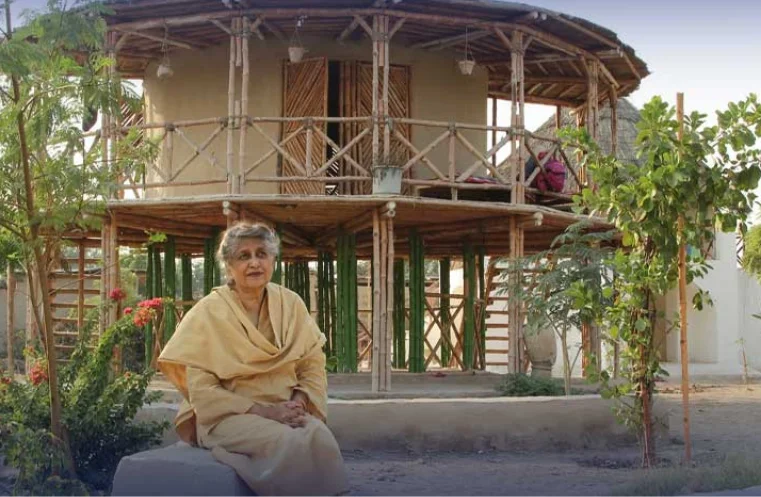
Islamabad, Mar 12, 2025: Prominent Pakistani architect Yasmeen Lari has turned down Israel’s prestigious Wolf Prize 2025 in architecture, formally announcing her decision on Tuesday due to the ongoing humanitarian crisis in Gaza.
In a letter addressed to the Wolf Foundation, Lari conveyed her appreciation for the honor but firmly stated she could not accept the accolade, citing “the tragic and persistent genocide in Gaza” as the reason for her refusal.
Media outlets report that Lari explicitly mentioned the prolonged suffering in Gaza as the primary cause behind her rejection of the award, reinforcing her stance on ethical and humanitarian grounds.
The Wolf Prize, established in Israel in 1978, is a globally recognized accolade presented to outstanding scientists and artists for their “contributions to humanity and the promotion of goodwill among nations.
” It is awarded in six disciplines: agriculture, chemistry, mathematics, medicine, physics, and an arts category that alternates among architecture, music, painting, and sculpture.
Lari, a distinguished architect known for integrating social equity into her designs, has dedicated her career to developing sustainable structures for underprivileged communities in Pakistan.
She co-founded the Heritage Foundation of Pakistan in 1980 alongside her husband, Suhail Zaheer Lari.
Her philanthropic initiatives include constructing over 50,000 eco-friendly self-built homes and more than 80,000 environmentally conscious cooking stoves, utilizing locally available materials such as mud, lime, and bamboo.
Read More:US Stock Market Loses $4 Trillion Amid Escalating Tariff Tensions
A staunch advocate of traditional, low-carbon building methods, Lari champions architectural approaches that minimize environmental footprints while fostering resilience in vulnerable communities.
In 2023, she was honored with the Royal Institute of British Architects’ Royal Gold Medal in recognition of her humanitarian-driven contributions to the field.
As of now, the Wolf Foundation has not publicly responded to Lari’s refusal of the award.
Architect Yasmeen LariIsrael’s Award
Wolf Prize Awarded forOutstanding achievement in Agriculture, Chemistry, Mathematics, Medicine, Physics, and ArtsCountryIsraelPresented byWolf FoundationReward(s)US $100,000First award1978; 47 years agoWebsitewww.wolffund.org.il Awarded forOutstanding achievement in Agriculture, Chemistry, Mathematics, Medicine, Physics, and ArtsCountryIsraelPresented byWolf FoundationReward(s)US $100,000First award1978; 47 years agoWebsitewww.wolffund.org.il |
|---|
The Wolf Prize is an international award granted in Israel, that has been presented most years since 1978 to living scientists and artists for "achievements in the interest of mankind and friendly relations among people ... irrespective of nationality, race, colour, religion, sex or political views."
History
[edit]The prize is awarded in Israel by the Wolf Foundation, founded by Ricardo Wolf, a German-born inventor and former Cuban ambassador to Israel. It is awarded in six fields: Agriculture, Chemistry, Mathematics, Medicine, Physics, and an Arts prize that rotates between architecture, music, painting, and sculpture. Each prize consists of a diploma and US$100,000. The awards ceremony typically takes place at a session in the Knesset.[1]
The Wolf Prizes in physics and chemistry are often considered the most prestigious awards in those fields after the Nobel Prize.[2][3][4][5] The prize in physics has gained a reputation for identifying future winners of the Nobel Prize – from the 26 prizes awarded between 1978 and 2010, fourteen winners have gone on to win the Nobel Prize, five of those in the following year.[3]
In medicine, the prize is probably the third most prestigious, after the Nobel Prize and the Lasker Award. Until the establishment of the Abel Prize, the Wolf Prize was probably the closest equivalent of a "Nobel Prize in Mathematics", since the more prestigious Fields Medal was only awarded every four years to mathematicians under forty years old. In agriculture, the prize has likewise been equated to a "Nobel Prize in Agriculture".[6]
The most recent Wolf Prize was awarded in June 2022 to:
- Agriculture—Pamela Ronald "for pioneering work on disease resistance and environmental stress tolerance in rice".
- Chemistry—Bonnie L. Bassler, Carolyn R. Bertozzi, and Benjamin F. Cravatt III "for their seminal contributions to understanding the chemistry of cellular communication and inventing chemical methodologies to study the role of carbohydrates, lipids, and proteins in such biological processes".
- Mathematics—George Lusztig "for groundbreaking contributions to representation theory and related areas".
- Physics—Paul Corkum, Ferenc Krausz, and Anne L'Huillier "for pioneering contributions to ultrafast laser science and attosecond physics".
- Architecture—Yoshiharu Tsukamoto and Momoyo Kaijima "for their work that highlights the importance to Architecture of its ethnographic and inhabitational characteristics, in their writings and practice", and Elizabeth Diller "for her exceptional and influential work connecting architecture to artistic practice, engaged in the public domain".
Laureates per country
[edit]Below is a chart of all laureates per country (updated to 2023 laureates). Some laureates are counted more than once if have multiple citizenship.
| Country | Number of laureates |
|---|---|
 United States United States | 190 |
 United Kingdom United Kingdom | 41 |
 Israel Israel | 25 |
 France France | 23 |
 Hungary Hungary | 16 |
 Japan Japan | 15 |
 Canada Canada | 15 |
 Soviet Union / Soviet Union /  Russia Russia | 14 |
 Germany Germany | 13 |
 Italy Italy | 11 |
 Austria Austria | 10 |
 Belgium Belgium | 8 |
 Sweden Sweden | 7 |
 Switzerland Switzerland | 6 |
 Spain Spain | 5 |
 Netherlands Netherlands | 5 |
 Argentina Argentina | 4 |
 Taiwan Taiwan | 4 |
 Poland Poland | 3 |
 India India | 2 |
 Portugal Portugal | 2 |
 Denmark Denmark | 2 |
 China China | 1 |
 Brazil Brazil | 1 |
 Mexico Mexico | 1 |
 Egypt Egypt | 1 |
 South Africa South Africa | 1 |
 Rhodesia Rhodesia | 1 |
 Jordan Jordan | 1 |
 Norway Norway | 1 |
 Finland Finland | 1 |
 Uruguay Uruguay | 1 |
 Georgia Georgia | 1 |
 Cyprus Cyprus | 1 |
See also
[edit]
References
[edit]- ^ "Faculty Notes". Cornell Arts & Sciences Newsletter. Cornell University. November 1980. p. 7.
- ^ Physicsworld.com: Wolf prize goes to particle theorists
- ^ a b Harris, Margaret (November 2010). "Gongs away". Physics World. 23 (11). Bristol: Institute of Physics Publishing: 46–47. Bibcode:2010PhyW...23k..46H. doi:10.1088/2058-7058/23/11/46.
- ^ Basolo, F: "From Coello to Inorganic Chemistry: A Lifetime of Reactions", page 65, Springer, 2002
- ^ "IREG List of International Academic Awards" (PDF). IREG Observatory on Academic Ranking and Excellence. 2019. Retrieved 26 February 2023.
- ^ National Research Council: "National Research Initiative: A Vital Competitive Grants Program in Food, Fiber and Natural-resources Research", page 155, National Academies Press, 2000
External links
[edit]- "Wolf Foundation General Information". Wolf Foundation. Retrieved 2007-08-24.
- "Wolf Foundation Founders and Donors". Wolf Foundation. Archived from the original on August 1, 2007. Retrieved 2007-08-24.
| Authority control databases: National |
|---|


No comments:
Post a Comment