Kindle
$17.69
Available instantly
Paperback
$18.81
Follow the authors
John PilgerJohn Pilger
Follow
Joe AllenJoe Allen
Follow
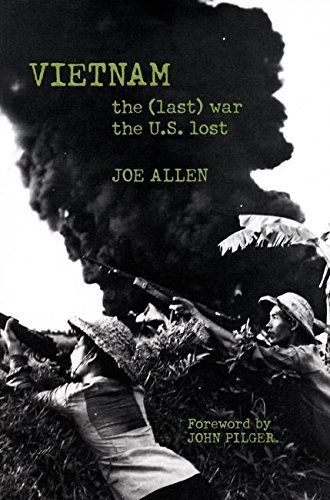
Vietnam: The (Last) War the U.S. Lost Kindle Edition
by Joe Allen (Author), John Pilger (Foreword) Format: Kindle Edition
3.6 3.6 out of 5 stars (7)
As the United States now faces a major defeat in its occupation of Iraq, the history of the Vietnam War, as a historic blunder for US military forces abroad, and the true story of how it was stopped, take on a fresh importance. Unlike most books on the topic, constructed as specialized academic studies, The (Last) War the United States Lost examines the lessons of the Vietnam era with Joe Allen’s eye of both a dedicated historian and an engaged participant in today’s antiwar movement.
Many damaging myths about the Vietnam era persist, including the accusations that antiwar activists routinely jeered and spat at returning soldiers or that the war finally ended because Congress cut off its funding. Writing in a clear and accessible style, Allen reclaims the stories of the courageous GI revolt; its dynamic relationship with the civil rights movement and the peace movement; the development of coffee houses where these groups came to speak out, debate, and organize; and the struggles waged throughout barracks, bases, and military prisons to challenge the rule of military command.
Allen’s analysis of the US failure in Vietnam is also the story of the hubris of US imperial overreach, a new chapter of which is unfolding in the Middle East today.
Joe Allen is a regular contributor to the International Socialist Review and a longstanding social justice fighter, involved in the ongoing struggles for labor, the abolition of the death penalty, and to free the political prisoner Gary Tyler.
Read less
Publisher : Haymarket Books (5 December 2016)
Language : English
File size : 2.0 MB
Text-to-Speech : Not enabled
Print length : 230 pages
Customer Reviews:
3.6 3.6 out of 5 stars (7)
About the authors
Follow authors to get new release updates, plus improved recommendations.
Previous page

Follow
John Pilger
Discover more of the author’s books, see similar authors, read book recommendations and more.
See more on the author's page
Follow
Joe Allen
Joe Allen worked for nearly a decade at UPS between its Watertown, Massachusetts and Chicago, Illinois Jefferson Street hubs. Starting out as a part-time loader he worked his way through a series of part-time sorting and driving jobs until his final year at UPS where he was a package car driver in Chicago's Loop.
Allen's work life has largely revolved different sections of the freight and logistics including for such major employers as A.P.A Transport (Canton, Mass.), Yellow Freight (Maspeth, NY), and UPS. He has been a member of several Teamster local unions and a member of Teamsters for a Democratic Union. He campaigned for Ron Carey's reelection in 1996, and for Tom Leedham in the two following Teamster elections.
Born and raised in Stoughton, Massachusetts, Allen has lived in Chicago for two decades. He is the son and nephew of United States Marines. His previous books Vietnam: The (Last) War the U.S. Lost and 'People Wasn't Made to Burn': A Trues Story of Race, Murder, and Justice in Chicago were both published by Haymarket books.
Joe Allen has been a socialist since he read Michael Harrington's The Other America in high school. He studied for several years at U-Mass Boston. Allen has contributed over the years to Socialist Worker (U.S.), the International Socialist Review, Counterpunch, In These Times, and Jacobin.
Sponsored
Top reviews from Australia
There are 0 reviews and 0 ratings from Australia
Top reviews from other countries
Gaylen Halbert
5.0 out of 5 stars Essential summary of Viet Nam WarReviewed in the United States on 21 July 2008
Verified Purchase
I have 14 books in my library about the Vietnam war. I believe Joe Allen's book is the most accurate summary of the etiology of the war,"in country" events and what was happening stateside. I was not in the military, but I lived through and participated in much of what Joe so aptly describes. If this book had been published and was read by High School students circa 2000 perhaps there would have been a more substantial resistance to the Iraq debacle. I believe Iraq is the [next] war the U.S.lost.
Report
Victoria Lomakin
1.0 out of 5 stars shipping problemReviewed in the United States on 20 January 2020
Verified Purchase
Book arrived wrinkled and half of it was soaking wet.
Report
Arkansaw Traveler
2.0 out of 5 stars Anti-American Socialist/Communist Slant on VietnamReviewed in the United States on 4 October 2008
Verified Purchase
This book was written by Joe Allen, a regular contributor to the International Socialist Review, and is only interesting as representing the viewpoint of Socialists and unrepentent Communists with regard to the greatest threat to world peace (as they see it), the United States. If you're an historian of the type that seeks representation from all sides, such as reading Mein Kampf to understand where Hitler was coming from, this book is valuable to see how facts, attitudes and intentions can be subverted, misstated or omitted to support a polemic for one side, and one side only.
The thrust of this book can be seen in several of the author's statements:
On page 203, "In 1965, the United States invaded (South Vietnam) to prevent the NLF from coming to power and reuniting the country that the United States had divided and conquered." This is false on three counts.
The dedication: "This book is dedicated to all .... who continue to suffer death and deformity as a result of America's use of weapons of mass destruction in Southeast Asia from 1960 to 1975." Since WMDs are usually limited in definition to Chemical, Biological and Nuclear weapons directed against mass populations (and do not include herbicides), one wonders what the author is talking about. In addition, the time period is wrong.
Page 91, commenting on the SNCC statement issued in 1966: "SNCC activitists were seen as heroes, not only to an entire generation of young people in the United States..." Really? Was there no support for the war at all among young people?
One of the more interesting facets of this book is that it includes some of the more extreme statements of Martin Luther King, Jr., that were downplayed or ignored in the post-1968 elevation of Rev. King to superhero status by the US media, a status that is not disputed by this reviewer. Nonetheless, the author makes use of MLK's most extreme statements, many not well-founded and some modified or adjusted to become less inflammatory by MLK himself almost immediately. The point is, that intemperate statements by national leaders taken out of context become used to condemn the US out of hand by its enemies.
Author Allen contends that the US lost the war due to the heroic resistance of the NLF (helped somewhat by North Vietnam), the brave rebellion of common soldiers within the US military which destroyed the fighting quality of US military forces, and the overwhelming political force of the anti-war movement and the sacrifices of its leaders. Obviously anyone doing his duty by serving his country (the US) was venal, cruel, and deserving of public contempt.
Supposedly this book dispells many myths concerning the war, but I was unable to discover any widely-held "myth" by the public that was actually refuted. There were a few strawman myths constructed to show how gullible the public was, but these are easily overlooked.
And lastly, there is a reason this book was published this year (2008). As one of the Haymarket editors says, "As the United States now faces a major defeat in its occupation of Iraq...." Apparently that defeat is fervently desired by the author, John Pilger (who wrote the Foreword) and the Haymarket organization.
With the main thrust being the necessity of defeating American Imperialism, I wonder if the author can point to any territory owned by the US today that it has obtained through imperialism or wars of conquest since World War I. In fact, we have lost territory, most notably the Philippines, but such facts fit poorly into the author's polemic. Instead he just continues to beat the drum: the US is racist, evil, imperialistic, undemocratic, and ready for the most extreme forms of class warfare. Sounds rather like Lenin's "What Is To Be Done."
But the book is clever with well-written propaganda, ignoring inconvenient truths, and concentrating on cherry-picking those events that can be spun to the author's liking, statements by various leaders that tend to support his points, and the ennobling of all those who tend to the left or far-left in the US. This book needs to be read by all, but understood for what it is -- the basis for the ultra-left in their condemnation of the US.
This is a very small book, but as the author states; "This book is not meant to be a substitute for reading many of the fine books by radical historians or memoirs of soldiers and activists..." The reader needs only to put the emphasis on the word "radical" and everything becomes apparent.
Read less
Report
See more reviews
Joe Allen (writer)
 | This article has multiple issues. Please help improve it or discuss these issues on the talk page. (Learn how and when to remove these messages)
|
Joe Allen | |
|---|---|
| Born | July 19, 1960 |
| Nationality | American |
| Occupation(s) | Author and Journalist |
Joe Allen (born July 19, 1960) is an American author, journalist, historian, and activist. He authored People Wasn't Made to Burn: A True Story of Race, Murder, and Justice in Chicago (ISBN 1608461262) published by Haymarket Books in 2011. His latest book is The Package King: A Rank and File History of United Parcel Service (2016).
Early life
[edit]Allen was born in Stoughton, Massachusetts, the son of Beverly Ann Vigneaux and William Henry Allen. He has three sisters.[citation needed] He graduated from Stoughton High School in 1978. He entered the University of Massachusetts Boston in the fall of 1978 and took classes through 1983 but did not graduate.[citation needed]
His previous books, Vietnam: The (Last) War the U.S. Lost and People Wasn't Made to Burn: A True Story of Race, Murder, and Justice in Chicago, were both published by Haymarket books.[citation needed]
Allen has contributed over the years to the U.S. edition of Socialist Worker, the International Socialist Review, CounterPunch, In These Times, and Jacobin.[citation needed]
Books
[edit]- Vietnam: The (Last) War the US Lost (ISBN 1931859493), foreword by John Pilger, 2007
- People Wasn't Made to Burn (ISBN 1608461262), 2011
- The Package King: A Rank and File History of United Parcel Service, 2016
References
[edit]External links
[edit]- People Wasn't Made to Burn - from Haymarket Books On YouTube.com
- Taylor, Elizabeth; Gary Krist; Joe Allen (June 9, 2012). "Book Discussion on [City of Scoundrels] and [People Wasn't Made to Burn]". Chicago Tribune Printers Row Lit Fest/Book TV. C-SPAN2 Video (49 minutes). Retrieved 18 June 2013.
- Media from Socialism

No comments:
Post a Comment