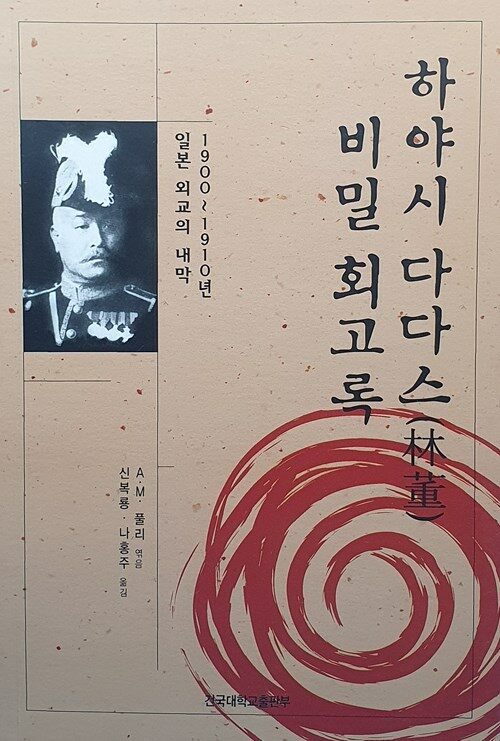
하야시 다다스 비밀 회고록 - 1900~1910년 일본 외교의 내막
A.M.풀리 (지은이),
나홍주,신복룡 (옮긴이)건국대학교출판부2007-11-30

미리보기
정가
13,000원
Sales Point : 134
315쪽
목차
옮긴이 재판 머리말|7
옮긴이 초판 머리말|9
엮은이의 머리말|17
하야시 다다스 백작의 생애|17 하야시 다다스 백작의 저술 활동|35
청일전쟁|44 대련항의 반환|57 영일동맹|66
부록 A
1. 은밀히 동쪽을 정벌할 계책을 정할 것을 청하는 상소문 78
2. 장패륜(張佩綸)의 정번복접(靖藩服摺)을 논하는 상소문 84
제1장 영일동맹에 관한 의견의 기원
3국 간섭|96
제2장 영일동맹의 전야
유산된 예비 교섭|107
니시-로젠 협상|109
러시아의 서툰 처사|110
누가 먼저 개입했나?|112
위테 백작의 계획|113
교주 점령|115
권력 투쟁|118
러시아의 친영정책|119
영국에 대한 위테 백작의 제의|120
부록 B
일본 외교 정책의 미래(요지)|122
제3장 영일동맹의 동지들
영국의 친일 감정|132
제4장 영일동맹의 체결을 위한 교섭
《지지신보》의 소견|155
이토 히로부미의 소견|157
제5장 영일동맹에 관한 그 후의 기록
영일동맹의 기원|206
러일동맹에 관한 의견|207
부록 C
영일동맹|210
제6장 프랑스·일본 협정
프랑스·일본 협정의 진정한 의미|217
부록 D
프랑스·일본 협정 전문|226
제7장 러일협정
부록 E
러일협정|242
제8장 미일협정
미국과의 문제|251
부록 F
미일협정 전문|257
제9장 외교정책(1) 매수할 것인가, 말 것인가?
제10장 외교정책(2) 친구 간의 거래
제11장 열강과 청국
참고문헌|308
찾아보기|310
접기
저자 및 역자소개
A.M.풀리 (지은이)
저자파일
신간알림 신청
최근작 : <하야시 다다스 비밀 회고록>
나홍주 (옮긴이)
저자파일
신간알림 신청
<일본의 독도 영유권 주장과 국제법상 부당성>
최근작 : <독도의용수비대의 독도주둔 활약과 그 국제법적 고찰>,<독도의 영유권에 관한 국제법적 연구>,<일본의 독도 영유권 주장과 국제법상 부당성> … 총 4종 (모두보기)
신복룡 (옮긴이)
저자파일
신간알림 신청
정치학자. 번역가.
충북 괴산 출신으로 건국대학교 정치외교학과를 졸업하고 동 대학원에서 박사학위를 받았다. 건국대 정외과 교수 및 동 대학 석좌교수를 역임했으며 미국 조지타운대학교 객원교수를 맡은 바 있다. 한국정치외교사학회 회장, 건국대학교 중앙도서관장과 대학원장, 대한민국학술원상 심사위원, 한국·동양정치사상사학회 회장, 국가보훈처 독립유공자심사위원(장) 등을 역임했으며 한국정치학회 학술상 및 한국정치학회 인재학술상을 수상했다.
저서로는 <아침의 메아리>, <한말 개화사상 연구>, <한국의 정... 더보기
최근작 : <한국현대사관계 미국관문서자료집 - 전2권>,<전봉준 평전>,<해방정국의 풍경> … 총 105종 (모두보기)
출판사 제공 책소개
이 책의 초판 번역을 낼 무렵만 해도 나의 의도는 대한제국 멸망에 대한 지적 탐구심 정도였고, 흔히 태프트-가쓰라 밀약(Taft-Katsura Agreement)에 의존하여 망국의 이유를 설명하려는 기존의 사관이나 학설에 대한 저항 심리가 크게 작용했던 것은 사실이다. 그런데 이제 나이 들어 원고를 개고하다 보니 이 책이 주는 함의(含意)도 다르게 느껴진다. 그래서 황산곡(黃山谷)이 말하기를, “어려서 책을 읽는 것은 문틈으로 달을 보는 것과 같고, 젊어서 책을 읽는 것은 툇마루에 나와 달을 보는 것과 같고, 늙어서 책을 읽는 것은 노대(露臺) 위에서 달을 보는 것과 같다.”고 말했는지 모르겠다.
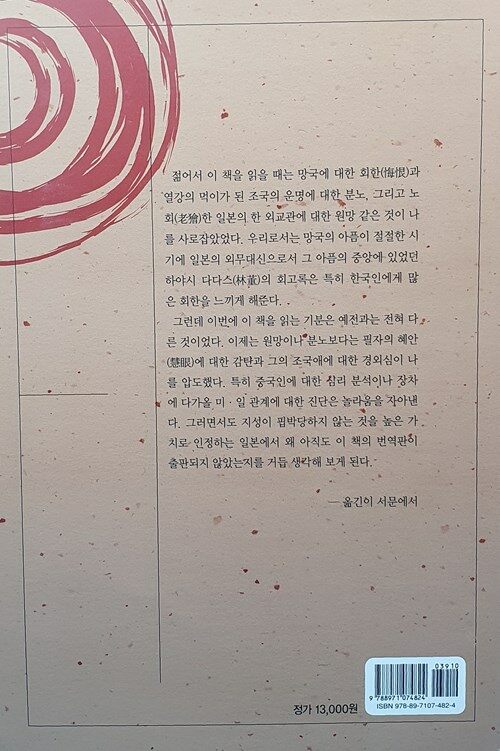
젊어서 이 책을 읽을 때는 망국에 대한 회한(悔恨)과 열강의 먹이가 된 조국의 운명에 대한 분노, 그리고 노회(老獪)한 일본의 한 외교관에 대한 원망 같은 것이 나를 사로잡았었다. 우리로서는 망국의 아픔이 절절한 시기에 일본의 외무대신으로서 그 아픔의 중앙에 있었던 하야시 다다스(林董)의 회고록은 특히 한국인에게 많은 회한을 느끼게 해준다. 그런데 이번에 이 책을 읽는 기분은 예전과는 전혀 다른 것이었다. 이제는 원망이나 분노보다는 필자의 혜안(慧眼)에 대한 감탄과 그의 조국애에 대한 경외심이 나를 압도했다. 특히 중국인에 대한 심리 분석이나 장차에 다가올 미·일 관계에 대한 진단은 놀라움을 자아낸다.
지성이 핍박당하지 않는 것을 높은 가치로 인정하는 일본에서 왜 아직도 이 책의 번역판이 출판되지 않았는지를 거듭 생각해 보게 된다. 접기
The Secret Memoirs of Count Tadasu Hayashi, G.C.V.O.
Paperback – 28 March 2017
by Tadasu Hayashi (Author), A. M. Pooley (ed)
미리보기
정가
13,000원
Sales Point : 134
315쪽
목차
옮긴이 재판 머리말|7
옮긴이 초판 머리말|9
엮은이의 머리말|17
하야시 다다스 백작의 생애|17 하야시 다다스 백작의 저술 활동|35
청일전쟁|44 대련항의 반환|57 영일동맹|66
부록 A
1. 은밀히 동쪽을 정벌할 계책을 정할 것을 청하는 상소문 78
2. 장패륜(張佩綸)의 정번복접(靖藩服摺)을 논하는 상소문 84
제1장 영일동맹에 관한 의견의 기원
3국 간섭|96
제2장 영일동맹의 전야
유산된 예비 교섭|107
니시-로젠 협상|109
러시아의 서툰 처사|110
누가 먼저 개입했나?|112
위테 백작의 계획|113
교주 점령|115
권력 투쟁|118
러시아의 친영정책|119
영국에 대한 위테 백작의 제의|120
부록 B
일본 외교 정책의 미래(요지)|122
제3장 영일동맹의 동지들
영국의 친일 감정|132
제4장 영일동맹의 체결을 위한 교섭
《지지신보》의 소견|155
이토 히로부미의 소견|157
제5장 영일동맹에 관한 그 후의 기록
영일동맹의 기원|206
러일동맹에 관한 의견|207
부록 C
영일동맹|210
제6장 프랑스·일본 협정
프랑스·일본 협정의 진정한 의미|217
부록 D
프랑스·일본 협정 전문|226
제7장 러일협정
부록 E
러일협정|242
제8장 미일협정
미국과의 문제|251
부록 F
미일협정 전문|257
제9장 외교정책(1) 매수할 것인가, 말 것인가?
제10장 외교정책(2) 친구 간의 거래
제11장 열강과 청국
참고문헌|308
찾아보기|310
접기
저자 및 역자소개
A.M.풀리 (지은이)
저자파일
신간알림 신청
최근작 : <하야시 다다스 비밀 회고록>
나홍주 (옮긴이)
저자파일
신간알림 신청
<일본의 독도 영유권 주장과 국제법상 부당성>
최근작 : <독도의용수비대의 독도주둔 활약과 그 국제법적 고찰>,<독도의 영유권에 관한 국제법적 연구>,<일본의 독도 영유권 주장과 국제법상 부당성> … 총 4종 (모두보기)
신복룡 (옮긴이)
저자파일
신간알림 신청
정치학자. 번역가.
충북 괴산 출신으로 건국대학교 정치외교학과를 졸업하고 동 대학원에서 박사학위를 받았다. 건국대 정외과 교수 및 동 대학 석좌교수를 역임했으며 미국 조지타운대학교 객원교수를 맡은 바 있다. 한국정치외교사학회 회장, 건국대학교 중앙도서관장과 대학원장, 대한민국학술원상 심사위원, 한국·동양정치사상사학회 회장, 국가보훈처 독립유공자심사위원(장) 등을 역임했으며 한국정치학회 학술상 및 한국정치학회 인재학술상을 수상했다.
저서로는 <아침의 메아리>, <한말 개화사상 연구>, <한국의 정... 더보기
최근작 : <한국현대사관계 미국관문서자료집 - 전2권>,<전봉준 평전>,<해방정국의 풍경> … 총 105종 (모두보기)
출판사 제공 책소개
이 책의 초판 번역을 낼 무렵만 해도 나의 의도는 대한제국 멸망에 대한 지적 탐구심 정도였고, 흔히 태프트-가쓰라 밀약(Taft-Katsura Agreement)에 의존하여 망국의 이유를 설명하려는 기존의 사관이나 학설에 대한 저항 심리가 크게 작용했던 것은 사실이다. 그런데 이제 나이 들어 원고를 개고하다 보니 이 책이 주는 함의(含意)도 다르게 느껴진다. 그래서 황산곡(黃山谷)이 말하기를, “어려서 책을 읽는 것은 문틈으로 달을 보는 것과 같고, 젊어서 책을 읽는 것은 툇마루에 나와 달을 보는 것과 같고, 늙어서 책을 읽는 것은 노대(露臺) 위에서 달을 보는 것과 같다.”고 말했는지 모르겠다.
젊어서 이 책을 읽을 때는 망국에 대한 회한(悔恨)과 열강의 먹이가 된 조국의 운명에 대한 분노, 그리고 노회(老獪)한 일본의 한 외교관에 대한 원망 같은 것이 나를 사로잡았었다. 우리로서는 망국의 아픔이 절절한 시기에 일본의 외무대신으로서 그 아픔의 중앙에 있었던 하야시 다다스(林董)의 회고록은 특히 한국인에게 많은 회한을 느끼게 해준다. 그런데 이번에 이 책을 읽는 기분은 예전과는 전혀 다른 것이었다. 이제는 원망이나 분노보다는 필자의 혜안(慧眼)에 대한 감탄과 그의 조국애에 대한 경외심이 나를 압도했다. 특히 중국인에 대한 심리 분석이나 장차에 다가올 미·일 관계에 대한 진단은 놀라움을 자아낸다.
지성이 핍박당하지 않는 것을 높은 가치로 인정하는 일본에서 왜 아직도 이 책의 번역판이 출판되지 않았는지를 거듭 생각해 보게 된다. 접기
===
Full text of "The Secret Memoirs of Count Tadasu Hayashi, G. C. V. O..: Ed. by A.M. Pooley."
====
The Secret Memoirs of
Count Tadasu Hayashi
G.CV.O.
EdBaihy
A. M. Pootey
Contents
XNTB£a>ucnoN:
The Cakeeb of Count Hayashi 3
Count Hatasbi's Ljtssart Wokk 34
The Chino- Japanese War . 37
The Anglo- Japanese Alliance . 61
I. — Origin of an Opinion fok an Anglo-
Japanbse Alliance. The Three-
Power iNTratvENnoN, 1895 . 77
II. — Preliminaries op the Alliance 86
Appbmdix: The Pdtuxk Poucv of Jatam I09
in. — The Prienim of the Alliance 115
IV. — The Negotiations for the Con-
clusion OF the Anglo-Japanese
Alluncb 119
V. — Later Notes on the Alliance . 200
VI. — ^Tbb Franco-Japanese Agrbehent,
1907 213
VII. — The Russo-Japanesb Convention,
1907 224
iti
Digi-izedbyGoOglC
Contents
VIII. — The American-Japanese Agreement,
1908. Hayashi on the Auekican
Question 339
IX. — Foreign Pchjcy. Part I. To Bribe
OR Not to Bribe .... 255
X. — Foreign Policy {CtnUinut^. Part II.
Friend "Pidgin" .... 285
XI.— The Powers and China . . . 296
Appendices 309
A. MeuorulofChang-peI'Lunand
THE Board of Censors, 1882. 311
B. Text of Anglo-Japanese Al-
UANCB, 1902 . . 323
0. The Franco-Japanese Agree-
ment, 1907 . -325
D. The Russo-Japanese Con-
vention, 1907 . 327
E. The American- Japanese Agree-
ment, 1908 .... 329
idbyGooglc
Illustrations
CouKT Tadasd HATASm Frontispiece
From ft pbotogtaph
General Marquis Katsura, Proi b Minxstbr
OF Japan 126
Pmn a photograph by Topical
Count KcsfURA, Japanese Minister for
Foreign Affairs 133
Frmn a photograph by G«rechd, Pftris
The Late Prince Hirobuhi Ito .210
Japan's Greatest Statesman
Map AiEnd
Digi-izedbyGoOglC
D„.;„.db,G00glc
INTRODUCTION
D„.;„.db,G00glc
idb,Googlc
The Career of Count Hayashi
Hatashi Tadasu was bom in the second
month of the third j^ear of Kaei (1850), at
Yedo. His father, Sato Taisen, was a native
of the village of Kozu in the feudal fief of
Salnira, where he had been adopted into the
family of Hayashi Kaisha imder the name of
Hayashi Dokai. He followed his adoptive
father's profession of physician, and became
one of the best-known doctors of the pre-
Restoraticm period, rising to the post of body-
physidan to the Shogmi.
At an early age the yoimg Hayashi, in
company with Ito Masimosuke, was placed in
the house of an American missionary at
Yokohama, where he quickly learned to
adapt himself to the ways of the "barbarians"
and acquired a good grounding in the English
language.
In 1866, on the recommendation of Sir
Harry Parkes, the bakufu decided to make an
Digi-izedbyGoOglC
==
The Career of Count Hayashi 21
should have been the reward of his eminent
services. The alleged cause of his exclusion,
it wUl be recollected, was that he had become
a Freemason, during his residence in London.
The Saionji Cabinet fell. It had never
been intended to live- The ostensible causes
of the fall were the finances, the real cause
was the ambition of Katsura to return to
power. But Hayashi left a legacy at the
Gaimusho in a carefully considered policy of
expansion, on the success of which the integ-
rity or disintegration of China hangs, and the
position of Japan amongst the Powers.
In the second Saionji Cabinet (1911-12)
Hayashi held office ad interim as Foreign
Minister, pending the return of Viscoimt
Uchida from Wadiington, and permanently
the portfolio d the Ministry of Communica-
tions.
During the military crisis in 1912, he stead-
fastly supported Marquis Saionji in his oppo-
sition to the Choshu demands. When the
Cabinet resigned he was scathing in his
denunciation of the Katsura dique. On his
journey to Hajrama he refused to occupy the
special coach placed at his disposal by Baron
Goto, his successor, travelling with his ser-
vants and family in an overcrowded second-
class carriage.
Digi-izedbyGoOglC
22 Secret Memoirs of Count Hayashi
He had for some time been suffering from
acute diabetes, and from December, 1912^
lived in strict retirement at his villa at Ha-
yama. In June of the following year he was
thrown out of a ricksha whilst returning
from KamaJoira, and fractured his thigh.
He was removed to the Jutendo Hospital,
where amputation was found to be necessary.
He never properly rallied from the operation,
and died in the hotir of the Snake (lo-i i a.m.)
on July ID, 1913.
He was buried at the Aoyama Cemetery
in the Foreign Office comer on July 13th.
It is pleasant to recall that his eminent
services to Japan received a somewhat be-
lated recognition from his sovereign, who
donated Y.5000, a quite exceptional amoimt,
to the cost of the funeral expenses.
Hayashi is said to have been rather soured
towards the close of his career and is alleged
to have complained because his services were
not sufficiently requited. The claim seems
to rest on but fiimsy evidence. Hayashi was
a man who was strictly honoxuable in all his
dealings, and he scorned to use his official
position for his private well-being. Like
General Nc^ he was deeply concerned at the
course of events in Japan, and was much
wraried as to the future of internal politics.
Digi-izedbyGoOglC
The Career of Count Hayashi 23
He saw that the country was rapidly falling
tinder the control of men whose only use for
power was profit, their own not the nation's,
and he was deeply grieved at the prospect.
In a country where it has become the rule
for statesmen to amass fortunes, he was a
brilliant exception. He had no private means
and never acquired any. When he retired
he sold his house in Tokio and Hved on his
small pension in the cotmtry.
His death was a loss to Japan. He was
one of the old school, one of the few statesmen
remaining who had been trained in the atmos-
phere of the Restoration. He has heea
described as an Edokko' to the backbone;
quiet and impretentious, a scholar and a
gentleman, he was a man of strong opinions,
and a good fighter. An excellent host, a
good conversationalist, he was an authority
on art and music and an expert at go.
His favourite recreations were singing and
dancing, and he was a patron of many of the
leading geisha, whilst as a calligraphist his
manuscripts and writings were highly prized.
' EdMo — B term used frequently hj novelists to denote ft
■pecul type of character, of which boldness, fortitude, chivalry,
hospitality, b)t;b cnhure, and lavish piodigali^ were the principal
Digi-izedbyGoOglC
n
Count Hayashi's Literary Work
The late Count Hayashi pubKshed a novel
in English (For His People, Harper, 1903),
and also contributed the introductions to
Mr. Alfred Stead's Mysteries of China, and
to Mr. Arthur Lloyd's Everyday Japan.
The first of these was a romance dealing
with a local episode in the feudal history of
Sakura, the author's legal birthplace. Kinchi
Sogoro, headman of Kozu, one of the villages
on Lake Inoa, in the fief of the Lord Hotta»
rouses his fellows against the tyranny of their
feudal chief. Failing to obtain redress for
their wrongs, Sogoro determined on the ex-
treme and unforgivable step of appealing
directly to the Shogun, counting the inter-
vention of the bakufu on behalf of the peasants
as wortii more than the death wfaidi Hotta
would mete out to him according to law for
addressing the Shogun. Sogoro carried out
Digi-izedbyGoOglC
Count Hayashi's Uterary Work 25
his plan and actually succeeded in handing
his petition to Tokugawa. He, his wife, and
children were condemned to death, crucified
and beheaded. In his last moments Sogoro
vowed revenge and ordered his spirit to haunt
Hotta till his family should be wiped out, a
curse which was duly ftilfilled.
Count Hayashi's object in publishing the
story was to teach the West the spirit that
animated his countrymen: prestunably their
persistence in a cotu-se once determined on,
their revenge for slights and wrongs.
The novel is noteworthy for the excellent
English in which it is written, which contrasts
most favourably with the so-called "quaint"
English with which Anglicized Japanese au-
thors of to-day harass their readers. As a
picture of pre-Restoration times For His
People is without doubt a faithful likeness.
The dose connexion of the Hayashi family to
Sakura and the Shogunate ensures that the
descriptions of Yedo and the customs of the
court and people are faithfully reproduced.
The introductions to Mr. Stead's and Mr.
Lloyd's volimies are brief and to the point.
In the former the reader is able to surmise
the writer's profound knowledge of Chinese
character. He practically summarizes the
Chinese as necrologists, blind worshippers of a
izedbyGoOglC
26 Secret Memoirs of Count Hayashi
dead past, but he frankly admits the brilliance
of that past, ev^i thotigh it is a hindrance
to a decent present or future.
He sajrs: "The essential feature of the poli-
tical teaching of the great sages is the supreme
importance attached to the individual moral-
ity of the ruler, and its prevailing spirit is that
intense reverence for antiquity which con-
stitutes the extreme form of conservatism."
"The Chinese mind was utterly enslaved
by the influence of these doctrines, so that
the idea of instituting a comparative study
of political or ethical questions was banished
therefrom."
"The inevitable result was careful preserva-
tion of a civilization acquired during a period
of greater receptivity but a complete cessation
of all further progress."
In iatroducing Mr. Uoyd's book, Count
Hayashi emphasizes the impcaiant part Japan
must play in Far Eastern aSairs and the
necessity of the world at large knowing every-
thing possible about her. As is evident fnun
parts of the Memoirs he fully realized the
power of the pen, but he did not sympathize
with the views of most of his colleagues, that
books on Japan should reveal only the bright
side of life in that cotmtry. He had mixed
too much with foreigners, both in Japan and
Digi-izedbyGoOglC
Count Hayashi's Literary Work 27
abroad, not to know that in every country
there must be dark spots, and in every govern-
ment some abuses requiring correction. As
he says, "Fish do not see water," and the
ability to "see ourselves as others see us" is
as valtiable a one in a nation as in individuals.
It has been asserted that if he had lived
Count Hayashi would not have published his
Memoirs. There is no evidence whatsoever
for such a statement. He left explidt in-
structions that they were to be published.
His whole course of life was a proof that he
was not ashamed to criticize his nation. In
a conversation I had with him in January,
1912, soon after I arrived in Tokio, he said:
"Don't be afraid to handle thorns. It will
be good for you and tis!" He himself was
not afraid, as his articles in the Jiji Shimpo
on the Korean Conspiracy Trial and the pre-
valence of torture in prisons in Japan and
Korea and on the fall of the Saionji Cabinet
in 1912, fully show.
In Japanese, Hayashi published Itarii Ski
{History of Italy), and a translation of Mill's
Political Economy.
So far as I have been able to learn, Hayashi,
on account of his official rank, rarely contri-
buted signed articles to the Japanese Press,
but he was practically respcmsible during
Digi-izedbyGoOglC
28 Secret Memoirs of Count Hayashi
many years for the attitude of the Jiji Skimpo
on foreign questions, and wrote a great num-
ber of anonymotis articles in that paper and
in the Chuo Koron. The consistently high
standard which %h%Jiji Skimpo has maintained
on all matters of foreign policy and its out-
and-out pro-British stand was in no small
degree due to the relationship between
its proprietor, M. Ftikuzawa, and the
diplomat.
I have referred on an earUer page to the
connexion which Hayashi practically initiated
between oflBdaldom and the Press. It is a
matter of the utmost importance. For many
years the British and American Press have
been so slovenly represented in Tokio, and
indeed is so to-day, that the close connexion
between the Government and the vernacular
Press has been sadly overlooked. If it were
realized that such institutions as the Bank of
Japan, the Finance Department, and the
Foreign OfiBce have each their own organ of
publicity, whilst every leading statesman has
some paper wedded to his views, the naive
dSmenHs of vernacular statements issued in
London would not receive so much credence
as they do.
After the fall of the second Saionji Cabinet,
I travelled in the same carriage with the late
Digi-izedbyGoOglC
Count Hayashi's Literary Work 29
Count from Toldo to Yokohama. He was
then on his way to his villa at Hayama. In
the course of conversation he said that he
would like to be younger, when he would
adopt a joiunalistic career.
About a year later I was travelling from
Oiso to Toldo in company with Baron Kato,
the present Foreign Minister. Discussing
the late Cotmt, Baron Kato said that Hayashi
had actually intended to enter journalism
and had hoped to become a regular contri-
butor on Japanese affairs to The Times, which
paper had a year before lost the services,
through death, of its veteran correspondent,
Captain Brinkley.
The Memoirs which are published hereafter
were written during 1902, 1903, 1906, 1907,
and 1908. The intention of the late Count
had been to write a history of Japanese diplo-
macy from the time when he began in 1871,
"as a small potato of the diplomatic world,"
down to his retirement from office at the fall
of the first Saionji Cabinet in 1908.
Such a work would have been, in fact, a
complete history of the whole of that remark-
able period of the Meiji Era, during which the
enormous changes in Japan itself and in
Japan's fcweign relations occurred, which
raised that country from being an unknown
Digi-izedbyGoOglC
30 Secret Memoirs of Count Hayashi
and rather discredited island to one of the
Powers of the world.
Unfortunately, methodical as he was in his
diplomatic work the Count was most un-
methodical in his literary work. He obvi-
ously intended to base his history on his own
diary and on the niunerous articles which he
contributed to the Press. He planned out
the whole of the proposed volimie but never
actually wrote more than the chapters dealing
with the Anglo- Japanese Alliance and the
chapters dealing with his own tenure of the
Foreign Office. Even these latter were not
complete, for the portions dealing with the
American Immigration question and with the
Fakumen Railway are not available. This is
a matter of considerable regret, as on both
of these some pleasing indiscretions might
from the circumstances of the case have been
reasonably looked for.
In the Memoirs as they are published here
certain material has been included which was
not in the completed manuscript, but was
ccmtained in unfinished chapters or in articles
contributed to the vernacular Press. It has
been considered advisable to insert this mate-
rial for the piupose of roimding oflE the Count's
story.
From May, 1913, the Chuo Koron, a reput-
Digi-izedbyGoOglC
Count Hayashi's Literary Work 31
able but little known monthly review in
Tokio, began the publication of a series of
disjointed paragraphs which were described
as the reminiscences of a retired diplomat.
On July 29, 1913, the Jiji Shimpo heig&n
to publish a series of articles embodying the
paragraphs from the Ckuo Koron and en-
titled "History of the Anglo- Japanese Alli-
ance." The paper announced that these
articles were narrative stories dictated by
Coimt Hayashi. The following day a second
article appeared which was much more de-
tailed in the information which it conveyed
and was obviously the diary of the late states-
man. A footnote added by the editor stated
that ttie article was, in fact, a reproduction
from the diary of the late Cotmt Hayashi
which had been placed at the disposal of the
newspaper by the executors, and that it was
proposed to continue its publication. On
the foCowing day, July 31st, the Jiji
Shimpo announced that it had received the
following letter from the Japanese Foreign
Office:
"The matter under the heading of the 'His-
tory of the Anglo- Japanese Alliance' is con-
sidered objectionable, and you are requested
not to publish any more articles of the series.
Digi-izedbyGoOglC
32 Secret Memoirs of Count Hayashi
I write this at the instruction of t^e Minister
of Foreign Affairs.
(Signed) "Yoshida Yosaku,
" Confidential Secretary to the Minister of
Foreign Affairs."
On August 2ist, the Jiji 5Hm/>o rushed out
a supplement containing a sununary of the
continuation of the articles. It was immedi-
ately seized by the police and suppressed, and
every eflfort made to prevent any translation
of the same going abroad, both telegrams
and letters being stopped. I was fortunate
enough to smuggle a translation to London,
where it was published and created no small
surprise.
At that time it was not to be expected that
any further parts of the Memoirs would be
available, as the Foreign Office seized all the
material which the Hayashi family or the
Jiji Shimpo held, and extracted an under-
taking that they would not countenance t^
encourage any further publication.
In October, 1913, I was approadied by a
certain Japanese, who held a manuscript
written by Count Hayashi and specifically
given by bim to the owner with instructions
for it to be published. The owner had ob-
tained a loan on the manuscript, which was a
Digi-izedbyGoOglC
Count Hayashi's Literaiy Work 33
wonderful example of calligraphy, and if I
paid oH the loan I could have the use of the
manuscript. An undertaking was given me
at the same time that the manuscript was
■ the legal property of the gentleman in ques-
tion. On receiving the manuscript I found
a letter from Count Hayasbi to the owner as
follows:
"I give you this manuscript with the inten-
tion that you shall publish the same after
my retirement from ofiQce or at some pr(^>er
occasion.
(Signed) "HAYAsm."
I had the most important parts of the
manuscript translated and my translations
were on their way to London and Shanghai
within forty-eight hours. A few days later
I was able to borrow this manuscript again
to complete and check my translation.
The day before the publication of the
selected extracts, I was approached by a re-
presentative of the Hayashi family, who
desired to suppress the publication. How
they learned about it I never knew, but I
suppose somebody talked. This gentleman
informed me that they believed that the
manuscript I had used was a copy made by
Digi-izedbyGoOglC
34 Secret Memoirs of Count Hayashi
an employ^ of the Jiji Shimpo, and was very
much surprised to find it contained material
of which he had neve* heard, and was one of
which the Hayashi family had no knowledge
whatever.
To prevent any charge of breach of faith
being made against any members of the
Hayashi family or any members of the stafE
of the /*;* Shimpo, I addressed the letter
given below to the Minister of Foreign Affairs.
It is perhaps not a matter for surprise that I
received no acknowledgment of it.
"H. E. Baron Maeino,
"HJ.J.M.'s MinistCT for Foreign Affairs,
"Tokio.
"Your Excixlencv,
"With reference to the continiiation of the
late Coimt Hayashi's Memoirs, which my
company (Reuter's) are now publishing in
London and Shanghai, I take the liberty of
informing Your Excellency that no member
of the Hayadii family nor any member of the
staff of the Jiji Shimpo has had any connexion
whatsoever with the same.
"The manuscript from which I have had
the advantage of working is one of which they
knew nothing, and of the existence of which
they were totally imaware.
Digi-izedbyGoOglC
Count Hayashi's Literary Work 35
"I write this letter in order that no charge
of breach of faith may be brought against
them. In fact, they have done everything
possible to prevent publication of the same.
"I am,
"Your Excellency's obedient servant,
(Signed) "Andrew M. Pooley."
To protect the reputation of the Hayashis
and their friends I had a copy of this letter
sent out to every newspaper in Toldo.
In April, 1914, 1 learned through Japanese
friends that there was yet another manuscript
in existence, actually in the possession of a
pawnbroker. I obtained access to this, and
was enabled to compare it with the other
material in my possession. It was a very
incomplete affair of some forty sheets, and
but comparatively little of it was in a suffi-
ciently finished state to be of value. It
consisted mostly of articles contributed to
the Press.
The most interesting point in connexion
witii the suppression of the Memoirs is that
on the day of King George's Coronation,
Hayashi published a summarized and in-
nocuous account of the negotiations for the
Alliance in The Japan Times. Three days
later he published a raoce extensive and dis-
Digi-izedbyGoOglC
36 Secret Memoirs of Count Hayashi
tinctly non-ofBcial version in the Asahi Skim-
bun, but did not sign it. This latter version
created some interest, but was pooh-poohed
by everybody as being a fiction of journalistic
imagination. Even so shrewd a critic as
The Japan Chronicle headed its translation:
"What passes fw history!"
Digi-izedbyGoOglC
Ill
The Chino-Japanese War
By the Treaty of 1885, known as the Tientsin
Convention, signed by Li Hung-Chang and Count
Ito, the relative positions of China and Japan
towards China's vassal State, Korea, were defined.
The final clause of the treaty stipulated that
neither Power should send troops into Korea
without notifying the other signatory. Each
Power should have the right to send an equivalent
number of troops to that sent by the other, in
case either side should consider such a measure
The Tientsin Convention was regarded by
Japan as a diplomatic triumph, annulling China's
suzerainty over Korea, and giving Japan equal
r^ts in that country. Nevertheless it did
nothing to modify the strong dislike of the Korean
Court and people for the Japanese, a dislike which
was steadily fostered by ^e Chinese Resident,
Yuan-Shi-Kai, and by the Russian Minister at
Seoul, M. PavloS, who in 1888 concluded the
"Overland Commercial Treaty" with Korea.
Digi-izedbyGoOglC
38 Secret Memoirs of Count Hayashi
Tlie Japanese authorities had ever since that
yeas been preparing to settle the Korean question
by force of arms, in the event of a peaceable
settlement proving impossible. The army and
navy had been steadily improved both in mate-
rial and personnel, and, as events were soon to
show, had reached a remarkably high state of
^dency.
Nevertheless it is improbable that the Japanese
statesmen would have pushed matters to a crisis
in 1894, ^^^ ^*^ ^ fortunate concatenation of
circumstances.
In February, 1894, a certain Kim-ok-In, a
Korean political refugee, who had for some years
been Uving in Japan, was enticed to Shanghai on
the pretence of negotiating with representatives
of the Korean Comt, and was there murdered.
Rumour was strong that the murder of Kim origi-
nated in the brain of Yuan-Shi-Kai. Whether
tiiis was so or not, his death removed from the
scene a very usefid pawn, on whom the Japanese
Foreign Office had been able to rely as a go-
between between itself and the Korean reformers.
His murder was made the opportunity for the
formation of a political association called the
"Anti-KcM-ean Association," which had for its
avowed object the forcing of an active Korean
policy on the Imperial Government, It was
largdy financed by semi-official institutions,
and was kept in touch with the authorities
by a certain Ryonosuke Okamoto, who has been
Digi-izedbyGoOglC
The Chino-Japanese War 39
well described as the stormy petrel oi Korean
politics.'
Owing to the intrigues of the "Anti-Korean
Association" and the financial support accorded
from Japan, the Tong-haks started an insurrec-
tionary movement in Southern KOTea towards the
end of May, 1894. The insurrection in itself was
of little importance, and there does not ever ap-
pear to have been any real danger to either the
Korean dynasty or to the foreign residents of the
coimtry. Both China and Japan availed them-
selves of the terras of the Tientsin Convention
to send troops into Korea, each country formally
notifying the other of its intention. China took
this step first. Li Hung-Chang undoubtedly was
amdous not to send troops into Korea, and it was
only after considerable delay that he deferred to
the opinion of Yuan-Shi-Kai, who was naturally
afraid that the Japanese forces would arrive first
on the scene. Tlrere is little doubt but that both
li and Yuan were worked on by Russian influence,
the former by Count Cassini and the latter by
M. PavlofE, for neither of these extremely astute
diplomats had any desire to see Chinese influence
at Seoul replaced by Japanese domination. li
accordingly dispatched 3000 men to Asan. On
■ Ryonosuke OkaiiK>to was subsequently forced on the KoKan
Court as Military Adviser; he led the band of gpaauMtui who
murdered the Oueen of Eorea in 1896. Later be was one of the
leaders of the Japanese partidpatii^ in the Chinese Revolution
at 1911, and died at RhiiTighiii in 1912,
Digi-izedbyGoOglC
40 Secret Memoirs of Count Hayashi
June 9th a mixed divisioa of 8000 Japanese troops
landed in Korea, although, as The Eastern World
ai Yokohama pointed out, nothing had as yet
happened in Korea to necessitate the dispatch of
such a large force.
On Jtme i6th the insurrection was declared to
have been suppressed, and China notified Japan
that she was about to withdraw her forces, and
requested Japan to do the same.
A week later it became known that Japan had
refused to comply with this proposal, and the
situation between the two coimtries was declared
by the Tientsin correspondent of The Times to be
critical. On June 24th a Chinese squadron was
ordered to Chemulpo. On the 25th a Japanese
ojEBcial statement claimed that the Tong-hak
rebellion had not been suppressed, and alterna-
tively that even if it had been steps must be taken
to prevent a recurrence of the trouble and that
such steps were of vital impcnrtance to Japan, as
her economic interests in Korea were greater than
those of China. A jcnnt intervention and the
establishment of a scheme of fiscal reform were
proposed by Japan. China replied that it was
contrary to traditional policy to interfere with
the internal afEairs of a vassal State, a reply that
elicited the retort that unless Qiina agreed to
intervene, Japan would have to do so alone.
The Korean situation was, as a result of the
Tong-hak trouble, favourable to Japanese policy.
Ccmditions in that country, especklly in the parts
Digi-izedbyGoOglC
The Chino-Japanese War 41
proximate to Japan, gave a nominal justification
for intervention, even though the rebellion itself
was but a poor thing as rebellions go, and without
doubt fostered by Japanese. The internal situa-
tion in Japan was also not without its arguments
in favour of drastic action. For' many years the
strongest movement in the political world bad
been that which demanded the revision of the
Japanese treaties with foreign Powers, and the
retrocession of the treaty ports. Cabinet after
Cabinet had fallen on accotmt of failure to accom-
plish this. It was perhaps unfortunate that cdn-
cident with the rise of the revision movement
came the efforts of Count Itagaki to establish
government by political parties. This at once
made the question one of internal politics. The
Diet, composed as to a large majority of men who
had no knowledge of foreign affairs, and ignorant
of the very A B C of politics, was unable to co-
ordinate the expenditure of large sums erf money
on armaments with the continuation erf extra-
territoriality. This resulted in bitter fights
between the Cabinet and the Parliament, and the
period from December, 1893 to June, 1894, saw
the dissolution of two Diets, the first of which only
sat for a month, and the second for only eighteen
days. The dissolution of both was due to the
insistence by an Opposition more powerful than
the Ministry on the pursuit by the latter erf a
strong foreign policy.
The large force thrown into Korea was primarily
Digi-izedbyGoOglC
42 Secret Memoirs of Count Hayashi
a sop to popular feding. The withdrawal of the
expedition at the request erf China would have had
most serious results in Japan, for the situation
would have resolved itself diplomatically into a
slalus gm ante, whilst politically it would have
meant ruin for Ito and Mutsu.
Besides the Korean situation and the condition
erf internal politics there was another impulse erf
which notice must be taken. Since 1893 Mutsu
had been negotiating with the British Government
for a revision of the Anglo- Japanese Treaty. The
conduct of the negotiations had been entrusted
to Viscount Aoki, Japanese Minister at Berlin.
When the Korean crisis arose, the draft of the
new treaty had been agreed upon by both sides,
but Lord Kimberley refused to allow the new
treaty to come into force until the codes had been
revised and were operating satisfactorily. A re-
vision of the treaty with Britain was a diplomatic
success on which Ito could have justifiably de-
manded praise from the Diet. A revision, the
action of which could be indefinitely postponed,
would be worse than useless. On the other hand,
a successful Korean campaign would not only
unite all parties, but would distract public atten-
tion from the question c^ the treaty revision, and
probably help forward the revision of the other
treaties.
The above were the immediate reasons for
Japanese action. There were, however, greater
issues at stake than the future of Parliamentary
Digi-izedbyGoOglC
The Chino-Japanese War 43
government in Japan or the Parliamentary future
of Ito or Mutsu. For years Japan bad bad tbe
nin of every secret document in Cbina. In 1882
the Board of Censors had raised in a memorial
to the Throne the problem of Korea. Chang-
Pei-Lun, afterwards the son-in-law of Li Hung-
Chang, in a very cleverly argued report, urged on
the Throne the necessity of China thoroughly
reforming her army and navy , finding a satisfactory
accuse for war with Japan, and then thoroughly
crushing the wqjen, a contemptuous term for the
Japanese. He advanced reasons for the belief
that Great Britain and tbe Powers would support
China. This memorial was sent by tbe Throne
to Li Hung-Chang for his opinion. The Viceroy
approved in the main the argument for reforming
the army and tbe navy, but was more inclined to
brieve that the Loochoo Islands would form a
better excuse for a war with Japan than tbe ques-
tion of Korea. He thought, contrary to Chang-
Pei-Lun, that the European Powers would support
Japan against China.' Tbe Japanese Foreign
Office had a copy of this memorial, and was con-
sequently fully aware of tbe intention of China to
pick a quarrel one day with Japan and fight.
The Japanese Government had thereiore for years
been preparing for the day, and was determined
itself to decide the time of the confiict. The late
Captain Brinkley, The Times correspondent in
'Appendix A.
Digi-izedbyGoOglC
44 Secret Memoirs of Count Hayashi
Toldo, and a close friend of Count Ito, entirely
endorses this view, both in the columns of his
own paper, The Japan Mail, and also in the cor-
respondence which he contributed to The Times.
He says that Japan was prepared to the last but-
ton, and "as for cartridges, she has stacks more
than she could possibly use in a war against China."
He admits that Japan's actions were not dictated
by philanthropy but were intended to transmogrify
Korea into a profitable neighbour for Japan.
"Japan," he writes, "weis ambitious to annex
Korea, but knew that her ambitions would be
restrained by the Powers, and Japan fears nothing
so much as European compUcations."
The manner in which Japan fomented trouble
in Korea and fixed a quarrel on China was ugly,
but at the worst ^e was only forestalling a similar
course of action by China. Her policy was oppor-
tune in view of the situation at home and abroad,
especially in China, where a closer rapprochement
with Russia was being effected. After all, the
Korean question as between China and Japan was
dne Machtfrage. Japan forced the Issue, and
because she was prepared, whilst China had only
talked preparation, she wcm.
From June 25th, when Japan declared her in-
tention of continuing her intervention in Korea,
matters became critical. Some doubt existed in
Japan as to the attitude of the European Powers
in the event of war breaking out. The Memoirs
left behind by the late Count Mutsu give an ac-
Digi-izedbyGoOglC
The Chino-Japanese War 45
count of the diplomatic conversations which todc
place in order to clear up this doubt. It is a
matter for regret that the Japanese Foreign 0£Sce
seized and destroyed as many copies of this work
as it was able to, and forbade further pubUcation
of the same. It is from one of the few remaining
copies that I obtained the following summary of
these conversations.
There were only two Powers from whom Japan
had to fear hostile action. They were Great
Britain and Russia. Of these two the fonner was
by far the more important. If Great Britain could
be persuaded to maintain a neutral portion it was
highly improbable that Russia would take any
steps beyond diplomatic representations. The
first point to be elucidated was as to whether
Great Britain had any secret agreement with
China, whidi would necessitate her taking naval
or military action on China's behalf.
The Japanese Minister in London was instructed
to ascertain the views of Downing Street. The
result of the interview was a warning to Japan
that Great Britain would deprecate any outbreak
of hostilities, and would most certainly refuse to
tolerate any actions which infringed her own in-
terests in China or the integrity or independence
of Korea. The Japanese representative was in-
structed that this information was insufficient,
and was ordered to try and obtain a further state-
ment as to how far Japan could go without tres-
passing on the limits prescribed by Great Britain,
Digi-izedbyGoOglC
46 Secret Memoirs of Count Hayashi
limits which Mutsu described as being "very
ambiguous," He was instructed to point out
that Japan's only object was to obtain a settle-
ment of the Korean question by reforming her
internal administration. The reply to this was
that Great Britain would weclome any ameliora-
tion of the internal conditions of Korea, but she
would not be able to regard with indifference any
material change in the foreign regulations of
Korea, nor would she acquiesce in the transfer
to Japan of any of the territorial possessions of
the King of Korea. This very definite exposition
of the British point of view was accompanied by
the warning that any attempt of the Japanese
to control the peninsula would certainly lead to
Russian intervention, and possibly the seizure
of a Korean harbour by Russia. On the receipt
of the above statement Mutsu instructed the
Japanese Minister at London to give a formal
assurance to the British authorities that whatever
the outcome of the existing situation, Japan had
no intention whatsoever of seizing any Korean
territory.
This assurance was very timely, as the general
impression in foreign drcles in the Far East was
that Japan really wanted to grab Korea, or as
Bishop Corfe more politely expressed it, "Japan
only wants to annex Korea."
There was good reason for Japanese fear of
opposition from Russia. Li Hung-Chang practi-
cally disclosed in his farewell speech to Count
Digi-izedbyGoOglC
The Chino-Japanese War 47
Cassini that the dispatch of Chinese troops to
Korea had been the result of the tatter's advice,
whilst the identical note presented on June 25th
by the atrps AiplomaXique at Seoul to Yuan-Shi-
Kai, and M. Otori, the Japanese Minister, calling
on both parties to withdraw their forces, was
drafted by M. PavlofiF, though it was nominally
presented at the request of the King. China
agreed immediately to the request, but Japan
never answered the note.
On Jione 28th Li Himg-Chang issued the fol-
lowing manifesto :
"China is Korea's suzerain; she receives tribute
and confers investiture, and therefore she owes
protection to the vassal State. Accordingly at
the King's request she dispatched b'oops to quell
the Tong-hak rebellion, informing Japan thereof
in accordance with the Convention of 1885, and
engaging to withdraw her troops on the suppres-
sion of the rebellion. There was no need for the
interference of Japan, though Japan, too, has the
right to send troops to Korea.
"On the appearance of the Chinese forces the
rebels dispersed. China now desires to withdraw
from Korea, but Japan refuses to evacuate Korea
simultaneously with China, and proposes joint
occupatioD, administration of the finances, and the
introduction of reforms. These are tasks which
China cannot accept, though she is willing to join
Japan and other nations interested in recommend-
ing the reforms necessary to the King of Korea.
Digi-izedbyGoOglC
48 Secret Memoirs of Count Hayashi
"J^poii's attitude threatens to cause a crisis in
Eastern Asia and may prove dangerous to both
countries, as well as deplorable to general commerce.
"The Viceroy, Li Hung-Chang, considers the
action of Japan to be inconsistent with the law
of nations, and with existing treaties. He will
nevertheless endeavour to preserve peace without
dishtmour to China."
The reply of Ito and Mutsu to this protest was
to present to the King of Korea a series of ftuther
demands, including the abandonment of Chinese
suzerainty, the dismissal of the Chinese Resident,
the reform of the civil, military, and legal systems,
and the grant to Japan of certain railway, mining,
and loan concessions.
Li Himg-Chang turned to Russia for advice.
Russia was in no mind and in no condition to draw
the sword to assist China, but she was willing to
go as far as possible in moral support, in order to
maintain the status quo in Korea. M. Hitrovo,
the Russian Minister at Tokio, called on Count
Mutsu and handed him a note in which the Rus-
dan Government expressed the point of view that
China had explicitly fulfilled all the conditions of
the Tientsin Convention; further, that she was
prepared to evacuate Korea, and that Japan should
do the same; further, that if Japan declined to
follow this advice and a breach of the peace should
be caused thereby, Japan alone could be held
responsible. The Japanese Minister tried to draw
M. Hitrovo, by asking him whether he was to
Digi-izedbyGoOglC
The Chinojapanese War 49
understand by the last clause of the note that
Russia was prepared to support China otherwise
than diplomatically, but the Envoy only answered
that he had no tostructions beyond those contained
in the note.
Mutsu was still in doubt as to how far Russia
would go, when a quite unforeseen turn was g^ven
to events by a bellicose statement in the Novoye
Vremya, that if Japan went too far, Russia would
declare a joint protectorate over Korea with
China. This brought Germany into the field,
with a declaration that any attempt to introduce
Russia into the settlement of t^ Korean question
would result only in the creation of a Far Eastern
Egypt, a threat which was followed by the dispatch
of warships to the North Pacific.
On July 1 6th, the Anglo- Japanese Treaty was
signed, and on the 19th the Japanese Minister
in London informed Lord Kimberley that Japan
would insist even by force on a satisfactory solu-
tion of the situation. As a result Lord Kimberley
telegraphed to Rome, Berlin, Paris, and St. Peters-
burg, asking the Governments of the Powers to
instruct their representatives at Pekin and Tokio
to use all their efforts for the maintenance of peace.
At the same time Mr. Gresham, the American
Secretary of State, telegraphed to Mr. Dunn and
Mr. Poster, the United States representatives at
Tokio and Pekin, o£Eering the services of the
United States as mediator. These dispatches
were held up by the Japanese authorities.
Digi-izedbyGoOglC
so Secret Memoirs of Count Hayasbi
On July 22d, the King of Korea acx:epted the Jap-
anese demands, contingent on the immediate evac-
uation of the country by Japan, a condition which
was prompUy refused. On July 23d, the Japanese
troops in Seoul seized the person of the King, and
in a riot which ensued killed a number of Koreans.
War was thereafter inevitable. Great Britain,
with the view of limiting the area of hostiUties,
demanded, and Japan agreed, to the neutraliza-
tion of Shanghai. The Kowshing incident imme-
diately followed, and war was formally declared
cm August 1st.
The Retrocession of Port Arthur.
As Coimt Hayadii remarks, the action of Russia
was by no means unexpected. The note of M.
Hitrovo, before the outbreak of war, had clearly
shown that Russia would side with China, and it
is possible that only the death of Alexander III.
and the assassination of President Camot pre-
vented her taking more effective measures than
diplomatic representations. In January and
February, 1895, when the overwhelmii^ victory
of the Japanese forces was obvious to the whole
world, Russia b^an military preparations of some
importance. Numerous transports were dis-
patched from Odessa to the Par East, the survey
c^ the Siberian Railway was ordered to be hurried
on, and preparations made for strengthening the
Vladivostock squadron.
Digi-izedbyGoOglC
The Chino-Japanese War 51
Oq February ist, a circular vras sent by the
Russian Foreign Office to the Russian ambassadors
at Paris, London, and elsewhere, outhning Hxe
views of the Czar's government, as to the tenns
of peace which Japan should be pennitted to
make with China. In the circular it was su^^^ted
that France had already agreed to the Russian
proposals, and that both England and America
would agree to them. This surmise proved to be
painfully incorrect. In the dreular it was further
stated that the terms which Japan would be al-
lowed to impose would be limited to the cession
of islands, the imposition of a war indemnity, the
opening of certain ports and trading places, and
the grant of certain commercial concessions, but
under no circumstances would she be allowed to
hold permanently one inch of Chinese territory
on the mainland, though she would be allowed
temporarily to remain in possession of certain
districts, which might be mutually agreed on, to
be held as security for the payment of the indem-
nity and to be evacuated as the indenmity was
paid off.
Count Hayashi assumes that Germany had had
the intention of intervening from the very bepn-
ning of the war, whatever terms of peace might
be made. This assumption does not altogether
appear to be justified. In March, 1895, the Ger-
man Minister at Tokio had been instructed by
Berlin to warn Japan that any permanent occupa-
tion of a portion of the Chinese mainland, as a
Digi-izedbyGoOglC
52 Secret Memoirs of Count Hayashi
ccmdition of peace, would provoke the interven-
tion of Russia. To this Count Hayashi specifically
refers. Germany, at the time she gave this
warning, was in receipt of the terms of the Russian
circular of February ist, and suspecting that
Russia would be only too pleased to take advantage
of any incident whidi might give her the oppor-
tunity of interfering and arrogating to herself a
decisive position in the Far East, warned Japan
in the most friendly spirit. In addition to this
Germany, certainly if she had any ambitions
herself in the Orient, could not afford not to join
Russia and France, after the threat made in July,
1894, that any interference by Russia would result
in the Bgyptianizing of the Korean question.
In addition there were other motives for Ger-
many joining the Russian protest. Cotmt Caprivi
had allowed the "Reassurance Treaty" with
Russia to lapse, and that country had made an
alliance with France. Since the beginning of the
Chino- Japanese War, Prince Hohenlohe had
succeeded Count Caprivi as Imperial Chancellor.
Hohenlohe was a good deal in touch with Bismarck
through his reliance on Count Herbert Bismarck.
The early days of the Hohenlohe regime were
devoted to trjTng to regain the Russian position
which Caprivi had thrown away, and one of the
steps taken towards this end was an almost touch-
ing acquiescence in the Russian proposals.
Yet another reason was the Kaiser's personal
attitude. It was at this period that he was coming
Digi-izedbyGoOglC
The Chinojapanese War 53
iato notice as an earnest advocate of a strong
colonial policy and a strong navy. It was on
January 9, 1895, that he invited to a soiree at
Potsdam all the members of the Reichstag, and
delivered to them a vehement lecture on the
pressing need of a powerful fleet. As was an-
nounced at the time, he worked into this lecture
numerous references to the lessons of the war in
the Far East. A month later he re-delivered Has
lecture with further references to the Asiatic
situation before the ofiScers of the Marinamt.
Then again he demanded more colonies. It is
dear that William 11. was fully alive to the posa-
bilities of future German development in the Far
East, and realized that by having a say in the
resettlement of the Treaty of Shimonoselri Ger-
many would be entitled to a voice in all further
dealings of Europe with Asia. It certainly does
not appear to have ever entered the heads of any
of the German statesmen that Japan was a nation
whose friendship might one day be of value to
Germany. This, however, is not to be wcmdered
at in view of the published opinions of the Kaiser
on the coloured races.
There was undoubtedly some sort of agreement
between the three Powers as to the price which
they were to extract from China for assisting her.
According to a Russian statement' Russia paid
for the co-operation of Prance with an undertaking
'Nmoyt Vnmya, April az, 1895.
Digi-izedbyGoOglC
54 Secret Memoirs of Count Hayash!
to support an eventual French demand for a
rectification of the Indo-Chinese frontier, and
for Germany's help with a promise to forward
German demands for industrial and commercial
Although the three governments were agreed,
the policy of intervention by no means received
the imanimous support of the three nations. The
German industrial circles were much upset by
the commercial privileges obtained by Japan, the
Govenmient's reply to an interpellation that the
concessions were for all nations being met by
the retort that Japan alone could benefit by the 2
per cent, commutation tax on cost, owing to the
cheapness of labour in Japan. The German
Radicals were loud in their assertion that the
transfer of Formosa and the Pescadores to Japan
converted the China Sea and the Gulf of Pechili
into Japanese lakes. The Vossische Zeitung led
a very strong campaign against the policy of
intervention, arguing that as Germany did not
hold a foot of territory in China she had no interest
in the business, beyond gratitude to Japan for
opening markets which eventually would be of
the greatest value to German industries. "In
any case," continued the paper, "there is no
reason for Gennany to strengthen the footing of
potential enemies, as Russia and France are, in
the Far East."
The Neueste Nachrichlen of Berlin became curi-
ous^ prophetic in its disgust at the Government's
Digi-izedbyGoOglC
The Chino-Japanese War 55
poKcy. It wrote; "In a struggle with France and
Rtissia Japan would be a very useful ally, and her
forces are strong enough to distract from her
Western frontier a good portion of the Russian
armies. As the end of the affair we seriously fear
that Germany will pay bitterly for her action, for
the Japanese will eventually seek their revenge,"
It is to be hoped that the writer of the above
passage is still living, to see the correctness of his
deductions.
In France the Soleil cleverly expressed the real
object of the German Government — to ciurry
favour with the Czar.
The Figaro disapproved of the intervention
unless Great Britain should agree to join the other
Powers, llie journal pointed out that after all
Great Britain had the biggest stake in China, and
unless she actively acquiesced in the policy of ihe -
Triumvirate, she would "open up and monopolize
the markets of the Rising Sun, whilst France will
be alienated" — another prophecy, which has been
almost exactly fulfilled.
Great Britain refused the invitation of Russia
to join in the intervention, on the ground that
such intervention would be contrary to the estab-
lished principles of international relationship, and
because British interests were in no way menaced.
On the contrary, they were considerably benefited
by the industrial and commercial concessions
extorted from China by Japan for the whole
world. It may be also that public opinion in
Digi-izedbyGoOglC
S6 Secret Memoirs of Count Hayashi
Bngland was to some extent sentimentally influ-
enced by the evidence of Japanese progress which
the war had afforded, and commercially by a
statement from the Japanese Legation that large
orders would be forthcoming from Tokio, eq>ecially
for a new fleet. The refusal of the Russian invi-
tation by Great Britain certainly was of great
negative value to the Japanese diplomats. It
limited the intervention programme purely to
the question of the cession of continental territory
and entirely knocked on the head Lobano£fs
progranune of the retrocession of the Pescadores
and the proclamation of a Russian protectorate
over Kmrea.
As the result of the intervention the Mikado's
Government withdrew the clause ceding Port
Arthur and accepted instead a further indemnity
of Tls. 30,000,000, which was raised by a Russian
loan to China.
No account of the negotiatitms which accom-
panied or followed the signature of the Treaty of
Shimonoseki would be complete without noticing
a truly Oriental touch in the bargaining cm either
side. Hayashi points out that both Ito and
Mutsu anticipated intervention, and it was only
in accordance with the circumstances that they
drove a bargain with China from whidi ample
deduction could be made in the event of foreign
opposition. Indeed it is not exposing any secret
to say that Japan was prepared to retrocede
Port Arthur, even without monetary compensa-
Digi-izedbyGoOglC
The Chino-Japanese War 57
tion, and a statement to this effect was actually
and o£5cia]ly issued at Tokio. Mutsu was strongly
opposed to the Liaotung clause but had to give
way to Ito and the army chiefs.
On the other hand, Li Hung-Chang was equally
astute, and, like Count Witte at Portsmouth,
surrendered nothing which he was not prepared
and glad to get rid of, except the indemnity. He
always considered Formosa a curse to China, and
was exceedingly pleased to hand it over to Japan,
and he shrewdly guessed that Japan would find
it a great deal more trouble than it was worth.
In this he proved himself a true prophetj for even
to-day (1915} the Japanese have not succeeded in
pacifying Formosa, and insurrections are frequent,
in spite of the drastic methods of the Japanese
gendarmaie.
As regards Liaotung, the \^ceroy was more than
willing to sign it away to the Mikado, for he had
already received very d^nite promises from Count
Cassini that Russia would never permit Japan to
keep it. Further, he had actually had a proposal
from Russia to lease it herself. He was only too
delighted to let Japan have the sensation of own-
ing the place as a preliminary to the ch^rin of
losing it. As for the Pescadores they were and
always had been useless to China. The commer-
cial privileges agreed to were bound to come even-
tually, as the result of the constant knocking on
the Chinese door by the merchants of Europe and
America. The permission to import machinery
Digi-izedbyGoOglC
58 Secret Memoirs of Count Hayashi
was merdy the translation into law of a custom
obtained by bribery.
Li Hung-Chang writes in his Memoirs after his
return to PeJdn from Japan: "I have pored to-day
over a mass c^ translated correspondence from
St. Petersburg, part of which is from my friend
Count Cassini, and my old frame seems to be
given thereby a new elixir erf life.
"I can return Soulii with better feelings if less
honour.
"Now once more the Throne feels more friendly,
but there is an apparent coldness in the treatment
accorded me by the Empress. Yet she was
gracious enough to acknowledge that the satis-
tactory assurances are the result of my representa-
tions to the Russian Court, last year, when these
troublous times were approaching.
"Briefly we discussed the Russian letters, and
their Majesties are heartily grateful that Japan
will not be permitted either now or in the future
to seize upon any part of Manchuria or the Main-
land.
"Why did not Z have these assurances before I
went to Japan?"
"Had I known the way the Czar's Government
feels in the matter of Japanese aggressions in Korea
and Manchuria, after my armistice proposal had
been answered in the manner it was, I could and
would have said to Ito, 'Go ahead with the war!'
' He did hav« them. — Ed.
Digi-izedbyGoOglC
The Chino-Japanese War 59
" Still, there is often a very serious doubt in my
mind as to the real object of these Europeans, and
I have found that some of their most able and
honourable diplomats will lie with as much ease
as a Nanking bird-hawker."
Again under date of June ii, 1897, he writes:
"England has ever asserted that in all my diplo-
matic work I have had Russia's interests con-
stantly in view. England is very wrong, just as
she has been many times before in other matters.
If I have appeared to be working for Russia's
interest, it is because in dwng so I have believed
that I was accomplishing the greatest good for
China. The British Foreign Office caused me to
be rated officially over the Manchurian Agreement
with the Czar's Government; but the British re-
fused to say that they would help us in the slight-
est dining our Japsmese conflict or after; while
Russia, at the close of the war at least, let Japan
understand that China was not alone.
" It may not be generally known that as early
as 1873, when complaints came from the British
traders at Tientsin I earnestly memorialized the
Throne to offer Taiwan to the English Govern-
ment to do with the wretched island as they saw
fit." "This memorial," the Viceroy continues,
"nearly cost me my position as well as my head.
Being summoned to Peking, I was asked by the
Grand Council what I meant by advocating that
a part of the Imperial territory be given away,
to which I replied that it was a hindrance rather
Digi-izedbyGoOglC
6o Secret Memoirs of Count Hayashi
than a benefit to the nation. If the great island
could not be sold I advocated that it be made a
present to England. I told the Council that as
En^and had been so ready to grab Hong-Kong
we might in a measure get even with her by making
a. gift of Formosa.
"It is true that when Marquis Ito made stipu-
lations as one of the chief terms of peace of the
cessicm of Formosa, I immediately declared that
I was willing to agree to aJmost anything except
that; yet, had I been in another apartment, all
alone, I would have danced with joy in s^nte of
my infirmities. As it was, my heart was indeed
glad, but I requested the chief plenipotentiary at
least to say that the Mikado would not insist upon
having the big island. His Excellency agreed to
put the question over until the next session of the
commissioners, and during the intervening time
I was sore afraid that he would change his mind
and make a declaration that his Government did
not want it."'
■ For the above and other details of li Hung-CHiang's n^o-
tiations with Maiquts Ito and hia views on the Treaty the reader
ii referred to Mr. Foster's Memoirs of Li Hm»grChant.
Digi-izedbyGoOglC
IV
The Anglo-Japanese Alliance
Probably no diplomatic instrument has
been so discussed, so praised, and so abused
as the Anglo- Japanese Treaty. Count Haya-
shi's relation of the preparatory prc^}ag;anda
which he conducted and of the negotiations
which preceded its signature is in all likelihood
the only authentic account of tbe intrigues and
counter-intrigues of that time which England
shall ever have.
The whole of Great Britain's relations with
Japan have been so glossed over and so
illuminated with a halo that the true condi-
tion of afiairs in the Far East during the last
decade of the nineteenth century has been
almost forgotten.
With the exception of a comparatively
small circle, Japan, until the Chino- Japanese
War, was regarded as being very much of a
light-opera coimtry, the setting fw dainty
music and farcical situations. It was princi-
pally thought of as a mysterious land, which
Digi-izedbyGoOglC
62 Secret Memoirs of Count Hayashi
was the home of the musume and the impres-
sionist painter, where the houses and hand-
kerchiefs were made of paper, where the
people wrote with a hmsh and wore gloves
on their feet, worshipped a strange thing
called bushido, and had a quaint reputation
in matters of morality.
The China War changed all this. It was
quickly recognized that a new Power had
arisen in the East. Many recognized it as a
Power potential of great benefits or of great
harm. On the whole, there was in England
a disposition to treat Japan well. The pro-
gress she had shown and the nerve she had
displayed created a sentimental feeling in her
favour, which was well displayed by Tenniel's
cartoons in Punch. The Japanese Foreign
Office fostered and developed this attitude
by the most wonderful Press campaign the
world has ever seen.
The very careful manner in which the
oracle was worked closed the usual avenues
by which a knowledge of the true sentiments,
the true policies, and the real intentions of
Japan could pass to the outer world.
No man was more intimate with the great
statesmen who have shaped the country's
destinies than the late Captain Brinkley.
Yet, so far as I am aware, it was not until
Digi-izedbyGoOglC
The Anglo-Japanese Alliance 63
1904, when he published his monumental
work on Oiina and Japan, that he informed
the public of the real goal at which the
Mikado's Government was aiming. In that
book, referring to Japan's object in forcing a
war on China, in 1894, he said, "Japan is
fightii^ for the supremacy of the Far East,
for the hegemony of Asia. A Japanese pro-
verb say^: 'Better be the tail of the ox than
the comb of the cock.' By beating China
she became the comb of the cock of Asia and
will go on to be the tail of the ox."
Old residents in Japan laugh cynically
over Japanese asseverations of friendship for
England. They recall the days of the war
with China, when England was loathed and
foreigners were stc^)ped on the streets and
asked if they were English, and when the
reply was in the aflBrmative were impolitely
told to go to a yet warmer climate. The
Japanese eqtiivalent of "Gott strafe England"
was a common saying in the streets c£ Tokio
then.
TTie leaders of Japan have always been
divided into two camps. Sometimes they .
are called the soldiers and the sailors, some-
times Choshu and Satsuma, sometimes anti- 1
Britidi and pro-British.
Tlie military party, the men of Choshu,
Digi-izedbyGoOglC
>^.
64 Secret Memoirs of Count Hayashi
are even to-day strongly anti-British, just as
the naval party are pro-British. Their dis-
like of the British is in part an heritage &om
Jto and the Briti^ liniitation of the area of the
Chinese War, and in part a consequence o£
their German tr aining and sympathies.
The people, who had no say in the matter,
were ratlier well disposed to England as hav-
ing held aloof in 1895 and as being their
principal customers from whom they e:q)ected
much future gain.
The following, written by Hitomi Ichitaro
in 1897, gives a fair idea of the situation:
"Un peu avant la guerre Chino-Japonaise,
I'Angleterre et le Japon se m6prisaient I'lm
I'autre: 1' Anglais croyait que la Chine forte
et riche 6tait la mattresse de TErtr^me Orient,
et que le Japon pauvre et faible n'6tait rien.
"Le Cabinet d'lto a toujours cherchg la
faveur de la Russie, et affects de s'^oigner
de TAngleterre: mais le peuple Japonais a
m6pris6 la Russie que le Cabinet craignait et
S3rmpathis6 avec I'Anglais qu'il repoussait."
The hakabaisu (white peril) campaign, the
ioctrine that the whites are ihs curse of the
yellow race, which was a remarkable accom-
paniment of the Calif omian agitation two
years ago, was only a revival of a spleen
which found an earlier but not less violent
Digi-izedbyGoOglC
The Anglo-Japanese Alliance 65
expreswm eighteen years before and was led
on both occasions by Tokutonu, Okuma, and
the Choshu clan.
So far as Japan is concerned, any alliance
between herself and a white race must be one
o£ political e:q)ediency. There can be no
other ground or justification for it. The
Japanese are Orientals. It is perfectly futile
to ai^e that their veneer of Western civiliza-
tion has made them anything else. If the
Chinese and Japanese have a vicious deep-
seated contempt for each other, as th^ have,
it is nothing in comparison with the innate
contempt, the btuTiing detestation, which the
Japanese have in excelsis for all white men.
Since 1895 this feeling has been deliberatdy
educated and developed by the Japanese
authorities, by means of Uiat most extra-
ordinary religion which ProfessOT- Badl Cham-
berlain has so ably and relentlessly exposed,
namely. Mikado-worship.^
The idea was sown and fostered and has
grown into a national creed, that there is no
country in the world which is so great as
Japan, and that any and every other country
is infinitely inferior. This idea has foimd
utterance on ntunerous occasions in ofl&dal
■ Tie StaJthe ef a New SMgim. By ProL B. Chambedain.
London, 191 1.
izedbyGoOglC
66 Secret Memoirs of Count Hayashi
documents and in the Diet, both from the
lips of Ministers and members. One expres-
aon of it, which is worth remembering in
these days of land agitation in California and
British Columbia, is the refusal to allow for-
eigners to own land, because such ownership
would be a "pollution of the sacred soil."
In all matters concerning Japan it has to
be remembered that public opinion in that
country is practically non-existent, except
on such rare occasions as after the Treaties of
Shimonoseki and Portsmouth and at the
death of the Meiji Tenno, when the sentiment
of the whole people was deeply affected. The
poUtical riots which are now almost an annual
feature of life in Tokio are not expressions
of public opinion but the carefully organized
demonstrations of the "outs" against the
"ins."
It is for this reason that the Alliance was
and is, so far as Japan is concerned, a political
expedient. I believe that the Japanese people
themselves would at one time, if they had
been canvassed and allowed to vote freely
(which would have been a rarity for them),
have been foimd to appreciate it deeply.
But this would not have been for any reasons
of foreign policy, but because the Japanese
people are a folk trying to be politically free
Digi-izedbyGoOglC
The Anglo-Japanese Alliance 67
and to attain, themselves, to those he^hts
of democracy at which they know England
has already arrived. The time for that is,
however, past. The Alliance now means to
them nothing but an increase of expenditure,
a constant rise in taxes, and a constant soaring
of the cost of living.
The great development of reading the
numerous translations of American and Eng-
hsh works, is gradually arousing a general
feeling that the country must be governed by
the people for the people. The consistent
disregard for the rights of the individual shown
by such men as Prince Yamagata, the late
Prince Katsura, Viscount Oura, and Count
Okuma, the steadily mounting debt and the
increasing burden of taxation, are creating a
social imrest that must before long find an
escape. In Japan all that is required for a
popular outbreak on a scale with which Impe-
rial edicts and Ministerial platitudes will be
imable to cope is a leader who will prove him-
self worthy of public confidence and adamant
against bribes of office and reward.
When that day comes it will be a duty of
the British Government to show that the
Alliance, if still in force, is not only a diplo-
matic instrument to secure Japan's military
aid in time of crisis, but is also founded on a
Digi-izedbyGoOglC
68 Secret Memoirs of Count Hayashi
ancere regard for the Japanese people them-
selves and a de^re to see them develop along
t^e true lines of Western civilization and
freedom.
At the present time the Alliance is merely
a political arrangement between govern-
ments, which is used by the Japanese bureau-
crats as an excuse, and a very plausible one,
for constant additions to armaments, and as
a safeguard for themselves in a policy of
aggression and expansion, which has for its
ultimate object a protectorate over China.
Whether from the EngHsh point of view
the Alliance has attained the objects int^ided
is a matter of doubt! Whether it was ever
really necessary or advisable is a frequent
subject of discussion!
When the first alliance was signed its honest
uUima ratio, so far as England was concerned,
was fear of Russian aggression on India and
Constantinople. So far as Japan was con-
cerned it was the absorption of Korea and a
predominating position in China. England
was to keep the ring whilst Japan attacked
Russia.
The net result was that Russia's ambitions
on the Pacific were checked and diverted to
Persia, Central Asia, and the Balkans, where
she is considerably nearer to India and her
Digi-izedbyGoOglC
The Anglo-Japanese Alliance 69
manifest destiny, Constantinople, than ever
before. The document which provided for
the integrity of China and the independence
of Korea handed over the latter country for
annexation by Japan, and a slice of the Chinese
Empire as big as India to Japanese controL
A British Government which had put its seal
to the Alliance, ostensibly to ensure China's
sovereignty over her own territories, became
an active party to the abrogation of that
sovereignty over a vast stretch of China. It
is not, perhaps, to be wondered at that Ger-
many expressed surprise at England's respect
for a "scrap of paper" in August of last year.
The second alliance treaty was the reitera-
tion of the first on a broader basis, except
that Germany was the enemy feared, and that
it incltided the enimdation of Japan's reward
for her services against Russia.
Hie third alliance treaty was an emascula-
tion of the second by the removal of any pos-
sibility of England's being called on to fight
America. It has been a source of the greatest
dissatisfaction in Japan, for America is the one
Power which Japan fears may attempt to annul
her claims to keep China in leading strings.
It will be for the historian to decide to what
extent any of these treaties were necessary,
and how far they were due to a lack of political
Digi-izSdbyGoOglC
70 Secret Memoirs of Count Hayashi
foresight. The ostensible cause of the first
treaty, namely the integrity and independence
of Korea, was of course nonsense. Lord
Lansdowne declared England had no import-
ant interests in Korea. Then why did he
mix England up in the affairs of the Hermit
Kingdom? Why did he sign a treaty which
he gravely feared was one-sided?
The British Govermnent was repeatedly
warned in 1 895 that Japan and Russia must one
day fight about Korea. England had nothing
to gain by interference. By being inv«gled
into the arena she has lost the whole of her in-
terests in Korea, Manchuria, Shantung, and
Fukien, and much of her prestige in China.
Count Hayashi reveals two things of great
importance. The first that Count Witte in
1897 and 1898 proposed a rapprochement with
England, which f^ed on account of the atti-
tude of the Press and the city. It would be
interesting to know to what extent Japan
infiuenced that attittide.
Secondly, he says Germany proposed a
Triple Alliance of Britain, Germany, and
Japan, from which Germany was eventually
cold-shouldered.' Attempts have been made
■ This statement has been denied in Bedin. On the other
hand, I have beard it confirmed by Gernun diplomats of high
tank.
Digi-izedbyGoOglC
The Anglo-Japanese Alliance 71
\
in interested qtiarters to minimize the import-
ance of this statement. It cannot be mini-
mized. It is the key to everything that has
happened since in the Par East, and of mudi
that has happened in Europe. This exclusion
in 1902 was the first of a long series of similar \
acts, each and every one of which was intended \
to shut Gennany out of the Far East. It j
will be an important duty of the historians
of posterity to decide to what extent German
ambitions have been clipped and German
opposition to England developed by the
manner of her treatment in the East of Asia.
The political idealist can find food for thought
at what woxJd have happened if either of
these overtiu'es had materialized, and then
consign his vain reflections to the Umbo of
diplomatic might-have-beens.
The only justification of the Anglo- Japanese
Alliance is that existence inEurope outweighs in-
terests in Asia. It will be for Time, the inexora-
ble accountant, to decide to what extent the
menace to England's existence in Europe was
due to slovenly diplomacy, and to what ex-
tent the sacrifices England has made in Asia
have been recompensed in the moment of trial.
China is the country which has most reason
to complain of England's policy in the Far East.
Instead of the Alliance really safeguarding
Digi-izedbyGoOglC
72 Secret Memoirs of Count Hayashi
her rights and territory, the process of ab-
sorption and the policy of aggression by
ne^hbouring Powers had been vastly accel-
erated since 1902. As the Sinwan Poo ex-
pressed it this year: "If the value of the
Alliance is only to substitute a lingering death
for a quick one, then so far as China is con-
cerned it has no value at all. Beheading is
infinitely preferable to the thotisand slices."
That Japan has been the most wanton ^^es-
sor is now generally recognized. But that she
has been in a position to cany out successfully
such a policy is due to the Alliance of 1902
and its corollaries.
I shall be very much surprised if within a
few years England does not realize that her
money and her support have raised up against
us in the Far East a Power as powerful and as
dangerous as Germany has become, and one
infinitely more difficult to handle on account
of her geographical position.
Japan is distinctly a country to be treated
with cautious courtesy and a country about
which English statesmen require to know a
great deal more than they do know. A theo-
cratic bureaucracy is probably the most effec-
tive government CMiceivable. Obedience is its
watchword. In Japan the world hasthe most
highly organized bureaucratic machine in
Digi-izedbyGoOglC
The Anglo-Japanese Alliance 73
existence. As ex-President Roosevelt would
put it, " They have Germany beat to a frazzle."
It must be remembered, too, tiiat the
Japanese are first-class diplomats, and every-
thing which that connotes. In Oriental diplo-
macy there is no room for scruples.
Diplomacy is war in the council chamber
instead of on the field. The true diplomat com-
bines the subtlety of the serpent with the sim-
plicity of the dove. He may affect to believe
everything and should, in fact, believe nothing.
He has his goal marked out and has to get there
or as near to it as may be humanly possible.
In Japan the European diplomat lives in an
atmosphere of blandishment and bushido, but
he should never forget that the "ethics of bu-
shido make no distinction between the 'ways
which are dark and the tricks which are vain*
so long as the aim is attained." Hence I may
say again that England's policy in the Far
East should be one of poUte preparaticm.
If a study of the late Count Hayashi's
Memoirs in the light of subsequent events
opens the eyes of the public to the futility of
a foreign poUcy which looks only to immediate
gain and recklessly disregards the future, then
they will not have failed in the purpose of their
publication.
A, M. P.
Digi-izedbyGoOglC
D„.;„.db,G00glc
THE SECRET MEMOIRS OF
COUNT HAYASHI
D„.;„.db,G00glc
D„.;„.db,G00glc
CHAPTER I
Origin of an Opinion for an Anglo-
Japanese Alliance
The origin of the desire for an alliance to
be concluded between Great Britain and Japan
is to be traced to the feeling existent in poli-
tical circles in the latter country after the
close of the Chino-Japanese War, when the
intervention of the three Powers, Russia,
France, and Germany, necessitated the retro-
cessitm of Port Arthiu-.
Prior to that intervention and during the
progress of the war with China, France had
shown herself to be friendly to Japan, a feeling
which was recijH"ocated by that coimtry.
As regards the relations between Great
Britain and Japan, the late Count Ito, who
was at that time the President of the Coimdl
of Ministers, before the war with China was
decided on, entertained great anxiety as to
the real position which Great Britain would
Digi-izedbyGoOglC
78 Secret Memoirs of Count Hayashi
take up. His anxiety was shared by other
persons occupying important positions in the
State and at Court. They feared lest Great
Britain might have a secret agreement with
China, and in the event of war breaking out
with Japan, she might render China some
aid.
Although Great Britain had tried very
hard to prevent the outbreak of hostilities
between Japan and China, when it was certain
that nothing could hinder such a development
instructions were given to the British Charg6
d' Affaires at ToHo at the end of July, 1894,
to demand from Japan a guarantee that
Shanghai and its vicinity should be regarded
as outside the area of hostilities.
As a result of this demand from the side
of the British Government, the Japanese
authwities realized that Great Britain had
no secret agreement with China, and in con-
sequence war with Qiina was resolved upon
on August I, 1894.
An important matter at this time was that
the negotiations for the revision of the Anglo-
Japanese Commercial Treaty had been con-
cluded, and shortly before the declaration of
war Great Britain had requested an early
exchange of ratifications. This appeared to
signify that, victoiy or defeat, neiUier result
Digi-izedbyGoOglC
Origin of Anglo-Japanese Alliance 79
would affect the question of the revision of
the treaty.
The net restilt of this was that Great
Britain's attitude proved in reality to be the
^[act opposite of what the Japanese authori-
ties believed it was. Instead of being bound
to China and hostile to Japan, Great Britain
seemed favourably inclined to the latt^
country. On the other hand, the interference
of the three continental Powers after the
conclusion of the war seriously affecting the
interests of Japan had the result of drawing
Japan towards Great Britain, and created
an opinion very favourable towards a future
Anglo- Japanese Alliance.
The Three-Power IntervenHon, 1895.
The first hint of the possibility of interfer-
ence with the policy of Japan in connexion
with the conditions to be imposed by her on
China as the result of her victcnies came from
the dispatches sent to the London Times by
its famous correspondent at Paris, M. de
Blowitz, during January and February, 1895.
Both the Premier, Count Ito, and the
Foreign Minister, M. Mutsu, anticipated such
action on the part of Russia, France, and
Germany, but they were quite imable to
Digi-izedbyGoOglC
8o Secret Memoirs of Count Hayashi
anticipate what direction iiitervention would
take, nor could they guess to what extent it
wotild be carried. They considered the matter
and came to the conclusion that even if th^
were to make less stringent terms with China
than those which they had in view, it would
still be impossible to avoid intervention from
the side of the Powers, as it was quite certain
that the latter had made up their minds to
control China's action and also to deal a deadly
blow at Japan.
Consequently the Japanese statesmen de-
termined to make no alteration in the terms
of peace which they already had in mind,
but to go as far as possible without paying
any immediate attention to the prospect of
intervention by the continental Powers.
Of course it was qtiite clear that interven-
tion from the side of Russia would mean an
excellent opportunity for that country to
extend her influence in the Far East, and it
was very natural that she was at the bottom
of the whole aSair. France had an Alliance
with Russia and on account of that Alliance
was obliged to support Russia's action, in
^te of her own earlier friendship for Japan.
The statement of M. Harmand, the French
Minister to Tokio at the time, fully proved
the real circumstances actuating French policy.
Digi-izedbyGoOglC
Origin of Anglo-Japanese Alliance 8i
As for Germany, she had no reason what-
soever for being at enmity with Japan, and
^e had no obligation whatsoever in Europe
to oblige her to support Russia, as was the
case with France. On the occasion of the
signature of the Treaty of Shimonoseki,
which concluded the war between China and
Japan, the German Minister at Tokio, Baron
von Gutschmid, was the first to dispatch a
telegram of congratulaticm to the Foreign
Minist^. Consequently it was a great sur-
prise to the Japanese when Germany suddenly
changed her attitude and agreed to talre
common action with France and Russia, to
obtain the siurender of Port Arthur by us.
An inquiry was made by our Foreign Office
from the German Minister in Tokio as to
the reason for German action in joining Russia
and France. Baron von Gutschmid re^^ed
very composedly that the German Govern-
ment had given warning to the Japanese
Government at the banning of 1895, and
had at that time pointed out that intervention
by the Powers would be inevitable if Japan
should take any steps towards the partition
of Manchuria. In spite of this friendly warn-
ing the Japanese Government had concluded
a treaty with China embodying territcoial
acquisition, and as a c<msequence Germany
Digi-izedbyGoOglC
82 Secret Memoirs of Count Hayashi
was forced to stand by the side of Rtisaa
and France.
This must indeed be called a strange ex-
planation. Preliminary notice as to the pos-
sibility of intervention might possibly be
listened to, but that a country shoxild join
in intervention, simply because of non-accept-
ance of the warning, is to me incomprehensible.
In short, it must be assumed that Russia
and France intervened solely on account of
our territorial E^grandizement, but Germany
had had the intention of intervening, what-
ever conditions of peace were made, long
before the conclusion of the treaty of
peace.
With r^ard to the attitude of the German
Government towards Japan at the time of
the intervention, the following interesting
anecdote throws some light.
At the time of the intervention of the three
Powers, Cotint Mutsu, the Foreign Minister,
was absent in the Kyoto district, and the
management of the Ministry of Foreign
AfEairs was in my hands, and it was I who
carried on the negotiations with the Ministers
of the three Powers. On one occasion (April
23. 1895) the Russian and French Ministers
called on me at the Fweign OfBce and brought
and read to me a memorandum briefly written
Digi-izedbyGoOglC
Origin of Anglo-Japanese Alliance 83
in the French language and left it for my
further perusal and consideration.
The same day the German Minister called,
but later in the afternoon. In spite of a
sufficient knowledge of English and French,
the German Minister apparently thought it
an indignity to draft a memorandum in either
of these languages, and in consequence of
my inability to understand German brought
me a memorandum written in romaji (Japan-
ese written in Roman letters, according to
tiie Japanese phonetics), and caused his secre-
tary, Herr Weipert, to read it out. Now the
secretary was extremely well acquainted with
the ordinary Japanese script and was vexed at
having to read out an unfamiliar transcript
of the original text, which had been composed
£rom Chinese ideographs. It was quite clear
that neitiier the secretary nor the Minister
understood a single word of what the former
was reading, whilst I, though paying the
deepest attention, was barely able to catch
the meaning of the memorandum.
The memorandum which had been left
by the French and Russian Ministers was
jMractically a brief sentence advising the retro-
cession of the territory acquired by the Treaty
of Shimonoseki, and giving as a reason for the
advice friendship for Uie neighbouring country.
Digi-izedbyGoOglC
84 Secret Memoirs of Count Hayashi
The German memorandum, on the other
hand, said that there was no possibility of
Japan being able to hope for a victory in
fighting Russia, Germany, and France, and
therefore it would be beneficial for Japan if
the advice tendered by the three Powers
should be accepted.
Standing at the table opposite to the Ger-
man Minister I said, "Your Excellency's
colleagues, the Ministers of Russia and France,
have been here and have given friendly advice
for the purpose of maintaining peace, and in
doing so they have used a friendly termino-
logy. But your Excellency's memorandum
is phrased as if it were the proposal to solve
the question by force of arms. If you mean
this then the dignity of the State, as well as
the feeling of the nation, must be considered,
let alone the words in which the memorandiun
is couched. It seems as if the memorandiun
has been written in the Japanese language,
with which you are unfamiliar, and conse-
quently errors have been made in the use of
The German Minister, in the most awkward
manner, said that the views expressed by me
as being in the memorandum were not so
meant, and if such views occurred in it, it
was due to errors in the wording of the memo-
Digi-izedbyGoOglC
Origin of Anglo-Japanese Alliance 85
randum in Japanese. He promised to cancel
tiie memorandum and asked me to regard the
German memorandum as being identical with
those of the Russian and French Ministers.
Note. The following was the text of the Rusaaa
Note, which was also adopted by the French Minister,
and, in the drcumstances described above, by the
German Minister, with, of course, the necessary
verbal alterations.
"The Government (rf His Majesty the Emperor
of All the Russias, in examining the conditions of
peace which Japan has imposed on China, finds that
the possession of the Peninsula of Liaotung, claimed
by Japan, would be a constant menace to the capital
of China, would at the same time render illusory the
independence of Korea, and would henceforth be a
perpetual obstacle to the peace of the Par East.
"Consequently the Government of His Majesty
the Empenn* would give a new proof of their sincere
friendship for the Government of His Majesty the
Emperor of Japan by advising them to renounce the
definite possesion of the Peninsula of Liaotong." — Ed.
Digi-izedbyGoOglC
CHAPTER II
Preliminaries of the Alliance
As the result of the intervention by the
three Powers after the Treaty of Shimonoseki,
the interests of the different countries in the
Far East fell into a new grouping. France
and Germany stood with Russia on the one
side; whilst Great Britain, Japan, and the
United States stood on the other. The result
of this was that an opinion gradually spread
both amongst the public and in the official
world at Tokio that an alliance with Great
Britain would be beneficial.
Ilie Alliance was really an epoch-making
event, when it had been concluded. It
stands out in the history of the world. The
glorious victories of our army and navy in
the Russo-Japanese War and the great fight
in the Straits of Tstishima were in themselves
almost imprecedented in the history of war-
fare, but they could never have taken place
without the Anglo-Japanese Alliance.
Digi-izedbyGoOglC
Prelimmaries of the Alliance 87
After the war great changes took place in
the relations between the Powers. Those
Powers which had previously been antipathetic
to Japan arranged compromises, and now
there is no reason to anticipate another war.
This result has been due entirely to the virtue
of the alliance.
Not one of the persons who, after the retro-
cession of Port Arthur, approved the idea of
an alliance, ever imagined that it would have
such far-reaching consequences. They only
felt at the time of discussing it that without
some sort of support the pressure of the
European Powers might be renewed. Indeed,
there were even different opinions as to
whether an alliance with Great Britain would
be the most suitable for our requirements, or
whether a Russo-Japanese Alliance or even a
Russo-Franco- Japanese Alliance would not
be better. Both these latter proposals re-
ceived the support of minorities in Japan.
The main point kept in view by everybody
was, however, that Japan's isolated position
must be abandoned.
I admit that I felt most strongly the
attitude of Germany in the intervention
question, as I considered that that coimtry
had no interest whatsoever in the matter.
On the other hand, I keenly appreciated the
Digi-izedbyGoOglC
88 Secret Memoirs of Count Hayashi
joint interests of Rtissia and France, with the
result that shortly after the interventioa
question had been settled I wrote an essay
bearing the title: "Future Policy in Foreign
ASairs." This was completed towards the
end of May, 1895, and I presented it to the
late Mr. Fukuzawa, the proprietor and manag-
ing editor of the Jiji Shimpo. This gentle-
man was a great savant, and entirely agreed
with the views expressed therein, with the
result that in Jime, 1895, he published the
essay in the Jiji Shimpo. Shortly aftorwards
I was appointed Minister to China and left
Tokio for Peking. A few days after my de-
parture, on June 2 ist , the Jiji Shimpo published
yet another article from my pen, again setting
out my views on the country's foreign policy
and emphasizing the necessity for the con-
clusion of some sort of an arrangement with
Great Britain, The considerable attention
paid to these two articles by the general public
is evidence enough that the idea of an alliance
was beginning to obtain a hold amongst the
people.
The then Foreign Minister, Count Mutsu
(created Count after the Treaty with China),
was also in favour of an alliance.
During the whole of my residence in Peking,
and later in St. Petersburg, having the object
Digi-izedbyGoOglC
Preliminaries of the Alliance 89
of creating the alliance always in view, I
tried continuously to cultivate the society of
the British representatives at those places.
I therefore considered it a matter for self-
congratulation that Sir Nicholas O'Connor,
who had been my colleague in Peking, should
also have been my colleague in St. Petersbui^.
The idea of the alliance gradually extended
until, on a obtain day in March, 1898, Mr.
Joseph Chamberlain, the then Minister for
the Colonies in the English Cabinet, had a
conversation with M. (later Baron) Kato,
who at the time was the Japanese Minister
in London, at a public banquet, which both
were attending. Mr. Chamberlain on that
occasion expressed to M. Kato the readiness
of Great Britain to enter into an agreement
with Japan for the settlement of relations in
the Par East. M. Kato sent a long telegram
to Coimt Okuma, at that time the Minister
for Foreign Affairs at Tokio, and urged on
him the advisability of complying with the
British statesman's wishes.'
In 1899 I returned to Tokio from St.
■ Eftto, Telca-ald, b. 1659. Entered Foreign OfBce, 1887;
Private Secretary to Porrign Minister, Count Okunm, 1888;
Minister at London, 1894-99; Ambassador at London, 1906-131
Minister for Foreign ASairs, 1900-01, 1906, 1913, 1914; G.C.M.G.
Olnima, Shigenobu, b. 1836. Foreign Minister, 188S, 1896-
97; 1898-99; Premier, 1897, 1914. — Ed.
Digi-izedbyGoOglC
go Secret Memoirs of Count Hayashi
Petersbtii;g and visited Count Ito at his
residence on Reinanzaka (one of the resi-
dential quarters in Tokio). Count Inouye
was present at that interview, and asked me
if I would like to go to London as Minister.
To this inquiry I replied that such was my
most earnest desire.
Count Inouye then continued by saying
that M. Kato was always pressing on the
Foreign Oflfice the urgent necessity of an
alliance with Great Britain, and he asked
for my views on the matter. I replied that I
considered the alliance to be most advisable
and important, but pointed out that an
alliance means something muttial, each side
bringing something into the bargain. If
Japan were not able to bring sufficient into the
alliance as her contribution then indeed it
might suit Great Britain better to make
an arrangement with Russia, which country
could certainly ofifer more than Japan. And
even if matters shotdd not go so far as an
Anglo-Russian Alliance, it might well be that
the idea of an Anglo- Japanese Alliance would
be blocked. I said that my experience in
Russia had been that England was very
popular with certain sections, and therefore
it would be very difficult to bring about an
Anglo- Japanese Alliance. To explain this
Digi-izedbyGoOglC
Preliminaries of the Alliance 91
statement I then added certain particulars of
matters which had happened whilst I was
Minister in St. Petersburg (March, 1897-
1899),
Pourparlers that miscarried.
At the time when I was Minister at St.
Petersburg the Russian Government was
getting more and more interested in Far
Eastern afiairs.
It is digressing a little to relate the follow-
ing story, but as it concerned a very important
matter and was illtistrative of the above I
will " strike it in, whilst the iron is hot. " In
regard to the Korean question in 1897, in
disregard of the Yamagata-Lobanoflf Agree-
ment,* the Russian Government, without
■ The Yomfigata-LobaooS Agreement waa signed at St, Petero-
burg in 1896 an the occasioa of the visit of Field-Marshal Count
(now Prince) Yamagata to St. Peteraburg to represent the
Mikado on the occasion of the coronation of the Tsar and Tsarina.
The agreement was to all intents and purposes merely a iatifica>
tion of Qie Kcnnura-Waeber Convention, ngned at Seoul on May
13, 1896, by the late M. (afterwards Marquis) Jutaro Eomura,
then Japanese Minister to Korea, and M. G. Waeber, Rusnan
Minister to Korea. Under the Eomura-Waeber Convention
both Powers obtained the right to maintain a L^ation guard
oi 800 men, whilst Japan obtained the further right to malntftin
a tel^raph guard of 300 men to patrol the cable line between
Pnsan and Seoul, which was the propertr of a Japoneoe conoea-
Digi-izedbyGoOglC
92 Secret Memoirs of Count Hayashi
notifying the Japanese Government, sent
several military officers to Korea for the
purpose of training the Korean army, and
also a financial adviser. Count Okuma, who
was then the Minister of Foreign Affairs at
Tokio, protested against this to the Russian
Government, and I, in accordance with his
instructions, saw Count Muravieff on the
matter. He said to me, "That is something
which happened under my predecessor, and
I have nothing to do with it." I replied
that a Government's responsibility could not
change just because the Foreign Minister
changed. "Well," he said, "to tell you the
truth the Korean Emperor desired to have
some military advisers, and so we sent them.
We could not refuse the request of the ruler
of a country with whom we have (diplomatic)
relations."
I then asked: "Would you then comply
with any request made to you by the Emperor
of Korea? Would you act thus in defiance
of the convention which you have s^ed
with us? If so, the agreement you have made
with Japan is not worth the paper on which
it is written. I must ask you to let us know
exactly where we stand." "No," replied
Count Muravieff. "What I mean is that we
have sent these officers to K(»ea and we can-
Digi-izedbyGoOglC
Preliminaries of the Alliance 93
not recall them immediately. As a matter of
fact, we were to have increased their ntunbers,
but we will not send any mOTe. We will
correct the matter and make amends to you
for it as you consider it a violation of the agree-
ment. But we must have some further time
for the matter to be settled in." This ended
the conversation, but there was never any
definite settlement of the matter.
Meanwhile there had been a change of
Ministry at Toldo, and the third Ito Cabinet
had taken office with Baron Nishi as Foreign
Minister.
In January, 1898, the Russian Foreign
Minister proposed, acting under the direct
instructions of the Tsar, to negotiate an
agreement with Japan in regard to Korea.
I at once telegraphed this information to
Tokio, and as our Government also wanted
to have the question settled I received tele-
graphic instructions to agree.
Tke Nishi-Rosen Negotiations.
My own opinion was that if Japan and
Russia were to make an agreement that
should require both countries to retire from
Korea, then Japan's interests being so com-
plicated she might be obliged to have to stand
Digi-izedbyGoOglC
94 Secret Memoirs of Count Hayashi
by, only being able to watch whatever might
occur internally in Korea. (It ^ould be
remembered that, since the China War,
Japan had very materially increased her
interests in Korea, independently of her
political situation toward that country. At
the close of 1897, for example, she obtained
the concession for the Seoul-Fusan Railway.)
Russia having fewer interests internally in
Korea might also be content to stand by and
watch, but, on the other hand, might, in
spite of the agreement, interfere if anything
serious should happen. It appeared to me
therefore better for both countries to be able
to send advisers to Korea, a course which,
as I thought, might work out more advan-
tageously than any agreement on the other
lines proposed at the time coiild do.
There were already a number of Russian
military advisers in Korea training the Korean
army, and as their number was laige it would
be a difficult matter to recall them. There
was also one financial adviser, M. Alexeieff
(head of the short-lived Russo-Korean Bank.
He succeeded Mr. McLeavy Brown as Finan-
cial Adviser to Korea, in the auttunn <^ 1897).
His recall would not, however, be a difficult
matter. I thought that Japan should prefer
to supply Korea with a financial adviser,
Digi-izedbyGoOglC
Preliminaries of the Alliance 95
rather than with military advisers. I there*
fore telegraphed to Tokio suggesting that a
clause might be inserted in the proposed agree-
ment, that Russia and Japan should mutually
agree to take over the military and financial
advisCTships respectively. Later, the negotia-
tioDS were transferred to Tokio and in April,
1898, the Nishi-Rosen Convention was agned,
whereunder military and financial advisers
to Korea should only be appointed with the
mutual consent of both countries.'
Whilst the negotiations for this convention
were in progress it loolffid as though the
question of the appointment of the military
and financial advisers to Korea mi^t create
some trouble.
Russian Clumsiness.
Just at that time the Russian Government
presented certain demands to the Korean
Government. The Korean authorities were
as usual very dilatory in their reply. M.
Spiers, the Russian Charg6 d'AfEaires, de-
* The Nishi JloseD Convention stated that both coimtriefl
racogmzed the sovereignty and entire independen c e of Kom
and pledged themselves not to interfere in the internal afEairs
of Korea. Rusaa agreed not to interfere with the derdopment
of the conunerdal and industrial lelatioos between Korea and
Japan, and neither country should send advisers to Korea without
the oonaent of the other party to the Convention. — Ed.
Digi-izedbyGoOglC
96 Secret Memoirs of Count Hayashi
manded a reply vithin a certain definite
time, and threatened if a reply were not
forthcoming within the time limit to with-
draw the Russian military and fitianriql
advisers. The Korean monarch was very
frightened and confidentially asked the Japa-
nese Minister, M. Kato, for his advice. M.
Kato gave him the following opinion : *' Since
the Russians threaten to withdraw their
advisers on their own account, it would be
perfectly correct for you to consent to the
withdrawal, imless — you are anxious to retain
their services!"
The Korean Government at once infcamed
the Russian representative that Korea had
no need of the services of the Russian advises
and consequently he could order their with-
drawal as soon as he liked. The Russian
representative was hoist with his own petard.
He could not very well eat his WOTds. He
therefore thimdered at the Korean Ministers:
"If you think that you can take care of your-
selves, just remember not to get any more
foreign advisers to come and help you. " He
then flung out and sent the Russian oABccts
home.'
<Wben the Conventaon had been mgned the Russo-Kirean
Bank put up its shutters, and M. AlezeieS fdlowed his mnitary
colleagues home. Col. Potiola and the I^^atioa guard foUoned
flbortljr after.— Ed.
Digi-izedbyGoOglC
Preliminaries of the Alliance 97
The precipitate action of the Russian
Chargfe thus solved the difficulty which lay
in the way of the conclusion of the Convention,
for the advisers having disappeared it was
possible to arrange that no others should be
sent without mutual consent. Later, when I
met the Russian Foreign Minister, he said
to me: "We have recalled the military officers
whom we had sent to Korea. I hope that
you are now satisfied!" I replied, "I certainly
should be satisfied, but since you have with-
drawn them of your own accord, there is no
special reason for Japan to thank you. "
Who intervened first ?
As I have digressed so far from my main
theme I may as well digress a little further
to mention another matter which occurred
about the same time as those events which
I have just been discussing. I refer to the
leasing of Port Arthur.
The Yin-chow (Liaotung) Peninsula had
once been Japanese territory, imda- the
terms of the Treaty of Shimonoseki. On
account of the intervention by the three
Powers, Russia, France, and Germany, we
restored it to China, receiving in return an
indemnity of T!s. 30,000,000. China raised
Digi-izedbyGoOglC
98 Secret Memoirs of Count Hayashi
the loans to furnish this and the war indem-
nity on guarantees given by Russia. In
payment far this service China agreed to give
Russia a concession for & branch of the
Siberian Railway, which was to penetrate
Northern Manchuria. Each cme of these
steps had been planned by Cotmt Witte, the
Russian Minister of Finance.
At that time there was living in Paris a
certain M. Schion, who had formerly been
a Councillor in the Depart:ment of Finance
at St. Petersburg. He had resigned his post
on account of disagreements with the policy
of Cotmt Witte, and from his retirement at
Paris published open letters attacking very
trenchantly the poUcy of his former chief.
These attacks were the more serious inasmuch
as they were based on material which he had
collected when employed at the finance de-
partment. Amongst other things exposed by
M. Schion was the fact that it was Count
Witte who had initiated the policy <rf inter-
vention at the conclusion of the Chino-
Japanese War, and further, that he was
prepared to carry that policy to the point of
hostilities, if necessary. Indeed (according to
M. Schion), Count Witte had given Coimt
Lobanoff, the then Rtissian Foreign Minister,
assurances that he would guarantee the raising
Digi-izedbyGoOglC
Preliminaries of the Alliance 99
of sufficient funds to carry on war, if it should
become necessary.
Later I heard from my British colleague
at St. Peto^burg, Sir Nicholas O'Connor^
that Count LobanofF had once assured him
that Count Witte was entirely responsible
for the intervention and retrocession policy,
and that he, Coimt Lobanoff, had only been
entrusted with the execution of the programme
drawn up by the Finance Minister. I am
therefore inclined to believe that M. Schion
was writing the truth in his open letters.
Count Witte' s Programme.
M. Schion went even further, however.
He attacked the scheme for the penetration
of Northern Manchuria with a railway. He
pointed out that as part of it would run
through the territory of another nation it
would be very difficult for Russia to defend
that pcHtion of the line. Again, he wrote
that the primary objects of a railway should
not be only to connect the termini of the line
but also to tap the regions through which it
should pass. The value of a line could not be
estimated simply by its mileage track.
In my opinion, however, M. Schion's ar-
gument on this point is falladotis, because
Digi-izedbyGoOglC
loo Secret Memoirs of Count Hayashi
Count Witte never had any intention of re-
specting China's sovere^ty over the portion
of Chinese territory through which the railway
would pass.
Count Witte's programme was to build a
railway, to create cities along that railway,
to develop the regions through which it
passed, and, as soon as this had been effected
in the Sungari district, to move on down to
the south. By this means the gradual de-
velopment o£ the line would blind other
nations, and by the time the crisis in the Far
East should arrive, Russian power would be
so fully developed and so strong that no other
country would or could dare to risk opposing
her advance.
Moreover, by this method ^Count Witte
wotJd have been able to effect considerable
financial economies in the construction of the
line, for each section of it would have been
self -supporting.
The diplomacy by which the Count created
the Triple Entente for the purpose of intimi-
dating Japan had been very striking. The
Count did not speak any English, and so I
was never able to talk intimately with him,
although I met him often. Nevertheless I
could not do otherwise than admire his ability
as a statesman. Had his progranmie been
Digi-izedbyGoOglC
Preliminaries of the Alliance loi
carried out as he:.aV first proposed, what
would not have been' tii&.r«ult? But jtist
after the prc^iramme Had'-b^en planned an
event took place which ate -up-'an enormous
amount of money. This was tlie.-'leasing of
Port Arthur. ' ■ ,■■ ,
The Occupation of Kiaockow. ■.■}
However, before I speak of the Riissiari
occupation of Port Arthur I shall discuss the
German occupation of Kiaochow.
As a lecompei^e for the support rendered
by the Triple Entente to Chhia, Russia ob-
tained the concession for the construction
of the Chinese Eastern Railway (August 27th,
September 8, 1896), France obtained con-
cessions in Yunnan and along the Yai^^tse,
but Germany only obtained the concession of
a portion of the city of Tientsin for the exclu-
sive use of the German colony at that place.
This was not enough for Germany. She"^.
naturally yearned after a concession at •
Kiaochow.^
I EjBcxdiow, BccordtDg to the reputed Cassini ConTentkm,
had been eannarked by Rosaa. The premature publication
of this hmous document b; the North China Daily Newt in
August, 1896, gave the Far East such a shock that both China
and Russia vehemently denied the authenticity of the document.
The Chioeae Eastern Railway Agreemeat is, bowever, so obvi.
Digi-izedbyGoOglC
102 Secret Memoirs of .QEjUpt Hayashi
How Germany ijiasoagwi to obtain her
enormous interests' :m'"Shantung, everybody
knows!'
When Gei^li^My first secured the concession
of KiaochQWj-'die had no idea why she wanted
it. gfie, took it haphazard, without any
d^fitfipc'end in view. This is seen by the
';o«i3ly framed on the Casaiiu Convention that the dental has not
''.^ined much credence. There is reason to believe that the
Cosaini CoDventioa was a.dmft agreement intended to bind China
down an the Manchuiian question, but not intended to be ratified
or promulgated. — Ed.
> The Eiaochow Concesmon was extorted from China aa in<
demni^ for the murder of two German missionaries in Shantung
in the autumn of 1S97. Kiaochow was seized on November
14, 1897, pending the settlement of the diplomatic questions
raised. In order to make the weight of the mailed fist still more
impresave, Baron von Heyldng, the German Minister at Peldng,
was ordered to prolong the negotiations by lefuang to accept
any oSera of reparation made by China. Meanwhile Prince
Henry U Prussia was dispatched to the For East at the head of
a strong squadron. On March 6, 1898, the leasing agreement
was signed. Tangtao, which is the ofGdal German name of the
colony, has proved itsdf a white dephant bo the German Govern-
ment, a destiny which was perhaps expected in view of the retro-
cession clause contained in the agreement. In 1914, on the
outbreak of the war between the Triple Entente and Japan, and
Germany and Austria, in response to the request of the British
Government that Japan should put into force the terms of the
Anglo-Japanese Alliance, the Mikado's Government sent an
ultimatum to Berlin demandii^ the unconditional surrender of
Tsngtao to Japan for eventual retrocesdon to China. The
demand being unanswered, a^e operations were undertaken
by a combined British and Japanese naval and military force
end the fortress surrendered in November, 1914. At the time
of writing it has not yet been restored to China. — Ed.
Digi-izedbyGoOglC
Preliminaries of the Alliance 103
fifth clause of the lease which provides
that in the case Germany should desire to
vacate the concession before the expiration
of the lease, China shall refund to her any
money expended on the same, and also
shall grant to Germany a more appropriate
territory.
At the time of the Kiaochow affair, acting
under instructions frcon the Foreign Office
at Tokio, I called on the Russian Foreign
Minister, and asked him for his opinion as to
Germany's true intentions. Count Mura-
vieff replied: "Probably the Klaiser wanted
it in order to encourage the expansion of the
German Navy." I then asked him: "Was
your Government consulted about it?" He
replied: "No, we were not. We were only
informed of the matter after the place had
been seized."
However, the very month after the Kiao-
chow lease was signed the lease of Port
Arthur to Russia was signed (March 27-
April 9, 1898). I cannot help thinking, there-
fore, that there was a secret agreement
between Germany and Russia on the mat-
ter, in spite of Count Muravieff's statement
tome.
In that case the negotiations with Japan
on the Korean question at about that time
Digi-izedbyGoOglC
104 Secret Memoirs of Count Hayasbx
were only intended to blind that country ^
to Russia's true intentions on the mainland.'
What crippled Russia afterwards was the
useless expenditiire of enormous sums of
money immediately after her acquisition of
Port Arthtu-, and with no prospect of getting
any returns. Having obtained Hiat place
she at once wanted to occupy Manchuria.
As the proverb says, "The himter who chases
■ Connt HayBdii's aasnmptioii does not appear to be justified.
Not only did both Count Witte and the Ruaman Foreign I^Iin-
istcr explicitly deny at the time that there was any previous
arrangement with Germany, but as Count Hayashi has earlier
pointed out, the acquisition of Fort Arthur at that moment vas
rather an nnftutnnate event for Rusaa, as it upset Count Witte'a
railway schemes. Probably the Rus^an statesmen considered
that tliia inconvenience must be endured for reasons of strategy
and prestige. In addition to these presumptions there is moie
direct evidence on the point. After the Boxer Rebellion the
secret archives of the Tsung-li-yamen fell into foreign hands,
and completely established the statement that Russia instructed
her representative at Peldng to do everything possible to block
the granting of the lease to Germany. In Europe also everything
was done to try to turn the Kaiser from his objective, as Russia
had always considered Eiaochow earmarked for an ice-free base
for her I^cific fleet. To Prince Henry of Prussia is owing the
information of how the deadlock whs terminated. In a speech
before the German club at Shanghai he told how the Kaiser had
met the Tsar, and pointed out that Germany was in Kiaochow
and intended to stop there. Russia could have no claim to the
place, because the Cas^ni Convention, which was the only docu-
ment mentioning it, had been declared by both Russia and China
to be spurious. He su^ested that Rusma should take Port Arthur
and Talienwan, which would be far more suitable to her needs, as
they could be made into great military outposts, and Russia's
future in the Par East was obviously on the mainland. — Ed.
Digi-izedbyGoOglC
Preliminaries of the Alliance 105
the deer does not see the motintain before
him." Russia plunged into the absorption of
Manchuria without regard to the opinions of
other countries, and this polity led her to the
war with Japan.
Rivalry for Power.
There is no clear evidence to prove it, but
thrae appears to have been something behind
the leasing of Port Arthur. Coimt Witte and
Count MuraviefE were really rivals for power.
Each wanted to do something which would
hand his name down to posterity as famous.
It was this which led to the leasing of Port
Arthur. Judging icom. the statements current
in Russian political circles at that time, there
was a good deal of truth in this story of
rivalry between the two statesmen.
About that time I met Cotmt Muiavieff
accidentally. He said to me: "Hie agree-
ment for the lease of Fort Arthur has been
signed. As, however, events have moved so
rapidly we have no map of that region. Now
as Japan once held Port Arthur it is probable
that you have a good map of that territory.
If this is so, would you be so kind as to lend
it to me?" I smiled as I looked at the Count,
and I repUed: "Certainly Port Arthur was
Digi-izedbyGoOglC
io6 Secret Memoirs of Count Hayashi
once occupied by Japan, and we have very
good maps of that r^on. But we have none
of them in our Legation here. And even if
we had I could not awnply with your request,
though if I can accommodate you in any other
way I would be glad to do so." The Count
smiled grimly and said: "You are quite right
and I don't blame you. "
The intervention of the three Powers had
taken place xmder his predecessor, and he did
not at the moment remember it. Anyhow, the
leasing of Port Arthur had taken place so
hurriedly that he had no maps of the district
and had come to me to borrow one!
Sometime after when negotiating with the
British Minister the Cotmt mixed up Dairen
(Dalny) and Port Arthiu*, and there was a
bitter quarrel between them, as a result of
which the British Minister was transferred
to Turkey. But the cause was most certainly
Count Miu:aviefE*s extraordinary lack of geo-
graphical knowledge.
Russia's pro-British PcUcy.
After the lease of Port Arthur, Counts
Witte and Muravieff became estranged. The
latter was the prot6g6 of the Empress Dowager
Marie (he was also the son of Muravieff of
Digi-izedbyGoOglC
Pjreliminaries of the Alliance 107
Amur fame), and had been promoted to be
Minister of Foreign Affairs from the very in-
significant post of Minister to Denmark. He
had therefore considerable influence with the
Tsar and the Court. His Far Eastern policies
were very well concaved and executed. Now
that Russia had by the leasing of Port Arthur
obtained the much desired ice-free port on the
Pacific, she must go ftu^er and secure railway
connexions between the port and the Siberian
Railway. The construction of the railway and
the towns along it was estimated to cost about
R. 100,000,000.
As the result of Coimt Miu^vieff's policy
the labotirs of Count Witte, who had sole
charge of the Russian finances, were doubled.
It was the ui^ent necessity of obtaining
money which sent Count Witte to the British
Minister with a proposal.
Count Witte's Proposal to Great Britain.
Count Witte said to the British representa-
tive: "Hitherto our policy has been to raise
national loans for pohtical purposes in France
and Germany exclusively. The markets in
those countries are tightening, and we must
therefore seek a market for our national bonds
in your country. The British Government
Digi-izedbyGoOglC
io8 Secret Memoirs of Count Hayashi
appears, however, to have but very little
influence over the money market, and so to
malffi any issues a success we must first secure
the goodwill of the British people. Russia is
therefore planning to give your countrymen
greater freedcnn to engage in the Russian
coastal trade, to introduce British capital
into industries, and other commercial privi-
leges. We also propose to send a committee
to London, to be permanently established
there, and they too will try to secure the good-
will of the British pubUc. We should like to
have the British Government with us and
give us all the help in its power to achieve
our end."
Further developing his idea Count Witte
proposed that a strong delegation of Moscow
merchants should visit London f cff the purpose
of studyii^ the ccMnmerdal situation and
business amditions, and that later this visit
should be balanced by a rettim visit from
English merchants.
However, this proposal to exchange visits
was dropped afterwards by reason of the
attitude of the City of London, where public
feding ran high on account of indignation
at the arbitrary methods adopted by the
Russian Government to quell an insurrection
in the interior of Russia.
Digi-izedbyGoOglC
Preliminaries of the Alliance 109
Indeed, the whole proposition came to
nothing at that time, for the British people
were then very ill-disposed towards Russia.
Even so, if the Russian statesmen had gone
about their work in the right way they would
have been able to reverse this feehng, fcM"
Russia was in a position to offer many favours
to Great Britain.
THE FUTURE POLICY OP JAPAN
(Summary of Articles in "Jiji Shimpo" in June
and July, 1S95.)
Our countrymen must be warned that the Treaty
of Shimonoseki and its amendments by no means
end matters. We must be prepared for many years
to come to carry on both warlike and peaceful
measures for the assertion of our rights. We must
not shrink from attacking both to the North and the
South with that object in view.
As to the permanent occupation of Port Arthur,
that port of Pengtien, which the second article of the
Treaty of Shimonoseki gave to us, we have had to
surrender it. The Russian, Prench, and German
Governments considered our possesion of it threaten-
ing to the peace of the Par East. They therefore
advised our Government to hand it back to China,
and as our only object has been the peace of the Par
East, we decided to accept that advice and to return
Digi-izedbyGoOglC
no Secret Memoirs of Count Hayashi
the Liaotung Territory. This is made qmte dear by
the Imperial Rescript.
It is naturally very unpleasant to relinquish some-
thing which has once been in our possession, and
thou^ we did this as the result of the friendly advice
of the Powers, it seems an insupportable hardship
that what we have once gwied should be so lost.
Opinions may difFer in connexion with this matter,
but as I have always pointed out, the ways of inter-
national intercourse amongst the so-called civilized
nations are inconcavably intricate.
If of course everybody is satisfied with the present
state of aEEairs, then there is nothing more to be said.
But as the proverb says, "To each ten men ten
complexions," and it is only natural to expect that
there will be many people who will be deeply dis-
satisfied with the turn which affairs have taken.
But there is no necessity to advise such people to
smother thdr discontent, nor to persuade them to be
contented, nor to seek to turn them to an amiable
frame of mind.
It must never be forgotten that discontent is the
prime factor which incites men to greater activity
and diligence. We should therefore retain our dis-
content to spur us on to greater diligence, with a view
to one day dispersing the gloom around us. We must
per^tently suffer the insufferable and support the
insupportable for the sake of what the future will have
in store for us. In this way we shall truly promote the
strength and prosperity of our nation.
We should exert ourselves to develop our commerce
and our industries, for these are the principal factors
of national expandon. Commerce and industry
produce wealth. We must also devote more attention
Digi-izedbyGoOglC
The Future Policy of Japan iii
than ever to btiilding up on sdentific princi{de8 our
army and navy.
We must continue to study according to Western
methods, for the application of science is the most
important item of warlike preparations that civilized
nations regard. If new ships of war are con^dered
necessary, we must build them at any cost. If the
organization of our army is found to be wrong, it
must at once be renovated. If advisable our whole
military system must be entirely changed. We must
build docks to be able to repair our ships. We must
establish a steel factory to supply guns and ammuni-
tion. Our railways must be extended so that we can
mobilize our troops rapidly. Our oversea shipping
must be developed so that we can provide transports
to carry our armies abroad.
This is the programme that we have to keep always
in view. We have suffered hard things, and we must
suffer yet harder things before we arrive at our destiny.
Whilst our preparations are in the making things will
not be easy. Our taxes will increase, our people will
suffer distress, our Government officials must work
for small salaries, and amidst a discontented populace.
Political parties will use the distress to raise political
disputes, and our whole Empire may feel unhappy.
But if we always keep in view the great ends which I
have indicated, then we shall endure all these things
gladly.
Peace has been restored, but it caimot be a lasting
peace. We must sacrifice ourselves, we must work
for those who come after us, we must face di£Bculties,
even as "combing our hair in the rain and bathing
in the wind. " Many will be disappointed and dis-
contented, but they most endure all thdr disappoint-
Digi-izedbyGoOglC
112 SeCTet Memoirs of Count Hayashi
ment and discoctent in silence and with a brave heart.
If they were private merchants they would endure
and continue struggling. As a nation we must do the
same. The actions of great Powers are like those of
individual merchants. Each one seeks his own gain,
and if he cannot at once win continues with increased
energy until he does so at last.
The man who misunderstands the attitude of the
Powers is a stupid clodhopper. It is no good beii^
angry with a meixhant because he sets bis prices high.
It is equally unreasonable to be angry with the Powers
because their gain is our loss.
It is not the first time in history that a Power which
has been strategically successful has been beaten in the
Council Chamber. Russia beat Turkey, but England
canc^ed her victory and she returned home empty-
handedi leaving behind the mountain of treasure for
which she had fought.
On another occasion Russia was beaten in the field
by England, but she was able to nullify all England's
victories by her diplomacy.
No modem war except tfae Franco-Prussian War
has been concluded without interference from some
outade Power. Even America, whidi boasts of its
isolation, keeps good watch on the evoits of the other
States of both North and South America. No Power
is to be blamed if it takes advantage of the weakness
fd another and can gain advantages tor itsdf thereby.
The precedents of history teach us that no sur-
prise should be evoked because Japan has been forced
by a combination of Powers to evacuate the Liao-
tung. Three Powers were banded against her, and it
was in her own interests as well as to preserve peace
that she followed their advice.
Digi-ize'dbyGoOglC
The Future Policy of Japan 113
What Japan has now to do is to keep perfectly
quiet, to lull the suspicions that have arisen ag^nst
her, and to wait, meanwhile strengthening the founda-
tions of her naticmal power, watching and waiting
for the opportuoity whidi must one day surely come
in the Orient. When that day arrives she will be able
to follow her own course, not only able to put meddling
Powers in their places, but even, as necessity arises,
meddling with the affairs of other Powers. Then
truly she will be able to reap advantages for herself.
If, however, the continental Powers are g<Hng to
continue the Alliance against her in order to curb
our jitst aspirations, to fulfil which we have poured
out life and money, then we too must endeavour to
ourselves make an alliance which shall counteract
their machinations.
The recent change of Ministry in England seems
likely to lead to a still further anti-Russian feeling in
that country.
During the war with China, feelings in Japan were
by no means friendly to England. Her arlntrary
limitation of the area of hostilities was stroi^ly felt
by our military men, and it was on account of this
that our plans for an attadc on Nanking had to be
based on Shantung.
England's attitude is, however, not difficult to
understand, and when it came to the time (rf making
peace her attitude veered from being strictiy neutral
to being rather friendly to us. True, she advised us
to give way before the Three-Power Note, but this
was not because she approved of the attitude of
Germany, France, and Russia, but because she fore-
saw that if we were to resist war would result. But
on the question of Formosa she strongly resented the
Digi-izedbyGoOglC
114 Secret Memoirs of Count Hayashi
French attitude, and let us know that she preferred
us to be in occupation of that island and not Prance.
For this we must be very grateful to her.
Affairs in the Par East are now only in a pre-
liminary stage. Russia certainly intends to obtain
a predominating podtion, and in that case England's
position in China might well become precarious. In
this countiy all are agreed that the question must
finally be settled by the sword, but England is not in a
good strategical position for such a course, for the
struggle would be settled on land and not on sea.
If, however, Enj^and and Japan should make an
alliance the problems of the Par East would be already
settled. If the events of the late war have proved to
the English statesmen that China is merely a big
idol, then they may in time come to realize that Japan,
though she is young and inexperienced, is earnest and
energetic. China is no longer the Power of the Par
East, nor is Japan yet it. Russia is trying to be it.
But the real Power in the Par East is England. If
she casts her lot in with Rusaa she can no longer be it,
for Russia can coerce China by land, which England
cannot oppose. But if England casts in her lot with
Japan, then she will more than ever be the Power of
the Far East, for ^e is the deciding factor at present.
England and Japan together can control China and
ensure the maintenance of peace in the Orient.
Digi-izedbyGoOglC
CHAPTER III
The Friends of the Anglo-Japanese
Alliance
I SHALL now go back to the point where I
I^t ofif discussing the Anglo- Japanese Alliance,
when I was at Count Ito's house. I had
then said in reply to a question by Count
Inouye that an Anglo- Japanese Alliance would
be most desirable. I had pointed out that
an alliance was In reality an exchange of
benefits. But as Russia was a much richer
country than Japan she would be able to ofiEer
much better terms to Great Britain, and conse-
quently it would be a matter of considerable dif-
ficulty to bring about such an alliance as that
under discussion. I had the facts about Russia
which I have now related and I used them as
the basis of my conclusions. I could only guess
at the real attitude of Counts Ito and Inouye,
but I formed the impression t^at they were in
favour of an alliance with Great Britain.
Digi-izedbyGoOglC
ii6 Secret Memoixs of Count Hayashi
In 1899 1 was appointed Minister at London,
and in 1900 took up my post there.
If I remember rightly it was in March, 1900,
in the early part of the month, that I discussed
the proposal for an alliance between Great
Britain and Japan with Dr. Morrison, the
famous correspondent of The Times at Peking,
whom I met in the rooms above the Jiji
Shimpo oflBce at Tokio.'
Mr. (now Sir) Valentine Chirol, the Foreign
Editor of The Times, visited the Far East
twice whilst I was Minister at Peking, and I
met him several times there and exchanged
views with him. When I was returning from
Peking I travelled on the same steamer with
him. Ever since I have been in close contact
with him, and he has always heartily favoured
the idea of an Anglo- Japanese Alliance.
I knew a great nimiber of newspaper men
when I was in London, and the lai^e majority
have been in favour of an alHance.
In the year 1900 the Boxer trouble broke out
in China, and the Legations in Peking were in-
vested. Troops were mobilized from the differ-
ent nations for the rescue of the Legations.
'The Count here refers to the Kojunsha Club, whicli forma
part of the bufldings of the Jiji Shimpo, end which was also
founded by the late Mr. Fulnizawa. There is a private entrance
to the dub imm the editorial offices of the Jiji Skimpo. — Bo,
Digi-izedbyGoOglC
Friends of Anglo-Japanese Alliance 117
ProrJapanese Sentiment in England.
At that time England was tired of war,
that in South Africa having only just been
concluded.^ She could not very well stretch
out her arms to the Far East. The people
of England were very alarmed at ihe reports
of the situation in China. When, however,
they found that Japan had mobilized an
army for the rescue of the Legations they
were very much obliged to Japan and felt
very reheved. I was received in audience
by Queen Victoria at Buckingham Palace '
at this time for the purpose of presenting \
my credentials, and Her Majesty specially |
requested me to convey her thanks to the I
Emperor of Japan for the prtnnpt dispatch ,'
of Japanese troops to China.
According to my judgment at that time,
the pro- Japanese sentiment in Ei^land ex- '
tended from Hie highest to the lowest and ,'
humblest citizen.
On the other hand, Russia was planning
to occupy the Manchurian Provinces as a
set-oS to and as an indemnity for the Boxer
outrages. Then began the infamous cam-
paign of bloodshed along the Amur River.
England could not but feel rather resentful
■ Tlie Sontli African War bad not been oondnded.— Ed.
Digi-izedbyGoOglC
ii8 Secret Memoirs of Count Hayashi
towards Russia. She realized Ihe necessity
of joint action with Japan in the Far East,
and that proved to be one of the most im-
portant reasons why the Anglo- Japanese
AlHance was later concluded.
However, no immediate steps were taken
by either England or Japan. Although public
sentiment in both countries greatly appre-
ciated the idea of an aUiance, the Governments
of the two countries did not then enter into
any serious negotiations for such an under-
standing.
Digi-izedbyGoOglC
CHAPTER IV
The Negotiations for the Conclusion
of the Anglo-Japanese Alliance
It was in March or April of last year (1901)
that Baron von Eckardstein, who was then
the German Charg6 d' Affaires in London,
called on me on several occasions. In the
course of my conversations with him he
expressed to me the opinion that nothing
would prove more effective for the main-
tenance of peace in the Far East than the
conclusion of a triple alliance between Japan,
Great Britain, and Germany. He told me
also that so far as he could learn many in-
fluential members of the British Cabinet,
the Marquis of Lansdowne, Mr. Arthur
Balfour, Mr. Joseph Chamberlain, and the
Duke of Devonshire had been of this opinion
for some time, and that lately the MarqiiJs
of Salisbury had also accepted the suggestion.
So far as Germany was concerned, continued
Digi-izedbyGoOglC
X20 Secret Memoirs of Count Hayashi
the Baron, the popular feeling against England
was certainly very strong, but the G^man
Government itself did not share this feeling.
The Baron specially mentioned that two c^
the most distinguished dignitaries <^ the
Empire were favourable to the idea <^ malfttig
an alliance between the three Powers. I
presume that the two persons to whom he
referred were the KaisCT and Count (now
Prince) von Bfllow. On the occasion of the
funeral of the late Queen Victoria the Kaiser
met King Edward several times at Osborne,
and then Baron von Eckardstein always at-
tended the Kaiser and so he was in a posi-
tion to know the real circumstances. The
Baron suggested that if the Japanese Govern*
ment should take the ioitiative in formally
proposing to ccmclude such an alliance the
scheme would most certainly be crowned with
Even to-day I am still doubtful of the true
object Baron von Eckardstein had m view
in making the above proposals to me. Did
he speak to me, su^esting such an alliance,
because be had been so instructed by his own
Government, or had he some other reason?
There was no doubt in my mind that if
the British Government had an intention of
entering into such an alliance as the German
Digi-izedbyGoOglC
Anglo-Japanese Alliance Concluded 121
Charg6 had outlined, it would prove to be a
combination of the utmost advantage to Japan.
I also thought that it would be an advantage,
and it (xrtainly could do no harm, to find out
the intentions of the British Government in
the matter. I therefore applied to my own
Government for its permission to try to do so.
I was authorized by a telegram, dated April
i6th of last year (1901], to sound the British
Government, but to do so only on my own
responsibility, and in such a manner as in no
way to bind my Government, which expressed
itself as not being in a position to give an
opinion either for or against the idea.
The following day, April 1 7th, I had occasion
to call on Lotd Lansdowne, and in the cotuse
of the conversation I referred to the situation
in China, and ejcplained that the future of
that country was a source of anxiety to myself
and that I believed that it was a matter of
urgent necessity for Great Britain and Japan
to make a permanent agreement for the main-
tenance of peace in the Far East. I expressed
this as being my own personal view. I asked
the opinion of Lord Lansdowne on the point,
and he agreed that it was advisable to elabc^-
ate some means for the purpose I had sug*
gested. Owing, however, to the absence
from London of the Premier, Lord Salisbury,
Digi-izedbyGoOglC
122 Secret Memoirs of Count Hayashi
the British Government could not at the
moment consider tius very important matter.
Lord Lansdowne said, however, that he was
quite willing to listen to me if I had any good
suggestion to make as to its solution. As I
was about to leave him Lord Lansdowne
added that an agreement such as I had
su^ested would not of necessity be confined
to two countries, but any other country might
be admitted to it.
Considering this last statement of Lord
Lansdowne in conjunction with those already
made to me by the German Charg6 d'Affaires,
I came to the opinion that the British Govern-
ment had already had occasion to consider
the matter, and might even have gone so
far as to seek the views of the German Govern-
ment on the same. However, owing to tiie
absence of Lord Salisbury from London, it
was impossible to do anything further in the
matter at t^t time.
I decided nevertheless to watch the atti-
tude of the British Government and to renew
my conversation with Lord Lansdowne when
Lord Salisbury returned. I accordingly tele-
graphed in these terms to my Government.
But I also thought that it would be difficult
for my Government to form a sufficiently
concrete idea of the conditions so as to be
Digi-izedbyGoOglC
Anglo-Japanese Alliance Concluded 123
enabled to send me any precise instructions,
as so far I had only been able to refer to the
matter in a vague way. I thought therefore
that it would be as well to have some sort
of a basis on which to negotiate, and this
would tend to hasten any n^:otiations that
might result. Accordingly I suggested in my
tel^ram that if my Government should
decide to try to make an Anglo- Japanese
Alliance, the following basic principles should
be adopted, on which to negotiate:
(i) That the principle of the open door
and the territorial integrity of China should
be maintained.
(2) That no country should be permitted
to obtain from China any territorial rights,
beyond those already granted by China in
published treaties.
{3) That Japan, having greater interests
in Korea than any other country, should be
allowed freedom of action in Korea.
(4) That should either party to the alliance
become involved in hostiUties mth any other
country, the other signatory should maintain
neutrality in the struggle, but in the event
of a third nation joining in the struggle and
attacking a party to the alliance then the co-
signatory should take up arms to assist her
ally.
Digi-izedbyGoOglC
124 Secret Memoirs of Count Hayashi
(5) That the existing Anglo-German Agree-
ment with regard to China remain in force.
(6) That the terms of the aUiance relate
exclusively to Eastern Asia, and the sphere
of its operations shall not extend beyond the
limits of Eastern Asia.
The reply which I received from Toldo
expressed no opinion on the terms which I
had suggested, but paid particular attention
to the possibility of an imderstanding having
already been arrived at between Great Britain
and Germany on the mattCT. This my
Government considered very possible, in view
of Lord Lansdowne's statement that such
an agreement as I had suggested should not
necessarily be confined to the two countries.
I was therefore instructed that it was very
necessary to find out whether any under-
standing already existed between England
and Germany, and I was again ordered to do
this on my own responsibility.
It was not until May loth that Lord Salis-
bury returned to London, and letting a few
days elapse I again called on Lord Lansdowne
<Mi May 15th. I asked him for his views on the
agreement between Great Britain and Japan
with regard to Far Eastern affairs, which I
had su^ested at our last meeting.
Lord Lansdowne said that, first, he would
Digi-izedbyGoOglC
Anglo-Japanese Alliance Concluded 125
]ike to have some idea as to my c^miion as to
the lines which such an agreement should
follow. I rephed that the policy of Japan
towards China had been repeatedly declared
and was to-day the same as it was in the
declarations, namely, the maintenanoe of the
open door and the territorial integrity of
China. As regards Korea, we only wished
to maintain our interests in that country.
I added that in my opinion the interests of
Great Britain and Japan in China were
identical, and I reiterated that I thought it
of the utmost impcvtance for the two countries
to stand together against any combination
of other countries. Lord Lansdowne replied
that the discussion of the main lines of an
agreement was easy, but the difBculty would
arise when details came to be settled. He
said, however, that he would refer the matter
to Lord Salisbury, and tell him my views,
and he again repeated that the proposed
agreement would not necessarily be confined
to Great Britain and Japan, but a third
cotmtiy could also be admitted.
Next day Baron von Eckardstein called
to see me, and told me that he had visited
Lord Lansdowne just after I had seen him
(Lord Lansdowne) on the previous day.
The British Foreign Secretary had told him
Digi-izedbyGoOglC
126 Secret Memoirs of Count Hayashi
the piuport of the conversation which he
had had with me.
I telegraphed to Toldo, reporting the details
of my conversation with Lord Lansdowne,
and at the same time recommended that the
Japanese Cabinet give the matter very careful
consideration. Meanwhile a Cabinet change
had taken place in Toldo. The foiuth Ito
Ministry collapsed and Prince Ito had resigned
the Premiership on May loth, being replaced
by Marquis Saionji as temporary Premier.
His appointment was, however, quickly
followed by another change, and on June 2d
Viscount (later Prince) Katsura was appointed
Premier. M. (now Baron) Kato was replaced
as Foreign Minister by Viscount Sone, who
also held the office of Minister of Finance.
On account of these changes at Tokio and
the confusion which ensued I received no
answer to my telegram, and as I received no
commimication from Lord Lansdowne I was
obliged to let the matter rest.
On July 15th, Sir Claude MacDonald, the
British Minister at Tokio, who was then in
London on leave of absence, unexpectedly
called to see me, and told me that in an
audience which he had had with King Edward
VIL a few days previously His Majesty had
expressed the opinion that it was necessary
izedbyGoOglC
D„.;„.db,G00glc
D„.;„.db,G00glc
Anglo-Japanese Alliance Concluded 127
for England and Japan to come to an under-
standing in scune way or another, and it was
desirable that it should not be a merely
temporary understanding. Sir Claude even
went further and said that he had seen Lord
Salisbiuy, whose views on the matter went
beyond those of the King. His opinion was
that an alliance must be made between C^^at
Britain and Japan which would provide that
in the event of two or more countries com-
bining against one of the parties to the
alliance then the ally should assist the party
attacked by force of arms. Sir Claude said
that the British Government had the idea of
making such an alliance, but as this would be
a departine from the long-established policy
of the country in foreign affairs the ne^tia-
tion^ of such an agreement would take some
time, and Lord Salisbury was a little afraid
that in the delay Japan and Rxissia might
form an alliance. Sir Claude added that
Baron von Eckardstein had been to the
Foreign Office and expressed fears that Japan
might make an alliance with Russia.
After I had considered my conversation
with Sir Claude I came to the conclusion that
his object in calling on me and in referring
so specifically to the question of ih& proposed
Ai^o-Japanese Alliance was to pave the
Digi-izedbyGoOglC
128 Secret Memoirs of Count Hayashi
way for the opemng of serious negotiations,
and that his visit had been inspired by in-
structions from Lord Salisbury. I therefore
tel^raphed to my Government the details of
my conversation with Sir Claude, and added
that as the British Government was nervous
of a possible alliance between Japan and
Russia, if my Government would hint that
Japan and Russia would combine if there were
no prospects of the successful concltision of
the proposed Anglo- Japanese Alliance, the
British Government would be stimulated into
making a favourable agreement.
What Sir Claude MacDonald actually said
in his conversation with me was: "Whilst
we are wasting time in discussing the terms
of an agreement with Japan, the Japanese
Government might take up the idea of making
an alliance with Russia. In fact, the German
Ambassador ( ? Cbarg6) has been to the Foreign
OfBce and said that there was a possibility
of such action on the side of Japan. "
To this I replied: "As you know, the
feelings of Japan are not friendly to Russia,
but are Mendly to Ei^land. Of course
sentiment should be subordinated to con*
siderations of actual profit, and without doubt
if Russia should see her way to make sub-
stantial concessions to Japan, then certainly
Digi-izedbyGoOglC
Anglo-Japanese Alliance Concluded 129
our feelings of enmity to that country would
disappear."
It appeared to me that Sir Claude Mac-
Donald was expressing opinions formed by
Lord Lamdowne after a consideration of my
views, and was striving for the materializa-
tion of what I had said about an Anglo-
Japanese Alliance. Considraing his remarks,
I came to the conclusion that the British
statesmen sincerely desired an alliance treaty,
but were fearful of the conclusion of a con-
vention between Japan and Russia. I
tho;^ht, ther^ore, that we might take ad-
vantage of that fear on England's part, and
by pretending that an agreement would be
n^otiated with Russia hasten on the con-
cluaon of the treaty with Great Britain.
Consequently when I tel^praphed to Tokio
the details of my conversation with Sir
Claude MacDonald I also telegraphed my
own views as I have expressed them above.
I saw Lord Lansdowne on July 31st, when
the following conversation took place. He
said: "We think that the time has come to
discuss seriously the question of making a
permanent treaty with Japan. I want, there-
fore, to ask you what is the view of the
Japanese Government with regard to the
relationship of international interests in Man-
Digi-izedbyGoOglC
13© Secret Memoirs of Count Hayashi
churia, and secondly what sort of treaty you
would want to make with us. "
My reply was : " In my opinion the interests
of Japan in Manchmia are only indirect.
But, if Russia should one day occupy a part
of Manchuria and extend her influence in
those parts, then she would be able to absorb
Korea, against which Japan wotild be obliged
to protest. What Japan wants is to prevent
Russia &om coming into Manchuria, and if
to do this she should be involved in war with
Russia she wants to prevent a third party
coming to the help of Russia. As for our
general policy in regard to China, we wish
to maintain the principle of the open door
and to maintain the territorial integrity of
China, as I said at our last conversation. "
Lord Lansdowne answered: "As regards
Korea, England has very httle interest in
that coimtry, but she does not wish to see
Korea fall into the hands of Russia. As re-
gards China, our policy is identical with
Japan's, namely, the maintenance of terri-
torial integrity and the open door. I believe
that in time we might adopt measures for
the mutual protection of oiu: interests in
Eastern Asia. Now, please tell me, when
Russia proposed to make Korea a buffer
state, why did Japan refuse to agree?"
Digi-izedbyGoOglC
Anglo-Japanese Alliance Concluded 131
I replied: "With regard to Korea, it is
qtiite useless to attempt to hold a neutral
position. The Koreans are totally incapable
of governing themselves, and we can never
tell when civil war may not break out. In
the event of civil war, who will hold the reins
of government? It is after all very natural
that the international interests in Korea
should be conflicting."
At this point LOTd Lansdowne interjected
the remark that the situation between Japan
and Korea was very similar to that which
had obtained between Great Britain and the
Transvaal. Lord Lansdowne said that my
views were a suitable basis for discussion,
and he would refer them to Lord Salisbury
with a view to negotiations for a definite
agreement being commenced.
I telegraphed this conversation to the
Foreign OiBce in Tokio, and on August 8th
received the following telegram in reply:
"Japanese Government acknowledges the
purport of the propositions made by England
regarding a definite agreement and accepts
in toto your reports of your conversations
with Lend Lansdowne. It desires you to
proceed to obtain full particulars of the
British attitude in this matter. Success or
failtu« c^ this convention depends on your
Digi-izedbyGoOglC
132 Secret Memoirs of Count Hayashi
carefulness. When our policy is fully decided
upon the work will be easy. "
Of course I felt delighted when I received
this telegram. Indeed, I had never felt
hapiaer in my life. I had a further interview
witli Lord Lansdowne and went into further
details with him. As I had not yet received
the power of plenipotentiary to conduct the
negotiations with him, I continued to speak
with him as a private person.
On August 1 6th Lord Lansdowne went to
Irdand for a holiday. Before he left London,
however, he tcAd me that he would give the
matter his most careful consideration during
his holiday, and he asked me meanwhile to
get the power of plenipotentiary from my
Government. Matters therefore remained in
abeyance for a time whilst I telegraphed to
Tokio for the power of plenipotentiaiy.
In Tokio a change had taken place at the
Foreign OfiBice. Chi September 21st Count
Komura had been appointed Foreign Minister.
On October 8th he sent me the following
tel^jam:
"The Japanese Government has carefully
considered the question of the proposed
alliance with Great Britain, and has formed
a definite policy supporting the same and
approving the course taken by you as pre-
Digi-izedbyGoOglC
COUNT KOMURA, JAPANESE MINISTER FOR FOREION AFFAIRS
Digi-izedbyGoOglC
D„.;„.db,G00glc
Anglo-Japanese Alliance Concluded 133
viously telegraphed. Hereby you are given
power to exchange officially views with
the British Government in regard to the
same."
Having thus received the formal power of
plenipotentiary I was ready to commence
the real n^otiations.
On October i6th, Lord Lansdowne having
rettumed to London, I called on him at the
Foreign Office. Our conversation on that
day resulted in the drafting of the preamble
of the treaty.
Our conversation was briefly as follows:
"Although," I said, "I have received the
formal power of plenipotentiary to negotiate
the treaty, I have not yet received the in-
structions of my Government about details.
Under these circumstances would you object
to my continuing to discuss the matter for
the present as a private person, which would
save a loss of time?"
To tliis Lord Lansdowne replied: "As I
understand from yoiur remarks that though
you have the formal power of plenipotenti-
ary from yoiu: Government to n^otiate the
treaty, you are as yet not in possession of full
instructions from your Government with re-
gard to details, I am therefore quite willing
to have our conversation regarded as per-
Digi-izedbyGoOglC
134 Secret Memoirs of Count Hayashi
sonal, and that what you may say shaJl not
be taken as binding on your Government. "
I thanked him and said that we cotJd
discuss the matter, and my home Government
could afterwards instruct me as to any
alterations which they might desire.
The Marquis again agreed and then said:
"As the first thing in making an agreement
is to ascertain the views and wishes of the
other contracting parties, I would like to
know officially what are the wishes of Japan
in this matter. "
I said in reply to Lord Lansdowne: "My
country considers as its first and last wish
the protection of its interests in Korea, and
the larevention of interference by any other
country in Korea. "
"What, then, next," asked the Marquis,
"is yotir poUcy in China?"
I answered: "As I have before stated, we
entirely agree with the British poUcy in that
country. That is to say, we wish to maintain
the territorial integrity of China and the
principle of equal opportunity. "
"Very well," said Lord Lansdowne; "now,
what sort of a treaty do you think that Great
Britain and Japan should enter into?"
I said: "The nature of the alliance should,
in my opinion, be, that in the event of one
Digi-izedbyGoOglC
Anglo-Japanese Alliance Concluded 135
of the allies appealing to arms to realize the
above objects, the co-signatory to the treaty
should maintain and observe neutrality, but
if another Power or other Powers sboidd aid
the enemy coimtry, then the allied Power
should at once take up arms in aid of its
ally.'"
To this Lord Lansdowne replied: "What
you ask appears to me to be reasonable. We
think, however, that the treaty should be on
broader hnes than you surest, and that aside
from the specific conditions which you have
mentioned and which would be embodied in
the treaty, Great Britain and Japan should
alwa3rs maintain the closest friendship and
connexion, especially in respect to Far East-
em affairs, and in regard to those we should
exchange views without reserve and act
throughout in a concerted manner. We
think that that is very important. "
I agreed with this proposal, but I thought
that Lord Lansdowne wanted to tie us down
beforehand so as to prevent us from entering
• There is a striking diSereace between the above MS. vtnka
oi Count Hayashi's proposed tenna of the alliance and the venioa
published in the Jiji Shimpo, The latter vemon said: "We
should like a treaty so that if another country should attack one
of the allies, and a third country should go to the assistance of the
hostile country, then the non-belligerent ally shall go to the help
of the attacked ally."— Ed.
Digi-izedbyGoOglC
i3fi Secret Memoirs of Count Hayashi
into any engagement with another country,
once we had signed the proposed treaty of
alliance with Great Britain. I said that the
wishes of my country would be the same,
and the Marquis ended the interview by
saying that he would report all I had said
to Lord Salisbiuy, and that as soon as they
had carefully studied the matter he would
discuss it with me again.
Before leaving the Marqxiis I asked him:
"What are your plans with regard to in-
cluding Germany in the agreement? "
He replied: "We think that it will be best
to negotiate with you first and then later we
can invite Germany to join in the negotiations
and come into the alliance. "
The reason why I asked about Germany
was becatise I was uncertain as to the re-
lationship of England and Germany on the
matter, and I wanted, as my Government
had instructed me, to find out whether or
not there was a definite arrangement between
England and Germany that the latter country
wotald have to be invited to join in the treaty.
I had various other conversations with
Lord Lansdowne following on the one above,
and I was quite satisfied that the British
Government r^arded the proposed alliance
seriously.
Digi-izedbyGoOglC
Anglo-Japanese Alliance Concluded 137
On November 6th Lord Lansdowne handed
me the first draft of the proposed treaty.
It was as follows:
"Desirous of maintaining the present state
of the affairs in the Far East, of preserving
the general peace, and in especial of pre-
venting the absorption of Korea by another
country, and of maintaining the independence
and territorial int^rity of China and of
seciuing to every coiuatry equal oDmmercial
and industrial privileges in China, the Govern-
ments of the two allied nations have agreed
upon the following articles:
"(i) If either of the two nations (Great
Britain and Japan) shall be engaged in war
with another foreign country for the object
of protecting the interests mentioned in the
foregoing, the allied nation shall maintain
a strict neutrality and shall endeavour to
prevent any other nation trom supporting
the hostile country.
" (2) If, in the conditions mentioned above,
another foreign country shall join the enemy
of the allied nation, then the two allied coun-
tries shall make common war, and peace
shall only be concluded with the mutual
consent of the two allies.
" (3) The allied nations shall not enter into
any agreement with another coimtry affect-
Digi-izedbyGoOglC
138 Secret Memoirs of Count Hayasbi
ing the interests of the allies in Korea without
muttial ojnsent.
" (4) In the event of Great Britain or Japan
at any time considering the interests men-
tioned above as being jeopardized, then the
Governments of the two countries shall com-
municate together fully and frankly without
concealment."
Lord Lansdowne asked that the Japanese
Government should most carefully study
this draft and said that he thought that it
fully covered all I had said about Japanese
interests in Korea.
He then said: "In the Cabinet Coimcil,
when this draft was discussed, two or three
members expressed the opinion that Japanese
interests in Korea are very great, in fact
much greater than British interests in the
Yangtse. They felt, therefore, that the
treaty as it is outlined there would be rather
one-sided and too much in favotir of Japan.
They suggest, therefore, that its scope be
extended so as to bring out Indian interests
under it. I wotJd like you to consider this
point and later let me know your opinion
about it."
The above draft showed no material differ-
ence from the substance of my conversations
with Lord Iiansdowne. There was, however,
Digi-izedbyGoOglC
Anglo-Japanese Alliance Concluded 139
one very important point about it. It said
that no foreign country should absorb Korea.
But it did ?iot say that Great Britain recog-
nized Japan's paramount interests in Korea,
and it gave no assurance that Great Britain
would not interfere with Japan in any action
she might feel called on to take to protect her
interests in Korea.
I felt that this was the whole essence of the
treaty and mtist be made clear, and if Great
Britain was Utely to feel embarrassed by
putting a clear statement in the treaty, then
it must be covered by a secret treaty. I,
therefore, telegraphed to Toldo, sending with
Lord Lansdowne's draft my views on the
same.
On November 13th I received the following
instructions from Tokio:
"Regarding the draft treaty the Govern-
ment will communicate its decision as soon
as reasonably possible. In the meanwhile go
to Paris and meet Marquis Ito and com-
municate to him all the telegrams exchanged
with regard to this matter, and try to get his
support to the British draft. Tel^ra^ the
result of your conversation with him imme-
diately. "
I must now say something in explanation
of Marquis Ito's a^^earance in Europe.
Digi-izedbyGoOglC
140 Secret Memoirs of Count Hayashi
Some weeks previous to this I had recdved
a private communication from home stating
that a Genro (Elder Statesmen) Coimdl had
been held at the residence of Count Katsura,
the Premier, presumably in connexion with
the suggested Russo-Japanese Agreement, and
it had been proposed that on the occasion
of Marquis Ito's visit to America he should
be entrusted to proceed to St. Petersburg
to conduct the n^otiations to conclude the
proposed agreement.
I had learned from newspaper statements
that the intended visit of Marquis Ito to
America was for the recovery of his health,
and to receive the honorary degree of LL.D.
on the occasion of the hundredth anniversary
of the foundation of Yale University.
On receiving the above-mentioned {wivate
communication I felt that as the Acting
Minister of Foreign Affairs, Viscount Sone,
had sent me telegraphic instructions on August
8th to initiate negotiations for the conclusion
of an Anglo- Japanese Alliance, there should
have been no reason for the Premier to contem-
plate a Russo-Japanese Agreement, or even to
agree to the contemplation of such an agree-
ment by others.
Of course the Russo-Japanese Agreement
might not be irrecondliable with the Anglo-
Digi-izedbyGoOglC
Anglo-Japanese Alliance Concluded 141
Japanese Alliance, but as the latter was
already in couise of negotiation it would be
most inopportune to negotiate simtUtaneously
with Russia, inasmuch as such an agreement
as a Russo-Japanese one ought only to be
concluded after mutual consideration and
after the conclusion of the alliance.
I thought, therefore, that the private com-
mtmication which I have mentioned really
only dealt with a rumour. At all events if
Marqxiis Ito should proceed to St. Petersbtirg
I might have an opportunity of meeting him
in Europe first, and as there was no necessity to
keep the matter secret from him, I could speak
to him fiilly and frankly of the affairs in con-
nexion with the negotiations with England.
I did not, therefore, pay much attention to
the private communication to which I have
refeired, but went on with the negotiations
for the alliance, and steady progress was
made in the pourparlers. Though I had
informed the British Government that it was
my private individual opinions which I was
presenting, all the proceedings were reported
to my home Government, and the Foreign
Minister had asstired me that all my actions
would be duly approved. Still, I felt that as
long as the instructions sent me on August
8th and October 8th were in force, whereby
Digi-izedbyGoOglC
142 Secret Memoirs of Count Hayashi
I was empowered to exchange views with the
British Government, the proposal that Mar-
quis Ito should visit Russia ought to be sus-
pended, if he had not already left Japan, or if
he had already started he ought to be recalled
from America. If the Government wished to
conceal the Anglo- Japanese negotiations from
Russia, some other means should have been
found not involving such dangers and risks.
Marquis Ito had just arrived in Paris when
I received the telegram of November 13th,
quoted above. He had proceeded directly
from America to France without coming to
England, presumably as the result of orders
to hurry on the negotiations for the Russo-
Japanese Agreement.
I had thought that the Marquis should
preferably pass by England, as otherwise it
might attract public attention. On the fol-
lowing day, Uierefore, November 14th, I
proceeded to Paris and submitted all the
tel^ams to the Marquis and reported to him
the details of the negotiations I had been
carryii^ on with Lord Lansdowne in r^ard
to the proposed alliance.
In the various manuscripts of the Memotfi there are two
difierent versions of the conversations with Marquis Ito in Patia,
As they differ in important details it is conadered best to pye
tbem both.— Ed.
Digi-izedbyGoOglC
Anglo-Japanese Alliance Concluded 143
Version as given by "Jiji Shimpo."
The following is a summary of the conver-
sations which I had with Marquis Ito in
Paris. He told me that before he left Japan he
had seen Marquis Yamagata, Count Inouye,
and other Genro, and also the Premier, Count
Katsura, and the Acting Formgn Minister,
Viscoimt Sone. In his ojanion it was tinpro-
fitable for Japan and Rtissia to continue to
look at each other with "cross eyes" in regard
to Korea. It was urgent that a compromise
should be effected, and it was therefore decided
that Marquis Ito shoidd go from Yale to Rus-
sia, taking with him M. Tsusuki as his diplo-
matic assistant, and at St. Petersburg discuss
the Korean problem. At the time of his
departure from Japan the Government had
not considered the n^otiations with England
as being serious. It did not really believe
that an Ar^lo- Japanese Alliance was possible.
The terms on which the Marquis was to
n^otiate in St. Petersbui^ were as follows:
Russia was to have a &ee hand in Manchuria
and Japan to have a free hand in Korea.
Both Powers were to agree not to establish
a naval base at Masampo.
This was as much as it was dared to ask for.
Whilst I was in Paris Mr. Tsusuki told me
Digi-izedbyGoOglC
144 Secret Memoirs of Count Hayashi
that M. Kurino had accepted the post of
Minister at St. Petersbui^ on condition that
power was given him to conclude a (X>nvention
with Russia.
Marquis Ito was much puzzled at my mis-
sion to him in Paris. He had had no idea
that the negotiations with Britain had pro-
gressed so f^ and he was at a loss to know
what to do.
I was in the same dilemma. Here was I
negotiating with Lord Lansdowne, getting
out plenipotentiary powers from Tokio to
n^otiate an alliance, and yet the Govern-
ment at home had sent Ito to n^otiate a
convention with Russia. If M. Tsusuki's
statement with regard to Mr. Kurino was
true, the matter was even more outrageous.
I thought that it was most inconsistent of my
Government to have telegraphed accepting
my views with regard to an Anglo- Japanese
Alliance and then to take such steps.
I therefore telegraphed from Paris to ask
the Government to reflect on the afiair. The
answer which I received was as follows:
'"ITie Government has not changed its
policy and Kurino has been given no such
mission."
When I received this telegram and showed
it to Marquis Ito he was still more puzzled.
Digi-izedbyGoOglC
Anglo-Japanese Alliance Concluded 145
The Marquis realized, however, that the
negotiations with Great Britain had reached
such a point that the Japanese Government
cotild not withdraw. So after further discus-
sion it was arranged that he shoiild support
the Anglo- Japanese Alliance in prindple, and
I only gained this point after employing much
persuasive oratory. It was further agreed
that he should continue his viat to Rima,
as his coming had already been announced to
the Russian Government.
I agreed not to give any reply to the British
Government with regard to the draft treaty
until after I had heard from the Marquis,
after his arrival in St. Petersbtuig.
MS. Version.
The Marquis, discussing my report of the
n^otiations with Lord Lansdowne, said:
"It had been my intention to proceed to
America for a visit, and before starting I met
Marquis Yamagata and Coimt Inouye at the
residence of the Prime Minister, Count Kat-
sura. There were ako present at the meeting
other persona, including Viscount Sone, the
Acting Foreign Minister. The three states-
men, Yamagata, Inouye, and Katsura, said
that a consultation must be made with Russia
Digi-izedbyGoOglC
146 Secret Memoirs of Count Hayashi
as furth^ complications with that country
would not be endurable. They requested
me to take the opportimity of my visit to
America to proceed as far as Russia, and there
to take such measures as might suit the occa-
aon. I felt it a nuisance to have to go to
Europe, but I accepted their request, anyhow,
without considering much what would be the
outcome. I am now informed by you of the
Anglo- Japane^ Alliance n^otiations, which
have made such progress that withdrawal
from them is no longer possible. It is con-
trary to my anticipations."
That evening, November 14th, the Marquis
dispatched a tele^am to the Japanese Govern-
ment, stating that he adhered to the principles
of the proposed Anglo- Japanese Alliance.
The next day the Marqus told me that as
the pourparlers for the Anglo- Japanese Alli-
ance had made such progress he thought that
he would rather return to Japan without
proceeding to Russia, but, on the other hand,
as preliminary notice had been given to Russia
of his intended visit, he must go to St. Peters-
burg. He said, however, that he would
endeavour to do nothing there which might
disturb the Anglo- Japanese negotiations.
M. Tsusuki, who accompanied the Marquis
as his diplomatic assistant, seemed to favotu-
Digi-izedbyGoOglC
Anglo-Japanese Alliance Concluded 147
a FrancoRussian- Japanese Alliance or Agree-
ment. Moreover, he informed me that report
had it that M. Kurino was to be appointed
Minister at St. Petersburg, and that as he
(Kurino) had asserted for a long time that
he would accept the St. Petersburg post only
on the condition that he were permitted to
negotiate a triangular treaty, it must be
presumed that he had received instructions
to conclude such a treaty.
I was very greatly surprised at this news.
As I have stated, it might be difficult to pre-
dict which would be the more preferable, a
Franco-Russian- Japanese Treaty or an Anglo-
Japanese Treaty, but I for my part was
confident that the latter would be preferable.
As according to my instructions I had good
reason to believe that my Government was
of the same opinion as myself, I had been
able to make good progress with the negotia-
tions in London. Since the td^raphic in-
structions had been sent to me on October
8th the British Government, in spite of my
non-committal declaration of October 16th,
seemed to have recognized that I had certainly
been acting under instructions from my home
Government.
Whilst the Anglo- Japanese n^otiations had
on the one hand reached to such a point, one
Digi-izedbyGoOglC
148 Secret Memoirs of Count Hayashi
of the Elder Statesmai had been dispatched
to St. Petersburg with the object of condud-,
ing an agreement with Russia. Even if it
were pretended that his visit was only an
ordinary trip in his private capacity, no one
in England would believe it.
Then there was also to be considered the
statement about M. Kurino, that he was em-
powered to make a triangular arrangement
between Japan, Russia, and France. If that
was true the success of the one policy must
inevitably lead to a loss of confidence in the
other.
After carefully thinking the matter over
I dispatched a telegram to the Foreign Minis-
ter on November i8th on the subject, and on
November 19th received the reply. This
absolutely denied M. Tsusuki's statement, and
said that the Government had no intention
whatsoever of withdrawing in any degree
from the position it had taken up in r^ard to
the proposed treaty of alliance with Great
Britain, and that the instructions given to
M. Kurino had merely been to endeavour to
obtain a settlement of Korean afEairs, and
that similar instructions would be given to
any Minister who might be accredited to
Russia.
[End (rf MS. version.]
Digi-izedbyGoOglC
Anglo-Japanese Alliance Concluded 149
Later I received a commtmication on the
subject from M. Kurino, but in it he did not
appear to recognize the true significance of
the telegram sent me from Tokio.
I returned to London on November 19th.
In spite of the reassuring tel^;rams which
bad been received by Marquis Ito and myself
from Tokio, I was still much perturbed over
the business, especially as Marquis Ito was
still going on to St. Petorsbiu^. After my
arrival in London, therefore, I telegraphed
to the Marquis in the following terms:
"So long as it is our policy to conclude a
Russo-Japanese Convention we should adopt
one or other of the following courses: first,
conclude the Anglo- Japanese Treaty, then
notify Britain of oiu* intention to negotiate a
convention with Russia and proceed to ihe
conclusion of the convention; or, secondly, so
long as the Anglo- Japanese negotiations in
London are in progress, you shall not discuss
a convention with the Russian statesmen,
unless they first propose it. In that case
you must put them off as best you can."
I felt that it would be most risky to attempt
to introduce Machiavellian tactics into either
ttie Anglo- Japanese or Russo-Japanese nego-
tiations. When Marquis Ito received my
tel^ram he replied assuring me that he would
Digi-izedbyGoOglC
ISO Secret Memoirs of Count Hayashi
adopt the second of the two courses fonnulated
by me.
The day after my return from Paris I saw
Lord Lansdowne, who asked me for the reply
of the Japanese Government to the draft of
November 6th. I had to tell him that I had
not yet received the reply and he then said
that there was grave danger in delay, as the
news of the proposed treaty might leak out
and obstacles might th«i be raised.
I said that I would telegraph to Tokio,
asking them to hasten their reply.
The Marquis then asked me about Marquis
Ito's visit to Russia and expressed a wish that
he shotJd come to England. He appeared
to be rather annoyed that he had not done so.
He said that if it was the intuition of the
Japanese Government to negotiate a conven-
tion or agreement with Russia whilst the ne-
gotiations with Great Britain were in prc^;ress
the British Government would be very angry.
I replied that an alliance was quite a new
departiue in Japanese policy, and therefore
it was necessary to study the proposal very
carefully. That was the reason for the delay
which had occurred, and as for the visit of
Marquis Ito to Russia, that had no special
meaning at all. I said that the Marqms
could not come to London in November,
Digi-izedbyGoOglC
Anglo-Japanese Alliance Concluded 151
because in that month the London climate
was at its worst, and fogs were general, and
would prejudice Marquis Ito's health, which
was not good.
Lord Lansdowne evidently did not think
very much of my explanation. He knew
quite well that Marqms Ito had travelled
across the Atlantic from America to France.
He (Ito) had given out that he was travelling
for his health. Why, if he was travelling
for his health, did he go to St. Petersburg in
the winter? The British Foreign Minister
was very dissatisfied with my explanation
of the Marquis's movements.
After I had left Lord Lansdowne I met
Mr. Bertie, the Under-Secretary of State,
who was much more outspokoi and came
immediately to the point. He asked me
straight out if Marquis Ito had any intention
of trying to negotiate an agreement with
Russia, and when I denied this he said:
" If the news of our n^[otiations with you
were to leak out and come to Russian ears,
Russia would most certainly try to make an
agreement with you, and perhaps offer you
what at first ^ght would appear to be more
advantf^eous terms. But," he added, "you
could not rely on those terms, for Russia
would certainly repudiate them whenever
Digi-izedbyGoOglC
152 Secret Memoirs of Count Hayashi
it a{q>eared to suit her." I said that I thought
that this was very probable. "Well," said
Mr. Bertie, "I want to warn you to be very
careful." I promised that I woxild be.
It was, of course, very natural for Lord
Lansdowne, Mr. Bertie, and others to talk
in this manner, and it was just because I
knew the state of mind of these men that I
had telegraphed to Marquis Ito the day be-
fore to be sure not to make any n^otiations
with Russia, when he should arrive at St.
Petersburg. I was strongly convinced, from
the mere fact of my being approached with
conversations of the above tenor immediately
on my return from Paris, that the British
Government was closely watching the move-
ments of Marquis Ito in Europe.
After my return from the Foreign Office
I tel^;raphed to Tokio, stating what were
the conditions in England and reporting my
conversations with Lord Lansdowne and Mr.
Bertie, and I strongly advised the Japanese
Government to proceed with the negotiations
with Great Britain, and to drop all idea of a
convention with Russia imtil after the con-
clusion of the treaty of alliance. I also sent
a copy c^ this telegram to Marquis Ito, in
order that he might be warned to be very
careful to confine his conversations with the
Digi-izedbyGoOglC
Anglo-Japanese Alliance Concluded 153
Russian statesmen to ordinary topics, and
leave Rtissia as soon as possible.
Marquis Ito telegraphed to me in reply
that he fully recognized the necessity of pro-
ceeding with the Anglo-Japanese n^otiations,
and that he would be most careful not to
touch upon any vital issues in the conversa-
tions which he might have with the Russian
authorities.
I also received a telegram from my Govern-
ment saying'that the Japanese Government
had no intention of playing a double game as
between Britain and Russia, and definitely
stating t^t Marquis Ito had no o£Gcial mis-
sion in St. Petersbiug, which information I
was instructed to give to Lord Lansdowne, if
the matter came up again in the conversa-
tions between us. The telegram concluded
with the statement that the Foreign Minister
was sick and tmable to deal with aSairs of
State for the moment, but the Government's
reply to the draft agreement would be seat
as soon as possible.
Both these pieces of information I conveyed
to Lord Lansdowne, and he expressed his
satisfaction that Marquis Ito's visit to Russia
was not an official one.
On November 30th the Tokio Government
sent me by telegraph the following amend-
Digi-izedbyGoOglC
154 Secret Memoirs of Count Hayashi
ments to the draft of the treaty which Lord
Lansdowne had handed me on Novembo:
6th.
In the preamble it was proposed that the
words "Far East," should be changed into
"Extreme East," and the words "China"
and "Korea" into "Chinese Empire" and
"Korean Empire" respectively, whilst the
words "or any part thereof being occupied"
were to be inserted after the words " absorp-
tion of Korea."
In the second artide, "another country"
was to be changed into "one or more foreign
coimtries."
In the third article, " affecting the interests "
should be changed into "jeopardizing the
interest."
The following was to be added as a fifth
article; "The alliance shall continue for five
years trom the day of signature, and if the
high contracting parties so desire it may be
ftirther continued thereafter. In case the
term of the alliance shall expire during a war,
then the alliance shall be continued in force
until peace ^all have been restored."
The following was to be added as a special
inovi^on : ' ' Great Britain shall recognize
Japan's right to take the necessary steps for
the protection of her interests in Korea."
Digi-izedbyGoOglC
Anglo-Japanese Alliance Concluded 155
Together with the forgoing amendments
my tdegraphic instructions from Tokio read:
"TTie Government has presented the pro-
posed amendments before the Throne; His
Majesty the Emperor referred them to the
Elder Statesmen remaining at this time in
Tokio for their opinion on them; His Majesty
also asked for the opinion of Marquis Ito
now in Europe. You shall attend to this
matter over there. But in order to keep the
amendments absolutely secret, you shall send
a member of the L^ation staff to St. Peters-
burg, and he shall take to Marquis Ito a copy
of the amendments in cipher, and this shall
be deciphered only after his arrival in St.
Petersbm^. He shall give the amendments
to Marquis Ito for his advice on them."
Almost immediately after I had received
this tei^;ram came another informing me
that Count Komura had given the following
note to the British Minister at Tokio, Sir
Qaude MacDonald:
" TTie Japanese Cabinet, after making slight
amendments in the original draft of the treaty
as proposed by the British Government, has
decided to accept that draft. The nature
of the amendments is such as we believe that
the British Government will not object to
accept. The Cabinet, before dispatching the
Digi-izedbyGoOglC
156 Secret Memoirs of Count Hayashi
amendments to London, had presented them
before the llirone."
Obedient to my instructions I sent M.
Matsui,' Secretary of the Legation at London,
to Russia to Marquis Ito. M. Matsui arrived
in St. Petersburg on December 3d, and having
deciphered them showed all the telegrams to
Marquis Ito. The latter did not at that time
make any particular comment on the amend-
ments, but it was stated to me afterwards
that he was very pleased indeed with the
tel^jam in which it was stated that his
Majesty had asked for his advice.
Marquis Ito thought that it was rather
hasty of Count Komura to have commimicated
with Sir Claude MacDonald with regard to
the amendments, and he was rather displeased
about this. He told M. Matsui that he would
study the amendments very carrfully, and
let him know his opinion on them when he
should arrive in Berlin from St. Petersburg.
He then asked M. Matsui whether he knew
that there was a telegram from Count Inouye.
M. Matsui replied that he had not heard
of such a telegram in London. Marquis Ito
then showed M. Matsui a telegram from Count
Inouye to the Marquis in which he advised
the latter to make a careful study of the rela-
■ ^noe-MiiuBteT of Foreign AOatis, 1913. — Ed.
Digi-izedbyGoOglC
Anglo-Japanese Alliance Concluded 157
tions between Germany and Russia before he
should send home any opinion about the
Government's proposed amendments.
Before the Marquis left the Russian capital
he applied for an interview with Count Lams-
dorff, and this he received on December 4th.
That same night he left Russia for Berlin.
M. Matsui, so as not to attract attention,
left St. Petersbui^ one day later and rejoined
the Marquis in Berlin. He remained in
Berlin with the Marquis for three days and
returned to London on December iith.
In Berlin M. Matsui heard for the first
time of the objections which Marquis Ito
had not only to the amendments but also to
the alliance itself. They were as follows:
"In both the British draft and also in the
Japanese amendments to it," said the Marqtds,
"there are words to the effect that the absorp-
tion of Korea by a foreign country shall be
prevented. But' in Korea only Japan and
Russia have interests of any importance.
England has no int^'ests there. In regard to
Korea the proper thing to do is to make a
convention with Riissia, and settle the pro-
blem of that country. Even if we make an
alliance with England it is not certain that
we shall reap much benefit from it.
"Besides this, according to the draft, Eng-
Digi-izedbyGoOglC
158 Secret Memoirs of Count Hayashi
land will attain the same position in Korea
as Japan has already. It really means giving
to England a position in that country which
she has not now got. From this point of
view I consider that the proposal is mireason-
able.
"Again, evea if we have another country
ioining in the alliance, as Germany, we shall
only be giving to that country the same as we
are giving to England. That country also
will obtain a new position in Korea which she
had not got before. Consequently the pro-
posed instnunent would be doubly bad.
"The Japanese Govenunent certainly ought
to malK some proper amendments with regard
to all that touches Korea. The Government
at Tokio may have been led to propose such
hasty amendments by promptings of the
British Government, but nevertheless such a
serious matter ought not to be concluded
without very careful consideration. We ought
also to study carefully the whole question
of the intonational relations between the
European nations. Count Inouye's telegram
shows that whilst all the members of the
Cabinet have agreed, he hin^elf has not
hastily thrown himself on the side of the
proposed alliance. According to his opinion,
first, it is difficult to trndo'stand why England
Digi-izedbyGoOglC
Anglo-Japanese Alliance Concluded 159
has broken her record in foreign politics and
has decided to enter into an alliance with us;
secondly, the mere fact that England has
adopted this attitude shows that she is in
dire need, and she therefore wants to use us
in order to niake us bear some of her biu^ens ;
thirdly, Germany in Count Inouye's view
may not enter the alliance. It is for these
reasons that the Count has telegraphed to me
a^ng me to reconsider the relations between
the European Powers and only then to form
my opinions.
"Now, my views ccandde with Count
Inouye's, and I have therefore tel^:raphed
home to the Cotmt that such a serious matter
as the Anglo- Japanese Alhance should not be
decided hastily, and also I have telegraphed
my c^inions on the proposed amendments,
just as I have expressed them to you, M.
Matsui.
"Now," continued the Marquis, "what we
ought to pay special attention to in connexion
with this problem is, in my opinion, the atti-
tude of Russia. I think that all negotiations
for an Anglo- Japanrae Alliance ought to be
suspended until we are quite sure that it is
hopeless to attempt to conclude a convention
with Russia.
"I am convinced from what I have seen
^yGooglc
i6o Secret Memoirs of Count Hayashi
and heard in the Rtissian capital that the
attitude of that country is at least rather
condliatory towards Japan, and it appears
to me that she is sincerely desirous of co-
<q}erating with us to settle the Korean question.
Count Witte, the very day after I arrived in
St. Petersburg, came to call on me, and pro-
posed to me to discuss Far Eastern affairs
with an open heart. Count Lamsdorff was
also very polite to me, but especially I was
struck by the words used by the Emperor
in the audience which he graciously granted
to me. At the very beginning he spoke of
the tirgent necessity of Russia and Japan
working harmoniously together, and he said
that it was his wish that some sort of an
agreement should be arrived at between the
two cotmtries.
"I met Count Witte again after the first
interview, of which I told you. He then
spoke in the characteristic diplomatic manner
repeating the stereotyped declaration that
Russia and Japan should work harmoniously
together.
"I, however, cut him short and told ^^im
that vague generalities would not help matters,
for the crux of the situation between the two
countries lay in Korea. I said that if both
countries were going on struggling for supre-
Digi-izedbyGoOglC
Anglo-Japanese Alliance Concluded i6i
macy in Korea the inevitable result must be
friction. I said to him: 'If your country
really wishes to work harmoniously with
Japan you must give us a free hand in Korea,
commercially, industrially, and politically.
And more than that, if civil war breaks out
in Korea we must have the right to send our
troops over there to restore order. Without
that there can be no question of Russia and
Japan working in harmony. '
"Count Witte agreed with my views alto-
gether. He said to me that Russia would
recc^tnize our privilege of sending troops to
Korea, and would give us freedom of action
in that country. But he said that if Russia
did that then Japan must undertake not to
maintain large forces in Korea, which would
amount to an occupation of the coimtry.
"When I met Cotmt Lamsdorfi I spoke
about the same subject. He was not so well
disposed to my views as Count Witte had
shown himself. He said that what I wanted
virtually amounted to a protectorate over
Korea, from which Japan would gain every-
tbiag and Russia nothing. He agreed, how-
ever, to consult his colleagues on the matter
and promised to send his reply to me at Berlin.
"In addition to these conversations," Mar-
quis Ito continued to M. Matsui, "Z have
Digi-izedbyGoOglC
i62 Secret Memoirs of Count Hayashi
made an arrangement to commimicate pri-
vately both with Cotmt I^amsdorff and Count
^tte, and to write to them on the matter
from time to time. As the result, therefore,
of my informal conversations in St. Peters-
bm^ we are in a position to commence formal
negotiations with the Russian Government
through the Japanese Minister at St. Peters-
burg, and this we can now do at any time.
That is the situation in regard to Russia at
this moment, and in my opinion the prospects
of our being able to make a satisfactory
convention with Russia are very favourable.
"I think that the time is premature fco"
making a co-operative agreement with Eng-
land. I have, therefore, telegraphed in this
sense to both Count Inouye and to Count
Katsura, giving them full details of my con-
versations with the Emperor and the Rusaan
statesmen. Why, in the Council of Elder
Statesmen before the Throne on December
7th, it has been unanimously decided in favour
of an Anglo- Japanese Alliance I do not know.
But perhaps my telegram had not arrived in
time. Anyhow, please convey my views to
Baron Hayashi and tell him that I want him
to let me know what he thinks before he
presents the Japanese amendments to the
British Government."
Digi-izedbyGoOglC
Anglo-Japanese Alliance Concluded 163
The foregoing is a summaiy of what Mar-
quis Ito said to M. Matsui and what M.
Matsui reported to me.
In the telegram of August 8th sent me by
the then Acting Foreign Minister, Viscount
Sone, it was stated that the Government had
decided favourably with regard to the British
proposal for a treaty. I had ^ce been in-
formed that this sentence had been inserted
at the express request of Marqius Ito. And
when I saw the latter in Paris he had in prin-
ciple approved the Anglo- Japanese Treaty,
and had prconised to confine his conversation
in St. Petersburg to generalities. He had
again repeated this promise in his telegram
to me after my return from Paris, and again
in his reply to my telegram reporting Lord
Lansdowne's stispidons with regard to his
visit to Russia. Yet, in spite of all these
promises, as soon as ever he met the Russian
statesmen he had plunged into conversations
on the most delicate of matters. It was
indeed most inconsistent of him. Just where
his mind really dwelt it is impossible to say.
I coxild not comprehend his views on the
Japanese Government's amendments to the
draft treaty, which he had tel^raphed to
Tokio and which were sent to me.
I came to the conclusion that they con-
Digi-izedbyGoOglC
i64 Secret Memoirs of Count Hayashi
tained nothing which should affect the desira-
bility of the alliance, and that the Govern-
ment, also taking that view, had passed them
by.
The. truth with regard to the Marquis was
that he just changed his mind, which was not
uncommon for him. In Tokio he was amongst
persons of conflicting views, some for and
some against the alliance. When he saw me
in Paris I had persuaded him to my view.
When he got to St. Petersburg the statesmen
told him in diplomatic language how easily
the Korean question could be settled if he
had charge of the negotiations, and so he
changed his mind again. Perhaps he is not
so much to be blamed.
I was even more puzzled about Coimt
Inouye's telegram to the Marquis to study
German-Russian affairs. As far as I could
see it had nothing to do with the matter,
nothing on earth. It raised from the very
beginning the whole question of the general
advisability of the alliance, and the time for
considering the broad general desirability
of the alliance was long past. So worried
was I at Marquis Ito's attitude that I tele-
graphed a statement of the whole matter to
Cotmt Komura, the Foreign Minister.
Before, however, my tel^ram was received
Digi-izedbyGoOglC
Anglo-Japanese Alliance Concluded 165
or even dispatched the Government had
ab-eady obtained the consent of the Elder
Statesmen, assembled in Coimdl («. e., Council
before the Throne on December 7th'), and on
December lOth Count Komura had tele-
■At tbe tim« <^ tii« public&tkm of Qm summary of these
Memoirs, by Reuter's A^ocy, the foUowing note was attached:
In connection with the Council before the Throne on December
7th, Reuter's Tokio correspondent recently heard from an authen-
tic source an account of that Council.
His informant said: "Ito in Europe and Inouye in Tokio had
been worldnf! hard for a Russo-Japanese agreement. Ito wrb
dispatching furious tel^^rams daily to the Government and to
Inouye on the matter. Finally a Council before the Throne was to
be held to decide the question.
"Tbe Cabinet were atl in favour of supportinK Hayashi in
London, and indeed so strong was the sentiment that both
Eatsnra and_Eoii)ura informed their colleagues that in the event
of the Emperor deciding against them and in favour of Ito they
would refflgn office.
"At the Council, reporla were submitted to his Majea^ with
i^ard to the Anglo- Japanese negotiations and then with r^ard
to Ito's Rusaan negotiations. After reading them and studying
them His Majesty turned to a Secretary and said: 'Go to the
Imperial Cabinet and get Marquis Ito's report on a proposed
Anglo-Japanese Alliance when he was Prime Minister.' When
the report was brought the Emperor looked through it, and then
turning to the Council Eoid: 'In this report Marquis Ito, when
Prime Minister, most strongly advised that an Alliance be made
with Great Britain, and nothing has happened to change the
situation during the last few months,' The Mikado then ordered
Komura to instruct Hayashi to go ahead with the negotiations
and then to telegraph to Ito to stop all negotiations with Russia.
"The Cabinet were really against Ito's proposals from the
very bqiinning, but were willing to use him as a lever on England
in order to hasten the negotiations; besides this, Ito and Inouye
were far too powerful to be estopped from thdr attitude by
anything }^v^ f^fin an Imperial command. " — En^
D„.;„.db,G00glc
i66 Secret Memoirs of Count Hayashi
graphed to me instructing me to present the
amendments to Lord Lansdowne. At the
same time I received a further telegraphic
^planation of the amendments.
Marquis Ito having asked me to communi-
cate with him before presenting the amend-
ments, I communicated with him, and at the
same time telegraphed as stated above to
Count Komura, also asking the Government's
views on Marquis Ito's representations.
The answer which I got from Count Komura
was as follows:
"TTie instructions which you have received
to present the amendments to the British
Government were sent to you after a consulta-
tion of the Cabinet with the Elder Statesmen,
and after careftil consideration of Marquis
Ito's views, and with the sanction of the
Emperor. You will therefore fulfil your in-
structions immediately."
The meaning of this telegram was very
clear to me. It signified that the Cabinet
and the Elder Statesmen had totally rejected
Marquis Ito's opinions and that the Anglo-
Japanese Alliance was to be carried through,
and I was of course very pleased.
I therefore went to the Foreign Office on
the next day, December 12th, and presented
the amendments to Lord Lansdowne, and
Digi-izedbyGoOglC
Anglo-Japanese Alliance Concluded 167
also explained to him the reasons of eadi
amendment. On December i6th I met the
British Foreign Minister again, and on Jan-
uary 30, 1902, the treaty was signed.
In this manner the opposition of Marquis
Ito to the Anglo-Japanese Alliance came to
nothing, although even after his return to
Japan he had hopes of the conclusion of a
Russo-Japanese Treaty or Convention, as he
had suggested in his conversations in St.
Petersburg.
On December 12th, after he had received my
telegram, saying that I was ordered to present
the amendments, he realized that his opinions
had been rejected by the Emperor, for he
telegraphed to Prince Katsura as follows:
"My proposals appear to have been re-
jected. I can now only hope that room will
be left for the speedy conclusion of a Russo-
Japanese Convention with regard to Korea.
I hope that you will keep the treaty of alliance
with Great Britain in strict secrecy. Should
that instrument be published it would create
a very bad impression amongst the continental
nations."
Now I shall teU a Uttle about the n^otia-
tions between Lord Lansdowne and myself,
after I had handed him the amendments to
the draft treaty.
Digi-izedbyGoOglC
i68 Secret Memoirs of Count Hayashi
It would only be confusing to follow the
proceedings chronologically, and it might be
difficult to make quite dear the views of the
two Govermnents if I proceeded by dates. I
shall, therefore, take the completed tert of
the Treaty and shall tell you about the articles,
taking each in turn.*
In the text of the draft treaty of Novem-
ber 6th is the following: "Desirous of main-
taioing the present state of affairs in the Far
East, of preserving the general peace, and
in especial of [^eventing the absorption of
Korea by a foreign country, and of maintain-
ing the independence and territorial integrity
of China and of securing to every country
equal commercial and industrial opportunities
in China, etc."
Now the cardinal principle of the alliance
had been declared by both Japan and Great
Britain to be that outlined in the above, and
there had been no question raised on that
principle during the negotiations. But in
the wording of the above there was a very
slight difference of opinion. In the original
draft of the British Government there was the
phrase about wishing to preserve Korea from
being abscarbed by a foreign Power. But
this referred <mly to the possible occupation
'AivntdizB.
Digi-izedbyGoOglC
Anglo-Japanese Alliance Concluded 169
of the whole country, and so the Japanese
Government, wishing to cover the eventuality
that a portion of the country might be occu-
pied on some pretext or other, asked that
words to that eflfect should be inserted, as I
related in telling of the first amendments sent
from Toldo.
Then in the British drafts stood the words
"China" and "Korea," which we asked to
be changed into Chinese Empire and Korean
Empire respectively, so as to cover the whole
territories of each Empire.
The British Government made no objecticm
to these alterations, but as the original word-
ing, "to prevent the absorption of Korea by
a foreign Power" and "to maintain the in-
dependence and the territorial int^^ity of
China," made some discrimination between
the two countries, the British Government
in January, 1902, presented ms with a new
draft, containing amendments with regard to
these points, and we accepted their amend-
Artide I. of the treaty said: "Japan has
special interests in Korea, politically, com-
mercially, and industrially," as pr(^)Osed by
the British Government. But we wanted
Great Britain to give us a free hand in Korea,
and therefore when we presented the first
Digi-izedbyGoOglC
170 Secret Memoirs of Count Hayashi
amendments in December we inserted, as a
separate provision : " Great Britain recog-
nizes Japan's privileges in Korea," as I have
told you. We considered this recognition
to be most important. Indeed, it was for
us the most important thing in the Treaty.
The discussion of this amendment took up
most of the time of the negotiations.
On December i6th I saw Lord Lansdowne
with regard to the amendments, and the
following conversation took place.
Lord Lansdowne said: "This is a very diflB-
cult matter, because if we put in your special
provision which you want to cover Japan's
interests in Korea, it would mean that Japan
would be virtually given a free hand in that
country. You know that would mean friction
with Rus^a and possibly end in a war between
all the Powers."
I replied that it was unthinkable that
Japan would lightly engage in an armed
confiict with Russia. If we were to lose it,
then we should find it no easy task to recover
from the losses which such a stru^le would
inflict. We wanted the British Government
to trust to the common sense of the Japanese.
Besides, according to the new draft a party
to the alliance is not called on to help the
other party unless a second or third party
Digi-izedbyGoOglC
Anglo-Japanese Alliance Concluded 171
should attack the ally. Even if Japan and
Russia should engage in war we thought that
it would be a little far-fetched to believe that
it would lead to a general conflagration.
To this Lord Lansdowne said: "Well, sui>-
pose now that we put it that Japan pledges
herself to consult Great Britain with r^ard
to any action she may take in Korea?"
I said at once that this would be quite
impossible. "Rtxssia," I said, "acts spas-
modically and it is quite impossible to foresee
or know beforehand what she is going to do
next. We, too, should have to act promptly,
in order to be able to meet any emergency
which might arise. If we had to consult you
each time there was necessity of action, de-
lays would ensue and the opportunity to do
something effective might be lost. For ex-
ample, a few years ago Russia tried to lease
a strip of land at Masampo. We, however,
beat Rtissia in the matter and leased that
strip of land ourselves so that Russia could
not have it. The same thing might happen
again, and time would be the essence of
Lord Lansdowne said that he was afraid
there would be criticism of the sphere of
influence of the alliance, for England would
gain much less under it than Japan would.
Digi-izedbyGoOglC
172 Secret Memoirs of Count Hayashi
He said that the interests of England along
the Yangtse were far less important than
those of Japan and Korea.
I replied to this: "I do not agree to that.
In the amount of trade done and also in the
area of territory affected the interests of Great
Britain are far greater. Besides, those dis-
tricts are to-day at peace, but danger lies
dormant there, and it should by no means
be underestimated. If the present viceroys
should be removed or die there might easily
occur along the Yangtse a greater rebellion
than that of the Boxers. In that case the
alliance with Japan would be of inestimable
value to Great Britain."
Lord Lansdowne said that he would con-
sult about it and let me know at otu* next
meeting.
When I left Lord Lansdowne I telegraphed
this conversation to Tokio, for I felt very
doubtful of what the British Cabinet might
think about the proposal. I suggested that
our Government should send the British
Government some definite assurance that we
did not want a free hand in Korea as a basis
for future aggression.
On December 19th, just before the meeting
of the Cabinet at which the matter was to be
discussed, I received the following assurance
Digi-izedbyGoOglC
Anglo-Japanese Alliance Concluded 173
with instructions to hand it immediately to
Lord Lansdowne:
"Even if Japan should have free action in
Korea, the British Government may rest
assined that the Japanese Government has
no intention of using that freedom as a means
of aggression. Until now Japan's policy in
Korea has not only not been aggressive, but
has been peaceful. The Japanese Govern-
ment wishes to point out, however, that dis-
turbances in Korea are liable to occur with
great suddenness, and in consequence it would
be necessary for Japan, in defence of her
interests, to act equally promptly. Whilst
the Japanese Government has every desire
to consult with Great Britain it would not be
altogether possible to do so, owing to the
resultant loss of time, whilst communications
were being exchanged. Japan realizes her
responsibihties towards Korea, and her policy
towards that country will be in strict con-
formity with the Nishi-Rosen Convention."
Using this assurance as a basis, I at once
wrote a memorandtun to Lord Lansdowne
on the subject, and sent it over to him. He
actually received it whilst at the Cabinet
meeting.
When I saw him afterwards, however, he
said that there was still objection to the special
Digi-izedbyGoOglC
174 Secret Memoirs of Count Hayashi
provision which we had proposed. He said
that the wording of it was not su£5ciently
clear, and some members of the Cabinet con-
sidered that the wording might be construed
as meaning that Great Britain was assisting
Japan in aggression on Korea. He suggested
that it might be better to insert some suitable
words in the preamble and drop the special
provision altogether.
I telegraphed home about this, but our
Government thought that it might be difficult
to get the matter covered in the preamble and
telegraphed to me:
"Instead of putting the provision in the
preamble, which may be awkward, surest
to the British Government that there be an
exdiange of diplomatic notes, wherein it shall
be declared that neither Japan nor Great
Britain have any ambitions or designs on
Korea, but that Great Britain recognizes the
privilege of Japan to take the necessary steps
in order to protect and promote her interests
in Korea."
I communicated this proposal to Lord haxts-
downe, but he did not care for it, and he
made a coimter-imsposal by means of an
altogether new draft, which was communi-
cated to me on January 14th, and which I at
once telegraphed to Toldo.
Digi-izedbyGoOglC
Anglo-Japanese Alliance Concluded 175
Text of the Second British Draft.
"Great Britain and Japan, desiring the
present status maintained in the Extreme
East, and considering that it is imperative
to preserve the independence and territorial
integrity of the Chinese Empire and of the
Korean Empire, and to permit every nation
to have equal opportunity in commerce and
industry in China and Korea, hereby agree
together as follows:
"Article I. Great Britain and Japan both
reo^nize the independence of the Chinese
Empire and of the Korean Empire, and declare
that they have not any aggressive tendencies
in those countries, jMovided, however, that
since the Japanese Government has called
the attention of the British Government to
Japan's ^wdal commercial as well as political
interests in Korea, and the British Govern-
ment has drawn the attention of the Japanese
Government to Great Britain's special inter-
ests in China, in the case of those interests
being jeopardized by other nations or when-
ever there is danger of invasion by a foreign
country, then the two nations shall have the
privilege of taking the necessary steps for the
protection of those interests.
"Article II. If Great Britain or Japan
Digi-izedbyGoOglC
176 Secret Memoirs of Count Hayashi
shall engage in war for the protection of Uie
interests mentioned in the foregoing article,
the other ally shall keep a strict neutrality
and shall try to prevent any other nation
bora joining tiie enemy.
"Article III. la case the foregoing situa-
tion arises and another nation shotild join
the enemy, then the other ally shall imme-
diately help its ally in war, and peace shall
be concluded only by mutual agreement.
"Article IV. The allies mutually agree
not to conclude any agreement with any other
nation, which might prejudice the mutual
interests of the allies, without consultation
between them.
"Article V. Whenever Great Britain or
Japan shall deem that the above-mentioned
interests are jeopardized, then they shall
freely and fraiJdy without reserve communi-
cate with each other.
"Article VI. This treaty shall be effective
immediately after its signature, and shall
continue in force for a period of five years.
"If neither of the allies should inform the
other twelve months before the expiration
oi tiie treaty of its desire to cancel lie same
on its expiration, then the treaty shall remain
in force for twelve months from the day of
expiration, provided, however, that if the
Digi-izedbyGoOglC
Anglo-Japanese Alliance Concluded 177
oEfMiation shotild occur during a war then
the treaty shall remain in force until after
peace be restored.
"Duly empowered by our respective Gov-
ernments, we hereby attach our signattire
and seal to this declaration."^
When Lord Lansdowne handed me the
second draft he said: "This draft has been
prepared in order to prevent any attack in
Parliament on the Cabinet on the ground
that the preservation of the territorial in-
te^ty of China and the prevention of the
absorption of Korea are two things which
cannot be considered as of equal impcntance.
In addition to this, the actual puixwrt of the
notes you have handed me at various times
embodying the views of the Japanese Govern-
ment, has been embodied in these articles.
I hope, therefore, that your Govemttnent will
^ree to thi draft. With regard to the
signature and publication of the treaty we
propose to make a public announcement
after consultation with the Japanese Govern-
ment. I may add that various members of
■ It has to be remembered that the drafts given in thia volume
piobabl; differ from the ofBdal drafts at the Foreign OfBce in
woidlag, owing to their being translated from the Japanese. As,
bovever. Count Hayoshi declares that they are based on the
offidal records, there can be no reasonable doubt of their sub-
■tantial accuracy as rt^iards tenor. — Bd.
Digi-izedbyGoOglC
178 Secret Memoirs of Count Hayashi
the Cabinet raised objections to l^e special
provision in Artide I., and I hope you will
give me credit for having got it put in."
When I received this draft I thought that
it embodied all the concessions which the
British Government was likely to make, and
as it contained all the points raised by my
Government, I expected that the Japanese
Government would agree to it. I, therefore,
immediately telegraphed it to Tokio and
asked for the Government's approval.
To my siuTJrise, however, my Government
sent me tiie following protest:
' ' Everything in the new draft is satisfactory
except Article I. According to the wording
in that article, 'Japanese Government . . .
in Korea' and 'British Government . . .
in China,' it appears as though Japan is to
abandon her interests in Qiina. Delete,
therefore, the sentence after 'the Japanese
Government' and substitute the following:
' Taking into consideration the fact that Japan
has special poUtical and commercial interests
in Korea, and also the fact that Great Britain
and Japan have special interests in China,
the British and Japanese Governments allow
each other to take the necessary steps to
protect the interests of each, in case there is
any danger of those interests being jeopard-
Digi-izedbyGoOglC
Anglo-Japanese Alliance Concluded 179
ized.' In e:q)laimng the reason of the
amendment to the British Government you
will say that Japan has at least as many
interests in China as Great Britain has, and
you should remember that the Japanese
Govranment cannot agree to any clause or
article setting aside Japanese interests in
China."
I showed this amendment to Lord Lans-
downe and e3q)lained to him what my Gov-
ernment had telegraphed about Japanese
interests in China.
The Marquis said: "That is of course true,
but we want to make it as unnoticeable as
possible, as otherwise the treaty may meet
with opposition in Parliament. We shall
have to consult further about the point."
The Marquis then continued: "According
to the Japanese amendment the phrase 'when-
ever there is danger of invasion by a foreign
country ' is deleted. This phrase was inserted
by Lord Salisbury with the special object of
preventing Great Britain from being dragged
into the maelstrom in case of Japan, on ac-
count of an aggressive policy in Korea, being
involved in war with a foreign country. It
was approved by the Cabinet, and if we try
to alter it now, it might prove very difficult
to secure the approval of the Cabinet."
Digi-izedbyGoOglC
i8o Secret Memoirs of Count Hayashi
I refuted this argument by saying that
there was sufficient safeguard against it in
the first words of Article I., by which both
nations denied having any aggressive inten-
tions.
Still the Marqtus would not agree. He
said: "If the words at the beginning of Article
I. really and truly express the desires of the
Japanese Government, then I think that the
Japanese Government ought not to raise any
difficulties with regard to the insertion of the
words desired by the British Cabinet. I will
be very pleased if you will inform the Japanese
Government of our view and obtain thar
opinion about it before the next meeting of
the British Cabinet."
I telegraphed to Tokio exactly what the
Briti^ Foreign Minister had said and re-
ceived the following reply:
"The reason why the phrase r^arding
the danger of invasion by a foreign country
has been struck out is because we are appre-
hensive of the interests of Great Britain and
Japan being trampled on in the event of in-
ternal distturbances in China and Korea. In
that case we are boimd to conader the atua-
tion created as being the same as if our interests
were attacked by a foreign country. If,
however, the British Government is willing
izedbyGoOglC
Anglo-Japanese Alliance Concluded iSi
to agree to the inserdon of a phrase covering
the possibility of internal d^urbances, we
shall be able to agree to the phrase about
danger of invasion."
I at once conveyed the sense of this instruc-
tion to Lord Lansdowne. He said that there
would still be a good deal of opposition in the
Cabinet to a phrase covering internal disturb-
ances, for such a phrase might be taken to
signify interference with the internal affairs
of an independent country, which was an
attitude entirely foreign to British policy and
interests.
I said, however, that China and Kcoea
could hardly be considered as being in the
same category with other countries, and
history had shown that internal disttubances
were a frequent and peculiar condition of
those countries. I narrated to Marquis Lans-
downe the numerous instances of revolution
in Korea in the 15th and i6th years of Meiji
(1882-3) and the instances of trouble in Qiina
from the time of Timg Shue Tong ri^t down
to the Boxer Rebellion.
I said to Lord Lansdowne: "These dis-
turbances may occur at any moment, and if
Great Britain and Japan are going to make
an alliance we might as well arrange in it for
all eventualities." I pdnted out, too, that
izedbyGoOglC
i82 Secret Memoirs of Count Hayashi
though the words in the draft, "invasion by
a foreign country," appeared to be quite
plain, yet in practice tJiey wotdd not prove
to be so, and it might be very difficult to
decide whether a certain action by a foreign
cottntry was or was not invasion. I said:
" Consider the ancient histories, wherein there
are many instances in which nations at war
call the enemy invaders, yet the onlookers
could not reaUy teU, as we say, 'which crow
was male, and which female,* and only his-
torians, hundreds of years afterwards, have
been able to decide which combatant was
really the invader. I think that if we do not
make some sudi provision as that suggested
we may not be able to accomplish the funda-
mental object of the alliance."
Nevertheless the Marquis was still obdurate
and replied that he would carefully conader
the matter. He showed me his private draft
of the amendment, and said that he would
send me another draft after he had consulted
with Lord Salisbiuy.
On January 24, 1902, he sent me another
draft, which had been approved at the Cabinet
meeting on that day. In the new draft the
amended passage read as follows:
"Whenever there is danger that these in-
terests are jeopardized by other nations or
Digi-izedbyGoOglC
Anglo-Japanese Alliance Concluded 183
there is need of intervention in order to pro-
tect the lives and properties of the subjects
of the allied countries, then the two nations
agree that they shall allow each other to take
the necessary steps." We had no objection
to offer to this amendment, except with regard
to one or two words. We had further con-
versations with regard to these, and very
quickly we came to a complete agreement, and
deared up all the difficulties of Article I.
It was arranged that our interests in China
should be covered by inserting this phrase:
"On the part of Japan, in addition to her
interests in China, her interests in Korea,"
etc., and so Article I. was agreed upon as it
stood in the completed treaty.
The question of Japan's interests in Korea
had thus been completely settled. As for
the points embodied in Articles 11. and III.,
namely, that in case one of the allies engages
in war with a third nation the other shall
maintain neutraHty, and if another country
helps the enemy then the ally shall take up
arms in defence of the first-mentioned ally,
these points had been discussed and agreed
on in my first formal n^otiations with Lord
Lansdowne, and so there was very little
negotiation with regard to them.
With r^;ard to the article prohibiting the
Digi-izedbyGoOglC
i84 Secret Memoirs of Count Hayashi
n^otiation of any special agreements during
the continiiance o£ the alliance there has been
no s«ious difference of opinion. The sen-
tence in Article IV. of the treaty and the sen-
tence in Article V., namely, '"libe allies agree
not to enter into any special agreement with
any other nation, which might prejudice the
interests mentioned in the forgoing articles
without mutual consent," and, "If Great
Britain and Japan should agree that the
above-mentioned interests are in jeopardy,
the two Governments shall communicate
tt^ether fully and frankly," had been covered
by my conversation with Lord Lansdowne
at the opening of the fonpal negotiations
when he had said that Japan and Great
Britain should always maintain intimate
friendship with each other, and in r^ard
to the problems of the Extreme East shall ex-
change views without reserve and shall take
joint action in defence of their interests. As a
result of this early tmderstanding no objection
to this point was raised.
On the other hand, in the first British draft
there was a phrase that in r^ard to China
and Korea no agreement should be made
with any other country. We, in our first
amendments, changed it so as to read that
no agreement should be made which might
Digi-izedbyGoOglC
Anglo-Japanese Alliance Concluded 185
be prejudidal to the interests of the other
party. The British Government offered no
objectiDn to this amendment.
I think that the object of our amending
the draft in this manner was that in the event
of our entering into scone agreement with
Miother country, with regard to our interests
in China or Korea, we should not be compelled
to inform Great Britain at the time (rf nego-
tiation. If we had been obliged to do so it
might have been very inconvenient for us.
For example, whilst I was actually negotiat-
ing with Lord Lansdowne over the treaty of
alliance, our Government, as already narrated,
had sent Marqtus Ito to St. Petersburg
and had even appdnted M. Kiuino as our
Minister to St. Petersbia^ with a view to
negotiating a Russo-Franco- Japanese Agree-
ment. That was the reason why we made
the amendment.
Regarding the term of the alliance, as set
forth in Article VI., there had been no provi-
sion for this in the British draft of November
6th. I had telegraphed to my Government
recommending it to make the term for five
years, to be renewable for a further period
of five years on the e:q)iration of the first
term. Tlie Government practically adopted
my suggestion. Thus this matter was settled
Digi-izedbyGoOglC
i86 Secret Memoirs of Count Hayashi
and inserted in Article V. o£ the first draft
amendments.
Another point, that of continuing the alli-
ance, in the event of its expiration during a
period of war, was also satisfactraily settled
at the same time. The British Government
made no objections to either of our sugges-
tions on these points, but in their second draft
of the treaty they slightly changed the method
of renewing the life of the treaty, by insert-
ing a sentence that unless one of the allies
should give a year's notice to terminate the
treaty it should automatically remain in force
indefinitely but subject to a year's notice
from either party. The Japanese Govern-
ment had no objection to that.
I have previously narrated that the British
Foreign Minister, as the result of agitation
by scone members of the Cabinet, wished to
ext^id the scope of the alliance so as to in-
clude the protection of British interests in
India in case of necessity.
The argimients advanced by Lord Lans-
downe for this were, briefly, that Japan under
the treaty obtained protection for her enor-
mous interests in Korea, but Great Britain
only obtained protection for her interests in
the Yangtse Valley. K these were compared
Japan's interests were far greater, for they
Digi-izedbyGoOglC
Anglo-Japanese Alliance Concluded 187
were vital to ha-. In order, therefore, to
obtain more equilibrium in the advantages
which the treaty gave, Japan should agree
to include Great Britain's interests in India
and their protection among the mutual objects
of the alliance.
I believe that Mr. Chamberlain felt strcmgly
on this point.
Anyhow, when oiu: Government considered
the matter it was not willing to include India
in the scope of the treaty, and it was for this
reason that in the first British draft it amended
the words "Far East" into "Extreme East,"
and then there could be no doubt on the point.
The argument which it sent to me for my
instruction was as follows:
"The original object of the alliance is to
protect the mutual interests of Great Britain
and Japan in the Extreme East, that is, in
China and Korea. Judging &om the declara-
tions of other Powers on the subject in
reference to China, they also feel that they
have interests in that country. So, by de-
claring otu: intention of maintaining the ex-
isting status in China, the alliance between
Japan and Great Britain is a document of
importance to all Powers, for not only does
it protect the interests of Great Britain and
Japan in China but also the interests of every
Digi-izedbyGoOglC
i88 Secret Memoirs of Count Hayashi
other country having interests in China.
The alliance is, therefore, impartial to all
nations. But if we now extend its scope to
cover India then it would be going beyond
the original intention of the two signatories,
and it could no longer be r^arded by other
nations in the same impartial manner. For
this reason we cannot agree to the British
proposal."
When I received this ai^ument I thought
that it looked very plausible, but on examina-
tion I came to the conclusion that it was very
feeble. I thought this because whilst the
argument with regard to international inter-
ests in China was correct, the introduction
of the protection of Japanese interests in
Korea was just as much outside the field
of impartiality as the British proposal was
supposed to be. I felt that if I were to attempt
to argue the point with Liord Lansdowne on
the hnes laid down by my Govenraient it
would be just like "poking a bush to produce
When I discussed the point with the Mar-
quis, therefore, I argued differently. I said:
"If we extend the ^>here of influ^ice of the
alliance we may be obliged to meddle with
various complicated interests, and thus we
may be obliged to step outside the objects
Digi-izedbyGoOglC
Anglo-Japanese Alliance Concluded 189
c^ginally intended when the alliance was
proposed. Our Government would much
prefer to limit the application of the alliance
to our interests in China and Korea."
later in the n^otiations Lord Lansdowne
again referred to the Indian proposition. He
said: "I am afraid there will be criticism that
the benefits d«ived by Japan and Great
Britain are not proportionate."
To this I could only repeat what I had said
before, namely, that British interests along
the Yangtse were in no way behind those of
Japan in Korea, and that should disturbances
arise in those districts, then the benefit which
Britain woiild derive from the alliance would
indeed be very great. I told Lord Lansdowne
that in the event of the development of neces-
sity, the Japanese Government would certainly
act in regard to India in the manner in which
the British Government would desire, and
the matter was left like that.
A very important matter which had to be
settled was the question of whether Germany
should be invited to enter the alliance. TTiis
question had been in suspense ance the begin-
ning of the negotiations, and to tell the truth
it had been rather worrying both the British
and the Japanese Governments. Marquis
Ito had been strongly of the opinion that we
Digi-izedbyGoOglC
190 Secret Memoirs of Count Hayashi
should not keep the n^otiations secret tintil
after the conclusion of the treaty, for he said
that if we thus excluded Germany and merely
gave her the chance to join in the alliance
after the conclusion of the n^fotiations, we
should get only very hard feelings from that
country.
On November 20th, the day after I had
returned from my visit to Paris to constilt
with Marquis Ito, I asked Lord lansdowne
for his opinion on the matter. He said then:
"Germany certainly recognizes that the in-
terests of Great Britain and Japan in C3iina
are very large and that her own interests do
not bear comparison with those of the two
nations; even if we do not inform her imtil
the n^otiations are concluded it does not
necessarily follow that she will be vexed.
Besides, if we inform Germany about the
alliance too soon she may use it as an instru-
ment to advance her own interests. I think
that it woidd be better to wait before we
inform her of it."
Later, however, the Marquis raised the
question himself to me and asked: "What
shall we do about letting Germany come into
the alliance?"
I replied that I believed oiu" Government
had the intention of proposing to Germany
Digi-izedbyGoOglC
Anglo-Japanese Alliance Concluded 191
after consulting the British Government on
the matter, but only when the treaty_had
been concluded.
I telegraphed to Count Komura on the
point and he replied:
"The Imperial Japanese Govenmient de-
sires that Germany should eventually enter
the treaty. But, until either the treaty has
been finally signed or until all the articles
have been finally agreed on, we think that it
is bett^ to keep the whole matter secret. It
would, therefore, be advisable to postpone
notifying Germany imtil latCT. We consider,
however, that as Great Britain, in comparison
with Japan, has far more important relations
with the Powers and particularly with Ger-
many, the matter of notifying Germany
should be left to the discretion of the British
Government."
I agreed with this view, and I was also
afraid that if Germany should be notified
she might utilize her participation in the
treaty to obtaio seme special interest for
herself under it. I, therefore, communicated
my views and those of my Government to
Lord Lansdowne. He at once ^reed to my
Government's attitude, and was indeed very
satisfied with it. Soon after that the negotia-
tions were brou^t to an end and I received
Digi-izedbyGoOglC
192 Secret Memoirs of Count Hayashi
instructions from Tokio to sign the treaty
and seal it.
Then our Government seemed to recognize
that there might be some necessity for invit-
ing Germany to participate in the trea^
and telegraphed to me:
"We have left the question of inviting
Germany to the discretion of the British
Government. However, we would like to
have Germany come into the treaty, but if
an invitation is to be extended to her it should
be done by the British and Japanese Govern-
ments simultaneously. Inquire from the
British Government when notice is to be
given to the British Ambassador at Berlin
to notify the German Government."
I conmiunicated this message to Lord
Lansdowne.
It happened just at that time that the
German Imperial Chancellor, Count von
Biilow, had made a speedi in the Reichstag,
attacking Mr. Joseph Chamberlain, the Brit-
ish Colonial Minister, and he had also used
some derogatory language with r^:ard to the
British army. As a result, the British people,
who had been getting very irritated with
the German Press on account of its attitude
in the South African War, now became seri-
ously hostile to Germany. Lord Lansdowne
Digi-izedbyGoOglC
Anglo-Japanese Alliance Concluded 193
thought that the moment was hardly propi-
tious for approaching Gennany, so it was
decided to wait a little. Later, however, he
thought it might be better to informally notify
Coimt von Metternich, the German Ambas-
sador in London, not giving him the text of
the tteaty but only an outline of the same.
He consulted me about this, and exphiaed
that this step would prevent Gennany from
raisii^ objections later on. He also thought
that by this it would be possible to gauge
the views of the German Government on the
matter.
I telegraphed to Tokio asking my Govern-
ment's opinion, and as a result it was decided
to notify the German representatives at Lon-
don and Tokio in the same manner on the
same day, February 3d.
Well, on the night of February 2d Lord
Lansdowne hurriedly sent me a messenger
with a message that he had decided for certain
reasons to postpone notifying the German
Ambassador, and asking me to tel^raph to
Tokio to postpone the notification there.
I calctilated the difference in time between
London and Tokio and the time necessary for
draftii^, coding, transmission, and de-coding,
and foimd that indeed I had no time to lose
if the message was to get to Tokio in time.
Digi-izedbyGoOglC
194 Secret Memoirs of Count Hayashi
So I sent the telegram as an urgent official
dispatdi, but all was in vain. The Foreign
Minister, Count Komura, before he had re-
ceived my telegram had already informally
notified the German Minister of the treaty.
So the British Government had in its turn to
notify infonnally the German Ambassador.
Afterwards I heard that the postponement of
the notification was desired on account of
some wish expressed by King Edward.
Anyhow nothing happened, for otu notifi-
cation to Germany was only a notification,
and was not an invitation to join the treaty.
It does not appear either that Germany really
wanted to be a party to it. It may have
been due to the strained relations between
Great Britain and Germany at that time. Or
it may be that the German Charg6 d'Aflfaires
who had been at one time so enthusiastic
about the matter had felt only a temporary
enthusiasm and the matter had been forgotten
altogether. Or agaio it may have been that
owing to the relationship between Russia and
Germany the latter had decided that there
was no advantage in joining in the alliance.
In 1899, after the Anglo-German Conven-
tion about China had been concluded, and
even whilst the ink was wet, Germany declared
tiiat Manchtiria was to be regarded as outade
Digi-izedbyGoOglC
Anglo-Japanese Alliance Concluded 195
the sphere of that Convention. That showed
plainly the real feelings which Germany had
at heart. On account of the strained rela-
tions between Great Britain and Germany we
certainly took no special steps to induce her
to join in the alliance, but, on the other hand,
if Germany had been really sincere in h^
earlier overttires and had proposed to come
into the alliance, a triple alliance might easily
have been concluded. It is not reasonable
to suppose that Germany was purposely
excluded by Great Britain and Japan.
As I have said, the first article, that refer-
ring to Japan's interests in Korea, took up
most of the time of the negotiations.
That article was agreed upon on January
28, 1902, and on the same day the remainder
of the articles were also approved. On Janu-
ary 29th I received a telegram from my Gov-
ernment givii^ me authority to sign and seal
the instnmient.
On January 30th, at 5 P.M., at the British
Foreign Office, the Marquis of Lansdowne
and I signed the treaty.
There was a little difference with regard
to the formalities observed. The British
Government was of opinion that all those
officials participating in the signature should
be empowered to sign by power of attorney
Digi-izedbyGoOglC
196 Secret Memoirs of Count Hayashi
from their respective Governments. Our
Government, however, was of the opinion
that as there were no ratifications to be ex-
changed it was not necessary to obtain power
of attorney, and the British Government
accepted this view.
After the signature of the treaty, the Tokio
Foreign Office published the text of the treaty
on February 12, 1902. Tliis date had to be
selected on accoimt of the public holidays,
otherwise it would have been published earlier.
The British Government published the treaty
on February nth. As a rule a treaty of
alliance is kept secret. TTie British Govern-
ment had not intended to publish the text
of the treaty ofiGcially, but to let it leak
out in an indirect method. Our Government
maintained that since the treaty was not
aimed at any one nation as an enemy, and
that as its objects coincided with the policy
declared by all the Powers in regard to Qiina,
namely, the maintenance of the principle of
equal opportunity and the territorial integrity
of China, no harm could be done by the pub-
lication of the entire document. On the
other hand, if it were kept secret, it might
tend to create wild rumours as to the sphere
of influence of the treaty, and this might be
injurious to the mutual interests of the allies.
Digi-izedbyGoOglC
Anglo-Japanese Alliance Concluded 197
We, therefore, thought that it was better to
publish the document, and the British Govern-
ment agreed to our opinion.
Of cotirse, once the treaty was signed and
sealed it would have been much more difficult
to keep it secret. Especially if Germany
was to be notified it would be difficult. On
the other hand, its pubHcation could have a
very salutary eflfect on the Manchiuian situa-
tion, which was then a very prominent
question in the Extreme East.
Our Government, when it had been decided
to publish, proposed to do so on February
1 2th. That day in Er^land was a Wednesday,
which was then private business day in the
British House of Commons, and Government
business could not be handled in consequence.
The British Government proposed, therefore,
to publish the treaty on Fetffuary nth, and
we would have done the same, but it was
Kigensetsu, an important Japanese holiday,
which made it impossible. It was, therefore,
published on different days in England and
Japan as described.
Our Government, of course, sent to the
Governments of the various Powers copies
of the treaty, through oiu- Ministers abroad.
The different Governments were all satis-
fied with the treaty, and replied to our notes
Digi-izedbyGoOglC
198 Secret Memoirs of Count Hayashi
that they considCTed the peace of the Extreme
East would be more securely safeguarded
by the conclusion of the treaty.
Only the Russian Foreign Minister was
astonished to see such words in the treaty as
"war" and "engaged in war." He thought
that very extraordinary. He had never
dreamed that there ever could be such a thing
as a war in the Extreme East, and so he was
much astonished to find that such an eventu-
ality was provided for.
By the way, there was a connexion between
the contents of the treaty and its announce-
ment. If the treaty were to be kept secret
there was not so much need to make trouble
about the wording of Article I. But if it
were to be made public, then such expressions
had to be chosen as would not invite the
criticism of outsiders. That is why the nego-
tiations over this clause took such a long time.
I have now written the history of the nego-
tiations for the Anglo-Japanese Alliance. It
; fWas a great pleasure for me to sign this treaty,
! I and it was a great success for Japan. But I
do not think that our Government behaved
[ well over it, especially in regard to sending
Marquis Ito to St. Petersbm^ whilst I was
negotiating with Lord Lansdowne. He ought
not to have been sent whilst the negotiations
Digi-izedbyGoOglC
Anglo-Japanese Alliance Concluded 199
with Great Britaio were in progress. Besides
the embarrassment which it caused me in my
negotiations, as the conversations with Lord
Lansdowne and Mr. Bertie showed, such a
lack of faith and breach of honour put Japan
in a very bad predicament. She has indeed
won the support of Great Britain, but she
lost the respect of Russia and of other Euro-
pean countries.*
■ With regard to the publicatioii of the treaty, Count HsyBshi
makes do reference to perhaps its most extraordinary iocideat.
Three days before the treaty was officially published, the Yorodtu
Ckoko, a v«ry sensatioDal Toldo ercning paper, came out with the
full text of the treaty. It created a considerable atir in Toldo,
but it was denied by the authorttiea, whilst amongst others who
were interviewed by the journalists. Baron v. Rosen, the Rus^oa
Minister, vebemently denied the possibility of such a treaty bdng
entered into. The full story of how the treaty leaked out has
never been published, but I have heard that the German Lega-
tion gave hint of it to a certain Aldmoto, who was connected with
the Fornita, and be obtuned the full test from a ckrk in the
Foreign Office.— Ed.
Digi-izedbyGoOglC
CHAPTER V
Later Notes on the Alliance
[The following additional notes on the Anglo-
Japanese Treaty were written by Count Hayashi
in 1907 or 1908. — Ed.]
As has been stated elsewhere, the visit of
Marquis Ito to Russia was apparently an
ordinary pleasure trip. Neverthdess, the vari-
ous Governments must have at once conjec-
tured the true object of the journey, and no
doubt his arrival was impatiently awaited in
The proposal of the Marquis to proceed to
Russia (after my interview with hi rn in Paris
on November i4tli) but to do nothing to
prejudice the negotiations for the Anglo-
Japanese Treaty was a difficult one to carry
out. I saw that it was necessary to sound
the depth of the Marquis's resolution on the
point, and, therefore, I wrote to him on
November 21st to Berlin, where he was then
Digi-izedbyGoOglC
Later Notes on the Alliance 201
==
==
==
==

No comments:
Post a Comment