Kindle $30.29
Hardcover $38.04
Paperback $27.00
Other New from $27.00
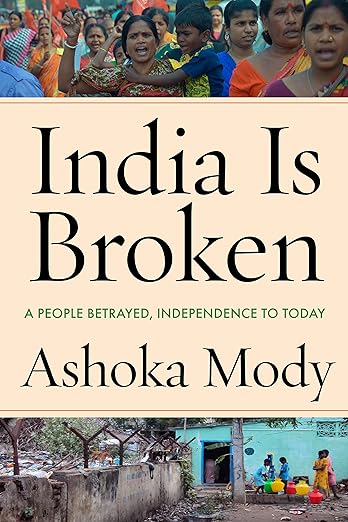
India Is Broken: A People Betrayed, Independence to Today Hardcover – 14 February 2023
by Ashoka Mody (Author)
4.5 4.5 out of 5 stars 227 ratings
A provocative new account of how India moved relentlessly from its hope-filled founding in 1947 to the dramatic economic and democratic breakdowns of today.
When Indian leaders first took control of their government in 1947, they proclaimed the ideals of national unity and secular democracy. Through the first half century of nation-building, leaders could point to uneven but measurable progress on key goals, and after the mid-1980s, dire poverty declined for a few decades, inspiring declarations of victory. But today, a vast majority of Indians live in a state of underemployment and are one crisis away from despair. Public goods--health, education, cities, air and water, and the judiciary--are in woeful condition. And good jobs will remain scarce as long as that is the case. The lack of jobs will further undermine democracy, which will further undermine job creation. India is Broken provides the most persuasive account available of this economic catch-22.
Challenging prevailing narratives, Mody contends that successive post-independence leaders, starting with its first Prime Minister, Jawaharlal Nehru, failed to confront India's true economic problems, seeking easy solutions instead. As a popular frustration grew, and corruption in politics became pervasive, India's economic growth relied increasingly on unregulated finance and environmentally destructive construction. The rise of a violent Hindutva has buried all prior norms in civic life and public accountability.
Combining statistical data with creative media, such as literature and cinema, to create strong, accessible, people-driven narratives, this book is a meditation on the interplay between democracy and economic progress, with lessons extending far beyond India. Mody proposes a path forward that is fraught with its own peril, but which nevertheless offers something resembling hope.
Read less
Report an issue with this product
Print length
528 pages
Language
English
Publisher
Stanford University Press
Publication date
14 February 2023
Dimensions
Product description
Review
"[An] impressive, sweeping narrative of India's economic and political history.... The book is very readable--a coherent and useful compendium of major events, policies, and scandals covering India's complex economic and political history from 1947 to the present."--Reeta C. Tremblay, Pacific Affairs
"India Is Broken is a brave book, flying in the face of both the chest-thumping nationalist narrative of a rising India and the collective wisdom of various finance bros, investment gurus, CEOs, and talking heads."--Dinyar Patel, Los Angeles Review of Books
"India is Broken is a highly readable book. Mody is deeply knowledgable, and can write as fluently and thoughtfully about the 1950's as he can about the last decade. I found his discussion of the Nehru period especially fascinating."--Anand Swamy, Journal of Economic Literature
"This book asks a straightforward question: has Indian democracy, as practiced since independence in 1947, improved the lives of people in general? The answer, contends Mody, is no. To substantiate this distressing yet sobering response, Mody conducts an expansive analysis of leaders and policy making in modern India.... Recommended."--A. A. Batabyal, CHOICE
"Fundamentally, Mody's claim is right. India is broken. It offers a poor deal to its working-age population, few good jobs and little welfare. A humanitarian crisis for migrant workers shortly after COVID-19 broke out was a brutal reminder of the condition. The book's message is stark and demands attention. That it is a highly readable account of India's development enhances the appeal."--Tirthankar Roy, The Developing Economies
"This is a well-documented readable history of the major economic and social policy strategies of Indian governments, from Nehru to Modi.... [Mody] makes a powerful case to the effect that education outcomes cannot be separated from politics."--John Richards, International Journal of Educational Development
"India is Broken is a masterful, wonderfully readable but searing indictment of the failures of Indian economic policy since Independence. Brilliantly weaving into his account a history of the key political events of the era, Mody chronicles how a dismal catalogue of flawed economic strategies and a dysfunctional political system have led to a country that is unable to produce enough jobs, where religious divisions keep growing, and inequality is relentlessly rising. An indispensable book for anyone trying to understand this complicated country."--Liaquat Ahamed, Pulitzer Prize winning author of Lords of Finance
"A compellingly readable history of Indian politics and economics since independence: Nehru's early mistakes--especially his tragic lack of attention to health, education, and jobs--multiplied into performative and destructive politics in the hands of his heirs. This is a profound account of how any democracy, even the world's largest, can be destroyed from within. Great storytelling. Hard to put down!"--Angus Deaton, Nobel Laureate in Economics
"A detailed and richly researched study of India's economy from independence to the present day, India Is Broken delves into many of the critical yet overlooked aspects of India's political and economic history. While I cannot endorse everything he writes, Mody's highly-readable account lays bare the deception and failure of the last several years, while maintaining a focus on the important details of economic policy."--Shashi Tharoor, Member of Parliament and author of The Struggle for India's Soul
"A magisterial political and economic history of post-colonial India, written with extraordinary eloquence and passion. Mody argues that successive leaders have failed the country's hundreds of millions of poor and borderline poor on its path from nascent democracy to mature authoritarian state. All too often the IMF, the World Bank, and other donors were willing to sign off on economic policies that had little chance of success. India is Broken will be a touchstone in policy debates for years to come."--Kenneth Rogoff, Harvard University, and coauthor of This Time is Different
"Combining statistical data with creative media, such as literature and cinema, to create strong, accessible, people-driven narrative, this book is a meditation on the interplay between democracy and economic progress, with lessons extending far beyond India. Mody proposes a path forward that is fraught with its own peril, but which nevertheless offers something resembling hope."--Discovery: Research at Princeton
"This book is the most sustained, accessible, and trenchantly argued alternative account of India's political economy and democratic crisis that I have seen in many years. Engaging and well written, it tells a striking and disturbing story. A major achievement."--Thomas Blom Hansen, Stanford University
About the Author
Ashoka Mody is an economic historian at Princeton's School of Public and International Affairs. Formerly, he worked at the World Bank and the International Monetary Fund. He is the author of EuroTragedy: A Drama in Nine Acts (2018), and his writing appears often in outlets such as Financial Times, Project Syndicate, and Bloomberg View.
Product details
Publisher : Stanford University Press (14 February 2023)
Language : English
Hardcover : 528 pages
Dimensions : 16.51 x 3.81 x 24.13 cmBest Sellers Rank: 323,767 in Books (See Top 100 in Books)643 in History of India
1,001 in Economic Conditions (Books)
1,176 in Economic History (Books)Customer Reviews:
4.5 4.5 out of 5 stars 227 ratings
Top reviews from other countries
Translate all reviews to English
drav
5.0 out of 5 stars Bollywood Economics: A Review of India is BrokenReviewed in the United States on 7 December 2024
Verified Purchase
Ashoka Mody's India is Broken offers a unique and engaging perspective on 75 years of missed economic opportunities in India. By drawing on the evocative power of Bollywood cinema, Mody skillfully intertwines politics, economics, and popular culture to illuminate complex issues. This approach makes the book accessible to a wide audience and transforms what could have been a dry academic analysis into a captivating narrative.
Mody's analysis is both insightful and critical, examining the impact of well-intentioned political novices, hubris, and outright malice on India's economic trajectory. The book's strength lies in its ability to connect historical events with contemporary challenges, providing a nuanced understanding of India's economic development.
By blending economic theory with cinematic references, Mody has created a truly original work that will appeal to both scholars and casual readers alike. India is Broken is a must-read for anyone interested in India's post-independence journey.
Report
Darlene Albright
5.0 out of 5 stars PerfectReviewed in Canada on 14 March 2023
Verified Purchase
I can't believe the problems in India.... the corruption, the lack of education, the pollution. And it doesn't seem to be getting any better. Racism, castes, and mistakes being made over and over. Money is needed but with conditions. Send in a team or something to help and monitor. It takes forever to change the culture and without education they may never come out of it. The spiritual Gange is a toxic mess and people still go into this river and use it regularly. Never want to visit there. Ever.
Report
Amazon Kunde
5.0 out of 5 stars Indien kritisch betrachtetReviewed in Germany on 24 October 2024
Verified Purchase
Wer sich mit Indien beschäftigt, kommt an diesem Buch nicht vorbei. Es zeigt die Entwicklung von den Anfängen des Staates bis heute (Modi) auf. Es ist kein Sachbuch, sondern eine wissenschaftliche Abhandung von einem der besten Kenner des Landes. Dennoch hervorragend zu lesen. Eine klare Empfehlung!
Report
Translate review to English
B. A. Anderson
5.0 out of 5 stars Gripping and informativeReviewed in India on 12 June 2024
Verified Purchase
I found Ashoka Mody's India Is Broken very easy to read and very enlightening.
However, I worry that his prescription of a universal basic income (UBI) will not address all of the major challenges that he highlights. While a UBI is likely to help parents afford better nutrition for their children, I imagine that much of the UBI would flow to private providers of education and health care. So, a UBI would do little to improve public goods.
But the devolution of power to city and state governments will probably increase accountability.
Report
MR S S DADWAL
1.0 out of 5 stars Well written, but hides important factsReviewed in the United Kingdom on 31 March 2023
Verified Purchase
was fun to read until i got to the bit about the Sikh saint Bhindranwale. What i read was shockingly false, i have heard almost all of Bhindranwales speaches and he never condoned what this author is claiming. This is a deliberate attempt to paint indian history in the authors chosen narrative. Manipulating.
Report
See more reviews
===
===
Ashoka Mody
Ashoka Mody | |
|---|---|
| Born | 14 January 1956 |
| Nationality | American |
| Academic career | |
| Field | Economics - emerging markets' access to foreign capital |
| Institution | Princeton University |
| Alma mater | IIT Madras (BTech) Centre for Development Studies (MPhil) Boston University (PhD) |
| Information at IDEAS / RePEc | |
Ashoka Mody (born 14 January 1956)[1] is an Indian-American economist. He is the Charles and Marie Robertson visiting professor in international economic policy and lecturer in public and international affairs at the Princeton School of Public and International Affairs.[2]
Education
[edit]Mody studied Electronics at the Indian Institute of Technology at Madras. After his B.Tech. (1978) he switched fields and obtained a M.Phil. in Applied Economics at the Centre for Development Studies in Trivandrum 1979, where he worked as a Research Associate until completing his PhD in Economics from Boston University in 1986.[3]
Career
[edit]He briefly joined AT&T Bell Laboratories as a member of their technical staff before joining the World Bank where he worked from 1987 to 2003. In 1997/1998, Mody was a visiting professor of public policy at the Wharton School. From 2001 until his retirement, Mody was the assistant director of the International Monetary Fund's European Department. He is opposed to fiscal austerity as a means to resolve credit crises.[4]
He was the chief IMF representative to Ireland during Ireland's troika bailout. Mody was critical of the troika for severity of the austerity regime enforced on Ireland. He was also critical of the Irish Government's lack of solidarity with other indebted EU nations and claimed that Irish Finance Minister Michael Noonan "blew it" by siding with the troika in 2015, when a debt reduction might have been reached.[5] Mody noted in 2018 that Ireland's heavy exposure to U.S. multinationals for its business model would be a problem post the Tax Cuts and Jobs Act of 2017 reforms.[6]
He is also affiliated with Bruegel in Brussels.[7]
Attempt on Mody's life
[edit]In October 2009 as Mody returned to his home in Bethesda, Maryland when he was shot multiple times whilst in his car by a masked gunman who then fled on foot. Police issued an arrest warrant for Mohau Mercy Mathibe who worked for a trial period at the IMF under Mody.[8][9] The assailant was suspected to be denied a promotion, leaving him embittered enough to commit the crime.[10]
Personal life
[edit]Mody is married and has two children.[8]
Bibliography
[edit]- Mody, Ashoka (2014). Foreign Direct Investment and the World Economy. Routledge. ISBN 978-0415654876.
- Mody, Ashoka (2018). EuroTragedy: A Drama in Nine Acts. OUP USA. ISBN 978-0199351381.
- Mody, Ashoka (2023). India Is Broken A People Betrayed, Independence to Today. Redwood City: Stanford University Press. ISBN 978-1-5036-3422-0. OCLC 1354208737.
See also
[edit]- Post-2008 Irish banking crisis
- Ireland as a tax haven
- Economic Adjustment Programme for Ireland
- Post-2008 Irish economic downturn
References
[edit]- ^ "Mody, Ashoka". Library of Congress. Retrieved 20 November 2014.
data sheet (b. 1/14/56)
- ^ "Profile: Ashoka Mody". Woodrow Wilson School of Public and International Affairs, Princeton University. Princeton University. Archived from the original on 2 December 2014. Retrieved 20 November 2014.
- ^ "Biography: Ashoka Mody". Woodrow Wilson School of Public and International Affairs, Princeton University. Princeton University. Retrieved 20 November 2014.
- ^ Newenham, Pamela; Crosbie, Judith (22 July 2013). "IMF distances itself from Ashoka Mody comments on Ireland". The Irish Times. Retrieved 20 November 2014.
- ^ "Noonan dismisses Ashoka Mody comments on debt writedown". Irish Times. 16 February 2015.
- ^ "Warning that Ireland faces huge economic threat over corporate tax reliance - Troika chief Mody says country won't be able to cope with changes to tax regime". Irish Independent. 9 June 2018.
- ^ "Profile: Ashoka Mody". The Guardian. Retrieved 20 November 2014.
- ^ a b Morse, Dan (9 October 2010). "Man shot in garage identified as IMF economist". Washington Post. Retrieved 20 November 2014.
- ^ Davis, Bob (5 January 2010). "IMF worker sought in attack". Wall Street Journal. Retrieved 20 November 2014.
- ^ Datta, Kanika (20 January 2023). "Why economist Ashoka Mody feels India needs to rethink its priorities". www.business-standard.com. Retrieved 21 January 2023.

No comments:
Post a Comment