Books
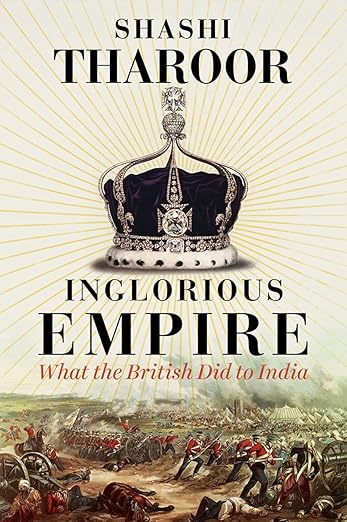
Inglorious Empire: What the British Did to India Hardcover – International Edition, 2 March 2017
by Shashi Tharoor (Author)
4.5 out of 5 stars 2,200
***THE SUNDAY TIMES TOP TEN BESTSELLER*** In the eighteenth century, India's share of the world economy was as large as Europe's. By 1947, after two centuries of British rule, it had decreased six-fold. Beyond conquest and deception, the Empire blew rebels from cannon, massacred unarmed protesters, entrenched institutionalised racism, and caused millions to die from starvation. British imperialism justified itself as enlightened despotism for the benefit of the governed, but Shashi Tharoor takes on and demolishes this position, demonstrating how every supposed imperial 'gift' from the railways to the rule of law was designed in Britain's interests alone. He goes on to show how Britain's Industrial Revolution was founded on India s deindustrialisation, and the destruction of its textile industry. In this bold and incisive reassessment of colonialism, Tharoor exposes to devastating effect the inglorious reality of Britain's stained Indian legacy.
Read less
Product description
Review
'In Inglorious Empire, Shashi Tharoor documents the realities of the British empire in India and makes a compelling case for the need to acknowledge, and, atone for, these realities.'-- Book Riot, ’14 Must-Read Indian History Books’
About the Author
Shashi Tharoor served for twenty-nine years at the UN, culminating as Under-Secretary General. He is a Congress MP in India, the author of fourteen previous books and has won numerous literary awards, including a Commonwealth Writers' Prize. Tharoor has a PhD from the Fletcher School and was named by the World Economic Forum in Davos in 1998 as a Global Leader ofTomorrow.
Product details
Publisher : Hurst Publishers; 1st edition (2 March 2017)
Language : English
Hardcover : 288 pages
ISBN-10 : 1849048088
ISBN-13 : 978-1849048088
Dimensions : 14 x 3.2 x 21.6 cmBest Sellers Rank: 246,527 in Books (See Top 100 in Books)170 in Asian History Textbooks
328 in Economics Textbooks
406 in History of Western Europe (Books)Customer Reviews:
4.5 out of 5 stars 2,200
==
Top reviews from Australia

Aengus Ryan
5.0 out of 5 stars Great ReadReviewed in Australia on 19 April 2023
Verified Purchase
Excellent book. A real eye opener to the dreadful things the British did in India.
HelpfulReport
Ajnabi
4.0 out of 5 stars Convincing critique of the British RajReviewed in Australia on 10 September 2018
Verified Purchase
A solid summary of the arguments against the supposed "benefits" of British Imperial rule of India from the mid 18th to mid 20th centuries. Tharoor moves quickly over a vast landscape as he refutes the many arguments put forth by Raj-nostalgics and neo-Imperialist writers.
As a student of Indian history it was good to be refreshed on how the Raj, like all Imperial regimes were all about extraction, suppression and discrimination ( to put it mildly) and not about providing benefits to India or Indians.
Former American Ambassador to the UN, Andrew Young, once created controversy by claiming Britain invented racism. This book is good evidence for that.
Tharoor himself is a divisive figure in India and his somewhat glib and supremely confident tone will turn some off but the substance he marshalls while not original is powerful.
2 people found this helpful
HelpfulReport
Gary
5.0 out of 5 stars British Empire UndressedReviewed in Australia on 16 October 2022
Verified Purchase
A look at where the money came from to build the amazing country homes the Brits are so proud of but can now longer afford due to the rivers of gold being dried up by Indian Independance. Explains why a country with such treasures as the Taj Mahal was reduced to an economic basket case after 200+ years of pillaging by the British Raj.
And now The Brits have the audacity to rename the Empire "The Commonwealth".
HelpfulReport

Amazon Customer
5.0 out of 5 stars Fascinating and horrifyingReviewed in Australia on 12 March 2018
Verified Purchase
I had heard of some things done by the British such as the Amritsar massacre, and the poor treatment of Indian people, mostly from films, but I had no idea of the depths of depravity of those involved. I agree with other reviewers, that this kind of material should be taught in schools. I found the book both fascinating and horrifying, like a slow-motion wreck. I admire the author's passion and position on the subject, and his impeccable writing style. As noted by one of the critics, for a Brit, it is indeed uncomfortable reading.
6 people found this helpful
HelpfulReport

Jacotte
5.0 out of 5 stars It's emabarrassing to admit that I didn't realise the extent ...Reviewed in Australia on 23 September 2018
Verified Purchase
It's emabarrassing to admit that I didn't realise the extent to which I'd absorbed imperialist British knowledge and values about India. This book is a tremendous corrective about topics such as the extent of British plundering of the Indian village economy, the arguable benefits of the railway system and British law, the suppression of independence movements.
4 people found this helpful
HelpfulReport
Luke baji thomas
3.0 out of 5 stars You might need a dictionary. UrrgghReviewed in Australia on 13 January 2021
Verified Purchase
This was a really good book but it appears to me that Shashis penchant for bombastic language got the better of him. If you write a book that you want a nation to read, i would strongly suggest he make an abridged version so that youth and even middle aged fellas like me don’t struggle with comprehension. I dont want to have to look up words in a dictionary every 10 minutes as it’s exhausting and greatly detracts from the thrill of the book.
One person found this helpful
HelpfulReport
Bill Shaw
4.0 out of 5 stars This book confirmed some of my thoughts re the British Empire.Reviewed in Australia on 19 March 2019
Verified Purchase
Having recently visited India I was motivated to find out more of the British Empires days. This book is well written and researched.
One person found this helpful
HelpfulReport
Christopher Cox
5.0 out of 5 stars I knew we were bad..Reviewed in Australia on 8 June 2018
Verified Purchase
The book we should have studied in school when I was growing up in the UK. I knew we were bad... but this incredibly well researched and accessible book takes this appalling chapter in Britain’s history to a new level.
4 people found this helpful
HelpfulReport
See more reviews
Top reviews from other countries
Translate all reviews to English

rose
5.0 out of 5 stars very enlighteningReviewed in the United Kingdom on 10 April 2024
Verified Purchase
I think every brit should read this and what ws done in their names.....
Report
Akif Uygur
5.0 out of 5 stars Engländer in IndienReviewed in Germany on 6 April 2024
Verified Purchase
Sollte jeder das Buch gelesen haben der sich mit der kolonialen Vergangenheit beschäftigt
Report
Translate review to English

Bayard B.
5.0 out of 5 stars Excellent! Describes British impositions on India but is weak on reasons why the British succeeded.Reviewed in the United States on 18 October 2020
Verified Purchase
This is an excellent polemic and intellectual critique of the British colonial looting of India. It describes in horrifying detail what colonialism really was: the exploitation of a land for the benefit of the colonizers at the expense of the colonized. The book discusses the many unfair impositions of the British on the Indians: the overt discriminatory racism, the taxation, the creation of import and export tariffs for the benefit of British manufacturers and traders, the forced deindustrialization or prevention of industrial development of the country, the famines, and the political subjugation of the country.
I thought the book, though, paid insufficient attention to how the British were able to occupy a huge and populace country such as India. To a certain extent, I think it was a coincidence or combination of events that happened to occur at the same time. The Mogul dynasty and central government collapsed, and India was invaded by the Persians, just when the British East India Company and the French went to war all over the world, including in India. The author (Shashi Tharoor) also, I think, misjudges the significance and effects of the European Industrial Revolution and the superior European military performance at the time. By the mid- to late 18th century, a European army and navy could defeat a much larger Indian or Asian army or navy. The European colonization or seizure of Africa and Asia occurred because of a huge superiority in military and industrial technology. To this day, if one country possesses a military or technological - industrial advantage over another country, it will use it for it's own benefit. The people of India, China, and Africa found this out.
Another excellent book on this subject is "The Anarchy: The East India Company, Corporate Violence, and the Pillage of an Empire" by Dalrymple (2019).
Read more
25 people found this helpfulReport
Catherine
3.0 out of 5 stars Good bookReviewed in Italy on 26 September 2021
Verified Purchase
The book is really an eye-opener, but the quality of papers is not good, and took longer to receive (like 2-3 weeks)
Report
ARUN KUMAR
5.0 out of 5 stars An Eye OpenerReviewed in Canada on 29 June 2020
Verified Purchase
I always wondered how come the narrative on the two sides of the aisles so different. If you have lived in India and you can hear the stories of the elders and a lot of indigenous literature in the native languages like Hindi, you will find so much of the excesses that British did to India. While on the other hand if you read the books by British writers which floods the western world you will find the romanticized starry eyed description of the India as the crown jewel of the colony. Trying to gloss over their cruelty and masquerading their wrongdoings as some kind of reform. This book cuts through that narrative and fills this gap.
How systematically industries were destroyed, exorbitant taxes were levied and used as the market for the finished goods from Britain. Natives were denied fair competition their industries, arts and cultures were destroyed and Economy decimated. Kohinoor was not the only diamond looted from India read Pitts Diamond and how it helped him buying the parliament seat and helped create the prime minister in UK, William Pitt junior and senior. No wonder no British remained in India after the Independence of India in 1947 like South Africa or Zimbabwe, because they sucked it dry. It is heartening to see India pipped UK to become 5th highest GDP in the world just over 70 years of independence, hope it finds its rightful place soon.
Anything that British did in India was to strengthen their instruments of exploitation like Railway, English Education but if the Indians took this and turned it around to their advantage it is their strength and not some kind of British Contribution. You just have to look at the African countries or for that matter any other former British colony.
While the contributions of even animals are recognized during the world war, the contributions of the Indians are largely ignored by the Britain. Even though, Indians were the first one to take the brunt of the offensive. Winston Churchill who is hailed as hero in the west is no less a tyrant than Heitler. He is responsible for deaths of millions of the poor peasants in the Bengal famine, just to shore up the stocks for world war. He lost all the respect I had for him and its nauseating to see the roads and towns named after him.
Read less
9 people found this helpfulReport
=======
Inglorious Empire
 Indian edition | |
| Author | Shashi Tharoor |
|---|---|
| Language | English |
| Genre | History |
| Publisher | Aleph (India) C. Hurst & Co. (UK) |
Publication date | March 2017 |
| ISBN | 978-1-84904-808-8 (hardcover) |
Inglorious Empire: What the British Did to India, first published in India as An Era of Darkness: The British Empire in India, is a work of non-fiction by Shashi Tharoor, an Indian politician and diplomat, on the effects of British colonial rule on India. The book has received mixed reviews. In 2017, Tharoor won the 2017 Ramnath Goenka Excellence in Journalism Award[1] and the 2019 Sahitya Akademi Award[2] for this work.
Background[edit]
Tharoor made a speech at a 2015 Oxford Union debate on the topic "Does Britain owe reparations to its former colonies?", which went viral over the web. Subsequently, his publisher floated the idea to transform the speech into a book; despite being initially skeptical, he went on to write a 330 page book.[3][4]
The Book[edit]
The following quote summarises the core theme of the book.
Reception[edit]
The Hindu Business Line called the book "one breathless read".[6] The Guardian called it a "passionately argued book [which] provides a crushing rebuttal of such ideas with regard to India".[7]
Tabish Khair praised the book for presenting an "intricate mixture of fact and anecdotes" that served as an effective counter to the view of "colonial apologists" but at the same time, did praise the British, when it merited.[4]
Eminent Scottish historian William Dalrymple criticised the book, saying it "was written in 12 days, involved no personal archive research and contains some serious factual errors" however he maintained that the book was, nevertheless, "persuasive".[8]
In a review published in the Cambridge Review of International Affairs, economic historian, Tirthankar Roy, a faculty at the London School of Economics criticized the book. He noted that "Tharoor makes his case with passion and plain good writing. The story is meant to be "blood-curdling and colourful language" — including liberal use of "depredation," "loot," "rapaciousness," "vicious," "brutality," "plunder" and "extraction" — produces that effect. Like a religious text, it tells a straight and narrow story with the zeal of a holy warrior. Yet "none of these qualities makes the interpretation right, however".
Another review of Inglorious Empire, published in the Literary Review, by historian John Keay, whose many writings on India include India: A History, applauds Tharoor for "tackling an impossibly contentious subject". However, he deplores the fact that "his moral venom sometimes clouds his own judgement" and notes that many of Tharoor's statistics are very seriously out of date, many coming from the polemics contained in the American Will Durant's Story of Civilisation written in the 1930s, which itself drew on the even earlier work of the crusading American missionary Jabej T. Sutherland, author of India in Bondage.[9]
A more detailed criticism of Tharoor's book and his use of statistics was set out by the writer of South Asian history Charles Allen in a lecture entitled Quis custodiet ipsos custodes: who owns Indian history? delivered to the Royal Society for Asian Affairs in London on 25 April 2018. A revised version was published in Asian Affairs under the revised title Who Owns India's History? A Critique of Shashi Tharoor's Inglorious Empire.[10]
References[edit]
- ^ "Vice-President Venkaiah Naidu presents 12th edition of Ramnath Goenka Excellence in Journalism Awards". Firstpost. Retrieved 14 April 2020.
- ^ "Shashi Tharoor wins Sahitya Akademi Award 2019 for An Era Of Darkness". India Today. 18 December 2019. Retrieved 14 April 2020.
- ^ Bangalore Literature Festival (15 January 2017), Inglorious Empire, The reality of the British Raj | Shashi Tharoor with Sanjeev Sanyal, retrieved 9 September 2017
- ^ a b Tabish Khair (2018). "Inglorious Empire: What the British did to India". Journal of Postcolonial Writing. 54 (3): 432–433. doi:10.1080/17449855.2017.1330759. S2CID 164354004.
- ^ Shashi Tharoor, March 2017, Inglorious Empire: What the British Did to India, C. Hurst & Co., UK.
- ^ Balakrishnan, Uday. "The bald truth is — the Raj ruined us". @businessline. Retrieved 14 April 2020.
- ^ Smith, P. D. (23 February 2018). "Inglorious Empire by Shashi Tharoor review – what the British did to India". The Guardian. ISSN 0261-3077. Retrieved 14 April 2020.
- ^ Dalrymple, William (27 September 2018). "The British in India by David Gilmour review – three centuries of ambition and experience". The Guardian.
- ^ Keay, John (March 2017). "Bristling with Raj". Literary Review. Retrieved 10 February 2018.
- ^ Allen, Charles (3 July 2018). "Who Owns India's History? A Critique of Shashi Tharoor's Inglorious Empire". Asian Affairs. 49 (3): 355–369. doi:10.1080/03068374.2018.1487685. ISSN 0306-8374. S2CID 158949586.
=======
Displaying 1 - 3 of 3 reviews

Dinesh Kumar
10 reviews
Follow
December 26, 2023
The book is full of hard facts with lots of details on impact of 200 year British rule in India. Shashi Tharoor's "Inglorious Empire" is a compelling exploration of Britain's colonial rule in India, delivering a scathing critique of the often romanticized narrative surrounding the British Empire. Tharoor, a historian and politician, meticulously deconstructs the myth of benevolent British governance, exposing the exploitation, economic devastation, and cultural destruction inflicted upon India during centuries of colonization.
Through a meticulously researched narrative, Tharoor presents a compelling argument, skillfully intertwining historical facts, personal anecdotes, and compelling arguments. He delves into the economic plunder, manipulation of Indian industries, and the deliberate policies that led to famines, poverty, and the dismantling of India's rich fabric.
While some critics debate certain interpretations or arguments, "Inglorious Empire" remains a pivotal work that forces a reevaluation of colonial legacies. It's a vital read not only for history enthusiasts but also for those interested in understanding the complex dynamics between colonizer and colonized, and its implications on global power structures. Tharoor's passionate narrative elevates this book to an essential piece in the discourse on imperialism and its aftermath.
colonism history india
...more
Like
Comment
Rose Hathaway
90 reviews · 8 followers
Follow
March 11, 2024
The content in this book was objectively great, but I just couldn’t get into it.
I usually get really engrossed in these types of book but for some reason this didn’t do it for me.
I picked this up because I saw a clip of the author in an interview or debate with someone saying the empire was good and thought he was fantastic there, spitting facts etc
I guess the satisfaction from listening to him speak just isn’t the same in a book, which I strange for me
So what it did for me - 2 star (enjoyment rating)
Content of the book - 5 star (objective rating)
Idk why I didn’t like it! This is defo an issue with me and not the book
====
Inglorious Empire review: Shashi Tharoor's indictment of the British in India
ByChristopher Kremmer
August 11, 2017 — 1.55pm
HISTORY
Inglorious Empire: What the British Did to India
SHASHI THAROOR
Scribe, $32.99
Remember the scene in Monty Python's Life of Brian when a Judean rebel leader fumes as his gormless but practical comrades detail the benefits of oppression under their powerful and technologically advanced Roman oppressors?
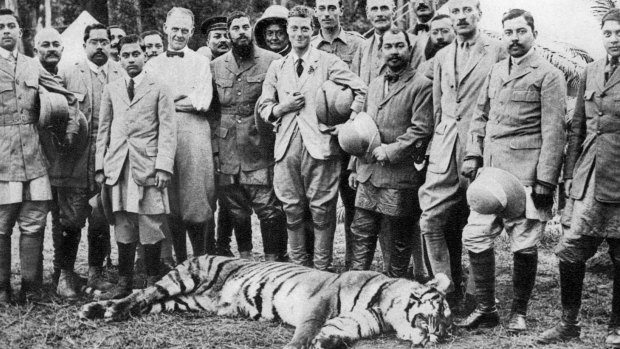
The Prince of Wales tiger shooting in Nepal during the Indian tour of 1921. CREDIT:THE PRINT COLLECTOR / ALAMY STOCK PHOTO
"Orright," concedes the leader, Reg, played by John Cleese. "But apart from the sanitation, the medicine, education, wine, public order, irrigation, roads, the freshwater system and public health, what have the Romans ever done for us?"
In Inglorious Empire: What the British Did to India, Shashi Tharoor, writer, politician and United Nations-based diplomat for 30 years, asks a similar question to the one posed by Cleese's beleaguered revolutionary.
Advertisement
'Inglorious Empire' by Shashi Tharoor.
In doing so, he seeks to remind misty-eyed Raj romantics that colonialism was no joke. As empires go, he says, Britain's was uncommonly ruthless, devious and rapacious in its quest to enslave a people whose leaders failed to see how free trade, unwisely managed, can undermine a country's long-term sovereignty and prosperity.
In the process, Tharoor accuses a number of historians, most prominent among them, Niall Ferguson, of being apologists for the racial discrimination, violence, economic sabotage and denial of liberty embodied by centuries of British rule in India.
It all began as a harmless commercial enterprise, Tharoor reminds us. In 1600, the British East India Company was formed under royal charter. Its aim was to compete with colonial rivals such as the French and Dutch for lucrative trade opportunities with India, an industrial and cultural superpower that under its Mughal emperors would account for 27 per cent of the world economy.
Awash with gems, natural resources, shipyards and a sophisticated cultural life, the Mughals were happy to trade. By the end of the century, however, they were tired, divided, and overextended. In 1739, the capital at Delhi was sacked by the Persians.
Advertisement
Meanwhile, in the expanding coastal trading posts, the initial presence of armed guards to protect the company's staff and premises had evolved into a fully fledged army that by 1757 under Robert "Clive of India" had toppled the independent nawab of India's richest province, Bengal. By 1800, the company had 260,000 men under arms and a talent for regime change that brought 200 million people under its control.
In 1857, after Hindu and Muslim rebels joined in a bloody revolt, India came under direct rule from London, and the company was eventually dissolved. The new Raj survived two world wars and the Great Depression, extending British rule for another 90 years until Gandhi's Freedom movement triumphed in 1947, albeit at the terrible cost of Partition.
It is unusual, but not unheard of today to meet Indians who believe their country was better off under the Raj. Muddle-headed history is much more prominent in soon to be Brexited Britain. Tharoor cites a 2014 opinion poll that found 59 per cent of British people polled believed the old empire was something to be proud of. Thirty-four per cent wished they still had one.
Tharoor marshalls a formidable array of research to make the case that such attitudes are anachronistic and poorly informed. All the old chesnuts, for example, that the British modernised India, bequeathed it a tradition of parliamentary democracy and civilised the locals by teaching them the gentlemanly sport of cricket, are lined up and skewered, or at least plausibly challenged.
The company smashed India's advanced textiles industries, literally by demolishing factories and imposing tariffs of 70-80 per cent on exports to Britain. In doing so, they turned a manufacturing, shipbuilding nation into a source of raw materials with little scope for value adding industries. The railways, he argues, were developed principally to more efficiently ship out those raw materials, and were financed by an elaborate and shonky racket that enriched British investors by inflating the cost of Indian rail track to twice that of Australia and Canada.
Advertisement
Meanwhile, ordinary Indians were taxed 50 per cent of their incomes, far beyond their experience and capacity to pay. Defaulters were tortured and jailed or, in the case of two-thirds of Indians under British rule in the late 18th century, fled their lands.
"The bones of the cotton weavers were bleaching the plains of India," as one colonial administrator observed. The treasuries of princely states such as Bengal were systematically looted by coercive and corrupt methods, while prices for basic commodities were driven up by the opulent lifestyles of expatriate Britons.
Indian taxes not only paid the salaries of the British army of occupation, but also of the hundreds of thousands of Indian troops who became cannon fodder for British interests on the Western Front, at Gallipoli, and in Mesopotamia.
Behind the entire rip-off, as Ferdinand Mount, has observed, "lay the hard calculus of the City of London". The Indian currency was manipulated to British advantage, and its trade with Europe was forced to go through London. Specifications were set to ensure that Indian steel could not be exported to Britain. India did not miss the bus of the Industrial Revolution – it was forcibly prevented from boarding it.
Discrimination against Indians in civil service employment was rife. Even the arch-colonial writer Rudyard Kipling observed that the bureaucracy was "neither Indian, nor civil, nor a service". The "justice" British rule gave India meant it was almost impossible for a white man to be given a serious term in jail for murdering his Indian servant, which happened rather a lot. The racism of the occupiers gave the lie to the fiction of modern, enlightened and benign British rule. As one viceroy put it, "We are all British gentlemen engaged in the magnificent work of governing an inferior race".
Tharoor acknowledges the sincere efforts of many British expats to ameliorate the harsh realities of colonial rule. But even in the 20th century, when the sun was setting on the Raj, enlightenment attitudes took second place to the desire to crush the Indian independence movement. The same people who condemned the nationalist leader Nehru to 10 years in British Indian jail cells also labelled Gandhi's non-violent campaign for freedom as terrorism. Newspapers that alerted the public to such injustices, particularly the vernacular press, were often censored or shut down.
For all its claims to superiority, the British Empire was in charge in India during no fewer than 11 famines in which 30 to 35 million people died of starvation, Tharoor notes. Ultimately, he believes, Britain's desire for wealth trumped all other values and considerations. The rhetoric of uplifting the benighted brown man was always a self-serving, grotesque and conceited pose to justify a regime that bribed and murdered, annexed and stole to enrich a certain class of Briton.
This book burns with the power of intellect married with conviction. It ends with Tharoor commenting that the way the Raj ended was its greatest indictment. The collapse of British rule amid devastating sectarian violence and creation of a Muslim "homeland" in Pakistan can be seen as the logical conclusion of 90 years of divide and rule strategies as London clung desperately to power in the subcontinent.
As they washed their hands and packed their carpet bags, the British departed an India in which 84 per cent of people could not read or write their own name in any language. What an achievement. In 1600, Britain produced 1.8 per cent of the world's gross domestic product, compared with India's 23 per cent. By the end of the Raj, Britain's share had multiplied fivefold, while India had been reduced to penury.
But in 70 short years, India's proud republic has made enormous strides in literacy, numeracy and poverty reduction, and is now the world's fastest growing major economy.
Advertisement
Yet there are contradictions in the new India's rise, some with their roots in the British period, like the ruling Hindu nationalist movement's proclivity to cast the Indian identity in sectarian terms. At times, Tharoor's determination to resist such trends leads him to downplay the injustices of earlier empires to more graphically illustrate the failings of the British one.
Yet overall, this is erudite, well-written, thoroughly documented and persuasive history that focuses varied sources into a coherent critique of colonialism in the Indian context. Tear up your copies of Ferguson's neo-liberal mind rot and get angry like Tharoor.
Shashi Tharoor is a guest at Melbourne Writers Festival (mwf.com.au) and the Antidote festival (antidote.sydneyoperahouse.com). Christopher Kremmer is the author of Inhaling the Mahatma (HarperCollins).
Save
Share
=========

No comments:
Post a Comment