audiobook
https://www.everand.com/audiobook/638325756/Identity-and-Violence-The-Illusion-of-Destiny
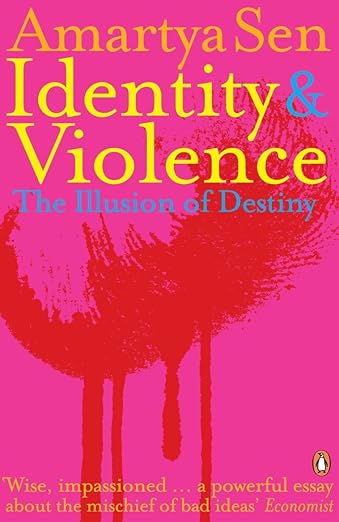
Roll over image to zoom in
Amartya Kumar SenAmartya Kumar…
Follow

Amartya SenAmartya Sen
Follow
Identity and Violence: The Illusion of Destiny Kindle Edition
by Amartya Sen (Author) Format: Kindle Edition
4.5 out of 5 stars 200
Part of: Issues of Our Time (7 books)
The world may be more riven by murderous violence than ever before, yet Nobel Laureate Amartya Sen argues in this sweeping philosophical work that its brutalities are driven as much by confusion as by inescapable hatred.
Sen argues in his new book that conflict and violence are sustained today, no less than the past, by the illusion of a unique identity. Indeed, the world is increasingly taken to be divided between religions (or 'cultures' or 'civilizations'), ignoring the relevance of other ways in which people see themselves through class, gender, profession, language, literature, science, music, morals or politics, and denying the real possibilities of reasoned choices.
Roll over image to zoom in
Amartya Kumar SenAmartya Kumar…
Follow
Amartya SenAmartya Sen
Follow
Identity and Violence: The Illusion of Destiny Kindle Edition
by Amartya Sen (Author) Format: Kindle Edition
4.5 out of 5 stars 200
Part of: Issues of Our Time (7 books)
The world may be more riven by murderous violence than ever before, yet Nobel Laureate Amartya Sen argues in this sweeping philosophical work that its brutalities are driven as much by confusion as by inescapable hatred.
Sen argues in his new book that conflict and violence are sustained today, no less than the past, by the illusion of a unique identity. Indeed, the world is increasingly taken to be divided between religions (or 'cultures' or 'civilizations'), ignoring the relevance of other ways in which people see themselves through class, gender, profession, language, literature, science, music, morals or politics, and denying the real possibilities of reasoned choices.
In Identity and Violence he overturns such stereotypes as the 'the monolithic Middle East' or 'the Western Mind'. Through his penetrating investigation of such subjects as multiculturalism, fundamentalism, terrorism and globalization, he brings out the need for a clear-headed understanding of human freedom and a constructive public voice in Global civil society. The world, Sen shows, can be made to move towards peace as firmly as it has recently spiralled towards war.
Read less
Read less
====
From other countries
Tristan Sherwin
5.0 out of 5 stars A powerful, thought-provoking argument
Reviewed in the United Kingdom on 22 April 2019
Amartya Sen’s *Identity And Violence* is probably one of the most thought-provoking and persuasive books I’ve read.
The general premise of his essay is to highlight the divisive and potentially incendiary effects that can transpire when we reduce an individual’s identity to a sole category, such as religion, nationality, language etc., instead of recognising, and celebrating, that individuals are defined by a plurality of affiliations.
In his concluding chapter, Amartya Sen neatly summarises how this illusion of singular identity easily serves the agendas of those with violent purposes:
“The advocacy of a unique identity for a violent purpose takes the form of separating out one identity for special focus, and it proceeds from there to eclipse the relevance of other associations and affiliations through selective emphasis and incitement... The specific identity that is separated out for special action is, in most cases, a genuine identity...: a Hutu *is* indeed a Hutu, a “Tamil tiger” is clearly a Tamil..., and a gentile German with a mind poisoned by Nazi philosophy is certainly a gentile German. What is done to turn that sense of self-understanding into a murderous instrument is (1) to ignore the relevance of all other affiliations and associations, and (2) to redefine the demands of the “sole” identity in a particularly belligerent form. This is where the nastiness as well as the conceptual confusions are made to creep in.” (p.176).
Sen, throughout this book, demonstrates how many of our social theories—even those working to tackle terrorism and violence—still fall into the trap of forcing people into singular identities, and how these theories are readily useable for “accentuating sectarian exclusion” and “warmly welcomed by leaders of social confrontation and violence.” The answer, Sen powerfully suggests, is to invoke the richness of the many identities that humans have.
A definite must read!
—Tristan Sherwin, author of *Love: Expressed*
4 people found this helpful
===
clauwau
5.0 out of 5 stars Refreshing views of the global perspective
Reviewed in Canada on 16 January 2017
Verified Purchase
This book may not be for everyone. It is by far an academic book but it reads extremely well. While the main idea of plural identities is repeated perhaps too often, the author makes very convincing arguments, while refraining from identifying "who is wrong and who is right". His ideas might be interpreted as utopian but it is an utopia that we must collectively achieved. The book opens the mind to a better world.
===
Carlos Allende
5.0 out of 5 stars A must read
Reviewed in the United States on 14 September 2017
Verified Purchase
A little longer that it should have been, yes, but quite insightful and an eye opener. This would be a better world if we followed Sen's recommendations of not constraining people to a sole identity.
3 people found this helpful
===
Nazariya
5.0 out of 5 stars How to make sense of the 'messages of hate' bombarded at us everyday and why they are created by uninformed/mis-informed people?
Reviewed in India on 23 July 2016
Verified Purchase
This is an extremely relevant and timely book that looks at the reasons for the growth of the 'right wing sentiment' across the world. And what can we and our democratic institutions do to reverse it. We already know Dr. Amartya Sen as a brilliant economist, but here, you will meet Dr. Sen, the social philosopher. You will be informed by his humane voice of reason how the per-conceived notions about our own identities can narrow our point of view about ourselves (and others too!) How can we make informed decisions about our politics/political leaders/policies/our personal tastes, with such narrow points-of-view?
Our newspapers/TV everyday are full of reportage about hate crimes/terror attacks and even referendums, elections in which candidates and political parties are asking specific groups (their identities defined by nationality, religion, language, ethnicity, etc.) to be vary and 'suspect' of the 'other'.
For eg. - If somebody is American and loves Japanese comics, Indian and Jazz music, Mexican food, European architecture, French films, Japanese electronics : Will we say that he/she is doing contradictory things? Or such tastes shouldn't be allowed! (How absurd does that sound!) Can't such a person be completely at peace with all his tastes and yet be also 'American' (Or from anywhere else!)). Where is the contradiction? Dr. Sen's reasoning shows how each one of us has multiple identities in the present day world and we are so much the better for it. Today, because of such identities we are richer (in every way) and inter-connected. Finally, I would just add ' this book will help you see your own perceptions more accurately and how you see others too! (And when they do the same to you ' you are very offended!). It's absolutely worth your time.
2 people found this helpful
Report
Lauren
5.0 out of 5 stars Great Read
Reviewed in the United States on 29 April 2014
Verified Purchase
By far my favorite non-fiction, Sen really dissects the tendency not only toward societal movements that inflict violence but also by individuals based on the constructs of identity.
One person found this helpful
====
TB
4.0 out of 5 stars Badly printed wonderful book
Reviewed in India on 9 August 2021
Verified Purchase
The book is of course brilliantly written and one of the finest books that Sen has written. However the printing quality was awful. This doesn't look like a Penguin publication. It is like a locally produced pirated print. Paper quality is horrible. Not at all reader friendly.
One person found this helpful
===
Amit Dixit
5.0 out of 5 stars Good book related to my own experience
Reviewed in India on 13 July 2021
Verified Purchase
Very good book. It will give you an idea about how our identity shapes violence. It also discusses role of reason and choice in selecting from our multitude of identities. I have faced this problem during my industrial experience when I lost my job just because I am brahmin. The marwari owners politicized the culture in such a way that it became anti-brahmin work environment. All my other identities got lost in the confusion and it became very difficult to work.
3 people found this helpful
Report
=====
Identity and Violence: The Illusion of Destiny
By Amartya Sen
Norton, 2006, 224 pp.
Reviewed by G. John Ikenberry
May/June 2006
Published on May 1, 2006
Why is the world racked by barbarity and violence? In this provocative little book, the Nobel laureate economist argues that the causes are as much distorted identities as nasty intentions. When people acquire a strong and exclusive sense of belonging to a single group, Sen notes, the conditions ripen for conflict and violence; when shrunken and shorn of its layered complexity, identity can kill -- Hutus massacre Tutsis, for example, when they no longer see themselves also as Rwandan, African, laborers, and human beings. Sen suggests that sectarian hatreds around the world -- in places such as Kosovo, Bosnia, Rwanda, Timor, Israel, Palestine, and Sudan -- are ignited or exacerbated by illusions of unique and choiceless identities, leading Sen to take issue with Samuel Huntington's "clash of civilizations" thesis. When civilizations conflict it is because of a failure -- often a cultivated failure -- to appreciate the true diversity of identities that infuse them. Sen eloquently describes the dangers of this flattening of human identity. He is less clear, however, about how to nurture a global environment where the richness and multiplicity of identities can thrive.
====
Identity and Violence : Illusions of Destiny — By Amartya Sen — A review
Posted by Vish Mangalapalli on April 21, 2008
My alma mater – FMS Delhi – boasts the presence of some venerated educational institutions like Delhi School of Economics (DSE) and St.Stephens in its neighbourhood. It was natural that students of these institutions also came to FMS to pursue a business degree and this resulted in an informal network of friends in these places. DSE and Stephens had a great culture of guest lectures and interested parties from FMS gate crashed these lectures.
One such lecture into which some of us gate crashed was Prof. Amartya Sen’s lecture on aspects of Game Theory. The problem that Prof. Sen was tackling that day was: What happens to a rational donkey equidistant from two haystacks? He then went onto resolve the “assinine” problem through techniques of Game Theory. It is a different matter that I did not understand the lecture beyond the initial proposition. He was not yet a Nobel Laureate then but carried a whispered respect of being next in line for Nobel in Economics. This was in 1994 and we had to wait for another four years to see the Nobel prize being awarded to Prof. Sen. Personally, I felt a surge of pride for all the obvious reasons when I got to hear that Prof. Sen won a Nobel in economics. Barring an article here and there and his penetrating essay “Tagore and his India” — I did not venture to read anything of Prof. Sen, although I managed to collect a few books of his. Then came “Argumentative Indian” (and a superb introduction to it by Sunil Khilnani (..of The Idea of India fame) in The Hindu) and this was followed by “Identity and Violence : Illusions of Destiny“. I managed to read this book over the weekend and should say that it is one of those rare books that is perspective changing.
9/11 is part of our collective lexicon now. Among the many other drastic negatives that it wrought on the world, the most important has been sharpening and thrusting the role of identities of individuals and communities to the centerstage in a much more forceful way than it is necessary and warranted. What this seems to have done is to provide a toehold or platform from where violence, discrimination and stereotyping based on selective identities has started to get legitimised. The progress of this legitimisation has been at the expense of suppressing the natural tendencies for people and communities to have multiple simultaneous identities. It is the role of these identities and the need for understanding and vigorously getting them into the mainstream as a remedial measure for a lot of world’s ills, the subject matter of Amartya Sen’s book “Identity and Violence : Illusions of Destiny”
The first three chapters viz. Violence of Illusions: Identity based thinking, Making sense of Identity: Pluraltiy of Identity, Civilizational Confinement set a firm context for the book and the subsequent chapters elaborate and discuss the themes in detail. Prof. Sen makes it clear from the word go that an individual can have multiple identities simultaneously and none of them be mutually exclusive. However, in dealing with plural identities people have adopted 2 extreme approaches. The first extreme of pendulum being Identity Disregard — where all identities get relegated to non existence. This is very evident in the fundamental assumptions and generalisations one gets to see in the area of a majority of social science theories especially in economics around rational agent or economic man. The other extreme of the pendulum being Singular Affiliation where only one identity gets a continued emphasis despite the context alteration. Both lead to problems i.e. of vapid generalisations or straightjacketing of people in society. Even while acknowledging the importance of plural identities, Prof. Sen goes out of his way to emphasise that a specific identity need not have a durable importance and will have to change along with the changing social context. And that in almost a majority of situations people do have freedom in choosing the relative importance of a specific identity. Having said that Prof. Sen quickly acknowledges that there are specific situations where the freedom of choosing ones identity in the eyes of others gets very limited leeway e.g. the perception of a landless labourer in the eyes of his armed landlord in Bihar. Prof. Sen goes onto emphasise that choices can also be made from encumbered positions that one happens to occupy and that one needs to be aware of the ability to exercise choice.
In the lively essay Civilizational Confinement, Prof. Sen goes onto discourage in no uncertain terms the approach to limiting identities to civilizations as was popularised by Samuel Huntington in his now famous book viz. “The Clash of Civilizations“. There are multiple bases that Prof. Sen points out to debunk this approach of which the most important being that there has been a continuous exchange between civilizations and so no one can and should claim exclusive ownership for what have come to be ideas that are now believed to have originated from their civilizations. For example there is an impression that Tolerance, Democracy, Science are typical values having origins in so called Western Civilizations. Prof. Sen debunks this as a myth and emphasises that many of these values have also been practiced in civilizations that thrived in Asia (India, China), Iran and Africa. On specific conflicts that one gets to see today e.g. Tamil vs. Sinhalese, Prof. Sen goes onto say that it has become a sort of fashion to abstract what should be limited to contemporary political processes and machinations into higher historical paradigms — ascribing weight and intellectual soundness which they do not deserve in the first place. Cultivated theory, Prof Sen, feels can bolster uncomplicated bigotry. His words on the mistake of seeing India as a Hindu Civilization and thereby denying the syncretic nature of various influences are an eye opener. In a very gentlemanly manner Prof. Sen disagrees with both the approaches of theorists who believe in inevitable clash of civilizations and proponents of civilizational amity — for both in his view have accepted and given into identities that can be firmly tied to civilizations
With this as a background Prof. Sen turns his eye on the topic of Religious Affiliations and Muslim History — where he provides the reader with any number of examples from the past where Muslim rulers despite being Muslims have subscribed to the right of people to have multiple identites and thereby gently draws the reader to the point of futility of a religion centered analysis of people as a helpful way of understanding humanity. He also castigates the American approach to fight Islamic radicalism especially while undermining of the role of civil society all over the world. Also he specifically deplores the role of western Goverments in not going beyond the Shia and Sunni differences in the muslim world when actually the diversity, outlook and temperament of the Muslim world is vastly wide.
In the chapter called West and Anti West, Prof. Sen focuses on the role of colonialism in defining identities. The natural fallout in the colonised mind is to have both disaffection and admiration for the colonising power and thereby developing a reactive self perception. This perception has a tendency to gravitate towards rejection of democracy and personal liberty, distorted reading of intellectual and scientific history of the world, support for growth of religious fundamentalism and even international terrorism. In a nice example he dwells on the behaviour of leading lights of the earlier stages of independence movement of India in limiting the intellectual identity to the spiritual dimension leaving out the material dimension. This has been so because in a sense they have accepted the superiority of the colonising power in the area of material. The fall out of this being the neglect or rejection of critical areas related to education, science and development. Elsewhere in Asia this reactive self perception has led to the articulation of so called “Asian Values” of discipline, obedience and order as distinct from the western values of personal liberty and freedom. Prof. Sen argues that this kind articulation does not have any firm basis. He also cautions the western nations that they have immense responsibility for their past deeds as colonial powers in Africa and the need to help Africa build institutional mechanisms to enable root taking of democracy and freedom
In the chapter, Culture and Captivity, Prof. Sen debunks the myth of cultural determinism which in his opinion has been engendered by hazy perceptions of cultures combined with fatalism about the dominating power of culture. This led to ( in Prof. Sens words) the creation of imaginary slaves of illusory forces. The identities that got created on account of this cultural determinism have unleashed tremendous amount of cruelty all over the world. Prof. Sen points out 2 classic examples of imagined truths and real policies. Firstly, the behaviour of Britain during the Irish Potato Famine, driven by the impression that women in Ireland cannot cook anything beyond potatoes and hence their over dependence on potato as the main ingredient in a Irish meal leading to shortages coupled with the perception of laziness of Irish people. Or that of the tendency of Indians to multiply in uncontrolled numbers leading to famine situations in Bengal. However the reality as we know today lies elsewhere. While acknowledging the role of the potency of culture, Prof. Sen also explains that culture needs to be placed in a broad framework and that culture is a) not uniquely significant factor in determining identities but that it is one among the many factors b) is not homegeneous and hence a need to have a caution in broad brushing c) is not still d) interacts with other social determinants. Given these Prof. Sen cautions that it is important to be able to clearly decide before swaying between either extremes of complete cultural liberty and cultural conservatism
In another chapter called Globalisation and Voice, Prof. Sen talks about the progress of globalisation and various voices against and for it. I have kind of understood that Prof. Sen talks about compassionate globalisation which should be combined with judicious policy making. However, I could not understand the linkages between globalisation and identities despite reading this topic twice over.
The penultimate chapter deals with the experience of various western countries with multi culturalism. Prof. Sen deplores the idea of practice of plural monoculturalism as a virtue when the need of the hour is true multiculturalism. While praising Britains’ experimentation with multiculturalism, Prof. Sen also deplores the British Govt’s attitude to encourage faith based schools for people and also putting the religious leaders of different faiths as spokepersons for the respective practitioners leading to automatic association of identities with religion. In an inspiring section in this chapter, Prof. Sen also elaborates the insistence of Gandhiji on the need for plural identities and equal representation to all involved in his negotiations with the British rulers. It is my conjecture that India’s predicament of the past and present with respect to managing multiculturalism can also become a pressing predicament for Britain (if it is already not) or for that matter any other western country with signifcant migrant populations
The last chapter ends with a caution around the penalities of solitarist identity illusion and also a very hopeful message of creating a harmonious world
The only aspect of the book that disappointed me was the lack of reference or citation to specific public policy instruments that have been successfully employed in combating the deleterious effects of identity politics.
All in all “Identity and Violence : Illusions of Destiny” is a illuminating and sensitive book and Prof. Sen comes out as a great mind, a great academecian and humanitarian. It is a tragedy that such humanising views never get the wide attention they deserve in public discourse, forums or media.
An afterthought: I wonder what would the reaction of right wing politicians be when they read this book
Share this:
==
Summary Contents
Insights from Chapter 1
Insights from Chapter 2
Insights from Chapter 3
Insights from Chapter 4
Insights from Chapter 5
Insights from Chapter 6
Insights from Chapter 7
Insights from Chapter 8
Insights from Chapter 9
==
Insights from Chapter 1
#1
The sense of identity can be a source of strength and confidence, but it can also be a source of exclusion and even violence. It can help us warmly welcome others, but it can also lead to the exclu-
sion of others.
#2
The world is full of examples of how identity conflicts can lead to violence. For example, the Sudanese Islamic identity combined with exploitation of racial divisions to lead to the raping and killing
of unarmed victims in the south of that militarized polity.
#3
We must recognize the power of competing identities to challenge the force of a bellicose identity. We must also understand that none of our identities is supreme, and that we can choose which
ones we want to be a part of and which ones we want to ignore.
#4
The existence of choice does not mean that there are no constraints restricting choice. Every choice in any field is made within particular limits. The freedom to determine our loyalties and priorities
between the different groups to which we may belong is a particularly important liberty that we should recognize, value, and defend.
#5
When we want to be seen in a certain way, we may have a hard time convincing others to see us in that way. The assertion of human commonality has been a part of resistance to degrading attri-
butions in different cultures at different points in time.
#6
The foundations of degradation include not only descriptive misrepresentation, but also the illusion of a singular identity that others must attribute to the person to be demeaned.
#7
The use of reasoning may be replaced by uncritical acceptance of conformist behavior, which typically has conservative implications. The unquestioning acceptance of a social identity may not al-
ways have traditionalist implications.
#8
The Clash of Civilizations thesis is based on the idea that humanity can be preeminently classified into distinct and discrete civilizations, and that the relations between different human beings can
be seen without any loss of understanding in terms of relations between different civilizations.
#9
The limitations of such civilization-based thinking can be just as treacherous for programs of dialogue among civilizations as they are for theories of a clash of civilizations.
#10
The West’s approach to global terrorism and conflict is particularly ham-handed because it relies on religious classification to define people, which then tends to make the Western response to glob-
al terrorism and conflict peculiarly blunt.
#11
The response to Islamic fundamentalism and terrorism is also complicated when people fail to distinguish between Islamic history and the history of the Muslim people. While it is true that Islam,
as a religion, does not obliterate the choice to be tolerant of heterodoxy, it is also true that many Muslims do not share this tolerance.
#12
While Akbar was free to pursue his liberal politics without ceasing to be a Muslim, that liberality was not mandated by Islam. Aurangzeb could deny minority rights and persecute non-Muslims with-
out failing to be a Muslim.
#13
The insistence on a single, unchanging human identity not only diminishes us all, but it also makes the world much more volatile. The alternative to the divisivity of one preeminent category is not
any unrealistic claim that we are all the same.
#1
The sense of identity can be a source of strength and confidence, but it can also be a source of exclusion and even violence. It can help us warmly welcome others, but it can also lead to the exclusion of others.
#2
The world is full of examples of how identity conflicts can lead to violence. For example, the Sudanese Islamic identity combined with exploitation of racial divisions to lead to the raping and killing of unarmed victims in the south of that militarized polity.
#3
We must recognize the power of competing identities to challenge the force of a bellicose identity. We must also understand that none of our identities is supreme, and that we can choose which ones we want to be a part of and which ones we want to ignore.
#4
The existence of choice does not mean that there are no constraints restricting choice. Every choice in any field is made within particular limits. The freedom to determine our loyalties and priorities between the different groups to which we may belong is a particularly important liberty that we should recognize, value, and defend.
#5
When we want to be seen in a certain way, we may have a hard time convincing others to see us in that way. The assertion of human commonality has been a part of resistance to degrading attributions in different cultures at different points in time.
#6
The foundations of degradation include not only descriptive misrepresentation, but also the illusion of a singular identity that others must attribute to the person to be demeaned.
#7
The use of reasoning may be replaced by uncritical acceptance of conformist behavior, which typically has conservative implications. The unquestioning acceptance of a social identity may not always have traditionalist implications.
#8
The Clash of Civilizations thesis is based on the idea that humanity can be preeminently classified into distinct and discrete civilizations, and that the relations between different human beings can be seen without any loss of understanding in terms of relations between different civilizations.
#9
The limitations of such civilization-based thinking can be just as treacherous for programs of dialogue among civilizations as they are for theories of a clash of civilizations.
#10
The West’s approach to global terrorism and conflict is particularly ham-handed because it relies on religious classification to define people, which then tends to make the Western response to global terrorism and conflict peculiarly blunt.
#11
The response to Islamic fundamentalism and terrorism is also complicated when people fail to distinguish between Islamic history and the history of the Muslim people. While it is true that Islam,
as a religion, does not obliterate the choice to be tolerant of heterodoxy, it is also true that many Muslims do not share this tolerance.
#12
While Akbar was free to pursue his liberal politics without ceasing to be a Muslim, that liberality was not mandated by Islam. Aurangzeb could deny minority rights and persecute non-Muslims without failing to be a Muslim.
#13
The insistence on a single, unchanging human identity not only diminishes us all, but it also makes the world much more volatile. The alternative to the divisivity of one preeminent category is not any unrealistic claim that we are all the same.
Previous ChapterNext Chapter
==
Insights from Chapter 2
#1
Belonging to various different groups can be extremely important in living in a society, but it has not always been easy to accommodate identity in a satisfactory way.
#2
There is a different kind of reductionism that takes the form of assuming that any person preeminently belongs to one collectivity only. This is called singular affiliation. It is surprisingly popular
among several groups of social theorists.
#3
The assumption of narrowly self-interested individuals has been made to seem natural by modern economists, and the oddity of that presumption has been made more extreme by the further insis-
tence that this is what rationality demands. But people who act with impeccable consistency and predictability can still be considered irrational fools.
#4
The rejection of purely self-interested behavior does not mean that one's actions are necessarily influenced by a sense of identity with others. It is possible that a person's behavior may be swayed by
other types of considerations, such as their adherence to some norms of acceptable conduct.
#5
The second type of reductionism is the assumption of singular affiliation. We are all individually involved in identities of various kinds in disparate contexts, arising from our background, associ-
ations, and social activities. The search for a unique way of classifying people for social analysis is not new.
#6
The importance of a particular identity will depend on the social context. For example, when going to a dinner, one’s identity as a vegetarian may be more crucial than one’s identity as a linguist,
whereas the latter may be particularly important if you consider going to a lecture on linguistic studies.
#7
The reasoning behind the choice of relevant identities must go beyond the purely intellectual into contingent social significance. Not only is reason involved in the choice of identity, but the rea-
soning may have to take note of the social context and contingent relevance of being in one category or another.
#8
We can distinguish between contrasting and noncontrasting identities. When we deal with groups classified on different bases, such as profession and citizenship, there may be no real contrast be-
tween them as far as belonging is concerned.
#9
The thesis of singular affiliation is that identity is a matter of discovery. However, it is difficult to imagine that a person can only discover their identities, and that they cannot consider alternative
identifications. In fact, we are all constantly making choices about priorities to be attached to our different affiliations and associations.
#10
The way we see ourselves may influence our practical reason, but it is not immediately clear how it works or how we can harness it. We must always consider the demands and implications of iden-
tity-based thinking.
#11
The dominant and compelling role of social identity in governing behavior and knowledge has been widely investigated and championed by communitarian philosophy. This thinking has argued that
a person’s identity with their community must be the principal or dominant identity they have.
#12
The so-called cultures of the world do not necessarily involve any uniquely defined set of attitudes and beliefs that can shape our reasoning. Many of these cultures contain considerable internal
variations, and different attitudes and beliefs may be held within the same broadly defined culture.
#13
The centrality of discovery in knowing who you are is dubious. We have different ways of identifying ourselves in our given locations, and these choices are constantly faced. We must address the
issue of conflict and ask about the implications of our loyalty to divergent priorities and affinities.
#14
The point at issue is not whether any identity whatsoever can be chosen, but whether we do indeed have choices over alternative identities or combinations of identities. Even when we discover
something important about ourselves, we still have to choose what importance to give to that particular identity.
Insights from Chapter 2
#1
Belonging to various different groups can be extremely important in living in a society, but it has not always been easy to accommodate identity in a satisfactory way.
#2
There is a different kind of reductionism that takes the form of assuming that any person preeminently belongs to one collectivity only. This is called singular affiliation. It is surprisingly popular among several groups of social theorists.
#3
The assumption of narrowly self-interested individuals has been made to seem natural by modern economists, and the oddity of that presumption has been made more extreme by the further insistence that this is what rationality demands. But people who act with impeccable consistency and predictability can still be considered irrational fools.
#4
The rejection of purely self-interested behavior does not mean that one's actions are necessarily influenced by a sense of identity with others. It is possible that a person's behavior may be swayed by other types of considerations, such as their adherence to some norms of acceptable conduct.
#5
The second type of reductionism is the assumption of singular affiliation. We are all individually involved in identities of various kinds in disparate contexts, arising from our background, associations, and social activities. The search for a unique way of classifying people for social analysis is not new.
#6
The importance of a particular identity will depend on the social context. For example, when going to a dinner, one’s identity as a vegetarian may be more crucial than one’s identity as a linguist, whereas the latter may be particularly important if you consider going to a lecture on linguistic studies.
#7
The reasoning behind the choice of relevant identities must go beyond the purely intellectual into contingent social significance. Not only is reason involved in the choice of identity, but the reasoning may have to take note of the social context and contingent relevance of being in one category or another.
#8
We can distinguish between contrasting and noncontrasting identities. When we deal with groups classified on different bases, such as profession and citizenship, there may be no real contrast between them as far as belonging is concerned.
#9
The thesis of singular affiliation is that identity is a matter of discovery. However, it is difficult to imagine that a person can only discover their identities, and that they cannot consider alternative identifications. In fact, we are all constantly making choices about priorities to be attached to our different affiliations and associations.
#10
The way we see ourselves may influence our practical reason, but it is not immediately clear how it works or how we can harness it. We must always consider the demands and implications of identity-based thinking.
#11
The dominant and compelling role of social identity in governing behavior and knowledge has been widely investigated and championed by communitarian philosophy. This thinking has argued that a person’s identity with their community must be the principal or dominant identity they have.
#12
The so-called cultures of the world do not necessarily involve any uniquely defined set of attitudes and beliefs that can shape our reasoning. Many of these cultures contain considerable internal variations, and different attitudes and beliefs may be held within the same broadly defined culture.
#13
The centrality of discovery in knowing who you are is dubious. We have different ways of identifying ourselves in our given locations, and these choices are constantly faced. We must address the issue of conflict and ask about the implications of our loyalty to divergent priorities and affinities.
#14
The point at issue is not whether any identity whatsoever can be chosen, but whether we do indeed have choices over alternative identities or combinations of identities. Even when we discover something important about ourselves, we still have to choose what importance to give to that particular identity.
Previous ChapterNext Chapter
==
Insights from Chapter 3
#1
The theory of a clash of civilizations between Western and Islamic civilizations has been widely discussed since the terrorist attacks of September 11, 2001. But the validity of classifying people ac-
cording to the civilizations they supposedly belong to is questionable.
#2
The presumption that seeing people exclusively or primarily in terms of their religion-based civilizations is a good way of understanding them is a prevalent one in social analysis. It lays the founda-
tions for misunderstanding nearly everyone in the world.
#3
The civilizational approach to conflicts sees local populations as being split into clashing groups with divergent cultures and histories, which naturally breeds animosity toward each other. However,
this approach is often used to explain conflicts that are much more ordinary and mundane, and it serves as a major intellectual barrier to focusing on prevailing politics and on the processes and
dynamics of contemporary incitements to violence.
#4
The depth that civilizational analysis seeks is not limited to the high road of intellectual analysis. In some ways, it mirrors and magnifies common beliefs that flourish in not particularly intellectual
circles.
#5
The illusion of singularity is the assumption that a person should not be seen as an individual with many affiliations, but rather as a member of one particular collectivity. The implicit belief in the
overarching power of a singular classification is not just crude as an approach to description and prediction, but also confrontational in form and implication.
#6
Huntington’s classification of India as a Hindu civilization has many problems. It downplayed the fact that India has many more Muslims than any other country, and it is impossible to think of the
civilization of contemporary India without taking note of the major roles of Muslims in its history.
#7
India has a Sikh prime minister and a Christian president of the ruling party, which is not bad for the largest democratic electorate in the world. However, the threat of a renewed promotion of the
Hindu sectarian conception of India is ever present.
#8
The Western civilization is often referred to as being tolerant and liberty-loving, but this is not an old historical feature of any country or civilization in the world.
#9
The Indian emperor Ashoka’s championing of religious and other kinds of tolerance in the third century B. C. is among the earliest political defenses of tolerance anywhere.
#10
The idea that democracy is a Western idea which is alien to the non-Western world is a completely wrong way to understand the problems we face today. Democracy has been influenced by Euro-
pean and American analyses and experiences, but to extrapolate backward from these experiences to construct a quintessential and long-run dichotomy between the West and non-West is very odd his-
tory.
#11
While Athens was the first city to implement voting, there were many other cities that did so in the following centuries. Democracy is not just about ballots and votes, but also about public delib-
eration and reasoning.
#12
The Western world has no proprietary right over democratic ideas. While modern institutional forms of democracy are relatively new everywhere, the history of democracy in the form of public partic-
ipation and reasoning is spread across the world.
#13
The idea that the Western world is the only place where science and technology have developed is an illusion. Learning and thinking tend to develop in the world, drawing on developments in dif-
ferent regions.
#14
The use of civilizational partitioning is flawed for at least two reasons. First, there is a basic methodological problem in assuming that a civilizational partition is uniquely relevant and must drown
out other ways of identifying people. Second, the foggy perception of global history yields a limited view of each culture, including an oddly parochial reading of Western civilization.
Insights from Chapter 3
#1
The theory of a clash of civilizations between Western and Islamic civilizations has been widely discussed since the terrorist attacks of September 11, 2001. But the validity of classifying people according to the civilizations they supposedly belong to is questionable.
#2
The presumption that seeing people exclusively or primarily in terms of their religion-based civilizations is a good way of understanding them is a prevalent one in social analysis. It lays the foundations for misunderstanding nearly everyone in the world.
#3
The civilizational approach to conflicts sees local populations as being split into clashing groups with divergent cultures and histories, which naturally breeds animosity toward each other. However, this approach is often used to explain conflicts that are much more ordinary and mundane, and it serves as a major intellectual barrier to focusing on prevailing politics and on the processes and dynamics of contemporary incitements to violence.
#4
The depth that civilizational analysis seeks is not limited to the high road of intellectual analysis. In some ways, it mirrors and magnifies common beliefs that flourish in not particularly intellectual circles.
#5
The illusion of singularity is the assumption that a person should not be seen as an individual with many affiliations, but rather as a member of one particular collectivity. The implicit belief in the overarching power of a singular classification is not just crude as an approach to description and prediction, but also confrontational in form and implication.
#6
Huntington’s classification of India as a Hindu civilization has many problems. It downplayed the fact that India has many more Muslims than any other country, and it is impossible to think of the civilization of contemporary India without taking note of the major roles of Muslims in its history.
#7
India has a Sikh prime minister and a Christian president of the ruling party, which is not bad for the largest democratic electorate in the world. However, the threat of a renewed promotion of the Hindu sectarian conception of India is ever present.
#8
The Western civilization is often referred to as being tolerant and liberty-loving, but this is not an old historical feature of any country or civilization in the world.
#9
The Indian emperor Ashoka’s championing of religious and other kinds of tolerance in the third century B. C. is among the earliest political defenses of tolerance anywhere.
#10
The idea that democracy is a Western idea which is alien to the non-Western world is a completely wrong way to understand the problems we face today. Democracy has been influenced by European and American analyses and experiences, but to extrapolate backward from these experiences to construct a quintessential and long-run dichotomy between the West and non-West is very odd history.
#11
While Athens was the first city to implement voting, there were many other cities that did so in the following centuries. Democracy is not just about ballots and votes, but also about public deliberation and reasoning.
#12
The Western world has no proprietary right over democratic ideas. While modern institutional forms of democracy are relatively new everywhere, the history of democracy in the form of public participation and reasoning is spread across the world.
#13
The idea that the Western world is the only place where science and technology have developed is an illusion. Learning and thinking tend to develop in the world, drawing on developments in different regions.
#14
The use of civilizational partitioning is flawed for at least two reasons. First, there is a basic methodological problem in assuming that a civilizational partition is uniquely relevant and must drown out other ways of identifying people. Second, the foggy perception of global history yields a limited view of each culture, including an oddly parochial reading of Western civilization.
Previous ChapterNext Chapter
==
Insights from Chapter 4
#1
The last problem with the Civilization versus Religion debate is that it overlooks the fact that people of the same religion are often spread over several different countries and continents. Classifying
people based on their religious affiliations cannot be easily fitted into classifications of countries and civilizations.
#2
The distinction between a person’s religious and nonreligious identities is extremely important in a world where Islamic fundamentalism and militancy have been powerful. Western opposition to Is-
lamic fundamentalism is often combined with a significant suspicion of Muslim people in general.
#3
There are vast differences in the social behavior of people belonging to the same religion, even in fields often thought to be closely linked with religion. This is easy to demonstrate in the contem-
porary world, for example, in contrasting the typical practices of traditionalist rural women in Saudi Arabia with those of Muslim women in urban Turkey.
#4
The issue of religious tolerance is a more political one, and has been socially important in the history of the world. While some Muslims are tolerant, others are not, and this has been historically
proven.
#5
The point to recognize is that it is not necessary to establish that either Akbar or Aurangzeb was not a proper Muslim. They could have been fine Muslims without sharing the same political attitudes
or social and cultural identities.
#6
The question we must ask is not whether Islam is a peace-loving religion or a combative one, but how a religious Muslim may combine his or her religious beliefs and practices with other aspects of
personal identity and other commitments and values.
#7
The fact that being a Muslim carries such a heavy burden should not be the only identity a Muslim has.
#8
The World Trade Center had symbolic significance for politically bellicose people. However, many intellectual contributions of Muslims were not purely Islamic. They were influenced by European
culture as they were translated from Arabic to Latin.
#9
The religion of the people involved, whether Muslim, Hindu, or Christian, made little difference to the scholarly commitments of these Muslim leaders of mathematics and science. They were among
the most committed globalizers of science and mathematics.
#10
The distinction between seeing Muslim people only as Muslims, and seeing them in terms of their many affiliations, is extremely important today. It is critical to understand that a person’s Islamic
identity does not take precedence over their other commitments.
#11
The distinction between religious and political identities allows us to see that many countries that are technically Islamic states have ongoing political struggles that do not stem from their Islamic
identity.
#12
The American-led war on terror has been so preoccupied with military moves, interstate diplomacy, and working with rulers that it has neglected the importance of civil society. The humanist tradi-
tion in Pakistan has produced many admirable results that have received global attention in other contexts.
#13
The confusion between the plural identities of Muslims and their Islamic identity in particular has serious implications for policies concerning peace in the world. The reliance on a single catego-
rization of the people of the world produces a deeply misleading understanding of them and their diverse relations with one another.
#14
The difficulty with acting on the presumption of a singular identity is not specific to Muslims, but applies to any attempt to understand the political views and social judgments of people who hap-
pen to be Christian, Jewish, Hindu, or Sikh by relying mainly or only on what their alleged religious leaders declare as spokesmen for their flocks.
#15
The problem of overlooking other identities other than those connected with religion can be a problem when trying to reduce the hold of religious sectarianism. The recognition of multiple identities
and of the world beyond religious affiliations can possibly make some difference in the troubled world we live in.
#16
The conclusion of the Amman conference, which stated categorically that it was not possible to declare any group of Muslims apostates, disappointed Judea Pearl. He felt that the scholars should
have been more clear about not only denouncing the terrorists, but also excommunicating them.
#17
We must ask whether it is even possible to define a true Muslim in terms of beliefs about confrontation and tolerance, on which Islam does not dictate and on which different Muslims have taken
widely different positions over many centuries.
#18
The basic recognition of the multiplicity of identities would militate against trying to see people in exclusively religious terms. Attempts to tackle terrorism through the aid of religion has only high-
lighted the voice of Islamic clerics and other members of the religious establishment on matters that are not in the domain of religion, at a time when the political and social roles of Muslims in civil
society need emphasis and support.
Insights from Chapter 4
#1
The last problem with the Civilization versus Religion debate is that it overlooks the fact that people of the same religion are often spread over several different countries and continents. Classifying people based on their religious affiliations cannot be easily fitted into classifications of countries and civilizations.
#2
The distinction between a person’s religious and nonreligious identities is extremely important in a world where Islamic fundamentalism and militancy have been powerful. Western opposition to Islamic fundamentalism is often combined with a significant suspicion of Muslim people in general.
#3
There are vast differences in the social behavior of people belonging to the same religion, even in fields often thought to be closely linked with religion. This is easy to demonstrate in the contemporary world, for example, in contrasting the typical practices of traditionalist rural women in Saudi Arabia with those of Muslim women in urban Turkey.
#4
The issue of religious tolerance is a more political one, and has been socially important in the history of the world. While some Muslims are tolerant, others are not, and this has been historically proven.
#5
The point to recognize is that it is not necessary to establish that either Akbar or Aurangzeb was not a proper Muslim. They could have been fine Muslims without sharing the same political attitudes or social and cultural identities.
#6
The question we must ask is not whether Islam is a peace-loving religion or a combative one, but how a religious Muslim may combine his or her religious beliefs and practices with other aspects of personal identity and other commitments and values.
#7
The fact that being a Muslim carries such a heavy burden should not be the only identity a Muslim has.
#8
The World Trade Center had symbolic significance for politically bellicose people. However, many intellectual contributions of Muslims were not purely Islamic. They were influenced by European culture as they were translated from Arabic to Latin.
#9
The religion of the people involved, whether Muslim, Hindu, or Christian, made little difference to the scholarly commitments of these Muslim leaders of mathematics and science. They were among the most committed globalizers of science and mathematics.
#10
The distinction between seeing Muslim people only as Muslims, and seeing them in terms of their many affiliations, is extremely important today. It is critical to understand that a person’s Islamic identity does not take precedence over their other commitments.
#11
The distinction between religious and political identities allows us to see that many countries that are technically Islamic states have ongoing political struggles that do not stem from their Islamic identity.
#12
The American-led war on terror has been so preoccupied with military moves, interstate diplomacy, and working with rulers that it has neglected the importance of civil society. The humanist tradition in Pakistan has produced many admirable results that have received global attention in other contexts.
#13
The confusion between the plural identities of Muslims and their Islamic identity in particular has serious implications for policies concerning peace in the world. The reliance on a single categorization of the people of the world produces a deeply misleading understanding of them and their diverse relations with one another.
#14
The difficulty with acting on the presumption of a singular identity is not specific to Muslims, but applies to any attempt to understand the political views and social judgments of people who happen to be Christian, Jewish, Hindu, or Sikh by relying mainly or only on what their alleged religious leaders declare as spokesmen for their flocks.
#15
The problem of overlooking other identities other than those connected with religion can be a problem when trying to reduce the hold of religious sectarianism. The recognition of multiple identities and of the world beyond religious affiliations can possibly make some difference in the troubled world we live in.
#16
The conclusion of the Amman conference, which stated categorically that it was not possible to declare any group of Muslims apostates, disappointed Judea Pearl. He felt that the scholars should have been more clear about not only denouncing the terrorists, but also excommunicating them.
#17
We must ask whether it is even possible to define a true Muslim in terms of beliefs about confrontation and tolerance, on which Islam does not dictate and on which different Muslims have taken widely different positions over many centuries.
#18
The basic recognition of the multiplicity of identities would militate against trying to see people in exclusively religious terms. Attempts to tackle terrorism through the aid of religion has only highlighted the voice of Islamic clerics and other members of the religious establishment on matters that are not in the domain of religion, at a time when the political and social roles of Muslims in civil society need emphasis and support.
Previous ChapterNext Chapter
==
Insights from Chapter 5
#1
The world today is full of examples of resistance to Westernization. This can take the form of shunning ideas that are seen as Western, even when these ideas have occurred and flourished histor-
ically in many non-Western societies.
#2
The effects of humiliation on human lives are difficult to overstate. The historical ills of the slave trade and colonization have left a massively negative legacy against which Africa and other regions
must battle.
#3
Mill’s assessment of Indian civilization was that it was on a par with other inferior ones, and just as inferior as those of other subordinate nations. He believed that the Indians were deceitful and per-
fidious, and this helped explain their paranoia toward the West.
#4
The colonized mind is constantly obsessed with the extraneous relation with the colonial powers. It cannot make sense to see oneself primarily as someone who has been misrepresented or treated
unfairly by colonialists, no matter how true that identification may be.
#5
The postcolonial world is full of people who think of themselves as quintessentially the other, and this otherness is often defined in terms of being different from Western people. This anti-Western
thinking can lead to a deeply biased and parasitically reactive self-perception.
#6
The colonized mind, which is the result of misdiagnosing what is Western, can make lives harder in Asia and Africa. It can also be used to undermine the understanding of objectivity in science and
knowledge.
#7
The championing of Asian values is a reaction to the Western claim to be the historical depository of ideas on liberty and rights. While Europe may have been the home ground of liberty and indi-
vidual rights, Asia cherishes discipline and order, and this is claimed to be a better priority.
#8
The idea that Asian countries have different values than Western countries is difficult to sustain. The diagnosis of Asian values is based on a reactive mode of responding to Western claims of being
the natural home of liberty and rights.
#9
The last half of the twentieth century was marked by a period of institutional handicap for Africa, as the continent was dominated by authoritarian rulers who were friendly to one side or the other in
the militancy of the cold war.
#10
The West’s military presence in Africa has become more constructive, as postapartheid South Africa plays a leading role in the constructive change. However, the West still supplies the arms that are
sold globally and used to sustain local wars and military conflicts.
#11
The fight for democracy in Africa was often seen as an attempt to import the Western idea of democracy from abroad. However, this view overlooks the importance of accountability and participation
in the African political heritage.
#12
The anti-Western nature of some non-Christian fundamentalists is clear, and they often focus on advancing values and priorities that are explicitly anti-Western. They see themselves as the other in
contrast with some external power structure.
#13
In crude civilizational classifications, one of the distinctions that is greatly blurred is that between a person’s being a Muslim, which is an important identity, and their being wholly or primarily de-
fined by their Islamic identity.
Insights from Chapter 5
#1
The world today is full of examples of resistance to Westernization. This can take the form of shunning ideas that are seen as Western, even when these ideas have occurred and flourished historically in many non-Western societies.
#2
The effects of humiliation on human lives are difficult to overstate. The historical ills of the slave trade and colonization have left a massively negative legacy against which Africa and other regions must battle.
#3
Mill’s assessment of Indian civilization was that it was on a par with other inferior ones, and just as inferior as those of other subordinate nations. He believed that the Indians were deceitful and perfidious, and this helped explain their paranoia toward the West.
#4
The colonized mind is constantly obsessed with the extraneous relation with the colonial powers. It cannot make sense to see oneself primarily as someone who has been misrepresented or treated unfairly by colonialists, no matter how true that identification may be.
#5
The postcolonial world is full of people who think of themselves as quintessentially the other, and this otherness is often defined in terms of being different from Western people. This anti-Western thinking can lead to a deeply biased and parasitically reactive self-perception.
#6
The colonized mind, which is the result of misdiagnosing what is Western, can make lives harder in Asia and Africa. It can also be used to undermine the understanding of objectivity in science and knowledge.
#7
The championing of Asian values is a reaction to the Western claim to be the historical depository of ideas on liberty and rights. While Europe may have been the home ground of liberty and individual rights, Asia cherishes discipline and order, and this is claimed to be a better priority.
#8
The idea that Asian countries have different values than Western countries is difficult to sustain. The diagnosis of Asian values is based on a reactive mode of responding to Western claims of being the natural home of liberty and rights.
#9
The last half of the twentieth century was marked by a period of institutional handicap for Africa, as the continent was dominated by authoritarian rulers who were friendly to one side or the other in the militancy of the cold war.
#10
The West’s military presence in Africa has become more constructive, as postapartheid South Africa plays a leading role in the constructive change. However, the West still supplies the arms that are sold globally and used to sustain local wars and military conflicts.
#11
The fight for democracy in Africa was often seen as an attempt to import the Western idea of democracy from abroad. However, this view overlooks the importance of accountability and participation in the African political heritage.
#12
The anti-Western nature of some non-Christian fundamentalists is clear, and they often focus on advancing values and priorities that are explicitly anti-Western. They see themselves as the other in contrast with some external power structure.
#13
In crude civilizational classifications, one of the distinctions that is greatly blurred is that between a person’s being a Muslim, which is an important identity, and their being wholly or primarily defined by their Islamic identity.
Previous ChapterNext Chapter
==
Insights from Chapter 6
#1
The world has come to the conclusion that culture matters. However, the question is how culture matters. Simple cultural generalizations have great effectiveness in fixing our way of thinking.
#2
The search for cultural causes of economic problems is not just harmless fun, but can be used to explain away failures of governance and public policy.
#3
The argument that cultural explanations of economic underdevelopment are valid is extremely deceiving. There were many important differences between Ghana and Korea in the 1960s, such as their
class structures, politics, and education systems.
#4
While cultural factors are not irrelevant to the process of development, they do not work in isolation from social, political, and economic influences. They are not immutable. When taken together
with others, they can help to broaden our understanding of the world.
#5
The Japanese educational system was developed and improved during the country’s isolation from the world in the seventeenth century. When Japan emerged from its self-imposed isolation in 1852,
it had a well-developed school system.
#6
paying attention to cultural interrelations can be a useful way of advancing our understanding of development and change. It would differ both from neglecting culture altogether and from the privi-
leging of culture as an independent and stationary force.
#7
The importance of culture cannot be understated, but it is not the central, inexorable, and entirely independent determinant of societal problems. Other factors, such as class, race, gender, profes-
sion, politics, and religion, also affect our lives and identities.
#8
There is a need to distinguish between the idea of cultural liberty, which focuses on our freedom to preserve or change our priorities based on greater knowledge or further reflection, and that of
valuing cultural conservation, which has become a big issue in the rhetoric of multiculturalism.
#9
The importance of cultural freedom must be distinguished from the celebration of every type of cultural inheritance, regardless of whether the individuals involved would choose those particular
practices if they were given the opportunity to critically examine other options.
#10
The merit of cultural diversity depends on how that diversity is achieved and sustained. It cannot be argued that diversity is worth promoting simply because it is diverse, because that would be a
case of promoting cultural conservatism simply for the sake of promoting diversity.
#11
Unfreedom can also arise from a lack of knowledge and understanding of other cultures and lifestyles. For example, the British government is currently moving toward faith-based schools, which will
primarily serve Muslim, Hindu, and Sikh students. This will reduce the role of reasoning in children’s lives.
#12
The federational approach to education has many problems, and in particular it reduces the development of human capabilities of British children from immigrant families.
Insights from Chapter 6
#1
The world has come to the conclusion that culture matters. However, the question is how culture matters. Simple cultural generalizations have great effectiveness in fixing our way of thinking.
#2
The search for cultural causes of economic problems is not just harmless fun, but can be used to explain away failures of governance and public policy.
#3
The argument that cultural explanations of economic underdevelopment are valid is extremely deceiving. There were many important differences between Ghana and Korea in the 1960s, such as their class structures, politics, and education systems.
#4
While cultural factors are not irrelevant to the process of development, they do not work in isolation from social, political, and economic influences. They are not immutable. When taken together with others, they can help to broaden our understanding of the world.
#5
The Japanese educational system was developed and improved during the country’s isolation from the world in the seventeenth century. When Japan emerged from its self-imposed isolation in 1852, it had a well-developed school system.
#6
paying attention to cultural interrelations can be a useful way of advancing our understanding of development and change. It would differ both from neglecting culture altogether and from the privileging of culture as an independent and stationary force.
#7
The importance of culture cannot be understated, but it is not the central, inexorable, and entirely independent determinant of societal problems. Other factors, such as class, race, gender, profession, politics, and religion, also affect our lives and identities.
#8
There is a need to distinguish between the idea of cultural liberty, which focuses on our freedom to preserve or change our priorities based on greater knowledge or further reflection, and that of valuing cultural conservation, which has become a big issue in the rhetoric of multiculturalism.
#9
The importance of cultural freedom must be distinguished from the celebration of every type of cultural inheritance, regardless of whether the individuals involved would choose those particular practices if they were given the opportunity to critically examine other options.
#10
The merit of cultural diversity depends on how that diversity is achieved and sustained. It cannot be argued that diversity is worth promoting simply because it is diverse, because that would be a case of promoting cultural conservatism simply for the sake of promoting diversity.
#11
Unfreedom can also arise from a lack of knowledge and understanding of other cultures and lifestyles. For example, the British government is currently moving toward faith-based schools, which will
primarily serve Muslim, Hindu, and Sikh students. This will reduce the role of reasoning in children’s lives.
#12
The federational approach to education has many problems, and in particular it reduces the development of human capabilities of British children from immigrant families.
Previous ChapterNext Chapter
==
Insights from Chapter 6
#1
The world has come to the conclusion that culture matters. However, the question is how culture matters. Simple cultural generalizations have great effectiveness in fixing our way of thinking.
#2
The search for cultural causes of economic problems is not just harmless fun, but can be used to explain away failures of governance and public policy.
#3
The argument that cultural explanations of economic underdevelopment are valid is extremely deceiving. There were many important differences between Ghana and Korea in the 1960s, such as their
class structures, politics, and education systems.
#4
While cultural factors are not irrelevant to the process of development, they do not work in isolation from social, political, and economic influences. They are not immutable. When taken together
with others, they can help to broaden our understanding of the world.
#5
The Japanese educational system was developed and improved during the country’s isolation from the world in the seventeenth century. When Japan emerged from its self-imposed isolation in 1852,
it had a well-developed school system.
#6
paying attention to cultural interrelations can be a useful way of advancing our understanding of development and change. It would differ both from neglecting culture altogether and from the privi-
leging of culture as an independent and stationary force.
#7
The importance of culture cannot be understated, but it is not the central, inexorable, and entirely independent determinant of societal problems. Other factors, such as class, race, gender, profes-
sion, politics, and religion, also affect our lives and identities.
#8
There is a need to distinguish between the idea of cultural liberty, which focuses on our freedom to preserve or change our priorities based on greater knowledge or further reflection, and that of
valuing cultural conservation, which has become a big issue in the rhetoric of multiculturalism.
#9
The importance of cultural freedom must be distinguished from the celebration of every type of cultural inheritance, regardless of whether the individuals involved would choose those particular
practices if they were given the opportunity to critically examine other options.
#10
The merit of cultural diversity depends on how that diversity is achieved and sustained. It cannot be argued that diversity is worth promoting simply because it is diverse, because that would be a
case of promoting cultural conservatism simply for the sake of promoting diversity.
#11
Unfreedom can also arise from a lack of knowledge and understanding of other cultures and lifestyles. For example, the British government is currently moving toward faith-based schools, which will
primarily serve Muslim, Hindu, and Sikh students. This will reduce the role of reasoning in children’s lives.
#12
The federational approach to education has many problems, and in particular it reduces the development of human capabilities of British children from immigrant families.
Insights from Chapter 6
#1
The world has come to the conclusion that culture matters. However, the question is how culture matters. Simple cultural generalizations have great effectiveness in fixing our way of thinking.
#2
The search for cultural causes of economic problems is not just harmless fun, but can be used to explain away failures of governance and public policy.
#3
The argument that cultural explanations of economic underdevelopment are valid is extremely deceiving. There were many important differences between Ghana and Korea in the 1960s, such as their class structures, politics, and education systems.
#4
While cultural factors are not irrelevant to the process of development, they do not work in isolation from social, political, and economic influences. They are not immutable. When taken together with others, they can help to broaden our understanding of the world.
#5
The Japanese educational system was developed and improved during the country’s isolation from the world in the seventeenth century. When Japan emerged from its self-imposed isolation in 1852, it had a well-developed school system.
#6
paying attention to cultural interrelations can be a useful way of advancing our understanding of development and change. It would differ both from neglecting culture altogether and from the privileging of culture as an independent and stationary force.
#7
The importance of culture cannot be understated, but it is not the central, inexorable, and entirely independent determinant of societal problems. Other factors, such as class, race, gender, profession, politics, and religion, also affect our lives and identities.
#8
There is a need to distinguish between the idea of cultural liberty, which focuses on our freedom to preserve or change our priorities based on greater knowledge or further reflection, and that of valuing cultural conservation, which has become a big issue in the rhetoric of multiculturalism.
#9
The importance of cultural freedom must be distinguished from the celebration of every type of cultural inheritance, regardless of whether the individuals involved would choose those particular practices if they were given the opportunity to critically examine other options.
#10
The merit of cultural diversity depends on how that diversity is achieved and sustained. It cannot be argued that diversity is worth promoting simply because it is diverse, because that would be a case of promoting cultural conservatism simply for the sake of promoting diversity.
#11
Unfreedom can also arise from a lack of knowledge and understanding of other cultures and lifestyles. For example, the British government is currently moving toward faith-based schools, which will
primarily serve Muslim, Hindu, and Sikh students. This will reduce the role of reasoning in children’s lives.
#12
The federational approach to education has many problems, and in particular it reduces the development of human capabilities of British children from immigrant families.
Previous ChapterNext Chapter
==
Insights from Chapter 7
#1
The world is both spectacularly rich and distressingly impoverished. There is unprecedented opulence in contemporary living, but there is also widespread poverty and appalling deprivation.
#2
The antiglobalization protests can be a positive and important contribution to raising questions about globalization and the economy. They can help us scrutinize the momentous issues that the
protesters can bring to the forefront, and this is itself a contribution toward global public reasoning.
#3
The term antiglobalization is not a good description of the nature of the discontent that goes under that name. The protesters themselves come from all over the world, and their concerns are ex-
tremely globalized.
#4
The globalization of knowledge is a positive aspect of globalization that deserves recognition. The Westernization story, which sees globalization as a gift from the West to the world, is not entirely
true. There is also an anti-Western element in the antiglobalization movement.
#5
Globalization has, over the past few thousand years, contributed to the progress of the world through travel, trade, migration, the spread of cultural influences, and the dissemination of knowledge
and understanding.
#6
The idea that globalization of ideas and practices must be resisted because it entails Westernization is extremely regressive. It narrows regionally narrows outlooks, and it undermines the advance-
ment of science and knowledge.
#7
The history of conquests, colonial dominance, alien rule, and the humiliation of conquered people is relevant today in many different ways. It would be a great mistake to view globalization primarily
as a feature of imperialism.
#8
The preeminent practical challenges today are to make good use of the remarkable benefits of economic connections, technological progress, and political opportunity in a way that pays adequate
attention to the interests of the deprived and the underdog.
#9
The distributional questions that figure in the rhetoric of the antiglobalization protesters and the no-nonsense proglobalization defenders need some critical scrutiny. The issue of fairness and equity
in the global economy today is not just about who is getting richer, but also who is excluded from the global economy.
#10
The issue of fairness in a world of different groups and disparate identities demands a fuller understanding. When there are gains from cooperation, there can be many alternative arrangements that
benefit each party compared with no cooperation. The division of benefits can widely vary despite the need for cooperation.
#11
The issue of whether the poor benefit from the existing economic order is an entirely inadequate focus for assessing what needs to be assessed. What must be asked instead is whether they can get a
better deal through international and domestic rearrangements.
#12
There is a common presumption that there is such a thing as the market outcome, no matter what rules of private operation, public initiatives, and nonmarket institutions are combined with the exis-
tence of markets. But this is entirely mistaken.
#13
The central question is not whether or not to use the market economy, but rather how to use it. The market economy does not work alone in globalized relations, and it is not easy to dispense with it.
But it is important to understand and utilize the interdependences between market outcomes and public policies.
#14
There are many difficult problems to be faced in working for fairer economic and social arrangements in the world. The continued inequities in the global economy are closely related to various in-
stitutional failures that must be overcome.
#15
The current patent systems, which are largely ineffective, provide very little incentive for medical research aimed at developing new medicines that would be particularly useful for the poorer people
of the world.
#16
There has been an increasing tendency in recent years to justify policies of poverty removal on the grounds that this is the surest way to prevent political strife and turmoil. However, this approach is
dangerous, as it could undermine the declared rationale of the public commitment to remove poverty.
#17
The issue of timing is important when it comes to the link between poverty and violence. While economic deprivation may not lead to any immediate violence, it can feed resentment over a long pe-
riod of time.
#18
There are many cases around the world where tolerance of terrorism is because of a sense of having been poorly treated, or because of a strong memory of having been politically roughed up in the
past.
#19
The world has shrunk a lot in recent times through closer integration, quicker communication, and easier access. However, two and a quarter centuries ago, David Hume spoke about the contri-
bution of increased economic and social relations in expanding the reach of our sense of identity and the coverage of our concern about justice.
#20
The voices of global protest are part of the newly developing ethics of globalization in the contemporary world. The critique of equity-neglecting global capitalism often stops at mere denunciation,
but it can be extended to demand more global equity through appropriate institutional modifications.
Insights from Chapter 7
#1
The world is both spectacularly rich and distressingly impoverished. There is unprecedented opulence in contemporary living, but there is also widespread poverty and appalling deprivation.
#2
The antiglobalization protests can be a positive and important contribution to raising questions about globalization and the economy. They can help us scrutinize the momentous issues that the protesters can bring to the forefront, and this is itself a contribution toward global public reasoning.
#3
The term antiglobalization is not a good description of the nature of the discontent that goes under that name. The protesters themselves come from all over the world, and their concerns are extremely globalized.
#4
The globalization of knowledge is a positive aspect of globalization that deserves recognition. The Westernization story, which sees globalization as a gift from the West to the world, is not entirely true. There is also an anti-Western element in the antiglobalization movement.
#5
Globalization has, over the past few thousand years, contributed to the progress of the world through travel, trade, migration, the spread of cultural influences, and the dissemination of knowledge and understanding.
#6
The idea that globalization of ideas and practices must be resisted because it entails Westernization is extremely regressive. It narrows regionally narrows outlooks, and it undermines the advancement of science and knowledge.
#7
The history of conquests, colonial dominance, alien rule, and the humiliation of conquered people is relevant today in many different ways. It would be a great mistake to view globalization primarily as a feature of imperialism.
#8
The preeminent practical challenges today are to make good use of the remarkable benefits of economic connections, technological progress, and political opportunity in a way that pays adequate attention to the interests of the deprived and the underdog.
#9
The distributional questions that figure in the rhetoric of the antiglobalization protesters and the no-nonsense proglobalization defenders need some critical scrutiny. The issue of fairness and equity in the global economy today is not just about who is getting richer, but also who is excluded from the global economy.
#10
The issue of fairness in a world of different groups and disparate identities demands a fuller understanding. When there are gains from cooperation, there can be many alternative arrangements that benefit each party compared with no cooperation. The division of benefits can widely vary despite the need for cooperation.
#11
The issue of whether the poor benefit from the existing economic order is an entirely inadequate focus for assessing what needs to be assessed. What must be asked instead is whether they can get a better deal through international and domestic rearrangements.
#12
There is a common presumption that there is such a thing as the market outcome, no matter what rules of private operation, public initiatives, and nonmarket institutions are combined with the existence of markets. But this is entirely mistaken.
#13
The central question is not whether or not to use the market economy, but rather how to use it. The market economy does not work alone in globalized relations, and it is not easy to dispense with it. But it is important to understand and utilize the interdependences between market outcomes and public policies.
#14
There are many difficult problems to be faced in working for fairer economic and social arrangements in the world. The continued inequities in the global economy are closely related to various institutional failures that must be overcome.
#15
The current patent systems, which are largely ineffective, provide very little incentive for medical research aimed at developing new medicines that would be particularly useful for the poorer people of the world.
#16
There has been an increasing tendency in recent years to justify policies of poverty removal on the grounds that this is the surest way to prevent political strife and turmoil. However, this approach is dangerous, as it could undermine the declared rationale of the public commitment to remove poverty.
#17
The issue of timing is important when it comes to the link between poverty and violence. While economic deprivation may not lead to any immediate violence, it can feed resentment over a long period of time.
#18
There are many cases around the world where tolerance of terrorism is because of a sense of having been poorly treated, or because of a strong memory of having been politically roughed up in the past.
#19
The world has shrunk a lot in recent times through closer integration, quicker communication, and easier access. However, two and a quarter centuries ago, David Hume spoke about the contribution of increased economic and social relations in expanding the reach of our sense of identity and the coverage of our concern about justice.
#20
The voices of global protest are part of the newly developing ethics of globalization in the contemporary world. The critique of equity-neglecting global capitalism often stops at mere denunciation, but it can be extended to demand more global equity through appropriate institutional modifications.
Previous ChapterNext Chapter
==
Insights from Chapter 8
#1
The subject of this book, ideas of identities and their relation to violence, is closely linked with the promotion of multiculturalism. There are two basically distinct approaches to multiculturalism: one
that focuses on the promotion of diversity as a value in itself, and another that focuses on the freedom of reasoning and decision-making.
#2
The British experience with multiculturalism is important to consider when discussing the theory and practice of inclusive multiculturalism. While Britain has been able to integrate immigrants fairly
well, it has recently experienced the alienation of a group of immigrants and homegrown terrorism.
#3
The British have been particularly successful at making room for different cultures. They have done so by encouraging cultural diversity, which has made the country a lively place in many different
ways.
#4
The cricket test is a positive example of how to become integrated into British society. It is difficult to identify any local culture that is genuinely indigenous, as cultural contacts are leading to a global
hybridization of behavioral modes.
#5
The inclusionary nature of British political and social traditions has helped make sure that cultural modes within the country are acceptable. However, this has led to Britain becoming a multiethnic
country, which some natives do not appreciate.
#6
The distinction between multiculturalism and what may be called plural monoculturalism is important. The existence of a diversity of cultures, which might pass each other like ships in the night,
does not count as a successful case of multiculturalism.
#7
The second question is related to the fact that while religion or ethnicity may be an important identity for people, there are other affiliations and associations that people also have reason to value.
#8
The narrow approach to multiculturalism, which assumes that a person’s identity must be defined by their community or religion, has taken a preeminent role in some of the official British policies
in recent years.
#9
The state actively promotes new faith schools that are designed for Muslim, Hindu, and Sikh children, which illustrates the approach of promoting a fragmentary perception of the demands of living
in a desegregated Britain.
#10
The demands of multiculturalism can differ from those of a monocultural society. While it is important to recognize the roots of Western science and culture draw inter alia on Chinese innovations,
Indian and Arabic mathematics, and West Asian preservation of the Greco-Roman heritage, there should be a more robust interactive past than can be found in the school curriculum of multiethnic
Britain.
#11
The British government has given the impression for years that it views British citizens and residents of Bangladeshi descent primarily as members of their respective communities, rather than as
members of the broader British culture.
#12
The British government is trying to stop the preaching of hatred by religious leaders, which must be right, but the problem is much more extensive than that. It concerns whether citizens should see
themselves as members of particular communities and specific religious ethnicities first, and only through that membership see themselves as British.
#13
The British Raj had a similar problem with representing the many different identities of its Indian subjects. Gandhi pointed out that while he was a Hindu, the political movement he led was not pri-
marily Hindu-based, but rather universalist.
#14
Gandhi was not successful in his attempt at staying together, though he was in favor of taking more time to negotiate than the rest of the Congress leadership. He would have been extremely pained
by the violence against Muslims in Gujarat in 2002.
#15
India has been able to avoid homegrown terrorism linked to Islam, thanks in large part to the country’s democratic politics and the wide acceptance of the idea that there are many identities other
than religious ethnicity that are relevant for a person’s self-understanding and relations with others.
Insights from Chapter 8
#1
The subject of this book, ideas of identities and their relation to violence, is closely linked with the promotion of multiculturalism. There are two basically distinct approaches to multiculturalism: one that focuses on the promotion of diversity as a value in itself, and another that focuses on the freedom of reasoning and decision-making.
#2
The British experience with multiculturalism is important to consider when discussing the theory and practice of inclusive multiculturalism. While Britain has been able to integrate immigrants fairly well, it has recently experienced the alienation of a group of immigrants and homegrown terrorism.
#3
The British have been particularly successful at making room for different cultures. They have done so by encouraging cultural diversity, which has made the country a lively place in many different ways.
#4
The cricket test is a positive example of how to become integrated into British society. It is difficult to identify any local culture that is genuinely indigenous, as cultural contacts are leading to a global hybridization of behavioral modes.
#5
The inclusionary nature of British political and social traditions has helped make sure that cultural modes within the country are acceptable. However, this has led to Britain becoming a multiethnic country, which some natives do not appreciate.
#6
The distinction between multiculturalism and what may be called plural monoculturalism is important. The existence of a diversity of cultures, which might pass each other like ships in the night, does not count as a successful case of multiculturalism.
#7
The second question is related to the fact that while religion or ethnicity may be an important identity for people, there are other affiliations and associations that people also have reason to value.
#8
The narrow approach to multiculturalism, which assumes that a person’s identity must be defined by their community or religion, has taken a preeminent role in some of the official British policies in recent years.
#9
The state actively promotes new faith schools that are designed for Muslim, Hindu, and Sikh children, which illustrates the approach of promoting a fragmentary perception of the demands of living in a desegregated Britain.
#10
The demands of multiculturalism can differ from those of a monocultural society. While it is important to recognize the roots of Western science and culture draw inter alia on Chinese innovations, Indian and Arabic mathematics, and West Asian preservation of the Greco-Roman heritage, there should be a more robust interactive past than can be found in the school curriculum of multiethnic Britain.
#11
The British government has given the impression for years that it views British citizens and residents of Bangladeshi descent primarily as members of their respective communities, rather than as members of the broader British culture.
#12
The British government is trying to stop the preaching of hatred by religious leaders, which must be right, but the problem is much more extensive than that. It concerns whether citizens should see themselves as members of particular communities and specific religious ethnicities first, and only through that membership see themselves as British.
#13
The British Raj had a similar problem with representing the many different identities of its Indian subjects. Gandhi pointed out that while he was a Hindu, the political movement he led was not primarily Hindu-based, but rather universalist.
#14
Gandhi was not successful in his attempt at staying together, though he was in favor of taking more time to negotiate than the rest of the Congress leadership. He would have been extremely pained by the violence against Muslims in Gujarat in 2002.
#15
India has been able to avoid homegrown terrorism linked to Islam, thanks in large part to the country’s democratic politics and the wide acceptance of the idea that there are many identities other than religious ethnicity that are relevant for a person’s self-understanding and relations with others.
Previous ChapterNext Chapter
==
Insights from Chapter 9 #1 The partition of India and Pakistan led to the creation of the new state of secular and democratic Bangladesh, with Dhaka as its capital. In the carnage that occurred in Dhaka in March 1971, during the painful process of separation, the identity divisions were along the lines of language and politics, not religion.
#2 The violence of identity was extremely hard to grasp for me, as it was for Kader Mia, when he was killed while working in a neighboring house. His wife had asked him not to go into a hostile area during the riots, but he had to go out in search of work because his family had nothing to eat.
#3 During the Hindu-Muslim riots, Muslim thugs killed Hindu underdogs with ease, while Hindu thugs murdered impoverished Muslim victims with abandon. No identity other than religious ethnicity was allowed to count in those days of polarized vision.
#4 The illusion of singular identity, which is used to promote and cultivate hatred between different groups, is promoted and fostered by the commanders of persecution and carnage. It is not sur- prising that such reductionism is so appealing to those who are in the business of fomenting violence.
#5 The martial art of fostering violence draws on some basic instincts, and uses them to crowd out the freedom to think and the possibility of composed reasoning. But it also draws on a kind of logic that is fragmentary and ignores the relevance of all other affiliations and associations.
#6 The theory of cultures and civilizations, which is very influential right now, views human beings not as persons with diverse identities but as members of one particular social group. Group member- ships are important, but the diminution of human beings involved in taking note only of one membership category for each person expunges at one stroke the far-reaching relevance of our manifold affinities and involvements.
#7 The reduction of human beings into singular identities can have divisive effects, which can be used to foster intergroup strife. The use of this route to fostered violence can be seen in the history of what is misleadingly called Islamic terrorism. #8 The fight against terrorism relies on the richness of human identities, but the intellectual component of the resistance has tended to remain confined to denouncing the religions involved or redefin- ing them to place them on the right side of the divide. #9 The political initiative in Iraq has largely focused on the decisions and statements of leaders of religious communities, rather than on the concerns of citizens. This was an easy way to proceed given the existing tensions in the country, but it is not always the best way to build the future of a nation.
#10 The solitarist illusion has implications for how global identities are seen and invoked. If a person can only have one identity, then the choice between the national and the global becomes an all or nothing contest. And so does the contest between any global sense of belonging and local loyalties.
#11 The contributions of other societies were not only remarkable in different fields, but the foundations of many of the features of what are now called Western civilization and Western science were deeply influenced by contributions coming from different countries.
#11 The contributions of other societies were not only remarkable in different fields, but the foundations of many of the features of what are now called Western civilization and Western science were deeply influenced by contributions coming from different countries.
#12 There is a need to ask questions not only about the economics and politics of globalization, but also about the values, ethics, and sense of belonging that shape our conception of the global world. In a nonsolitarist understanding of human identity, involvement with such issues does not require that our national allegiances and local loyalties be entirely replaced by a global sense of belonging.
End of Insights. Thank you for reading.
==
End of Insights. Thank you for reading.
==
==
==
==

No comments:
Post a Comment