Kindle Store
›
https://www.scribd.com/doc/167699124/Will-Durant-The-Story-of-Civilization-Part-I-Our-Oriental-Heritage-1954
https://archive.org/details/in.gov.ignca.21085/page/n37/mode/2up
https://ia802905.us.archive.org/15/items/TheStoryOfCivilizationcomplete/Durant_Will_-_The_story_of_civilization_1.pdf
Roll over image to zoom in
Read sample
 Audible sample
Follow the author

Will DurantWill Durant
Follow
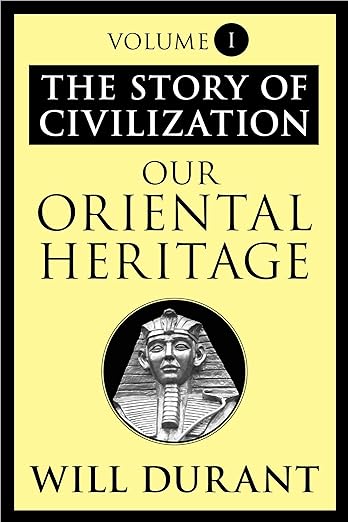
Our Oriental Heritage: The Story of Civilization, Volume I Kindle Edition
by Will Durant (Author) Format: Kindle Edition
4.7 out of 5 stars 296
Book 1 of 11: The Story of Civilization
The first volume of the expansive Pulitzer Prize-winning series The Story of Civilization.
Discover a history of civilization in Egypt and the Near East to the Death of Alexander, and in India, China, and Japan from the beginning; with an introduction on the nature and foundations of civilization.
Book 1 of 11
The Story of Civilization
Print length
1681 pages
Next page
Due to its large file size, this book may take longer to download
Report an issue with this product
Sponsored
All 7 available for you in this series See full series
See included books
Total price: $135.33 + applicable tax
Buy 7 items now with 1-Click
By clicking on the buy button, your order will be finalised and you agree to the Kindle store terms of use.
Sold by: Amazon Australia Services, Inc.
For 5 items the price is set by publisher
Books In This Series (11 Books)
Complete Series
 The Story of Civilization
Kindle Edition
Page: 1 of 4Page: 1 of 4
Previous page
1
 Our Oriental Heritage: The Story of Civilization, Volume I
Will Durant
4.7 out of 5 stars (296)
Kindle Edition
$13.99
2
 The Life of Greece: The Story of Civilization, Volume II
Will Durant
4.7 out of 5 stars (149)
Kindle Edition
4
 The Age of Faith: The Story of Civilization, Volume IV
Will Durant
4.4 out of 5 stars (81)
Kindle Edition
$13.99
Next page
Customers who read this book also read
Page 1 of 10Page 1 of 10
Previous page
The Lessons of History
Will Durant
4.4 out of 5 stars 4,850
Kindle Edition
Product description
About the Author
WILL DURANT (1885-1981) was awarded the Pulitzer Prize and the Presidential Medal of Freedom. He spent over fifty years writing his critically acclaimed eleven-volume series, The Story of Civilization. A champion of human-rights issues such as social reform and the brotherhood of man long before they were popular, he continues to educate and entertain readers worldwide through his writings.
Product details
ASIN : B004ZZS93Q
Publisher : Simon & Schuster; 1st edition (7 June 2011)
Language : English
File size : 10671 KB
Text-to-Speech : Enabled
Screen Reader : Supported
Enhanced typesetting : Enabled
X-Ray : Not Enabled
Word Wise : Not Enabled
Sticky notes : On Kindle Scribe
Print length : 1681 pagesBest Sellers Rank: 180,034 in Kindle Store (See Top 100 in Kindle Store)88 in Ancient Early Civilization History
337 in History of Civilization & Culture
1,024 in History of Ancient CivilizationsCustomer Reviews:
4.7 out of 5 stars 296
About the author
Follow authors to get new release updates, plus improved recommendations.
Follow
Will Durant
William James Durant was born in North Adams, Massachusetts, in 1885. He was educated in the Roman Catholic parochial schools there and in Kearny, New Jersey, and thereafter in St. Peter’s (Jesuit) College, Jersey City, New Jersey where he graduated in 1907, and Columbia University, New York. For a summer in 1907 he served as a cub reporter on the New York Journal, but finding the work too strenuous for his temperament, he settled down at Seton Hall College, South Orange, New Jersey, to teach Latin, French, English, and geometry (1907-11). He entered the seminary at Seton Hall in 1909, but withdrew in 1911 for reasons which he has described in his book Transition. He passed from this quiet seminary to the most radical circles in New York and became (1911-13) the teacher of the Ferrer Modern School, an experiment in libertarian education. In 1912 he toured Europe at the invitation and expense of Alden Freeman, who had befriended him and now undertook to broaden his borders. Returning to the Ferrer School, he fell in love with one of his pupils, resigned his position, and married her (1913). For four years he took graduate work at Columbia University, specializing in biology under Morgan and Calkins and in philosophy under Woodbridge and Dewey. He received the doctorate in philosophy in 1917, and taught philosophy at Columbia University for one year. Beginning in 1913 at a Presbyterian church in New York, he began those lectures on history, literature, and philosophy which, continuing twice weekly for over thirteen years, provided the initial material for his later works. The unexpected success of The Story of Philosophy (1926) enabled him to retire from teaching in 1927, and is credited as the work that launched Simon & Schuster as a major publishing force and that introduced more people to the subject of philosophy than any other book. Thenceforth, except for some incidental essays and Will’s lecture tours, Mr. and Mrs. Durant gave nearly all their working hours (eight to fourteen daily) to The Story of Civilization. To better prepare themselves they toured Europe in 1927, went around the world in 1930 to study Egypt, the Near East, India, China, and Japan, and toured the globe again in 1932 to visit Japan, Manchuria, Siberia, Russia, and Poland. These travels provided the background for Our Oriental Heritage (1935) as the first volume in The Story of Civilization. Several further visits to Europe prepared for Volume II, The Life of Greece (1939) and Volume III, Caesar and Ch
Volume III, Caesar and Christ (1944). In 1948, six months in Turkey, Iraq, Iran, Egypt, and Europe provided perspective for Volume IV, The Age of Faith (1950). In 1951 Mr. and Mrs. Durant returned to Italy to add to a lifetime of gleanings for Volume V, The Renaissance (1953); and in 1954 further studies in Italy, Switzerland, Germany, France, and England opened new vistas for Volume VI, The Reformation (1957). Mrs. Durant’s share in the preparation of these volumes became more substantial with each year, until in the case of Volume VII, The Age of Reason Begins (1961), it was so great that justice required the union of both names on the title page. And so it has been on The Age of Louis XIV (1963), The Age of Voltaire (1965), Rousseau and Revolution (1967), for which the Durants were awarded the Pulitzer Prize (1968), and The Age of Napoleon (1975). The publication of The Age of Napoleon concluded five decades of achievement and for it they were awarded the Presidential Medal of Freedom (1977). Throughout his life, Will Durant was passionate in his quest to bring philosophy out of the ivory towers of academia and into the lives of laypeople. A champion of human rights issues, such as the brotherhood of man and social reform, long before such issues were popular, Durant’s writing still educates and entertains readers around the world, inspiring millions of people to lead lives of greater perspective, understanding, and forgiveness.
Read less
Review this product
Share your thoughts with other customers
Write a customer review
Sponsored
Top reviews
Top reviews from Australia
There are 0 reviews and 3 ratings from Australia
Top reviews from other countries

Busy Reader: Get To The Point
5.0 out of 5 stars A magnificent education. When you finish, you’ll know important history.Reviewed in the United States on 23 February 2022
Verified Purchase
Why I read this book
I want to understand the world around me, how it works, where it is going. The past is all we have to study in this regard. It tells us what people did, thus what they are likely to do again, instead of the delusional ideas they have about themselves.
“Wise men say, not without reason, that whoever wishes to foresee the future must consult the past; for human events ever resemble those of preceding times. This arises from the fact that they are produced by men who have been, and ever will be, animated by the same passions; and thus they must necessarily have the same results. … I believe that the world has always been the same, and has always contained as much good and evil, although variously distributed among the nations according to the times.” —Niccolo Machiavelli
Will Durant has a lot to teach me, and I like his tone and approach. He wants to see the big patterns in human behavior and derive whatever lessons may be found there. In this book he shares his definition of a civilization and traces our earliest knowledge of people living in large, organized societies. I felt as though I were reading letters from my distant ancestors.
If you want the latest scholarship or a political deconstruction, Durant won’t appeal to you. For me, these distinctions are only relevant if you are already knowledgeable about the history, and if you are, there is no need to read Durant. I do not know the history, and the general topics Durant covers are not likely to be wiped out by new discoveries. I knew little about the Peloponnesian Wars, for example, so now I know more. Nobody from Harvard is going to shock the world next week with proof the wars never happened. More important to me is to walk through this long story with a companion I like. I like Will Durant. I like his voice from the early 20th century, and he is the perfect companion for me.
He writes, “The world has almost forgotten [Polybius]; but historians will long continue to study him because he was one of the greatest theorists and practitioners of historiography; because he dared to take a wide view and write a “universal history”; and because, above all, he understood that mere facts are worthless except through their interpretation, and that the past has no value except as our roots and our illumination.” [Vol. 2]
The big questions for me were:
1. Would I commit to completing the entire “Story of Civilization?” (yes)
2. How could I fit it into my busy life? (see below) and
3. Would it be worth the time?” (yes again)
How I read the whole set
I set a daily goal to reach the end within one year. When I took away the extensive notes, bibliographies and indexes, the eleven volumes in my set totaled 9,300 print pages. It looks like the number of "pages" in Kindle is different, but since the amount of content on screen is adjustable, that number is ambiguous. Back to ink on paper: If I gave myself a full year, about 26 pages per day would do it. I didn’t like waiting that long to finish, so I set my daily rate at 40, finishing in 233 days, about 8 months. Durant writes meaty pages, so I had to prioritize my 40 above other activities to get through them. After a few weeks, however, 40 pages per day was just normal life.
We can take inspiration from a character in the story, Caius Plinius Secundus, known as “Pliny the Elder.” He had to work all his life for the Roman navy, but managed to write a small library of nonfiction books. His nephew described him arising before 2 a.m. and stealing every spare minute for his studies. “He once reproved me for walking; ‘you need not have lost those hours,’ he said, for he counted all time lost that was not given to study.”
I bought each volume on Kindle and also checked out the paper copy from my local library. The Kindle allowed me to listen to my computer read pages (by invoking the text-to-speech feature) while I cooked breakfast or worked in the yard. Every extra minute spent reading speeds completion. The other value in the Kindle is the highlights and notes feature. Once you mark or note passages, you can go to a website and copy them all at once. You can also export the notebook directly from Kindle, but this document has formatting difficulties, in my experience. The combination of paper and Kindle helped break up the work.
If you embark on this journey, I salute you. For me it was well worth the price in money, time and concentration. If you want to know what I took away from this study, see my review of “The Age of Napoleon.”
Read less
34 people found this helpfulReport

Nathalie Fremaux B
5.0 out of 5 stars One of the best historianReviewed in the United Kingdom on 3 August 2021
Verified Purchase
Great approach of history from a very cultivated author. His collection should be available in any college and university.
Excellent book.
One person found this helpfulReport
Brian R Farmer
5.0 out of 5 stars Five StarsReviewed in Canada on 18 April 2018
Verified Purchase
All Durant's books are well written and informative, without bias.
Report

U.B.P Sikhamani
5.0 out of 5 stars One can not miss the beautiful language and a vry subdued humourReviewed in India on 4 January 2016
Verified Purchase
Every History loving person must read it. If you can, obtain all the eleven volumes written by Durants for they are priceless as regards to their contends- the product of tremendous research. One can not miss the beautiful language and a vry subdued humour. Will Durant is a consummate writer who can make history read like an exciting novel.
15 people found this helpfulReport
Gajapathi Raju A V R
5.0 out of 5 stars Will Durant is HistoryReviewed in India on 19 July 2018
Verified Purchase
Excellent. Every public and personal library must have it, otherwise it should not be called a library.
7 people found this helpfulReport
========

The Story of Civilization #1
Our Oriental Heritage
Will Durant
4.31
3,168 ratings384 reviews
Want to read
Buy on Kobo
Rate this book
This is the classic reference on world history, recognized as the most comprehensive general history ever written, the result of four decades of work by Will and Ariel Durant -- a set that The New York Times called "a splendid, broad panorama of hereditary culture in words and images that the layman can fully understand." This series began as an effort to write a history on the nineteenth century, an undertaking that Will Durant realized could only be understood in terms of what had come before. So the Durants embarked on an encyclopedic survey of all civilization, ancient and modern, Occidental and Oriental.
The books:
Our Oriental Heritage (Volume 1): Will Durant opens his massive survey of civilized history with a sweeping look at the Orient: the Egyptians, who perfected monumental architecture, medicine and mummification; the Babylonians, who developed astronomy and physics; the Judeans, who preserved their culture in the immortal books of the Old Testament; and the Persians, who ruled the largest empire in recorded history before Rome.
The Life of Greece (Volume 2): Will Durant's survey of ancient Greece shows us the origins of democracy and the political legacy to the Western world; the golden age of Athens, its architecture, poetry, drama, sculpture and Olympic contests; the blossoming of philosophical thought amid a society still rooted in slavery and barbarism; and the mysterious lost island of Crete, land of the Minotaur and the Labyrinth.
Caesar and Christ (Volume 3): Spanning a millenium in Roman history, the third volume in the Durants' series shows us a world-conquering Roman army, undefeated, unafraid and...vegeterian; Hannibal, who transported an army of elephants over the Alps to invade Rome; Julius Caesar, who brought Western Europe under Roman rule; the life and Passion of Christ; and the struggle of the rising church.
The Age of Faith (Volume 4): Over 1,000 years, we meet the Christian ascetics and martyrs, including Simeon Stylites, who sat atop a pillar for 30 years, exposed to rain, sun, and snow, and rejoiced as worms ate his rotting flesh; the saints, including Augustine, the most influential philosopher of his age; Mohammed, the desert merchant who founded a religion that conquered one-third of the known world in two centuries; and the Italian poet Dante, whose sensibility marks the transition to the Renaissance.
The Renaissance (Volume 5): In this volume, Will Durant examines the economic seeds -- the growth of industry, the rise of banking families, the conflicts of labor and capital -- for Italy's emergence as the first nation to feel the awakening of the modern mind. He follows the cultural flowering from Florence to Milan to Verona and eventually to Rome, allowing us to witness a colorful pageant of princes, queens, poets, painters, sculptors and architects. We see humanity moved boldly from a finite world to an infinite one.
The Reformation (Volume 6): In Europe's tumultuous emergence from the Middle Ages, we encounter two rival popes fighting for control of a corrupt, cynical church; the Hundred Years' War and 13-year-old warrior Joan of Arc; Christopher Columbus' accidental discovery of the New World; and Martin Luther, who defied the pope and ultimately led Northern Europe into the age of individualism.
The Age of Reason Begins (Volume 7): In one of Europe's most turbulent centuries, Philip II of Spain sees his "invincible" armada suffer defeat at the hands of England; Elizabeth I of England receives assistance from explorer Walter Raleigh and pirate Francis Drake; and new appeals for reason and science are exemplified in the ideas of Copernicus, Galileo and Descartes.
The Age of Louis XIV (Volume 8): This installment is the biography of a period some consider the apex of modern European civilization. "Some centuries hence," Frederick the Great predicted to Voltaire, "they will translate the good authors of the time of Louis XIV as we translate those of the age of Pericles or Augustus." Those authors are lovingly treated here: Pascal and Fenelon, Racine and Boileau, Mme. de Sevigne and Mme. de La Fayette, and, above all, the philosopher-dramatist Moliere, exposing the vices and hypocrisies of the age.
The Age of Voltaire (Volume 9): A biography of a great man and the period he embodied. We witness Voltaire's satiric work in the salons and the theater as well as his banishment to England. With him we view the complex relationships between nobility, clergy, bourgeoisie and peasantry in the France of Louis XV. We explore the music of Bach and the struggle between Frederick the Great and Maria Theresa of Austria. And finally we hear an imaginary discussion between Voltaire and Pope Benedict XIV on the significance and value of religion.
Rousseau and Revolution (Volume 10): This volume ranges over a Europe in ferment, but centers on the passionate rebel-philosopher Jean-Jacques Rousseau, who contended with Voltaire for the mind of Europe. Rousseau condemned civilization as a disease, glorified the noble savage, proclaimed to the world with equal intensity his own love affairs and the natural rights of man, and became the patron saint of the French Revolution and social upheavals across the globe for two centuries.
The Age of Napoleon (Volume 11): The final volume. Napoleon is the archetypical hero, whose restless, ambitious, and intelligent mind dominated his age and has never ceased to fascinate the world he helped fashion. Yet even Bonaparte is dwarfed by the age that took his name. For, the Durants have re-created the life, the history, the arts, the science, the politics, the philosophy, the manners and the morality, the very spirit of the turbulent epoch that began with the French Revolution, ended with the fall of the emperor and ushered in the modern world.
GenresHistoryNonfictionPhilosophyAncient HistoryWorld HistoryChinaHistorical
...more
1047 pages, Hardcover
First published January 1, 1935
Book details & editions
Will Durant725 books2,704 followers
Follow
William James Durant was a prolific American writer, historian, and philosopher. He is best known for the 11-volume The Story of Civilization, written in collaboration with his wife Ariel and published between 1935 and 1975. He was earlier noted for his book, The Story of Philosophy, written in 1926, which was considered "a groundbreaking work that helped to popularize philosophy."
They were awarded the Pulitzer Prize for literature in 1967 and the Presidential Medal of Freedom in 1977.
Displaying 1 - 10 of 384 reviews

Ahmad Sharabiani
9,564 reviews · 95 followers
Follow
December 2, 2021
Our Oriental Heritage (Story of Civilization 1), Will Durant
This volume covers Near Eastern history until the fall of the Persian Empire in the 330's BC, and the history of India, China, and Japan up to the 1930's.
Discover a history of civilization in Egypt and the Near East to the death of Alexander, and in India, China, and Japan from the beginning; with an introduction on the nature and foundations of civilization.
Date of first reading: 1993 AD
Title: The Orient, the cradle of civilization; Author: Will Durant; Translators: Ahmad Aram; Asgari Pasha'i; Amir Hossein Arianpour; Ahmed Aram editors; Mahmoud Musaheb; Amir Hossein Arianpour; Tehran, Iqbal, 1337; Another edition of the same work, Tehran, Iqbal, in 1343 AH; Subject: History of Civilization from the authors of the United States of America - 20th century.
This book, translated by Mr. "Amir Hossein Arianpour" in 1241, is the first book of the history of civilization; Islamic Revolution publications, in 1367, with map and picture on 100 pages, and on 1144 pages; Another edition in 1376; and the 15th edition of 1391 Hijri
Index: Introduction: The birth of civilization; The first book: Near East: ...; The seventh chapter of Sumer; The eighth chapter of Egypt; The ninth chapter of Babylon; The tenth chapter of Assyria; The eleventh chapter of mixing races; The twelfth chapter of the Jewish people; The thirteenth season of Pars; The second book: India and its neighbors; The third book: Far East; Conclusion: our eastern heritage; •••; Attachments from p.995 to p.1144;
History of Civilization is the name of a collection of eleven books, which: "Will" and "Ariel Durant" wrote about the history of human life, from prehistoric times to the 18th century; This collection is incomplete; "Durant" and his wife wanted to continue writing it until the contemporary history of the West, but with the death of both, the collection of the history of civilization only went up to the eleventh volume, which is dedicated to the "Napoleon" era; In the first six volumes of this series, the name "Will Durant" appears as the author, and his wife "Ariel Durant" is the editor; But in the next volumes, both authors are
updated date 09/14/1399 Hijri; 10/09/1400 solar Hijri; A. Sherbiani
Show more
Like
Comment

Luffy (Oda's Version)
757 reviews · 1,000 followers
Follow
January 23, 2020
I read this incredibly glued together account of history. It was a privilege to read a history book from the eyes of a deceased scholar. I mean, when discussing India, Will Durant mentions Gandhi and includes him in his book when the latter is still alive!
This was a fascinating read. It was my longest slog. I began reading in early 2019 and finished it after what seemed a long time of shifting from civilization to civilisation.
I have never read a book like this. Nor will anyone. This tome lies alone as a work of science rendered into everyday language. I am giving it only 3 stars for petulant and childish reasons. My impatience with some repetitions have something to do with it. It doesn't matter. I loved reading about the lost and earliest civilisations with awe. What a show this was.
best-of-2020 chunkster classic
...more
99 likes
Like
Comment

Darwin8u
1,629 reviews · 8,797 followers
Follow
January 17, 2019
"But a nation, like an individual, can be too sensible, too prosaically sane and unbearably right."
- Will Durant, Our Oriental Heritage
I jumped into this series with not a small amount of skepticsm. How can you not be skeptical of a project that is basically 10,000 pages, in 11 volumes, totalling about 4 million words? But I was curious. This series is ubiquitous in used bookstores. I was more than curious. It almost seemed stupidly large. That was a selling point. It also seemed nearly (11/12) designed for a year-long big book quest. My worries increased when a friend of mine suggested I abandon my copy back to a "little free library or used bookstore". But I figured I'd give Vol 1 a shot. I was apprehensive because a History of Civilization written in 1935 is going to come from a completely different perspective than the one I'm used to from contemporary historians (academic or otherwise). But that same worry also made me curious. The fact that this series was published over forty years (Vol 1 = 1935; Vol 11 = 1975) made me interested to see if/how the Durant's approach to history changed from pre-WWII to post-Vietnam.
Vol 1: "Our Oriental Heritage" is 938 pages that span:
I. The Establishment of Civilization - pages 1 to 110
II. The Near East (Sumeria, Babylon, Egypt, Assyria, Judea, Persia, etc) - 111 to 386
III. India and Her Neighbors - 387 t0 634
IV. The Far East - 635 to 824
V. Japan - 825 to 944
The introduction almost turned me off. Durant's almost causal use of "savage" and "primative" to discuss early man and civilization irritated me, and there were brief periods where I was worried Durant was going to emerge as a fangirl of eugenics. But I also had to remember this was written by an American, white male intellectual in the middle of the 30s, almost 80 years ago. It is also a book aimed at the general reader not the academic. I kept on reader, because once engaged I'm an indulgent reader. And... it got better. Actually, it became quite good. I enjoyed his style. I felt Durant was (as much as an outsider can be) fair to most of his subjects. I enjoyed his horde of historical truisms/maxims/aphorisms that he sprinkled willy-nilly throughout the volume. I felt, after reading Vol I, like I learned a lot. It was just ambitous enough, broad enough, and interesting enough to warrent me continuing to Vol II next month. There was plenty of fluff, and I'm sure academics in any of the areas he covered could shake up his views considerably, but like Durant said: "most of history is guessing, and the rest is predjudice"
Some of my other favorite of Durant's historical aphorisms in Vol I, Section 1 The Establishment of Civilization:
"Societies are ruled by two powers: in peace by the word, in crisis by the sword" (22).
"Time sanctifies everything" (24).
"Liberty is a luxury of security; the free individual is a product and a mark of civilization" (29).
"To transmute greed into thrift, violence into argument, murder into litigation, and suicide into philosophy has been part of the task of civilization" (53).
"men are more easily ruled by imagination than by science" (56).
"It is the tendency of gods to begin as ogres and to end as loving fathers" (63).
"In the end a society and its religion tend to fall together, like a body and soul, in a harmonious death" (71).
"Possibly every discovery is a rediscovery" (107).
2019 asian history
...more
76 likes
Like
Comment

Peiman Iran
1,438 reviews · 787 followers
Follow
January 31, 2019
Dear friends, "History of Civilization" consists of 11 volumes... of which this book is the first volume, it consists of something close to 1000 pages and 31 different chapters. In my opinion
, the eighth chapter, which was related to "Ancient Egyptian Civilization" and the 29th, 30th, and 31st chapters, which were related to "Japanese Civilization", were very interesting and useful for completing historical information. I chose "Execution" to write a review that I think will be interesting to you, so I prepared a piece by piece summary of each section and added other information, made it more complete, which I am writing below for you... in other reviews I will try to write more about the history of civilization
. --------
Laws in "Babylon": In "Babylon", the laws of "Hammurabi" ruled over this people. In "Hammurabi's law", there are many cases of harsh punishments, one of which is the death penalty. Even the death penalty was considered for some actions that are apparently not very important at that time. These laws that It is composed of [282] items in an imperative way and is written in the form of conditional sentences, in such a way that if someone does this, then it should be done
********************** ************
"Assyrian" Laws: Punishments and legal punishments in "Assyrian Laws" had different degrees, such as showing the guilty person among the people, forcing him to do difficult work, whipping From twenty to hundred blows, cutting off the ear or nose, castration or castration, cutting out the tongue, gouging out the eyes, tearing open the stomach and beheading... in the laws of "Sargen II" there are other punishments such as eating poison and burning the boy or girl. The sinner has also come to the altar of the temple. But there is no evidence that these laws were implemented in the last millennium BC. Adultery, dishonor and some methods of theft were usually punished by death. Sometimes they would punish the accused with the judgment of the gods or throw the sinner into the water with his feet tied and leave his head in the hands of the water
********************** ************
Achaemenid period: During the Achaemenid period, some of the punishments used were so strange and terrible that "Will Durant" says: the intellect cannot believe it. ... One of the methods of capital punishment during the Achaemenid period was to put the condemned head on a stone and crush it... For example: in the case of a traitorous woman who had poisoned the wife of the Achaemenid king Ardeshir II. The royal guards took that woman and according to the Persian laws that were prescribed for poisoners, they killed her with torture, that is, they put her head on a stone and beat her until it was crushed and her face was spread.
Another method of execution was skinning. : "Kambojie" killed one of the royal judges who had taken a bribe to issue an unjust sentence, by skinning him.. "Will Durant" has expressed this matter as follows: the punishment, the briber and the bribe taker of both executions Was. "Cambojie" ordered to flay the corrupt judge alive and spread the flayed skin over the judge's seat in the court.Then "Kambojie" showed the son of the same judge on the judge's bench so that he would constantly remember the story of his father and not deviate from the right path.
Small sins and offenses were punished by whipping... Bigger sins were punished by burning, mutilating limbs, cutting off limbs, gouging out eyes, or throwing them in prison and killing them... But treason to the country And the land, insulting the honor, burning the dead, violating the sanctity of the royal palace, getting close to the king's maids or sitting on the king's throne or disrespecting the royal family were punishable by death. In such situations, the sinner was forced to drink poison, or he was impaled on four nails, or he was hanged - at the time of hanging, the criminal's head was usually downwards - or he was stoned, or his whole body except for the head. They buried him in the ground or smashed his head between two big stones, or punished the accused with a strange punishment that the mind cannot believe, called "two karji" punishment.
A soldier named "Mohrdad" said while drunk that Killing "Little Cyrus" in the "Konaxa" war was his work, and the king did not get to attribute this great work to himself. Ardashir II, who heard this, ordered to execute that soldier with the punishment of "two Karajis" in this way: two Karajis should be chosen in such a way that they match each other exactly. The sinner who is to be tortured is placed in one of the two cages and the other cage is placed on him in such a way that his whole body except the head and hands remains between the two cages. Then they give him food and if he refuses to eat it, they force him to do this by putting a nail in his eye. When he eats, they sprinkle a mixture of milk and honey on his head and face and make him drink from this syrup. At the same time, the karajis are kept in such a way that it faces the sun. In this way, the flies attack him and catch him in their midst because he has to do something that all other people who eat and drink do. Insects and worms are produced from his filth and enter his insides and eat his entire body. After a few days, they knew that the sinful man was really dead, they removed the upper part of the body, and at that time no more flesh could be seen on his body because the vile insects that had risen from his insides had eaten all over him. This is how Mehrdad died after being tortured for seventeen days
.
"Sasanian" period: Punishments and especially the death penalty during the "Sasanian" period were not much different from the "Achaemenid" period, but in some stages it was more violent than the "Achaemenid" period.. For example, very severe physical punishments such as Execution, blinding, imprisonment and flogging have been common; Especially in the case of crimes committed against the king or the government, such as espionage and treason, the death penalty is accompanied by torture and severe physical abuse, such as cutting off the nose, ears, and tongue before execution or mutilation. Dragging, burying alive and the like followed. If someone commits a crime against God and the religion of the king and the country, he deserves to be executed... The death penalty is by hanging, beheading, stoning, skinning and tying the criminal to a rebellious horse or throwing him under the feet of an elephant and The like has been done
The daughter of the king of Haran, who betrayed her father and surrendered the city to Shapur I, was punished as follows: the daughter was handed over to the executioner by the order of the king. The executioner tied the girl's hair to the tail of the unruly horse and let the horse go.
The punishment for murder was generally done with a sword. Some crimes, such as treason to the state or religion, were punished by hanging. Sometimes, after crucifixion, for the sake of the watchers, they would peel off the skin of the criminal and fill it with feathers and straw and hang it on the city gate
************************** *********
The era of the dirty rule of the "Safawi" Arab worshipers: in this era, the common punishment was to tie the robber's legs to four camels and rip open his chest and stomach from top to bottom. They beat and as a lesson to the spectators, they took the camel around all the neighborhoods and streets of the city, or they put the head in a narrow hole in the wall so that the head stays on one side and the body on the other side of the wall and is unable to move. They would leave his mouth so that he would be polite and killed in this way... Cannibalism was common during the Safavid era to kill sinners and those who rightly or wrongly caught the fire of the nobles' anger. which I explained in the review about the Safavids... beheading, skinning, burning in fire, cutting off hands and feet, ears and nose, gouging out eyes, drawing in cow skin and the like were among the usual punishments. ... Another punishment during the Safavid period was: piercing the feet of the condemned and hanging him upside down on a tree, so that his head was towards the ground, so that he would die, and if the poor man was not killed by this method, his stomach They would tear it with a sword and he would suffer a gradual and painful death, because in this case his intestines would fall on his face in a terrible way and he would have to swallow them in his stomach and finally die in a horrible way.
*********************************
The dirty era of the Arab-worshipping "Qajar" rule: the punishments of the "Qajar" era in The violence was not less than during the Safavid period, but by using new tools, harsher punishments were also applied. They put the criminals in a ball pit, buried them alive, inserted sharp objects and tools into their lower body, stamped their feet like a horse, tied the ends of two trees that were bent, and then released the trees. They used to return to their natural state with a lot of pressure and spring, and the body of the accused would be torn apart. Ripping open the stomach, mutilating, throwing alive into boiling water, burying alive against the wall, etc. are among the punishments of the "Qajar era"
********************** ***********
In Japan: In this land, whipping was a punishment for minor offenses and the death penalty was given to many crimes. Emperor "Shomu" abolished the death penalty and put the procedure on compassion, but after him, the number of crimes increased, and Emperor "Kunin" not only re-established the death penalty, but also ordered that thieves should be punished in public. Whip them to destruction. There were different types of death penalty: suffocation, beheading, hanging, quartering, burning and boiling in oil. They used to tie him up and cut his body in two by pushing the cow on both sides. Another punishment was to tie the convict to an arrow in public and ask the passers-by to saw his body in turn
************************** *********
The "Renaissance" period in Europe: execution in this period could only be done by the relatively less painful act of cutting off the head.. but this punishment was usually a privilege given to noble men and women. He was cheaply born, and the punishment for the poor poor was the gallows. "Henry VIII" made a law in 1531, according to which he could boil prisoners in water to punish them. One of the mayors of "Salzburg" issued a decree to the following effect: a person who falsifies documents should be burned at the stake or die in boiling water, and a person who swears falsely should have his tongue pulled out from the back of his neck, and a servant who has a daughter or wife And if his master's sister commits adultery, he should be beheaded or hanged... In the same city, several people were burned for the sin of eating meat on Friday and refusing to repent!! And those who had repented were just hanged. Usually, they left the bodies of the dead on the gallows as a lesson to the living, until the vultures tore their flesh and ate them
. They enjoyed watching the executions and tortures, and sometimes they helped the executioners. When "Monte Coccoli" confessed under torture that he had poisoned "Francois", the beloved son of "Francois I", or had planned to poison him, his hands and feet were tied to four horses and his body was cut open from four sides. . People chopped up his remains, cut off his nose, took out his eyes, crushed his jaws, and dragged his head in the mud until they killed him a thousand times before he died
******* ******************************
The "post-renaissance" period in Europe: "post-renaissance" not only did not reduce the severity of punishments, but in some cases and in some countries continued more brutally than before... In England, brutal punishments in public, He made people his prey. According to the law that was canceled in 1790, a woman who was convicted of cheating or killing her husband was burned alive. But custom allowed him to be suffocated before being burned. The stomachs of the men who were convicted of treason were torn open while they were still alive, and their intestines and internal organs were burned in front of their eyes. Then they cut their heads and cut them into pieces. Gallows had been set up in all neighborhoods of London, and on many of them, the corpses of the condemned were hung to die. The convicts were sometimes made to drink sweat in order to make them suffer less, and if the executioner was in a good mood! He would kill their legs so that they would die sooner. These punishments, which were carried out with complete violence, were carried out with the same severity in other European countries... Defamation of others, even if nothing but the truth was said, made the criminal subject to the death penalty and confiscation of his property. Carrying a pistol secretly carried a similar penalty, but in some cases these laws were strictly enforced. A person was hanged for pretending to be a priest, and another suffered the same fate for stealing a priest's robe, which he sold for one and a quarter francs. Another person who wrote a letter to "Pope Clemens XI" and accused this corrupt preacher of having relations with "Maria Sobska", got away with it... Even until 1762, the bones of the prisoners were crushed on the torture wheel or The convicts were tied to the tail of a raised horse and dragged on the ground
**************************************
Friends Dear and rationalist, many campaigns and activities have been carried out all over the world in order to abolish the brutal laws of execution. And these punishments have been abolished in about 100 different countries, but unfortunately in some countries such as Iran, China, North Korea and some African countries and Arab countries, the death penalty and execution in various ways are continuously used to punish the convicts. It is used.
I hope the day will come when we will no longer witness the execution of any human being anywhere on this earth
------------------------------ --------------
I hope that writing this review has been useful for you, good friends and book lovers,
"Be victorious and Iranian"
favorites historical
46 likes
Like
Comment

Marcus
520 reviews · 40 followers
Follow
April 29, 2023
There are two reasons why I found this book to be a pure joy. First and foremost it is always extremely enjoyable to read a book written by someone with both extraordinary clarity of mind and superior skill of written word. Second, 'Our Oriental Heritage' is very accessible introduction to history of China, India and Japan, topics that were previously unknown to me.
It must however be said, that this is not a history book in traditional meaning of that term. The aim of Will Durant, as he clearly states at the beginning of this book, is not to write only about politics, dynasties and wars, but also other areas that define a civilization, but which are often overlooked by traditional historians. Therefore, huge parts of 'Our Oriental Heritage' focus on religion, philosophy and arts. If those areas are not your cup of tea, then you may find yourself both a little bit bored and also overwhelmed by completely unfamiliar names and ideas.
It is clearly a silly idea to rate this sort of book – it is undeniably a classic work of literature and a labor of love of a man that was infinitely more intelligent that I can ever hope to become. At the same time, I have to be honest with myself and admit that much of ‘Our oriental heritage’ covered topics that don’t hold much interest for me.
38 likes
Like
Comment

Judy
1,770 reviews · 360 followers
Follow
February 12, 2012
I read this first volume of The Story of Civilization off and on for over a year. It was my first successful attempt at reading history and taught me how to do so. I have to thank Will Durant for that. Finishing it was a triumph for me as a student of literature, the world, and life.
We all probably remember doing a unit in Social Studies on the cradle of civilization, Babylonia and all that. Boring but some cool pictures. My theory on the study of history during childhood is that we have our whole lives ahead of us, we are interested in the future, not the past. So to that teacher who did her best with me, I can report that I finally learned what is so important about the cradle of civilization. Our Oriental Heritage even got me to read The Epic of Gilgamesh.
I felt enriched and full of learning. I had many ah ha moments and wish that I had taken notes. Most of all I learned (as if I did not already know) that the same insanities have been replayed over and over for thousands of years. It became true for me that though we have made great strides in learning to control and handle the material world, we lag in mental and emotional growth and have not brought about much more peace or security.
I grew to appreciate what a long and winding road mankind is traveling. If it is our destiny to evolve to any sort of higher state, it will not be happening anytime soon and attempts to predict such an evolution are laughable at best though entertaining to contemplate. And yet, knowing where we have come from and how it has gone has value. Our Oriental Heritage gave me hope. We are capable of much understanding, we can create and build amazing things, even while we are stupid, greedy and much too adept at destruction.
Durant takes the reader from the earliest evidences of civilization through ancient Sumeria, Egypt, and Babylonia and the countries of the Old Testament. He covers India, China, and Japan. As he says in the Preface, "I wish to tell as much as I can, in as little space as I can, of the contributions that genius and labor have made to the cultural heritage of mankind." He did do that in as readable a history as I have come across.
Note: This book was originally published in 1935 by Simon and Schuster, not 1997, as it says here at Goodreads.
history
23 likes
Like
Comment

Ehsan'Shokraie'
654 reviews · 177 followers
Follow
August 26, 2021
The history of civilization is more than just a history book, it tries to show different aspects of civilizations and nations, in fact, each part of the history of civilization deals with the most remarkable and unique features of each civilization..so wide and It is beautiful that if we intend to select parts of it, it will be a book by itself. In fact, the history of civilization is not just a history book, but a rich source of history, art, and philosophy of the greatest civilizations. 6000 years ago to today's world.
For today's readers, however, the history of civilization has a big but natural flaw, and that is that the book was written in the 30s and 40s, and fortunately, since then, a lot of new information and findings have been found. Human knowledge has increased from ancient history
. Therefore, simultaneous reading of history from a newer collection such as Phoenix World History Collection is a wonderful supplement and a pleasant companion for the wonderful journey of reading the great work of the history of civilization. And we come to trade in the 30s..when Japan, America, Russia and Europe are competing in a tense atmosphere, which is the flame of the event that today we call the Second World War..
19 likes
Like
Comment

Howard
1,498 reviews · 96 followers
Follow
June 6, 2022
4 Stars for Our Oriental Heritage: Story of Civilization (audiobook) by Will Durant read by Robin Field.
Wow, this was an epic story. I think this is an amazing history of Asia. It’s a great overview for most of the countries there. It’s was a little jarring sometimes with the last 90 years of history missing from the book. Overall I’m glad I made it through to the end. It helped put some things into perspective.
audiobooks non-fiction
20 likes
Like
Comment

Fouad
1,081 reviews · 1,915 followers
Follow
October 16, 2017
I read the book halfway, until the end of the India section. It's been like this for a long time in carnetly-readings, hoping to get back to it. But I don't think there will be an opportunity for now. Since its constant presence in front of the eyes was annoying, I will leave it in the unfinished, until I come back to it another time.
According to my interests, this is the most attractive cover of the series. Especially the half that I read was related to the beginning of history, primitive religions and peoples, and the first civilizations (Mesopotamia and Egypt). I took notes as much as I could and put them in the updates. For someone who is interested in anthropological studies and the history of religions, it is a very exciting experience.
Mythology-Religions Humanities unfinished
17 likes
Like
Comment

Bryan
74 reviews · 7 followers
Follow
October 10, 2015
WARNING TO READERS CONSIDERING THIS BOOK: DO NOT READ THIS BOOK TO LEARN ABOUT HISTORY UNLESS YOU ARE SKILLED AT CRITICALLY EVALUATING DIDACTIC LITERATURE, FOLLOWING SOURCE CITATIONS AND RECOGNIZING WHAT IS FACT AND WHAT IS SPECULATION. AT LEAST HALF OF THIS BOOK IS COMPLETE GARBAGE.
There was certainly a great deal of valuable information in this tome, but it is extremely poorly documented and heavily peppered with supposition, speculation and littered with personal opinion loosely being passed as "history".
With a very lengthy introductory section on pre-history, Durant paints a vivid picture of what human life was like prior to written records. This is done with heavy doses of words and phrases like "surely", "presumably", "without a doubt", "certainly", etc. It appears that the rich picture of pre-historic humanity was virtually created out of thin air with the very rare mention of actual information followed by a massive leap of faith to what the author believes happened. One thing I found curious was that with the introduction of many early innovations of mankind, Durant cannot conceive that intelligent humans had original ideas and thoughts, but rather everything had to be copied from something they observed; often from the beasts around them.
Once the book entered the realm of recorded history, the information was marginally better with more references to real information, but there was a heavy undertone which left no question as to the personal opinions of the author on politics, religion and philosophy.
history

No comments:
Post a Comment