News
Books and Literature
A guide to reading Arundhati Roy: From 'The God of Small Things' to 'Mother Mary Comes to Me'
A guide to reading Arundhati Roy: From ‘The God of Small Things’ to ‘Mother Mary Comes to Me’
From Booker-winning fiction to incendiary essays, Arundhati Roy has emerged as a defiant voice in literature and politics. With her first memoir arriving, here’s how to navigate her remarkable body of work.
By: Express Web Desk Written by Aishwarya Khosla
Updated: August 29, 2025 02:38 PM IST

 3 min read

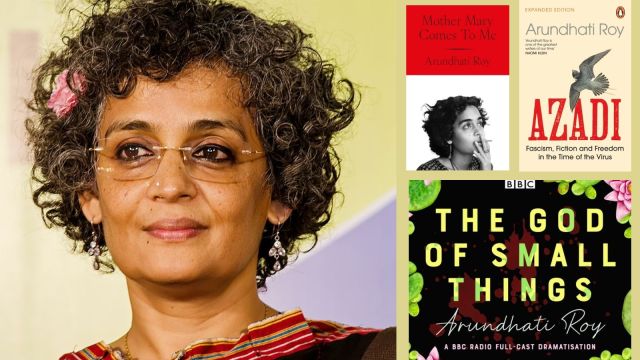 Arundhati Roy, author of The God of Small Things and The Ministry of Utmost Happiness, will release her first memoir, Mother Mary Comes to Me. (Source: Penguin)
In September, Arundhati Roy will publish Mother Mary Comes to Me, her first memoir. Written after the death of her mother, Mary, an educator, activist and formidable presence in her daughter’s life, the book promises to be both an intimate reckoning and a continuation of Roy’s lifelong project to chart the entanglement of love, politics and freedom.
For those new to Roy, or for readers keen to revisit her work, here is a guide to where to begin.
The novels
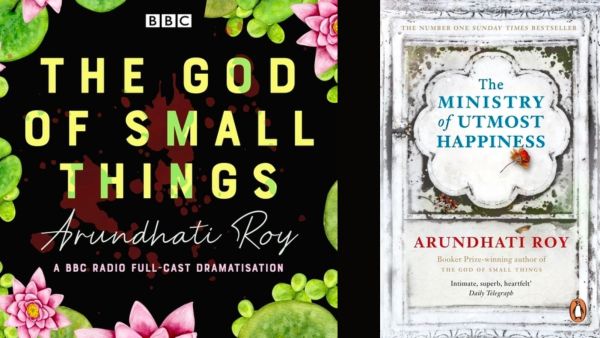 Arundhati Roy’s fiction includes The God of Small Things (1997) and The Ministry of Utmost Happiness (2017). (Source: Penguin)
The God of Small Things (1997)
Roy’s debut novel was a sensation. A Booker prize winner that went on to sell millions, it is set in Kerala and tells the story of twins, Rahel and Estha, and the “Love Laws” that destroy their family. Lyrical, experimental and heartbreaking, it remains a touchstone of postcolonial literature, and a reminder of Roy’s ability to turn local tragedy into universal resonance.
Story continues below this ad
The Ministry of Utmost Happiness (2017)
Two decades later, Roy returned with a very different kind of novel:, which was sprawling, fragmented, full of voices. It begins with Anjum, a transgender woman who lives in a Delhi graveyard, before moving through the politics of Kashmir, the wreckage of war and the precarious lives of outsiders. Longlisted for the Booker, it showed Roy’s refusal to separate the personal from the political, or the novel from the world.
The essays that made her a public intellectual
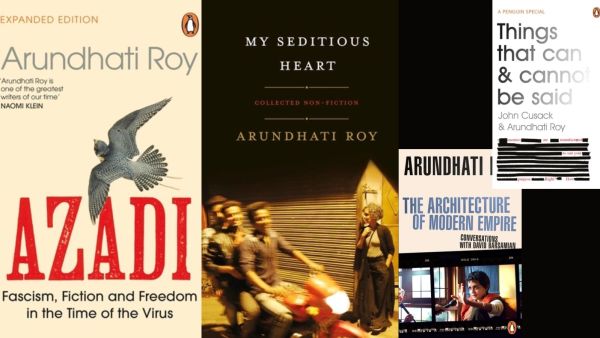 Arundhati Roy’s nonfiction that cemented her role as a critic of power. (Source: Penguin)
If her fiction brought global acclaim, it is her nonfiction that cemented her role as a critic of power, both in India and abroad.
My Seditious Heart (2019): A collection of two decades of political essays, from India’s nuclear tests to the ravages of neoliberalism.
Azadi (2020): Shorter, sharper, written in the shadow of the pandemic and authoritarian politics. The book is banned in Jammu & Kashmir.
Story continues below this ad
The Architecture of Modern Empire (2023): Conversations with journalist David Barsamian, tracing themes of war, nationalism and resistance over 20 years.
Things That Can and Cannot Be Said (2016, with John Cusack): A brief but urgent text, built around conversations with Edward Snowden and Daniel Ellsberg, about surveillance, secrecy and empire.
Also Read | 7 books that faced bans in India and why they were controversial
How to read her
📌If you want to see where it all began, start with The God of Small Things.
📌 If you’re drawn to her politics, pick up Azadi or My Seditious Heart.
📌If you want to understand the breadth of her imagination, read The Ministry of Utmost Happiness.
📌 And if you are looking for Roy herself, wait for Mother Mary Comes to Me.
===
Arundhati Roy
Goodreads Author
Born
in Shillong, Meghalaya, IndiaGenre
Member Since
May 2017

· 385,537 ratings · 30,145 reviews · 117 distinct works • Similar authors
 | The God of Small Things by — published 1997 — 2 editions | |
 | The Ministry of Utmost Happiness by — published 2017 — 114 editions | |
 | Azadi: Freedom. Fascism. Fiction by — published 2020 — 35 editions | |
 | Capitalism: A Ghost Story by — published 2014 — 26 editions | |
 | The Doctor and the Saint: The Ambedkar - Gandhi Debate by — published 2017 — 10 editions | |
 | An Ordinary Person's Guide to Empire by — published 2003 — 20 editions | |
 | The Algebra of Infinite Justice by — published 2001 — 22 editions | |
 | Walking With The Comrades by — published 2010 — 23 editions | |
 | Field Notes on Democracy: Listening to Grasshoppers by — published 2009 — 33 editions | |
 | The Cost of Living by — published 1999 — 17 editions |
A perfect day for democracy
Arundhati Roy
Wasn’t it? Yesterday I mean. Spring announced itself in Delhi. The sun was out, and the Law took its Course. Just before breakfast, Afzal Guru, prime accused in the 2001 Parliament Attack was secretly hanged, and his body was interred in Tihar Jail. Was he buried next to Maqbool Butt? (The other Kashmiri who was hanged in Tihar in 1984. Kashmiris will mark that anniversary tomorrow.) Read more of this blog post »
Wasn’t it? Yesterday I mean. Spring announced itself in Delhi. The sun was out, and the Law took its Course. Just before breakfast, Afzal Guru, prime accused in the 2001 Parliament Attack was secretly hanged, and his body was interred in Tihar Jail. Was he buried next to Maqbool Butt? (The other Kashmiri who was hanged in Tihar in 1984. Kashmiris will mark that anniversary tomorrow.) Read more of this blog post »
35 likes · Like • 0 comments • flag

Twenty years after The God of Small Things, Roy's second novel arrives this month. She talks about her political activism in India and how she...
75 likes · 31 comments
What should be our February 'Read Around the World' Group Read? (Asia)
The God of Small Things by Arundhati Roy (India)
Last Train to Istanbul by Ayşe Kulin (Turkey)
The Pillow Book by Sei Shōnagon (Japan)
A House Without Windows by Nadia Hashimi (Afghanistan)
Do Not Say We Have Nothing by Madeleine Thien (China)
Snow Flower and the Secret Fan by Lisa See (China)
Wild Swans: Three Daughters of China by Jung Chang (China)
Anna and the King of Siam by Margaret Landon (Thailand [Siam])
The Good Earth by Pearl S. Buck (China)
I'll Be Right There by Kyung-Sook Shin (South Korea)
House of Cards by Sudha Murty (India)
Sunlight on a Broken Column by Attia Hosain (India)
Hullabaloo in the Guava Orchard by Kiran Desai (India)
67 total votes
Voting ended on: Jan 21, 2017 11:59PM PST===
===

No comments:
Post a Comment