North Korean Human Rights: Activists and Networks: Yeo, Andrew, Chubb, Danielle: 9781108425490: Amazon.com: Books
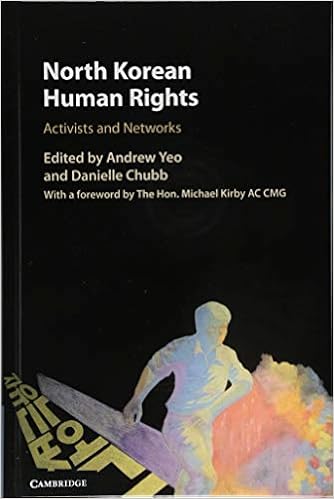
North Korean Human Rights: Activists and Networks
by Andrew Yeo (Editor), Danielle Chubb (Editor)
ISBN-13: 978-1108425490
ISBN-10: 1108425496Why is ISBN important?
Kindle

from $72.63
Hardcover
$35.26 - $41.48
Paperback
$35.99
List Price: $110.00
Save: $68.52 (62%)
11 New from $41.48The evidentiary weight of North Korean defectors' testimony depicting crimes against humanity has drawn considerable attention from the international community in recent years. Despite the attention to North Korean human rights, what remains unexamined is the rise of the transnational advocacy network, which drew attention to the issue in the first place. Andrew Yeo and Danielle Chubb explore the 'hard case' that is North Korea and challenge existing conceptions of transnational human rights networks, how they operate, and why they provoke a response from even the most recalcitrant regimes. In this volume, leading experts and activists assemble original data from multiple language sources, including North Korean sources, and adopt a range of sophisticated methodologies to provide valuable insight into the politics, strategy, and policy objectives of North Korean human rights activism
1 - Adaptive Activism pp 1-28 By Danielle Chubb, Andrew Yeo
Part I - Domestic Discourse and Activism pp 29-128
2 - A Prisoner’s Dilemma of Movement Nationalization pp 31-60
By Jacob Reidhead
3 - North Korean Human Rights Discourse and Advocacy in the United States pp 61-84
By Andrew Yeo
4 - Linking Abductions Activism to North Korean Human Rights Advocacy in Japan and Abroad pp 85-108
By Celeste L. Arrington
5 - North Korean Human Rights Discourse and Advocacy: The European Dimension pp 109-128
By Rajiv Narayan
Part II - Transnational Networks
pp 129-198
6 - NGOs As Discursive Catalysts at the United Nations and Beyond pp 131-153
By Joanna Hosaniak
7 - Human Rights Diffusion in North Korea pp 154-176
By Patricia Goedde
8 - The Politics of Networking pp 177-198
By Danielle Chubb
Part III - North Korean Voices pp 199-290
9 - The Emergence of Five North Korean Defector-Activists in Transnational Activism pp 201-223
By Jay Song
10 - North Korea Responds to Transnational Human Rights Advocacy pp 224-248
By Sandra Fahy
11 - Breaking Through pp 249-271
By Jieun Baek
12 - Conclusion pp 272-290
By Andrew Yeo, Danielle Chubb
Editorial Reviews
Review
'The more closed and repressive a regime, the more difficult to form effective transnational human rights coalitions. North Korea is undoubtedly among the toughest cases. But this outstanding collection shows the ingenuity of those perspicacious individuals and groups that have pushed the North Korean human rights agenda. These activists have produced some striking surprises, such as the United Nations Commission of Inquiry and clever informational strategies. With interesting theory and novel methodological approaches, this book is indispensable not only for those working on North Korea, but for the human rights community more generally.' Stephen Haggard, Krause Distinguished Professor, University of California, San Diego
'The United Nations Commission of Inquiry on North Korean human rights concluded that the Kim regime is likely guilty of crimes against humanity, and the Commission urged accountability, including referral to the International Criminal Court for North Korea's leaders. There is no silver bullet, no single way to deal with that country's horrendous rights violations, but Andrew Yeo and Danielle Chubb have given us an excellent series of essays with options, analysis and advocacy for the great variety of approaches.' Robert R. King, former US Special Envoy for North Korean Human Rights
'Having been passionately involved in North Korean human rights activism since the 1990s, and experiencing first-hand the frustrations of trying to enact meaningful change in the country, I found this book to be a timely and encouraging analysis of the role of transnational advocacy networks in persuading the DPRK to honor its human rights obligations. This work insightfully explores the unique dynamics of North Korea, which lacks a developed civil society of its own, and the challenges and opportunities of transnational activism. A must-read for scholars as well as practitioners, this book will have important implications for the next generation of activism in the field of North Korean human rights.' Changrok Soh, Korea University and Human Asia
Book Description
This book will appeal to students, activists, and scholars interested in human rights, international relations, law, sociology, and media studies. Top experts and leading activists provide valuable insight into the emergence, evolution, and politics of North Korean human rights based on new empirical data and original language material, including North Korean sources.
About the Author
Andrew Yeo is an Associate Professor of Politics and Director of Asian Studies at Catholic University of America, Washington DC. He is the author of Activists, Alliances, and Anti-US Base Protests (Cambridge, 2011) and co-editor of Living in an Age of Mistrust: An Interdisciplinary Study of Declining Trust and How to Get it Back (2017). He received his Ph.D. in Government from Cornell University.
Danielle Chubb is Senior Lecturer in International Relations and member of the POLIS research network at Deakin University, Victoria, Australia. She is the author of Contentious Activism and Inter-Korean Relations (2014). Before arriving at Deakin University in 2012, she worked as a Research Fellow at Pacific Forum CSIS in Honolulu, and completed her Ph.D. in International Relations at the Australian National University.See less
Product details
Hardcover: 330 pages
Publisher: Cambridge University Press (August 9, 2018)
Language: English
---
https://pacificaffairs.ubc.ca/book-reviews/north-korean-human-rights-activists-and-networks-edited-by-andrew-yeo-and-danielle-chubb-with-a-foreword-by-the-hon-michael-kirby-ac-cmg/
NORTH KOREAN HUMAN RIGHTS: Activists and Networks | Edited by Andrew Yeo and Danielle Chubb; with a Foreword by The Hon. Michael Kirby AC CMG
Cambridge, UK: Cambridge University Press, 2018. xxxi, 301 pp. (Tables, graphs, figures) US$110.00, cloth. ISBN 978-1-109-42549-0.
This edited volume describes the complexities and politics of advocating for human rights in the Democratic People’s Republic of Korea (DPRK). It chronicles the emergence of a transnational advocacy movement in the past two decades, composed of “domestic and international nongovernmental organizations (NGOs), intergovernmental organizations (IGOs), government agencies, legislative bodies, foundations, think-tanks, churches and other religious organizations, journalists, scholars, students, and concerned citizens” (3). At the heart of the movement are self-identified “defectors” from North Korea and committed activists of various ethnic backgrounds, mainly living in South Korea and the United States, but also in Canada, Japan, and the European Union. Although defectors and activists share the ultimate goal of improving human rights in North Korea, they differ in the means. Some prefer humanitarian assistance in cooperation with the DPRK regime, and oppose sanctions that would block such assistance. Others advocate more confrontational approaches, including lobbying the United Nations for punitive sanctions and illegally smuggling information to North Korean people through radio broadcasts and thumb drives.
North Korea is theoretically important for the literature on human rights and social movement activism, because it is currently the only country where domestic human rights activism has yet to germinate and therefore the conditions for a “boomerang pattern” (Margaret Keck and Kathryn Sikkink, Activists beyond Borders, Cornell, 1998) cannot be satisfied. The editors ask, “First, how does a transnational advocacy network emerge to push for change in a highly repressive context where there is no domestic opposition? And second, by what pathways might transnational activists create change in such contexts?” (2).
The eleven contributing writers each address one or both of these questions. The contributors analyze local, regional, and international pressure tactics and the responses from the North Korean (NK) regime. Even in the absence of human rights activist partners in North Korea, transnational advocates (outside of North Korea) have successfully lobbied for the establishment of the 2013–2014 UN Commission of Inquiry (COI) on Human Rights in the Democratic People’s Republic of Korea and other resolution-based mechanisms to monitor human rights in North Korea. The question remains whether these institutional monitors will lead to substantive changes in DPRK policy, or merely cosmetic ones, in the absence of domestic human rights actors.
The volume is divided into three parts. Part 1 (Domestic Discourse and Activism) investigates DPRK-related discourse and advocacy in South Korea, the US, Japan, and Europe. In South Korea (chapter 2), Jacob Reidhead analyzes how right-leaning activist movements advocating civil and political rights (CPR) and politically allying with right-wing parties eventually dominated media discourse and the civil society field over left-leaning groups advocating economic, social, and cultural rights (ESCR). In the US (chapter 3), Andrew Yeo finds, North Korean human rights activism is deeply embedded in the Cold War normative framework of the 1970s and early 1980s; as such, compared to advocates elsewhere, US-based advocates connect DPRK human rights violations to the DPRK regime’s threat to international security (e.g., nuclear missiles).
Compared to those of the United States and South Korea, Japanese rights discourse and activism are more recently and narrowly focused on the abduction of Japanese nationals by Pyongyang in the 1970s and 1980s (Celeste Arrington, chapter 4).
North Korea human rights advocacy in South Korea, the US, and Japan tends to be dominated by right-wing, anti-communist activists and politicians. In chapter 5, Narayan demonstrates a less politicized and confrontational approach in the European Union, where human rights advocates and governments seek “to maintain a constructive relationship with the North Korean government while at the same time introducing human rights issues into the dialogue,” an approach called “critical engagement.”
Part 2 transitions from national to transnational-level analysis, as contributors Hosaniak, Goedde, and Chubb consider how activists from various backgrounds and nations develop coherent transnational networks. In chapter 6, Hosaniak discusses NGOs as catalysts for agenda-setting and discourse at the United Nations and other inter-governmental organizations. Most NGOs and IGOs have converged on an accountability paradigm that seeks to hold the DPRK regime accountable for human rights violations, as reflected in the increasing number of UN member nations voting for human rights resolutions. Goedde examines DRPK reactions, ranging from propaganda pushback and rejection to more constructive legal and policy changes (chapter 7). In chapter 8, Danielle Chubb discusses the theoretical ramifications of the previous chapters. She asks how and why the normative and discursive contours of activist networks shift over time and what are the implications of this for campaign outcomes.
Part 3 contemplates the voices of North Koreans themselves, both anti-regime defectors and regime officials. Because of the lack of independent voices within North Korea, defector accounts are central to the credibility of the human rights movement. Jay Song maps out the intricate connections and interactions of five prominent defectors with activists and agencies in their countries of residence (chapter 9). Sandra Fahy systematically analyzes thousands of pages of the DPRK newspaper Rodong sinmun for the regime’s reactions to UN resolutions; these include the old defense of sovereignty and a more recent one of an “ersatz” civil society that perfectly echoes government rhetoric (chapter 10). Jieun Baek explores the bottom-up strategy of providing information to ordinary North Koreans, from illegally smuggling thumb drives to legal market trading between North Koreans and Chinese (chapter 11).
The concluding chapter by Yeo and Chubb describes the empirical and theoretical contributions of the book. The authors modify the spiral model, which outlines the stages of behaviour of repressive regimes, from violators to compliant participants of human rights campaigns. The model highlights that countries like North Korea initially deny the very assumption of human rights violations. As they face pressure from the international community, they start to change their position. After some time, they adjust their domestic policies to align with human rights norms. In the long term, they may change their behaviour to comply with the international human rights framework. During this process, information flows and rights discourse are essential elements in empowering ordinary citizens to fight for their rights.
Left-wing scholars such as Christine Hong critique North Korean human rights advocates as right-wing imperialists committed to regime change. Yeo and Chubb recognize that hardline elements exist, but argue that the current movement is diverse and complicated, and increasingly includes actors that equally support humanitarian engagement and human rights. Yeo has been personally involved in such engagement efforts and hopes to boost their influence in the human rights movement.
This edited volume is an outstanding collection of chapters that shows the challenges and opportunities of transnational activism with respect to the world’s most isolated and repressive country. The chapters offer interesting theories and novel methodological approaches, and shall be invaluable contributions to scholars, policy makers, and activists working on North Korea and on human rights more generally.
Joseph Yi
Hanyang University, Seoul, South Korea
Wondong Lee
University of California, Irvine, USA

No comments:
Post a Comment