
Want to Read
Rate this book
1 of 5 stars2 of 5 stars3 of 5 stars4 of 5 stars5 of 5 stars
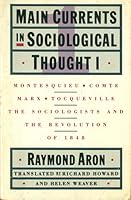
Main Currents in Sociological Thought: Montesquieu, Comte, Marx, deTocqueville, and the Sociologists and the Revolution of 1848
(Main Currents in Sociological Thought #1)
by
Raymond Aron
4.05 · Rating details · 112 ratings · 7 reviews
This is the first of Raymond Aron's magisterial two-volume treatment of the sociological tradition--perhaps the definitive work of its kind. The second volume treating Durkheim, Pareto, and Weber is scheduled to appear in spring 1998. More than a work of reconstruction, Aron's study is, at its deepest level, an engagement with the question of modernity: What constitutes the essence of the new modern order that, having emerged in the eighteenth century, still forms the categories of our experience, sweeping us along toward an unknown destination? With his usual scrupulous fairness, Aron looks to the major social thinkers to discern how they answered this pressing question.
Volume 1 explores three traditions: the French liberal school of political sociology, represented by Montesquieu and Tocqueville; the Comtean tradition, anticipating Durkheim in its deemphasis of the political and its elevation of social unity and consensus; and the Marxists, who posited the struggle between classes and placed their faith in historical necessity. A foreword by the eminent French philosopher Pierre Manent highlights Main Currents as a unique contribution to political philosophy as well as the history of sociological thought, while Daniel J. Mahoney and Brian C. Anderson provide an introduction situating Main Currents within the corpus of Aron's work as a whole. This work is essential reading for philosophers, historians, sociologists, and political scientists. (less)
GET A COPY
Kobo
Online Stores ▾
Book Links ▾
Paperback, 376 pages
Published March 2nd 1998 by Routledge (first published 1965)
Original Title
Main Currents in Sociological Thought
ISBN
0765804018 (ISBN13: 9780765804013)
Edition Language
English
Series
Main Currents in Sociological Thought #1
Other Editions (22)


All Editions | Add a New Edition | Combine...Less DetailEdit Details
EditMY ACTIVITY
Review of ISBN 9780765804013
Rating
1 of 5 stars2 of 5 stars3 of 5 stars4 of 5 stars5 of 5 stars
Shelves to-read
edit
( 927th )
Format Paperback edit
Status
September 11, 2021 – Shelved
September 11, 2021 – Shelved as: to-read
Review Write a review
comment
FRIEND REVIEWS
Recommend This Book None of your friends have reviewed this book yet.
READER Q&A
Ask the Goodreads community a question about Main Currents in Sociological Thought

Be the first to ask a question about Main Currents in Sociological Thought
LISTS WITH THIS BOOK


 Sociology Books
480 books — 420 voters
More lists with this book...
COMMUNITY REVIEWS
Showing 1-30
Average rating4.05 ·
Rating details
· 112 ratings · 7 reviews

More filters
|
Sort order

Sejin, start your review of Main Currents in Sociological Thought: Montesquieu, Comte, Marx, deTocqueville, and the Sociologists and the Revolution of 1848
Write a review

Aug 31, 2012Szplug rated it really liked it · review of another edition
This book sees Aron translated once again into wonderful English. The engaging French sociologist presents here an educational and erudite exegesis upon the primary sociological output of a handful of French and German pioneers in that ineluctably modern field: Montesquieu, Comte, Marx, and Tocqueville, concluding with an overview of how the great revolutionary wave of 1848 was perceived by the last three thinkers named above.
The opening section on Montesquieu whets your appetite for reading the eighteenth century thoughts of this fascinating man. Aron makes a strong and persuasive case for considering the French aristocrat as one of the founders of sociology, though he stood as a precursor to Auguste Comte, who has generally been attributed with creating the social science for which he coined the name. Aron is a pure pleasure to read, and he makes his way through Montesquieu's impressively thorough The Spirit of the Laws, interpreting the manner in which the latter, through its detailed assessment of causal forces and the legislated order that arises from their impetus, explicates the diversity of human institutions and memes that prevail across the settled globe in both what and how the governmental forms of republic, monarchy, and despotism produce upon, and are produced by, the human constituents who comprise their respective populaces—no small part of which was inherence for liberty and equality in their essential orders and conditions. The learned Frenchman left few stones unturned in his societal-based quest, examining economics, science, industry, climate, land, tradition, religion, and warfare in his efforts to assemble these variegated parts into a whole. And that whole makes no claims to universality, or having assessed the past sufficient to predict the future; Montesquieu, in Aron's presentation, was a cautious man, inclined to merely make suggestions, mostly of the negative sort, to potential readers placed to try and effect a difference. Montesquieu's conservative nature meant that he proffered no utopias, saw no historic current directing mankind towards a conjoined civilizational endpoint; he merely worked empirical knowledge in order to make inductive and deductive reasonings about how human societies came to be so diversely constituted, with the political always uppermost in his mind. And, frankly, in the opinion of both Aron and this reader, to set such prudent goals within a work of this type possesses itself of a hale wisdom that future sociologists might have done well to imitate.
Speaking of which, the man whom many believe to be the true founder of sociology is the French thinker Auguste Comte, who not only provided the name for the social science but also developed and espoused Positivism, the positive science, which was to fuel the creative mental engines of so many intellectuals throughout the nineteenth century. And science was Comte's preferred prism for filtering the various composite properties of society through in determining how human beings operate, both singly and at the community and national level. Comte was a prodigious thinker and writer, considerably influenced by and drawing upon the work of Saint-Simon, and Aron works his way through the lengthy corpus, approaching Comte's writings from different time periods and differing top level considerations. Whereas Montesquieu was concerned with the political, covering the whole in order to determine why man proved himself such a diverse creature, Comte collated that vast diversity in order to assemble it into a unified whole, a means for explaining every aspect of human behavior across the spectrum of both the physical world and time; for Comte was one of the first to consider history as a cohesive movement across the centuries driving humankind towards a unifying endpoint. The Frenchman believed that prior human societies had been weighed down under the dominant structures of the Military/Feudalistic and the Theological—however, with the development of the sciences, the embracing of empiric and material measurements of the sensory world, man was evolving towards a new configuration of the Industrial and Scientific, in which he would abandon his prior obsessions with the supernatural and metaphysical in order to determine what natural laws were operating within his material-bound world and allow the production of goods sufficient to satisfy his many wants. Violence, the enduring plague of mankind, would also fall to the wayside: Comte's later works explicitly condemned the propensity for and future civilizational potentialities within such enduring aggressive actions as slavery, colonization, and warfare. Perhaps spurred by travails and disappointments within his personal and private life, in his latter period Comte would come to view himself as, more or less, the high priest of a pseudo-religious Positivistic Humanism that, having synthesized the various sciences, would be regnant around the globe, lifting the world's peoples and nations via the power of progressive historical currents to a new era of causal understanding, prosperity, and concurrence—the unifying of an array of differentiated temporal societies by means of a widely-spread, transcendent love for that very unity and respect for the natural law unveiled and utilizable through widely-understood science that would serve to temper man's egoistic feelings and promote those that were unselfish. Not the most abhorrent of utopian dreams by any means, but one that, like all of the others, nonetheless failed to materialize. Yet whatever the endpoint limitations of Comte's impressively detailed thought, he was a man of genius, and he spread his mental tendrils into such a broad field of subjects that even his lesser works contain much that would prove worthy of enduring study.
The meatiest portion of the book is that of Aron's presentation of Marx. Right from the start, the author states his understanding of the infamous German doomsayer of capitalism:
It is really no more difficult to present Marx's leading ideas than those of Montesquieu or Comte; if only there were not so many millions of Marxists, there would be no question at all about what Marx's leading ideas are or what is central to his thought.By necessity, Aron was limited in how much of Marx's prodigious output he was able to bring to the table, and in his determination it is in the mature work of the German thinker that Marx's (sociological) ideas can be found in their most complete and evolved form. In particular, the later writings evince the extensive understanding of economics that Marx had amassed, and which he deemed important to providing the requisite scientific rigor to his explication of why capitalism was certain to be utterly undone by the contradictions rife within its constituted systemic makeup. For Marx, the material world was what mattered, the theatre in which history unfolded in order to fulfill its purpose by moving human societies, through dialectical processes, to the point wherein, with the overcoming of capitalism by the proletariat and its subsequent stateless communism, the class conflict that had perdured as the principal societal element across the span of human existence would finally be negated in this penultimate dialectical synthesis.
Aron treats Marx seriously, noting the transplanted German's great mind, that Aron has the benefit of critiquing from the vantage point of hindsight, and that some of what has not arisen that Marx foresaw can be appended with the modifier yet. With that said, the author painstakingly analyses Marx's output via the approaches of economics, philosophy, and sociology—and through them finds errors or ambiguities that limit its effectiveness as the complete system of societal understanding that Marx deemed it to be. Indeed, it is by these means that Aron espies the major problem with Marx's methodology: although he aimed for the rigor of economic analysis, he nonetheless combined the latter with philosophical and sociological elements, and in doing so was led astray from the empirically- and materially-determined realist critique that he aimed for—became a curious intellectual intertwinement of British Empiricism, French Socialism, and German Hegelianism. Marx was furthermore continually shifting from analysis to polemic and moral condemnation, and thus the entirety of his work took on the tones of the messianic and prophetic—oracular garb that ill-suited the more austere, dispassionate, and thorough analysis of such as the methods of capitalist forces and relations of production. While Marx was strongly indebted to Hegel's self-resolving endpoint historicism and the dialectic, Aron hints that elements of the latter's metaphysics may have perhaps left subtle traces when the borrower believed he had expunged the whole.
It is difficult to compress the superb exploration undertaken by Aron within a few paragraphs of a partitioned review, but among the primary points that the author advanced was that Marx had made the contradictory and antagonistic nature of capitalism, its alienating properties and inhering drive to the revolution that would overthrow it, immanent within its historical advent. However, in Aron's calculation, Marx failed, on several fronts, to convincingly prove that this central property, and its attendant and necessary outgrowths, were actually as he had proclaimed them. Firstly, the principal source of labour's alienated state, that the surplus value was expropriated by the capitalist class, was not only determined in error as set against technological advance and productivity increase, but Aron also shows that a surplus value will always exist and be deprived of the labourer, simply because there is no other way to enable the accumulative mechanism inherent to any manner of progressive and industrialized society; while the claim that a capitalist society, due to income distribution inequities and distortions, was incapable of absorbing its own production has been proven wrong now, to an increase in output of an order of magnitude, for well over a century. Additionally, Marx was mistaken in holding that the political could be entirely reduced to the economic, and Aron states why this is not the case—no matter the economic and social regime set in place, the political problem will perdure in its own stead. Nor was it possible to define a political regime solely through the class alleged to be exercising power. What's more, the author undertakes to show how the elements of the capitalist infrastructure and superstructure, as described by Marx, were confusingly capable of being part of both when their isolated property in each respectively was assumed; he also laid out how Marx's proclamation of the revolutionarily derived stateless society was mythological in nature. In the proletariat Marx confused that class—a great mass, the majority populace of the globe—with that of the economic, political, and societal mastery of the capitalists, who were but few in number; thus the proletariats who would enact the dictatorship of the latter would be a select group of individuals performing the roles of a political party. Furthermore, Aron sets out the basic impossibility of an industrial civilization being able to operate without some manner of governing—that is, organizing—centralization. As this would be resigned to a small percentage of the general populace, there was no way that Marx could foresee how such individuals would operate once they had the levers of power and control within their hands. Rather, Marx's revolution would see one state structure being replaced by another. Finally, all of this was sewn together to present Aron's determination that the capitalist contradictions did not show the latter's inevitable collapse; and this was only to be expected considering that Marx, situated in time as he was, was only capable of observing the capitalist state in its originary form—in a certain phase of development, in a particular country's economic configuration, and with what that implied for industrial society as a disparate whole. In addition, using the concept of ideology as it was envisioned by Marx, Aron pressed that the very class-bound limitations that such ideologies imposed upon their possessors would have had the same inhibiting and distorting effect upon Marx himself, calling into question his ability to accurately perceive the multifarious and class-crossed operations of the capitalist system—indeed, this ideological conflict could only be resolved by a professed skepticism from all sides of the argument, which would bring attempts to uncover the truth to an impasse.
The above really only touches upon Aron's calmly methodical and relentless interpretation and questioning of Marx's extensive ideation as regards capitalism and its self-inscribed negatory fate. Much less detailed than the similar undertaking performed by Leszek Kołakowski, Aron yet proved just as eruditely enjoyable in his task. What's more, the fact that he respects Marx as a great thinker whose genius is never in question is both a nice touch and deepens his critique. While I've never accepted Marx's utopian historic envisioning—and, really, I'm a slaphappy pumpkin-humping simp compared to Herr Frazzlebeard—I regard his intellectual prowess as formidable and his works doubtless filled with much that one could profit from ingesting. Unfortunately, the ambiguity induced by a significant amount of that prodigious output meant that his foundational thought could be led in many directions by creatively intelligent successors. Aron pursues a few of them—Lukacs, Lenin, Stalin, Kautsky—to show how each fervently believed that they had grasped the truth of Marx's intent while also endeavoring to affirm what a fruitless effort it is to try and gauge which of these strains the Germanic original would embrace had he lived to experience them. Montesquieu was sociology from the political standpoint, Comte that of science—with Marx the exemplar of that social science from the economic, all that remained was for Aron to bring in the sociologist of the democratic reality: Alexis de Tocqueville.
I don't know if it is because I have read a fair bit of Tocqueville's writing and comparatively little of the other three, but, again as with the author, I found myself impressed anew with the great liberal French thinker. Aron considers the man through his two principal works: Democracy in America and The Ancien Regime and the French Revolution; and whereas Aron classifies the sociological visions of Comte as Organized Technocracy and Marx as Apocalyptic Revolutionary, he espies Tocqueville's as being Equable Embourgeoisement. The latter borrowed much of his methodology from Montesquieu and, as with that predecessor, his primary point of focus for his sociological methods was the political. In particular, Tocqueville was determined to understand democracy, which he saw as the political system of the (West European) future—framed within the question, so applicable to his own era, of why was America proven to be so liberal as set against a France which perdured in struggling to maintain that same liberty? Tocqueville came from the Norman aristocracy, and had lost several family members to the Guillotine—and his works continually display that antagonism between his heart, which firmly believed in the hierarchical gradations between enlightened noble souls and the leveling tendencies of the material-minded commoner, and his head, which accepted that democracy's promotion of the greatest good for the greatest number, upheld by its twin pillars of freedom and equality—delicate balancing act those these two prove to be—was not only accretional but desirable as a political system. And again, as per Montesquieu, Tocqueville collected the parts into a whole in order to explain—via climate, land, laws, customs, manners, religion—the diversity of democratic memes in the Old and New World.
In America the Frenchman found several realities that explained democratic success in that country: the tendency for politicians to begin at the community level and progress upwards; the exemplary marriage of the Spirit of Religion with the Spirit of Freedom from the very outset of colonial establishment; a constitutional and procedural adherence to the rule of law, self-governance by representatives of the people, and extensive checks on power by balancing it; and the inherent taste for freedom and resistance to power within the populace, together with a proclivity for forging communal associations to deal with arisen problems, that all proved so vital to a workable and sustainable democracy. As against this, Tocqueville beheld a France with little tradition of freedoms except as espoused by the aristocracy against absolutist monarchs; and that aristocracy was crippled during the Revolutionary terror. The French political parties were also far more ideological than their American counterparts, and the clashes between rich and enlightened groups often reduced the French legislature to paralysis—at which point a single individual would arise to claim sole power and actually get things done. Catholic France was distinct from Protestant America as well, in that the Spirits of Religion and Freedom worked in opposition, instead of accordance; the Catholic church invariably aligned itself with the forces of monarchial reaction. The United States also reconciled itself with industrial capitalism far more readily—as everybody had a job that provided pay, work itself was never looked down upon, whereas France continued to be plagued by the elitist beliefs of its past feudalistic, landowning hierarchy, though it had been permanently laid low.
Indeed, Aron saw in Tocqueville a democratic analyst of the first rank. He was well aware of the endemic perils to that system of the tyranny of the majority and the general tendency for the populace to increasingly favor equality over freedom—even equality in slavery, if it came to that—and hence the lurking peril of the demagogue and potential despot. He saw democratic societies as restless, materialistic, and socially conservative. Revolutions and wars would both be eschewed, as in each the average citizen could tally far too much that he stood to lose as compared to the ineffable gains of victory—but, especially as regards the latter, when required to participate a democratic society would throw itself into it with everything it had. He discerned the issue of race as the great problem facing American democratic freedom and equality, and deemed the only solution either a strict segregation or a full integration—and that the former, chafing against American democratic notions, would then lead to ruinous violence or the latter. What I marvel at is how sound Tocqueville's understandings and cautions were, and how relevant they remain today. In particular, his warning that any turn to ideology by either of the American political parties (and Canadian, I'd add) would cause a breakdown of the federal governing system is something I deem to have transpired—or at least been initiated— today, with the Republican Party adhering to a radical market ideology that it mistakes for conservatism, when the latter can never be reconciled to the former. Tocqueville also predicted that if an aristocracy is ever to be reestablished in America, it will be by Captains of Industry—combine the monetary and political clout of corporations and their executives with the increasing tendency to pass along political offices from one generation of a family name to another, and this warning might be one to particularly keep in mind going forward. (less)
flag10 likes · Like · 12 comments · see review

Szplug The final section presents Aron musing upon the three primary figures previously examined in their reactions to the revolution of 1848 in France, which saw the ushering in of the Second Republic and, but a short while later, the coup of Louis Bonaparte and the creation of the Second Empire. At the outset Aron makes the interesting observation that this mid-nineteenth century tumult shared certain linkages with the great conflict of the mid-twentieth: that is, in a manner of speaking, one can view the French Socialists, Monarchists/Republicans, and Bonapartists as respectively analogous to the Communists, Liberals, and Fascists. The ties are not exacting, of course, but serve Aron sufficiently to serve as a starting point for his comparison.
Comte was pleased with the eventual result, as he considered constitutional monarchy to be the temporal dictatorship of the aristocratic element, opposed to his positive science and an importation and imposition upon the French realm of an institution that was purely derived from, and effectual for, the British. In his determination there was a fundamental disconnect with the system, in that in England constitutional monarchy arose out of an alliance of the aristocracy and the commons as against the absolute power of the king; whereas in France the Revolution followed a process of the king allying with the commons against a power individuating aristocracy—and bringing the latter back into a position of political influence seemed a retrograde devolution towards the Aristocratic/Feudalistic form which, in Positivism, had been superseded.
Tocqueville deplored the revolution and the subsequent bastard monarchy of Napoleon III. He held that the revolution was pure folly, and entirely unnecessary, notwithstanding that he had predicted its outbreak. In his estimation it had arisen from a belief by the democratic army and Parisian masses that their misery was the result of human laws, and therefore fully ameliorative through change. Tocqueville also made note of how governmental forms invariably fell through regime change, which came about through the paralysis of rule and a widely disseminated disgust and contempt for the reigning political system. In its early implementations, republican France so often failed in managing an effective way to rule in the face of ideologically-riven party factionalism.
Marx agreed to a considerable extent with Tocqueville, with the addition of noting that the revolution saw the rise of the fourth estate, following that of the third during the earlier revolution of 1789. Both Marx and Tocqueville analyzed the social in order to determine the political results—but Marx held that the former was the reigning element while, for Tocqueville, it was the latter. As Aron saw it, Marx's predisposition for interpreting the political through the sociological is, to a large extent, sociological mythology: projecting onto the sociological infrastructure that which is observed at the political level. Thus, in Marx's determination, the revolution was the capping of a conflict between the industrialists/capitalists and landed property, a bifurcation whose existence was belied by their easy reconciliation under a parliamentary republic sans monarchical pretenders backed by the two wealthy elements. (less)
updated Sep 04, 2012 08:52PM · flag

howl of minerva Thanks so much for taking the time to write this excellent précis and review. Definitely going on the to-read list.
I wonder if Aron mentions the anarchist tradition at all? Proudhon, Bakunin, Kropotkin et al. may be worthy interlocutors for this sort of discussion, even if Anarchism has had a lesser impact on the course of history. As Kolakowski points out, Bakunin was the first to infer Leninism from Marxism, as it were. Despite not having the benefit of Marx's genius, he has the decent consolation prize of having been right.
Also wonder why Aron is snarky about Marx's base-superstructure argument. In the classical formulation: " It is not the consciousness of men that determines their existence, but their social existence that determines their consciousness." It would be easy to caricature this as crude economic determinism but I think an engaged reading of Marx shows he appreciates that political and economic structures co-determine one another. Would Aron argue that politics can entirely determine sociology, uni-directionally? When looking at the historical origins of political structures, it seems hard to believe that they burst fully-formed from the brow of Zeus. (less)
updated Sep 04, 2012 08:19AM · flag
Szplug Thanks, Howl of M. Proudhon makes the briefest of appearances, and Bakunin not at all. The book is a textual fleshing out of Aron's sociological lectures at the Sorbonne, and he does try, as much as possible, to configure the thinkers examined as innovative foundational figures in the modern evolution of that social science.
Aron is critical of Marx, but I felt he did so throughout in a respectful manner—trying to show the brilliant man's errors (from the vantage point of almost a century's worth of history) without demeaning the thought behind it. If it sounds snarky, it would be from my inability to compress Aron's erudition into the handful of sentences I was able to muster for each avenue of his exegesis in a way that does them justice. Here's Aron on the infrastructure/superstructure:
In general, it seems that infrastructure should refer to the economy, particularly the forces of production. But what are these so-called forces of production? All the technical apparatus of a civilization is inseparable from scientific knowledge; and the latter, in turn, seems to belong to the realm of ideas, of knowledge, and these last elements should derive from the superstructure, at least to the extent that scientific knowledge is, in many societies, inseparable from the way of thinking, from philosophy and ideology.
In other words, there are already present in the infrastructure, defined as forces of production, elements which should derive from the superstructure. This fact in itself does not imply that one cannot analyze a society by considering in turn the infrastructure and the superstructure. But it is exceedingly difficult to separate what belongs, according to the definition, to each.And he then follows this with a further delving into this difficulty that he perceives.
I've also been reading Berlin's biography of Marx, and I'm curious to actually take a run at one of his works—perhaps The German Ideology or, if I can muster the nerve, the Grundrisse. (less)
updated Sep 04, 2012 09:12PM · flag
howl of minerva Yeah, I think co-determination of base and superstructure makes sense and I agree it may be difficult to clearly differentiate the two.
How's the Berlin bio? I've read the McLellan one which was pretty good. Not read as much Marx as I'd like either. I'd quite recommend just diving straight into Capital volume 1 though. It's actually a great read and nothing like as dry or intimidating as it's made out to be. If you take Althusser's advice and initially skip Part 1, coming back to it at the end, you'll storm through it. (less)
Sep 05, 2012 04:53AM · flag
Szplug I agree with you that Capital would be an excellent starting point, but as I already own copies of the two books I mentioned above, I'm tempted to sam ...more
updated Sep 05, 2012 03:04PM · flag

Esteban del Mal Damn, Chris. I'm tired of typing "great review." I'm going to clutter your thread with an "excellent review" this time.
And that's my contribution (oth ...more
Sep 05, 2012 07:31PM · flag
Szplug Thanks, Esteban and Bird B. The thing is, nowadays I pretty much have to write these lengthy reviews for this type of book, as my memory has sprung so ...more
updated Sep 06, 2012 09:21PM · flag

Ian "Marvin" Graye Great review, Chris, as usual.
I'm interested in your comments about surplus value. We all tend to assume that the primary goal of the expropriation of surplus value by the capitalist is to enrich the capitalist and that it does so in all cases.
However, I wonder whether its first role is to compensate or protect the capitalist against the risk of economic or business failure.
For example, if a capitalist makes 100 widgets and is only able to sell 50, then the surplus value inherent in the price of the first 50 helps the capitalist fund the production costs of the 100.
If the capitalist prices aggressively, the sale of the 50 might lead to a break even.
He can then cut his price on the remaining 50.
I guess this is the strategy behind the remaindering of books and end of season sales.
A profit might only be earned during the discounting phase. (less)
Dec 31, 2012 01:32AM · flag

Traveller Chris! I haven't seen a review from you in a loonng long time!
But this one almost makes up for the drought, except that your reviews are in any case a ...more
Dec 31, 2012 10:31AM · flag
Traveller Oh, boo. I see this is an old review, not a Chris come-back. I guess i was simply alerted to it by my friend the Pharaho's post.
(Whose photographs i am loving, btw! ) (less)
updated Dec 31, 2012 10:34AM · flag
Traveller Ian wrote: "Great review, Chris, as usual.
I'm interested in your comments about surplus value. We all tend to assume that the primary goal of the expr ...more
Dec 31, 2012 10:35AM · flag
Szplug Thanks, Traveller and Ian. Your comments deserve more, of course, but I'm squeezing in here in between back-turned moments at the office—and I so habitually stand the pair of you up when putting your imprints on one of these threads that I had to say something... (less)
Jan 18, 2013 01:12PM · flag

Sep 03, 2014Liam Porter rated it really liked it · review of another edition
Shelves: nonfiction, politics, intellectual-history, pelicans
This book taught me a lot about early sociologists, and gave me the impression of a world where sociology was an exciting, almost mystical, emerging land in the republic of letters. Rather than the mundane picture of contemporary sociology, they pushed interesting reversals of intuition: could it be that, rather than men creating their environment, that the environment creates the type of man?:
In many cases, Montesquieu directly attributed the temperaments of men, their sensibility, their way of life, to climate. Here is the typical formula, from Chapter 2 of Book XIV:
In cold countries men have very little sensibility for the pleasures of life; in temperate countries, they have more; in warm countries, their sensibility is exquisite. [...] As climates are distinguished by degrees of latitude, we might distinguish them also in some measure by those of sensibility... I have been at the opera in England and in Italy, where I have seen the same pieces and the same performers; and yet the same music produces such different effects of the two nations; one is so cold and phlegmatic, and the other so lively and enraptured, that it seems almost inconceivable.
Logically, then, the proposition is of the following type: a certain physical environment is directly responsible for certain physiological, nervous and psychological traits in the inhabitants. But there are more complex explanations as well. I shall take a famous example - that of slavery - from Book XV, in which Montesquieu dealt with the relation between slavery and climate, and which even bears the title, "In What Manner the Laws of Civil Slavery Relate to the Nature of the Climate." p.40
In comparison with dogmatic marxist sociology, the book covers figures whose attitude to the "science" was quite a lot more tentative in tone:
Montesquieu was a man, and not merely a sociologist. As a sociologist, he justified slavery. When he was revolted by it, it was the man speaking. After all, as we have already noted, in Chapter 8 of Book XV Montesquieu writes: "I know not whether this article be dictated by my understanding or by heart. Possibly there is not that climate upon earth where the most laborious services might not with proper encouragement be performed by free men. Bad laws having made lazy men, etc." When he condemned or defended, it is because he forgot he was writing a book on sociology. [...] In the first chapter of Book I, Montesquieu stated explicitly that there are relations of justice anterior to positive laws: "we must therefore acknowledge relations of justice antecedent to the positive law by which they are established." And there is this other, more famous remark: "To say that there is nothing just or unjust but what is commanded or forbidden by positive laws, is the same as saying that before the describing of a circle all the radii were not equal." [...]Montesquieu believed in relations of equity, in principles of justice, which are universally valid and are antecedent to positive law. p.52-3
The book is the first account of Comte that I read that really explained his thought. I think it's very interesting, so I'll reproduce the important parts here:
According to Comte, a certain type of society is dying, another being born before his eyes. The dying type is characterized by two adjectives: theological and military. Medieval society was united by transcendent faith as expounded by the Catholic Church. Theological thinking is contemporaneous with the predominance of military activity, a predominance which is expressed by the fact that the highest rank is granted to warriors. The type being born is scientific and industrial. This society is scientific in the sense in which the moribund society was theological: the thinking typical of the modern age is that of scientists, just as the thinking typical of the past was that of theologians or priests. Scientists are replacing priests or theologians as the social category providing the intellectual and moral foundation of the social order. The scientists are inheriting the spiritual power of the priests. [...]Moreover, just as the scientists are replacing the priests, the industrialists, in the broad sense of the word (i.e. in the all-inclusive sense of businessmen and managers and financiers), are replacing the warriors. Indeed, from the moment men think scientifically, the chief activity of collectivities ceases to be the war of man against man and becomes the struggle of man against nature, the systematic exploitation of natural resources. The conclusion Comte drew from the analysis of the society in which he lived is that the basic condition of social reform is intellectual reform. p.64
He reproaches the economists who speculate on "value" - who try to determine the functioning of the system in the abstract - for being metaphysicians. [...] Nevertheless the economists had one virtue in his eyes. This is the belief that, in the long run, private interests are in harmony. In the fundamental opposition between capitalists and socialists results from the fact that the former believe in the ultimate harmony of private interests and the latter believe in the inevitability of the class struggle, we may say that on this essential point Auguste Comte is on the side of capitalists. He did not believe in a fundamental antagonism of interests between proletariat and management. There may be a temporary and superficial rivalry in the distribution of wealth; but, unlike the capitalist economists, Auguste Comte believed that the increase of wealth is (by definition, so to speak, consistent with the interests of all and that the basic law of industrial society is this increase of wealth and thereby the ultimate harmony of interests. p.64
That force should prevail is normal[, Comte asserts]. How could it be otherwise as long as we look at life as t is, at human society as it is? [...] But a society consistent with human nature must include a complement to the domination of force, just as in human nature there must be a complement to the inevitable primacy of the affective impulses [...] Spiritual power. [...]
It must regulate the inner life of man. It must rally men to live and act in common. It must sanctify the temporal power in order to convince men of the need for obedience, because social life is impossible unless there are men who command and others who obey [...] it must also mitigate and limit temporal power. In order for it to do this, social differentiation must be already at an advanced stage. When the spiritual power sanctifies the temporal power - that is, when the priests declare that the kings are God's anointed or that they rule in God's name - the spiritual power adds to the authority of the temporal power. This sanctioning of the strong by the spirit may have been necessary in the course of human history. Naturally, there had to be a social order, and an accepted social order. But, in the final phase, the spiritual power will bestow a partial consecration on the temporal power: scientists will justify the industrial order, and in so doing they will add a kind of moral authority to the ruling power of management, or the bankers. But their essential function will not be so much to sanctify as to temper and limit, that is, to remind the powerful that they are merely performing a social function and that, further, their leadership implies no moral or spiritual superiority. p.99
Comte unceasingly reproached his scientific colleagues for a double specialization which seemed to him to be excessive. The scientists studied one little section of reality, one little arena of a science, and ignored the rest. This is scientific or analytical specialization, so to speak. Further, the scientists were not all as sure as Comte was that they represented the priests of modern society and that they ought to have exercised a spiritual authority. They were lamentably inclined to be content with their role as scientists, without ambition to reform the world. Deplorable modesty, said Comte; a fatal aberration. p.106
If one insists on deriving a religion from sociology (which I do not), the only one that seems to me thinkable, were I forced to do so, is that of Auguste Comte, because it does not instruct us to love one society among others, which would be tribal fanaticism, or to love the social order of the future, which no one knows and in whose name one begins by exterminating all skeptics. What Comte wanted us to love is neither the French society of today, nor the Russian society of tomorrow, nor the American society of the day after tomorrow, but the essential humanity which certain men have been able to achieve and towards which all men should raise themselves. [...] Of course, this may be the reason why it has been politically the weakest [sociological doctrine]. It is difficult for men to love what would unite them and not to love what divides them, once they no longer love transcendent realities. p.109 conc
Aaron covers Marxism with skepticism but an understanding of its appeals, memorably describing it as necessarily, being a state ideology, "lending itself to simplification for the simple and sublety for the subtle" (p114). He draws attention to the technical issue of the value of labour, describing the theoretical rules applied to working hours and the true vaue of those hours "casuistry":
[Marx] was convinced that the working day in his time, which was ten and sometimes 12 hours, was manifestly higher than the labour time necessary to create the value embodied in the wage itself. From this, Marx developed a casuistry of the struggle over labour time. There are two fundamental methods of increasing the rate of exploitation: one consists in increasing labour time, which, in the Marxist's schema, results in greater surplus labour time; the other consists in reducing necessary labour time to a minimum. One of the ways of reducing necessary labour time is by increased productivity, that is, by producing a value equal to that of the wage in fewer hours. Hence the mechanism that accounts for the tendency of a capitalist economy constantly to increase the productivity of labour automatically reduces necessary labour time and, therefore, assuming the continuation of the level of nominal wages, increases the rate of surplus value. p.132
Hammering the criticism home, Aaron grimly surveyes the "crisis" of faith brought about by the October revoluton, noting the trend of "new orthodoxies" to "victimize" the older:
The second crisis in Marxist thought was the crisis of Bolshevism. A party calling itself Marxist seized the power in Russia, and this party, as was natural, described its victory as the victory of the proletarian revolution. A fraction of the Marxists - the orthodox Marxists of the Second International, the majority of the German socialists, and the majority of Western socialists - did not agree. Since, let us say, 1917 to 1920 there has been within those parties calling themselves Marxist a dispute whose central point might be summarized as follows. Is Soviet power a dictatorship of the proletariat or a dictatorship over the proletariat? These expressions were used as early as 1917 to 1920 by the two great protagonists of this second crisis, Lenin and Kautsky. In the first crisis of revisionism, Kautsky was on the side of orthodoxy. In the Bolshevist crisis, he believed that he was still on the side of orthodoxy, but there was now a new orthodoxy to victimize him. p.180
In the concluding chapter, Aaron notices that in these figures there is the birth of the intellectual as a shaper of culture, rather than a result of the culture, and the possible dangers of this:
Earlier I mentioned Tocqueville's criticism of the role of men of letters. In this chapter on men of letters, he refused to accept the explanation for their activity in terms of national character. On the contrary, he said that the role played by men of letters had nothing to do with the spirit of the French nation and was explained by social conditions. It was because there was no political freedom, because men of letters did not participate in public affairs, because they were ignorant of the real problems of government, that they became lost in abstract theories. Tocqueville's chapter on men of letters is the first example of an analysis, very fashionable today, of the role of intellectuals in society in the process of modernization, when these men of letters have no experience with the problems of government and are drunk with ideology. p.217
This book was very useful for me although an absolute beginner, although at times I wished I had access to a brief biography to clarify things chronologically. Perhaps others, beginners like me, ought to do some background work on the 4 figures discussed before delving straight in. (less)
flag1 like · Like · comment · see review

Oct 12, 2020Titus Hjelm rated it really liked it
There is something about the French to English connection that makes translation awkward, even part of the blame lies in the obscurantism of French academic prose. There is none of that in Aron's overview of early sociological thinking: he is erudite and so is the translation. Even after reading quite a bit about the four thinkers presented here (although very little about Montesquieu previously), Aron presented new perspectives. Many of these are timeless, but the interpretation on Marx is largely a product of Aron's own time. The discrepancy between the Marx chapter and the others is in a way obvious: the others are, literally, dead theory, whereas Marxism was experiencing a renaissance in the 1960s and is still around. Despite his anti-Marxism, Aron gives Marx the thinker a fair hearing (not so much Engels). Comte and Tocqueville seem to have aged worst. Comte simply was too rigid to age well, and very little of the latter's vision of America remains in the undemocratic, massively unequal nation that is the US in the 21st century. Anyway, although many sociologists might have an alternative vision of who should be included in the 'founding fathers', Aron's is a brilliant exposition of some of the key ideas of these four thinkers, even if three of them are practically around only as museum pieces. (less)
flag1 like · Like · comment · see review

Aug 29, 2017Olivia rated it liked it · review of another edition
This was a most useful, clear and lucid introductory text. Often re-consulted along the way as other texts proliferated post 1970. Still useful to have on one's own shelves. A useful loan offering as it will set out information and discussion material without a bias. It is what is says, an outline of revolutionary thought as it informed early change and the subsequent development of post and new-revolutionary thoughts. (less)
flagLike · comment · see review

No comments:
Post a Comment