조선인에 대한 평가
드레이크는 제I장에서 일한관계에 대한 의견을 나타냈다. 신복룡은 그것을 아래와 같이 소개하고 있다.
첫째로, 외국인들이 한국인들에게 동정심을 가지고 있는 것은 사실이지만 그것만으로 한국인들을 일본의 압제로부터 구원할 수는 없다는것이다. 외국인들이 아무리 선의의 의지를 가지고 있다고 하더라도 누구도 한국인을 도울 수 없으므로 한국은 스스로 일어서야 한다는 것이다.
둘째로, 일본인들이 행하고 있는 한국에서의 활동이 효율성을 갖는 것은 사실이지만 그들이 추구하는 방법과 그 적용을 호의적으로 생각하는 사람은 아무도 없다는 것이다. 그들이 아무리 선의로 출발했다고 하더라도 그들은 남을 돕는 법을 결코 배울 수 없는 민족이다. 따라서 그들의 호의나 개심에 의해서 한국이 독립할 수 있는 희망은 없다.
셋째로, 일본인들의 오만, 주제넘은 호의, 불법적인 작태, 교활함은 한국인들이 자신들의 저하된 정신을 앙양시키기 위한 그들의 초인적이고도 애끓는 노력에 비해 훨씬 앞서 가고 있다는 것이다. (p. 230) |
원문을 보면 셋째는 "앙양할 수 없는 조선인들을 앙양시키기 위한 일본인들의 초인적이고도 애끓는 노력"이어야 한다 .
| One pities the Koreans, but knows them for incorrigible ineffectives ; one admits the Japanese efficiency, but dislikes its methods and applications. With the best will in the world no one can help the Koreans ; and with the best will in the world the Japanese will never learn how to help. Their arrogance, their officiousness, their bursts of injustice, their subtlety, are so much more conspicuous than their superhuman and heart-breaking endeavours to uplift a people incapable to uplift. (p. 11) |
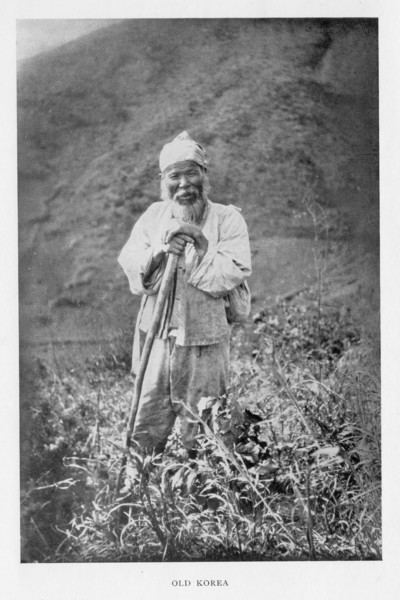
"한국은 스스로 일어서야 한다는 것이다," "따라서 그들(일본인)의 호의나 개심에 의해서 한국이 독립할 수 있는 희망은 없다"라는 부분은 신복룡이 추가한 해석들이다. 그러나 "구제불능한 무능함(incorrigible ineffectives)"과 같은 조선인에 대한 낮은 평가를 고려하면 드레이크가 독립의 가능성을 조금이라도 인정하는지 의심스럽다. "자치 능력이 완전히 결여한 국민"이라는 것이 조선인에 대한 그의 기본적인 시각였다. 예컨대 "앙양할 수 없는 조선인들을 앙양시키기 위한 일본인들의 초인적이고도 애끓는 노력"의 바로 뒤에는 조선사람들을 어른이 없는 세상을 원하는 애들로 비유했다.
| The Koreans clamour for freedom as children clamour for a world without grown-ups. But who's to cook the dinner, and light the fires, and clean the rooms ? (p. 11) |
그 전에는 "외국의 지배를 받은 것이 조선인의 본성"이라는 글도 있다.
| The Koreans as a people are marked down as a prey to any predatory power. Hate domination as they will, it is in their nature to be dominated. (p. 5) |
제XII장에는 "조직적 통제의 능력이 전무하다"는 평가도 있다.
| Whether Japan has set herself as a remote aim the training of Korea for self-government I don't know. If she has, she is very optimistic. The Koreans are a delightful people, extremely approachable and full of laughter, but they show not the least aptitude for organized control. (p. 148) |
심지어 조선 후기의 정치적 문란과 쇠락은 조선인의 국민적 결함에 의한 것이고 무고한 희생자로서 동정하면 안된다고 했다.
| A corrupt and tyrannous Court persisting from generation to generation is a sure sign of national debility. If a people continues to be badly governed it is because they have it in them to be badly governed. Actively or passively they must be held responsible, and not weakly pitied as innocent victims of an evil beyond their power. (p. 149) |
즉, 지금의 북조선처럼 백성들을 괴롭히는 정부가 장기간 계속되는 것은 그 국민 탓이고 하루 빨리 강대국의 지배를 받아야 된다는 것이 바로 제국주의의 논리이다.
당시 영국은 최대의 제국주의 국가였지만 영국인인 드레이크도 제국주의를 무조건적으로 옹호한 것은 아니었다. 제VII장에서는 경복궁을 보면서 "무슨 권리로 일본은 조선을 지배하는가"라는 의문을 가지지만 그것은 바로 "무슨 법으로 강대국은 약소국을 침탈하는가"라는 의문으로 바꿘다. 그러나 영국인인 드레이크는 적극적으로 사태를 바꾸는 의지는 없었다. 비록 제국주의같은 약육강식 상태가 비인도적인 법이기는 하지만 너무나 강력하고 근본적인 법이기 때문에 세계사의 진로는 신들에게 맡길 수 밖에 없다는 것이다.
| For it is not simply that one finds oneself asking, "By what right does Japan rule in Korea ?" The doubt penetrates more deeply : "By what law are the weak devoured of the strong ?" It is not a human law, for human justice and human pity rebel against it. But it is too powerful for human justice and human pity, because too fundamental. The world is driven along the path of its destiny by forces imperative and ruthless. "It is the gods, the gods above, that govern our condition. . . " (p. 80) |
신복룡이 쓴듯이 드레이크의 기본적 태도는“체념"이였다.
그가 한일 합방의 당위성을 주장하고 있는 것도 아니고, 일본이 잘하고 있다고 칭찬하는 것은 아니지만 당분간 조선의 독립이란 어려울것 같다는 체념을 바닥에 깔고 있다. (p. 229)
오히려 그는 그 대답을 체념하고 있는 듯이 말함으로써 일본에 의한 한국의 지배는 상당 기간 지속되리라는 인상을 품기고 있다. (p. 230) |
제XII장은 매아리 박(가명)이라는 조선인 여성과의 논쟁을 기록하고 있다. 매아리는 7살때 미국으로 건너가 21살에 귀국했다. 그는 자기가 미국에서 즐길 수 있던 자유를 조선에서는 가질 수 없다며 조선인, 일본인, 서양인을 포함해 주위의 모든 인간들을 증오했다. 드레이크에 대해서는 제국주의, 강력하고 혹독한 정부, 오만한 백인의 대표로서 성토했지만 드레이크의 형제(영어이기 때문에 형인지 동생인지 불명)는 중국의 무질서와 불공정을 가지고 강력한 정부의 필요성을 역설했다.
| At this time I knew little enough of the benefits of the Japanese rule, and wasn't qualified to reply, but my brother could quote China. Liberty under the Chinese nationalists meant liberty for the idle to rob the industrious, for the strong to rob the weak. It was simply that the Government had been removed and bandits sprang up like weeds. (pp. 144-145) |
여기서 드레이크는 영국이 무슨 권리로 인도를 지배하는가 라는 의문을 느꼈지만 그의 형제는 "미망인을 태워 죽이는 인도인들이 나쁘다"고 치부했다.
… of course we defended the Japanese, because we were doing exactly the same in India as the Japanese were doing in Korea. But what right had we in India? What right had we to impose our regulations on the Indians against their will ? We had made them a nation of slaves.
"Certainly," my brother said, "we don't let them burn their widows." (p. 145) |
매아리와의 논쟁을 통해서 드레이크가 얻은 결론은 조선인의 동양적 정신에 문제가 있다는 것이었다. 즉, 조선인들은 "자유"의 진정한 의미를 모르고 질서와 자유를 어떻게 양립시킬까 고민하지도 않고 자유를 마치 자연의 혜택처럼 간주하고 노력도 없이 요구하고 있다는 것이다.
| Principles which are commonplaces in the West, but not in the East. As, for instance, that without order there can be no liberty ; that liberty is not the birth of a moment, but of the labour of generations. Commonplaces, I repeat ; yet to the Korean mind paradoxes and contradictions. Even to Mary Pak ; intellectually of the West, but emotionally of the East. To her, liberty and order (which she called restriction) were fundamentally opposed ; and being a gift of nature, like the sun and the open air, liberty needed no cultivation, no preparation. Simply one behaved as one pleased, and one was free. And perhaps it is that spirit, rather than national resentment, that is thwarting the work of the Japanese Government in Korea. (pp. 145-146) |
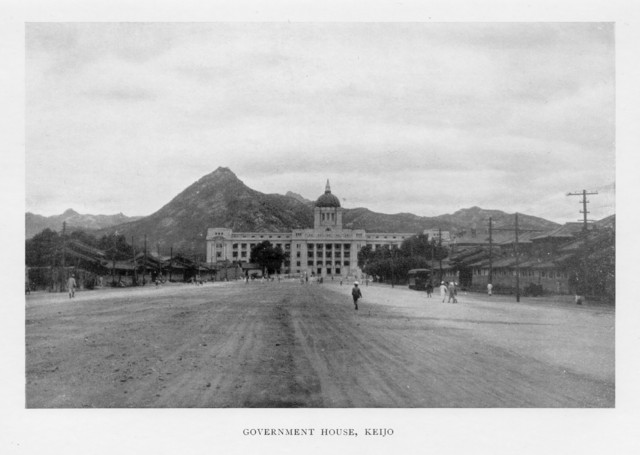
신복룡은 드레이크가 "한일 합방의 당위성을 주장하고 있는 것도 아니고, 일본이 잘하고 있다고 칭찬하는 것은 아니지만…(p. 229)"라고 했다. 그러나 조선인에 대한 낮은 평가와 제국주의에 대한 소극적 지지(체념)를 감안하면 조선 식민지화의 당위성은 인정했다고 볼 수 있다. 일본의 조선지배에 대해서는 칭찬은 아니지만 상당히 높게 평가했다. 그는 아래와 같이 일본의 업적을 열거했다.
A further port is to be built somewhere to the north-east, and the line continued beyond Kwainei across Manchuria. When this has been completed Japan will be in absolute control of the Manchurian export trade. And central in this system of commercially strategic railways is the capital. (p. 78)
… and from this apathetic exhaustion Japan is striving, with all her resources of ingenuity and power, to lift the country to the level of a modern nation. She has created roads, railways, postal and telegraph services, universal electric lighting, sanitation. Whether these things are benefits or not, they are now there. She has distributed wholesale, and free, the best breeds of fowls, so that the Korean egg is no longer a meagre thing hardly worth the shelling for the meat within, but has both quality and size. She has planted fruit-trees on the hill-sides where rice cannot grow. She has set aside spaces for experimental farms. She has irrigated waste land, is rapidly damming the rivers and building cisterns to obviate both flood and drought. She is afforesting the hills, which, left to themselves, the Koreans completely denuded except in the grounds of palaces and temples and royal tombs. (pp. 146-147) |
또 몸을 씻고 깨끗이 유지하는 것은 일본인이 도입한 습관임을 지적했다.
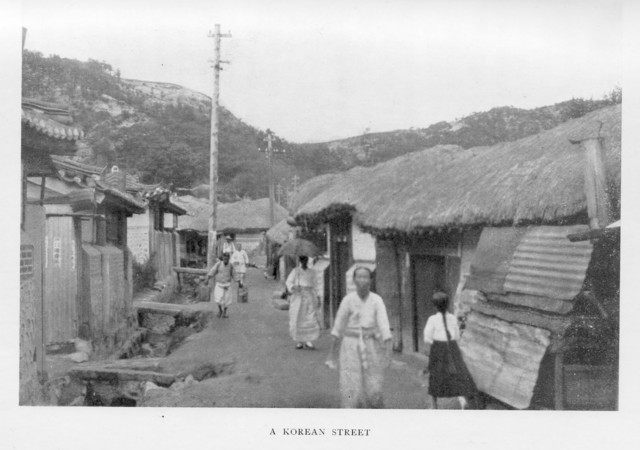
| … and young men stripped to the waist washing themselves and one another, or with their mouths in a foam vigorously scrubbing their teeth. But then, this is not Seoul ; this is Keijo intruding again ; for washing is an innovation from Japan. (pp. 98-99) |
심지어 깨끗한 일본인과 불결한 조선인을 대조하고 조선인은 병원균에 대한 저항력이 강하다고 했다.
| And the factis, that during any typhoid epidemic it is the clean Japanese who die, not the dirty Koreans. There is probably a heavy infant mortality, but those who survive are surprisingly immune from pestilence. (p. 108) |
그러나 일본지배하의 조선이 일본문화가 아니라 서양문화에 의한 침략을 받은 것을 지적하고 최종적인 승리자는 서양인임을 암시하기도 했다.
| But it is sufficient merely to see these people in Western clothes. They know neither how to make nor how to wear them. The trousers, except that they open in front -- quite obviously ! -- might by their shape be reversible. They divide a full six inches too low. They are of the American pattern -- that is, supported by a belt instead of braces ; but the Easterner has no hips, and the belt is certain to miss a loop or two, so when the jacket is off, which is frequent, the trousers hang from the waist in uncertain festoons overlapped by tags of shirt. (p. 87) |
법적 공평성이나 정치적 공정성을 갖추는 국민은 동양에서는 일본인 뿐이다는 글을 보면 일본에 대한 드레이크의 평가는 "칭찬"이라기 보다는 "인정"이였다 .
| And not merely brains for organization, but that peculiar gift for judicial rectitude and political honesty which is the portion in some measure of all the Western nations, but in the East of the Japanese alone. (p. 149) |

No comments:
Post a Comment