Vietnamese famine of 1944–1945
 | This article possibly contains original research. (September 2018) |
| Vietnamese famine of 1944–45 Nạn đói Ất Dậu | |
|---|---|
.jpg) Children in the famine | |
| Country | Tonkin, French Indochina (Northern Vietnam) |
| Total deaths | 400,000—2,000,000 |
The Vietnamese famine of 1944–45 (Vietnamese: Nạn đói Ất Dậu – famine of the Ất Dậu Year or Nạn đói năm 45 – the 1945 famine, due to most of the deaths occurring in 1945) was a famine that occurred in Northern Vietnam and northern Central Vietnam during the Nguyễn dynasty from October 1944 to June 1945. At the time Vietnam was under the Vichy France regime and later the Empire of Vietnam government, and the country was also under Japanese occupation in the context of World War II. Between 400,000 and 2 million people are estimated to have starved to death during this time.[1][2][3]
Causes


A cause of the famine was the effects of World War II on French Indochina (including Vietnam). The involvement of France and Japan in Vietnam caused detrimental effects to the economic activities of the Vietnamese. In 1944, after US bombing had cut off supplies of coal from the north to Saigon, the French and Japanese used rice and maize as fuel for power stations. According to the diplomat Bui Minh Dung, "the Japanese occupation of Vietnam was the direct cause, in the final analysis, of several other factors, in turn affecting the famine, but their military efforts together with their economic policy for the Greater East Asia Co-Prosperity Sphere per se seem to have systematically played a role considerably greater than any other factors in the Vietnamese starvation."[2]
The mismanagement of the French administration in Vietnam was another cause. The French reformed the economy to serve the administration and to meet the needs of war, including the Japanese occupation. They imposed a compulsory system of government rice purchases with a price ceiling of 1.40 piastres for every 10 kilograms, which they continued paying even as the market rates soared from 2.50 to 3 piastres in 1943 to 6 to 7 in June 1944. It ballooned tenfold to 60-70 piastres the following year. This meant farmers could no longer afford to repurchase rice needed for new harvests or to feed themselves.[5]
Natural causes included cold weather in Tonkin in late 1944 and early 1945, as well as natural disasters such as droughts and floods which destroyed northern crops.[citation needed]
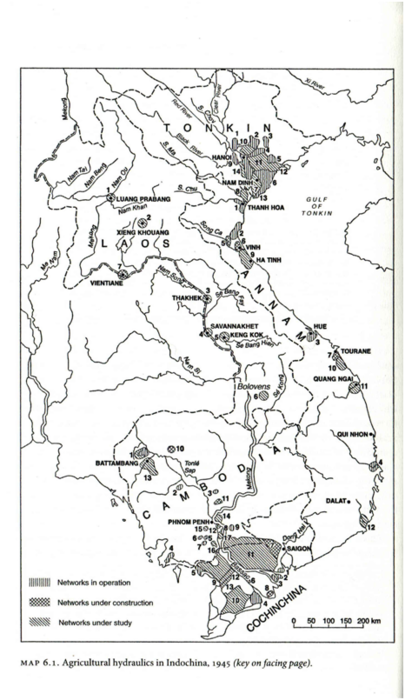
The crop failures of 1943–1945 were compounded by lack of dike maintenance after the US bombing of the north and the catastrophic rainfall of August–September 1944, causing flooding and loss of rice plants.[citation needed]
French colonial administration
After the Great Depression in the 1930s, France returned to its policy of economic protectorate and monopolized the exploitation of natural resources of French Indochina. The people in French Indochina had to increase the economic value of the area by growing cash crops in place of lower-value agricultural produce, but only the French, a small minority of Vietnamese and the Hoa and some people in the cities benefited.[2]
World War II
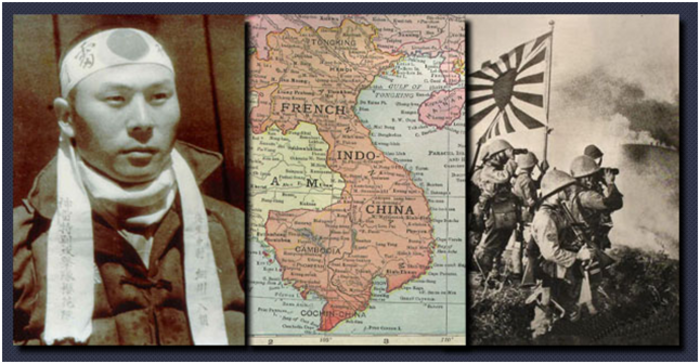
When the war started, France was weakened. In East Asia, Japan began to expand and viewed French Indochina as a bridge into Southeast Asia and a means to isolate and further weaken the Nationalist government of China. In mid-1940, Metropolitan France was occupied by Nazi Germany. Germany's Axis partner Japan then increased pressure on France and entered French Indochina that September. Vietnam was pulled into a wartime economy, with France and Japan competing in administration, often with Japan gaining the advantages. Japanese troops forced farmers to grow jute, instead of rice, thus depriving them of needed food, but France had already started the same policy to a smaller degree. The land set aside for growing staple crops such as maize and potatoes was decreased to make land for growing cotton, jute and other industrial plants. Because of the decreased land available for growing, harvests of staple crops decreased considerably. Crops were also exported to Japan.[citation needed]
The militaries of both France and Japan forcibly seized food from farmers to feed their troops. By 1941, there were 140,000[6] Japanese troops in French Indochina in addition to the Vichy French forces. During the occupation, the Allies made frequent air strikes against roads, warehouse and transportation facilities, which made the transport of rice from the south to the north extremely difficult. In the meantime, the Vichy civilian administration was highly corrupt, dysfunctional and unable to distribute remaining food stocks to areas where needed.[citation needed]
In March 1945, the Japanese ousted the Vichy administration and replaced it with the Japanese-backed government of the Empire of Vietnam, headed by Trần Trọng Kim. While this new government increased efforts to alleviate the famine, the inadequate food supply and the hoarding of food by the Imperial Japanese Army made their efforts futile.[citation needed]
Consequences
.jpg)
.jpg)
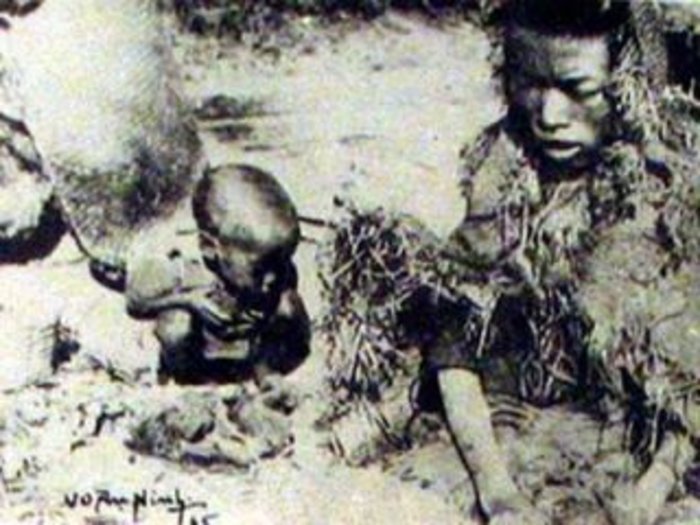
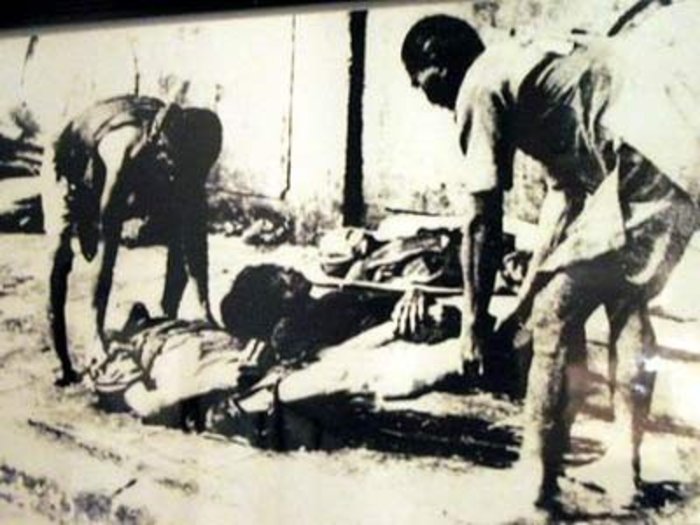
By early 1945, many were forced to walk from town to town in search of food.[7] The exact number of deaths caused by the 1944–1945 famine is unknown and is a matter of controversy. Various sources estimate between 400,000 and 2 million people starved in northern Vietnam during this time. In May 1945, the envoy at Hanoi asked the northern provinces to report their casualties. Twenty provinces reported that a total of 380,000 people starved to death and 20,000 more died because of disease. In October, a report from a French military official estimated half-a-million deaths. Governor General Jean Decoux wrote in his memoirs A la barre de l'Indochine that about a million northerners had starved to death.[citation needed]
The Viet Minh, led by communists, successfully directed public resentment and encouraged the peasants to seize the rice granaries of the occupation powers. In response, the Japanese imposed harsh punishment upon the transgressors and sometimes even mutilated them physically, which further inflamed popular anger. In the process, the Viet Minh transformed itself from a guerilla organization into a mass movement.[7] Ho Chi Minh, in his Proclamation of Independence of the Democratic Republic of Vietnam on 2 September 1945, would refer to the famine and quote a figure of 2 million deaths.
.jpg)
According to the Việt Minh, 1 to 2 million Vietnamese starved to death in the Red River Delta of northern Vietnam because of the Japanese since they seized Vietnamese rice and failed to pay. In Phat Diem, the Vietnamese farmer Di Ho was one of the few survivors who saw the Japanese steal grain.[8] The North Vietnamese government accused both France and Japan of the famine and said that 1–2 million Vietnamese had died.[2][9] Võ An Ninh took photographs of dead and dying Vietnamese during the great famine.[10][11][12] Starving Vietnamese died throughout northern Vietnam in 1945 from the Japanese seizure of their crops when the Chinese came to disarm the Japanese, and Vietnamese corpses were all throughout the streets of Hanoi and had to be cleaned up by students.[13]
The pro-Japanese Empire of Vietnam government tried its best to supply rice to fight the famine. Regarding the Japanese government, Prime Minister Tran Trong Kim asked Japan to abolish the law that forced landowners with 3 acres of land to sell rice to Japan. Second, there was a "relief" movement in all three regions. In the North, Mr. Nguyen Van To, appointed as the President of the "Northern Relief" Association, from March 24 to May 24, 1945, collected 782,403 dong and spent 593,836 dong. According to the central government's order, those who were too hungry and had to go far away to seek food were gathered in special camps for relief. In the Central region, there was a "Central Committee for Relief of Northern Victims", with its office located at 43 Paul Bert Street, chaired by the empress dowager Tu Cung (mother of emperor Bảo Đại). Because all ships over 30 tons were requisitioned by the Japanese while important areas were constantly attacked by Americans (Allies), the transportation of rice from the South to the North was delayed. In addition, the Viet Minh also intercepted many government boats to take rice. Minister of Supply Nguyen Huu Thi was sent to Saigon to arrange the transportation of rice from the South to the Central and Northern regions. Seaports far from Saigon were used as departure points to avoid American bombing. Private individuals were allowed to freely transport and trade rice. To prevent dishonest behavior, the government ordered price and inventory controls on rice. Violators could be sentenced to death or have their property confiscated. The Northern Economic Intelligence Service, headed by Nguyen Duy Que, was established to prevent smuggling. In the South, in May, more than 20 relief associations were established, and within a month, the above organizations raised 1,677,886 dong, including 481,570 dong to buy and transport 1,592 tons of rice for famine victims. Thanks to the good harvest in May and June 1945, and thanks to the sharp decrease in consumption demand after more than 1 million people died of starvation, the food crisis gradually eased. By June 1945, the famine had significantly decreased.[14]
In 1951, Vietnam as the State of Vietnam was one of the countries that signed with Japan a peace treaty, including war reparations clause. After Vietnam was divided, in 1959, Japan negotiated with the Republic of Vietnam in the South (continuation of the State of Vietnam) on war reparations. The Japanese side claimed that there were about 300,000 victims of starvation, while South Vietnam gave the figure of 1,000,000 people. The final compensation agreed upon was 14 billion 40 million yen (about 39 million US dollars) in 1960.[15]
See also
- Bengal famine of 1943
- Dutch famine of 1944–1945
- Greek famine
- Holodomor
- Vietnam in World War II
- Chinese famine of 1942–1943
References
- Charles Hirschman; Samuel Preston; Vu Manh Loi (December 1995). "Vietnamese Casualties During the American War: A New Estimate" (PDF). Population and Development Review. 21 (4): 783–812. doi:10.2307/2137774. JSTOR 2137774. Archived from the original (PDF) on 20 June 2010.
- Gunn, Geoffrey (24 January 2011). "The Great Vietnamese Famine of 1944-45 Revisited". The Asia-Pacific Journal. 9 (5). No. 4. Article ID 3483. http://www.japanfocus.org/-Geoffrey-Gunn/3483 http://japanfocus.org/data/japanese_indochina.png http://japanfocus.org/data/indochina_map.png http://japanfocus.org/data/faminevictims_1.jpeg http://japanfocus.org/data/famvic.2.jpeg http://japanfocus.org/data/agricultural_hydrolics_indochina.png http://japanfocus.org/-Geoffrey-Gunn/3483
• Gunn, Geoffrey (15 April 2019). "The Great Vietnamese Famine of 1944–45 Revisited". Mass Violence & Résistance, [online] (published 12 May 2011). - Huff, Gregg (March 2020). "The Great Second World War Vietnam and Java Famines". Modern Asian Studies. 54 (2): 618–653. doi:10.1017/S0026749X18000148.
- "Horrific photos recall Vietnamese Famine of 1945". Thanh Nien News. 15 January 2015. Archived from the original on 4 February 2015.
- Wise, Edward Taylor (1991). "Vietnam in turmoil : the Japanese coup, the OSS, and the August revolution in 1945". UR Scholarship Repository: 46.
- Reid, Anthony (2015). A history of Southeast Asia : critical crossroads. John Wiley & Sons. p. 323. ISBN 978-1118513002. Retrieved 24 September 2018.
- Spector, Ronald H. (2007). In the ruins of empire : the Japanese surrender and the battle for postwar Asia (1st ed.). New York. pp. 104–105. ISBN 9780375509155.
- Gunn, Geoffrey (17 August 2015). "The great Vietnam famine".
- Dũng, Bùi Minh (1995). "Japan's Role in the Vietnamese Starvation of 1944–45". Modern Asian Studies. 29 (3). Cambridge University Press: 573–618. doi:10.1017/S0026749X00014001. S2CID 145374444.
- Hien, Nina (Spring 2013). "The Good, the Bad, and the Not Beautiful: In the Street and on the Ground in Vietnam". Local Culture/Global Photography. 3 (2).
- Vietnam: Corpses in a mass grave following the 1944–45 famine during the Japanese occupation. Up to 2 million Vietnamese died of starvation. AKG3807269.
- "Vietnamese Famine of 1945". Japanese Occupation of Vietnam.
- Bui, Diem; Chanoff, David (1999). In the Jaws of History. Vietnam war era classics series (illustrated, reprint ed.). Indiana University Press. p. 39, 40. ISBN 0253335396.
- Chieu, Vu Ngu (February 1986). "The Other Side of the 1945 Vietnamese Revolution: The Empire of Viet-Nam (March–August 1945)". The Journal of Asian Studies. 45 (2). doi:10.2307/2055845. JSTOR 2055845.
- Quốc Việt (27 December 2015). "Bao cuộc bể dâu bi thảm, chỉ có người dân là khốn khổ". Tuổi Trẻ Online (in Vietnamese). Retrieved 12 June 2020.
Further reading
- Gunn, Geoffrey C. (2014). Rice Wars in Colonial Vietnam: The Great Famine and the Viet Minh Road to Power. Rowman & Littlefield. ISBN 9781442223035.
- MacLean, Ken (2016). "History Reformatted: Vietnam's Great Famine (1944–45) in Archival Form". Southeast Asian Studies. 5 (2): 187–218. doi:10.20495/seas.5.2_187.
External links
- Vietnam famine's living legacy
- Images of the famine Archived 21 November 2009 at the Wayback Machine (in Vietnamese)
- Famine fed farmers' fight for freedom
1944년-1945년 베트남 기근
.jpg)
1944년-1945년 베트남 기근(베트남어: Nạn đói Ất Dậu)은 1944년부터 1945년까지 일본 제국 하 프랑스령 인도차이나의 북부 베트남에서 일어난 기근이다. 이 기간 동안 40만 명에서 200만 명 사이의 사람들이 굶어 죽은 것으로 추산됩니다.[1][2][3]
원인
프랑스 식민 통치
대공황 이후 프랑스는 보호경제 정책으로 회귀하여 프랑스령 인도차이나의 천연자원 착취를 독점했다. 프랑스령 인도차이나에서는 저소득 농작물 대신 고소득 농작물이 재배됐지만 경제적 이익은 프랑스인, 호아족, 그리고 베트남인 극히 일부에게만 돌아갔을 뿐이다.
제2차 세계 대전

일본은 프랑스령 인도차이나를 동남아시아로 침략할 발판이자 중화민국을 약화시킬 지역으로 간주했다. 1940년 중반 프랑스 본토가 나치 독일에 함락됐다. 나치 독일과 같은 추축국이었던 일본은 9월에 프랑스와 프랑스령 인도차이나를 압박했다. 베트남에서는 전시 경제가 가동됐고 프랑스와 일본은 행정력을 경쟁적으로 뻗쳤는데, 주로 일본이 우위에 있었다. 일본군은 쌀 대신 황마포 재배를 강요하고 식량을 수탈했다. 이는 프랑스의 종전 정책을 확대한 것이었다. 옥수수와 감자 같은 주곡을 재배하는 농지는 목화, 황마포 재배 및 공장 지대 조성을 위한 토지로 바뀜에 따라 그 면적이 줄었다. 주곡을 재배하는 토지가 줄어들었기 때문에 수확이 급격히 줄었다. 농작물은 또한 일본으로 수탈됐다.
비시 프랑스군과 일본군은 군용으로 사용하기 위해 농민들로부터 농작물을 수탈했다. 1941년 프랑스령 인도차이나에 주둔한 일본군은 14만 명이었다. 점령기에 연합국은 도로, 창고, 수송 수단을 빈번하게 공습했고 이로 인해 남부로부터 북부로의 쌀 운송이 아주 어려워졌다. 비시 프랑스 측 정부는 아주 부패했고, 행정력을 잘 가동하지 못했으며, 남은 식량을 분배할 수 없었다.
1945년 3월 일본은 메이고 작전을 일으켜 비시 프랑스 세력을 몰아내고 쩐쫑낌을 수장으로 하는 괴뢰국인 베트남 제국을 세웠다. 신생 정부가 기근 사태를 완화하기 위해 노력했지만 부적절한 식량 공급과 일본군에 의한 식량 비축으로 인해 소용 없이 되었다.
자연 재해
베트남 북부에서는 가뭄과 해충 때문에 1944년의 겨울-봄 수확이 20% 줄었고 수확기에 발생한 홍수가 기근의 한 원인이 됐는데, 이로 인해 1945년까지 기근이 이어졌다.
각주
- Charles Hirschman; Samuel Preston; Vu Manh Loi (December 1995). “Vietnamese Casualties During the American War: A New Estimate” (PDF). 《Population and Development Review》 21 (4): 783–812. doi:10.2307/2137774. JSTOR 2137774. 2010년 6월 20일에 원본 문서 (PDF)에서 보존된 문서.
- Gunn, Geoffrey (2011년 1월 24일). “The Great Vietnamese Famine of 1944-45 Revisited”. 《The Asia-Pacific Journal》 9 (5). No. 4. Article ID 3483. http://www.japanfocus.org/-Geoffrey-Gunn/3483 http://japanfocus.org/data/japanese_indochina.png http://japanfocus.org/data/indochina_map.png http://japanfocus.org/data/faminevictims_1.jpeg http://japanfocus.org/data/famvic.2.jpeg http://japanfocus.org/data/agricultural_hydrolics_indochina.png http://japanfocus.org/-Geoffrey-Gunn/3483
· Gunn, Geoffrey (2019년 4월 15일). “The Great Vietnamese Famine of 1944–45 Revisited”. 《Mass Violence & Résistance, [online]》 (2011년 5월 12일에 출판됨). - Huff, Gregg (March 2020). “The Great Second World War Vietnam and Java Famines”. 《Modern Asian Studies》 54 (2): 618–653. doi:10.1017/S0026749X18000148.
- “Horrific photos recall Vietnamese Famine of 1945”. 《Thanh Nien News》. 2015년 1월 15일. 2015년 2월 4일에 원본 문서에서 보존된 문서.



No comments:
Post a Comment