Takaichi stands firm on controversial Taiwan contingency remarks
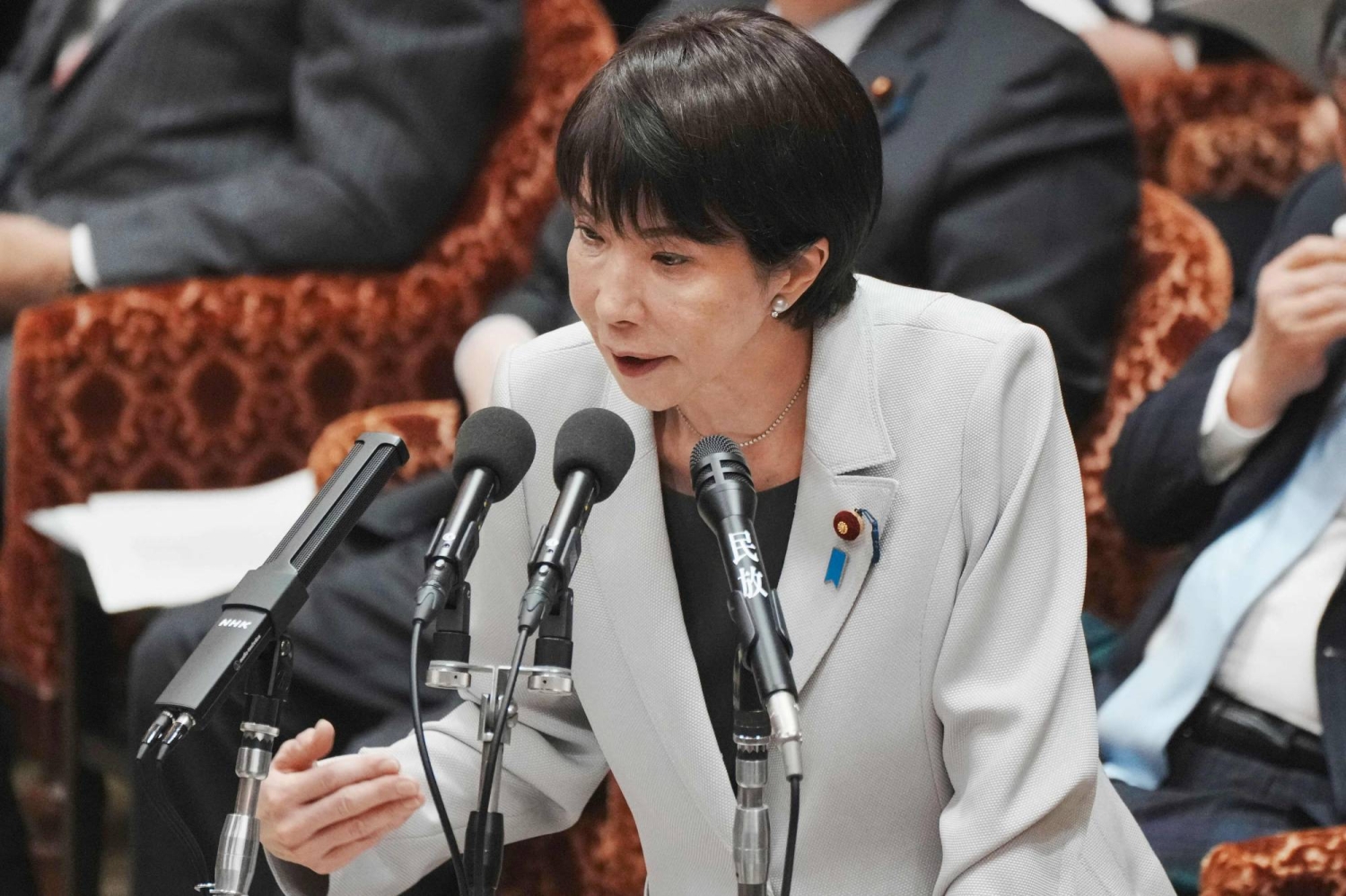
Prime Minister Sanae Takaichi responds to questions during a session of the House of Representatives' Budget Committee in parliament in Tokyo on Monday. | AFP-JIJI
By Gabriele Ninivaggi
STAFF WRITER
SHARE/SAVE
Nov 10, 2025
기사를 들어보세요.
4 분
Prime Minister Sanae Takaichi has refused to back down following her controversial remarks Friday on the possibility of Japan becoming involved in a Taiwan contingency under certain circumstances, pushing the line further than any of her predecessors.
On Monday, she tried to soften the impact of the remarks, noting that she has “no intention” of changing the government’s official position.
“I gave a somewhat concrete answer while considering the worst-case scenario,” Takaichi told the Lower House Budget Committee on Monday, declining to backtrack on her remarks last week. “From now on, I’ll refrain from making explicit statements on specific scenarios.”
During a heated exchange with the Constitutional Democratic Party of Japan’s Katsuya Okada on Friday, Takaichi voiced her thoughts on the concrete ways in which Japan’s response could potentially unfold in the event of China attacking Taiwan by sea.
“If battleships are used and a naval blockade involves the use of force, I believe that would, by any measure, constitute a situation that could be deemed a threat to Japan’s survival,” Takaichi said, implying the criteria would have been met for the Self-Defense Forces (SDF) to be mobilized.
Before Friday's exchange, a sitting prime minister had never gone as far as to offer a concrete example of a potential emergency over Taiwan and indicate what Japan’s reaction might be.
Unlimited access
US$30 US$18/mo
FOREVERsubscribe NOW
While Takaichi’s stance seems to be shared among her party allies — Liberal Democratic Party (LDP) Vice President Taro Aso angered Beijing last year by saying an emergency in Taiwan would also be an emergency for Japan — her predecessors had avoided referring to concrete scenarios.
A law approved in 2015 under the administration of former Prime Minister Shinzo Abe stipulates that the use of military force is permitted for collective self-defense if three conditions are met.
The first condition would be for Japan, or a foreign country in a close relationship with Tokyo, to be facing an armed attack that posed a threat to Japan’s survival and a danger to people’s right to life, liberty and pursuit of happiness.
The second would require there to be no other appropriate means available to repel the attack, ensure the country’s survival and protect its people. Thirdly, the use of force would need to be kept to a minimum.
At the time, the law — which entailed a significant change in the interpretation of Japan’s postwar Constitution and past legislation related to the SDF — was met with fierce opposition both within and outside parliament.
On Friday, Okada had initially pressed Takaichi on remarks she’d made in a televised debate during last year’s LDP presidential election.
After her response, which included the controversial remarks, Takaichi went on to reiterate the government’s formal position — that the government would make a comprehensive judgment based on each specific case.
But it was too late.
“This is about whether or not the nation will be driven into war,” the CDP’s Hiroshi Ogushi said, demanding further clarification from Takaichi. “We can’t afford to leave it ambiguous.”
China’s reaction was not long in coming.
In a post to X on Friday, Beijing’s Consul General in Osaka, Xue Jian, vehemently attacked Takaichi in response to her Taiwan remarks, saying, "We have no choice but to cut off her dirty neck without any hesitation.”
Chief Cabinet Secretary Minoru Kihara said Monday that the government had lodged an official protest over Xue’s post through Japan’s Foreign Ministry and the Japanese Embassy in Beijing, asking for a clear explanation and a deletion of the post. As of Sunday evening, the post had been deleted, he added.
However, with another post on X on Monday morning, Chinese Ambassador to Japan Wu Jianghao doubled down, saying the resolution of the Taiwan question was solely up to Beijing.
“Fueling the notion that ‘a crisis in Taiwan is a crisis for Japan’ and seeking to bind Japan to China's war tanks will ultimately lead only down a path of no return,” Wu said.
The Chinese Foreign Ministry also filed an official complaint against Japan over Takaichi’s remarks, media reports said.
Takaichi’s positioning on Taiwan is leading to growing tensions between Japan and China.
Only days after Takaichi’s bilateral talks with Chinese leader Xi Jinping, her meeting with a Taiwanese representative on the sidelines of an international summit in South Korea last weekend caused a stir in Beijing.
In her encounter with Xi, Takaichi had attempted to strike a more hopeful tone regarding her relationship with China, even while underlining the controversial issues currently straining the relationship.
KEYWORDSSANAE TAKAICHI, TAIWAN, CHINA, defense, SDF, China-Japan relations, Taiwan-Japan relations

No comments:
Post a Comment