Kindle
$16.92
Available instantly
Audiobook
1 CreditAvailable instantly
Hardcover
$25.29
Paperback
$42.39
 Audible sample
Follow the author
Stephen KinzerStephen Kinzer
Follow
The True Flag: Theodore Roosevelt, Mark Twain, and the Birth of American Empire Kindle Edition
by Stephen Kinzer (Author) Format: Kindle Edition
4.4 4.4 out of 5 stars (330)
See all formats and editions
The public debate over American interventionism at the dawn of the 20th century is vividly brought to life in this "engaging, well-focused history" (Kirkus, starred review).
Should the United States use its military to dominate foreign lands? It's a perennial question that first raised more than a century ago during the Spanish American War. The country's political and intellectual leaders took sides in an argument that would shape American policy and identity through the 20th century and beyond.
Theodore Roosevelt, Henry Cabot Lodge, and William Randolph Hearst pushed for imperial expansion; Mark Twain, Booker T. Washington, and Andrew Carnegie preached restraint. Not since the nation's founding had so many brilliant Americans debated a question so fraught with meaning for all humanity.
As Stephen Kinzer demonstrates in The True Flag, their eloquent discourse is as relevant today as it was then. Because every argument over America's role in the world grows from this one.
Read less
Print length
320 pages
Language
==
From Australia
GJ Maybury, Perth WA Australia. Author, Writer
5.0 out of 5 stars Excellent coverage of the events and developments of the era
Reviewed in Australia on 24 February 2017
Format: KindleVerified Purchase
Excellent coverage of the events and developments of the era, and the key figures driving them. My estimation of Twain is even higher, of TR, decidedly less so. Kinser's research and writing are impeccable. This book is a worthy addition to his previous work, of which The Brothers is the standout for this writer.
Helpful
Report
yshoraka
5.0 out of 5 stars Very informative
Reviewed in Australia on 5 January 2018
Format: KindleVerified Purchase
I found this book very informative. As people throughout should and can affect the policies of their government, this book is a must-read for everyone. Thereby, I highly recommend it.
Helpful
Report
From other countries
Sherri Cianca
5.0 out of 5 stars Every American Should Know
Reviewed in Canada on 12 September 2023
Format: PaperbackVerified Purchase
If a country were a person, the US would be diagnosed as having a dissociative identity disorder. In this book Stephen Kinzer documents America's two conflicting personalities, one driven by capitalistic greed and love of war, the other by peace and love for humanities well being. The question remains "Can a nation so conceived, and so divided, long endure?"
Report
Amber Smithwhite
5.0 out of 5 stars Informative Historical perspective of USA
Reviewed in the United Kingdom on 31 May 2022
Format: PaperbackVerified Purchase
Mark Twain, Samuel Clements, is one of my favourite writers so I enjoyed reading about his political viewpoint. Didn't know much about Teddy Roosevelt so was an interesting book for many people to get an insight to the American attitude to 'ruling' the world and acting as though they are the only country that counts on this planet.
Report
Pbiker
5.0 out of 5 stars One of the debates that will turn the USA around for all time!
Reviewed in the United States on 17 March 2017
Format: KindleVerified Purchase
I consider myself to be very knowledgeable about US History. In fact I have read at least 10 books about TR. It is fair to say that I have been at least a fan, but more likely I/d describe myself as a Teddy devotee. This book showing the annexation of Cuba, Porto Rico (as the Senate called it) and the Phillipines reads like a Clive Cussler novel. The speeches made for the Imperialist forces versus the anti-imperialists was a mighty clash of philosophies. Roosevelt, Lodge, McKinley former Pres.Garfield wanted America to utilize it's Manifest Destiny. Samuel Gompers, Booker T. Washington Andrew Carnegie (who offered to pay the millions that the US was going to pay Spain for these outposts with the only condition was free elections by the Native population.). The there is the almost bizarre split-personality of William Jennings Bryan.He had the ability to sway the treaty ratification in the Senate. In a dramatic switch he announced that the US would be doing this ONLY until the country was "stabilized" then free elections would happen The treaty passed by one vote. Amazingly Bryan had a 2nd chance to defeat the annexation if only he would not raise "Free Silver" in his soon-to-come next presidential election. Carnegie was willing to pump millions into his campaign. McKinley would lose. Teddy Roosevelt would NOT be the VP of the USA. But Bryan could not let go of his "Cross of Gold" fanaticism. His omen dried up. McKinley, as you know, lost, was assassinated and Roosevelt, the true jingoist became the President who adopted the American empire climb into the superpower line-up. Fascinating Book. I left out one of the foremost anti-imperialists. Mark Twain, who once said, "God created war so that Americans could learn Geography!"
33 people found this helpful
Report
Kerry Timmins
5.0 out of 5 stars the train is funny and clever
Reviewed in Germany on 22 July 2019
Format: HardcoverVerified Purchase
Good stories
Report
Cliente Amazon
5.0 out of 5 stars Luis de Velasco
Reviewed in Spain on 23 March 2017
Format: KindleVerified Purchase
Excelente libro.Ahora con razón se habla de las mentiras de Trump.Antecedente:Teddy Roosevelt y compinches imperialistas.Trump y otros presidentes EEUU alumnos distinguidos.
Report
Translate review to English
D.
5.0 out of 5 stars arrived in excellent condition
Reviewed in Canada on 23 August 2020
Format: HardcoverVerified Purchase
enjoyed the read
Report
Jim Lester
4.0 out of 5 stars Excellent history of American foreign policy
Reviewed in the United States on 9 May 2017
Format: KindleVerified Purchase
This is an important and thought-provoking piece of history. Kinzer details the ideas and activities of American political leaders, led by Theodore Roosevelt, who wanted our country to expand America's overseas empire at the beginning of the 20th century. Their efforts were opposed by a group of anti-imperialists led by Mark Twain, who believed America would lose its soul if it seized other countries and tried to govern them.
According to Kinser, the broad outlines of this argument have formed the basis of America's foreign policy discussions for over a hundred years. The book is well written and the closing section on the nation's post-World War II foreign policy is worth the price of the book. I would highly recommend this book to any reader interested in American history or any reader searching for an explanation of our country's recent expansionist foreign policy.
2 people found this helpful
Report
Thomas A. Regelski
3.0 out of 5 stars Of interest to those who don't know much about the ...
Reviewed in the United Kingdom on 8 June 2017
Format: HardcoverVerified Purchase
Of interest to those who don't know much about the time period in question, but there's hardly any info (and, then, not until the ending chapters) about Twain's role in the politics of the time.
One person found this helpful
Report
==
cassim bakharia
5.0 out of 5 stars Five Stars
Reviewed in the United Kingdom on 30 May 2018
Format: PaperbackVerified Purchase
Well Received - Great Item - Prompt Delivery - Thank You
Report
Jerome Brown
5.0 out of 5 stars The Author always does a great job !
Reviewed in the United States on 10 June 2025
Format: HardcoverVerified Purchase
It’s politics and culture to a detailed degree.
Report
Katherine Cameron
5.0 out of 5 stars LONG BEFORE DONALD TRUMP....
Reviewed in the United States on 18 April 2017
Format: HardcoverVerified Purchase
Every country has a "before and after" narrative - a critical turning point. For the USA, we frequently cite the Civil War or WWII. At these junctions, we had a choice, took a particular path, and changed the country profoundly. These were defining moments.
The True Flag pinpoints an entirely different junction - mid-way between the Civil War and WWII, at the turn of the 20th Century. This is the time when the entire country debated whether or not to become an imperialist power. The pawns in the game were Cuba, Puerto Rico and other Caribbean Islands, Hawaii, and the Philippines. The US successfully fought Spain to "free" these territories, but then had second thoughts.
Twain, Carnegie, and Hearst, championed self-governance for these far-flung lands, outside our existing borders. Teddy Roosevelt and Henry Cabot Lodge were on the other side, arguing for the US to become a strong world power. They persuaded President Mckinley. The True Flag focuses on the very short period of time during which this debate was engaged, and fatefully resolved.
Every bad thing you ever heard about the US war in the Philippines comes alive on these pages, and things you never heard. Ditto Cuba. The bitter surprise is that the debate came so close. On several occasions, the anti-imperialists lost by a singe vote. The whole country threw itself into this agonizing debate, much as it is doing now, with Trump. Digest this sad story, and a whole heck of a lot of our current political and international situations will suddenly make more sense. Tragic sense.
The True Flag is VERY well-written, a page turner, and a bitter-sweet story of what might have been. Despite our history of genocide, slavery, and other well-known depravities, the United States also had some important ideals and democratic principles imbedded in our Constitution - ideals that have inspired others throughout the world, and provided a corrective force to our nation's many missteps. Key among these principles is the idea that government should function by consent of the governed - the people.
When the imperialists won the debate at the end of the 19th century, arguing cynically that brown people were incapable of governing themselves, the American democratic experiment hung in the balance, then went down to defeat. We have McKinley, Teddy Roosevelt, and Henry Cabot Lodge to thank, long before Donald Trump arrived on the scene to trample the remnants.
19 people found this helpful
Report
Florian
5.0 out of 5 stars While reading Stephen Kinzer's The True Flag I listened to ...
Reviewed in the United States on 27 September 2017
Format: HardcoverVerified Purchase
While reading Stephen Kinzer's The True Flag I listened to Maurice Ravel's Bolero.
Somehow the music and the events match. The Bolero's incessant drive of sound resembles the powerful push for war and conquest the United States experienced during the years from 1898-1902. As documented in this book, it began with the Spanish-American War and proceeded with establishing an American Empire that included Hawaii, the Philippines, Guam, Cuba, and Puerto Rico.
There is never a shortage of reasonable persons who stand in opposition to U.S. wars of choice, but they seem to drown in the ever increasing crescendos of hypnotic war drums which will dominate across the country. With a current in the American psyche that gravitates toward action, and doing, and getting things done, foreign adventures appear to be tempting. Perhaps the autocratic temperament persists even in democracies, and
finds an outlet in orchestrating war, occupation, and colonial acquisition. For individual men with big egos and even bigger agendas, the processes of democratic government can be too pedestrian and too slow. Kinzer's finely crafted study, for this reader underscored by the forceful music of the Bolero, makes the hazards of such political patterns perfectly clear.
3 people found this helpful
Report
Mr Oates' Willie
3.0 out of 5 stars Denounce the pacifists for lack of patriotism
Reviewed in the United States on 17 February 2022
Format: HardcoverVerified Purchase
The birth of jingoism. If you leave out manifest destiny, the American Indian wars & TX/Mexico.
I would have appreciated a few pages of how this debate continued between the Treaty of Paris 1898 & The treaty of Versailles 1919. I guess the answer is W Wilson & the Hall of Mirrors. Very timely, as 'we' approach Ukrainian conflict.
One person found this helpful
Report
Joel Marks
4.0 out of 5 stars An interesting and timely history of the U.S.'s debut as a world power
Reviewed in the United States on 24 March 2017
Format: HardcoverVerified Purchase
I am very glad to have read this book, even though it is written in a way that swings between pedestrian and sensationalist. There is no denying that Kinzer brings to the reader's attention an exceedingly interesting and important episode of U.S. history, about which most of us, I imagine, had not an inkling. I for one had not realized that a specific event (or set of events) over a century ago, and occurring in the space of just a couple of years, decided our fate as a world power.
In "The True Flag" we learn that, at the turn of the Twentieth Century, there was a fierce public debate about whether the U.S. should be involved militarily in international affairs only as a liberator or as a conqueror -- as an embodiment of the idea that all people are entitled to be self-governing, or as the colonizer of an empire. Various American idealists rallied to the former conception, while mercantile and "religious" interests defended the latter.
What makes this debate so interesting is that the "bad guys" really did have some persuasive arguments. They pointed out, first of all, that the supposed American ideal of self-governance completely ignores our (then very recent) history of snatching other people's territory in the creation of the country. They also argued that the people of other lands were not (today we would say "might not be") prepared to self-govern in an effective way. Finally, and no doubt the main engine of their motives, they argued that, with so many European countries grabbing colonies all over the world, if we didn't take what we could get, we would miss our chance to acquire economically and strategically important markets and bases of operation.
Meanwhile the anti-imperialists also offered a mix of high-sounding and pragmatic arguments. Aside from wanting the U.S. to stand out as a unique bastion of liberty for all the world, they also predicted that imperialist adventures would embroil us in endless strife and cause, rather than alleviate, humanitarian disasters.
The imperialists won the debate in practical terms, setting us on the course we follow to this day (albeit in modified form), but the anti-imperialists' predictions proved painfully on the mark, both in the short and long terms. Particularly our (mis)adventure in the Philippines was every bit the forerunner of the Vietnam debacle my generation thought was so unique. Overall this book (and its story) leaves one -- or at least an idealist like myself -- lamenting the lost opportunity the U.S. had to be truly unique on the world stage, rather than just another bullying power. Reading it coincides, also lamentably, with a different but related kind of disillusionment with this country due to the election of a demagogue as President.
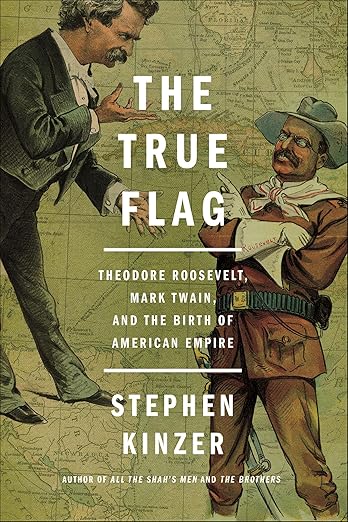
By the way, the elevation of Mark Twain to shared top billing in the subtitle (and cover illustration) is misleading. Twain does not enter Kinzer's story with any significance until more than two thirds of the way through the book (page 178). Meanwhile, I would definitely have appreciated more in-depth background on the other principal anti-imperialists, such as Andrew Carnegie, Booker T. Washington, William Jennings Bryan, Carl Schurz, and George Frisbie Hoar. Again, I would not have known about their roles in this dramatic story without Kinzer's book, but the book treats them largely as characters who walk on stage for the imperialism debate, leaving us curious about just who these people were in their totality. The Imperialists get better coverage.
23 people found this helpful
Report
Rkkjr
5.0 out of 5 stars a must read -- how the US went from being a model for the world to a master of imperialism
Reviewed in the United States on 10 May 2017
Format: HardcoverVerified Purchase
An incredible book detailing the critical points in our history when we 'made a wrong turn' -- The Paris Agreements with Spain where we got Cuba, the Philipines and a few other islands - and how that re-inforced our mission to not rule, but safe and help the lower class peoples of the world find God and Democracy -- And how has that worked out!
Key roles of Teddy Roosevelt and others changed our future. Meanwhile, Mark Twain was railing against expansionism.
I cannot recommend this book more highly and it helps understand why the US is both loved and hated in the world today
3 people found this helpful
Report
T Richards
2.0 out of 5 stars This was another hit job on America. The author’s unrelenting undermines credibility
Reviewed in the United States on 19 July 2025
Format: KindleVerified Purchase
I’m glad I read this book, as I learned much about how deeply divided our country was at the turn of the 20th century regarding how half of the country was adamantly devoted to the principles and the myths of our patriotic split from England, and the other half was pragmatic and bold about America’s role in the world. Aside from the unmistakable bias of the author, which the reader spots after about three pages, an objective perspective comes away that both sides were right in their own ways. My problem with this book was that it was a 300+ page Op Ed. I’m glad it was so short, I couldn’t have taken anymore. Knowing a lot about Roosevelt and the era generally, I found the presentation of facts so one-sided and biased, I had to question the author’s honesty, and his presentation of true facts. His motives were clear. Only the last chapter is there any glimmer of objectivity, but even then, it was drenched with cynical snap judgments condemning US more recent actions abroad in such a simplistic and conclusive manner that any student of history would know ignored the actual nuances and complexities of what was really happening at the time. Some of the cataclysmic causal connections the author can make in one sentence is actually laughable. The short shrift he gives to WWII and the Nazis (0%) is stunning, and blaming the Cold War completely on the American fear of Soviet aggression makes one angry this simplistic “fact” was in the last chapter. Had it been in the preface, it would have saved readers some time. And would have provided some tinder. The latter observation made me research this author, and I was not surprised by what I found. This was a “Hate America” book dressed up like objective reportage. It wasn’t objective in the slightest. Every instance of international suffering is blamed on America’s racist, saber-rattling, and insatiable quest for domination of the weak. Every.Single.One. I must give credit when credit is due. He can really turn a venomous phrase when piously rubbing America’s nose in what he thinks is it’s missteps. It was short. It’s always good when propaganda pamphlets don’t take that long to read. I’m glad I have this woke diatribe in the rear view mirror.
2 people found this helpful
Report
Sixthga
2.0 out of 5 stars Biased "History"
Reviewed in the United States on 25 March 2017
Format: HardcoverVerified Purchase
I will leave comments re Kinzer's knowledge of the political history of the era to others. I will say, and I'm being charitable, that his take on the military history of the Cuban war, especially from the soldiers' perspective, is not his strength. His ignorance shows clearly when he describes U.S. military arms as superior to those of the Spanish. Most American troops, the state volunteers, were armed with antiquated single shot Springfield Trapdoor rifles of the Indian Wars era. U.S. regulares were armed with the modern Krag Jorgensen rifle but, like the Springfield, it fired a black powder cartridge which belched white smoke on firing, giving away U.S. positions. Likewise, U.S. artillery, in short supply in any event, also used black powder propellant making Spanish counter-battery fire accurate and remorseless. Spanish troops were armed with the superior Mauser rifle which fired modern smokeless powder. Spanish artillery, also smokeless, far outmatched that of the Americans. And then there were the modern machine guns behind Spanish barbed-wire. We were using gatling guns, a late Civil War invention. Kinzer shows his true colors when he describes the fighting as an American walk-over with no aspects of bravery or courage involved. Has he not read primary sources and soldiers accounts of the fighting? Brutal. Savage at times. Great bravey was shown by soldiers in both armies. Whatever TR's motivation for going to war, once he was in it he led from the front and demonstrated raw gourage. He led U.S. forces up Kettle Hill on horseback -- the only mounted officer in that charge. It is absolutely amazing that neither he nor his horse were hit. He only dismounted when he encountered wire at the top of the hill. Unfortunately, Kinzer apparently writes with a political agenda and his book suffers for it.
20 people found this helpful
Report
RK
4.0 out of 5 stars Continuing coverage
Reviewed in the United States on 12 June 2017
Format: HardcoverVerified Purchase
This is a very good book about an important topic that, as Kinzer mentions, has been and will be debated forever. It is short enough that even a casual interest in American imperialism (especially in Cuba and the Philippines) will get you through to the end. I did think it odd that Twain occupies a space on the cover and in the title but is sparsely found in the text. Roosevelt has a larger role (naturally, as a man of consequence), but Kinzer focuses just as heavily on McKinley, Bryan, and Lodge--all of whom are worthy of discussion, if not as big of booksellers today.
The last chapter of the book departs from the 1898-1902 bulk and draws a continuous line from Roosevelt to Obama with details of many (failed) US foreign escapades. Kinzer is staunchly opposed to intervention but provides ample evidence to support his position.
4 people found this helpful
Report
==
==
==

No comments:
Post a Comment