History as Literature, Literature as History:
Download PDF
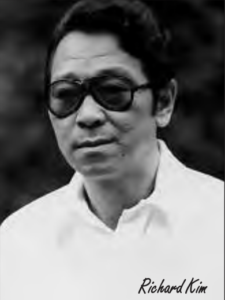
By Richard E. Kim (Berkeley, California: University of California Press, 1998). 196 pages
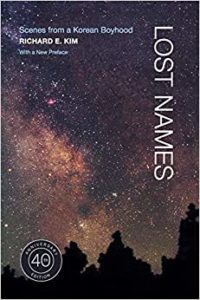
In the pages that follow, we feature an interview by EAA editorial board member Kathy Masalski with Richard E. Kim and essays by a junior high, senior high school, and university instructor on how they have used Lost Names as a highly effective teaching tool. We sincerely hope this special feature encourages teachers at all levels to read Lost Names and consider using it with students.
Lucien Ellington
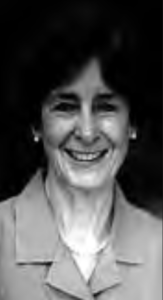 Kathleen Woods Masalski — I first met Richard Kim in 1994 when I asked him to speak at a National Endowment for the Humanities summer institute on the War in the Pacific. The audience responded so well that I invited him to speak at several other summer institutes sponsored by the Five College Center for East Asian Studies. After reading Peter Wright’s, Susan Mastro’s, and Dick Minear’s essays about their teaching of Lost Names, I asked Lucien if he would be interested in an interview with Kim. Lucien had read the book and read the essays (Kim did not ask to see them before publication), and urged me to proceed. Kim agreed to get together with me on May 18 in Amherst, Massachusetts.
I presented him with a list of questions that I had prepared. The interview lasted three hours; I took copious notes and wrote them up immediately afterward. Although I suggested that he edit the final interview, Kim declined. What follows are selected passages from our discussion that afternoon.
I should note that I approach Lost Names as history, and my questions reflect my background as a history teacher. An English teacher would have asked different questions. Lost Names is first and foremost creative writing. Social studies teachers may well wish to introduce the book to their colleagues in the English or Language Arts departments.
MASALSKI: One question the audience always has about Lost Names is whether it is fiction or nonfiction. Do you really intend to tell readers that nothing in Lost Names is “factual” or “historical”? How much of what is in it actually happened? How much actually happened to you?
KIM: Everything in the book actually happened. It happened to me. So why am I always insisting it’s not autobiographical? I think because of the way I used the things that actually happened. You have to arrange them, mix them up. Above all, it’s interpretation of facts, of actual events—some thirty or forty years later. For example, when “the boy” gets beaten, what went through his mind? We don’t know. . . . even I don’t know. I like to separate the actual events from the emotional, the psychological. One shouldn’t confuse the actual events with the inner events. That’s where a lot of beginning writers make a big mistake. A lot think everything is exactly as it happened; but we put our own interpretation on events. I didn’t invent any actual events. . . . but everything else is fiction. That is very important to me.
MASALSKI: When you wrote the book in 1970, how did you go about gathering evidence? Or didn’t you?
KIM: I didn’t have to gather much. I made a chronology of actual political events and a chronology of events in my life. Then I rearranged . . . I had to rearrange the events in my life. I think that the private events happened at the time [I described them] . . . but maybe not. The big world events happened . . . [the question was] how to bring them together . . . .
The original plan for this book was different from what it turned out to be. Praeger planned a series of books on different countries, Japan, China, India, Korea, etc. to introduce these countries to American children. I decided to introduce Korea through family life. As soon as I started writ- ing, the book took on a different life. I called my editor and said, “I can’t do it the way it was planned.” She said, “What is your idea for the book?” and I said I didn’t know. She said, “Let it loose, let it go.” I had already listed many details, for example, what we typically ate for breakfast, because I was using that information to intro- duce what Koreans eat. When I fin- ished writing (it took me only three months), we took a look at the manu- script. It was not what the editors had in mind, but they liked it. They took the work out of the country series and decided to publish it separately. But, they wondered, how should they treat it? They sent the manuscript to Pearl Buck, and she praised it as a novel. But Praeger didn’t want a novel. So they convinced her to call it something else. [She called it “the best piece of creative writing I have read about Korea.”] So Praeger decided to just get it out . . . to let others decide. And the reviews were good. [Edward] Seidensticker reviewed it for the New York Times and Praeger breathed a sigh of relief.
MASALSKI: You were a boy of thirteen or fourteen when the book—and the war— ended. What do you remember of your feelings then? Now, fifty-plus years later, how have your feelings changed?
KIM: I don’t feel differently about things today. I feel the same as when they happened. My father was in a detention camp, so I didn’t jump up and down for joy. Rather, I felt that finally it’s happened. Something that should have happened happened.
I didn’t have feelings of hatred for the Japanese. My feelings were more of contempt. I despised, had contempt for [them]. . . . In a perverse sort of way, I had a feeling of superiority. It was a defense mechanism to think, “Forgive them, Lord, for they know not what they do.” This may be a cultural, a class thing. I felt the Japanese were not to be trusted or respected. It might have been different in Seoul, but not in my small town. The Japanese we dealt with were not very good. After all, who would go to a dinky town, a dinky province, if they had a choice?
I [didn’t] think of the Korean characters as saintly, but as ordinary. In those days there was no room for cynicism. Everything seemed clear cut. We knew where we were and where we stood. Today is different; I don’t know where I stand. I don’t know what to think. . . . in those days I knew. Them and us. Cynicism comes from self- doubt. There was no room for that sort of thing.
When the Japanese priest and his wife [who lived nearby] came [when the end of the war was announced] and begged that we protect them, my grandfather didn’t know what to do. . . . I didn’t know what to do….We went back to the source of authority. . . . do what your father would have done. The tenant farmer, too, kept telling me that my father would have protected them….
Actually, my father was a saint. I wrote an inscription on his gravestone, “He was a good man and just.” He was like that—truly. I never heard him say anything bad about anyone. I never saw him enraged. I’m not like him. . . . He had a great capacity for suppressing his feelings; he was patient.
If I had been exposed to constant hatred at home, maybe I would have felt differently about Japan and the Japanese. But I wasn’t. Grandfather never said much. And I never heard my father say nasty things verbally. We thought, they’re bad ones. . . . so why should we waste our time talking about them….
MASALSKI: What difference to Lost Names does it make that you and your family were well-to-do and Christian?
KIM: This is a very important question. We were upper-middle class, the town’s elite. The Japanese who were there were not. We saw them as men who couldn’t get jobs in Tokyo. “Why are they here?” we asked ourselves. As colonizers, they were supposed to be better than the colonized, but a lot of Japanese were simply not that great. It’s a cultural, a class thing. I didn’t hate them. They were like dangerous dogs to be avoided.
Although we were not that wealthy, we were reasonably well-to-do. In those days we were made to look upper class because we went to college. The Christian thing is tricky. I’ve been thinking about it. Some really well-todo Koreans, especially in the South— even among my generation—sometimes the Japanese treated them like upper class, with kid gloves. Made them feel better, like the aristocracy, the ruling class, the landlord class. Made them feel as if they were treated with respect. To this day I know people with backgrounds like this who are without anti-Japanese feelings.The lower classes—what did they care if they were governed by the Japanese or a Korean dynasty? They were treated the same. My grandfather told me that one time, when he witnessed royalty passing by, he saw someone miserably beaten because he didn’t bow low enough. And he (my grandfather) felt that when the dynasty perished, well, it served the royalty right.
I don’t know how much of a sense of nationalism existed at the time of Japanese annexation. As long as the upper classes kept their money and status, and as long as the Japanese left them alone, what difference did it make? And what difference did it make to the peasants—both Korean royalty and the Japanese took eighty percent of their crops, regardless. If the Japanese had been victorious, if the war had lasted another four or five years, maybe most Koreans would have become “Japanized.”
I think it was the middle class, the upper-middle class who were affected most by the war. That group produced more educated people, those with expanded consciousness.
To the Japanese, the Christians were the ones with the most connections with the West—simply because they were Christians. They were therefore characterized as outsiders, as dangerous. They were an important minority because they were upper-middle class. They sent their sons to schools and colleges. So as a group they were more conscious of national identity. I don’t think the upper or lower classes thought about nationalism or independence, but I really don’t know. The early uprisings were not organized by the upper classes. In those days [during the war], memories were fresh. Twenty–thirty years later, I don’t know. . . .
Belonging to that class and being Christian made all the difference. We were more aware of where we belonged. I grew up thinking we were a little different. Lost Names would be a different book if it were written by someone else at the same time but in a different class and in a different place.
The book is not representative of “the Korean experience.” I was a marked boy. Somehow the village had voted me most likely to succeed, because I was my father’s son. My grandfather, the minister, was one of the best-known leaders of the Christian community. Most Christians knew my grandfather’s name. The first day back in a Korean school, things were very tense for me. My parents wondered, how would he (I) be received—both by the Japanese and the town’s kids. I always had to be conscious of what I was. The key was “do not disgrace the family.”
MASALSKI: In your opinion, has the Japanese government apologized to the Korean people for its treatment of them during the occupation period?
KIM: I’m not so sure they’ve apologized. Regret, maybe. But that’s beside the point. I don’t really care if any government apologizes. It’s probably a political thing, anyway. It seems to me that Asians are less capable than Europeans of accepting collective responsibility for their actions. Maybe the Judeo-Christian culture has more possibilities for atonement and redemption. Not so true for Asians. Why is it so difficult for Asians or Koreans to say we are all guilty? We tend to say, “I didn’t do it.”
MASALSKI: The title of the book is problematic—in all three languages. Why did you choose it? What was your intent?
KIM: I loved the word “lost” and all the things that it conjures up, especially in English. Paradise Lost. Lost is almost damned. . . . almost sinful. Lost Souls (which was at one point my working title). I like “lost” because it has a lot to do with my sense of my generation. Kind of like I am now. I don’t belong. Born in Korea. Moved to Manchuria. Back to the north [Korea]. Then to South Korea. Didn’t belong either place. Then to the military, where I didn’t belong. To here. For awhile I thought about it, then I gave up thinking about it, for it’s not important. Especially my generation of Koreans happened to be between periods. . . . Japanese occupation . . . a little of that . . . then the country was divided. . . . then exodus . . . lost again. Led a refugee’s life . . . lost again . . . then ended up here in god-forsaken Shutesbury with a name like Richard. . . .
My college dean in this country thought that other students would have difficulty pronouncing my Korean name, so we looked at names in a telephone book. I chose Richard because I knew of Richard the Lion-Hearted. I finally had it legalized. I like to think it fits with my character . . . it’s how I think of myself. I’m lost, lost between two cultures, two worlds, neither North or South Korea, not Korean or American. I felt that way always, even as a little kid. I couldn’t even sing Korean songs. . . .
This has been one of my missions in life, to teach Koreans to accept responsibility for their lives, to stop blaming others, the Japanese, the Chinese. We lost it. . . . but many Koreans would like to think someone grabbed it. . . . thinking this justifies hatred. I’ve often said that Koreans need a national psychotherapy session, a large couch. Why are we as we are, why is self-examination such a rare commodity in Korean life? Koreans are so good about blaming others . . . they know so little about what they have done. They lack a collective sense of guilt or action.
Koreans can’t say we were careless, we dropped our names, and someone else picked them up and took them away. What the Japanese did was terrible—perhaps more stupid than terrible. How can such smart people do such dumb things? Didn’t they see that what they did would cause more resentment?
MASALSKI: One of the most important scenes in the book takes place in a graveyard, where all your known ancestors are buried. You, your grandfather, and your father visit that burial ground after the Japanese have given you new names, Japanese names. Your grandfather says, “We are a disgrace to our family. We bring disgrace and humiliation to your name. How can you forgive us?” He and your father bow, their tears flowing (p. 111). . . . Will you explain that scene?
KIM: My father felt that his generation had failed. (Maybe that’s why there isn’t naked hatred of the Japanese.) The kind of man he was resulted in his asking, “What have we done? How could we have allowed this to happen?” I don’t think he blamed grandfather’s generation. My father had a perfect right to fly into a rage, but there was none of that. “The important thing,” my father said, “is now how can we deal with this? Someday your generation will forgive us.” Why otherwise would he have taken me to the graveyard where he and my grandfather asked their ancestors to forgive them? He was almost telling me that one day we would have to forgive his generation.
MASALSKI: Were you surprised by the book’s reception? By the way readers (then and now) interpret it? Is there a difference?
KIM: It has been a surprise. It’s especially a great honor to find it’s read in so many schools. I really feel good about that. I have no way of influencing how readers take it, however. One exception I take is to anyone who says it’s anti-Japanese. It’s not; there are some bad Japanese characters in the book, but it is not anti-Japanese.
I wrote it quickly—between books. I had some legal problems with my second book and decided to do something with the Praeger series. It started out as one thing and ended up another. So I was very surprised.
MASALSKI: When they finish reading Lost Names, how do you want readers to feel toward the characters and the countries represented?
KIM: When I wrote the book, I didn’t feel that I wanted the reader to feel this way or that. I really didn’t think about writing for a foreign audience. I never thought about any audience, in fact.
MASALSKI: What led to the rebirth of Lost Names? How much did the 50th anniversary of World War II have to do with it?
KIM: I was willing to let it go, but the time came when Asian studies programs here and there realized that there’s not enough material around. The talk was taken up on the Internet, and there you are. I don’t think it had anything to do with the anniversary of the war.
MASALSKI: What do you think the book has become?
KIM: I don’t know. A textbook. I’ll tell you . . . when The Martyred came out, the New York Times reviewer said it would last. . . . When I finished Lost Names, I didn’t think it was in the same class as The Martyred, but I said to my wife, Penny, this is an exquisite piece, a small jewel. Because that was how I felt. It was hard to find fault with the book. The technique, the language: granted that the author was biased, prejudiced . . . I felt it was nice, not grand, not big (The Martyred was), but nice. I felt good, really good about it.
I don’t know. . . . maybe it [the book] will last. If it does, it’s only because people will look at it [in a larger context?] . . . if it were only a picture of a family. . . . I don’t know, maybe there’s something more to it than a family and a family’s survival.
MASALSKI: If you were teaching in a college, high school, or junior high/middle school classroom today, how would you “teach” the book?
KIM: I would stress that they shouldn’t read this book as issue-oriented, as anti-Japanese or anti-colonial. I would ask that they [teachers and students] observe and understand how a family, both in private and in times of war, copes with war and with one another. I know you think the characters are almost too good to be true, but we really were good. We never fought. My parents never exchanged harsh words.
My grandparents were patient souls. It may have to do with the culture thing. . . . They had humble beginnings. . . . didn’t have the “more sinned against than sinning” attitude . . . they didn’t feel wronged; they were always grateful for what they had. I think I have that. I’m so grateful every time I go into a grocery store that I am able to pick from the shelves that which I want. . . .
My grandmother was tough. . . . grandfather was saintly. They didn’t talk that much. I’m different. I’m told that on the second day of Kindergarten I didn’t like school so I stopped going. I left the house every morning and hid. No one knew until the school came looking. I never went back. . . . I’m different. . . .
MASALSKI: At every one of our summer institutes, teachers have brought up the incident in Lost Names that involves rubber balls. The chapter, “An Empire for Rubber Balls,” presents such an engaging, dramatic scene. When the Japanese Empire was at its height, the Japanese distributed rubber balls to all children. But after the tide turned for Japan, they wanted them back. As class leader, the boy was responsible for collecting the balls. He pricked them in order to fit them into a container, and the teacher beat him severely. What is the message here, the lesson?
KIM: The Japanese really wanted the balls back. And here is the irony of the situation. My grandmother, in her peasant wisdom, came up with the idea of pricking holes in them. I think the Japanese assumed that the boy’s father had influenced him. It was not so . . . the incident happened. . . . I was beaten pretty badly. . . . I don’t remember all the details . . . for example, there was a Korean policeman, but I don’t think he intervened. . . . this is where the fiction comes in. . . . I brought him into the story.
That’s the fun part of a book like this. . . . taking fact and fiction and mixing them together. I don’t know what my mother said in certain situations, but I’d make what she said sound good in certain situations. The momentum creates the situation. . . . dialogue comes out . . . you can’t plan every dialogue. I would call my mother up (when I was writing the book) and say guess what you said today, and she would ask, “did I really say that?”
“There is no nobility in pain; there is only degradation” (p. 134). This was an unusual thing for me to say. It’s not Christian, but . . . the truth is, for most people a beating is a beating. I remember my father was held upside down from the ceiling, not by the Japanese, but by a Korean who was working for American intelligence. (This took place in South Korea after the family moved from the north to the south.) He was picked up in 1946, ‘47, ‘48. . . . a Korean detective working for the Americans brought him in, saying he was a communist spy sent by the north Koreans. They held him upside down and pulled all his hair out. (In the Japanese prison earlier, the Japanese shaved his head every day. . . . he said that was so painful. . . .) The Americans held him until something happened that proved he was not a spy. When I arrived in the south, I found him and spoke with a Korean American in intelligence. When my father was released, I shouted, “Someday I’ll kill all you Americans.” This was so difficult for me. . . . the Americans had come as our liberators. . . .
MASALSKI: Which incident/passage in the book lends itself to teaching, or presents an “ideal” teaching situation?
KIM: I don’t know about teaching it, but my favorite scene in the book is in “Once upon a Time, on a Sunday.” . . . They come home, finally, and the boy is outside the cottage with paper screen (shōji) for windows; the light inside glows, and the boy is looking up. . . . and this is fact and fiction . . . being so afraid of the dark, but suddenly with a sense of the insignificance of things . . . of his minute existence . . . and yet we were killing each other. . . . the sudden ludicrousness of being in a vast universe. That day we had studied with the map in the classroom. . . . and the day ended with the entire universe in the dark. . . . I felt some kind of fear, a primordial fear drove me into the cottage. Mom, Dad, and light were there in the face of this primordial fear of the vast unknown. And what was there to protect me was the family.
I like that one-page scene because it suggests the possibility for the mind and the view of this boy. . . . the scene is so commonplace, the beautiful stars, a conventional thing . . . why be terrified of that when everyone else sees something beautiful, awesome. . . . What is there to terrify him . . . something scary out there? Something terrifying out there—all this is 27 going on out there—war, nationalism, colonialism—it’s all so insignificant.
Maybe in a sense that’s what I think today, having gone through colonial life, war which consumed my youthful existence . . . and defined everything for me . . . now is so insignificant . . . in the twilight of my life. Really, what we think is so earthshaking turns out in the end to be so insignificant. . . .
===
RICHARD E. KIM was born in Korea and has lived in the U.S. much of his adult life. He was educated at Middlebury College, Johns Hopkins University, the State University of Iowa, and Harvard. Richard Kim has taught at several universities in the U.S. and, as a Fulbright Scholar, at Seoul National University in Korea. In addition to Lost Names, he is the author of several books including The Innocent (Boston: Houghton Mifflin, 1968) and The Martyred (New York: George Brassiller, 1964). He has also scripted and narrated several documentaries for KBS-TV in Seoul.
KATHLEEN WOODS MASALSKI is Program Coordinator for the Five College Center for East Asian Studies located at Smith College in Massachusetts. She directs projects on China, Japan, and Korea that serve New England teachers. She serves as chair of the AAS Committee on Teaching About Asia (CTA) and is a member of the editorial board of EAA.
“BECOMING JAPANESE:” IDENTITY UNDER JAPANESE OCCUPATION
GRADES:
9-12 AUTHOR:
Katherine Murphy
TOPIC/THEME: Japanese
Occupation, World War II, Korean Culture, Identity
TIME REQUIRED: Two 60-minute
periods
BACKGROUND:
The lesson is based on the impact
of the Japanese occupation of Korea during World War II on Korean culture and
identity. In particular, the lesson focuses on the Japanese campaign in 1940 to
encourage Koreans to abandon their Korean names and adopt Japanese names. This
campaign was known as “sōshi-kaimei." The purpose of this campaign, along
with campaigns requiring Koreans to recite an oath to the Japanese Emperor and
bow at Shinto shrines, were to make the Korean people “Japanese” and hopefully,
loyal subjects of the Japanese Empire by abandoning their Korean identity and
loyalties. These cultural policies and campaigns were key to the Japanese war
effort during World War II.
The lesson draws from the
students’ lives as well as two books: Lost
Names: Scenes from a Korean Boyhood by Richard E. Kim and Under the Black Umbrella: Voices from
Colonial Korea 1910-1945 by Hildi Kang.
CURRICULUM CONNECTION:
The lesson is intended to use the
major themes from the summer reading book Lost
Names:
Scenes from a Korean Boyhood
to introduce students to one of the five essential questions of the
World History II course: How is identity constructed? How does identity impact
human experience? In first investigating the origin of their own names and the
meaning of Korean names, students can begin to explore the question “How is
identity constructed?’ In examining how and why the Japanese sought to change
the Korean people’s names, religion, etc during World War II, students will
understand how global events such as World War II can impact an individual.
This content will be revisited later in the year during not only the World War
II unit but in several units where we challenge students to make connections
between global events and individual lives (i.e. impact of Enlightenment
writing and European revolution on the life and decisions of Simon Bolivar in
Bolivia)
CONNECTION TO STUDENTS’ LIVES:
The lesson begins with students
examining the origin of their own names and their own identity, so they can
begin to empathize with the impact of Japanese policies on the Korean people.
Historical empathy and empathetic inquiry are key elements in historical
understanding. It is also important for students to investigate and understand
the impact of global events such as World War II on individual lives.
Furthermore, this lesson is planned for the beginning of the year so students
can share the origin of their names, learn about each other, and begin to
understand the diversity within our classroom.
OBJECTIVES AND STANDARDS:
1.
Students will be able to explain the impact of Japanese
occupation during World War II on the Korean people, their culture, and their
identity.
NCSS Standard: Theme IX: GLOBAL CONNECTIONS
Students will examine the local
and individual implications of global processes and events.
MA Standard: WHII.28 Explain the consequences of World War II.
2.
Students will be able to empathize with the narrator of
Lost Names and the Korean
people.
NCSS Standard: Theme IV: INDIVIDUAL DEVELOPMENT AND IDENTITY
Students will explore the
influence of peoples, places, and environments on personal development and
identity formation.
MA Concept and Skills Standard 7: Show connections, causal and
otherwise, between particular historical events and ideas and larger social,
economic, and political trends and developments.
3.
Students will be able to explain the connection between
Korean names and Korean culture and history.
NCSS Standard: Theme I: CULTURE
Through experience, observation,
and reflection, students will identify elements of culture as well as
similarities and differences among cultural groups across time and place.
Common Core Standards
RH 1 Cite specific textual
evidence to support analysis of primary and secondary sources
RH 2 Determine the central ideas or information of a
primary or secondary source RH 3 Compare the point of view of two or more
authors for how they treat the saem or similar topics
MATERIALS REQUIRED:
1.
Class set of Lost
Names: Scenes from a Korean Boyhood by Richard E. Kim or class set of
Chapter 4: Lost Names, pages 87-115. If this book is unavailable, you can still
proceed with the lesson (see Procedure 1).
2.
Class set of handout “Korean Names and Naming” (See
attached Handout #1)
3.
Class set of Under
the Black Umbrella: Voices from Colonial Korea 1910-1945 by Hildi Kang,
pages 117-122 (See attached Handout #2)
4.
Short-answer quiz (See attached Handout #3)
INTRODUCTION and EXPLORATION:
In preparation for this lesson
students will explore the origin of their name by asking their parents where
their first, middle, and last/family name comes from. In the first activity of
the lesson students will explore connections between their names and other
aspects of their identity
(ethnicity, religion, traditions,
etc.), so they understand the humiliation and anger incited by the Japanese
policy of “Sōshi-kaimei.”
PROCEDURE:
THE
DELIVERY OF THE CONTENT:
1.
In preparation for the lesson students should read or
review Chapter 4: Lost Names in Lost
Names: Scenes from a Korean Boyhood by Richard E. Kim. If you are unable to
get copies of Lost Names by Richard
E. Kim, you can still proceed with the following questions in which students
have been asked to investigate the origin of their name. Students should
investigate the origin of their name by answering the following questions:
a.
What is the origin of your last/surname?
b.
What does your surname mean?
c.
Are there any interesting stories about your
family/surname?
d.
Ask you parents, why did they choose your given (first
and middle) names?
e.
Are there any interesting stories about your given
names?
f.
What does your name reveal about your identity or
background? Religion?
Language? Traditions?
Day One:
2.
Do Now/Bell Ringer: When students arrive they should
begin working on the following questions. This activity should take 3-5 minutes
and gets students focused on the upcoming lesson and requires students to make
connections to their homework and their own lives.
a.
Respond to the following question: “Who am I?”
Consider: role in family, background, interests, and physical characteristics.
See
http://www.facinghistory.org/resources/strategies/identity-charts for
additional ideas for creating identity charts and http://www2.facinghistory.org/Campus/rm.nsf/sc/IDCharts for a
sample identity chart using the Facing History model.
b.
Last night you investigated the origin of your name.
How does your name reflect characteristics your identity? For example: My last
name is Murphy which is Irish in origin, and reflects my heritage and my
religion, Catholic.
3.
Next student will get into groups of 3-4. Each person
in the group will share their story about the origin of their name and what
their name reveals about their identity. This activity should take about 10
minutes. As the students are discussing their names, the teacher should be
walking around the room and monitoring the conversations, and asking probing
questions such as: What does your name
tell us about who you are? Your interests? Your heritage? Your family?
4.
When each group has finished, they will return to their
seats and regroup as a class. The teacher should write on the front board, What do our names reveal about who we are?
or What do our names reveal about our
identity?
5.
Next, tell students that they are going to learn more
about the significance of Korean names. Students will read the handout “Korean
Names and Naming” and answer questions. See attached Handout #1.
6.
Wrap Up: What
does the structure of Korean names reveal about Korean history and culture? This
question is intended to parallel the line of questioning earlier in the lesson
when the students investigate what their name reveals about their history and
culture. This question is also intended to serve as a bridge to Day Two where
students will explore why the Japanese sōshi-kaimei campaign was so intense.
Day Two:
1. Do Now: As students walk into the
classroom assign them a letter and number (1A, 1B, 1C, 1D, 2A, 2B, 2C, 2D, 3A,
etc.) and ask them to respond to quote that corresponds with their letter as
designated below). If you have 24 students in your class then you should have 6
groups of 4. They should spend 3-5 minutes responding to their quote and
question(s).
a. “’I don’t care about losing my name! I
am just cold and hungry’ And only
then do I give in to a delicious sensation—and I begin to cry. My father is at
my side.
‘We’ll go home now.’
With tear-filled eyes, I look up at him. ‘I am sorry,
but...’
‘Yes?’
‘But—what good can all this do? What
good will all this do for us?’ I say defiantly, flinging my arms wide open to
encompass the burying ground, with all its graves and the people; ‘What good
will all this do to change what happened!’
To my surprise he says quickly,
‘Nothing.’
‘Then, why do you?...’
‘That’s enough now,’ he says.
‘Someday, you will understand.’” (Lost
Names, 114)
What does the young boy not understand? What does the
father mean when he says “Someday, you will understand.”
b.
“When we are in front of the graves of our ancestors,
my father wipes the snow of the gravestone…The three of us are on our knees,
and, after a long moment of silence, my grandfather, his voice weak and choking
with a sob, says, ‘We are a disgrace to our family. We bring disgrace and
humiliation to your name. How can you forgive us!’ He and my father bow,
lowering their faces, their tears flowing now unchecked…and I, too, am weeping,
thought I am vaguely aware that I am crying because the grown-ups are crying.”
(Lost Names, 111)
What does the grandfather mean when he says “We bring
disgrace and humiliation to your name”?
c.
“[Father] gives me a hug. ‘I am ashamed to look into
your eyes…someday, your generation will have to forgive us.” I don’t know what
he is talking about, but the scene and the atmosphere of the moment, in the
roaring wind and with the snow gone berserk, make me feel dramatic.
“We will forgive you, Father,” say I, magnanimously.
…”I hope our ancestors will be as
forgiving as you are,’ he says. ‘It is a time of mourning.’ And, only then, do
I understand the meaning on his sleeve and those of his friend.” (Lost Names, 110)
What does the father mean when he says “I am ashamed”? What
does the father mean when he says “It is a time of mourning”?
d.
“…the teacher gestures abruptly, as if to touch my
face. ‘I am sorry,’ he says.
My father gives him a slight bow
of his head.
‘Even the British wouldn’t have thought of doing this sort
of primitive thing in
India,’ says the Japanese.
I am at a loss, trying to
comprehend what he says and means.
‘…inflicting on you this
humiliation…’he is saying, ‘…unthinkable for one Asian people to another Asian
people, especially we Asians who should have a greater respect for our
ancestors…’” (Lost Names, 109)
What
is the teacher trying to say?
2.
After students finish the “Do Now,” introduce the
concept sōshi-kaimei. “Sōshi” means “creating a family name” and “kaimei” means
“changing a given name.” There is a great description of it on page 117 of Under the Black Umbrella (see attached
Handout #2).
3.
After you introduce the concept have all of the 1’s get
into a group, 2’s, 3’s, 4’s, etc. So, in each group you will have 1 student who
responded to each of the 4 quotes (a, b, c, d). Once in their groups of 4 ask
students to respond collectively from the following question, drawing on their
quote for evidence and Lost Names.
Questions:
i.
How did the
Korean family in “Lost Names” respond to the namechanging campaign?
ii.
Predict: In
what other ways do you think Koreans responded to the campaign?
iii.
Why would the
Japanese want to change Koreans names?
This should take 10-12 minutes.
*You can modify
this by having students who all read quote A get into one group, students who
read quote B in one group, etc. to have them discuss the quote before breaking
off into their “number groups”.
4.
Ask one representative from each “number group” to
report out their group’s comments in the discussion to the class.
5.
Ask students to return to their seats. Next tell them
that they will read the testimony’s of Koreans who lived through the Japanese
occupation and compare their predications to the true stories told by Koreans
themselves. Distribute Handout #2 to each student (Under the Black Umbrella, 117-121).
6.
As they read they should respond to the following
questions:
a.
Considering the historical context of WWII, what is the
purpose of the sōshikaimei campaign?
b.
There is no evidence that this was a government
campaign, rather than a law with legal consequences. So, why did many Korean’s
change their names?
c.
Why would the Korean people refuse to change their
names?
d.
How did many Korean people hold on to their heritage
while still changing their names?
7.
After students finish reading and answer the questions,
ask the class as a whole to reflect on the question What is the purpose of the sōshi-kaimei campaign? Record student
responses on the board.
8.
Next, ask them Do
you think the Japanese campaign was successful? Ask them to take into
consideration the primary sources they just read. Were the Japanese successful
in
their aim to make the Koreans
“Japanese”? Strip Koreans of their heritage and identity? Make them loyal
subjects of the Japanese emperor, etc?
9.
Wrap Up: Reflect
on the Japanese name-changing campaign and the Korean response. Where else in
history have we seen these policies and responses? The purpose of this
question is for students to make connections to other parts of the curriculum.
Possible answers could include: Nazi control of identity during the Holocaust
and Jewish response by still celebrating Shabbat in the concentration camps or
changing their names; Spanish colonization of the Americas and mass conversion
to Christianity as a means of control and the native response of creating a
hybrid religion taking indigenous elements and Christian elements, etc.
THE
APPLICATION OF THE CONTENT:
The activities and questioning in
this lesson are designed to serve as a case study. The concepts developed in
this activity can then be applied to the study of a variety of topics in world
history. When we study events like the European colonization of the Americas,
European imperialism in Africa and Asia, fascism in Italy and Germany, and
communism in the USSR and China, students can apply understanding of the
purpose of cultural policies like sōshi-kaimei to understanding of cultural
policies like Nuremburg Laws, assimilation, etc. Similarly, students can apply
understanding of how Koreans maintained their identity under Japanese
occupation to understanding how Jews maintained their identity in the
Holocaust, Indians under British imperialism, native Americans under
Americanization campaigns, artists and musicians under the totalitarian
policies of Stalin, Mao, etc.
The concepts in this lesson can
be extended in a variety of ways. Using Chapter 11 in Under the Black Umbrella students can explore other methods the
Japanese used to try to make the Koreans “Japanese.” Students could also
investigate how Koreans maintain their heritage in an increasingly globalized
world.
ASSESSMENT:
The structure and design of this
lesson allows for several opportunities for informal or formative assessment.
The homework assignment, “Do Now” questions, Handout #1 and Handout #2
questions can be collected and assessed for student completion and comprehension.
Throughout the lesson there is collaborative group work which allows the
teacher to walk around the room and listen to individual student comments and
assess their understanding. This lesson can also be assessed by a short-answer
quiz. See attached Handout #3.
RESOURCES:
Armstrong, Charles. History of Korea, Part I. Podcast audio,
Korea Society. Accessed August 8,
2011.
http://www.koreasociety.org/korean_studies/lectures/history_of_korea.html
DeMente,
Boye Lafayette. “Korean Etiquette
& Ethics in Business.” Asia Pacific
Management Forum. December
1999.Accessed August 14, 2011.
http://www.apmforum.com/columns/boye33.htm
Eckert, Carter, et al. Korea, Old and New: A History. Seoul:
Ilchokak Publishers for Korea Institute, Korea University, 1990.
Facing History. “Identity Chart.”
Accessed August 20, 2011.
http://www.facinghistory.org/resources/strategies/identity-charts
Kang, Hildi. Under the Black Umbrella: Voices
from Colonial Korea, 1910-1945. Ithaca & London:
Cornell University Press, 2001.
Kim, Richard E.. Lost Names: Scenes from a Korean Boyhood.
Los Angeles: University of California Press, 1998.
HANDOUT 1: KOREAN NAMES AND NAMING
There are approximately 250
surnames in Korea which originate from the Silla and Koryŏ
Dynasty. Approximately 55% of all
Koreans have one of five surnames: Kim, Lee/Yi/Rhee,
Park/Pak, Choi, Chung/Jung.
According to the 2000 census, there are over 9 million Kims in Korea, but not
all Kims are the same. All Korean family names, including Kim, are separated
into different clans named by their place of origin (pon’gwan). Today there are
over 250 pon’gwan for Kim. Of these, the two major Kim clans are the Gimhae
Kims (over 4 million people) and the Gyeongju Kims (over 1.7 million
people).
The pon'gwan and the family name
are inherited from a father to his children, People in the same paternal
lineage share the same combination of the pon'gwan and the family name. A
pon’gwan does not change by marriage or adoption. In fact, when a woman
gets married she does not take on the name of her husband. Some clans grew so
large they were organized further into sub-clans called "-pa"
(literally means "branch"). A Korean last name could look like this:
[region] [last name]-ssi [subclan]-hu [sub-sub-clan]-pa
[number]-daeson. Koreans can trace their ancestry back through their father’s
line to a place of origin with the help of the comprehensive genealogies
published by clans. These genealogical books are known as jokbo.
 “Another
long-standing custom is for each Korean to have two given names - one a
personal name and the other a generational name, chosen by the parents,
grandparents, or an onomancer (name-giver). A male generational name is given
to the first son born in a family, and a female generational name is given to
the first daughter. Thereafter all additional sons and daughters in the family
are given the same generational names. As the family branches out over
generations, the generational names continue in the male and female lines, so
that eventually very distant relatives may have a common generational name that
goes back to a remote ancestor.
“Another
long-standing custom is for each Korean to have two given names - one a
personal name and the other a generational name, chosen by the parents,
grandparents, or an onomancer (name-giver). A male generational name is given
to the first son born in a family, and a female generational name is given to
the first daughter. Thereafter all additional sons and daughters in the family
are given the same generational names. As the family branches out over
generations, the generational names continue in the male and female lines, so
that eventually very distant relatives may have a common generational name that
goes back to a remote ancestor.
A great deal of thought goes into
the selection of both personal names and generational names, and it is still
common for parents to seek the
help of onomancers. The object is to select a name that
fits the child based on time of birth and the parents' expectations for the
child.” (DeMente)
Confucianism, introduced by the
Chosŏn Dynasty (1392-1910), has greatly influenced the development of Korean
names. Confucian influence is reflected in the paternal structure of naming and
the Confucian concept of filial piety, or respect and reverence for one’s
ancestors encourages Koreans to carry on and honor the family name.
Questions:
1. Summarize
the article in 3-4 sentences using your own words.
2. From
this information, what significance does a Korean name carry?
3. How
does the history and practices surrounding Korean names compare to your
culture’s naming practices? How are the naming practices similar? How are the
naming practices different?
HANDOUT #2
Excerpts from Under the Black Umbrella, pages 117-121


HANDOUT #3
Name: _________________________________________
Date:
___________
“Becoming Japanese” Quiz
1.
What is the purpose of the sōshi-kaimei campaign?
2.
How did many Korean people maintain their heritage
during the sōshi-kaimei campaign?
3.
Why did speaker’s father wear a black armband during
the sōshi-kaimei campaign, as referenced in the quote below:
“’I hope our ancestors will be as forgiving as you are,’
[my father] says. ‘It is a time of mourning.’
And, only then, do I understand the meaning of the black
armband on his sleeve and on those of his friends.”

No comments:
Post a Comment