Kindle
from $28.00
Hardcover
from $40.00
Paperback
from $26.52
Mark MullinsMark Mullins
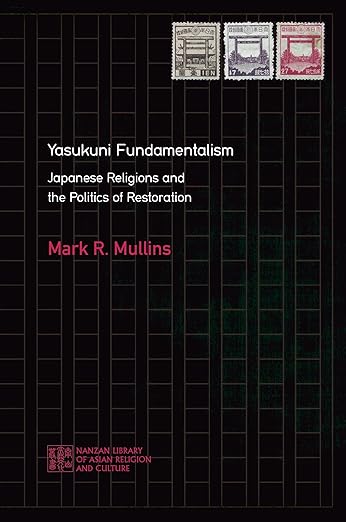
Yasukuni Fundamentalism: Japanese Religions and the Politics of Restoration (Nanzan Library of Asian Religion and Culture) Hardcover – July 31, 2021
by Mark R. Mullins (Author)
5.0 5.0 out of 5 stars (2)
Although religious fundamentalism is often thought to be confined to monotheistic “religions of the book,” this study examines the emergence of a fundamentalism rooted in the Shinto tradition and considers its role in shaping postwar Japanese nationalism and politics. Over the past half-century, the Liberal Democratic Party (LDP) and the National Association of Shrines (NAS) have been engaged in collaborative efforts to “recover” or “restore” what was destroyed by the process of imperialist secularization during the Allied Occupation of Japan.
Since the disaster years of 1995 and 2011, LDP Diet members and prime ministers have increased their support for a political agenda that aims to revive patriotic education, renationalize Yasukuni Shrine, and revise the constitution. The contested nature of this agenda is evident in the critical responses of religious leaders and public intellectuals, and in their efforts to preserve the postwar gains in democratic institutions and prevent the erosion of individual rights. This timely treatment critically engages the contemporary debates surrounding secularization in light of postwar developments in Japanese religions and sheds new light on the role religion continues to play in the public sphere.
Book Reviews, Northeast Asia
Volume 96 – No. 1
YASUKUNI FUNDAMENTALISM: Japanese Religions and the Politics of Restoration | By Mark R. Mullins
Nanzan Library of Asian Religion and Culture. Honolulu: University of Hawai‘i Press, 2021. xii, 258 pp. (Tables, B&W photos, illustrations.) US$64.00, cloth. ISBN 9780824889012.
There is no overstating how good this book is in explaining what animates neonationalist politics in contemporary Japan. It is brimming with insights about what drives advocacy for reinstating a public role for Shinto, resuming official visits to Yasukuni Shrine, and revising the constitution. Drawing on extensive fieldwork, archival research, and the vast secondary literature, Mark Mullins probes the nexus of Shinto religious organizations and rightwing nationalism. The Shinto National Association of Shrines (Jinja Hon-chō; NAS) and the Liberal Democratic Party (LDP) have made common cause in trying to restore what was lost during the US Occupation (1945–1952).
Mullins asserts that during the Meiji era (1868–1912) a new form of Shinto was invented to provide the foundation for the nascent political order. Meiji oligarchs “pursued a policy of uniting the people under the canopy of a state-sponsored and emperor-centric expression of Shinto,” in order to “mobilize the people for nation-building, modernization, and military expansion” (12). As such, State Shinto was implicated in Japan’s rampage through Asia from 1931 to 1945. In a multi-pronged reform effort to democratize and demilitarize Japan, US authorities issued the 1945 Shinto Directive banning governmental administration and support for organized religion and curtailing Shinto’s broader social influence through, inter alia, educational reforms, removal of god-shelves (kamidana) from schools and public institutions, termination of compulsory shrine visits, and abolition of the Imperial Rescript on Education. Subsequently, Article 20 of the 1947 Constitution mandates the separation of the state and religion, thereby removing religion from the public sphere. Righting these wrongs is the common cause of “restorationist politicians” and Shinto religious leaders. Hypocritically, General Douglas MacArthur saw no problem in providing extensive state support for Christianity, but to no avail; the number of Christians in Japan remained below 1 percent of the population.
Part 1 of the book explains how and why a religio-political movement emerged to overturn Occupation-era reforms. The third chapter examines the surge of support for the political agenda of NAS and the LDP over the past quarter century, which the author attributes to the social crises generated by disasters in 1995 (the Hanshin Awaji Earthquake and Aum Shinrikyo sarin gas attack on the Tokyo metro) and 2011 (the triple disaster of earthquake, tsunami, and nuclear meltdowns in Tohoku). Additionally, in 1997, the Japan Conference was established—a small but politically well-connected lobby group that shares the core values and goals of NAS and the LDP. From 2012 to 2020, nearly 80 percent of Abe Shinzō’s cabinet, and about one-third of politicians in the National Diet, were members of this organization.
Part 2 examines the contested nature of this triads’ neonationalist agenda and how various groups have weighed in against symbolic acts such as official Yasukuni Shrine visits by political leaders and mandatory flag and anthem directives requiring public school teachers to stand and sing “Kimigayo” while facing the Hinomaru flag; many educators oppose veneration of these symbols of wartime Japan, but despite enjoying the Heisei Emperor’s expressed support, they struck out with the Supreme Court. Chapter 6 focuses on efforts to revise the Japanese constitution, highlighting the risks to individual rights and freedoms evident in LDP draft proposals. When Abe stepped down in 2020, under a cloud of gathering scandals and waning popularity, he especially lamented that he was unable to mobilize support for revision; in fact, the more he pushed the stronger the backlash.
Key members of the ruling political elite and religious leaders believe that marginalization of Shinto from public life is a deracinating legacy of the US occupation that must be reversed. They believe that the 1947 Constitution subverted national identity by imposing the separation of state and religion and subordinated Japan through the pacificist Article 9. For these neonationalists the goal is restoring an emperor-centric, Shinto infused patriarchal polity. A central paradox probed in Yasukuni Fundamentalism is the significant decline in the numbers of those affiliated with organized religion and overall low level of religiosity among Japanese juxtaposed with the intensified political engagement by religious groups to promote their revanchist agendas. Aging and depopulation have diminished the power of organized religion in communities, but as Mullins argues, the rightward shift of Japan’s political centre of gravity since the mid-1990s, coupled with a lingering post-disaster malaise, has opened opportunities to regain the initiative. Such efforts draw on “the close connections and symbiotic relationship between the Shinto establishment (i.e., leadership within the NAS) and the LDP” (19). And yet, this remains a top-down phenomenon with scant grassroots support.
Reinstating government funding for Yasukuni Shrine and normalizing the prime minister’s official visits are central to Yasukuni fundamentalism. Yasukuni possesses talismanic appeal for rightwing nationalists who associate it with a vindicating and exculpatory narrative of Japan’s wartime conduct, a perspective brazenly displayed at the adjacent Yushukan Museum. For Mullins, Yasukuni fundamentalism is “an umbrella term for a movement that seeks to revive and restore the social order and values” (26) that prevailed pre-1945. Yet over the past 25 years this regressive project has made little headway with the Japanese public, probably because this “authoritarian form of fundamentalism … distorts the actual pluralism of Japanese tradition with its particularly narrow version of what constitutes authentic Japanese identity” (27). Moreover, since the enshrinement of Class A war criminals at Yasukuni Shrine in 1978, three emperors in succession have boycotted this sacred site and distanced themselves from the neonationalists’ agenda. Moreover, the Heisei Emperor Akihito and Prime Minister Abe were at odds over Japan’s wartime history with Akihito pursuing regional reconciliation while Abe salted wounds in East Asia due to his support for a vindicating, unapologetic narrative.
The brutal assassination of Abe in July 2022 has sparked public concern about, and intense media scrutiny of, the nexus of religion and politics in Japan. Mullins’ fine book clarifies that rightwing politicians have long had no qualms about cooperating with religious groups in pursuing their extremist dogma.
Jeff Kingston
Temple University, Japan Campus, Tokyo
 Books with Buzz
Discover the latest buzz-worthy books, from mysteries and romance to humor and nonfiction. Explore more
Similar items that may deliver to you quickly
Yasukuni Fundamentalism (Nanzan Library of Asian Religion and Culture, 28)
Mark R. Mullins
5.0 out of 5 stars 2
Paperback
6 offers from $2652

Japan's Holy War: The Ideology of Radical Shinto Ultranationalism (Asia-Pacific: Culture, Politics, and Society)
Walter Skya
4.8 out of 5 stars 18
Paperback
-21%$24.59
List: $30.95
Get it as soon as Monday, Oct 6$13.52 shipping
Hidden Horrors: Japanese War Crimes in World War II (Asian Voices)
Yuki Tanaka
4.5 out of 5 stars 33
Paperback
-23%$40.14
List: $52.00$13.18 shipping
Only 2 left in stock (more on the way).

The Invisible Third Culture Adult: Time for everyone to be seen and heard
Camellia Yang
3.0 out of 5 stars 4
Paperback
1 offer from $2788
Next set of slides
TopAbout this itemSimilarQuestionsReviews
Editorial Reviews
Review
This well-researched and gracefully written book brings us inside the worldview surrounding the ardent veneration of the war dead at the Yasukuni Shinto Shrine. It brilliantly details the resurgence of sectarian patriotism in Japan exemplified by the shrine and illumines the controversies around its xenophobic adoration. In doing so it not only provides an important case study of Japanese religious politics, but also portrays a significant example of a global phenomenon. For that reason, it should be required reading for those interested in Japanese religion and society, and for anyone concerned about the rising tide of religious nationalism around the world. -- Mark Juergensmeyer, University of California, Santa Barbara
Mark Mullins’s study, Yasukuni Fundamentalism, goes well beyond the issue of Yasukuni to explore religious nationalism in Japan in all its forms. Set in the context of a sophisticated view of the nature of secularization in Japan, as essentially an elite, top-down project, he examines the Association of Shinto Shrines and its close ally the Japan Conference. Association leadership, he writes, acts out of a sense of having been unfairly deprived by the Occupation of Shinto’s public status and a determination to restore lost privileges. He shows that in fact, however, support for nationalist campaigns such as constitutional revision is weak among Shinto shrine priests and parishioners. This book is a major contribution to the study of religion and nationalism. -- Helen Hardacre, Harvard University
Professor Mark Mullins reveals the complex political process during the U.S. Occupation of Japan that resulted in the transformation and survival of Shinto, before presenting a comprehensive analysis of the close relationship between the postwar Shinto restorationist movement and the revisionist political initiatives of the ruling Liberal Democratic Party. A huge contribution to the fields of Japanese studies, sociology of religion, and the comparative politics of nationalism, this book is a must read for those interested in modern Japan as well as those who study the contemporary and global phenomenon of religious nationalism from a comparative perspective. -- Koichi Nakano, Sophia University
A brilliant study of religious nationalism in contemporary Japan that puts the Yasukuni Shrine―a central space for memorializing Japan’s war dead―in a global context. The book demonstrates that the use of religious symbolism by right-leaning political organizations in Japan is indeed a global phenomenon with close parallels in Europe and the United States, and elsewhere. Mullins shows how the complex interplay of social, economic, and political factors in post-war Japan originated and depended on the rhetoric of religious nationalism symbolized most powerfully in the Yasukuni Shrine. A significant and groundbreaking contribution to the study of religion. ― Judges' comments, 2022 AAR Book Awards
About the Author
Mark R. Mullins is professor of Japanese studies and director of the Japan Studies Centre at the University of Auckland.
Matthew D. McMullen is senior research fellow at the Nanzan Institute for Religion and Culture and associate professor at Nanzan University.
Product details
Publisher : University of Hawaii Press
Publication date : July 31, 2021
Pacific Affairs
Issues
Current Issue
Forthcoming Issue
Back Issues
Book Reviews, Northeast Asia
Volume 96 – No. 1
YASUKUNI FUNDAMENTALISM: Japanese Religions and the Politics of Restoration | By Mark R. Mullins
Nanzan Library of Asian Religion and Culture. Honolulu: University of Hawai‘i Press, 2021. xii, 258 pp. (Tables, B&W photos, illustrations.) US$64.00, cloth. ISBN 9780824889012.
There is no overstating how good this book is in explaining what animates neonationalist politics in contemporary Japan. It is brimming with insights about what drives advocacy for reinstating a public role for Shinto, resuming official visits to Yasukuni Shrine, and revising the constitution. Drawing on extensive fieldwork, archival research, and the vast secondary literature, Mark Mullins probes the nexus of Shinto religious organizations and rightwing nationalism. The Shinto National Association of Shrines (Jinja Hon-chō; NAS) and the Liberal Democratic Party (LDP) have made common cause in trying to restore what was lost during the US Occupation (1945–1952).
Mullins asserts that during the Meiji era (1868–1912) a new form of Shinto was invented to provide the foundation for the nascent political order. Meiji oligarchs “pursued a policy of uniting the people under the canopy of a state-sponsored and emperor-centric expression of Shinto,” in order to “mobilize the people for nation-building, modernization, and military expansion” (12). As such, State Shinto was implicated in Japan’s rampage through Asia from 1931 to 1945. In a multi-pronged reform effort to democratize and demilitarize Japan, US authorities issued the 1945 Shinto Directive banning governmental administration and support for organized religion and curtailing Shinto’s broader social influence through, inter alia, educational reforms, removal of god-shelves (kamidana) from schools and public institutions, termination of compulsory shrine visits, and abolition of the Imperial Rescript on Education. Subsequently, Article 20 of the 1947 Constitution mandates the separation of the state and religion, thereby removing religion from the public sphere. Righting these wrongs is the common cause of “restorationist politicians” and Shinto religious leaders. Hypocritically, General Douglas MacArthur saw no problem in providing extensive state support for Christianity, but to no avail; the number of Christians in Japan remained below 1 percent of the population.
Part 1 of the book explains how and why a religio-political movement emerged to overturn Occupation-era reforms. The third chapter examines the surge of support for the political agenda of NAS and the LDP over the past quarter century, which the author attributes to the social crises generated by disasters in 1995 (the Hanshin Awaji Earthquake and Aum Shinrikyo sarin gas attack on the Tokyo metro) and 2011 (the triple disaster of earthquake, tsunami, and nuclear meltdowns in Tohoku). Additionally, in 1997, the Japan Conference was established—a small but politically well-connected lobby group that shares the core values and goals of NAS and the LDP. From 2012 to 2020, nearly 80 percent of Abe Shinzō’s cabinet, and about one-third of politicians in the National Diet, were members of this organization.
Part 2 examines the contested nature of this triads’ neonationalist agenda and how various groups have weighed in against symbolic acts such as official Yasukuni Shrine visits by political leaders and mandatory flag and anthem directives requiring public school teachers to stand and sing “Kimigayo” while facing the Hinomaru flag; many educators oppose veneration of these symbols of wartime Japan, but despite enjoying the Heisei Emperor’s expressed support, they struck out with the Supreme Court. Chapter 6 focuses on efforts to revise the Japanese constitution, highlighting the risks to individual rights and freedoms evident in LDP draft proposals. When Abe stepped down in 2020, under a cloud of gathering scandals and waning popularity, he especially lamented that he was unable to mobilize support for revision; in fact, the more he pushed the stronger the backlash.
Key members of the ruling political elite and religious leaders believe that marginalization of Shinto from public life is a deracinating legacy of the US occupation that must be reversed. They believe that the 1947 Constitution subverted national identity by imposing the separation of state and religion and subordinated Japan through the pacificist Article 9. For these neonationalists the goal is restoring an emperor-centric, Shinto infused patriarchal polity. A central paradox probed in Yasukuni Fundamentalism is the significant decline in the numbers of those affiliated with organized religion and overall low level of religiosity among Japanese juxtaposed with the intensified political engagement by religious groups to promote their revanchist agendas. Aging and depopulation have diminished the power of organized religion in communities, but as Mullins argues, the rightward shift of Japan’s political centre of gravity since the mid-1990s, coupled with a lingering post-disaster malaise, has opened opportunities to regain the initiative. Such efforts draw on “the close connections and symbiotic relationship between the Shinto establishment (i.e., leadership within the NAS) and the LDP” (19). And yet, this remains a top-down phenomenon with scant grassroots support.
Reinstating government funding for Yasukuni Shrine and normalizing the prime minister’s official visits are central to Yasukuni fundamentalism. Yasukuni possesses talismanic appeal for rightwing nationalists who associate it with a vindicating and exculpatory narrative of Japan’s wartime conduct, a perspective brazenly displayed at the adjacent Yushukan Museum. For Mullins, Yasukuni fundamentalism is “an umbrella term for a movement that seeks to revive and restore the social order and values” (26) that prevailed pre-1945. Yet over the past 25 years this regressive project has made little headway with the Japanese public, probably because this “authoritarian form of fundamentalism … distorts the actual pluralism of Japanese tradition with its particularly narrow version of what constitutes authentic Japanese identity” (27). Moreover, since the enshrinement of Class A war criminals at Yasukuni Shrine in 1978, three emperors in succession have boycotted this sacred site and distanced themselves from the neonationalists’ agenda. Moreover, the Heisei Emperor Akihito and Prime Minister Abe were at odds over Japan’s wartime history with Akihito pursuing regional reconciliation while Abe salted wounds in East Asia due to his support for a vindicating, unapologetic narrative.
The brutal assassination of Abe in July 2022 has sparked public concern about, and intense media scrutiny of, the nexus of religion and politics in Japan. Mullins’ fine book clarifies that rightwing politicians have long had no qualms about cooperating with religious groups in pursuing their extremist dogma.
Jeff Kingston
Temple University, Japan Campus, Tokyo

No comments:
Post a Comment