Listening to Grasshoppers
 First edition | |
| Author | Arundhati Roy |
|---|---|
| Publisher | Hamish Hamilton |
Publication date | 2009 |
| Publication place | India |
Listening to Grasshoppers: Field Notes on Democracy (2009) is a collection of essays written by Booker Prize winner Arundhati Roy. Written between 2002 and 2008, the essays have been published in various left-leaning newspapers and magazines in India. The first edition of the book consists of eleven essays with an introduction by Roy was published by Hamish Hamilton in India.
Reviews
Financial Times remarked about Roy over the book, "There is little doubt that Roy, with her eloquence, concern for the poor, and personal magnetism, is an important voice in the Indian public sphere. But the danger is that her extreme views – and her fierce hostility to a liberalisation programme that many Indians credit with dramatic improvements in their own lives – will alienate those whose support will be essential in India's struggle for social justice in the years ahead."[1]
Nirmalya Dutta harshly criticised her at Freepress Journal and wrote, "Roy should've stuck to writing fiction instead of creating fiction in news. That febrile imagination would’ve been better served creating genocidal maniacs in a Rowling-type literary tour de force than imagining genocides in the real world."[2]
Hindustan Times also reviewed the book, "The collection is thought-provoking, well-researched and worth reading. But in retrospect, the thin line between reportage, editorial writing, sermonising and the fine art of non-fiction essay writing seems to overlap too frequently in the anthology."[3]
eferences
"Listening to Grasshoppers". www.ft.com. Retrieved 2021-08-02.
"Arundhati Roy - the author who cried genocide". Free Press Journal. Retrieved 2021-08-02.
"Arundhati's book takes a hard look at democracy". Hindustan Times. 2009-07-23. Retrieved 2021-08-02.
Categories: Indian essay collections
2009 non-fiction books
Books about politics of India
21st-century Indian books
Essay collections by Arundhati Roy
Hamish Hamilton books
=
eferences
- "Listening to Grasshoppers". www.ft.com. Retrieved 2021-08-02.
- "Arundhati Roy - the author who cried genocide". Free Press Journal. Retrieved 2021-08-02.
- "Arundhati's book takes a hard look at democracy". Hindustan Times. 2009-07-23. Retrieved 2021-08-02.
Categories: Indian essay collections
2009 non-fiction books
Books about politics of India
21st-century Indian books
Essay collections by Arundhati Roy
Hamish Hamilton books
=
Kindle$15.99
Available instantly
Hardcoverfrom $26.26
Paperback$24.99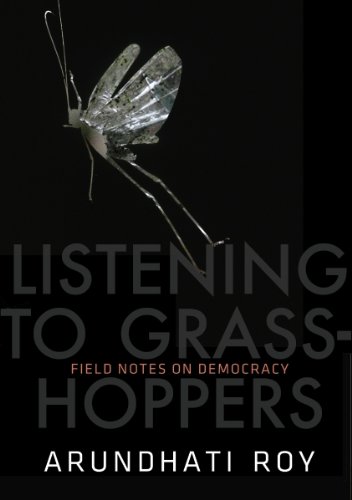
Arundhati Roy
Listening to Grasshoppers: Field Notes on Democracy Kindle Edition
by Arundhati Roy (Author) Format: Kindle Edition
4.5 4.5 out of 5 stars (247)
This series of essays examines the dark side of democracy in contemporary India. It looks closely at how religious majoritarianism, cultural nationalism and neo-fascism simmer just under the surface of a country that projects itself as the world's largest democracy.
Beginning with the state-backed pogrom against Muslims in Gujarat in 2002, Arundhati Roy writes about how the combination of Hindu Nationalism and India's Neo-liberal economic reforms which began their journey together in the early 1990s are now turning India into a police state. She describes the systematic marginalization of religious and ethnic minorities - Muslim, Christian, Adivasi and Dalit, the rise of terrorism and the massive scale of displacement and dispossession of the poor by predatory corporations. The collection ends with an account of the of the August 2008 uprising of the people of Kashmir against India's military occupation and an analysis of the November 2008 attacks on Mumbai.
The Dark Side of Democracy tracks the fault-lines that threaten to destroy India's precarious democracy and send shockwaves through the region and beyond.
Read less
Print length
284 pages
From other countries
Kindle Customer
5.0 out of 5 stars Arundhati Roy continues to enlighten and inform on all issues ...
Reviewed in the United States on 11 April 2015
Verified Purchase
Arundhati Roy continues to enlighten and inform on all issues of importance to me and many others Her writing is exquisite!. She continues to go to remote places, places under siege, and at some risk to her own health and safety. Her courage and sense of purpose are admirable and one hopes she will continue to discover, analyze and write. Her wisdom is much needed and not appreciated enough.
One person found this helpful
Report
Arun
5.0 out of 5 stars Disturbing,but a must read
Reviewed in India on 28 May 2018
Verified Purchase
What a courageous book! You must have a guts to write such book. Raising several questions on how this so called democracy is being functioned and that too with enormous facts and figures. It is a chilling experience to read the real stories of 2001 parliament attack and how that was mishandled or rather deliberately mishandled.Still some hope exists that some people like her are still alive in this country who can fight against injustice.
3 people found this helpful
Report
Adelaide.123
5.0 out of 5 stars Brilliant polemic
Reviewed in the United Kingdom on 13 January 2014
Verified Purchase
This is a wonderful book. Roy scrupulously details the miscarriages of justice in her own country; injustices we should all know about. These range from simple government ignorance to endorsement of genocide.
I feel that the book serves as a crashcourse in Indian politics; a topic which I am ashamed to say I knew very little about. I strongly recommend this book to anyone with an interest in politics, Indian culture, religion, or someone who would like to acquire a plethora of new information. It is our duty as readers to know this.
2 people found this helpful
Report
Subbu
5.0 out of 5 stars Listening to grasshoppers: Field notes on Democracy
Reviewed in the United Kingdom on 24 October 2012
Verified Purchase
Listening to Grasshoppers: Field Notes on Democracy Good and very realistic presentations with thorough in-depth analysis of issues in the pseudo-democratic country called India! great work is the least I could say
One person found this helpful
Report
SK
5.0 out of 5 stars Excellent book
Reviewed in India on 9 November 2023
Verified Purchase
Excellent book that one must read to know what's happening behind the curtain of the Indian political scenario.
Report
Okienoah
5.0 out of 5 stars Field Notes on Democracy: Listening to Grasshoppers
Reviewed in the United States on 17 November 2009
Verified Purchase
Excellent book to read and ponder about the human behavior. Instead of harmonious living, religion plays a horrible role throughout the world. I wish democracy changed some of the human behavior, but so far, it did not. Field Notes on Democracy: Listening to Grasshoppers I am an avid reader of Arundhati Roy's books.
One person found this helpful
Report
Lokesh Bag
5.0 out of 5 stars Amazing book
Reviewed in India on 8 February 2018
Verified Purchase
Great book about democracy in India and its loopholes.. a must read.... It will open your eyes on media and government , political motives etc
==
BlackJack21
4.0 out of 5 stars Please Listen to the Grasshoppers:
Reviewed in the United States on 10 October 2012
Verified Purchase
In "Field Notes on Democracy" Arundhati Roy argues that India resembles a pseudo-democracy considering Muslims are being slaughter and relegated to second class citizen status, and since 9/11 the Indian government has used this U.S. tragedy as an excuse to further their genocidal program against these people. According to Roy, "The Muslim community has seen a sharp decline in its fortunes and is now at the bottom of the social pyramid, along with Dalits and Adivasis." The Adivasis are the indigenous inhabitants of India, while the Dalits are the oppressed. This is all transpiring because of the ideology of the Hindu Rashtra, which means Hindu nation.
Political parties such as Vishwa Hindu Parishad, Bajrang Dal, Shiv Sena, and the Bharatiya Janata Party are pushing their extreme rightwing agenda upon the general populace, and Arundhati Roy's essays emphatically thrust this issue to the surface, calling for immediate action. The main point she makes throughout this book is if India continues its political/sociological backslide; then democracy (mob-rule) as they perceive it will metastasize "into something dangerous," which means it will become a Failed State.
Most of the time when we contemplate on what a Failed State is we think of countries such as Afghanistan, Pakistan, and Somalia, we rarely look at countries such as India. Roy compares what's happening to Muslims and other groups in India to the 1915 Armenian genocide orchestrated by the Ottoman Turkic in Anatolia. The Armenians were the largest Christian minority living under their rule at the time.
Some examples of Indian governmental malfeasance, which Arundhati dares to point out are "the massacre of three thousand Sikhs in Delhi in 1984 and the massacres of Muslims in Mumbai in 1993 and in Gujarat in 2002." She compares the 2002 Gujarat massacre to other genocides such as Congo, Rwanda, and Bosnia, and even though Arundhati states the loss of life in Gujarat pales in comparison, her analogy needs to be emphasizes. The mass slaughter started because of "an unsolved crime-the burning of a railway coach in which fifty-three Hindu pilgrims were burned to death." Arundhati claims that the Indian squads of armed killers, organized by fascist militias were backed by the Gujarat government, which in-turn orchestrated the mass slaughter of two thousand Muslims. Muslim businesses, shrines and mosques were also destroyed, while women were gang-raped and burned alive. She also claims that the Indian government celebrates this sanguineous atrocity with pride. I would think this would cause trepidations in the International Community considering how unstable India is appearing to be.
Nonetheless, there are actual cases of the government allowing the people to starve to death even though India's "GDP growth rate is phenomenal, unprecedented." According to Roy, in 2003 "Reports of starvation and malnutrition (came) in from across the country." "The government allowed sixty-three million tons of grain to rot in its granaries. Twelve million tons were exported and sold at a subsidized price (and) the Indian government was not willing to offer the Indian poor" any. Furthermore, 47 percent of Indian children suffer from malnutrition and 46 percent are stunted, while 40 percent of rural population's grain absorption levels equal that of sub-Saharan Africa. "An average rural family eats about (220 pounds) less food in a year than it did in the early 1990's." Also India is suffering from mass privatization as nearly 70 percent of the rural population is being disenfranchised by this circumstance. The country of India has fallen even further into a state of entropy since the British no-longer occupy the region, and its feud with Pakistan isn't helping matters either.
Arundhati Roy details the events of the November 2008 Mumbai terrorist attacks, which were devastating, but she points out that there were other attacks equally devastating in nature. In the same year the cities and towns of "Ahmadabad, Bangalore, Delhi, Guwahati, Jaipur and Malegaon have all seen serial bomb blast in which hundreds of ordinary people have been killed and wounded." What she articulated throughout her essays is that the Indian parliamentary system isn't working in the interest of the people. She writes about accused terrorist such as Mohammad Afzal, S.A.R. Geelani and others being put on trial for the December 13, 2001 attack on the Parliament House in New Delhi and how the trials nearly ended in a kangaroo court scenario.
Overall, the essays are an eye-opener, from Governmental corporate fraud, media complicity, and the discombobulating of Democracy in India. Arundhati goes for the jugular; however, if you're not familiar with India's history then I suggest catching up on it before tackling this book. Moreover, two of the essays in this book appear in her previous books.
Chapter one: "Democracy Who's She at Home?" appears in her book "War Talk."
Chapter two: "How Deep Shall We Dig?" appears in her book "An Ordinary Person's Guide to Empire."
So, if you recently read those essays in her previous books then feel free to skip the first two chapters.
Just be cognizant of the fact, "Field Notes on Democracy Listening to Grasshoppers" is a dated work so these essays are not current. Some of them are dated as far back as ten years ago.
I hope Roy will continue to keep us informed on what's transpiring in India in the near future.
Other Books that should be read along this one are as follows:
John Pilger: "Freedom Next Time, Resisting the Empire"
Tariq Ali: "The Clash of Fundamentalisms"
Tariq Ali: "Speaking of Empire and Resistance"
Tariq Ali: "The Duel Pakistan on the Flight Path of American Power"
Christopher Hitchens: "God is not great"
Noam Chomsky: "Failed States and the Assault on Democracy"
Noam Chomsky: "Hegemony or Survival"
The Club of Rome: "Limits to Privatization How much is Too Much of a Good Thing"
I also highly recommend watching Patrick Swayze's movie "City of Joy" to learn a little about India's culture and rural infrastructure.
5 people found this helpful
Report
Rudi
4.0 out of 5 stars The unholy truth about India's democracy
Reviewed in the United Kingdom on 2 June 2010
Verified Purchase
Arundhati Roy peels the gloss of India's success, a valuable insight in India's democracy. You will see through a lot of media trickery and governmental statements after reading this book. Recommended.
4 people found this helpful
Report
peter shaw
5.0 out of 5 stars Five Stars
Reviewed in the United Kingdom on 18 June 2017
Verified Purchase
Good service, book a bit heavy going.
Report
==
From other countries
Shraddha upadhyay
4.0 out of 5 stars To question or not to question.
Reviewed in India on 3 August 2015
Verified Purchase
If you are inquisitive to get different perspective of the conditions that were prevailing in the past decade you should read such books. It enhance your questioning or analysing power. And certainly at the end you have your opinion about such issues. It was a nice experience reading this book' listening to grasshopper'
8 people found this helpful
Report
Chris
5.0 out of 5 stars Enlightening!!
Reviewed in the United States on 9 December 2011
Verified Purchase
Read this book and A Feast For Lambs with group. I just couldn't believe the picture of India I was reading in this book. This book really opened my eyes to the plight of the tribals and low castes in India. It's hard to believe all these politician-inspired genocides still take place like on a yearly basis in India. Makes you wonder why we do business with a country that still practice caste slavery and uses extreme violence to silence the underprivileged. I also recommend A Feast for Lambs by Thind, a powerful look at Hindu terrorism in the 80s A Feast for Lambs .
2 people found this helpful
Report
R1z
5.0 out of 5 stars I like arundhati's writing
Reviewed in India on 16 February 2016
Verified Purchase
Great book and fantastic writing. fast read and you will finish in one day even if you dont read much. I ordered all her other books as well.
The book talks about things which the common public has ignored. It is a good narrative against the main stream.
4 people found this helpful
Report
Enrique Romero
5.0 out of 5 stars Five Stars
Reviewed in the United States on 23 May 2017
Verified Purchase
great essays on the politics of india and the region. Great Book
Report
संजय @ बसेरा
3.0 out of 5 stars A Must Read Book
Reviewed in India on 26 August 2016
Verified Purchase
Book has mainly self reflection based on social and political events. The author is expert in writing any type of literature. It is a good thing that explicit analysis at least in one view is what reader gains through the reading.
5 people found this helpful
Report
StarStruck
5.0 out of 5 stars Beyond awesome
Reviewed in the United States on 16 May 2010
Verified Purchase
Arundhati Roy is one of the great thinkers of our time. This book exlains the world in ways most of us never thought. The knowledge learned in Fieldnotes on Democracy changed my views of democracy. PLEASE, everyone read it.
One person found this helpful
Report
SFT
5.0 out of 5 stars a must read
Reviewed in the United States on 17 November 2009
Verified Purchase
Arundhati Roy writes of the horrendous crimes against humanity in our times with such prose and elegance that one is capable of enduring the information. She deserves the highest honors for Her work.
6 people found this helpful
Report
Shahnawaz. Ahmed
5.0 out of 5 stars Interesting book
Reviewed in India on 4 March 2020
Verified Purchase
I continuously read 20 pages since I got the book.its interesting.
Report
P. Divakaran
4.0 out of 5 stars Indian Democracy exposed!
Reviewed in the United States on 7 June 2010
Verified Purchase
A collection of essays on behind the screen happenings of the largest democracy on earth!. Its worth a reading, whether you believe in or not in what Arundhathi say. One can feel the courage, anger and sarcasm on every page of this book. No wonder why corporate media and politians in Indian don't like her.
3 people found this helpful
Report
ARAFAT
5.0 out of 5 stars Worth reading
Reviewed in India on 1 January 2018
Verified Purchase
This is worth your time especially for those who has the courage to confront bitter truths. Arundhati Roy has very vividly explained the fault lines in our system.
One person found this helpful
Report
==

No comments:
Post a Comment