==
Cart

Pub Date: December 2013
ISBN: 9780231167147
192 Pages
Format: Hardcover
List Price: $65.00£55.00
Add To Cart
Pub Date: December 2013
ISBN: 9780231536615
192 Pages
Format: E-book
List Price: $64.99£55.00
Get the E-Book
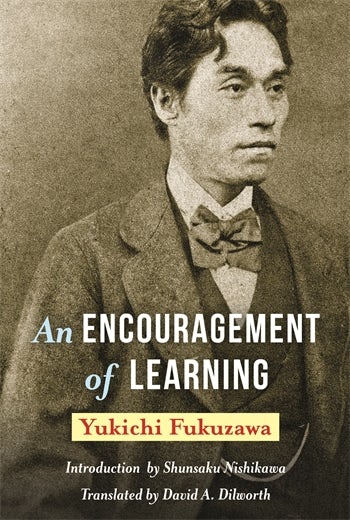
An Encouragement of Learning
Yukichi Fukuzawa. Introduction by Shunsaku Nishikawa. Translated by David A. Dilworth
Columbia University PressMain
Reviews
Contents
Excerpt
Links
Awards
The intellectual and social theorist Yukichi Fukuzawa wrote An Encouragement of Learning (1872–1876) as a series of pamphlets while completing his critical masterpiece, An Outline of a Theory of Civilization (1875). These closely linked texts illustrate the core tenets of his philosophical outlook: freedom and equality as inherent to human nature, independence as the goal of any individual and nation, and the transformation of the Japanese mind as key to advancing in a rapidly evolving political and cultural world.
In these essays, Fukuzawa advocated for the adoption of Western modes of education to help the Japanese people build a modern nation. He also believed that human beings' treatment of one another extended to and was reflected in their government's behavior, echoing the work of John Locke, Thomas Jefferson, and other Western thinkers in a classically structured Eastern text. This volume translates the full text into English and includes a chronology of Japanese history as it relates to Fukuzawa and his work. An introduction provides additional background on the life and influence of this profound thinker, and a selection of representative writings and suggestions for further reading fully introduce readers to the rare brilliance of his thought.
About the AuthorYukichi Fukuzawa (1835–1901) founded Keio University, the first private university in modern Japan, and was an engaged speaker and controversial journalist. His books include An Outline of a Theory of Civilization, The Autobiography of Yukichi Fukuzawa, and Conditions in the West.
Shunsaku Nishikawa is professor emeritus at Keio University, where he also served as the director of the Fukuzawa Memorial Center for Modern Japanese Studies at the Keio Institute of East Asian Studies. His books include The Labor Market in Japan: Select Readings.
David A. Dilworth is professor of philosophy at the State University of New York, Stony Brook. He is also the translator, with G. Cameron Hurst III, of Yukichi Fukuzawa's An Outline of a Theory of Civilization.
==
==
Book Review: An Encouragement of Learning
Book Review: An Encouragement of Learning, by Yukichi Fukuzawa
Trans. David A. Dilworth. New York: Columbia University Press, 2013. Pp. xxxi +192. Hb $49.50.
Reviewed by Kanako Ide
An Encouragement of Learning is one of Japan’s best-selling and most enduring books. The author, Yukichi Fukuzawa (1835-1901), founded Keio University, one of the highest-ranked private schools in Japan, and his portrait appears on the 10,000 yen bill. The book’s first phrase, ‘Heaven, it is said, does not create one person above or below another’ (p. 3), is taught in all Japanese elementary schools. As such, this book and its author are very familiar to Japanese audiences. Nevertheless, it is a challenge to review this famous book as a work of philosophy of education. Minoru Murai (2000), a contemporary Japanese educational philosopher and a professor emeritus of Keio University, states that Fukuzawa’s contribution to educational philosophy has not yet been properly appreciated. In fact, major encyclopedias describe Fukuzawa as an Enlightenment thinker, Japanese author, or publisher rather than an educational philosopher. The publication of this new English translation by Columbia University Press offers an opportunity to reexamine his work.
Masao Maruyama (2001), a Fukuzawa scholar, compares Fukuzawa’s idea of education with John Dewey’s philosophy of education and pragmatism. Indeed, Fukuzawa’s work is full of pragmatic sentiments, such as, ‘Reading is a mere means to learning. Learning issues forth in practice. Power will come only as we actually come to grips with things in concrete life’ (p. 42). Fukuzawa had, however, little direct historical connection to American Pragmatism, living a little earlier than John Dewey (1859-1952). An Encouragement of Learning is actually a collection of 17 disparate articles written from 1872 to 1876 (Tomita, 1992, p. 34). It was around this span of time that Charles Sanders Peirce coined the term ‘pragmatism’, although he did not officially publish the idea until 1878. These details help us to understand the precise nature of the historical connection to Western thought, which is an important part of understanding the influence of Fukuzawa’s philosophy. Fukuzawa is often thought to be a major champion of Western ideals in Japan. He was indeed influenced by the United States and European countries through his global travels and his study of Western literature, but his observations of Western countries were rather critical:
The civilization of the West is of course to be admired… it would be better not to believe at all than to do so superficially. The West’s wealth and power must truly be envied, but we must not go so far as to imitate the unequal distribution of wealth among her people as well (p. 116).
Thus, even though Fukuzawa’s oeuvre reminds us of pragmatism as well as early American democratic thought, he does not blindly celebrate the West.
Masafumi Tomita (1992), another Fukuzawa scholar and an honorary doctor of Keio University, sees the main question of the book as: ‘Why do people need to learn?’ In A Defense of an Encouragement of Learning, the answer to this question seems to be ‘democracy’ (p. 143). Fukuzawa observed that Japan did not have a fully realized democracy, despite the Meiji period’s affiliations for Western thought:
The governments of the past used force, but the present regime uses both force and intelligence. In contrast to the former, the latter is rich in techniques of controlling the people. Past governments deprived the people of power; the present regime robs them of their minds. Past governments controlled men externally, the present regime controls their internal life as well. The former was a devil to the people, the latter is now a god. […] If such abuses of the past are not reformed at this juncture […] the people will be totally enervated, so that the spirit of civilization will gradually wither away (p. 40).
Fukuzawa’s criticism is that Japan maintains the ‘evil customs’ (p. 16) that command obedience to authority rather than democracy: ‘a nation’s harsh government is not necessarily attributable to a tyrant or tyrannical officials. The people, through their own ignorance, bring down such misfortune upon themselves’ (p. 17).
As a means of breaking through these ‘evil customs’, Fukuzawa insisted that ‘national independence must follow from personal independence’ (p. 20), and as such, he emphasized the establishment of the individual spirit of independence and freedom. For Fukuzawa, education was a key means of achieving this independence. His approach was, again, reminiscent of pragmatism: ‘Letters are the instruments of learning; they are like the hammers and saws used to build a house’ (p. 11). Fukuzawa was also careful to disclaim ‘dispassionate calculation’ as the sole means of learning: ‘Scholars who are intoxicated with rational economic arguments should not forget that there is also room for the private virtues of love and kindness’ (pp. 107-108). Murai’s (2000) views this warm-hearted and gentle approach to education as an important facet of Fukuzawa’s contribution to the philosophy of education.
As a critical social theorist, Fukuzawa was suspicious any kind of authority. He criticized the authority of Japanese traditional learning in stringent terms, proclaiming, ‘Anyone who advocates ideas contrary to the natural law, even if he be Mencius or Confucius, should unhesitatingly be called a criminal’ (p. 64). This is not to say that Fukuzawa opposed Japanese tradition for being unscientific, nor should he be taken as fully embracing Western culture for its emphasis on modern science. His criticism focused on both Western and Chinese scholars who were sycophantic to the authorities. He was particularly critical of sentimental historical narratives, which glorify death as expressing loyalty to the ruling powers. He advised against the Japanese social code of being dutiful to one’s parents, reasoning that some parents may unjustly take advantage of the idea. He was critical of Japanese society as ‘very convenient for men’ (p. 63). In particular he protested the custom of concubinage, saying, ‘We should not hesitate to call such men beasts’ (p. 63). His radical arguments for ‘equality’ won him many threats, but he did not stop writing, demonstrating his commitment to practicing and teaching the idea of civil disobedience through his own actions (Tomita, 1992, p. 397).
One last important thing to note is Fukuzawa’s philosophy of nonviolence. He proposed that there are three ways for ordinary citizens to respond to authority. ‘First, they surrender their integrity and submit to the government. Secondly, they may resist the government by force of arms. Thirdly, they may go as far as sacrificing their lives to uphold the principle of justice’ (Fukuzawa, p. 54-55). For Fukuzawa, education is what gives people the courage to take the third way. A glimpse of Fukuzawa’s philosophy of nonviolence can be seen in 1867, when Fukuzawa made his second visit to the United States. He was asked by a feudal domain to go and buy American firearms. However, he spent almost all of the allocated funds on books, and returned the rest. He explained that he had seen many firearms, but that he did not have the professional knowledge necessary to know which ones to buy (Tomita, 1992, p. 259).
Fukuzawa’s style of writing conveys the delights of his passion for the improvement of society. At the same time, the book gives a sense of his deep faith in the power of education to emancipate people’s minds and improve the quality of their lives.
References:
Maruyama, M. (2001) Fukuzawa Yukichi no Tetsugaku hoka roppen (Tokyo, Iwanami).
Murai, M. (2013) Nihon Kyouiku no Konponteki Henkaku (Tokyo, Kawashima).
Tomita, M. (1992) Kosho Fukuzawa Yukichi jyo (Tokyo, Iwanami).
Correspondence: Kanako Ide, School of Education, Soka University, 1-236 Tangi, Hachiouji, Tokyo, 192-8577, Japan.
Email: kide@soka.ac.jp
Visit our Book Reviews page for more reviews, and read interviews with the authors here.
==
Kindle Store
›
Kindle eBooks
›
Business & Investing
======
Kindle
$3.99 to buy

An Encouragement of Learning Kindle Edition
by Yukichi Fukuzawa (Author), Clayton Maris (Translator) Format: Kindle Edition
5.0 5.0 out of 5 stars (1)
"An Encouragement of Learning" (Gakumon no Susume) by Yukichi Fukuzawa is a groundbreaking work that revolutionized Japanese thinking in the late 19th century and continues to inspire readers today. This influential book, which sold an astounding 3.4 million copies in its time, is a must-read for anyone interested in personal growth, societal progress, and the power of education.
Fukuzawa, one of Japan's most revered intellectuals, challenges readers to break free from traditional hierarchies and embrace the concept of individual equality. He argues passionately that education is the key to personal and national advancement, encouraging all citizens to pursue knowledge regardless of their social status.
The book is filled with timeless wisdom and practical advice that remains remarkably relevant in our modern world. Fukuzawa's insights on topics such as:
- The importance of critical thinking
- The balance between individual rights and societal responsibilities
- The role of education in creating a just and prosperous society
make "An Encouragement of Learning" a compelling read for students, professionals, and anyone seeking personal growth.
Fukuzawa's accessible writing style, use of relatable examples, and powerful arguments make this book engaging and thought-provoking. By reading "An Encouragement of Learning," you'll gain a deeper understanding of the foundations of modern Japanese society and discover universal principles that can guide your own pursuit of knowledge and success.
Don't miss the opportunity to be inspired by one of history's great minds. Fukuzawa's "An Encouragement of Learning" is not just a book – it's a call to action that will challenge you to reach your full potential and contribute to a better world.
Read less
Print length
211 pages
Language
English
===
Next slide of product details
See all details
==
==

No comments:
Post a Comment