2025-10-31

古事記 (日本の古典をよむ 1)

Amazon.co.jp:Customer Reviews: 古事記 (日本の古典をよむ 1)


古事記 (日本の古典をよむ 1)  2007
by 山口 佳紀 (Author), 神野志 隆光 (Author)
4.4 4.4 out of 5 stars   (22)
===

4.4 out of 5 stars

古事記 (日本の古典をよむ 1)
by山口 佳紀
Format: Paperback Change
====

Z?
5.0 out of 5 stars 意外とエゴイスティックな神々
Reviewed in Japan on November 21, 2012
Format: Paperback
本書は言わずと知れた日本最古の歴史書。
ずっと以前から気になる古典の一つであったが、今年で編纂1300年とのことなので手に取った。

本書ではイザナギ・イザナミによる国生みから推古天皇の統治まで、「日本という国はどのようにして生まれ、今(天武天皇統治の時代)に至るのか」が、多くの神々のエピソードを系譜通りに連ねることによって描かれている。
訓読文に原文を添える形式であるため、とても読みやすかった。

本書を読むと、神々の意外にもエゴイスティックな一面に驚かされるだろう。
身勝手な荒くれ者であったスサノオや、それに輪をかけたように凶暴なヤマトタケルノミコトが好例である。
他にも裏切りや略奪婚など、登場人物の間では常に争いや諍いが絶えない。
しかしそれらが「古事記」という古典の固いイメージを良い意味で覆し、不思議な親近感が湧いてくる。

また「ヤマタノオロチ」や「因幡の白兎」など、日本人なら聞いたことくらいはあるだろう言葉や物語の多くの起源がここにあった。
意外にも読みやすい書物であり、読後の満足感が大きかった。
編纂1300年の節目に、是非読んでみてはいかがだろうか。
===
〈 書籍の内容 〉
現代語訳と原文で気軽によめる『日本の古典をよむ』全20冊の第一回配本。神と国と天皇の歴史を記した、わが国最古の書物。古代の人々の豊かな創造性とダイナミックな世界観に圧倒される。

[特色]
●厳正な現代語訳を先に、原文を後に掲載し、作者の言葉や作品内容をストレートに伝え、原文と対比しながら読むことができます。
●一度は読んでおきたい有名作品を網羅しました。
●巻頭カラー特集や文学紀行を設け、古典から広がる、知の世界を楽しめる構成になっています。
〈 オーディオブック情報 〉
古事記(日本の古典をよむ 1)
Jp-e : 093621717000v0000000
ナレーター/岩崎博 原きよ 
日本最古の物語が誘うロマンあふれる古代世界

古典文学の主要作品をセレクトし、現代語訳と原文とで構成した「日本の古典をよむ」(全20冊)シリーズの1冊です。「古事記」は、奈良時代のはじめに書かれた、現存する日本最古の書物です。天地の始まりから神々の誕生、国土の生成から天孫降臨、そして天皇の歴史へと続く物語から著名なものを選び出しました。また、文学紀行コラム「古事記の風景」も収録しています。
本タイトルには付属資料・PDFが用意されています。ご購入後、PCサイトのライブラリー、またはアプリ上の「目次」からご確認ください。

【本書の内容】
〈はじめに〉日本最古の書物の魅力
〈上巻〉あらすじ/序/初発の神々/伊耶那岐命と伊耶那美命/天照大御神と須佐之男命/大国主神/忍穂耳命と邇々芸命/日子穂々手見命と鵜葺草葺不合命
〈中巻〉あらすじ/神武天皇/綏靖天皇(概略)/安寧天皇(概略)/懿徳天皇(概略)/孝昭天皇(概略)/孝安天皇(概略)/孝霊天皇(概略)/孝元天皇(概略)/開化天皇(概略)/崇神天皇/垂仁天皇/景行天皇/成務天皇(概略)/仲哀天皇/応神天皇
〈下巻〉あらすじ/仁徳天皇/履中天皇(概略)/反正天皇(概略)/允恭天皇/安康天皇/雄略天皇/清寧天皇(概略)/顕宗天皇(概略)/仁賢天皇(概略)/武烈天皇(概略)/継体天皇(概略)/安閑天皇(概略)/宣化天皇(概略)/欽明天皇(概略)/敏達天皇(概略)/用明天皇(概略)/崇峻天皇(概略)/推古天皇(概略)
〈解説〉 
〈古事記の風景〉(1)出雲大社 (2)高千穂 (3)熊野 (4)三輪山 (5)能煩野
レビューを見る(ネタバレを含む場合があります)>>

===
8 people found this helpful
Helpful
Report
Translate review to English

Amazon カスタマー
4.0 out of 5 stars 古事記全文は載っていません
Reviewed in Japan on October 16, 2017
Format: PaperbackVerified Purchase
「日本の古典をよむ」シリーズは小学館の新編日本古典文学全集をベースとしたシリーズとのことで、旧版日本古典文学全集の簡装版とされる「完訳日本の古典」シリーズと同じようなものかと思って購入したが、「完訳」シリーズとは違って抄出版で全文が載っていない。失敗でした。
11 people found this helpful
Helpful
Report
Translate review to English

マーシャ
5.0 out of 5 stars 良い本です。
Reviewed in Japan on December 8, 2012
Format: Paperback
現代語訳→原文(古語)の順で書かれています。
現代語訳がわかりやすく、簡単に古事記の世界に入っていけます。
段落のレイアウトや文字が大きく読みやすいです。この点は、読んでいく上で大事な点だと、気づきました。
古事記全文が載っているではないのですが、省略されているところは、概略を口語訳のみで書いてあります。
古事記全体からすれば、概略で十分です。
他の文庫版の古事記は、現代語訳がわかりにくかったり、文字が小さかったりと、意外に読みにくいものです。
古事記を読みたいのあればこの本がおすすめです。
ハードカバーで、値段が多少高いのですが、読む価値のある本です。
16 people found this helpful


ししどえみ
4.0 out of 5 stars 古事記初心者にぜひ!
Reviewed in Japan on October 8, 2021

天岩戸、ヤマタノオロチ、因幡の白兎、ヤマトタケル……。 この本を読むことによって今までバラバラになっていた物語が、やっと繋がりました!

弟が怖くて引きこもってしまう天照大御神。泣いてばかりいた須佐之男命。お父さんに愛されたい倭建命。

人間らしく愛すべき神様たちの姿が、そこにありました。

日本はそんな神様たちが作った国!

愛すべき国ですね。

すごくわかりやすくて、古事記初心者の私には、とてもありがたい本でした!
2 people found this helpful

skinhead-f
5.0 out of 5 stars 眺めて良し、手にとって良し、開いて良し、
Reviewed in Japan on May 1, 2008
Format: Paperback
書棚に収めて並んでいる姿も絵になる美しい装丁の「日本の古典シリーズ」全20巻。
古典シリーズといっても、大人の書斎に重厚な佇まいでずらっと並ぶイメージではなく、
各巻現代的な柔らかい装画で統一されたデザインです。最初に発行された1巻と13巻
(古事記・平家物語)を見たとき一目惚れし全シリーズ揃えようと決めました。

本文も年齢を問わず入りやすく読みやすいレイアウトで、あらすじ→現代語訳→原文で
構成され、原文を声に出して読む場合なども非常にとっかかりやすいです。視覚でとら
える日本語のまろやかさと色気、音声に出すときのリズムの味わい、何百年も読み継が
れた文学を童話のように読めるとは…思いませんでした。
権威的すぎる序章や写真、解説などが必要以上に挿入されていないのも美点ですね。この
飾り気のなさが、最大に気を遣われた部分ではないかと感じます。
とてもセンスのいい素敵な本です。
49 people found this helpful

‹ See all details for 古事記 (日本の古典をよむ 1)


===


===

고사기 (일본의 고전을 부르는 1)
Amazon.co.kr:Customer Reviews: 고사기 (일본 고전 1)


고사기 (일본의 고전을 부르는 1) 2007
by 야마구치 가키 (Author), 칸노시 다카미츠 (Author)
4.4 4.4 out of 5 stars (22)
===

4.4 out of 5 stars

고사기 (일본의 고전을 부르는 1)
by 야마구치 가키
Format: Paperback Change
====

Z?
5.0 out of 5 stars 의외로 에고이스틱한 신들
Reviewed in Japan on November 21, 2012
Format: Paperback
이 책은 말하지 않고 알려진 일본에서 가장 오래된 역사서.
계속 이전부터 신경이 쓰이는 고전의 하나였지만, 올해로 편찬 1300년이므로 손에 들었다.

본서에서는 이자나기·이자나미에 의한 국생으로부터 추고 천황의 통치까지, 「일본이라고 하는 나라는 어떻게 태어나 지금(천무 천황 통치의 시대)에 이르는 것인가」가, 많은 신들의 에피소드를 계보대로에 연속시켜 그려져 있다.
훈독문에 원문을 더하는 형식이기 때문에 매우 읽기 쉬웠다.

이 책을 읽으면 신들의 의외로 에고이스틱한 일면에 놀라게 될 것이다.
제멋대로인 거친 ​​사람이었던 스사노오나, 거기에 고리를 걸었듯이 흉포한 야마토 타케르노미코토가 좋은 예이다.
그 밖에도 배신이나 약탈혼 등 등장 인물들 사이에서는 항상 다툼이나 욕이 끊이지 않는다.
그러나 그들이 '고사기'라는 고전의 딱딱한 이미지를 좋은 의미로 뒤집어 신기한 친근감이 솟아온다.

또 ‘야마타노오로치’나 ‘인하의 백토’ 등 일본인이라면 들은 것 정도는 있을 것이다 말이나 이야기의 많은 기원이 여기에 있었다.
의외로 읽기 쉬운 책이며, 독후의 만족감이 컸다.
편찬 1300년의 고비에, 꼭 읽어 보는 것은 어떨까.
===
<책의 내용>
현대 어역과 원문으로 부담없이 얽히는 『일본의 고전을 맡는』전 20권의 제1회 배본. 하나님과 나라와 천황의 역사를 기록한 우리나라에서 가장 오래된 책. 고대 사람들의 풍부한 창의성과 역동적인 세계관에 압도된다.

[특색]
● 엄정한 현대 어역을 먼저, 원문을 나중에 게재해, 작자의 말이나 작품 내용을 스트레이트에 전해, 원문과 대비하면서 읽을 수 있습니다.
● 한번은 읽어 두고 싶은 유명 작품을 망라했습니다.
●권두 컬러 특집이나 문학 기행을 마련해, 고전으로부터 퍼지는, 지의 세계를 즐길 수 있는 구성으로 되어 있습니다.
<오디오 북 정보>
고사기 (일본의 고전을 부르는 1)
Jp-e : 093621717000v0000000
내레이터 / 이와사키 히로하라 키요 
일본에서 가장 오래된 이야기가 초대하는 로맨스 넘치는 고대 세계

고전 문학의 주요 작품을 선택해, 현대 어역과 원문으로 구성한 「일본의 고전을 요한다」(전 20권) 시리즈의 1권입니다. 「고사기」는, 나라 시대의 처음에 쓰여진, 현존하는 일본에서 가장 오래된 책입니다. 천지의 시작부터 신들의 탄생, 국토의 생성에서 천손 강림, 그리고 천황의 역사로 이어지는 이야기에서 저명한 것을 선택했습니다. 또, 문학 기행 칼럼 「고사기의 풍경」도 수록하고 있습니다.
본 타이틀에는 부속 자료・PDF가 준비되어 있습니다. 구입 후, PC 사이트의 라이브러리, 또는 앱상의 「목차」로부터 확인해 주세요.

【본서의 내용】
<소개> 일본에서 가장 오래된 책의 매력
<가미마키> 개요/서/초발의 신들/이야나 기명과 이야나 미명/아마테루 오미카미와 스사노오 생명/오오쿠니 주신/오니호 이명과 나나미 예명/히코호수 수명
〈나카마키〉 줄거리/진부 천황/綏靖天皇(개요)/안녕 천황(개략)/간덕 천황(개요)/효쇼 천황(개요)/효안 천황(개략)/ 효령천황(개략)/효원천황(개략)/개화천황(개략)/숭신천황/수인천황/경행천황/성무천황(개략)/중애천황/응신천황
<하권> 줄거리/닌토쿠 천황/이나카 천황(개략)/반정 천황(개요)/안협 천황/안강 천황/웅략 천황/청녕 천황(개요)/현종 천황(개요)/인현 천황(개요)/무열천 황(개략)/계체천황(개략)/안한천황(개략)/선화천황(개략)/기묘천황(개요)/도다치천황(개요)/용명천황(개략)/숭준천황(개요)/추고천황(개략)
<해설> 
<고사기의 풍경> (1) 이즈모타이샤 (2) 다카치호 (3) 구마노 (4) 산와야마 (5) 노베노
리뷰 보기(스포일러가 포함될 수 있음) >>

===
8 people found this helpful
Helpful
보고서
Translate review to English

Amazon 고객
4.0 out of 5 stars 古事記 전문은 실려 있지 않습니다
Reviewed in Japan on October 16, 2017
Format: PaperbackVerified Purchase
「일본의 고전을 맡는」시리즈는 쇼가쿠칸의 신편 일본 고전 문학 전집을 베이스로 한 시리즈라는 것으로, 구판 일본 고전 문학 전집의 간장판으로 되는 「완역 일본의 고전」시리즈와 같은 것이라고 생각해 구입했지만, 「완역」시리즈와는 달리 초출판으로 전문이 실려 있지 않다. 실패했습니다.
11 people found this helpful
Helpful
보고서
Translate review to English

마샤
5.0 out of 5 stars 좋은 책입니다.
Reviewed in Japan on December 8, 2012
Format: Paperback
현대어 번역 → 원문(고어) 순으로 적혀 있습니다.
현대 어역을 알기 쉽고 쉽게 고사기의 세계에 들어갈 수 있습니다.
단락의 레이아웃이나 문자가 크게 읽기 쉽습니다. 이 점은 읽어 가는데 중요한 점이라고 깨달았습니다.
고사기 전문이 실려 있는 것은 아니지만, 생략되고 있는 곳은, 개략을 구어역만으로 써 있습니다.
고사기 전체로부터 하면, 개략으로 충분합니다.
다른 문고판의 고사기는 현대 어역이 이해하기 어렵거나 문자가 작거나 의외로 읽기 어려운 것입니다.
고사기를 읽고 싶다면이 책을 추천합니다.
하드 커버로 가격이 다소 비싸지만 읽을만한 책입니다.
16 people found this helpful


시시도 에미
4.0 out of 5 stars 고사기 초보자에게 꼭!
Reviewed in Japan on October 8, 2021

아마이와도, 야마타노오로치, 인하의 흰 토끼, 야마토 타케루… 이 책을 읽음으로써 지금까지 엉망이 된 이야기가 마침내 연결되었습니다!

남동생이 무서워서 끌려 가는 아마테루 오미카미. 울기만 했던 스사노오 생명. 아빠에게 사랑받고 싶은 왜건명.

인간답게 사랑해야 할 하나님들의 모습이 거기에 있었습니다.

일본은 그런 하나님들이 만든 나라!

사랑해야 할 나라군요.

굉장히 알기 쉽고, 고사기 초보자의 나에게는, 매우 고마운 책이었습니다!
2 people found this helpful

skinhead-f
5.0 out of 5 stars
Reviewed in Japan on May 1, 2008
Format: Paperback
책장에 담아 줄지어 있는 모습도 그림이 되는 아름다운 장정의 「일본의 고전 시리즈」전 20권.
고전 시리즈라고 해도, 어른의 서재에 중후한 모습으로 쭉 늘어선 이미지는 아니고,
각 권 현대적인 부드러운 장식으로 통일된 디자인입니다. 처음 발행된 1권과 13권
(고사기·히라가 이야기)를 보았을 때 한눈에 반해 전 시리즈 가지런히 하려고 결정했습니다.

본문도 나이를 불문하고 들어가기 쉽고 읽기 쉬운 레이아웃으로, 줄거리→현대어 번역→원문으로
구성되어 원문을 소리 내어 읽는 경우 등도 매우 확실히 쉽습니다. 시각적으로 취해
일본어의 부드러움과 성적 매력, 음성에 넣을 때의 리듬의 맛
문학을 동화처럼 읽을 수 있다고는 생각하지 않았습니다.
너무 권위적 인 서장이나 사진, 해설 등이 필요 이상으로 삽입되지 않은 것도 아름다움이군요. 이
장식의 느낌이 최대한 신경 쓰인 부분이 아닐까 느낍니다.
매우 센스 좋은 책입니다.
49 people found this helpful

‹ See all details for 고사기 (일본의 고전을 부르는 1)

===


===

2025-10-30

Trump gives South Korea permission to build nuclear-powered submarine | South Korea | The Guardian

Trump gives South Korea permission to build nuclear-powered submarine | South Korea | The Guardian

Trump gives South Korea permission to build nuclear-powered submarine

Trump’s decision to allow South Korea to build a nuclear-powered submarine will admit Seoul to a small club of nations possessing such vessels

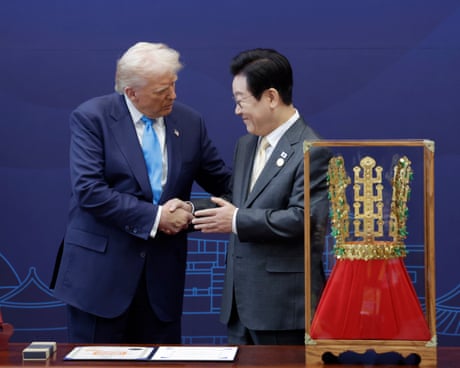
US president Donald Trump has given approval for South Korea to build a nuclear-powered submarine, a move that would admit Seoul to a small club of nations possessing such vessels.

Trump met South Korean counterpart Lee Jae Myung on Wednesday in the southern town of Gyeongju, where the US leader arrived for a summit ahead of the Asia-Pacific Economic Cooperation (Apec) forum.

On Wednesday, Seoul’s presidential aide said the two countries had reached a broad deal covering investment and shipbuilding, while Trump said the agreement was “pretty much” finalised.

“I have given them approval to build a Nuclear Powered Submarine, rather than the old fashioned, and far less nimble, diesel powered Submarines that they have now,” Trump said on Truth Social Thursday.

In a separate post, Trump wrote: “South Korea will be building its Nuclear Powered Submarine in the Philadelphia Shipyards, right here in the good ol’ U.S.A.”

“Shipbuilding in our Country will soon be making a BIG COMEBACK,” he added.

While South Korea has a sophisticated shipbuilding industry, Trump did not spell out where the propulsion technology would come from for a nuclear-powered submarine.

The US has been working with Australia and Britain on the Aukus project, which will allow Australia to acquire nuclear-powered submarines involving technology transfers from the United States. The US has so far only shared that technology with Britain, back in the 1950s.

On Wednesday, Lee asked Trump to “make a decision to allow us to receive fuel for nuclear-propelled submarines.”

“We are not proposing to build submarines armed with nuclear weapons; rather, diesel submarines have inferior submerged endurance, which limits our ability to track North Korean or Chinese submarines,” Lee told Trump.

Lee’s predecessors had wanted to build nuclear-powered submarines, but the US had opposed the idea for decades.

The dessert at a luncheon for Trump featured the word “PEACE!”, according to Seoul’s presidential office, echoing the two leaders’ first meeting when they pledged to act as a “peacemaker” and a “pacemaker” for peace on the Korean Peninsula.

Tensions with nuclear-armed North Korea remain high as Pyongyang deepens military and economic links with Russia.

Trump said Wednesday he was not able to arrange a meeting with North Korean leader Kim Jong-un during his visit to the South, ending fierce speculation over a possible summit after years of diplomatic deadlock.

Daryl Kimball, executive director of the Washington-based Arms Control Association, said the issue of South Korea acquiring such submarines “raises all sorts of questions.”

“As with the AUKUS deal, (South Korea) is probably looking for nuclear propulsion services suitable for subs, including the fuel, from the US,” he said.

Kimball said such submarines usually involved the use of highly enriched uranium and would “require a very complex new regime of safeguards” by the International Atomic Energy Agency, which has a key role in implementing the Treaty on the Non-Proliferation of Nuclear Weapons (NPT).

“It remains technically and militarily unnecessary for South Korea to acquire the technology to extract weapons-usable plutonium from spent fuel or to acquire uranium enrichment capabilities, which can also be used to produce nuclear weapons,” he said.

“If the United States seeks to prevent the proliferation of nuclear weapons worldwide, the Trump administration should resist such overtures from allies as strongly as it works to deny adversary access to these dual-use technologies.”

Pilgrimages and Spiritual Quests in Japan (2007) | Pilgrimage | Camino De Santiago

This summary is not available. Please click here to view the post.

Understanding Japanese Society - J HENDRY 2 & 3 ED

Understanding Japanese Society - Association for Asian Studies

Understanding Japanese SocietyBack to search results
Download PDF
BY JOY HENDRY
SECOND EDITION, NEW YORK: ROUTLEDGE, 1995
Reviewed by ROBIN LEBLANC

“Scintillating” is not a word one would use to describe Joy Hendry’s Understanding Japanese Society. Nonetheless, this attempt at a general overview of Japanese culture can be a serviceable supplementary text in courses on postwar Japanese culture or a useful reference for nonspecialists who would like to include Japan-related material in more general classes. Hendry claims that her book is designed to “open a door” into Japanese life primarily through the examination of the findings of anthropological studies of Japan. Having read Understanding Japanese Society, students will be, she says, “armed with background information” that will make it “possible to achieve a deeper understanding of specialist books in other areas” (3–4). I think her claims are largely true.

Hendry’s book is organized rather traditionally, with a beginning chapter tracing Japanese history from the beginning of time to the postwar era, followed by a series of chapters that break Japanese society down into unsurprising categories such as “The House and Family System” and “The Education System.” Each chapter is followed by a well-rounded list of references and suggestions for further exploration, some of which include films and novels as well as scholarly books and articles that relate to the chapter topic. Hendry moves along systematically, acquainting the reader with the findings of the most well known works on Japanese culture and detailing some of the differences between research done in different time periods and in different locations in Japan. In both good and bad ways, Hendry’s chapters read most like literature reviews.

Hendry’s readers will receive a broad orientation to the work available on many different topics. Given the conscientiousness with which Hendry points out differences between specialists’ various perspectives, one is likely to take away a fairly realistic impression of the difficulty of making all-encompassing general statements about Japanese society. Students will get a summary explanation of theoretical approaches that have made an important mark on the Japanese studies field; they will also be cautioned about the limitations of those approaches. For example, in her chapter “Status and Stratification in the Wider World,” Hendry offers a detailed and cogent description of Nakane Chie’s famous “vertical principle” explanation of Japanese social structure (86–89). However, Hendry also points out that “Nakane’s model has been criticized for being too all-embracing,” and Hendry describes ways in which social behavior among housewives, for instance, may not conform to Nakane’s analytical framework (89–90).

Hendry’s even-handedness is sometimes her downfall. The book moves smoothly from topic to topic but seldom digs deeply enough into a single one to be truly fascinating. Furthermore, although, she is careful to avoid shaping her interpretation of Japan according to one simplistic perspective, the matter-of-course tone with which she moves through topics as diverse as toilet training and geisha training produces the ironic effect of privileging her overall authority. She admits to disagreement between scholars about how to classify Japanese experience. She does not admit that some parts of it might resist clear classifications or that the social science categories into which she has organized the book are, though common tools of her discipline, nonetheless makeshift in their own way.

Because of this fact, Hendry sometimes undercuts her own purposes. For example, she is very careful to point out that a Japanese person’s experience would vary greatly depending on where she is raised, and that Japanese customs are constantly undergoing change. Yet, by beginning her book with the “everything before the postwar” history chapter, Hendry seems to reinforce a rigid binary distinction between the traditional and modern in Japanese life. While she describes contemporary urban life as in contrast to rural and past practices, at least half of the book’s pictures depict “traditional” Japanese items such as shrines which, from my own research experiences, I would argue have only a small place in the lives of Japan’s largely urban population. “Religion” is a common anthropological category. “Train station culture” is not, and thus gets slighted even though that is where many Japanese spend several hours of each day. Students of Understanding Japanese Society will not be encouraged to think critically or comparatively about how we come to know what we think we know about another culture, and in that way, the book is limited to a relatively introductory role in the classroom.

Despite these misgivings, however, I think Understanding Japanese Society could be profitably included in the required reading of courses on postwar Japanese society. The book would be especially helpful in courses where the students either do not have a uniformly strong educational background or are entirely unfamiliar with Japan. Many of us teach precisely such courses. If I were to use Hendry’s book, I would combine it with other, more focused works—matching Hendry’s chapter on careers with a book such as Dorinne Kondo’s Crafting Selves or Hendry’s chapter on community with Theodore Bestor’s Neighborhood Tokyo, for example. (note 1) Since Hendry consistently provides very accessible introductions to other readings that a student might do, her book could also be a first stop for students doing research papers and wondering how to phrase their topic or where to begin in their approach to the library. Few of us would deny the value of such a resource.


NOTE

1. Theodore C. Bestor, Neighborhood Tokyo (Stanford: Stanford University Press,1989); Dorinne Kondo, Crafting Selves: Power, Gender, and Discourse of Identity in a Japanese Workplace (Chicago: University of Chicago Press, 1990).

ROBIN LEBLANC is an Assistant Professor of Politics at Washington and Lee University. Her book, Bicycle Citizens: The Political World of the Japanese Housewife, will be coming out later this year from the University of California Press.
===

조이 헨드리(Joy Hendry) 교수의 <Understanding Japanese Society> 제3판에 대한 1,000단어 분량의 요약 및 비평을 제공해 드리겠습니다. 이 책은 사회 인류학적 관점에서 일본 사회와 문화를 심도 있게 다루는 고전적인 입문서입니다.


🇯🇵 조이 헨드리, <Understanding Japanese Society> 제3판 요약 및 비평

<Understanding Japanese Society> 제3판(2003)은 저명한 사회 인류학자인 조이 헨드리가 쓴 일본 사회에 대한 포괄적이고 접근하기 쉬운 입문서입니다. 이 책은 단순한 사실 나열을 넘어, 일본인들이 세상을 바라보고, 분류하고, 질서를 부여하는 방식에 대한 인류학적 통찰을 제공하며, 서구에서 흔히 접하는 스테레오타입에 도전합니다. 제3판은 특히 1990년대 후반과 21세기 초반의 일본 사회 변화, 즉 '잃어버린 10년'의 경제 침체, 고베 대지진, 옴진리교와 같은 종교적 광신의 영향 등을 반영하여 내용을 업데이트했습니다.

📚 핵심 내용 요약 (Summary)

이 책은 개인의 일상생활부터 국가적인 제도에 이르기까지 일본 사회의 모든 측면을 시간의 흐름과 공간의 확장을 따라 체계적으로 분석합니다. 주요 내용은 다음과 같습니다.

1. 사회의 기본 구조: 집과 가족 (The House and Family System)

헨드리는 일본 사회의 근간으로 <이에>($\mathit{ie}$) (집/가족 시스템) 개념을 제시합니다. 이는 단순히 혈연 공동체를 넘어, 세대에 걸쳐 지속되는 연속적인 사회적 단위이자 재산을 상속하는 법적·경제적 실체로 설명됩니다. 이러한 $\mathit{ie}$ 시스템이 개인의 사회화, 역할, 그리고 기대치를 형성하는 데 중추적인 역할을 한다고 강조합니다.

2. 사회화와 분류 (Socialisation and Classification)

일본의 사회화 과정은 개인이 집단에 속하는 방식관계의 맥락을 중시하도록 이끌어줍니다. 특히, <우치>($\mathit{uchi}$) (내부)<소토>($\mathit{soto}$) (외부) 라는 개념은 일본인의 사고방식과 행동을 이해하는 데 핵심적인 분류 기준입니다. 이분법은 가정, 직장, 사회적 상호작용 등 모든 영역에서 공손함의 정도(경어 사용)와 허물없는 정도를 결정하는 데 사용됩니다.

3. 사회적 지위, 위계, 그리고 다양성 (Status, Hierarchy, and Diversity)

일본 사회는 위계지위에 대한 강한 인식을 가지고 있습니다. 나카네 치에(Chie Nakane)의 <다테 사회> (vertical society) 모델과 같은 기존 이론을 소개하면서도, 헨드리는 이러한 위계질서가 항상 엄격하거나 일률적이지 않다는 점을 지적합니다. 제3판에서는 특히 민족적 다양성 (아이누족, 재일 한국인 등)과 여성의 역할 변화를 포함하여, 일본 사회 내부의 다양성을 새롭게 인식하는 경향을 강조합니다.

4. 교육 및 직업 생활 (The Education System and Working Life)

교육 시스템은 경쟁이 치열하며, 사회적 성공의 주요 경로로 기능합니다. 학교는 단순히 지식을 전달하는 곳이 아니라, 집단에 대한 소속감규율을 배우는 중요한 사회화 기관입니다. 직장 생활은 일생의 헌신과 집단 충성도를 요구하는 독특한 문화(예: 종신 고용)를 보여주지만, 제3판에서는 비정규직 노동자(프리타)의 증가와 같은 변화를 언급하며 전통적인 '샐러리맨' 독사(Doxa)에 균열이 생기고 있음을 보여줍니다.

5. 종교와 의례 (Religious Influences and Ritual)

일본의 종교는 신도(Shinto)와 불교(Buddhism)가 일상생활에 깊이 스며들어 있으며, 합리적인 사회 조직 방식으로서의 의례의식의 중요성을 강조합니다. 생애 주기 의례(Life Cycle Rituals)는 개인을 사회 집단으로 통합하는 역할을 하며, 종교적 장소나 행위가 일상적인 삶의 맥락에서 어떻게 의미를 갖는지 인류학적 관점에서 분석합니다.

6. 현대 일본의 도전과 활력 (Modern Challenges and Vitality)

제3판은 일본이 직면한 현대적 문제들을 심도 있게 다룹니다. 경제 침체와 이에 따른 사회적 불안정, 정치인에 대한 불신, 그리고 1995년 고베 대지진과 옴진리교 사태와 같은 대형 사건들이 사회에 미친 영향을 분석합니다. 동시에, 헨드리는 이러한 어려움 속에서 나타난 활기찬 시민 사회의 등장을 긍정적으로 평가하며, 일본 사회가 경제적 암울함이나 경직된 이미지와 달리 내부적 다양성을 수용하고 해외 문화에 대한 유쾌한 관심을 보이는 더욱 복합적이고 긍정적인 모습을 가지고 있음을 주장합니다.


📝 비평 (Review)

조이 헨드리의 <Understanding Japanese Society> 제3판은 일본 사회의 입문서로서 뛰어난 가치를 지니고 있습니다.

<장점>

  • 인류학적 통찰: 이 책의 가장 큰 강점은 사회 인류학적 접근 방식입니다. 헨드리는 <이에>, <우치/소토> 와 같은 핵심 개념을 사용하여 일본 사회의 내재된 논리를 설명하며, 독자들이 단순히 외형적인 행동을 암기하는 것이 아니라 일본인의 생각의 틀을 이해하도록 돕습니다.

  • 균형 잡힌 시각: 헨드리는 일본 사회에 대한 단순하고 획일적인 스테레오타입 (예: 지나치게 순종적이고 집단주의적이라는 인식)을 피하고자 노력합니다. 그녀는 전통적인 구조를 설명하면서도, 급변하는 현대 사회의 모습(여성의 역할 변화, 프리타 증가, 시민 운동의 활성화)을 병치하여 일본 사회의 복잡성과 역동성을 생생하게 전달합니다.

  • 포괄적인 범위: 이 책은 가족, 교육, 종교, 직업, 정치, 법률, 여가 등 사회생활의 거의 모든 영역을 다루며, 입문서로서 매우 포괄적인 개요를 제공합니다. 또한, 아이누족이나 재일 한국인 등 소수 집단의 경험을 포함하여 사회적 다양성까지 폭넓게 다룹니다.

  • 접근성: 헨드리의 문체는 명료하고 이해하기 쉬워, 일본에 대한 배경 지식이 전혀 없는 독자에게도 매우 적합한 교과서로 인정받고 있습니다.

<단점 및 한계>

  • 깊이의 한계: 광범위한 주제를 다루는 입문서의 특성상, 각 주제에 대한 깊이 있는 논의는 부족할 수밖에 없습니다. 일부 비평가들은 헨드리가 주요 연구자들의 견해를 나열하는 문헌 고찰처럼 느껴질 때가 있으며, 한 가지 주제를 심도 있게 파고들지 못한다고 지적합니다.

  • 자료의 시점: 제3판은 2003년에 출간되었으므로, 주로 21세기 초반의 상황까지 반영하고 있습니다. 그 이후의 중요한 변화들, 예를 들어 글로벌화의 심화, 디지털 기술과 소셜 미디어의 영향, 인구 고령화 및 저출산 문제의 심화, 그리고 2011년 동일본 대지진과 같은 최근의 사회적 충격에 대한 논의는 후속 개정판(제4판, 제5판)에서 다루어졌습니다. 이 때문에 제3판을 읽는 독자는 최신 상황에 대한 이해를 위해 추가적인 자료가 필요할 수 있습니다.

  • 인류학적 관점의 특수성: 헨드리는 인류학적 연구(현장 연구 및 사례 연구)에 기반하여 일본 사회를 분석하지만, 그 분석 틀이 때로는 서구 사회과학의 분류 기준에 의존한다는 비판이 있을 수 있습니다. 예를 들어, '전통'과 '현대'를 이분법적으로 대비시키는 방식이 일본의 복잡한 현실을 충분히 담아내지 못할 수도 있습니다.

✨ 결론 (Conclusion)

조이 헨드리의 <Understanding Japanese Society> 제3판은 일본 사회의 근본적인 구조와 사유 방식을 이해하고자 하는 모든 이에게 필수적인 텍스트입니다. 인류학적 관점을 통해 일본을 피상적인 이미지에서 벗어나 복잡하고 다층적인 사회로 이해할 수 있게 해줍니다. 비록 시기적으로 최신 사회 변화를 모두 담고 있지는 않지만, **<이에>**와 <우치/소토> 같은 변치 않는 핵심 개념에 대한 탁월한 설명은 일본학 입문자들에게 여전히 가장 명료하고 유익한 기초 지식을 제공합니다.


혹시 이 책의 특정 장(Chapter)이나 주제에 대해 더 자세한 정보를 원하시나요?

===