🕵🏽 Memoir of Epstein survivor says that she was brutally raped and choked unconscious by the Prime Minister of Israel
Her posthumous memoir describes a “well-known prime minister” who choked and raped her. Prior filings had pointed to Israel’s former PM Ehud Barak — who repeatedly denies any wrongdoing.
Shaun King
Oct 22, 2025
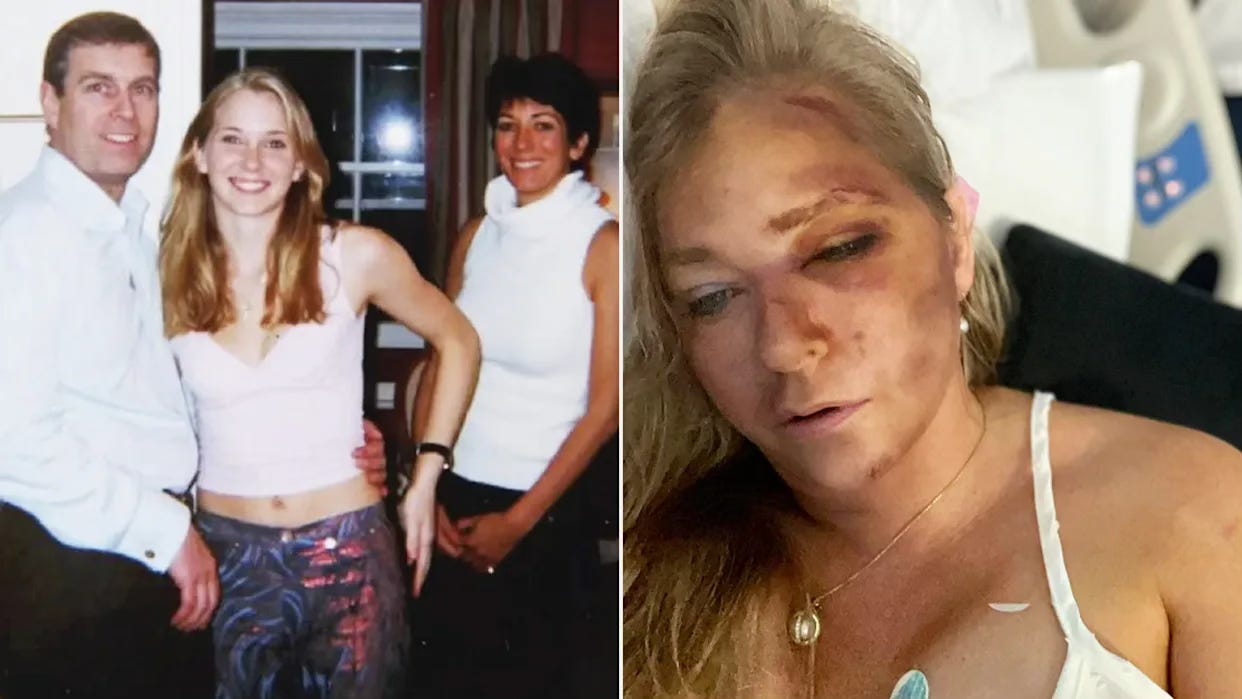
Family — this is not gossip. It’s a survivor’s words, on the record.
Virginia Giuffre’s posthumous memoir, Nobody’s Girl, is being reported with verbatim passages that describe a “well-known prime minister” who, she writes, brutally assaulted her when she was eighteen, and again later on Epstein’s jet. In prior court filings she pointed to Ehud Barak. Barak has repeatedly denied her claims and denies any knowledge of trafficking. That tension — between a survivor’s detailed account and a former head of government’s denial — is a matter of public interest and accountability, not tabloid curiosity.
If you believe her voice deserves daylight — not PR — please click here to become a member of The North Star. We’ve doubled since July and are 3,026 strong. When we reach 4,000, we launch the video version of The Breakdown with a three-person team so these investigations can’t be buried.
The North Star with Shaun King is a reader-supported publication. To receive new posts and support my work, consider becoming a free or paid subscriber.
Subscribe
Her words, his denials
According to The Post (Katherine Donlevy, Oct 18, 2025), quoting the memoir directly, Giuffre writes that a “well-known prime minister” “raped me more savagely than anyone had before,” repeatedly choked her until she lost consciousness, and laughed while she begged for her life. When she ran to Jeffrey Epstein pleading not to be sent back, his answer was ice cold: “You’ll get that sometimes.” The article notes her earlier filings pointing to Ehud Barak among elites she says raped her; Barak has repeatedly denied those accusations. He is the only Prime Minister she has ever named.
It places the first assault on Epstein’s island in 2002, when she was 18, describes choking to loss of consciousness, and recounts a second encounter in a cabin on the Lolita Express. Epstein’s reaction is identical: “You’ll get that sometimes.”
The BBC (Noor Nanji & George Wright; “Giuffre thought she might ‘die a sex slave’…”, adds the texture of the system. In her own words: “I was habitually used and humiliated — and in some instances, choked, beaten, and bloodied… I believed that I might die a sex slave.”
She recounts sex with Prince Andrew “on three separate occasions,” including an encounter with Epstein present and “approximately eight other young women,” adding: “The other girls all appeared to be under the age of 18 and didn’t really speak English.” The London episode includes the now-familiar line about the prince “sweated profusely,” Maxwell instructing in the car, “When we get home, you are to do for him what you do for Jeffrey,” and the morning-after message: “You did well. The prince had fun.” Prince Andrew has always denied wrongdoing and settled a civil case in 2022 without admitting liability. The BBC also notes that the Met Police is “actively” looking into media reports he tried to obtain Giuffre’s personal information through a police protection officer; a former royal protection chief called that allegation “scandalous” and said it must be considered for potential offences.
That is the shape of it: a survivor’s detailed testimony; prior filings naming Barak; Barak’s denials; and a broader record of travel, money, and proximity in the Epstein orbit that mainstream coverage has often treated as trivia when it is actually context.
Why the Barak focus matters
Titles should not be armor. When a survivor of global renown describes a “Prime Minister” who isolated, choked, and brutalized her — and when those passages echo prior filings that pointed to Ehud Barak — journalism is supposed to tighten, not blur. This is precisely where receipts outweigh reputations. Opportunity is not proof, but it isn’t irrelevant: visits, flights, and investments mentioned in the coverage you shared sketch proximity that deserves independent verification. The method she describes — isolation, violence, terror normalized by handlers — fits the pattern survivors have documented across the network: girls routed through a private island and a private jet, instructed and paid, and then erased by money, media, and power.
Barak denies the allegations. Good. Then the honest path is sunlight. Truth doesn’t need a fog machine. If the answer is exoneration, the records will show it. If not, the records will show that too.
Objection & Answer
Objection: “She didn’t name Ehud Barak in the memoir. Isn’t that speculation?”
Answer: The memoir uses “well-known prime minister.” In prior court filings, she pointed to Ehud Barak. We state both realities side-by-side and repeat, in full, that Barak denies any wrongdoing.
What the evidence shows: The sources you’ve provided align on the core passages: the island encounter at eighteen, the choking “to the point of losing consciousness,” the second encounter on the plane, and Epstein’s response — “You’ll get that sometimes.” Those details are specific. Denials are specific. That’s exactly when independent records — visitor logs, manifests, security logs, contemporaneous communications — must be examined.
Objection: “This is posthumous. We can’t question her; timing invites doubt.”
Answer: Posthumous publication raises the standard for documentation — it doesn’t erase the account. The reporting you shared quotes verbatim text from Nobody’s Girl. It also references earlier filings made while she was alive.
What the evidence shows: The narrative predates her death and is consistent with long-standing allegations in the record. If anything, the moment calls for more receipts in public, not fewer.
Objection: “She settled with Prince Andrew; doesn’t that undercut credibility?”
Answer: A civil settlement is not an exoneration; it’s a legal closure on terms the parties chose. Even the BBC reporting you provided notes Andrew’s denials while recounting her description of three encounters and Maxwell’s instructions that night.
What the evidence shows: We publish her words and his denials, both on the record. Then we ask for verifiable timelines and logs — the only things that don’t have a PR department.
Objection: “Memories from decades ago are unreliable.”
Answer: Memory can blur; patterns tend not to. In the materials you shared, the method is steady: isolation, coercion, choking, instruction by handlers, payment after the fact, the island and the jet as controlled environments.
What the evidence shows: Specific phrases recur across sources you supplied (“sweated profusely,” “When we get home…,” “You’ll get that sometimes”). The way to test memory is not dismissal; it’s corroboration: travel manifests, island staffing logs, aircraft crew statements, security schedules.
Objection: “At eighteen she was ‘of age’; maybe this was consensual.”
Answer: Consent is not a math problem solved by a birthday. The account describes choking to unconsciousness, terror, and the power imbalance of a trafficked teenager inside a closed system run by billionaires and officials.
What the evidence shows: The sources you shared quote injuries, fear, and the normalizing of violence. In law and ethics, coercion voids consent. The question isn’t her age in isolation; it’s the conditions under which anything occurred.
Objection: “Prior associations don’t prove assault; proximity is not guilt.”
Answer: Correct — proximity isn’t proof. It is, however, the start of a competent inquiry: who was where, when, and with whom.
What the evidence shows: The reporting you provided notes travel and financial ties in the broader network; it also records explicit denials. That’s precisely why we call for an independent timeline — island gate logs, flight manifests, crew rosters, and any contemporaneous communications for the dates she describes.
Objection: “This feels sensational — tabloids chasing a former PM.”
Answer: Sensation is in the framing; substance is in the text. We quote her exact words as reported, cite prior filings, repeat Barak’s denials, and ask for verifiable records.
What the evidence shows: When a survivor of global renown alleges a “well-known prime minister” choked and raped her, and when prior filings name a former PM who denies it, that’s not a tabloid tease — it’s a public-interest test of whether evidence outweighs reputation.
Objection: “Raising questions about her death is conspiratorial.”
Answer: We’re not speculating; we’re standardizing transparency. Multiple outlets in your stack state she died by suicide. The disciplined public ask in a case of this magnitude is routine: full autopsy and toxicology, a documented last-72-hours timeline, device and access logs, and an independent review.
What the evidence shows: Truth is not threatened by sunlight. Power often is. Survivors — and the public — are owed receipts, not insinuations in either direction.
Objection: “Why focus on Barak when others are named?”
Answer: Because titles should not be armor. A former Prime Minister implicated in prior filings and implicated indirectly via “Prime Minister” in a posthumous memoir demands scrutiny commensurate with the office — while his denials are carried in full.
What the evidence shows: This is receipts-versus-reputations. The ethical path is neither presumption of guilt nor presumption of innocence; it’s proof — or the public acknowledgment that proof was never sought.
What real scrutiny looks like
An honest inquiry starts with basics: a documented timeline for the dates and places she describes, including island visitor logs, flight manifests, and security logs; interviews with staff and crew who served on those trips; preservation and disclosure of contemporaneous communications; and public, on-the-record responses that address specifics rather than issuing global denials. The standard here should match the stakes — a former prime minister on one side of the ledger, a survivor’s posthumous words on the other. No euphemisms. Exact quotes. Exact denials. Exact receipts.
The moral line
Her words deserve daylight. Power doesn’t get to write the ending. If the accusations are false, prove it. If they are true, accountability cannot stop at titles. We will not look away — not for a prince, not for a prime minister, not for a billionaire.
Why we keep digging
We’ve doubled since July and stand at 3,027 members. When we reach 4,000, we launch the video version of The Breakdown from our home studio with a three-person team — so stories like this cannot be sanitized or buried. 👉🏽 Please click here to become a monthly, annual, or founding member today. Your membership funds independence, courage, and receipts.
225 Likes∙
101 Restacks

No comments:
Post a Comment